christina

Running around in Rome

By the time we arrived in Rome, we were all starting to show signs of travel fatigue but we continued our gruelling pace for the final three days, in fact, I think our pace intensified as there was so much to see in Rome.  We had another great apartment located  a short bus ride from the historic core.  It was a large two bedroom, two bathroom apartment with a very modern kitchen and a lovely, private patio/garden.


Trevi Fountain

We arrived at the tail end of Culture Week (held each year during the first week after Easter) which allows visitors free access to all the national museums with a few exceptions. Over the course of three days, we saw the following sights:  the Spanish Steps, the Pantheon, the Trevi Fountain, St. Peter’s Basilica, the Colosseum, the Arch of Constantine, Palantine Hill, the Vatican Museums and the Sistine Chapel, numerous churches as well as several smaller museums.  We walked everywhere and along the way enjoyed the different squares: Piazza del Popolo, Piazza Venezia, Piazza Navona, Piazza del Campidoglio, Piazza di Spagna, Piazza de Trevi to mention a few.  Rome is a treasure chest of archaeological and artistic treasures, with a rich history that spans two and a half thousand years; it is a melting pot of architectural styles such as ancient, medieval, renaissance, baroque, and neoclassical.  We barely skimmed the surface as we tried to cram as much in as we could; you could easily spend a month in Rome and still have more to see.

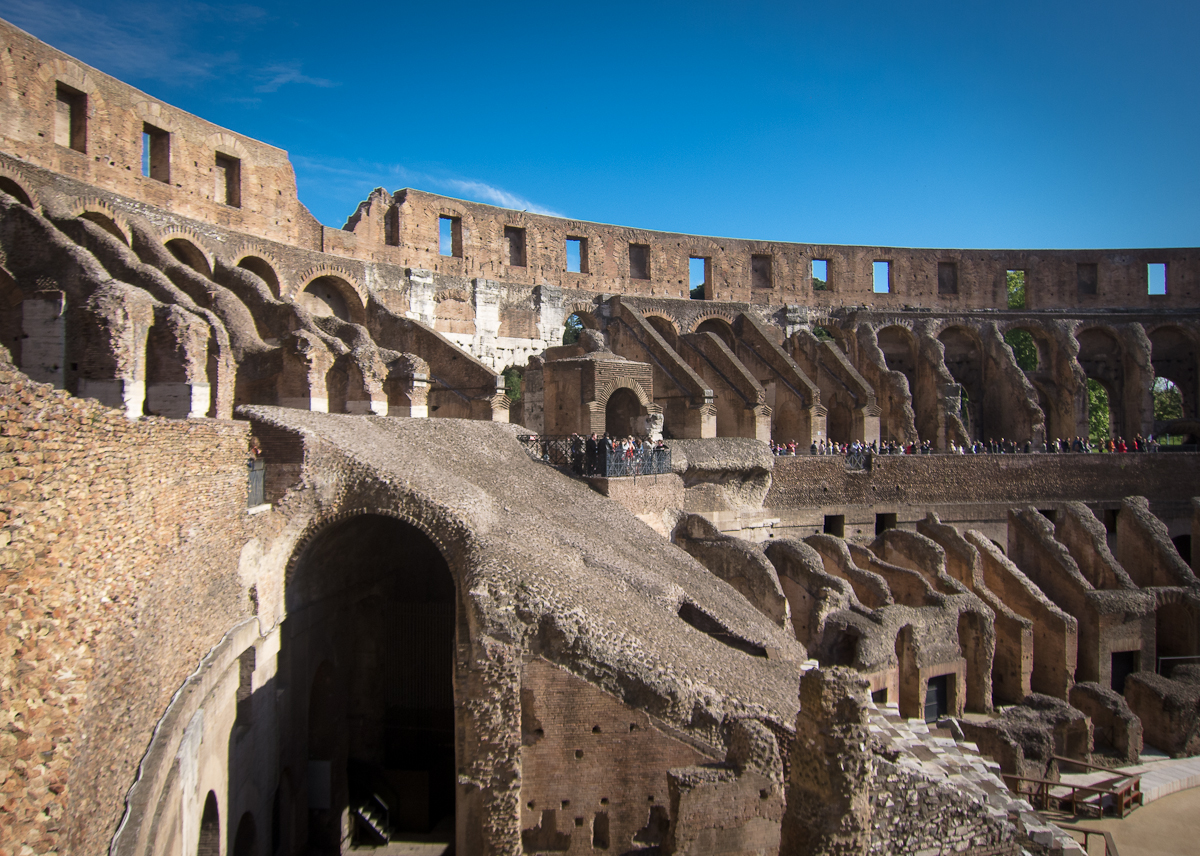
The Colosseum
Inside the Colosseum
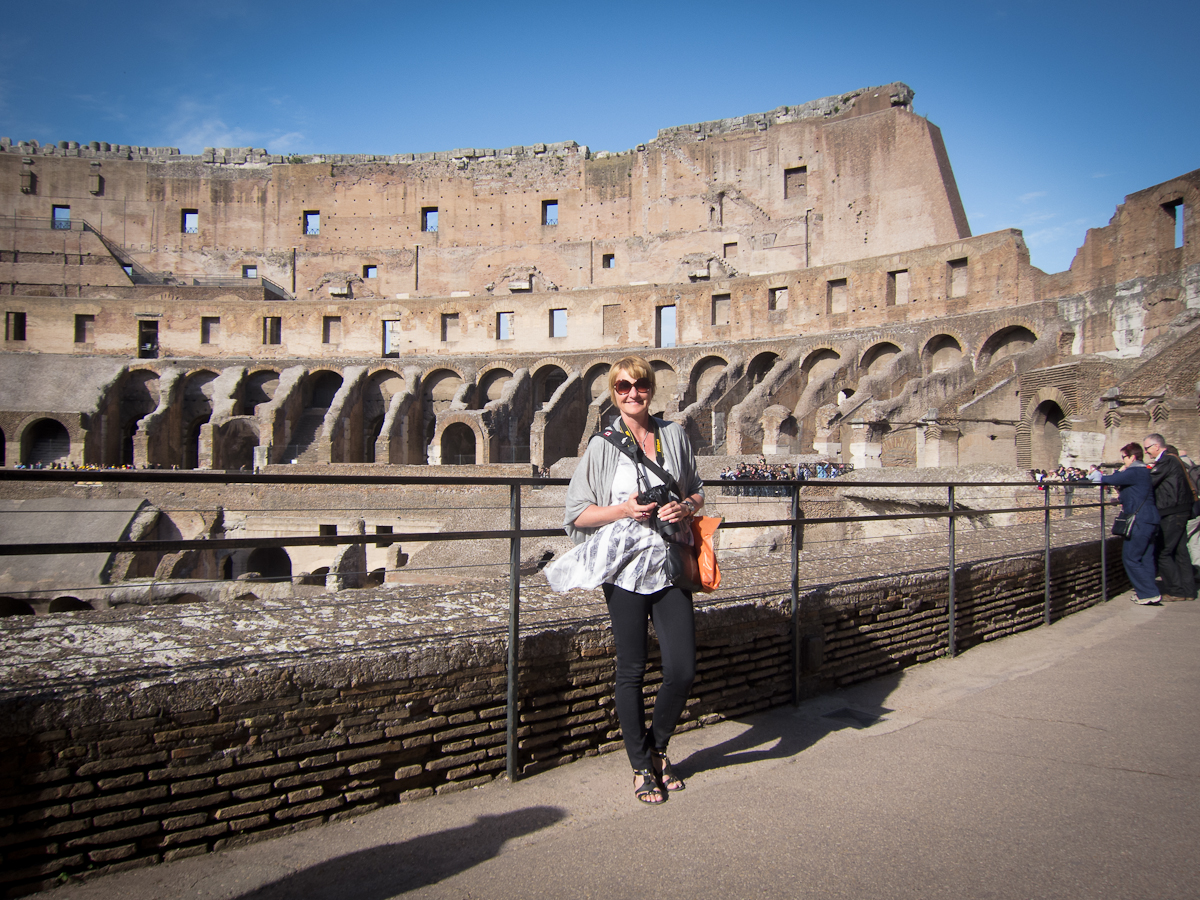
 Sonja at the Colosseum
Piazza Venezia
The Spanish Steps
Sonja and Christina in a courtyard of a museum.
Street scene in Rome
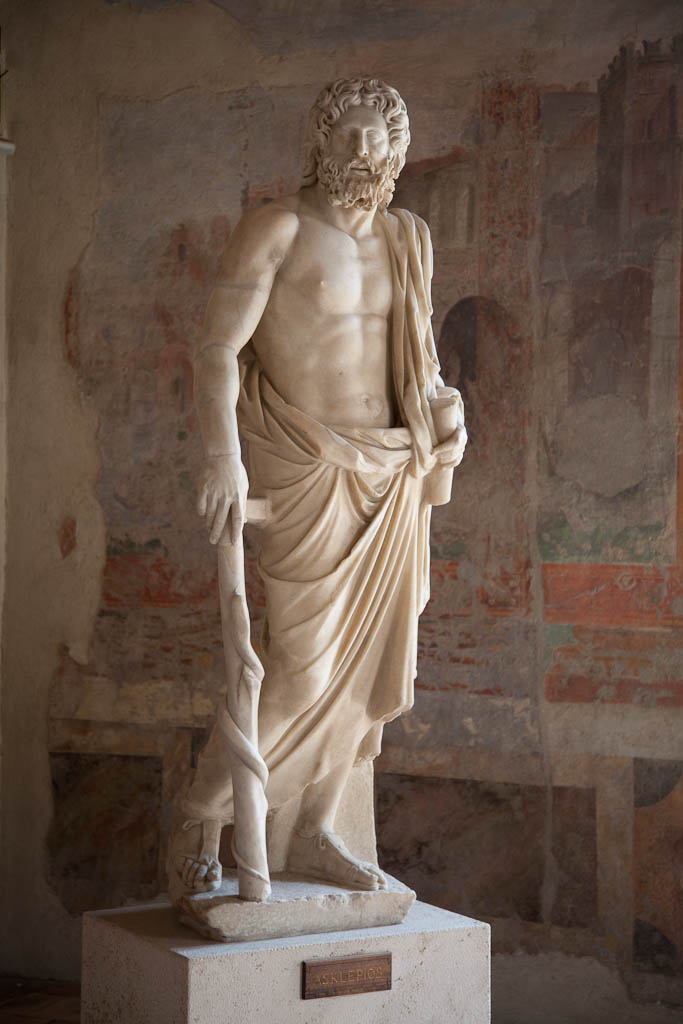
One of many statues we saw in Rome.
The Pantheon
Inside the Pantheon.

The opening at the top of the dome measures 43.3 m in diameter, which also happens to be the height of the Pantheon at its highest point.

Amongst the ancient ruins.

Piazza del Popolo

While in Rome, Sonja ran another marathon distance – she has committed to running the equivalent of a marathon each week this year.  Why? She thought it was a fitting challenge for her 52nd year of life, thus the name of her year-long event: 52 @ 52.  As part of this event, she is raising funds for the Ottawa Chapter of the Snowsuit Fund.  You can follow her weekly runs from the comfort of your couch via her website:  There’s Something About Running.  Or if you’re a runner, you are welcome to join her Sunday running group most of whom run 20K with her. And everyone is welcome to support a good cause and help her reach her goal of raising $5,200 for the Snowsuit Fund.

Sonja planned to run the Rome Marathon route which proved to be rather complicated and difficult to follow.  I joined her at the beginning with the intention of running the first 10K, but somewhere along the way we took a wrong turn and got off track by a few kilometres.  There was nothing I could do but keep running with her until we got back to a more recognizable neighbourhood and a bus stop.  I surrendered after 20K (didn’t know I still had it in me to tell you the truth) and after enjoying a cappuccino together in a little café, we went our separate ways – Sonja continued on to complete the route a couple of hours later, and I headed back to the apartment to meet up with Chris for another afternoon of sightseeing.  It was a fun run and the route was great passing all kinds of interesting historic sights, even though we got lost for a while.  It was a sunny, dry day, almost too warm by early afternoon, but much better than the miserable weather we had in Milan the week before.

Video:  Running in Rome (before we got lost)
 

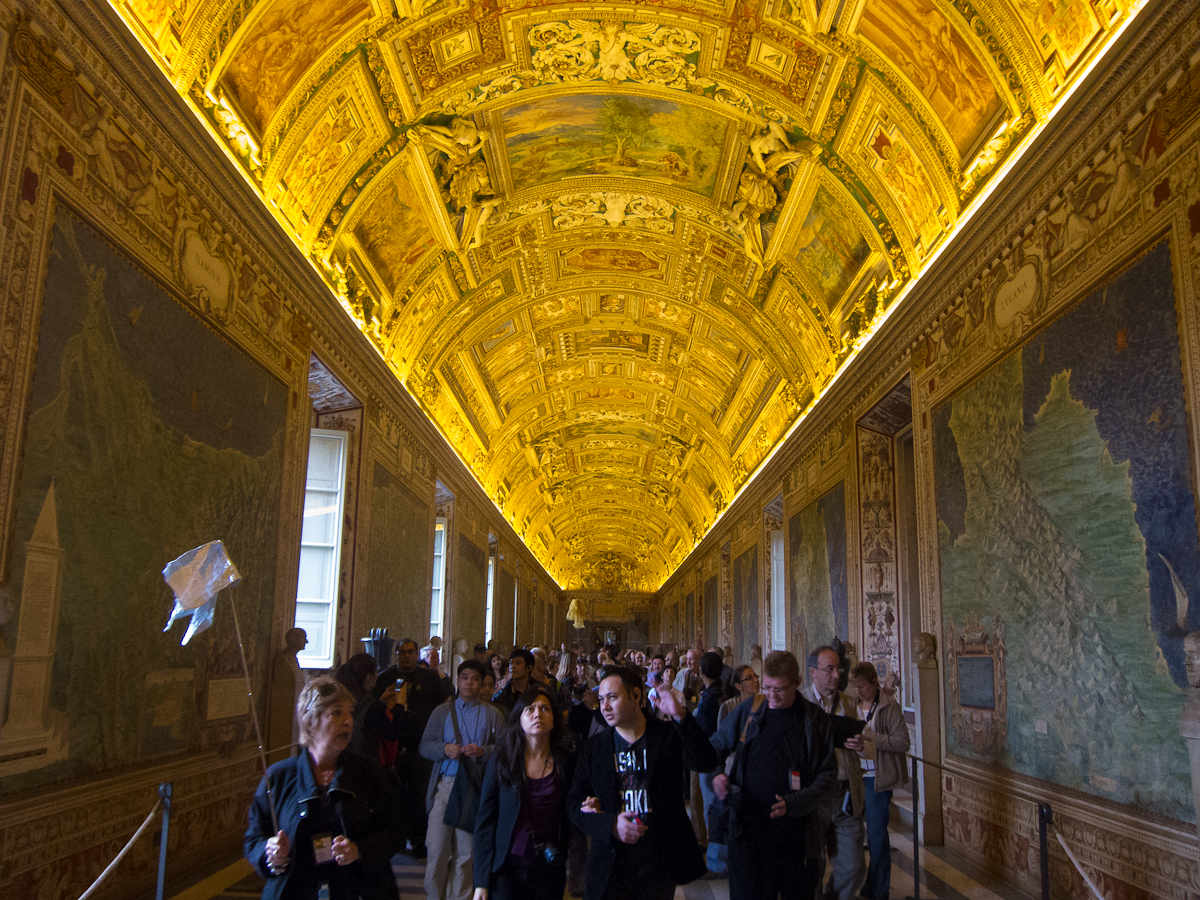
My favourite sight in Rome was our visit to St. Peter’s Basilica, the Vatican Museums and the Sistine Chapel.  We arrived at St. Peter’s before 8:00 well ahead of the crowds.  This was the most beautiful and largest church we have seen to date.   The Basilica is almost a kilometre away from the entrance to the Vatican museums and the lineup was almost as long.  Happily, we had reserved our tickets in advance (see travel tip below) and could therefore walk to the front of the line.  It was only 9:00 when we entered and the long corridors were already clogged with tour groups.  We agreed in advance that we would go our separate ways and meet later in the afternoon – a wise decision given the crowds.

Crowded corridors in the Vatican.
St. Peter’s Dome and Altar

Since I was most interested in the Sistine Chapel, I headed in that direction, elbowing my way through the tour groups that would stop and block the entire passageway – how annoying!  As I entered the dimly lit Sistine Chapel, I felt a twang of disappointment.  The large rectangular room, reputed to be the same dimensions as King Solomon’s temple, was jam packed with tourists – wall to wall, you could barely move.  It felt claustrophobic and seemed almost irreverent the way people were talking so loudly, especially the tour guides.  I walked to the centre of the room and just stood there quietly, looking all around me.  My neck started to hurt as I peered at the ceiling above.  I caught snippets of information from the tour guides. As I started to understand some of the paintings, I wanted to learn more.  After all, here I was standing before Michelangelo’s masterpieces that some authorities deem to be the best in the entire world.

Ceiling of the Sistene Chapel with the famous “Creation of Adam” panel,
one of six that told the tale of the creation and downfall of mankind.

Sistene Chapel – Judgement Day by Michelangelo

Sistene Chapel – View looking towards the back.
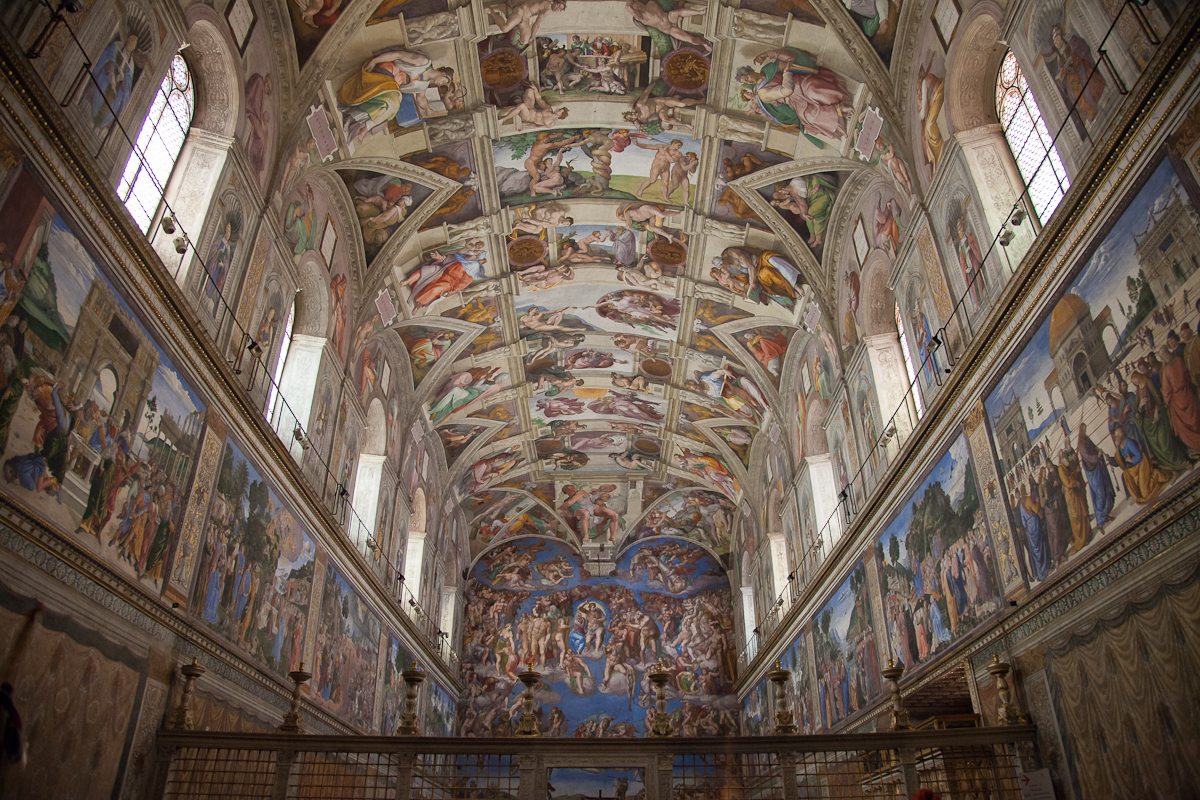
Sistene Chapel – View looking towards the front.

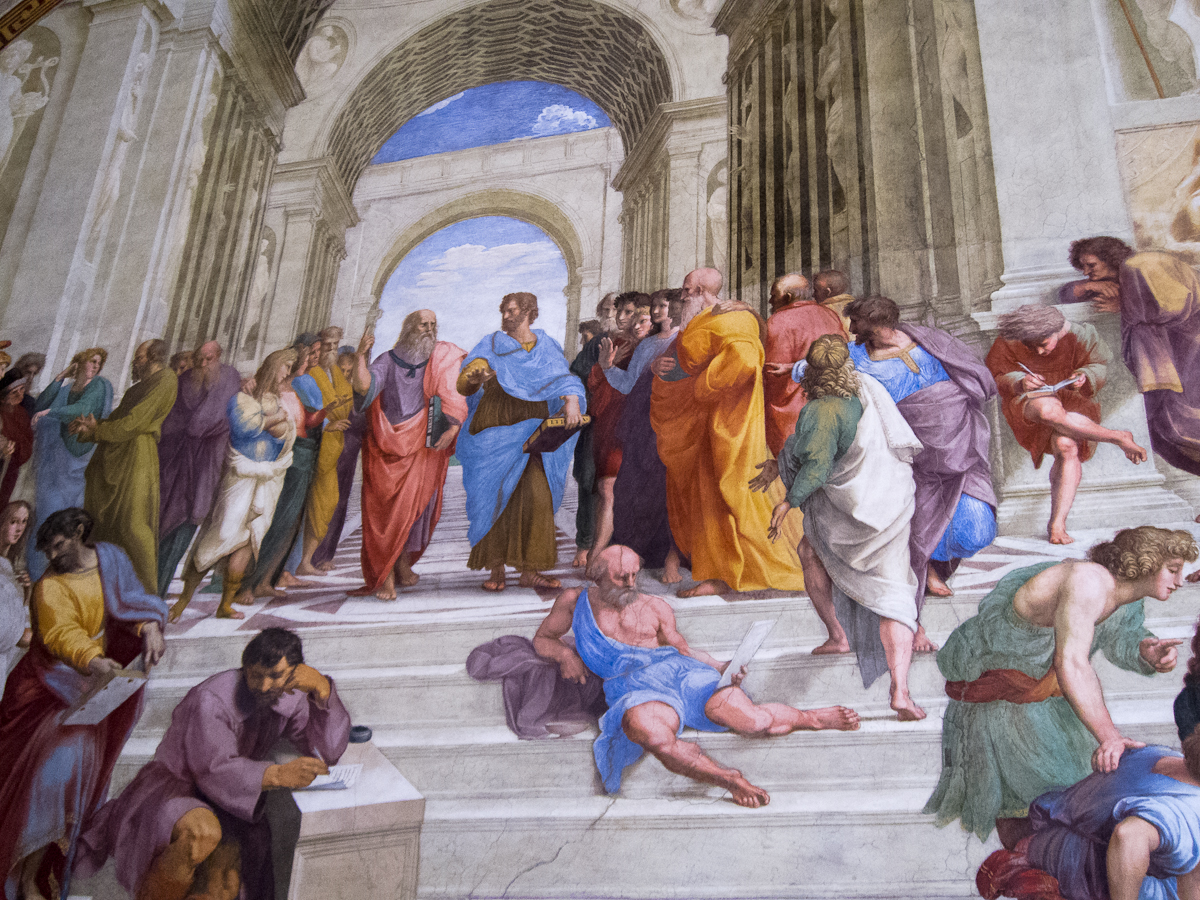
I decided to go back to the entrance and get an audio guide and then proceeded to spend the next five hours slowly making my way back to the Sistine Chapel, visiting the many museums along the way.  The amount and variety of art I saw that day was simply astounding. As I made my way back to the Sistene Chapel, I took a “wrong” turn and discovered the four rooms known as the Stanze of Raphael.  These rooms formed part of the apartment situated on the second floor of the Pontifical Palace that was chosen by Julius II della Rovere (pontiff from 1503 to 1513) as his own residence and used also by his successors. The walls and ceilings were covered with frescos painted by Raphael and his school between 1508 and 1524.  Below are scenes from the Raphael rooms.
Back at the Sistine Chapel which was even more crowded in the afternoon, I sat on a bench along the wall and listened to all the audio segments describing every aspect of the Chapel.  I left with a much better appreciation and a deep feeling of gratitude for having the opportunity to witness in person such magnificent masterpieces from the past.

As our whirlwind tour through Italy came to an end, we saw Sonja off at the airport and we spent the the next three days just taking it easy in our apartment in Rome.  Honestly, we were exhausted and tired of playing the tourist.  We were very much looking forward to our next adventure, a month on a farm in Tuscany.

Travel Tip: To avoid insanely long lineups, I’m talking hours of waiting, purchase tickets to the Vatican Museums and Sistene Chapel (one ticket covers admission to both) online in advance.  Buy the tickets directly from the Vatican ticket office to avoid excessive surcharges. The entrance fee per person (unguided) is 15 euros plus a pre-sales fee of 4 euro.  Once you complete your on-line purchase, a voucher will be emailed to you.  Simply print the voucher, and show it to the ticket agent at the front of the line.

Travel Tip:  Avoid the long lineups at the Colosseum by purchasing your ticket at the entrance to Palantine Hill which is just a few minutes away.  Your ticket gives you access to both sites.

Travel Tip: If you are staying outside the historic district as we were, purchase a multi-day bus pass (12 Euro for 7 days).  We used the bus system extensively. Piazza Venezia was a central hub where most bus lines terminated.

Travel Tip:  For better food at more reasonable prices, head over to the Travestere neighbourhood.  It’s a 5 minute bus ride from Piazza Venezia.

Note: We have been at Trove, the farm in Tuscany for more than two weeks already. I have several entries ready to post but a bad storm a few nights ago knocked out the telephone service and we have been without internet ever since.  Such is country living I suppose.  Currently finishing this entry from an internet cafe in a town called Sinalunga.  Hopefully we’ll be back on line within next couple of days and will then be able to post to the blog.

Getting lost in Venice

Upon the recommendation of one of our guidebooks, we spent two days deliberately getting lost in Venice which is not hard to do when you consider Venice is really a collection of 118 islands connected by 400+ bridges.  At times we split up and went our separate ways but for the most part we wandered through the streets together.

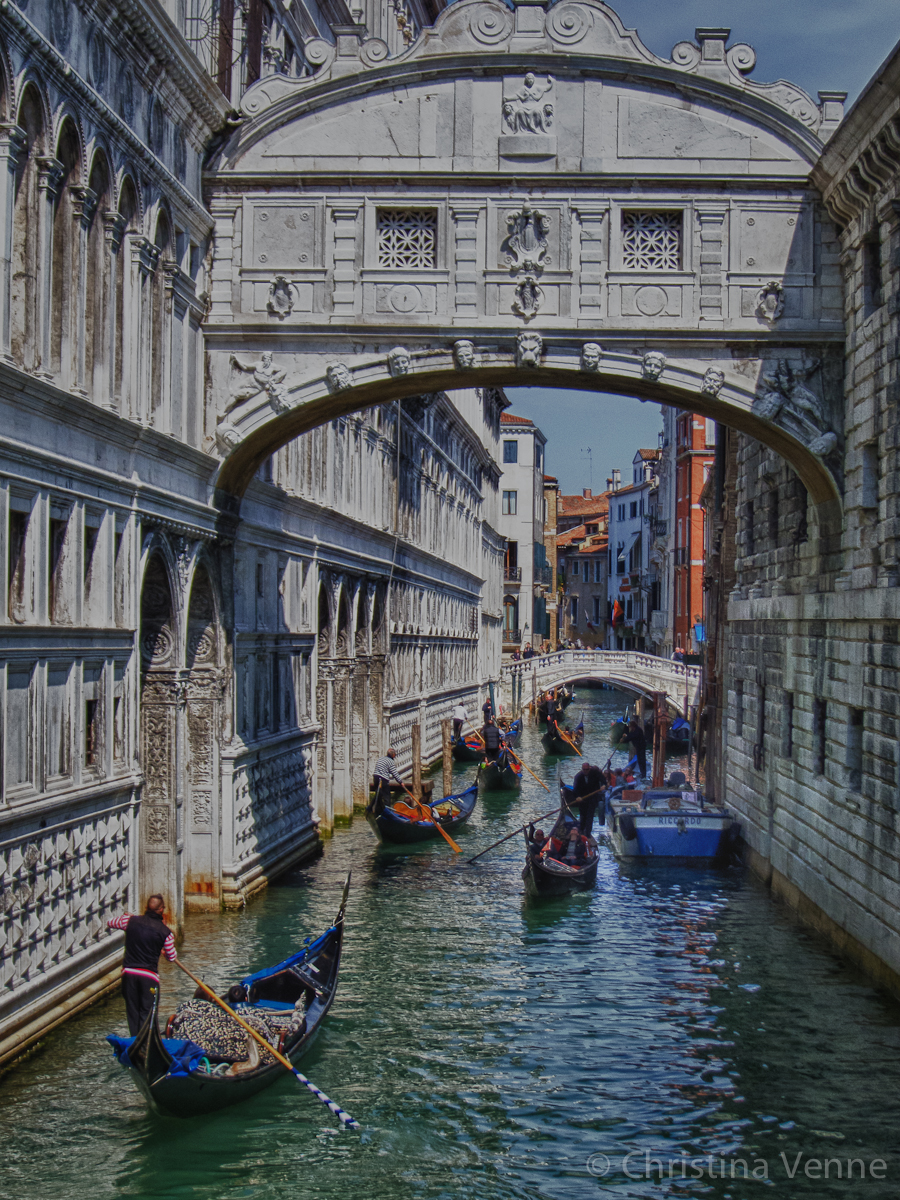
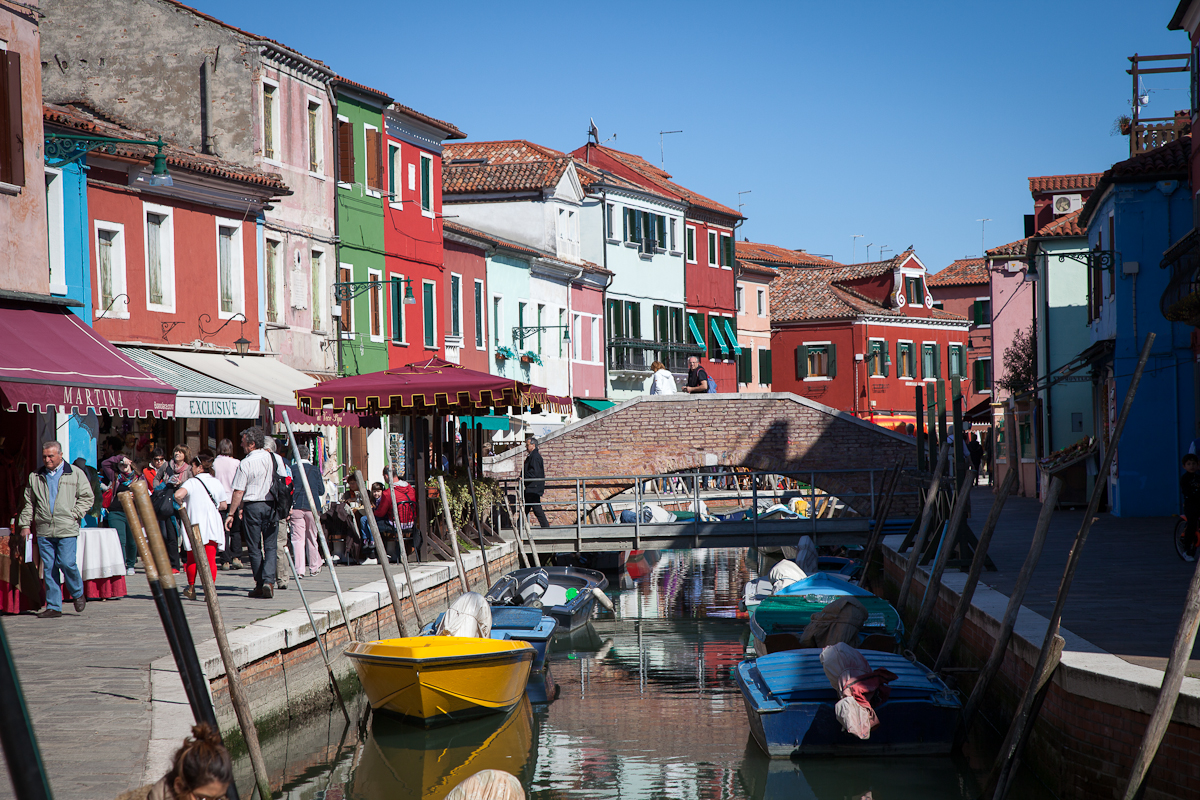
Around every corner, we saw charming scenes unfold: winding alleyways some just a few feet wide, medieval buildings bulging this way and that, stone bridges over canals, unexpected piazzas, gondolas and their drivers in their black and white striped jerseys and straw hat – it was a photographer’s dream.  Sonja was giving her new camera a good workout – I think by the end of our trip, she exceeded 1500 photos!  I tagged along with the little point and shoot which I use to entertain myself more than anything as I wait for the photographers with the real cameras.  I would describe myself as a reluctant photographer, a photographer of circumstance not necessarily of choice.  Sometimes I do surprise myself when I manage to take a half decent photo.  And I must admit I am always secretly pleased and perhaps even a little smug when I happen to get a great shot other’s have missed.

Sonja and I managed to squeeze in a few early morning runs while in Venice which was a great opportunity to see the city awaken.  It was surprising to see the number of people already heading off to work at 6:30 am.  I was intrigued by the way boats were used to make deliveries of every sort in much the same way trucks are used in other cities.  The other thing that amazed me was how the postal service managed to deliver the mail in what looked to me like a maze.  After our run each morning, Sonja treated us (I always forgot to bring money, convenient, I know) to a couple of cappuccino’s at the coffee bar around the corner from our apartment – we were practically regulars on a first-name basis with the owner by the end of our visit.

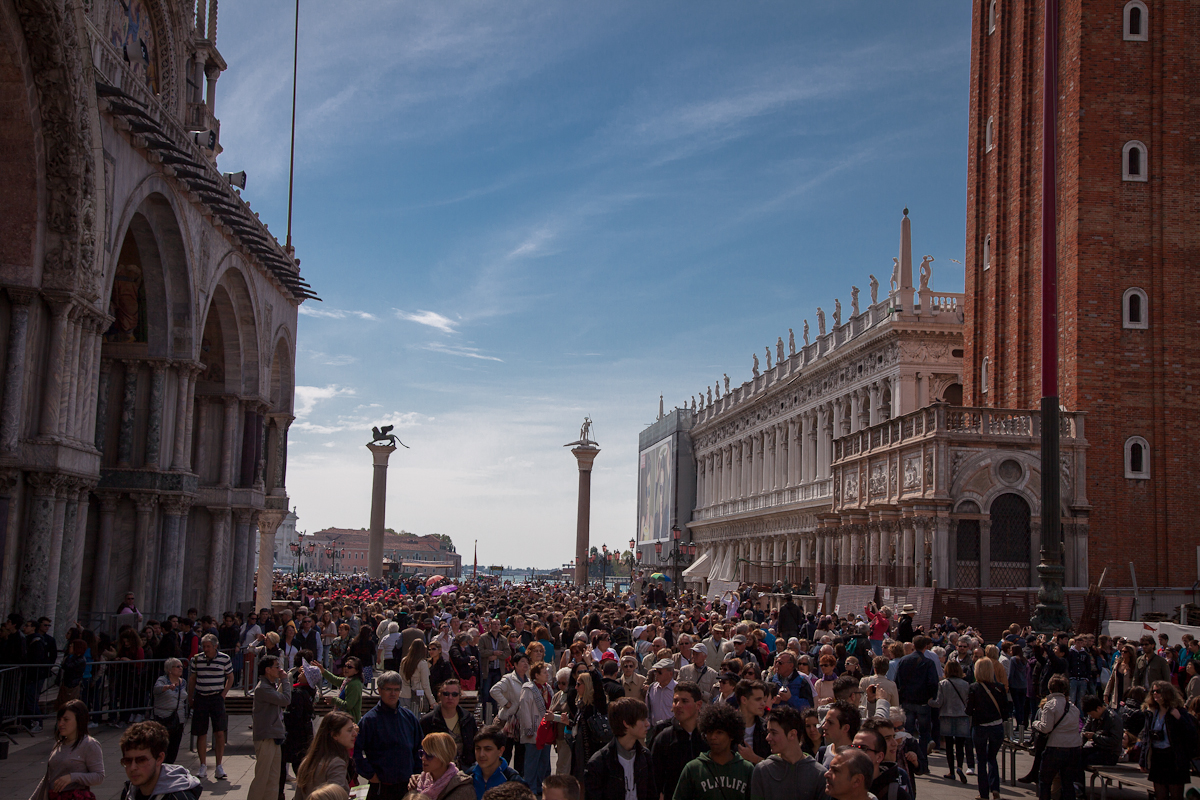
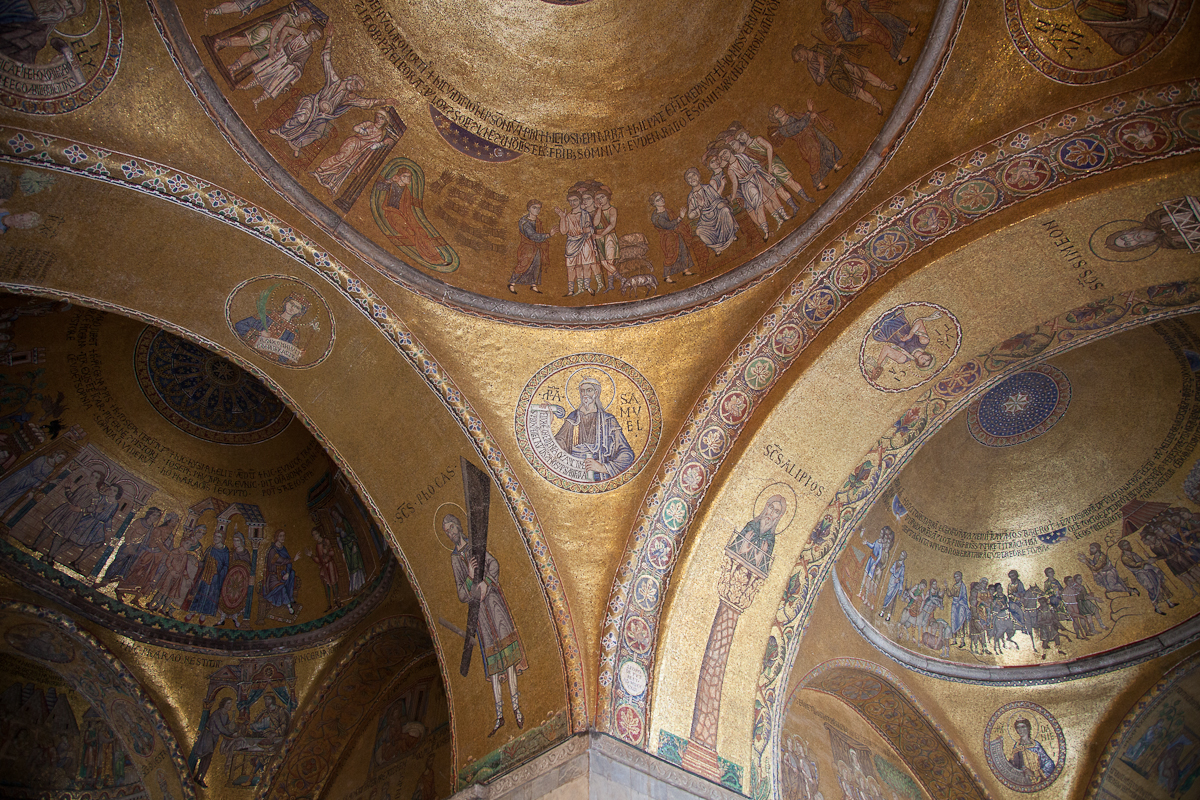
We visited Piazza San Marco both during the day and one evening.  Because of a tip offered to us by the hostel owner on our first night in Venice, we managed to avoid the long line up of tourists waiting to get into the Basilica (see travel tip below for more details).  It felt a little like cheating when we walked past everyone to the head of the line, showed our pass, and waltzed right in.  The Basilica is an example of Byzantine architecture that dates back to the 9th century although much has been altered over time. Once inside, we were in awe: the walls, ceiling and floor of the Basilica were adorned with complex, bright mosaics.  We couldn’t take pictures inside, but managed to capture a few shots in the corridor just outside the main entrance.

When we returned to the Piazza at night, we were surprised to see a wooden walkway erected from one side of the Piazza to the other because it was now covered in ankle deep water that was rising.  We were experiencing what is known as the Acqua Alta, “high water” which is caused when several events coincide: a very high tide, low atmospheric pressure, and a scirocco wind blowing up the narrow, shallow Adriatic Sea which forces water into the Venetian Lagoon.  By official definition, acqua alta occurs when the tide is 90 mm (3.54 inches) above normal high tide.  I’m not sure how high the water got the night we were there, but it was up to the knees of those who waded into the lowest parts of the Piazza.  This natural phenomenon used to be rare, but lately it happens quite frequently, many times each year in fact, mainly during the winter months between September and April.  As you can imagine, this type of flooding causes all kinds of problems so much effort is being made to find solutions that range from floodgates at the Lagoon’s entrances to raising of pavements in low-lying areas of the city.

We wandered into many churches which could easily be mistaken for art galleries as these churches were home to wonderful works of art, even some masterpieces, from famous Italian artists.  The buildings themselves were stunning examples of Renaissance architecture.  

A trip to the Peggy Guggenheim Museum, home to a collection of modern art, offered a refreshing change of scenery. The museum is housed in what used to be the home of Peggy Guggenheim and her family for over 40 years.  It was interesting to learn how this rich American heiress used her inherited wealth to advance living artists of her day.  The museum is a tribute to her generosity towards the arts and a lasting legacy of her contribution to the art community.

Before we arrived in Venice, I had the romantic notion of taking a ride in a gondola with Chris, but this fantasy was dashed when we saw the gondolas lined up like taxis, and then stuck in traffic jams along the canals.  It was anything but romantic.  We decided we could find a better way to spend 120 Euros – yup, that’s what 30 minutes in a gondola will set you back these days.

In Venice, and in many other places in Italy, restaurants will charge a service charge (not to be confused with a tip which is still expected), a cover charge (for the privilege of stepping foot in the establishment) and now something we had never seen before, a table charge (an added cost for sitting at a table rather than standing at a counter).  We discovered (the hard way of course) having a coffee at the table could cost as much as 3 times what you would pay if you drank it at the counter. No wonder Italians order their shot of espresso and down it quickly while standing.  It is a very different culture from North America where lingering over a coffee at Starbucks or Tim Horton’s while reading the paper or a book or catching up on your email is a common way to spend an hour or two.  In spite of the added charges, we still enjoyed some great meals in Venice but suffered through a few misses too.  The gelato was divine, especially the mango flavour which tasted just like the fruit.

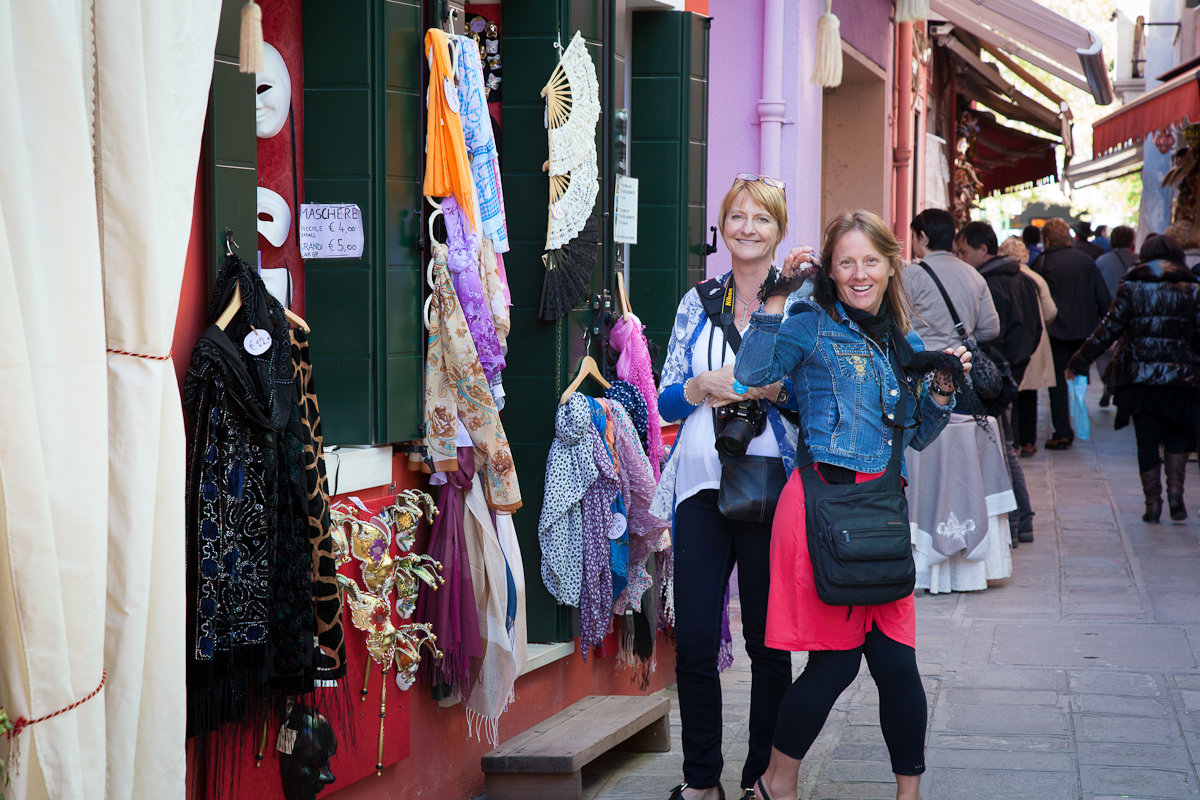
Venetian masks, a centuries-old tradition of Venice, are typically worn during Carnivale  (Carnival of Venice), but have been used on many other occasions in the past, usually as a way for hiding the wearer’s identity and social status. Mask are sold everywhere in Venice but shoppers must be wary of the cheap knock-offs from China which are distinguished by their low price and equally low quality.  The masks that are made in Italy are often made right in the shop where you can observe the artist at work.  These masks are works of art and can be quite elaborate, with a matching price tag (hundreds of Euros).  I took advantage of my sister’s presence (and willingness to be our mule both bringing provisions to us from Canada and taking things back home), and selected a beautiful mask for my daughter Alyssa who had just celebrated her 25th birthday. As a collector of masks, this seemed like the perfect gift for her.  I’m not sure why we made an exception to our “policy”of not buying gifts or souvenirs….it just seemed like the perfect opportunity that I didn’t want to pass up.

After spending four full days in Venice, we all agreed that this was our favourite city in Italy and that four days was a sufficient amount of time to get a good sense of the city and to see the highlights.  Much more time would be needed if you wanted to visit more museums.  And so we were off to Rome, our final destination on this whirlwind tour through Italy.

Video:  Snapshot of Venice
 

Travel Tip:  Avoiding the line ups and saving hours of precious time at San Marco Basilica is as simple as checking a bag.  The baggage storage is located off a small alleyway to the left of the church.  Just ask a security guard on the side of the building to point you in the right direction.  You simply leave a bag (we left an empty camera bag) in exchange for a token which then permits you (and your group) to walk straight into the church, avoiding the line altogether.  You see, entrance to the Basilica is free of charge; people are lined up just to have their bags searched by the security guards.


Follow the shopping carts to the Lido market

As we pulled into the train station in Venice, the sun broke through the clouds promising us a respite from the rain.  Once we figured out the water bus system (conveniently located on the canal immediately in front of the train station), we managed to find our apartment without too many wrong turns along the way.  The apartment, located on the third floor of another old building without elevators, was everything we had hoped for.  It was in the heart of the historic district in the Cannaregio neighbourhood, just a five minute walk from the Rialto bridge and within walking distance to all the major tourist sights.  Each of the two bedrooms had two large, shuttered windows overlooking the canal. It had a large living room, dining room, kitchen and even a balcony on which was a washing machine and clothes line from which to hang our laundry – just like the locals.

We settled into our apartment, and then explored the neighbourhood; we were delighted to find the following amenities within a couple of blocks radius: a grocery store, an outdoor fruit and vegetable stand, a cheese shop, bakery, and a unique wine store that sold wine in volume by the litre.  In this shop, the wine was stored in an array of large carboys from which you selected your variety, after sampling it, of course.  The shop keeper then poured the desired amount into a recycled plastic water bottle.  We picked up a couple of bottles on the first day but our enthusiasm for this concept waned as we realized the wine was not as good as we had hoped.  No worries, as there were several wine shops in our neighbourhood as well as wine in the local grocery store.

Our first full day in Venice was spent visiting the nearby islands of Lido, Murano and Burano.  We purchased a 12-hour water bus pass for 16 Euro each and we were determined to get our money’s worth.

Lido is an 11 km long sandbar, home to about 20,000 residents.  It is renowned for its beaches which became popular way back in 1857 when the first bathing facility was set up. This was the first time that anything similar had been seen in Europe. Soon, it became “The Lido”, meaning a beach resort. Major beach facilities, hotels and private summer villas have remained the heart of the island that is still known as the “Golden Island”.  But we were not going to see the beaches, we wanted to visit the local market held every Tuesday morning.

We followed the ladies with the shopping carts right to the market.

View of Venice from the Lido market.

Water bus on the Grand Canal

Water buses travel slowly along the Grand Canal offering plenty of opportunity to sightsee along the way.  As we inched our way closer to Lido, the tourists thinned out and were replaced by little old Italian ladies with their shopping carts.  I made the observation that all we needed to do once we arrived in Lido was follow the ladies with the shopping carts.  And that is exactly what we did, practically running after them to hop onto a regular bus, and then jumping off at the last minute as they quickly exited without warning.  And so we found the market, a bustling affair full of locals out doing their regular shopping at the food stalls.  We saw lots of clothes, shoes, and household goods too.  It was as much fun to look at the merchandise as it was to people watch.

Video:  Taking the water bus along the Grand Canal

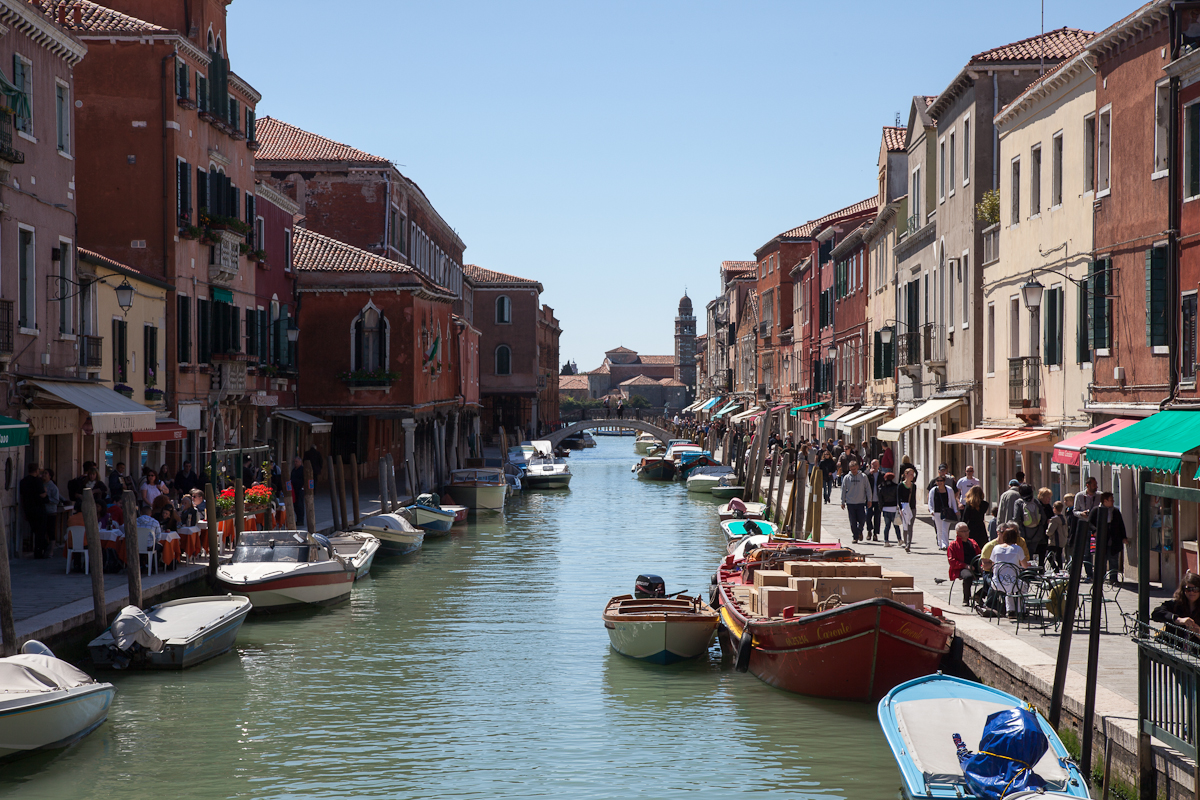
Next stop was Murano renowned the world over for its hand blown glass.  It is a series of small islands connected by bridges about 1.5 km north of Venice.  It measures about 1.5 km across with a population of just over 5,000.  We were taking full advantage of the glorious day of sunshine – our first since we stepped foot in Italy.   After a couple of hours meandering along the canals, admiring the exquisite works of art and jewellery all made from glass, we stumbled upon some glass makers making intricate pieces for a huge chandelier. It was fascinating to watch these artistic craftsmen at work.


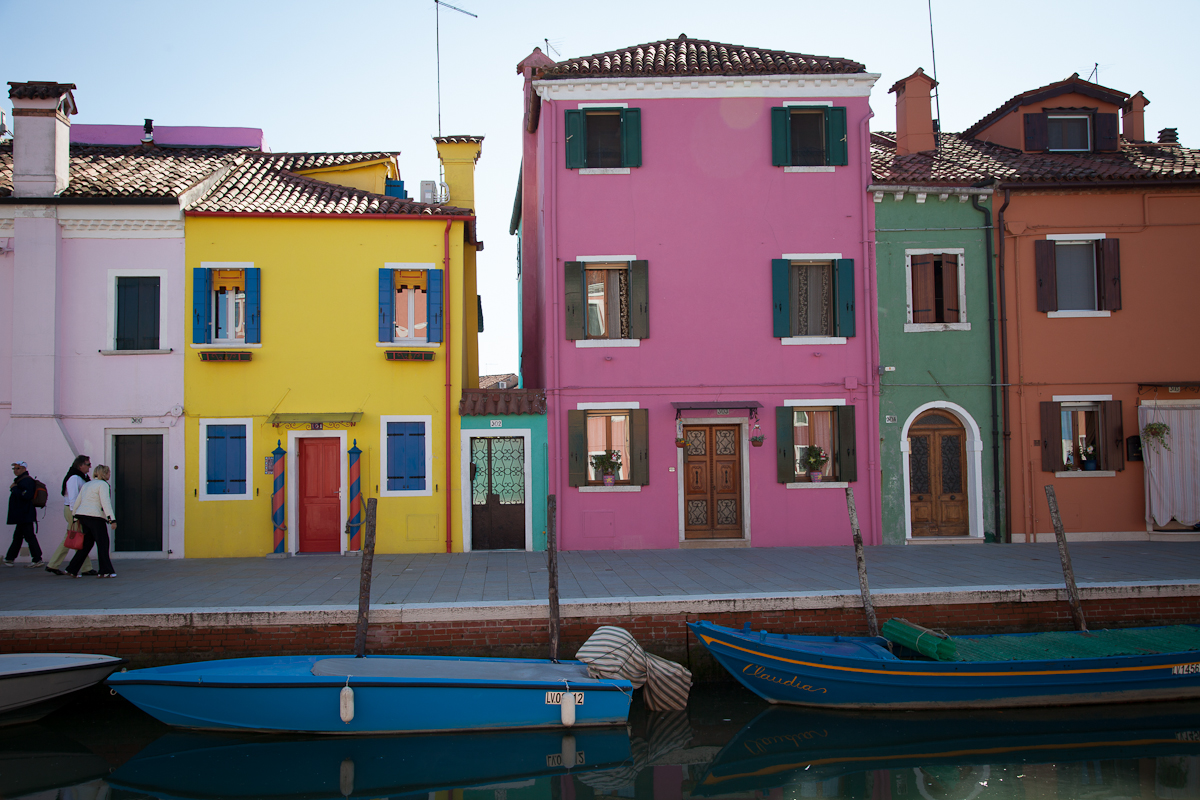
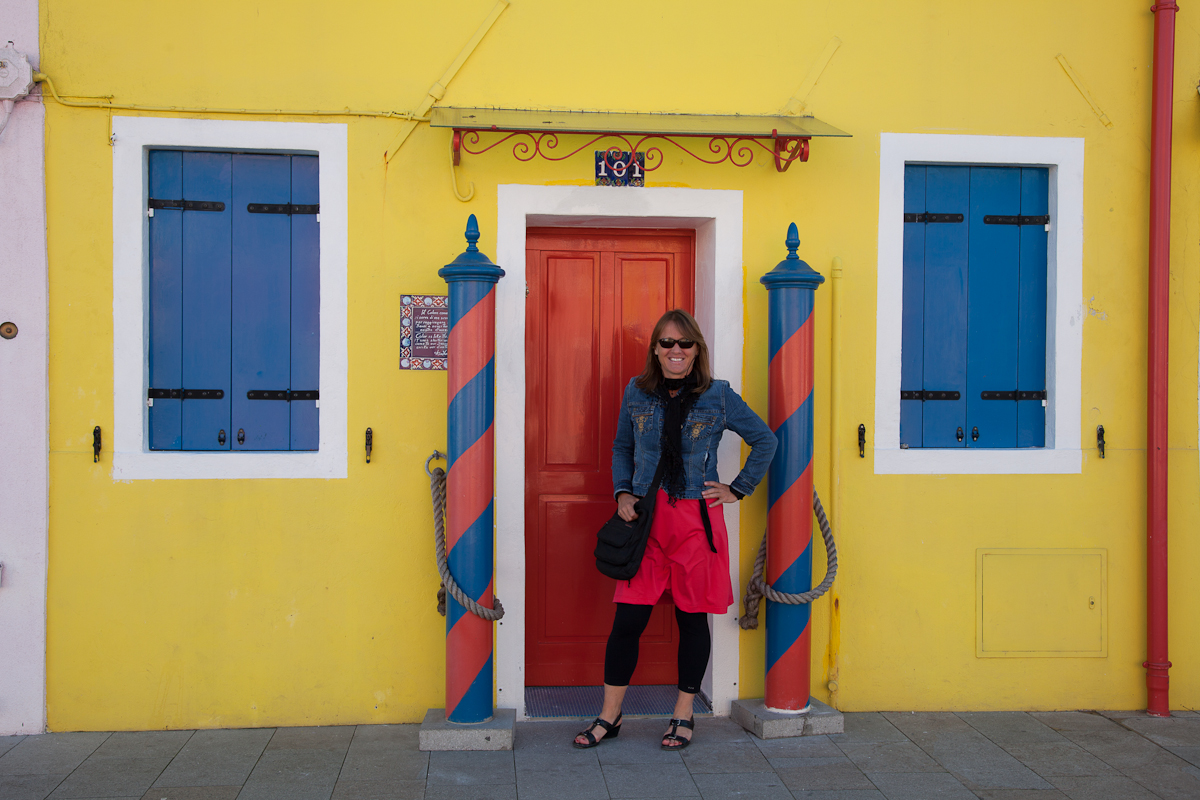
The final stop of the day was the island of Burano, also accessed via water bus.  This island is renowned for its brightly coloured houses and lacework.  The colours of the houses follow a specific system originating from the golden age of its development so if your house needs to be painted, you must make a request to the government who will then let you know what colour you can use.  We ended our busy day with a relaxing glass of white wine on a patio basking in the fading sunshine.

A wet weekend in Milan

Accommodations were scarce in Milan on the weekend we planned to visit because of several events going on in the city including the Milan Marathon.  Sonja managed to find us two nights in an apartment a little outside the city centre.  This modern apartment with paper thin walls (and a screaming baby as a neighbour) lacked character, in stark contrast to the museum-like apartment in Florence.  It was less than ideal, but it was across the street from a Metro station giving us easy access to the entire city.  This was the smallest apartment we stayed in – a loft bedroom with twin beds and a double bed in the living area – but it was also the cheapest.  For two nights, it was sufficient to meet our needs.

As the second largest city in Italy (Rome is the largest), Milan is the main industrial, commercial and financial centre of Italy.  The city is recognized as a major world fashion and design capital with 12,000 companies, 800 show rooms, and 6,000 sales outlets, and four weeks dedicated to top design shows each year.  It is also well-known for several international events and fairs, including Milan Fashion Week and the Milan Furniture Fair, which was one of the events happening during the weekend we were there.

But we were there for the marathon so the first order of business was a visit to the race expo where Sonja picked up her race kit, after which we headed towards the historic centre to check out the sights – in the pouring rain.  In fact, it rained from the minute we arrived on Saturday afternoon until we left on Monday morning.

We found the Castello Sforzesco, one of the most famous monuments in Milan dating back to the 14th century, and wandered around the grounds for a short while; you could easily spend an entire day going through the twelve mini-museums and large archives that cover a vast array of subjects and periods from Palaeolithic history through to 1950s furniture of all things. The Castello complex includes The Museum of Ancient Art, The Furniture Museum, The Museum of Musical Instruments and the Applied Arts Collection, The Egyptian and Prehistoric sections of the Archaeological Museum and the Achille Bertarelli Print Collection. The best known of the current civic museums is the Pinacoteca del Castello Sforzesco, with an art collection which includes Michelangelo’s last sculpture, the Rondanini Pietà, Andrea Mantegna’s Trivulzio Madonna and Leonardo da Vinci’s Codex Trivulzianus manuscript. During the 15thcentury, this castle was home to the aristocratic court of Lovico ‘il Moro’ Sforza, patron of Leonardo da Vinci.  Of course, we didn’t have time to visit any of these museums.

The highlight that afternoon was a visit to the Duomo.  This gothic cathedral took over five centuries to build; it is the third largest cathedral in the world and the largest gothic cathedral in the world.  To say it was impressive would be an understatement.  We entered the cathedral during mass and so we were privy to the medley of sounds of the organ, the choir and the priests.

On Sunday, Sonja arose before dawn to find her way to the marathon starting point. It was still raining and it was quite cold.  Chris and I thought of her as we stayed behind in our cosy beds (yes, we had the twin beds in the loft) sipping our espresso coffee.  We could easily have just lounged around all day, but we pushed ourselves and went back to the historic centre to do a little more sightseeing.  Imagine our surprise when we found ourselves next to the marathon route when we exited the subway in front of the Duomo.  We watched the runners for about a half an hour, clapping and cheering them on as loudly as we could even though the handful of other spectators lining the course were as quiet as church mice and kept darting puzzled looks our way.  We were even more surprised and pleased to see my sister heading our way – we couldn’t have planned it any better.  Chris managed to get a few photos of her as she made her way through the piazza.  I think she was happy to see our familiar faces even though she still had 16 km to go.

We went into the Duomo for a second look and I was surprised to see so many things I had missed the day before, like the huge crucifex hanging high above the alter at the front of the church, reputed to have one of the nails from the cross Christ died on.  After climbing 250 steps to the roof top, we stood outside on the Duomo roof in absolute awe.  Even though it was raining steadily, we walked slowly around the entire perimeter of the Duomo, taking in all the fine details of the gothic spires that were adorned by over 2000 statues.  I have never seen anything quite like it.

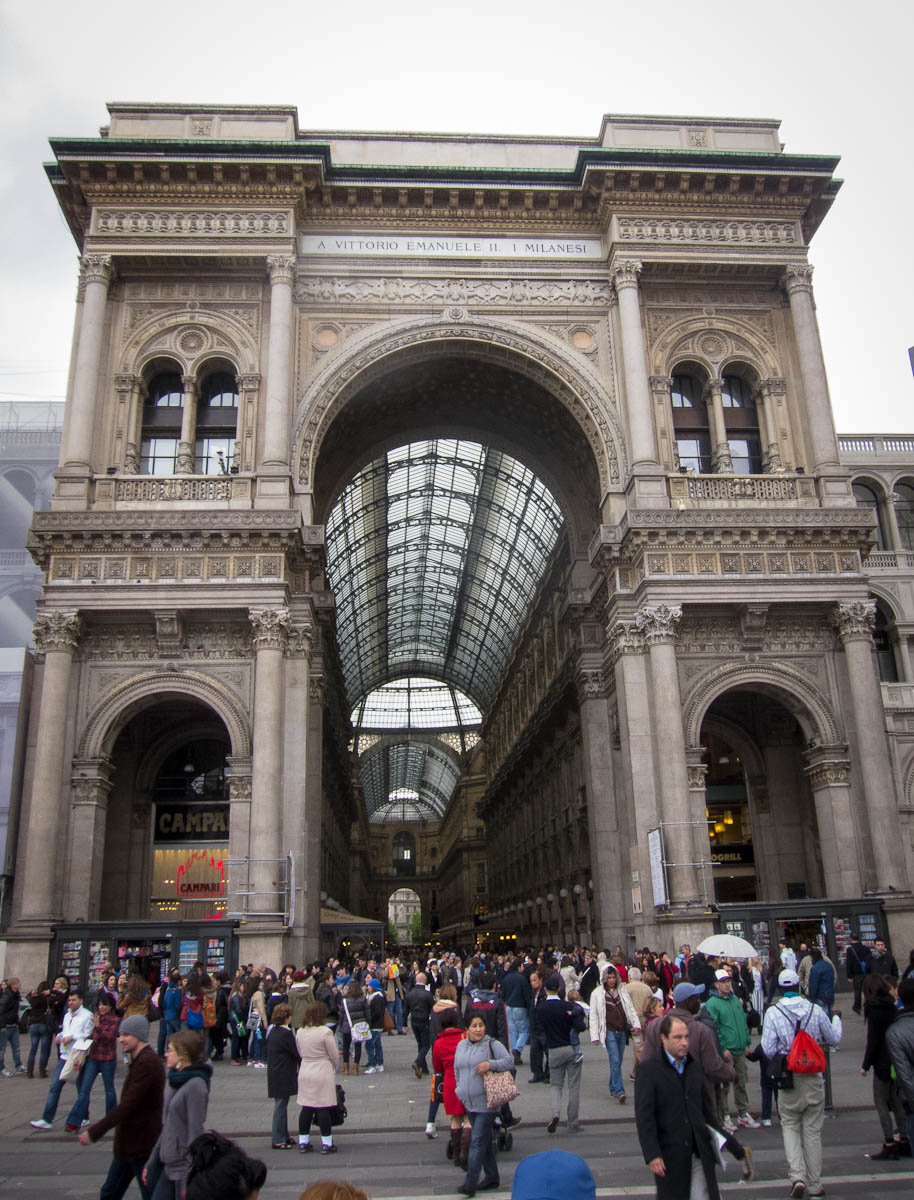
Off to the side of the piazza, we discovered the Galleria Vittorio Emanuele II, where we joined hordes of tourists seeking shelter from the rain under the double glass vaulted arcades. Apparently, this Milanese Galleria, larger in scale than its predecessors, was an important step in the evolution of the modern glazed and enclosed shopping mall. It has inspired the use of the term galleria for many other shopping arcades and malls.

We only spent a weekend in Milan but it was enough time to see the most important and memorable sights.  We found the city to be rather drab, an impression that I don’t think was entirely influenced by the dismal weather.  It seemed ironic that some of the world’s leading fashion designers came from such a dull and dreary place.

History and art in Florence

By now you may be wondering if we spent any time at all in Florence with all the day trips we had been doing.  Since it was our home base, we managed to squeeze in some sightseeing after our excursions to Pisa and Sienna but we hardly did the town justice.  A case in point, we stayed across the street from Santa Croce Basilica and didn’t have time to visit it!

As you probably know, Florence is the capital city of the Italian region of Tuscany and of the province of Florence. It is the most populous city in Tuscany, with approximately 370,000 inhabitants, expanding to over 1.5 million in the metropolitan area.  Florence is famous for its history and is considered the birthplace of the Renaissance.  It was declared a World Heritage Site by UNESCO in 1982, and it has been ranked by Forbes as one of the most beautiful cities in the world, due to Florence’s artistic and architectural heritage.

The best-known site of Florence is the domed cathedral of the city, Santa Maria del Fiore, known as The Duomo, whose dome was built by Filippo Brunelleschi. Some 600 years after its completion, the Duomo is still the largest dome built in brick and mortar in the world. The cathedral has an imposing presence in the centre of the historic district. When we entered the cathedral, the sombre notes of an organ echoed throughout the cathedral.  While I loved the exterior of the Duomo, the interior was a disappointment for me.  Sure it was huge and had some beautiful mosaic pictures on the walls, but the overall architecture was just not very inspiring, at least not to me.  I still can’t say whether or not the music, which I must admit was a nice touch, was live from the huge organ or whether it was just piped in, no pun intended.

A visit to the Uffizi Gallery marked our last afternoon in Florence.  Imagine, for centuries, people have been walking the hallways I was standing in, admiring the very paintings I was admiring.  Next to each painting, after the artist’s name, title and date of the painting, was the date the painting was acquired by the museum.  I was intrigued to see paintings that had been acquired as far back as the 16th century and as recently as the 1970’s.  As for the art, well I think Sonja summed it up rather nicely:  “If I see one more painting of the virgin and baby, I’m going to scream!”  Yes, the renaissance artists loved this theme and we saw it repeated in room after room.  This was the first museum where I have seen paintings represented in relief format next to the original painting for the visually impaired.

My favourite part of the gallery was the temporary exhibit of tapestries that left me perplexed as to how it could be possible to create such magnificent masterpieces on the loom.  One tapestry was hung backwards to demonstrate the original, vivid colors which had long since faded from the front.  Much effort and expense is expended annually to restore these beautiful pieces of art to their original glory.

We elbowed our way through hordes of tourists and tour groups in the museum.  You could barely move without bumping into someone.  I hate crowds like that, especially in a museum because it is so difficult to see anything (notice the crowds in the photo above).  Florence in general was inundated with tourists.  I shudder to think what it is like in the middle of summer at the height of the tourist season.  No wonder the locals flee the cities to escape the heat and crowds.

“Pinocchio”, a classic of children’s literature and Italy’s second most read book after Manzoni’s “The Betrothed”, was written by Tuscan writer Carlo Lorenzini who was born in Florence in 1820.  He wrote under the pen name of C. Collodi and the story was first published in Rome in 1881. Naturally, there is an abundance of shops selling everything imaginable with a Pinocchio theme.  While very touristy, Sonja and I found this particular shop (photo above) to be very charming, filled with hand made wooden Pinocchio paraphernalia.

Sonja, posing with the artist of the artwork she bought.  
The Duomo is in the background.

Sonja’s photo – she was obsessed with bikes – and
had lots of photo opportunities to indulge her passion.

Our time in Florence was far too short, as there was much more to see.  I was disappointed that we didn’t have time to visit the Accademia Gallery where the original “David” sculpture by Michelangelo was on display.  I guess we’ll have to go back one day.

The Leaning Tower of Pisa

We couldn’t argue with Sonja’s logic:  How can you go to Italy and not see the Leaning Tower of Pisa?  Off we went by train to Pisa one morning, only an hour from Florence and only 7 euros per person each way.  By now we were getting the hang of the train system which was very easy to use.  The trains were fast, clean, comfortable, and most important, on time.  Tickets could be booked online or purchased at the ticket machine at the train station.  We each had a euro rail pass which we used for the more costly trips between the major cities.

We arrived in Pisa without a map and without any idea where the Tower was located.  Luckily, there was a large tourist map outside the train station where the path to the Tower was actually worn out from use!  We studied the map for a minute, committed the route to memory and set out for the half hour walk through streets that were lined with many chic shops and restaurants along with a few churches which of course we popped in to see.


Suddenly, while walking down the street, the Tower appeared before our eyes, leaving me with a memorable first impression. I have seen pictures of the tower, but nothing prepared me for this first glimpse of it.  Quite simply, it was beautiful.  It was also much larger than I had expected.  For some reason, perhaps because all the photos I have seen the Tower stands alone, I wasn’t expecting it to be part of a large complex of equally stunning buildings which are now museums, open to the public. I don’t know what I was thinking because, after all, the tower is the freestanding bell tower of the cathedral. It is situated behind the Cathedral and is the third oldest structure in Pisa’s Cathedral Square after the Cathedral and the Baptistry.

The photo to the right is not an illusion.  It accurately illustrates the degree to which the tower is leaning – 3.99 degrees to be exact.  Prior to restoration work performed between 1990 and 2001, the tower leaned at an angle of 5.5 degrees. The top of the tower is now displaced horizontally 3.9 metres (12 ft 10 in) from where it would be if the structure were perfectly vertical.

Just like in Florence, this place was swarming with tourists, tour groups, and school children on class trips.  It was difficult to take a photo without a dozen strangers in it.  And of course everyone was posing for photographs pretending to “hold up” the leaning tower to prevent it from falling. The illusion is created through the principle of forced perspective.  We didn’t even bother trying to take such a photo mainly because we thought it was pretty cheesy but also because there were just too many people in the way.

Given our time constraints (we wanted to be back in Florence by early afternoon), we walked around the area, taking lots of pictures, before heading back to the train station.  Although our time in Pisa was short, we all agreed it was well worth the trip to see the Tower in person.

Of course, Chris and I were secretly content with the knowledge that we could return for a day to explore the Tower and the museums in depth later in May.

A walk back in time on the Italian Riviera

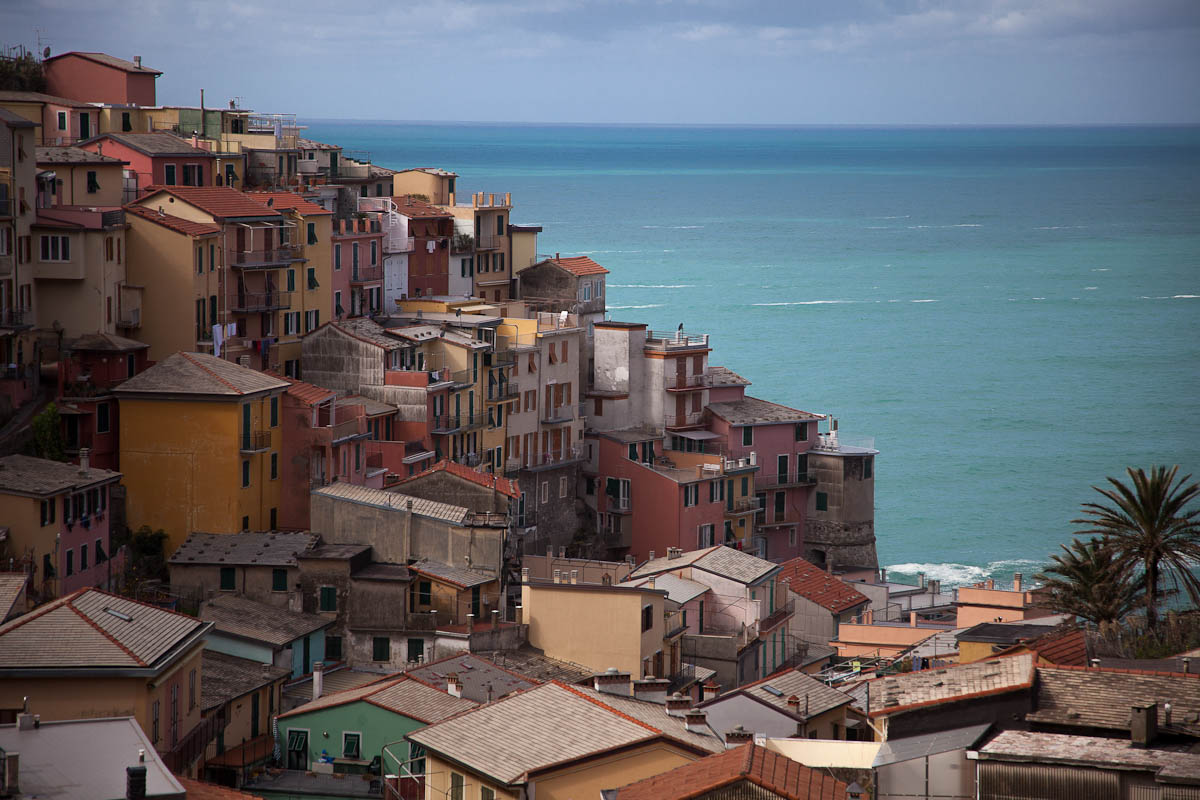
Cinque Terre is comprised of five quaint fishing villages connected by ancient rustic paths that hug this rugged part of the Italian Riviera coastline.  A century ago, the trails and boats were the only means of transport to and from the villages.  Today trains link the five villages offering visitors and locals more convenient access.  This area is now protected within the boundaries of a National Park ensuring the region retains its historic integrity. The lack of modern development gives visitors the opportunity to enjoy the charm and beauty of these villages that date back to the Middle Ages. Grapes are grown on terraced gardens perched high on the cliffs overlooking the Ligurian Sea.  Lemon trees dot the hillsides in abundance.

We booked our tour through Viator which is a third party agency that offers access to tours worldwide.  The local tour company was called WalkaboutFlorence.  We would recommend both Viator in general and this tour in particular.

As we travelled 2.5 hours by bus to the starting point of the tour which would begin at the second village, Manarola, our tour guides Alex and Chris introduced themselves and offered excellent information en route such as clarifying the white mountains we saw in the distance were not covered in snow but were actually glistening with Carrera marble.  It then made sense why we saw so many yards along the highway full of huge slabs of marble ready to be cut.

We began in the second village, Manarola, where we had the opportunity to walk along some of the ancient paths along the edge of the terraced hills, overlooking the village.  We took the train to the next village, Corniglia which was perched about 100 metres above sea level.


After climbing 382 steps, or the equivalent of 33 flights of stairs, we were rewarded with spectacular views.  We enjoyed a delicious lunch on a terrace overlooking the town and the sea we returned to the train station, yes, back down those 382 steps, and on to the next town, Vernazza.


View of Corniglia from the restaurant terrace where we had lunch.
Notice the lemon tree in the foreground. 


Vernazza was the town which was greatly affected by the floods and mudslides last November.  They have made tremendous progress cleaning up the mud and the damage – mud went as high as the first story of many buildings.


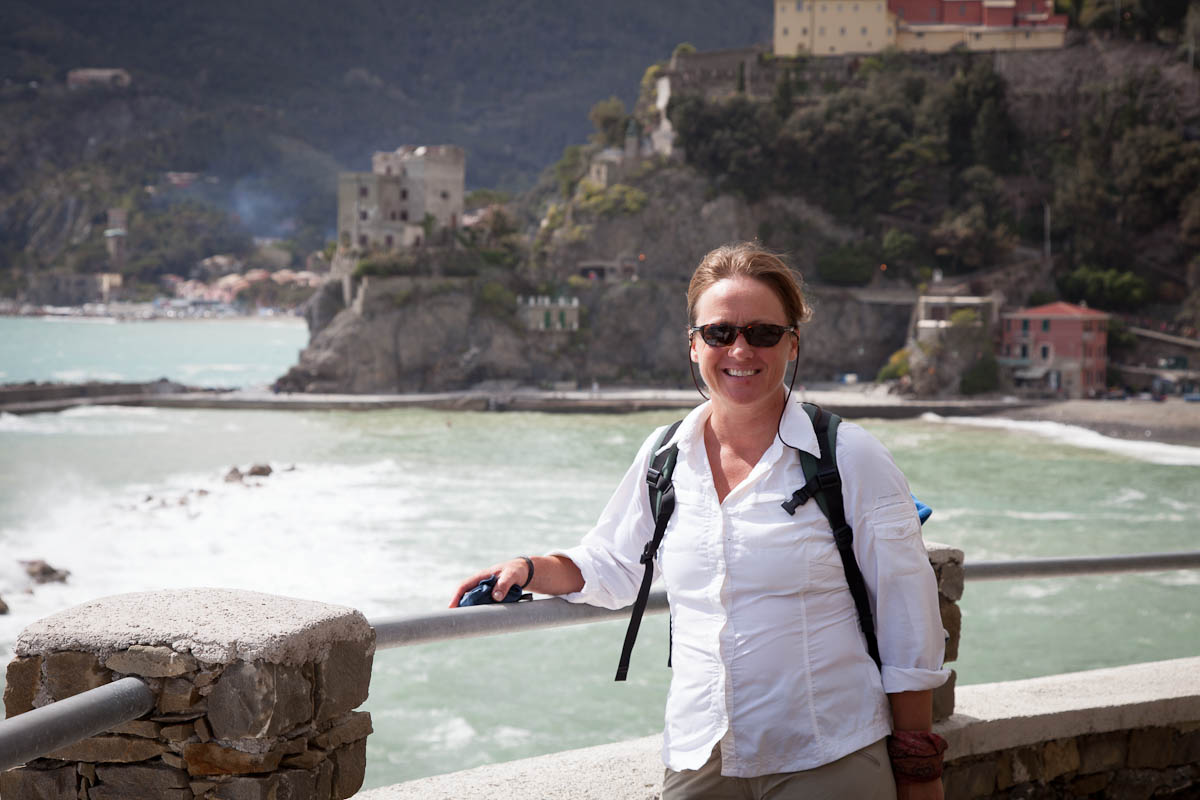
It was from here that we hiked to the last town, Monterosso.  The hike was challenging as we traversed the hills following rather narrow and sometimes treacherous and slippery paths.  It was no surprise that Sonja lead the pack setting a rather quick pace.  As she pointed out, the sooner we got there the more time we would have to do some shopping and sample the local food and wine. The two hour hike only took us one hour!


In Monterosso, we discovered a lovely little shop where the shopkeeper encouraged us to sample everything in the store, including several of the wines from the region.  Sonja found many items to purchase as souvenirs.  With a half an hour to spare, we parked ourselves on a patio overlooking the sea and enjoyed a couple of glasses of the local white wine.  I couldn’t think of a better way to spend a Tuesday afternoon.

Dipping our toes in the Mediterranean Sea.

Back on the train, we returned to the first village, Riomaggiore where we explored for a little while before we stopped for another glass of wine on yet another beautiful patio overlooking the sea.  This time, our guides treated the group to compensate for not being able to take the boat from Monterosso due to high winds which was hardly their fault but we appreciated the gesture of goodwill nonetheless.  We did one final walk along the coast back to the train station which took us to La Spezia where we boarded our bus for the journey to Florence.

It was a long day – almost 12 hours – but well worth it.  The weather cooperated with a mixture of sun and cloud, comfortable temperatures and most importantly, no rain.  Our tour guides, Alex and Chris were knowledgeable, energetic, and very attentive to the needs of each member in the group.  They were some of the best tour guides we have encountered in our travels.  The entire tour was well organized; we would highly recommend it to anyone who is tight on time and wants to see Cinque Terre in a day.


Rained out in Sienna

Our trip with my sister Sonja began in Florence where we met at the train station; we came from Venice and Sonja came from Rome.  We stayed in an apartment in the historic centre, across the street from Santa Croce Basilica.  In fact, our living room windows looked out to the Basilica.  It was a perfect location and a wonderfully charming apartment, with more space than we needed or even used.  We walked everywhere from the apartment, including to the bus and train stations.  The apartment was on the third floor of an old building that did not have an elevator.  While the apartment boasted all modern conveniences it was filled with antiques, wonderful artwork, and lots of interesting knick knacks giving it a very authentic feel.

Santa Croce Basilica – Our apartment is to the left of the church.

Sonja had a “must see” list that included excursions to Sienna and Pisa.  We also had a full day tour already booked to Cinque Terre.  We were cramming a lot into our four days but first we had to get ourselves oriented.  I am always surprised at how we drop ourselves into a new place that is completely foreign to us and within 24 hours I know my way around sufficiently to feel like I have been there for a month.  In short order, we found a grocery store to stock up on provisions, ate an over-priced and not very good lunch on a patio, and we were unpacked and had the first load of laundry on the go.  And then the rain began.  It rained on and off for the next four days.

Sonja snapped this photo after we ducked into a cafe to seek shelter from the relentless rain.

We awoke the next morning to steady drizzle.  Chris suggested it might be a good museum day, but Sonja made the astute observation (of which we reminded her frequently afterwards):  We’re going to get a little wet no matter what we do.  And so we stuck to our original plan and took the bus to Sienna which was only an hour away – on the express bus – and an hour and a half on the local bus which we inadvertently took.  By the time we arrived, it was pouring buckets.  We wandered around for a while browsing through the infamous “Tuesday Market” and stocking up on some local cheese, salami and vegetables.  But when the thunder and lightning began and the rain turned to hail, and we were soaked to the skin, we all agreed it was time to go home.  Sienna was a bust as far as I was concerned, but Sonja was satisfied that she had at least caught a glimpse of it and saw the beautiful countryside as well.  I comforted myself with the knowledge that Chris and I would go back later in May while we were on the farm which was only 50 km south of Sienna.

Soaked to the skin and ready to go back to Florence.

Travel Tip:  If travelling with three or more people, consider staying in an apartment of which there are many to choose from.  It can be very cost effective and offers a lot more space than a traditional hotel room not to mention full kitchen and often laundry facilities too.  Airbnb.com is a great site for accommodations – we found all our South American apartments through this site as well as those in Italy.  Click here to see the airbnb listing for the Florence apartment.

A whirlwind through Italy

We have been in Italy with my sister Sonja for just over two weeks and have visited the major tourist destinations: Florence, Venice and Rome.  We even managed to squeeze in a weekend in Milan so that Sonja could run the Milan Marathon.  We did as much as humanly possible so that Sonja could see and experience everything on her bucket list. What a time we have had!  The history and architecture, the plethora of art, sculptures, churches, mosaics, tapestries – it has left us in awe. We have discovered Italian coffee – cappucino is my absolute favourite and I may never go back to drinking American coffee again.  And the gelato – divine! We have tasted what “al dente” really means and now understand why Italians think we massacre pasta in America.  The cheese and salamis and abundance of cheap but good red wine – we love it all.  Was I Italian in a former life??

This was the first time I have travelled for more than a weekend with my sister and while the pace was much more intense than what we’ve been used to these past few months, I was pleasantly surprised at how well we all travelled together.  We all seemed to be in agreement most of the time as to what to see, where to go and what to eat.  And when we didn’t agree, we were quite happy to go our separate ways for a few hours to pursue our own interests before regrouping later in the day. Amazingly, our itinerary was executed perfectly: we never missed a train, we always found our apartments, all our accommodations were better than expected, we never got lost unless it was intentional (more about that later), we never lost each other.

Everything was perfect, except, of course, the weather.  We arrived in Venice to cold temperatures (below 10C which felt freezing cold to us after spending the last two months in the tropics) and cloudy skies but at least it didn’t rain on that first day in Italy.  The rain began the next day and it rained on and off for a week! Some days were downright miserable like the day we visited Sienna and got soaked to the skin as the relentless rain turned to hail accompanied by thunder and lightening.  But then the sun came out in Venice and continued to shine right through to the end of Sonja’s visit.   I’ve been told temperatures are going to hit 30C by the weekend!

Sonja left yesterday and we have now resumed our slow travel pace.  Today is a national holiday in Italy and most things are closed so we are taking a welcome break from sightseeing.  Besides, my brain is so full right now, I don’t think I can absorb anything new, and my feet are still aching from wearing the wrong shoes for hours on end on those ancient cobblestone streets in Rome. The price of vanity I suppose.

I will now take some time to write about what we did during these past two weeks and share some of the amazing photos that have been taken.  There is so much to tell but I will try to stick to the highlights.

In the meantime, check out the latest addition to our website: the photo gallery.  After much discussion and many debates, this part of the website is finally coming together in a way that I have always envisioned it.   It can be accessed from the header image at the top of the website – it is the first item listed on the sign post – or you can access it from the left hand column, about half way down in the “Other Info” section.  We have created a Flickr account to host all our photos and we have linked our website to Flickr via a slick plugin very appropriately called “slickr flickr”.

The main purpose of the photo gallery is to showcase more of the amazing photos taken by Chris.  While the photos in the blog support the narrative text, they are a drop in the bucket compared to the thousands of photos that Chris has taken. But the photo gallery offers so much more.  Chris manipulates many of his photos using a variety of techniques that transforms them into veritable works of art.  He is continuously finessing his technique and striving for the perfect shot. As his biggest fan, I am thrilled to have a forum in which to display his wonderful work.

The photo gallery is a work in progress and we’re still trying to figure out the best way to organize the photos to make them easy to access and enjoyable to view.  You’ll notice that Chris has added a watermark to his photos, also something that we’re experimenting with in terms of size and location on the photo.  The purpose of the watermark is to prevent his photos from being reproduced without his permission.  You’re free to enjoy them on-line but if you wish to print them or use them in any way, we’d appreciate hearing from you beforehand.  We’re also exploring commercial opportunities and it’s important to retain ownership of the photos in order to leverage such possibilities.

You can expect a lot more photos to be added to the gallery in the coming days and weeks. We’d love to hear your feedback on the photo gallery both in terms of how we have organized the photos as well as the content itself.


Getting to Europe the old-fashioned way

We took slow travel to a new level as we spent 21 days travelling by ship from Santos, Brazil to Venice, Italy.  Along the way, we stopped at six ports of call in Brazil and five ports of call in Europe.  We spent a total of nine days at sea of which five were consecutive days as we crossed the Atlantic Ocean.

From the moment we made the decision to travel to Europe by cruise, we had been looking forward to it.  Even the tragic accident off the coast of Italy and the untimely incident in the Indian Ocean just weeks before our departure date could not dampen our enthusiasm.  Settling into one room for three weeks instead of the usual three nights, eating  familiar food that would be readily available, making no travel arrangements, taking a break from being tourists – this is what we were focusing on.  Yet within minutes of boarding, or maybe it was in the long line-ups during the tedious embarkation process, I recalled how much I don’t really like these mega cruises.  The crowds, the line-ups, the pushy tourists, the lack of personal space, the loud obnoxious cruise director who thinks everybody wants to play bingo or learn how to salsa by the pool, the absence of peace and quiet – it all gets on my nerves after awhile.  And we would be on this ship for 21 days – what was I thinking??

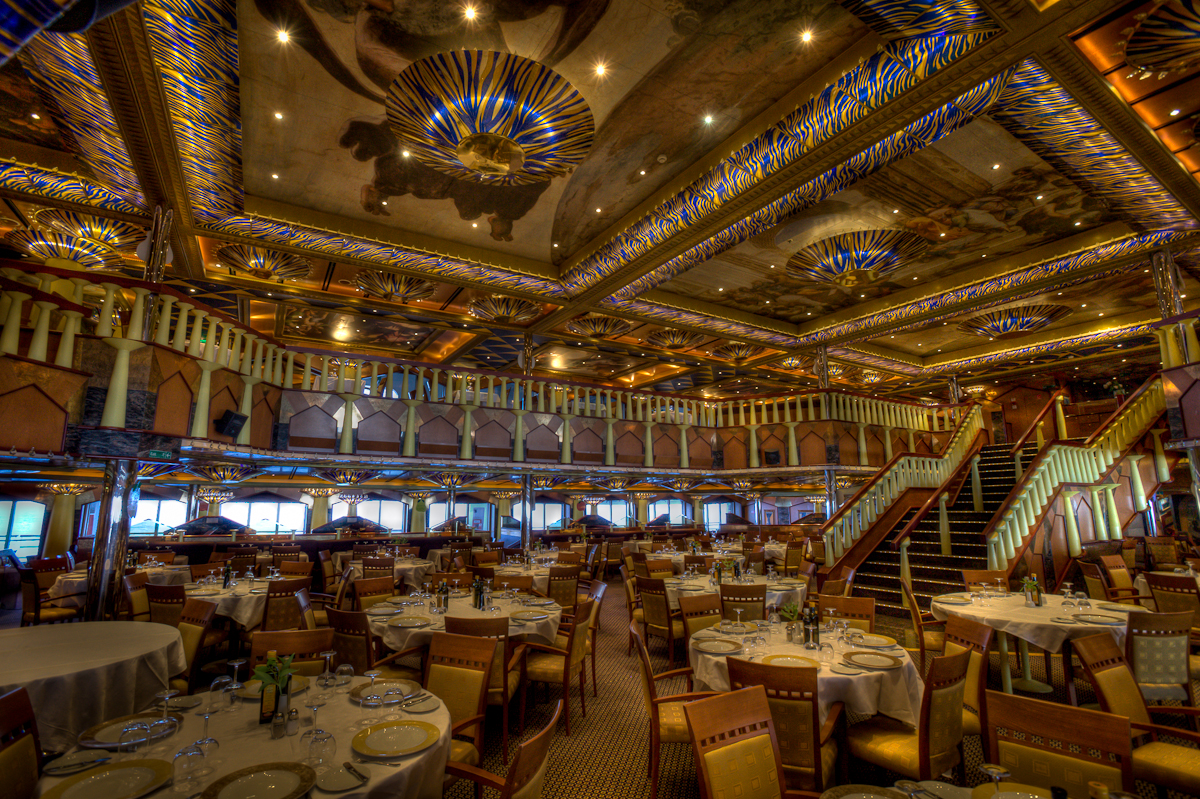
Main Dining Room

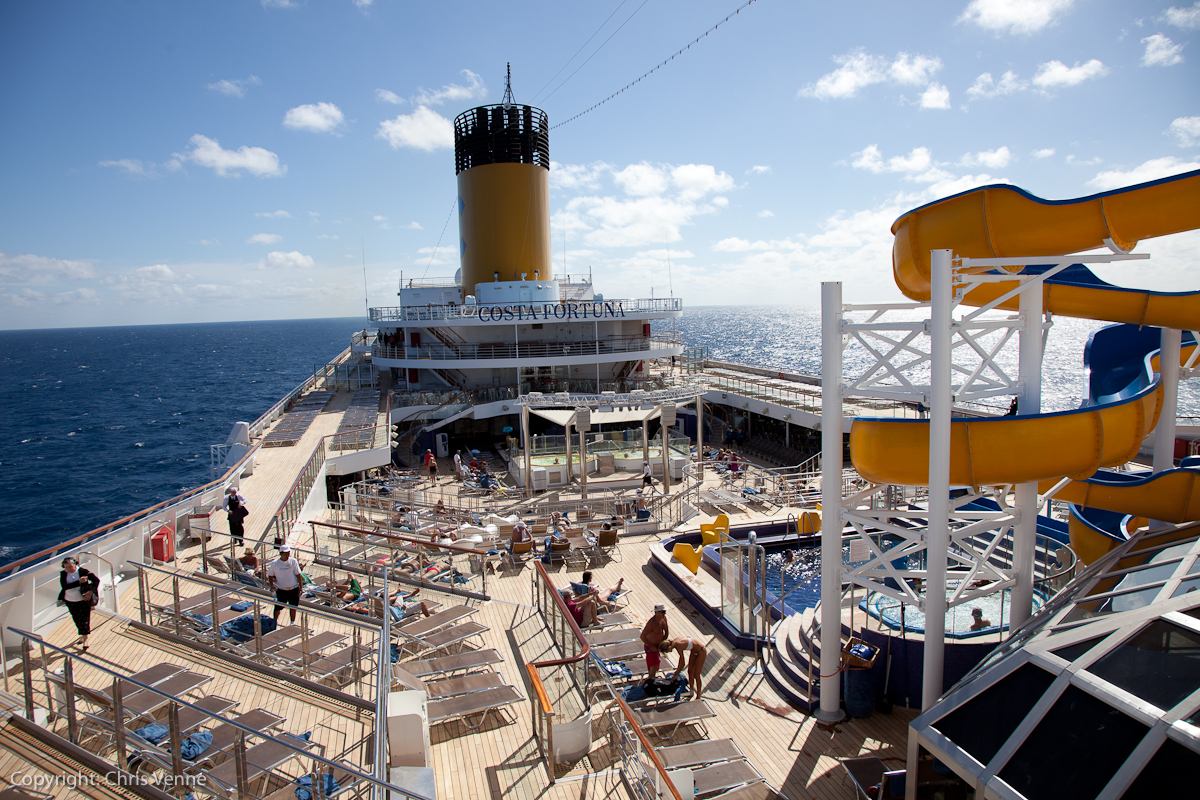
The ship

Costa Fortuna excelled in mediocrity; from the food to the entertainment, everything was completely adequate yet nothing was remarkable or memorable.  Only nine years old, this ship already seemed rather dated in its gaudy décor, but maybe that’s just the Italian style.  It had all the standard amenities you would expect on a large ship – two restaurants for sit-down meals, one upscale restaurant (for a surcharge), a large cafeteria style dining room for breakfast and lunch, a multi-level theatre for nightly entertainment, a large casino, several bars and lounges, a couple of pools and a few hot tubs, a spa and gym, and a children’s play area.

Main Theatre

Of the 3,000 passengers on board, the majority were Brazilian, followed by Europeans.  I would guess the average age was 60+.  We were definitely in the minority based on country of origin, language and age.  The nightly entertainment in the main theatre seemed to target the majority demographics – think Lawrence Welk and you’ve got the picture.  There were plenty of activities planned each day if you were into that sort of thing.  You know, things like arts and crafts (let’s paint ceramics or make paper boxes or paper flowers), dancing lessons by the pool, daily bingo, and games like “Tiles Tournament”, “Belly Smackers Championship” and “Hula Hoop Championship”.  Sorry I can’t offer more details – we were too busy relaxing to get involved.

Ports of Call in Brazil

We explored all the ports of call independently using local transportation that included taxis, buses and metro systems.  We had several electronic guide books to help us figure out what we should see in each port of call as well as the research that I had done in advance when we had internet access.

Ipenema Beach, Rio de Janeiro, Brazil

Of the six cities we visited in Brazil (Rio de Janeiro, Ilheus, Salvadaor, Maceio, Recife, and Fortaleza), Rio was our favourite and we wished we had more time to spend there.  In Rio, we walked along the infamous Cococabana and Ipenema beaches, enjoying spectacular scenery from Sugarloaf Mountain and sipping refreshing coconut milk which came complete with a lesson from an English-speaking local who showed us how to eat the soft, unripened coconut flesh afterwards.  Simply delicious.

Salvador, Brazil

While every city had miles of beautiful beaches, we enjoyed the beaches in Maceio the most.  The turquoise waters were crystal clear and warm like the Caribbean; no signs of pollution like the other beaches.  The worst port of call was Recife which we visited on a Sunday when everything was closed; perhaps this only served to highlight the filth and decay in the historic part of the city where we were saddened to see so many down and out homeless people.  Salvador’s historic district, Pelourinho was recognized as a UNESCO World Heritage Site in 1985.  This area dates back to the 16th and 17th centuries and boasts numerous richly decorated baroque churches, tiny squares, beautiful old colonial mansions, and cobblestone streets. Yet when we visited, I felt like I was on a set in a theme park – it was so contrived and touristy including the ladies dressed up in local costume offering to have their picture taken with you – for a fee of course.

Maceio, Brazil

Our appreciation of Brazil deepened as we visited each city.  While we may not have been wowed by every port of call, they all shared some things in common: gorgeous beaches, cleanliness (except for Recife), friendly locals who were always happy to help you in spite of language barriers, and beautiful climate (hot, humid and sunny).  We definitely want to return to Brazil one day to explore it in more depth.

Lazy, hazy days at sea

I got a cold again on this cruise but somehow timed it perfectly to align with our days at sea which were spent lazing around, amusing ourselves with books and movies, working on our computers (writing and photography) and working out.  It was idyllic as was the weather: sunshine every day and hot (low 30’s) at the beginning with the days gradually getting cooler (low 20’s) as we headed north.  We adjusted to the European time zone gradually by setting the clocks one hour ahead for six consecutive days which for a while really messed us up – we were staying up until two or three in the morning and sleeping almost until noon – easy to do with an inside cabin and no natural light, but we had nowhere pressing to go or things to do so it didn’t really matter.

Ports of Call in Europe

We loved every single port of call in Europe to the point where we are fantasizing about how we can relocate to any of these destinations: Tenerife (Canary Islands, Spain), Malaga (Spain), Valletta (Malta), Corfu (Greece), Dubrovnik (Croatia).

Malaga, Spain

Puerto de la Cruz, San Tenerife, Canary Islands

We docked in Santa Cruz on the island of Tenerife, the largest and most populous of the seven Canary Islands. After exploring the downtown area for a couple of hours, we hopped on a local bus and headed to Puerto de la Cruz, on the north end of the island.  It was love at first sight for both of us; the European architecture, the charming café’s along the pedestrian-only streets and the gorgeous waterfront completely enamored us.  Just as we were thinking this was the place to retire to, we stopped in Malaga next, on the southern coast of Spain in an area known as the Costa del Sol (coast of sun), and we fell in love all over again.  Picasso’s birthplace offered a breathtakingly beautiful cathedral, an ancient castle and fortress, plus the beautiful European architecture, charming café’s and a gorgeous harbour.

Valletta, Malta

We were disappointed when we arrived in Malta on Good Friday to find everything closed for the holiday. Luckily we had been there on a previous cruise so we had already seen many of the highlights.  Our afternoon took an unexpected turn when we met a very nice English couple (Angela and Harry) and their two grandchildren (Skyler and Joseph) while we were enjoying a beer on a patio.  As we engaged them in small talk, we learned they had retired to Malta five years earlier. This was a great opportunity to learn about what life was like on this small island.  Much to our surprise, as we finished up our drinks, Angela invited us back to their place to see where they live. Harry took us on a bit of a walking tour to their maisonette which was a lovely 2 storey home similar to a townhouse.  After a short visit over a cup of coffee, Harry kindly offered to drive us back to the ship, taking the scenic route and pointing out all the highlights along the way.  It turned out to be one of our most enjoyable ports of call!

Corfu, Greece

Our visits to the last two ports of call, Corfu (Greece) and Dubrovnik (Croatia) were only a few hours long – just enough to get a glimpse of each city but not long enough to really see or do much.  We still enjoyed these cities.

While this cruise had its shortcomings, it was perfect for what we needed – transportation from South America to Europe and some rest and relaxation. We arrived in Europe feeling refreshed and ready to tackle the next continent, starting with Italy.

Dubrovnik, Croatia

After spending just one day in Venice, we headed to Florence, Italy, where we met up with my sister Sonja.  It’s going to be a busy couple of weeks as we try to cram as much in as possible.  I’ll share the highlights from Florence, Milan, Venice and Rome in the next few posts.

Grand Canal, Venice, Italy