Brazil

Getting to Europe the old-fashioned way

We took slow travel to a new level as we spent 21 days travelling by ship from Santos, Brazil to Venice, Italy.  Along the way, we stopped at six ports of call in Brazil and five ports of call in Europe.  We spent a total of nine days at sea of which five were consecutive days as we crossed the Atlantic Ocean.

From the moment we made the decision to travel to Europe by cruise, we had been looking forward to it.  Even the tragic accident off the coast of Italy and the untimely incident in the Indian Ocean just weeks before our departure date could not dampen our enthusiasm.  Settling into one room for three weeks instead of the usual three nights, eating  familiar food that would be readily available, making no travel arrangements, taking a break from being tourists – this is what we were focusing on.  Yet within minutes of boarding, or maybe it was in the long line-ups during the tedious embarkation process, I recalled how much I don’t really like these mega cruises.  The crowds, the line-ups, the pushy tourists, the lack of personal space, the loud obnoxious cruise director who thinks everybody wants to play bingo or learn how to salsa by the pool, the absence of peace and quiet – it all gets on my nerves after awhile.  And we would be on this ship for 21 days – what was I thinking??
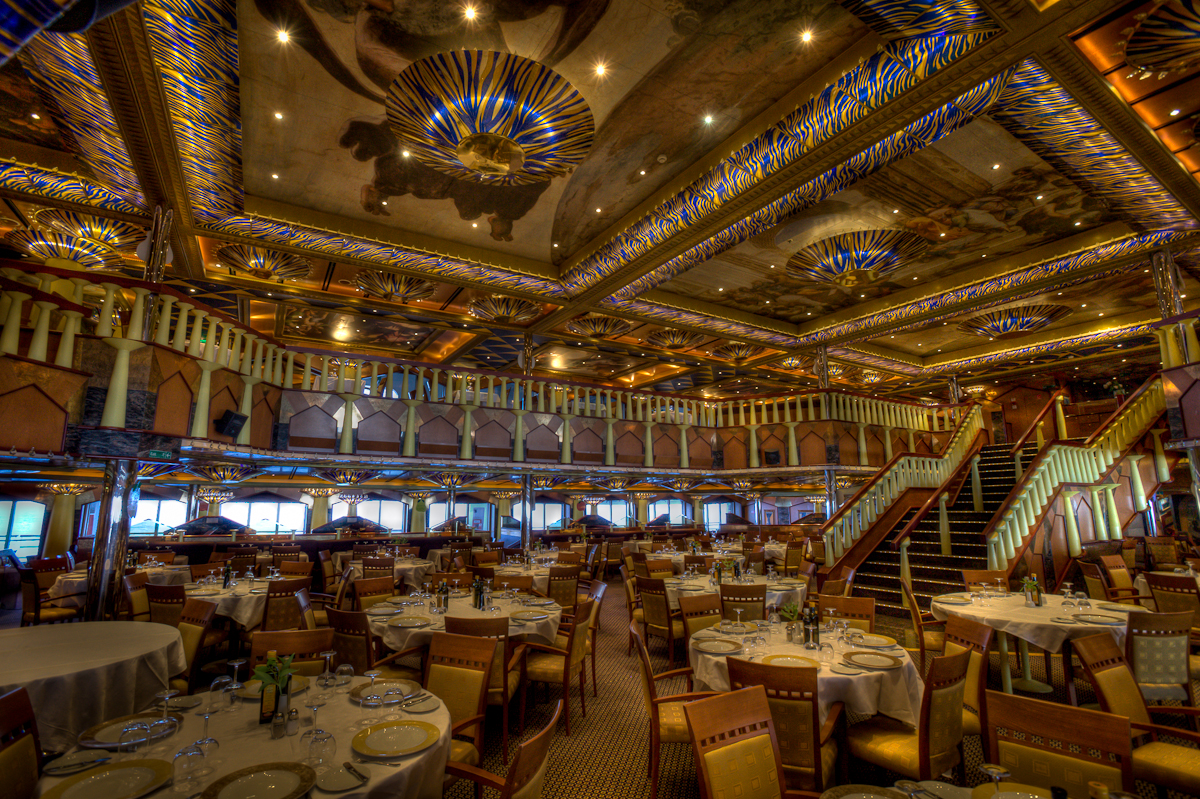
Main Dining Room

The ship

Costa Fortuna excelled in mediocrity; from the food to the entertainment, everything was completely adequate yet nothing was remarkable or memorable.  Only nine years old, this ship already seemed rather dated in its gaudy décor, but maybe that’s just the Italian style.  It had all the standard amenities you would expect on a large ship – two restaurants for sit-down meals, one upscale restaurant (for a surcharge), a large cafeteria style dining room for breakfast and lunch, a multi-level theatre for nightly entertainment, a large casino, several bars and lounges, a couple of pools and a few hot tubs, a spa and gym, and a children’s play area.

Main Theatre

Of the 3,000 passengers on board, the majority were Brazilian, followed by Europeans.  I would guess the average age was 60+.  We were definitely in the minority based on country of origin, language and age.  The nightly entertainment in the main theatre seemed to target the majority demographics – think Lawrence Welk and you’ve got the picture.  There were plenty of activities planned each day if you were into that sort of thing.  You know, things like arts and crafts (let’s paint ceramics or make paper boxes or paper flowers), dancing lessons by the pool, daily bingo, and games like “Tiles Tournament”, “Belly Smackers Championship” and “Hula Hoop Championship”.  Sorry I can’t offer more details – we were too busy relaxing to get involved.

Ports of Call in Brazil

We explored all the ports of call independently using local transportation that included taxis, buses and metro systems.  We had several electronic guide books to help us figure out what we should see in each port of call as well as the research that I had done in advance when we had internet access.

Ipenema Beach, Rio de Janeiro, Brazil

Of the six cities we visited in Brazil (Rio de Janeiro, Ilheus, Salvadaor, Maceio, Recife, and Fortaleza), Rio was our favourite and we wished we had more time to spend there.  In Rio, we walked along the infamous Cococabana and Ipenema beaches, enjoying spectacular scenery from Sugarloaf Mountain and sipping refreshing coconut milk which came complete with a lesson from an English-speaking local who showed us how to eat the soft, unripened coconut flesh afterwards.  Simply delicious.

Salvador, Brazil

While every city had miles of beautiful beaches, we enjoyed the beaches in Maceio the most.  The turquoise waters were crystal clear and warm like the Caribbean; no signs of pollution like the other beaches.  The worst port of call was Recife which we visited on a Sunday when everything was closed; perhaps this only served to highlight the filth and decay in the historic part of the city where we were saddened to see so many down and out homeless people.  Salvador’s historic district, Pelourinho was recognized as a UNESCO World Heritage Site in 1985.  This area dates back to the 16th and 17th centuries and boasts numerous richly decorated baroque churches, tiny squares, beautiful old colonial mansions, and cobblestone streets. Yet when we visited, I felt like I was on a set in a theme park – it was so contrived and touristy including the ladies dressed up in local costume offering to have their picture taken with you – for a fee of course.

Maceio, Brazil

Our appreciation of Brazil deepened as we visited each city.  While we may not have been wowed by every port of call, they all shared some things in common: gorgeous beaches, cleanliness (except for Recife), friendly locals who were always happy to help you in spite of language barriers, and beautiful climate (hot, humid and sunny).  We definitely want to return to Brazil one day to explore it in more depth.

Lazy, hazy days at sea
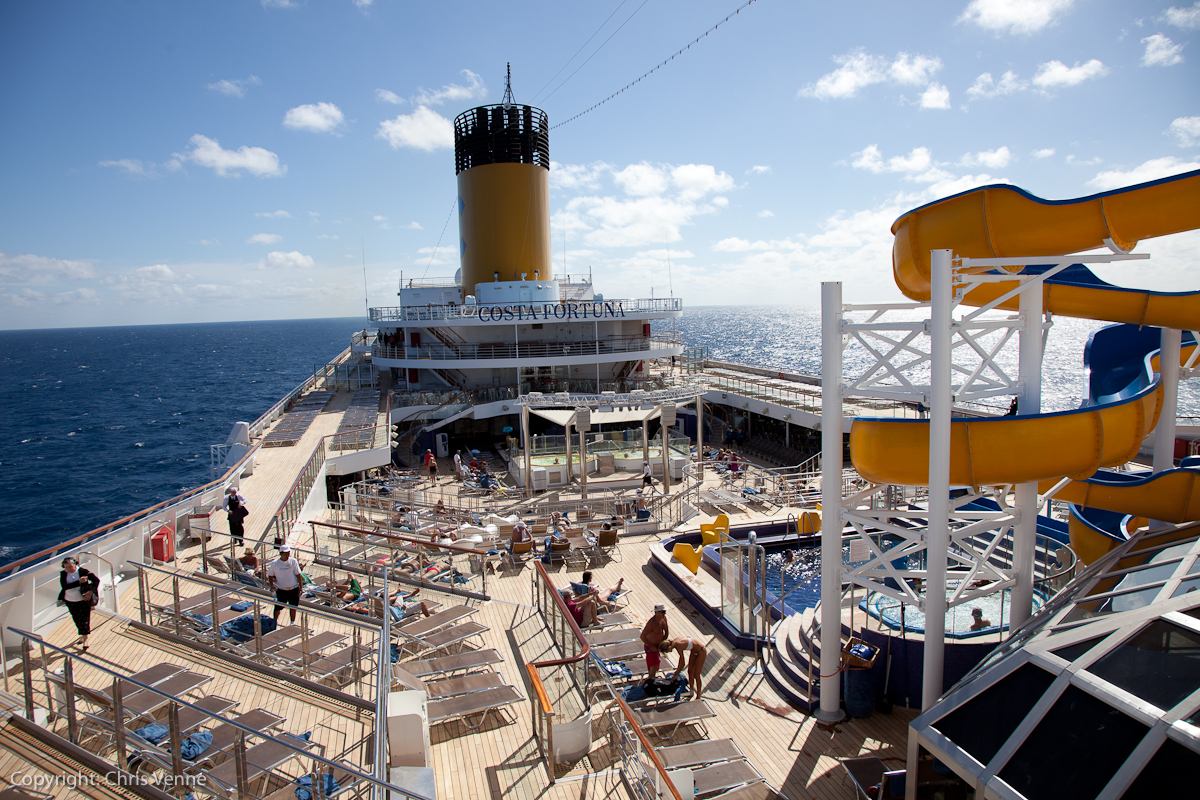
I got a cold again on this cruise but somehow timed it perfectly to align with our days at sea which were spent lazing around, amusing ourselves with books and movies, working on our computers (writing and photography) and working out.  It was idyllic as was the weather: sunshine every day and hot (low 30’s) at the beginning with the days gradually getting cooler (low 20’s) as we headed north.  We adjusted to the European time zone gradually by setting the clocks one hour ahead for six consecutive days which for a while really messed us up – we were staying up until two or three in the morning and sleeping almost until noon – easy to do with an inside cabin and no natural light, but we had nowhere pressing to go or things to do so it didn’t really matter.

Ports of Call in Europe

We loved every single port of call in Europe to the point where we are fantasizing about how we can relocate to any of these destinations: Tenerife (Canary Islands, Spain), Malaga (Spain), Valletta (Malta), Corfu (Greece), Dubrovnik (Croatia).

Malaga, Spain

Puerto de la Cruz, San Tenerife, Canary Islands

We docked in Santa Cruz on the island of Tenerife, the largest and most populous of the seven Canary Islands. After exploring the downtown area for a couple of hours, we hopped on a local bus and headed to Puerto de la Cruz, on the north end of the island.  It was love at first sight for both of us; the European architecture, the charming café’s along the pedestrian-only streets and the gorgeous waterfront completely enamored us.  Just as we were thinking this was the place to retire to, we stopped in Malaga next, on the southern coast of Spain in an area known as the Costa del Sol (coast of sun), and we fell in love all over again.  Picasso’s birthplace offered a breathtakingly beautiful cathedral, an ancient castle and fortress, plus the beautiful European architecture, charming café’s and a gorgeous harbour.

Valletta, Malta

We were disappointed when we arrived in Malta on Good Friday to find everything closed for the holiday. Luckily we had been there on a previous cruise so we had already seen many of the highlights.  Our afternoon took an unexpected turn when we met a very nice English couple (Angela and Harry) and their two grandchildren (Skyler and Joseph) while we were enjoying a beer on a patio.  As we engaged them in small talk, we learned they had retired to Malta five years earlier. This was a great opportunity to learn about what life was like on this small island.  Much to our surprise, as we finished up our drinks, Angela invited us back to their place to see where they live. Harry took us on a bit of a walking tour to their maisonette which was a lovely 2 storey home similar to a townhouse.  After a short visit over a cup of coffee, Harry kindly offered to drive us back to the ship, taking the scenic route and pointing out all the highlights along the way.  It turned out to be one of our most enjoyable ports of call!

Corfu, Greece

Our visits to the last two ports of call, Corfu (Greece) and Dubrovnik (Croatia) were only a few hours long – just enough to get a glimpse of each city but not long enough to really see or do much.  We still enjoyed these cities.

While this cruise had its shortcomings, it was perfect for what we needed – transportation from South America to Europe and some rest and relaxation. We arrived in Europe feeling refreshed and ready to tackle the next continent, starting with Italy.

Dubrovnik, Croatia

After spending just one day in Venice, we headed to Florence, Italy, where we met up with my sister Sonja.  It’s going to be a busy couple of weeks as we try to cram as much in as possible.  I’ll share the highlights from Florence, Milan, Venice and Rome in the next few posts.

Grand Canal, Venice, Italy

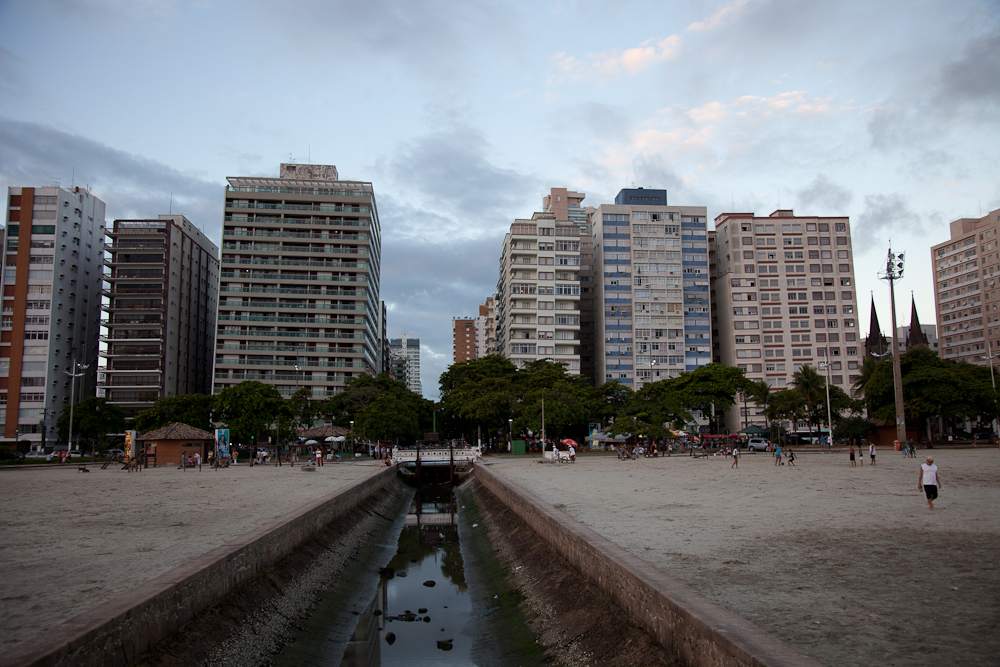
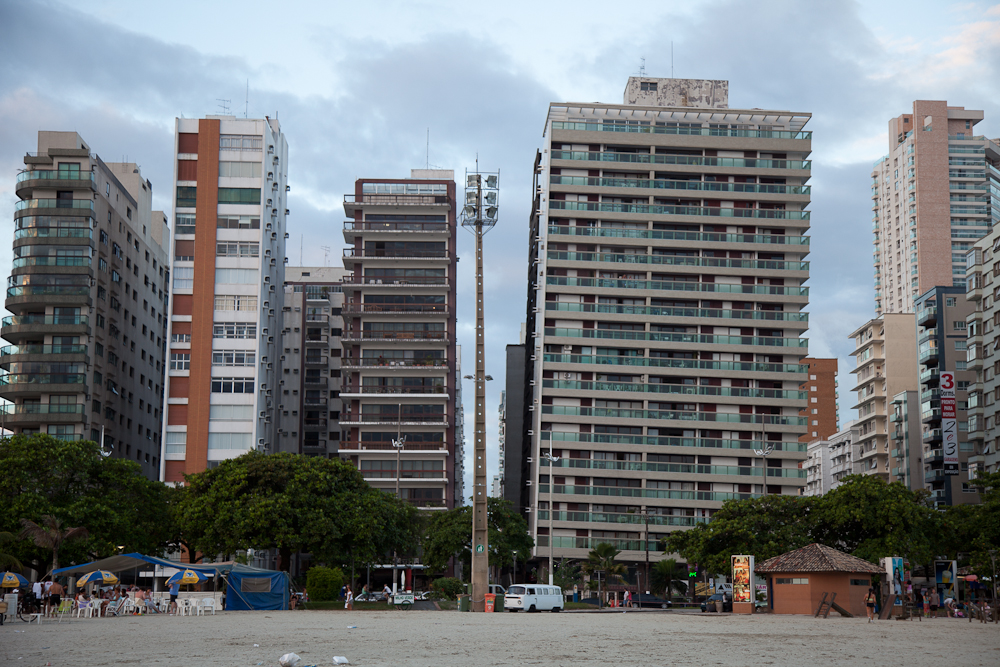
Leaning towers of Santos

About 80 km from Sao Paulo, Santos has the biggest seaport in Latin America and it is from here that we board our transatlantic cruise.  So it made sense to spend our last few days in this area, even though we had been warned this was not the nicest tourist destination.

Santos is known for being the country’s coffee exporting capital and home of Pele, the legendary Brazilian soccer star who played most of his career here. The 100,000-plus seat stadium that dominates Santos’ skyline is regarded as much a shrine as the city’s historic Coffee Exchange, now a museum, where farmers once haggled with barons over the price of their crop.

As possibly the only foreign tourists in this city of about half a million, we enjoyed being immersed in the local culture, a little off the beaten tourist track.  We joined the many locals who headed to the beach in droves on Saturday and Sunday, although we did stand out in our beach attire.  I simply could not convince Chris to buy a speedo, the standard for all males regardless of age and physique. Contrary to common belief, not all women wore skimpy micro bikinis, in fact they were in the minority. Much to my surprise (and perhaps Chris’ disappointment), most wore rather modest bikinis.  Things might be different when we get to Rio.

Our hotel, Ibis, was ideally situated about 50 m from the beach giving us quick and easy access. The beach was long and wide, with a 5 km beachfront garden that made it in the Guinness Book of Records as the largest beachfront garden in the world.  We joined runners of all shapes and sizes for two morning runs along the firm sand at the water’s edge.  What a fabulous running route!

Setting up for the day.  Each weekend morning, vendors set up
their chairs and umbrellas along with a mini bar to serve their clients.

Packing up at the end of the day.

The beach cleared out by dusk, but as night fell, the beach was illuminated
by large flood lights; we saw people strolling along the beach
(from out hotel window) well into the night.

Taking a stroll in the early evening,
watching the cruise ships sail away into the sunset.

While walking along the beach, we noticed a strange phenomenon – many of the buildings appeared to be leaning.  At first we thought it might be an optical illusion, but on closer scrutiny, we confirmed these buildings were definitely leaning. I later learned that the problem became manifest back in the 40’s, 50’s and 60’s and is the result of a combination of poor soil conditions and shoddy workmanship. Below a seven-meter layer of sand is a 30-40 meter deep bed of clay that doesn’t cope well with the weight of the structures. Almost 100 buildings have been affected, all of which are inhabited, and which authorities are quick to assure are completely safe.   Some speculate that if one building were to collapse, it could trigger a domino affect that could literally wipe out the beach front. It is possible to correct these structural problems but the cost is prohibitive; only one building has been repaired thus far at a cost of over half a million dollars.

We arrived in Santos with back packs full of dirty clothes; we were in desperate need of doing laundry.  While travelling for six months in South America, laundry services have been available on practically every street corner. But now, when we were in desperate need, not one could be found. There were plenty of dry cleaners around our upscale neighbourhood, but not a single laundry service.  And so we washed our clothes by hand in our hotel sink and made some makeshift clothes lines to dry them out.  Not ideal, but at least we had clean clothes before our cruise.

Today, we are boarding our ship, Costa Fortuna, and we will most likely be off line for the next three weeks.  If that cruise line sounds familiar, it’s probably because you’ve read about some cruise related accidents in the news recently.  The ship that went aground off the coast of Italy in January was part of Costa’s fleet as was the one that drifted for days close to the Seychelles Islands in the Indian Ocean because a fire killed all electrical power on board.  We’re keeping our fingers crossed that this ship will sail without incident and we’ll make it across the pond in one piece.

Here’s our itinerary:

Mon 3/19 Santos (Brazil)
Tue 3/20 Rio de Janeiro (Brazil)
Wed 3/21 At Sea - -
Thu 3/22 Ilheus (Brazil)
Fri 3/23 Salvador Bahia (Brazil)
Sat 3/24 Maceio (Brazil)
Sun 3/25 Recife (Brazil)
Mon 3/26 Fortaleza (Brazil)
Tue 3/27 At Sea - -
Wed 3/28 At Sea - -
Thu 3/29 At Sea - -
Fri 3/30 At Sea - -
Sat 3/31 At Sea - -
Sun 4/1 St. Cruz de Tenerife (Canary Islands)
Mon 4/2 At Sea - -
Tue 4/3 Malaga (Spain)
Wed 4/4 At Sea - -
Thu 4/5 At Sea - -
Fri 4/6 La Valletta (Malta)
Sat 4/7 Corfu (Greece)
Sun 4/8 Dubrovnik (Croatia)
Mon 4/9 Venice (Italy)

See you in three weeks in Italy!

Scratching the surface of São Paulo

With a population of 11+ million in the city and almost 20 million in its metropolitan region, to say São Paulo is big would be an understatement.  In fact, São Paulo is the largest city in Brazil, the largest city in the southern hemisphere and America, and the world’s sixth largest city by population. We spent four days in São Paulo and barely scratched the surface of this vast city.

Our hostel, Telestar was located in the Vila Mariana neighbourhood, and was well situated within a few minute walk to the metro, which was our primary means of transportation as we explored various parts of the city.  This hostel catered to a younger crowd of primarily solo, male travellers, many of whom were working in the city. Like every hostel, there were things we liked and things we didn’t like. I found the level of cleanliness to be seriously lacking, we didn’t have wifi in our room, and the general atmosphere was more of a frat house than a commercial hostel. The best part of our stay was the food. Breakfasts included freshly squeezed orange juice, delicious brewed coffee, fresh fruit, and a choice of ham omelette or melted cheese and ham sandwich.  Dinner was provided by the resident chef who prepared delicious meals each night that represented typical Brazilian cuisine.

Posing with the chef at our hostel.

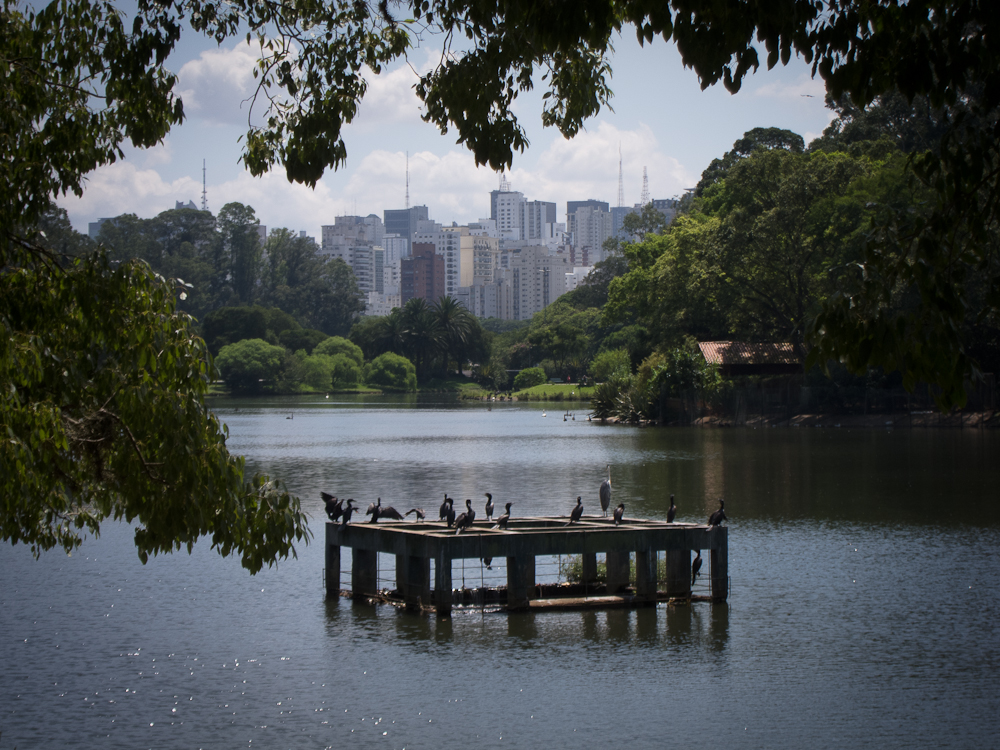
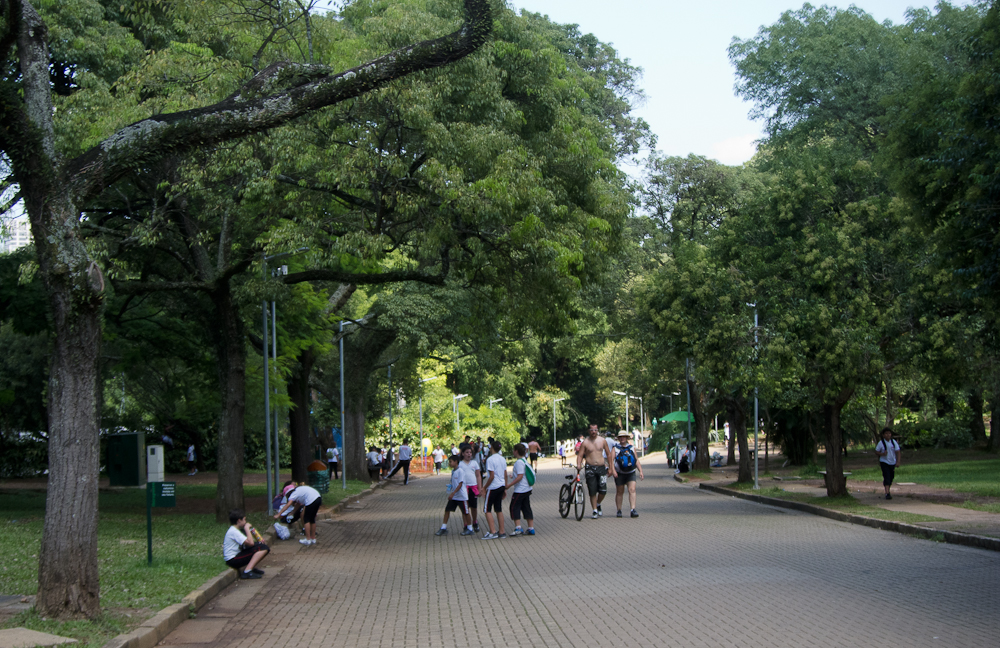
The second largest park of the city and probably the most popular, Ibirapuera Park was within walking distance from our hostel. Reminiscent of Central Park in New York City in terms of its location in the middle of a city, its size and its beauty, we visited the park twice – the first time for a touristy run (run, take pictures, walk, take more pictures, visit the art gallery, run a little more, etc.), and the second time for a real run.

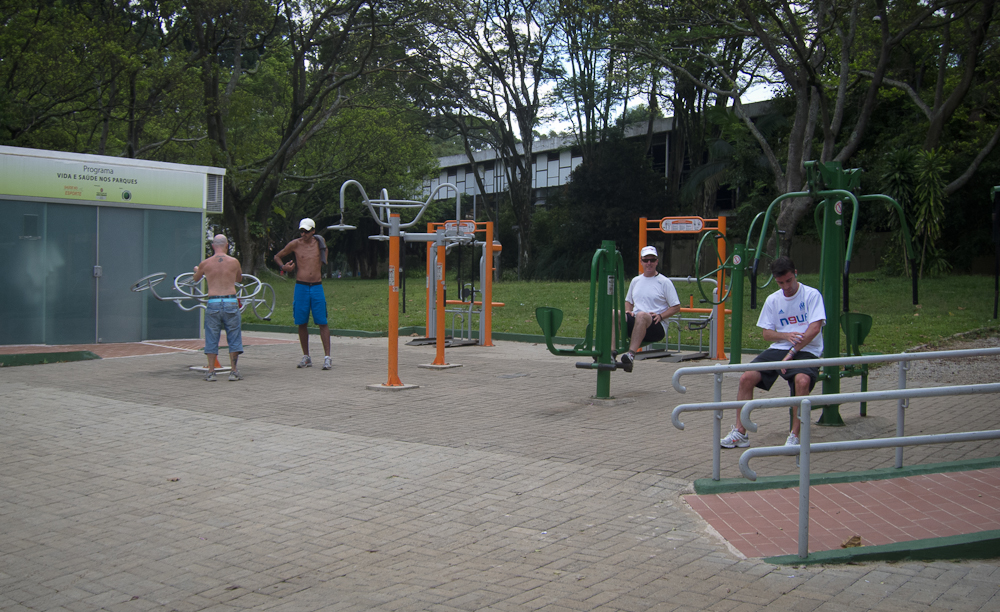
A large main roadway (closed to traffic) provided a perfect running track as it passed around two man-made lakes that were home to black and white swans along with a variety of other birds.  A choreographed water fountain entertained us for almost an hour, reminding us of the water fountain in front of the Bellagio Hotel in Las Vegas. The park features several pavilions, museums and galleries; we visited the Afro-Brazil Museum which honored Brazil’s rich African heritage. Both times, we visited the park mid-morning in the middle of the week and it was full of people engaged in all forms of physical fitness: walking, running, cycling and exercising in the many exercise stations located throughout the park.  Paulistanos, as residents of São Paulo are known, take exercising seriously!

Choreographed water fountain.

Exercise station in the park.

Video:  Dancing waters

We discovered Parque Trianon while walking along Paulista Avenue, which was in the heart of the downtown financial district. This small park was a  tropical oasis in the middle of the city, offering a lovely escape from the traffic, noise and pollution.  In fact, while walking through this jungle-like park, one could easily forget that you were in the middle of a city since even the buildings were obscured by the thick vegetation.

Architecture along Paulista Avenue.

The Liberdade neighborhood is home to the largest Japanese population outside of Japan and we spent one day wandering through this area and the neighbouring Centro district.  It was here that I decided to do a little bit of shopping in preparation for our cruise and trip to Italy. And it was here that I faced head on the challenge of not knowing a single word of the local language, Portuguese.   How to ask for another size, or a different color?  The majority of the boutiques were staffed with zealous assistants who made it their mission to help you.  As I entered a boutique, I would be greeted by one of the sales staff who would ask me, I assume, if she could help me find something.  I immediately said I spoke no Portuguese, only English.  Nobody spoke English.  Undeterred, the assistant would stay by my side, making suggestions even though I didn’t understand what she was saying, holding any clothes that I wanted to try on.  Somehow I managed with a creative use of sign language and facial expressions to find the things I was looking for: a pair of high heels, dress pants and a dressy top. It was exhausting!

Centro district in Sao Paulo.

Metropolitan Cathedral

View of the plaza from the cathedral steps.

Shopping in downtown Sao Paulo.

As we walked around the city, we wondered why there were no billboards or advertisements anywhere to be seen.  Apparently, the city passed a Clean City Law in 2007 which resulted in the removal of about 15,000 billboards, 1,600 signs and 1,300 towering metal panels. This law even extends to the air space above São Paulo.  The goal of this law was to remove “visual pollution”, which resulted in exposing both the beauty and ugliness of Brazil’s bustling business capital. For the first time in decades, the ornate facades of old downtown buildings have been revealed in all their glory; on the other hand, the slums, or favelas, that line the expressways are no longer hidden behind gaudy billboards.

In spite of its formidable size and reputation as a dangerous city, São Paulo made a favourable impression on us.  The areas we explored were extremely clean, probably the cleanest South American city we have visited, and we always felt very safe.  Police presence is strong throughout the city which has gone a long way towards curbing petty crimes.  The extensive metro system was modern, clean and air conditioned.  Brazilian cuisine was delicious; no matter where we ate, we always had a great meal.  The people were friendly and helpful despite our lack of basic language skills.  All in all, we enjoyed our few days in Sao Paulo, even though we know we barely scratched the surface.

Getting to Iguazú Falls in style

Much to my great dismay we arrived in Iguazú Falls a full hour ahead of schedule.  This meant one hour less on the most luxurious bus I’ve ever been on.  Perhaps I’m being a little facetious, but I’m not kidding about our very enjoyable 17 hour bus ride from Buenos Aires to Puerto Iguazú (Bus company: Via Bariloche, Full Cama Service, if anybody is planning a trip).

Each pair of seats was ensconced in its own cubicle, complete with individual television monitors that offered a range of videos and music to entertain, and plush red leather seats that were more comfortable than our Lazy-Boy recliners at home and these seats fully reclined into a perfectly horizontal position.  We were issued cozy fleece blankets and pillows.  The only thing missing was a remote control which really would have been handy when you were fully reclined, but my toes provided a suitable alternative, much to Chris’ amusement.

I’m not sure what you call the guy tending to all our needs; I’ll call him our butler although he looked more like an airline pilot in his smart uniform, but he acted in a very suave manner much like I would imagine a butler would act.  (Maybe I’ve been reading too much fiction lately.)   We knew we were in for a treat when our butler offered us an array of candies as soon as we sat down.  They don’t do that on the buses in Ecuador!

Once we were on the road, dinner was served – salad, bread, and a delicious hot meal (beef casserole with mashed potatoes), and of course dessert.  We had our choice of refreshments including wine.  Coffee and biscuits were served after dinner, followed by a shot of Irish whiskey.  We all slept like babies throughout the night. The next morning we were greeted by our ever friendly and obliging butler who served us coffee and a typical South American breakfast of croissants along with white bread and jam. Doesn’t this sound like a civilized way to travel?  Now do you understand why I didn’t want to get off the bus, especially an hour earlier than scheduled?  I’m sure we are ruined for all future bus travel.  It’s just as well we’re leaving South America soon.

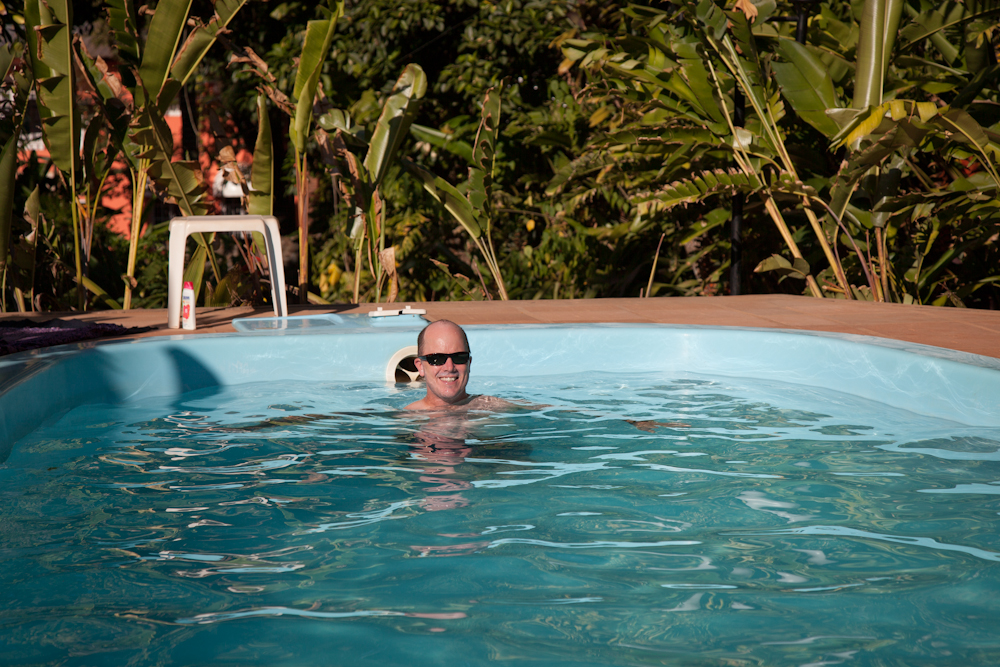
The first thing we noticed about Puerto Iguazú was the heat.  The relentless sun beat down on us without a hint of a breeze to offer any relief.  It was almost unbearable.  We were drenched in sweat when we arrived at our hostel, just a short three block walk from the bus station.  But what a delight to discover our hostel (Garden Stone in case you’re looking for a place in Puerto Iguazú ) had a pool – something that saved us each day.  A funny thing about our hostel:  our room was very small and right next to the office so rather noisy, the bed was terribly uncomfortable, the breakfast was mediocre at best – yet we loved our time there and wished we had booked an extra night or two.

Our hostel felt like a mini resort or a friend’s back yard.

Behind the hostel was a lush, tropical garden, complete with hammocks in the shade, garden chairs, the pool, and a lovely open air, common kitchen and dining area. At the end of each day, guests would hang out around the pool, getting to know each other, sharing where they’ve travelled and where they’re going next. It was here we met Russ who was one year into a two year journey.  He had walked the Camino de Santiago last June – something we are planning to do this June. I had never met anyone who had done this walk before so naturally I peppered him with questions about his experience and am now even keener than ever to do this pilgrimage.  Yet, I still can’t answer the simple question, why?  I just feel I want to, maybe even need to do it.

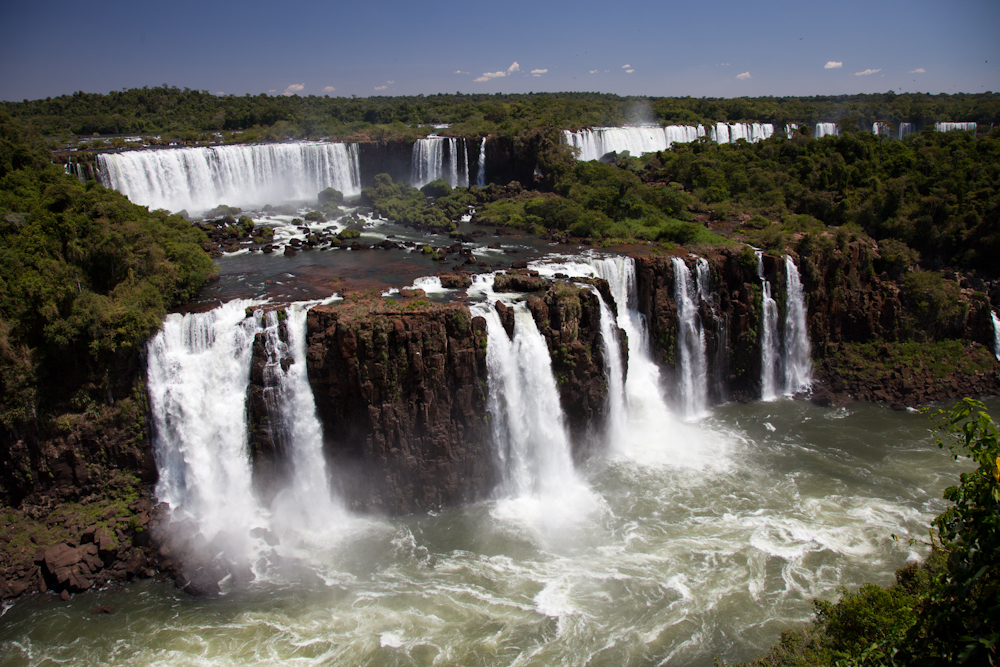
I digress from the main purpose of our trip to Puerto Iguazú which was, of course, to visit Iguazú Falls, the second largest waterfalls in the world (Victoria Falls in South Africa are the largest and Niagara Falls in Canada are a very distant third).  Declared a Natural World Heritage Site by UNESCO in the early 1980’s, these falls are comprised of 275 individual falls spanning three kilometres. cascading up to 70 m into a giant gorge amidst a lush, subtropical rainforest.   Its normal flow is about 1.3 million litres per second.  The falls straddle both Argentina and Brazil; catwalks are built on both sides providing closer (often times mistier and wetter) views of this impressive waterfall. On November 11 of 2011, Iguazú Falls was declared to be one of the seven winners of the New7Wonders of Nature by the New Seven Wonders of the World Foundation.

Igauzu Falls MapMap of the walking trails and boat routes (red dots) on the both sides of the falls.
The island in the middle, San Martin, was closed to the public the day we were
there because a film crew was shooting a movie at that location. 

We spent one day on the Argentine side and one day on the Brazilian side.  We were relieved that our Brazilian Visas passed the scrutiny of the immigration officials.  These were the visas we had obtained in La Paz, Bolivia (doesn’t that seem like ages ago?) and we always wondered, and maybe worried a little if we would have any problems with them since they had been produced so quickly, and in a third world country no less.

Lookout from the Brazilian side of the falls.

Close up of the falls.

Rainbow at Devil’s Throat (La Garganta del Diablo)
as seen from the Argentine side.

An impressive network of walkways often passed right over
the water as it spilled over the very edge of the waterfall. 

The view from the Brazilian side – note that these are just
some of the falls.  It was impossible to capture it all
in a single photo! 

Contrary to what most people say, I think the Brazilian side of the falls was just as stunning as the view from the Argentine side, it just offered a different perpsective.  The Brazilian side offered a panoramic view that helped you appreciate how large these falls were.  From the Argentine side, one feels and hears the thunderous power of the falls more intimately.

Another view from the Brazilian side.

My favourite lookout on the Argentine side.  I felt very small
next to these powerful falls – and I was only standing at the
mid-point – half the falls were still below me. 

Chris and I at the same lookout as above.  Can you believe
we had the lookout to ourselves – well, at least for about
thirty seconds! 

View from the Argentine side from the upper walkway.

A great view from the Brazilian side.  
Devil’s Throat is in the background. 

My favourite view from the Brazilian side plus we got
soaked from the spray which cooled us off nicely. 

Another shot from the Brazilian side.

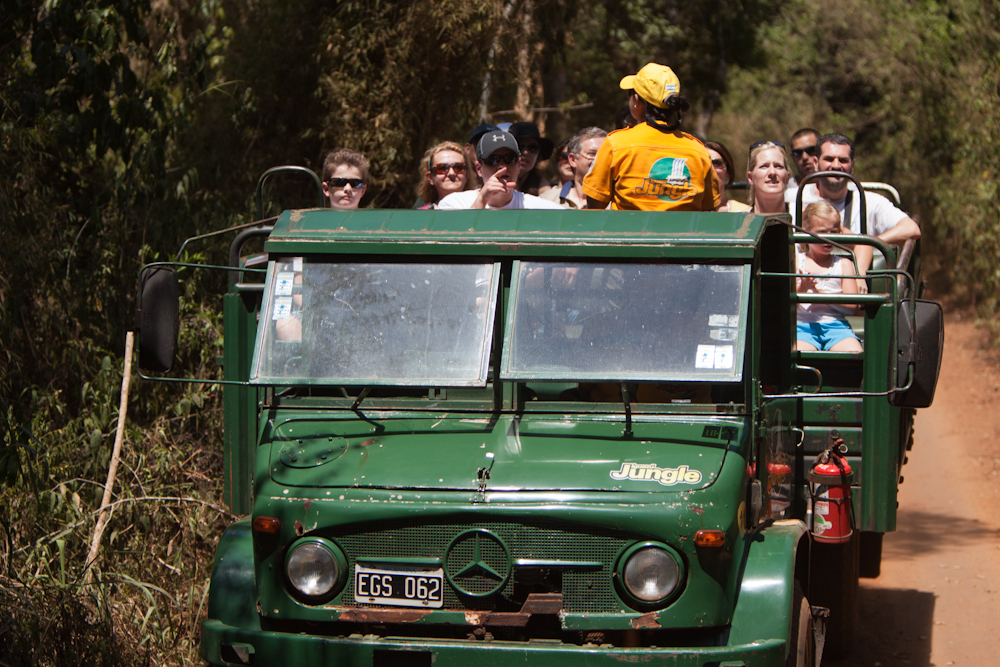
We succumbed to the lure of a tour offering a grand adventure under the falls.  Very much like the “Maid of the Mist” tour in Niagara Falls, this tour brings you by boat very close to the falls, even dunking you under a few times just for the thrill of it.  This was followed by a quick ride down the river through some fast moving water that they called “exciting rapids” (hardly!) after which we were transported by open truck through eight kilometres of rainforest during which we saw absolutely no wild life, not even a bird (contrary to the brochure’s promises of encounters with exotic wildlife like orangutans).  It was all over in less than an hour.  I think the best part was getting completely drenched and thoroughly cooled off; otherwise, it was really just another cheesy tourist attraction that we got suckered into. When are we going to learn?

No animals on this “jungle tour” which was quite ridiculous
when we encountered wildlife just walking through the park.
A few samples are below.

Video:  Experience the power and force of Iguazú falls with us.