christina

Camino de Santiago: Day 2 (Christina)

From Roncesvalles to Zubiri (21.5 km)

I got an early start today, on the road walking at 6:30 am. I didn´t have the best sleep last night even though my bed was super comfortable and it was  quiet in my little area.  The Roncesvalles alburgue has been recently renovated and offers all the comforts and necessities a pilgrim could want.  The beds are configured in pairs of bunk beds with walls between each pair giving you a sense of privacy aside from there being a stranger in the bunk across from you.  At least you don´t feel exposed to the hundreds of pilgrims who are sleeping there. Still, I had some difficulty sleeping, but I have difficulty sleeping most nights so I wasn´t too worried about it.  I felt pretty good physically – my quads were a little sore but otherwise no complaints.

The temperature was quite cool when I headed out and I was glad to have my base layer top to wear over my t-shirt. There was no food on hand that I could see so I munched on my cheese that I had bought in St. Jean Pied de Port and had a few bites of what was left of my day old baguette. It was enough to get me going but I knew I needed to get some provisions for the trail as soon as I came across a grocery store.

I was still in the Pyrennes foothills and the scenery was beautiful in the early morning light – rolling hills of lush pastures with forests in the distance.  The trail today was still quite hilly and rocky and got the heart rate going in a few spots.  I didn´t mind carrying my pack, although I was feeling some strain in my hips by mid morning (damn those weak hips of mine).

Pauline and I had planned to walk together again today.  By chance we ran into Monique and we started out with her as well but she wanted to go at a slower pace so we got ahead for awhile.  About 2 km in we came across a little town where we enjoyed our breakfast, European style which meant a coffee and croissant and orange juice – not exactly a hearty breakfast for a day of hiking!

We stopped again a few kilometres later for another coffee – actually we really needed to use the bathroom (probably because of all the coffee) and it was only available to paying guests.  We didn´t mind getting off our feet and enjoying another cup of java.  I learned how to order my coffee in Spanish: cafe grande americano con leche.  Pauline speaks Spanish quite well so she handles the Spanish and I handle the French as necessary – good teamwork.

We found a grocery store at around 10:30 and by then I was starving.  I bought some fruit, a stick of salami and some snacks like nuts, sunflower seeds and candy for a total of 9 euros.  I think I may have some trouble sticking to the 30 euro a day budget!  After another snack, we kept going.  By now it was getting really hot and we had some pretty tough hills to deal with.

Conversation flowed freely between Pauline and I.  I learned her life story today which was only fair as I had bored her with mine yesterday.  But seriously, there seemed to be no end of things to talk about.  It really helped to pass the time.

I was happy that the Camino was not crowded.  There were people along the way but we enjoyed long stretches where there was nobody but us causing us to wonder sometimes if we had taken a wrong turn.  But we followed the trail with no problem.  The camino symbol is posted regularly so it really is quite impossible to get lost.

Our walking day ended at 1:30 when we arrived in the little town of Zubiri where we found a private albergue that had beds available for 10 euro each per night.  The room is dormitory style with 4 pairs of bunkbeds.  There are 7 girls in the room and 1 guy.  A group had just arrived before us and were using the showers so we headed out for some lunch: tapas and beer – delicious!  Back at the albergue I had a great shower (this is luxury compared to South American hostels) and I washed my clothes.

I saw Chris this morning before I left.  I think he headed out before me but I haven´t seen him all day.  I suspect he has gone on to the town ahead which is just half a kilometre away.  But who knows, maybe I´ll run into him at dinner like I did last night.  I could have walked further today, but the next town with accommodations is 20 km away – too far for me.

All in all, it´s been another great day on the Camino – good weather, beautiful scenery, lovely trail and good company.

Update at 9:30 pm:  I have just discovered I have two very small blisters in the same place I get them when I run a marathon.  Also my toes feel bruised from hitting to toe box in my shoe with all the down hill.  I will switch to my hiking sandals tomorrow to give my feet a change.  Hopefully that will help them heal.  This is tough on the body!

Camino de Santiago: Day 1 (Christina)

From St Jean Pied de Port to Roncesvalles (31.7 km)

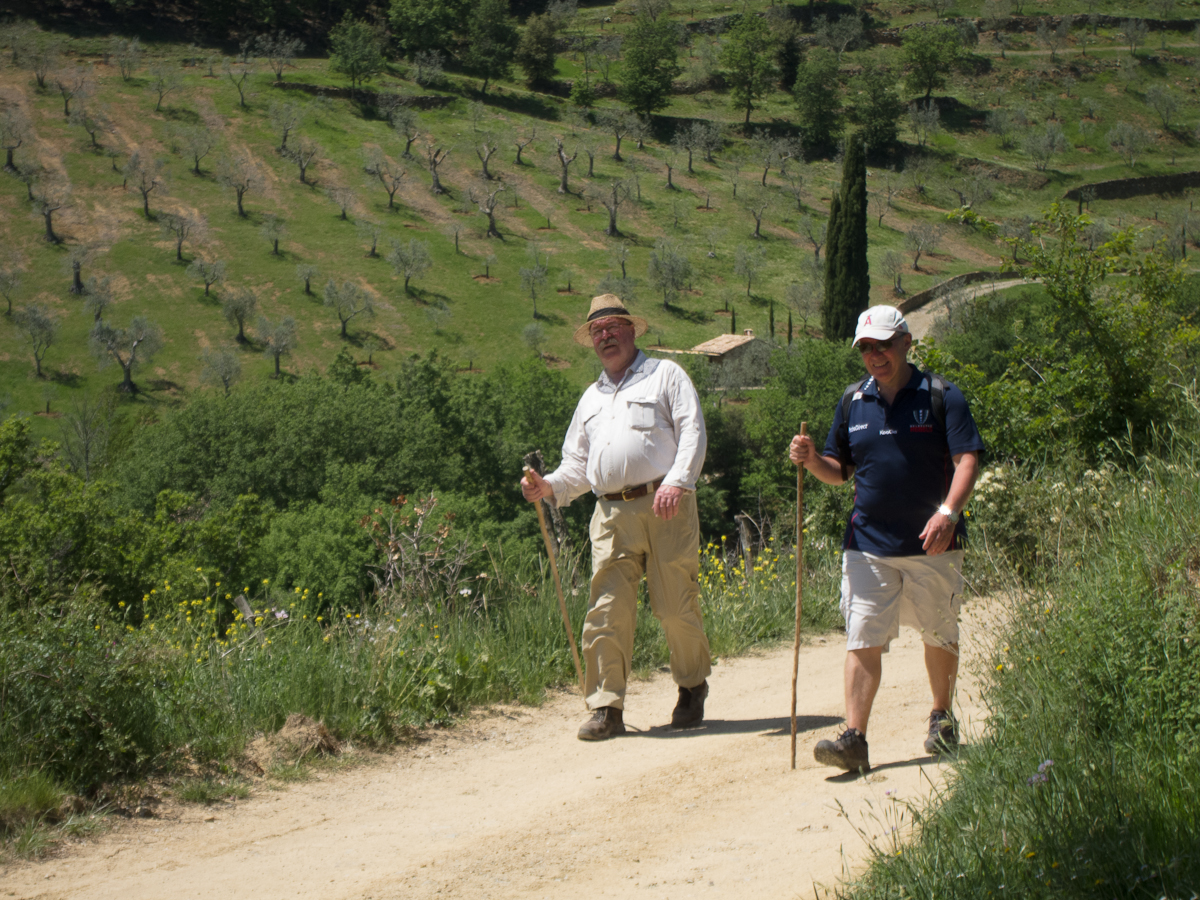
I began to walk at 7:45 under beautiful sunny skies and warm temperatures even this early in the day.  I tried to get provisions for the day but most of the shops were still closed.  I found a baguette and a piece of cheese and bought a small bottle of water.  I hoped my 1.5 L of water would be sufficient.  Turns out this was not a problem as there was potable water along the way. I walked on my own relishing my solitude for the first few hours.  I felt really happy, really really happy.  The scenery was gorgeous, the trail was not crowded, I felt good and my pack felt light.  I revelled in the fact that I had no one to take care of but me.  I can´t remember the last time – if ever that I have been in such a position.  You see, when I was a child, I usually had responsibilities for caring for younger siblings (such is life when you´re one of the oldest in a large family) and then I got married very young and had my children young.  It seems I have spent my lifetime caring for and being responsible for others.  But today, I only had myself to care about and it felt wonderful.

My first Camino friend: Pauline from Ireland.

Just before the town of Orisson (8km), I met a girl from Ireland named Pauline.  We both wanted to get a coffee as soon as we could, so when we arrived in Orisson we shared a table and enjoyed a coffed together.  There was something about this girl that I liked and I felt a connection with her right away and we just decided to start walking together.  Well, conversation came easily between us and we talked about many things.  I ended up walking the rest of the day with her.  I met another lady, Monique from Vancouver who we talked to briefly and then walked closely with her too, but she trailed behind us for the most part using us as her motivation to keep going.  My first two camino friends 🙂

My conversation with Pauline became quite deep as she is very self aware and interested in people and the way people interact.  I ended up telling Pauline my entire life story which I think sort of amazed her.  She is just 32 but seems to be so mature and insightful for her age.  I feel like I began living my life when I was 32 and it was sobering to reflect on all that has changed in my life since then.  This conversation was not planned, it was quite unexpected actually.  I thought I would walk alone today.  I really like Pauline and we plan to walk together again tomorrow.

Only 763 km to go!

We arrive at Roncesvalles at 4:30 and after soaking our tired feet in the little stream before the town (so refreshing I don´t know why everybody wasn´t doing it) we checked out the hostel. We were both prepared to continue on to the next town but there was no need.  This hostel is amazing.  I think it is an old monastery but it has been transformed into a modern home for pilgrims.  They have thought of everything.  I will post pictures as soon as I can – you just won´t believe it.

The old monastery converted into a hostel exclusively for pilgrims.

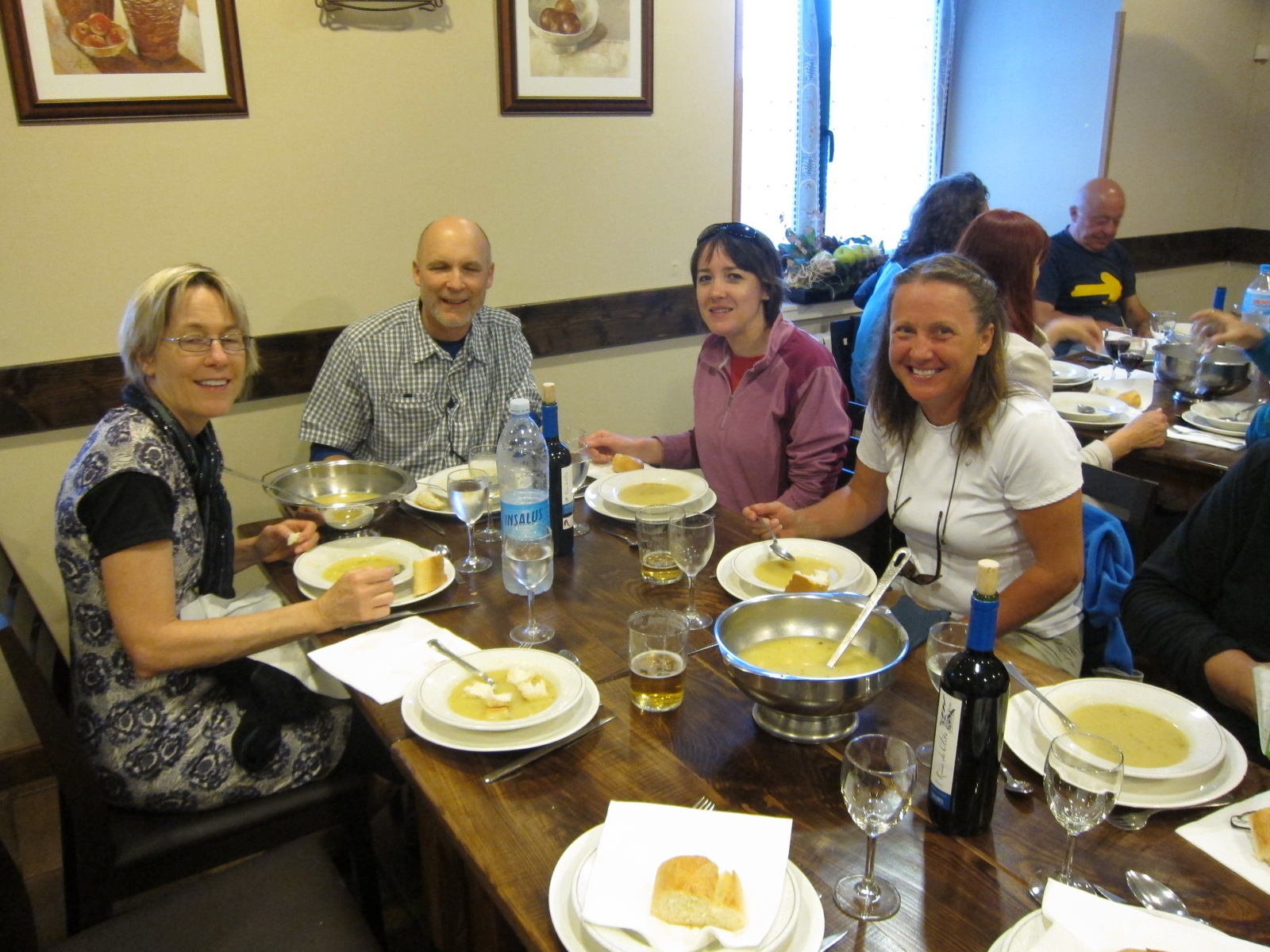
After showering and doing our laundry we headed over to one of the two restaurants in town for a beer and dinner – we were starving.  Who do I run into but Chris who was also having dinner at the same restaurant.  We enjoyed dinner together and I met a couple of his friends from the States.  We shared our experiences from the day and then we said our goodbyes.

My second Camino friend, Monique, from Vancouver, Canada.
These were the best laundry facilities on the Camino. 

This has been a wonderful day, perfect in every aspect.  I felt very in the moment every step of the way.  I did not find the walk to be too difficult, although I am tired, my legs are sore and my feet ache.  I went really slowly, stopping often for photos or just to have a little rest and a snack.  It was a perfect pace for me.  It was a perfect day on the Camino.  And now I will go to sleep even though it is only 9 pm.

Getting to St. Jean Pied de Port

I´m a little behind but what´s new.  I see that Chris has posted a blog entry already (isn´t he speedy!) which is great.  I´ve completed my first day too, but before I write about that I wanted to tell you about getting to St. Jean Pied de Port as it turned into even more of a rigamarole than I expected.  I wrote the following ¨journal¨entry while waiting for the train to SJPP:

We left the hostel at 8:15 am and it is now 6:30 pm and we are still in Bayonne. Our day did not go as planned right from the start.  Imagine our surprise when we arrived at the post office at 8:30 sharp when it was supposed to be open only to find it locked up tight.  Come to think of it, the streets were awfully deserted for a Monday morning at rush hour.  As we stood in front of the post office looking rather confused and perplexed, a passerby called out in Spanish, ¨It´s a holiday today – everything is closed!¨  Great, now what were we going to do with all our stuff than needed to be shipped to Santiago de Compostela? Our gear was now reorganized and not easy to carry.  After considering our options, we headed to the bus station with all our bags, not a simple task.  If we could catch the 9:30 bus to Irun we may have enough time to post our baggage from there, assuming, of course that they didn´t have a holiday today too.

We soon discovered the 9:30 bus was sold out.  How could that be when just the night before we checked on line and the bus was virtually empty? I guess there were more travellers with the holiday.  All we could do was book the next bus, a luxury bus at more than twice the cost (29.50 euro instead of 13.95).  Ahhh, but what luxury we enjoyed.  These were quite possibly the most comfortable seats we have sat in since be began travelling eight months ago.  And we had on-board service to boot!  It was the best bus ride we have taken, even better than that luxurious bus between Buenos Aires and Iguazu Falls.

As we pulled into Irun, we kept our eyes peeled for a post office.  Amazing – there was a post office just two blocks from where the bus dropped us off.  When we reached the post office, it was open – no holiday in Irun!  The lady at the post office did not speak a word of English but very patiently listened to my bastardization of the language as I tried to explain what we needed to do.  Well, in no time flat she produced two large boxes, tape, marker, scissors and proceeded to package up our belongings.  Within fifteen minutes we were on our way.

Now we needed to hurry to catch the train from Hendaye to Bayonne, but we were still in Irun.  I thought Hendaye was just a short walk down the street but we learned it was over 3 km away.  We needed to get there fast in order to make our connection.  We went back to the train station where the bus had dropped us off.  Imagine our surprise when we saw a train departing in just 10 minutes.  When I tried to purchase our tickets, the man said, in French, we needed to go to the regional train station to catch that train.  Just 300 m straight ahead and then turn right for 100 m.  Sure, no problem.  Now that we only had our Camino packs on our backs (11 kg for me and 13.5 kg for Chris – I know they are too heavy), we could really hustle our way to the station.  In fact, I broke into a run near the end, only to see the tail end of the train leaving the station a full five minutes early.  Now what?

A station attendant who only spoke Spanish (I was getting dizzy with the languages) said we could catch the local train to Hendaye – just 100 m ahead and then turn right and then something something.  My Spanish is not very good.  We found the exit to the station but could not find the entrance.  Finally, losing patience and just focused on catching the damn train, I suggested to Chris we jump the exit barrier – we needed to catch this train.  As I was hopping over the barrier (something I have never done in my life I assure you), Chris feebly observed there were security cameras watching us….but he followed suit anyways.  We had been reduced to criminals but at least we were partners in crime!

Once in the station, we saw the next train left in 15 minutes giving us plenty of time to purchase our tickets.  Now it was obvious where the entrance was so we headed to the entrance but we were stopped in our tracks.  You needed a ticket to exit and you need to exit to purchase the ticket.  The woman selling tickets came out of her booth to see what our problem was and I explained we did not have tickets but we wanted to buy tickets (this was in French).  She said, ¨But where did you come from?¨ ¨From downstairs,¨ I replied innocently.  She looked confused and then I explained we jumped the barrier.  I apologized profusely assuring her we were not criminals and we now wanted to legitimately buy our ticket.  She obliged us shaking her head in disbelief.

We arrived in Hendaye with 20 minutes to spare only to learn our 6:00 train to SJPP was cancelled.  Why?  A holiday in France of course.  These holidays are killing us today.  But there is a 9:00 train that will bring us in at 10:30.  We buy our tickets wondering where we will sleep tonight as we know all the hostels shut their doors at 10:00 pm.  Perhaps this will be our first night sleeping under the stars.  Outside the station we met a mother and daughter who tried to persuade us to share a taxi ride with them at 110 euros.  We declined and they found another person to split the cost.

I wrote the above while we were waiting for our train.  The end of the story is as follows:

The train was on schedule and we arrived at 10:30 in SJPP to find the little village quite closed down for the night.  We headed to the Pilgrim Office as we heard they sometimes stayed open for the last train.  Maybe they could help us find a room for the night.  On our way, a woman popped out of her hostel and notified our small group (about 10) that she had 4 beds available – a double private room and 2 dorm beds.  We grabbed the private room sight unseen.  We then went to the Pilgrim Office which was open to get our passports and general information and a shell, the symbol of the camino.  We even managed to get a snack and a beer.

We crawled into bed at about midnight enjoying our last night together.

Note:  I apologize there are not photos.  I have a few for this post but cannot upload from this computer.  Will do so later when I have better access.


What to pack for the Camino de Santiago?

We have spent today getting ourselves organized for our month long walk doing the Camino de Santiago. Most people spend a fair bit of time getting themselves prepared for such a long journey even purchasing special gear.  We will make do with what we have on hand, using our regular back packs even though they are much larger (65L) and heavier(2.5 kg) than they should be and we’ll wear our standard hiking clothes and shoes.

Weight is the big issue when undertaking such a colossal hike; we’re gong to feel every ounce that we are carrying for 780 km.  The rule of thumb is to carry no more than 10-15% of your body weight. So my goal is to carry a pack between 7 – 10 kg in weight.   I did a test run at Trove and was discouraged to find that I couldn’t get the pack lighter than 10 kg.  I knew I needed to be more ruthless but I couldn’t see what should go.

Today I made my final decisions but it was a challenge without a scale. Chris devised a clever system to at least determine which item was heavier.  While knowing the weight would have been better, this system did help me make some critical decisions.  I think my pack weighs about 9 kg now but I can’t be certain.  It’s definitely not more than 10.

For those of you who may be considering this hike in the future, click here to see my complete packing list.  It seems pretty skimpy on the clothes. Basically, I’ll be wearing the same clothes each day and washing clothes each night.  I’ll have one change of clothes for the evening.  I will use one t-shirt and my running shorts as pj’s.  I have a long sleeve base layer in case it gets cold but left the bottoms behind (tough decision, let me tell you). We’ll be traversing mountains and it can still get chilly – hope I don’t regret leaving the bottoms behind (ha ha).  I’m bringing a sleeping bag and sleeping mat – total weight 2.3 kg.  These items are not an absolute necessity because most hostels will have at least basic bed linen.  But the sleeping bag will give me a lot of comfort because it is very warm and cozy so I’m reluctant to leave it behind. The sleeping mat will give me the flexibility to sleep outdoors (gasp!) in the event I don’t find an available bed one night.  Anything I haven’t used within the first week, will probably be posted to Santiago de Compostella to hold until I get there.  I’m also bringing my walking sticks – remember one of my poles snapped in two when I lost my balance during a river crossing in Patagonia? Luckily, my sister brought me a replacement pair when she came to Italy and took the old ones home.

Christina’s gear including what she is wearing.

The weighing system was pushed to its limit with full packs,
but it did demonstrate Chris’ pack on the right is heavier,
if only by a few pounds.  He’ll also be carrying his camera around his neck. 

Tomorrow is another travel day for us.  But first, we must go to the post office to pack our extra stuff into boxes and ship them to the post office in Santiago de Compostela where they will sit until we pick them up at then end of June.  It is called “poste restante” and apparently most post offices around the world provide this service.  We’re keeping our fingers crossed that our stuff makes it there safely as we’re sending all our electronics (lap tops and extra camera equipment).

We will then travel by bus to a little town on the border of Spain and France called Irun (NOT to be confused with Iran).  The bus will drop us off on the Spanish side and we’ll walk over to the French side where the town is called Hendaye.  From there we catch a train to Bayonne and then another train from Bayonne to St. Jean Pied de Port.  It’s quite a rigamarole to go less than 300 km, but hopefully we make all our connections so that we can begin our camino on Tuesday morning.


View Larger Map

 Buen Camino!

Off to Spain and the Camino de Santiago

We are now headed to Spain to walk the Camino de Santiago, a 780 km journey from St Jean Pied de Port, France to Santiago de Compostela, Spain.  We have 29 days allocated (yes, that translates to approximately 27 km per day) after which we hop onto a plane and fly to London, England where we will be visiting relatives (Colin and Lynne) for a few days (my niece, Catherine’s in-laws) and then staying on at their place for the month of July while they travel to Canada. But I’m getting ahead of myself. First, we must complete our odyssey in Spain.

There are many pilgrimage routes that end in Santiago de Compostela but the one we are planning to walk, Camino Francais or The Way of St. James has existed for over a thousand years. It was one of the most important Christian pilgrimages during medieval times, together with Rome and Jerusalem, and a pilgrimage route on which a plenary indulgence could be earned.  There are other major pilgrimage routes such as the Via Francigena to Rome which I mentioned we followed for a few kilometres while doing the walking tour of Tuscany a couple of weeks ago.

Nowadays, thousands of people embark on these pilgrim walks and they are becoming increasingly popular with each passing year.  For example, according to Wikipedia, only 690 people walked the Way of St. James route in 1985 compared to 272,703 in 2010.  Today, the reasons for doing a pilgrim walk are as varied as the people who do it.  I’m still trying to figure out the reasons why I am doing this journey.  I am attracted to the challenge of it both physically and psychologically in much the same way I was attracted to the challenge of running a marathon.  The idea of having time to think, time to enjoy my solitude and the opportunity to meet people from around the world also appeals to me. Maybe the most tempting reason of all is having a legitimate excuse to ditch my husband for a month.  That’s right, we plan to walk the Camino independently.  So while we may start off together, or maybe we’ll stagger our start, we will each go at our own pace and walk our own Camino.  We will meet up again on June 26th in Santiago de Compostela.

I have mixed feelings about walking the camino alone, especially as a woman. Part of me embraces this idea and thinks it is what I need.  But part of me is really quite scared to venture out on my own like this. I’m following my own personal philosophy to “feel the fear but do it anyways” and will embrace this walk and all it will entail.

You may also be interested to know that as pilgrims, we will enjoy special privileges along the way. At the beginning, we will be issued an offical “pilgrim’s passport” that will be stamped at each albergue (hostel) we stay at.  We will receive pilgrim rates at restaurants and hostels; some hostels only serve the needs of pilgrims.  On average, we expect to spend about 30 euros each per day unless of course, unbeknownst to me, Chris packs it in after the first couple of days and checks into a five star resort for the rest of the month.

What does this mean for the blog?  I have decided, after a lot of deliberation, not to bring my laptop with me as I don’t want the excess weight or the distraction.  I would like to share my journey with our friends and family in real time so I plan to write about my experience along the way whenever I can find an internet cafe.  I can’t promise a daily post, but will try to get online every couple of days. I’ll do my best with photos as well. Let’s put it this way, I’ll do what I can to share my experience with you as I live, or should I say, walk it.

I invite you to come and walk the Camino with me.  Buen Camino.

Trove is a wrap

Our last two weeks at Trove have passed by very quickly.  We house sat for the final 10 days of our stay while Barbara and Ugo were away on tours.  During that time we got into a comfortable routine – waking up around 7:30 each morning, enjoying coffee and breakfast before starting our “work day” around 9:00. Mid morning we stopped for a coffee (and to give my aching muscles a rest) and then we would continue on until 1:00 or 1:30 at which time we would have our “shower” while the paid workers (doing the renovation work) were away on their lunch break.  Then it was time to have lunch.  After that, our time was our own to spend as we pleased: reading, researching, writing, photography, touring around, and going for walks. During this time we visited the town of Cortona which is the location where “Under the Tuscan Sun” was filmed.

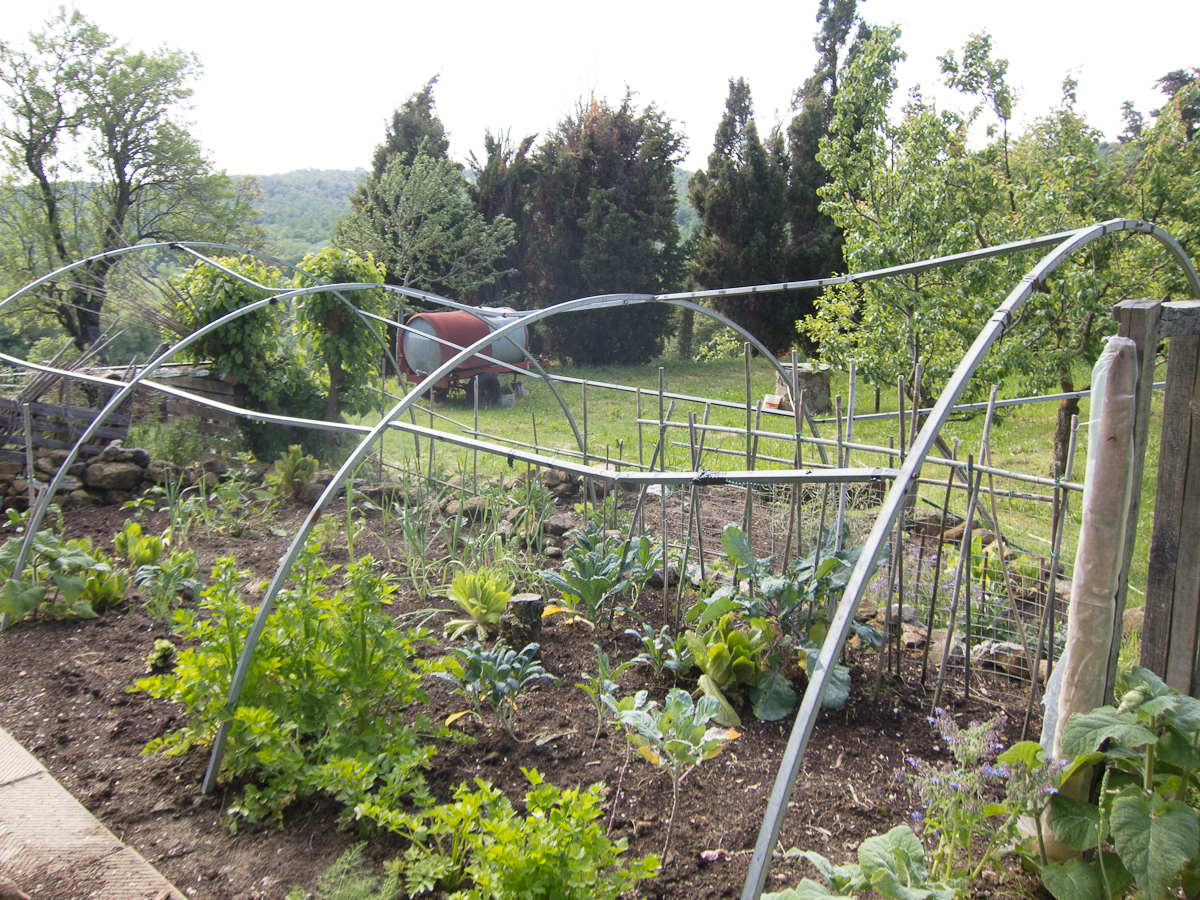
As you know, my job was to get the garden under control.  It was a large, terraced vegetable garden that was completely over grown with weeds.  I was surprised to find so many plants under all those weeds – I think Ugo must have planted earlier in the springtime but then didn’t have time to maintain the garden.  I was also tasked to purchase more plants – anything I wanted – to fill in the empty spots in the garden.

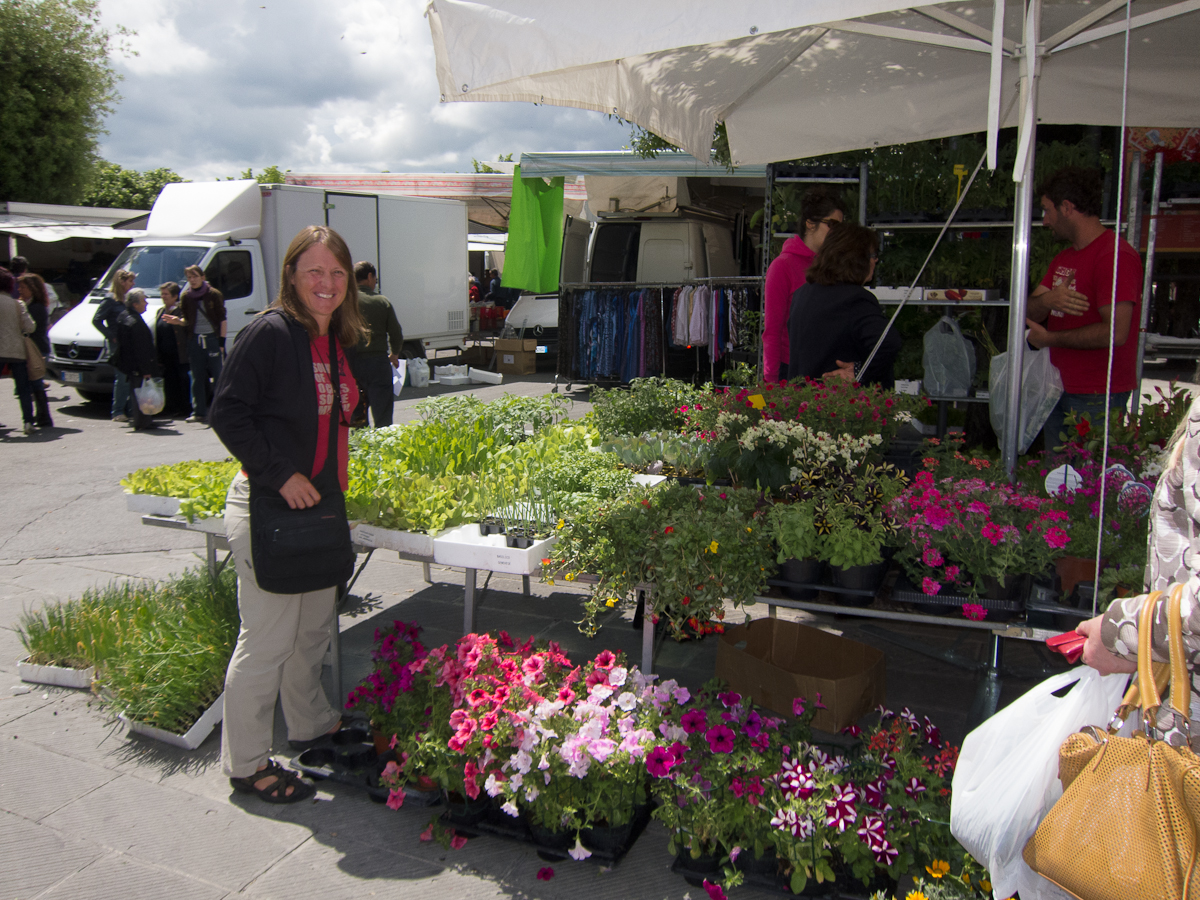
Following Barbara’s suggestion, we went to the Tuesday morning market in Sinalunga to purchase our plants. This presented something of a challenge as nobody spoke English and most of the plants were not marked, at least not in any way I could recognize.  I bought what I knew although who knows if the pepper plants are green or red or yellow, or what type of tomato plants I bought.  I guess they’ll find out later on in the season.  The other challenge at the market was getting served. Barbara warned me about the pushy little Italian ladies who would have no qualms butting in front of me.  Sure enough, a very old lady butted in front of me but I let it go since she was just buying one item.  But when a young couple started to go next, I tapped the man on the arm and said in English, Excuse me but I am next in line, and then proceeded to point out what I wanted.  His wife pulled him back and he had no choice but to defer to me, even though he probably had no idea what I just said.  By the time I had decided on the plants and got them purchased, I was exhausted and had had enough of the market for one day.

I must admit I found it physically challenging to work for four hours in the garden each day. I tried to break things up by taking time to water the garden, do some weeding, do some planting and then some more weeding.  The weeding was back breaking work, with weeds that were so tenacious I had met my match. By the end of our stay, I had cleaned up all the vegetable gardens and was quite happy with the results of my hard work.  As an added bonus, all that physical labour was good preparation for the upcoming Camino de Santiago.

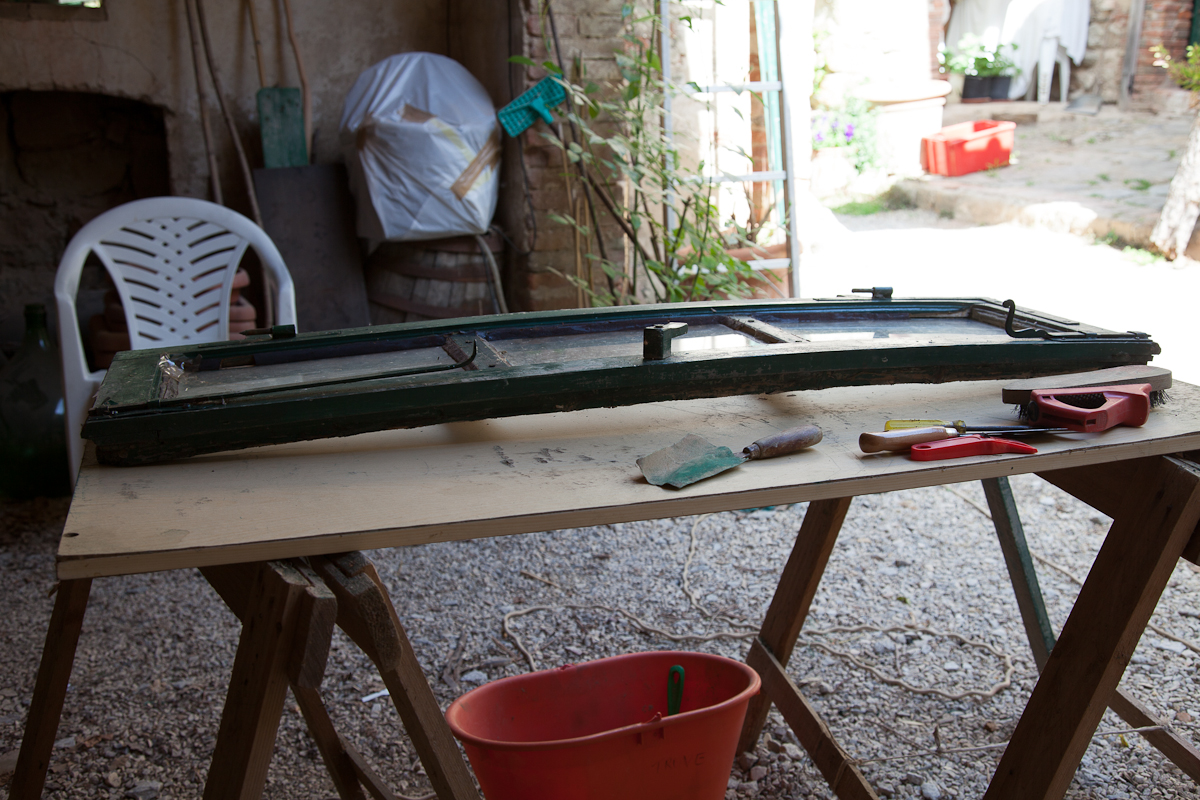
Chris had the task of refinishing the original windows in the kitchen – we’re talking windows that were hundreds of years old.  At first glance, Chris’ gut told him the windows were beyond repair and should just be replaced but Barbara put forth the case that she was just trying to buy some time with them – just a few more years.  And so Chris spent the better part of two weeks taking apart the old kitchen window, sanding it down and removing the layers upon layers of old paint, scraping years of gunk off the window panes, trying to flatten severely warped windows that were curved like bananas and grumbling throughout the entire process.  He said it more than once: I could be spending my time making beautiful windows instead of wasting my time on a futile exercise, if only I had the proper tools and the proper environment and the proper supplies.  I think that sums up Chris’ big challenge with the HelpX experiences so far:  he finds it very frustrating not being able to maximize his skills and to have to settle for a mediocre outcome.  In fact, it drives him crazy and he really struggles to cope in the situation.  He puts pressure on himself by taking off more he can chew and then he tends to get caught up in working incessantly and forgetting to have fun in the process.

The end result:  A refinished kitchen window that
Barbara thought was wonderful.

During the last few days of our stay, we enjoyed the company of the next pair of HelpXers, a young Aussie couple, Amber and Alex.  We had been given the responsibility of picking them up at the train station and then showing them the ropes at Trove which we did.   Lucky for them, the weather warmed up so having a “shower” was not such an ordeal. There have been some downright chilly days at Trove this past month which made us yearn for indoor plumbing.  But this last week has been warm again.  We did a few excursions with them since they needed to become familiar with the area and Alex needed to get used to driving Barbara’s car. One evening, we went back to the Abbey in Sant’Antimo in time to hear an unusual service: four monks clothed in white robes singing Gregorian chants.  It was a unique experience to observe.  The scenery on the way home was incredible as we were treated to a beautiful sunset over the rolling Tuscan hills.  Magnifico!

Last meal with Barbara and Ugo before they entrusted their house to us.

The month at Trove passed by in a flash. It was the longest period of time we have stayed in one place and we both enjoyed having a break from being on the go.  We soaked up the peacefulness and beauty of our surroundings, but I was surprised at how isolated I felt being out in the middle of nowhere with minimal social interaction. Equally surprising considering the picturesque landscape, I never felt completely relaxed at Trove.  I found the circumstances we landed into, with the renovation and all the associated upheaval, to be a little unsettling and certainly not what I was expecting.

In spite of the minimalist kitchen, I enjoyed preparing tasty, nutritious
meals for us all month
My secret cooking tip from Tuscany:
add high quality olive oil (like that produced on the farm)
to anything and everything! 

In the end, I think we made the best of the situation and turned it into a win-win: Ugo and Barbara expressed a lot of appreciation to us for our contribution and our ability to cope in somewhat trying circumstances.  On our part, we got to experience living like a local in the Tuscan countryside in the springtime, we saved a lot of money since we had no living expenses for the month, and we got to meet some wonderful people and make new friends.  On that note, Trove is wrap.

A walking tour of Tuscany

Ugo was hosting a walking tour in our area during our second week at Trove and we were invited to join in some of the walks, but only if his clients, an Australian couple, were in agreement.  Ugo and Barbara arranged for us to meet the clients one evening early in the week so that they could size us up to see if they could put up with our company for a few days.  Of course I’m joking, but seriously, it really was up to them whether or not they wanted our company.  We had our fingers crossed (and we were on our best behaviour for that initial meeting) because we were dying to join them.  We had nothing to worry about, as we felt an immediate connection with Jenny and Tony and they felt the same.

For the next four days, we toured the Tuscan countryside with Ugo, our faithful guide, and Jenny and Tony with whom we became fast friends.  We covered all the expenses we incurred during the tour, money that was well spent in our opinion.

Day 1:  After some local sightseeing, we began our first walk – two hours through the Tuscan countryside following the via Francigena, a pilgrim route that has been travelled upon since the Middle Ages.  We met one pilgrim while walking, a young fellow from Germany who was doing an 18 day pilgramage along this route.

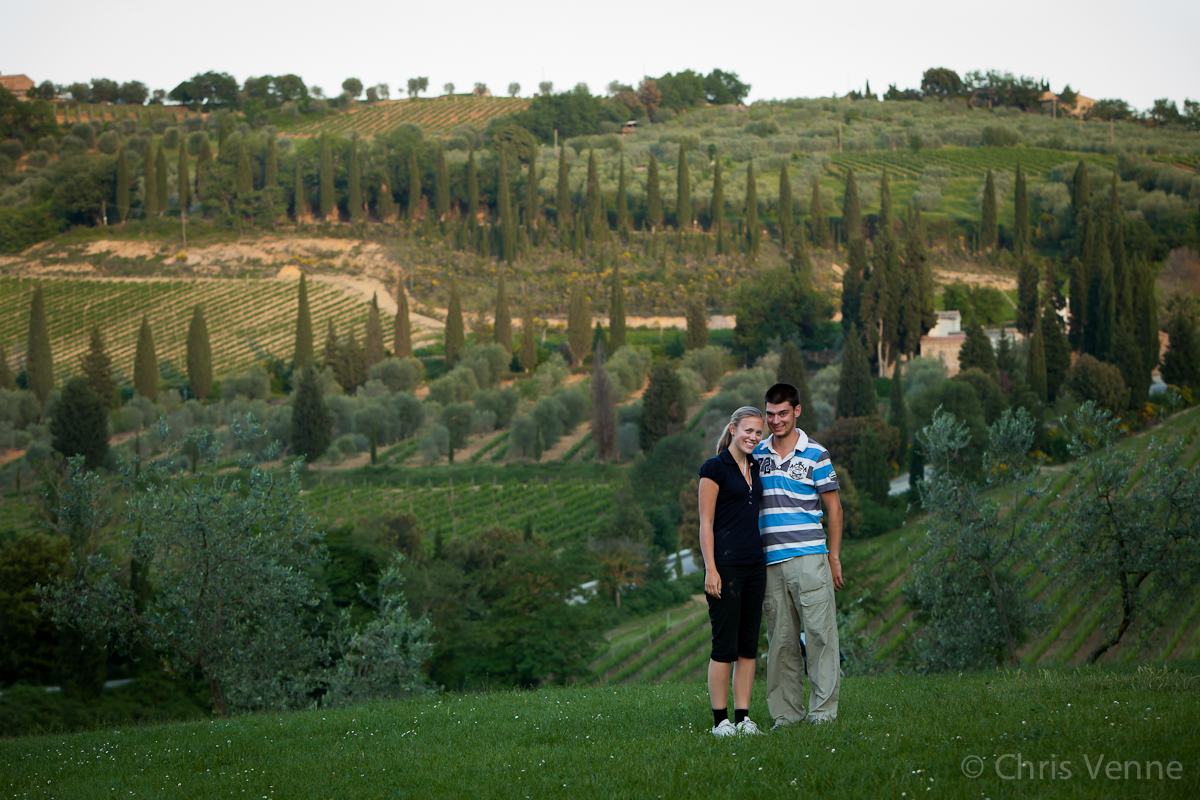
A postcard-perfect scene unfolded everywhere you looked: rolling hills awash with wild flowers of all colours, fields of red poppies gently blowing in the wind, perfectly symmetrical vineyards and olive groves, and medieval homes along roads lined with majestic cypress trees.

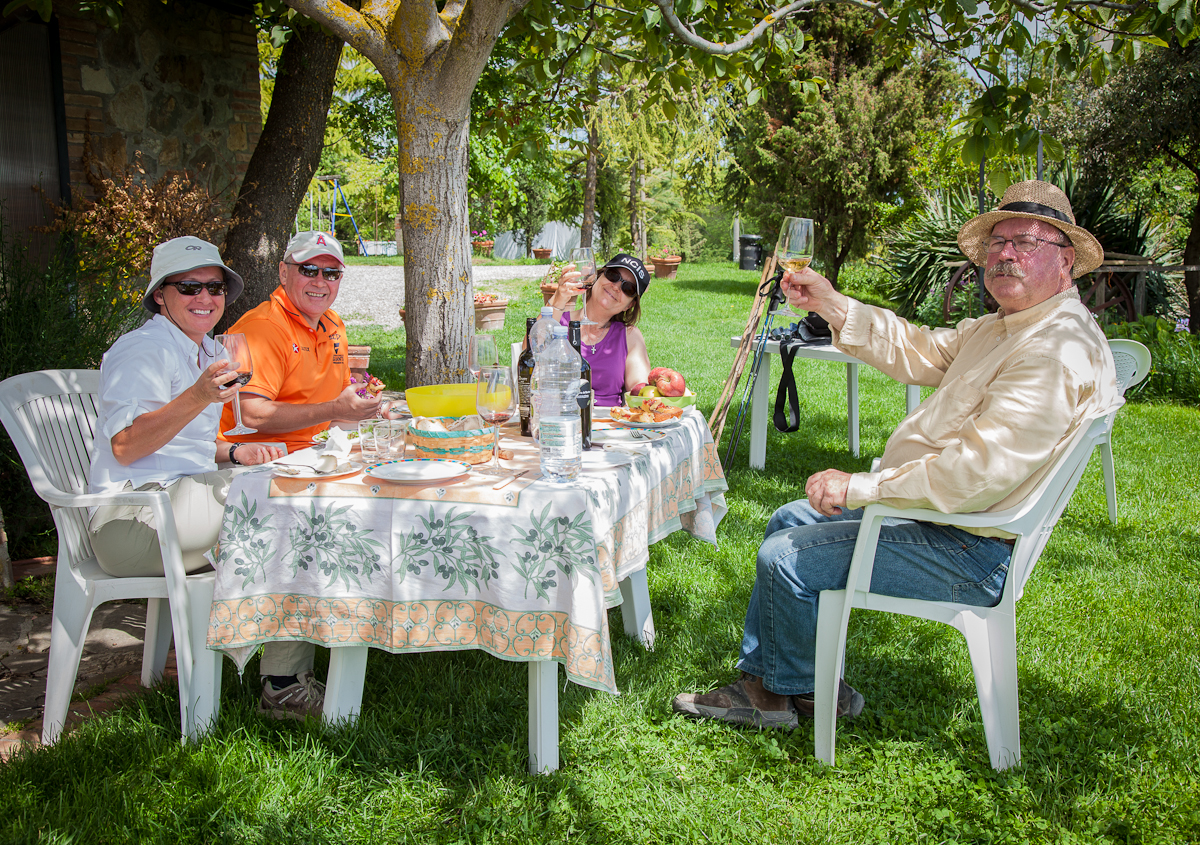
We ended our walk at Poggio Al Vento where we ate lunch and enjoyed a wine tasting.  We were about 5 km from the medieval village of S. Quirico d’ Orcia. A picnic table was set up on a grassy terrace overlooking Monte Amiata and Montalcino’s hills which are speckled with Brunello vineyards.  Poggio al Vento has a vineyard and olive tree plantation where they produce delicious red wines which are Orcia Rosso DOC – I don’t remember what the DOC means exactly other than it indicates wine of a high quality. DOC does not mean Department of Control – but it was a good guess on Chris’ part.  Their oil, Extra Virgin Olive Oil Frantoio is produced from a special selection of olives picked earlier than normal which results in a uniquely aromatic and tasty product – the best olive oil I have ever tasted.

Once we were seated on the terrace, we met the owner, Roberto, a very friendly and engaging man who introduced us to his farm, in very good English I might add. We began our meal with small toasted pieces of white bread that had been drizzled with olive oil and sprinkled with salt – how could something so simple be so unbelievably delicious! We tasted several types of wine and learned about the process of making wine on a small, multi-generational, family-run vineyard.  Everything we ate had been produced locally from the salamis (thanks to Rosalie the pig), pecorino cheese (a local speciality), bread, olive oil and lovely homemade desert prepared by Roberto’s grandmother.  If you’re looking for a unique place to stay in Tuscany (you will need a car), they also rent apartments on-site.  We didn’t see the accommodations, but based on everything else we experienced, I’d suspect you wouldn’t be disappointed.

After lunch we walked, or should I say staggered, back down the hill to Bagno Vinoni for a soak in the therapeutic thermal baths. Swimming in the warm thermal waters that have been used by the Etruscans and Romans for centuries was a wonderful way to spend the afternoon.  Imagine, we soaked in waters where eminent personalities of the past such as Pope Pius II, Santa Caterina da Siena, Lorenzo the Magnificent and many other artists had been before us.  A special bonus for Chris and I:  we enjoyed a real shower with warm, running water…ahh the simple pleasures!

Day 2: Again we began our day with a walk for a couple of hours, from Monte Follonico to the medieval and renaissance hill town of Montelpulciano.  The countryside was similar to the previous day offering one beautiful view after another.  The pretty town of Montelpulciano is renowned for its pork, cheese, pici pasta, lentils, and honey, and it is known world-wide for its wine. Connoisseurs consider its Vino Nobile, which should not be confused with varietal wine merely made from the Montepulciano grape, among Italy’s best.

We passed by several properties with For Sale signs and Chris and I briefly entertained the idea of picking up a fixer upper and then flipping it once we had restored it.  Chris and Tony even went to take a closer look at a property close to town.  Ugo swiftly dashed this idea when he mentioned the prices for these run down country estates could run into the millions of Euros even for properties without a roof and windows!  He conceded we might be able to pick up a bargain say for a million bucks given the current economic downturn in Italy.  That would still be way out of our league.  Ah well, so much for that fantasy!

We lingered for two and a half hours at a wonderful winery and restaurant, Gattavecchi  where we enjoyed good conversation, excellent wine and one of our best meals in Italy thus far.  Lunch began with tomatoes served with buffalo mozzarella and fresh basil, drizzled with olive oil.  We all had a good laugh when the waitress tried to remove the seemingly empty dish and we all dove in like a flock of vultures, each with a piece of bread to sop up the remaining olive oil.  If that isn’t a compliment to the food, I don’t know what is.  The waitress graciously and wisely left the plate on the table for us.  The rest of the meal included roasted potatoes with fresh herbs under melted pecorino cheese, duck lasagna, pork scallopini in cream sauce, and a garden fresh salad.  We sampled generously from the vineyard:  Rosso di Montepulciano DOC, Vino Nobile di Montepulciano DOC, and Riserva dei Padri Serviti.

After lunch we walked along the main street of Montepulciano that stretches for 1.5 kilometers from the Porta al Prato to the Piazza Grande at the top of the hill. The city core is car free which makes it very walkable.  The streets are lined with touristy shops selling all the specialities from the area such as wine and cheese.  Local artists are showcased in several galleries.  Later, we sipped coffee and ate dessert on a terrace overlooking the valley far below. It just doesn’t get much better than this!

Day 3:  This was the day for the cooking lesson at Trove.  Chris and I were recruited first thing in the morning to help with the preparations.  It reminded us of preparing for one of our family get-togethers back home. Marizza, an 82-year old local woman from Pienza would teach us how to make Peci, a type of pasta that was a local speciality.  Everyone participated and agreed it was harder than it looked.  Marizza made it look so easy.

Video:  Making Pici in Tuscany

Under a clear blue sky, lunch was served on the concimaia (literal translation: shit heap).  This was the area where hundreds of years ago the animal and human waste was discarded but today it is the location of a lovely patio.  Lunch consisted of a typical Tuscan menu: Peci (that we had made earlier) with tomato sauce, pan cooked chicken and rabbit, roasted potatoes and salad.  We enjoyed “corrected dessert” a phrase cleverly coined by Chris.  We had heard of “corrected coffee” which consists of a shot of espresso and a shot of grappa.  Well, we dipped our cantucci (similar to biscotti) into glasses of vino santo (dessert wine) and voila, corrected dessert.

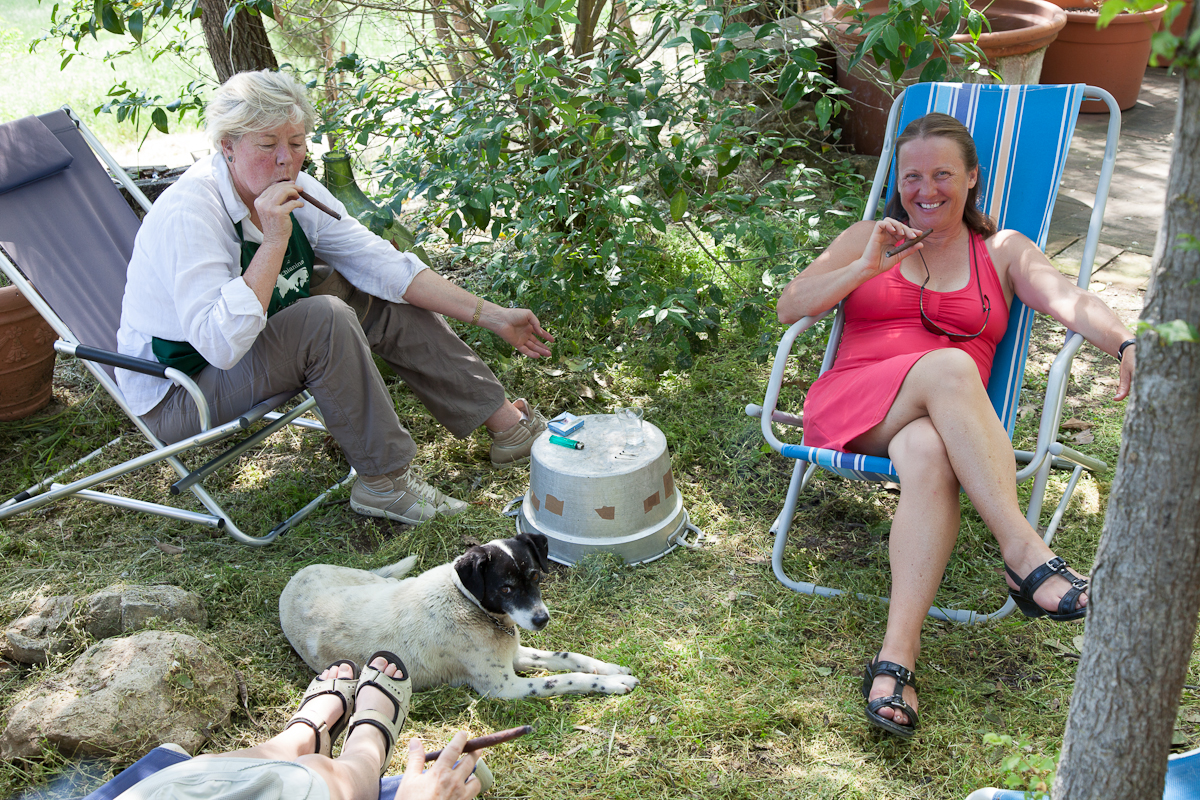
After lunch, we all retired to the lounge chairs in the shade (Ugo went for a nap in the house) and Chris brought out his cigars and the grappa we had bought the other day at Roberto’s.  It was a very relaxing way to spend a couple of hours before heading off to Petroia to visit the terracotta museum, after which we brought Jenny and Tony back to Pienza where they were staying.  Back at Trove, we helped Barbara with some of the tidy up – but we didn’t have to do the dishes!

Day 4:  By now we had spent three full days with Jenny and Tony and the more we spent time with them, the more we liked them and I think (hope) the feeling was mutual.  There was an easiness between all of us that doesn’t usually come until years into a friendship, if it comes at all.  Jenny and I are almost the same age (just 18 months apart) and I felt a kindred spirit from the start.  We talked about all kinds of things and found we had a lot in common.  Conversation came easily between all of us, as did the laughter.  We laughed so much during those days together, it was so much fun.  Meeting this couple and having the opportunity to develop a friendship with them was an unexpected gift we received in Tuscany. We hope to see them again when we reach Sydney, Australia (their home city) later this year.

Back to our last day in Tuscany with Jenny and Tony and Ugo of course.  We did our longest walk that day – 10 km from Montalcino to Sant’ Antimo. Ugo wasn’t feeling well and we were all concerned for him, but he was determined to keep going.  It turned out to be the most interesting and challenging hike.  Not only was the distance longer, but the terrain was more rugged as we traversed several rather steep hills.  We passed through forests which offered us a respite from the relentless heat and sunshine (it was close to 30C) where we observed the tracks of wild boar.  The views were stunning.  We ended in Sant’ Antimo where we lingered in the coolness of the abbey where the monks sing Gregorian chants during mass.  Unfortunately, no service was underway while we were there; maybe we’ll have a chance to go back before our time is up.

We took the bus back to Montalcino where we enjoyed another wine tasting before we said our final good byes.  Jenny and Tony were heading to the town of Chuisi from where they would catch a train the next day to Nice (well actually, it would take four trains to get there, but who’s counting).  They still had another month of vacation to enjoy and they were planning to spend it doing similar walking tours in the wine regions of Southern France.  I was tempted to drop our plans and join them, but we were committed to Barbara and Ugo for the next two weeks, and the Camino was beckoning as well.  We’ll just have to wait until Sydney to enjoy their company again.

After experiencing four days of walking tours with Ugo, I would highly recommend this form of travel to anyone who wants to get off the tourist track in exchange for a more authentic Tuscan experience.  Ugo is very organized and experienced and knows the region like the back of his hand, and everyone knows him too.  He adapts the tours based on the needs and interests of the clients (more walking, less walking), and of course the weather.  Speaking of the weather, we enjoyed warm, sunny days without so much as a hint of rain for the entire week.  It felt more like summer than spring  On Sunday, when Tony and Jenny left for Nice, the weather turned and we had a ferocious storm that night followed by much cooler, wetter conditions.

Travel Tip:  If you want to see fields of poppies (as depicted in so many photos and paintings), visit Tuscany in the springtime (May is best in my opinion as it can still be quite cold and wet in April).  At this time of year, the fields have been planted and are just starting to sprout.  The vineyards have been pruned and are also budding new growth.  There are so many shades of green, it is dazzling to behold.

Travel Tip:  If you really want to explore Tuscany, join a walking tour such as those offered by Ugo and Barbara’s company, Tuscany Under the Skin or rent a car and do it independently. Buses and trains connect you to the larger towns, but there is really no other way to see the charming medieval hill towns and gorgeous countryside.

Attention to all our readers:  First we are assuming there are still a few people out there who are reading our blog.  Did anybody notice anything unusual about our Rome posting? And what about the naked photo of Chris bathing in a bucket – did anybody notice that one?  We thought for sure these photos would have prompted a comment or two, but nada, not a word.   So what’s it going to take? Do we need to post pictures of Chris bending over to pick up the soap? Let us know while we’re still in Tuscany 🙂

Sunshine and tragedy in Siena

At Barbara’s insistence, we began our second week at Trove with a visit to Siena. You may recall that we had attempted a visit to this beautiful Tuscan hill town earlier during my sister’s visit but we had been rained out.  This time, the weather cooperated with warm sunshine all day long. We were looking forward to an excursion after feeling somewhat isolated on the farm all week.

We travelled to Siena by bus which we caught at the train station in Sinalunga (Barbara drove us to the station) and we took the train back.  Once in Siena, we found our way into the historic centre which has been declared a World Heritage Site by UNESCO.  Siena is famous for its cuisine, art, museums, medieval cityscape and the Palio which is a horse race held twice a year, once in July and then again in August right in the middle of town.  Like other Tuscan hill towns, Siena was first settled in the time of the Etruscans (c. 900-400 BC).  The Etruscans were an advanced people who changed the face of central Italy through their use of irrigation to reclaim previously unfarmable land.  Throughout Tuscany, medieval towns are perched on the top of hills – a legacy of the Etruscans who strategically built their settlements in well-defended hill forts.

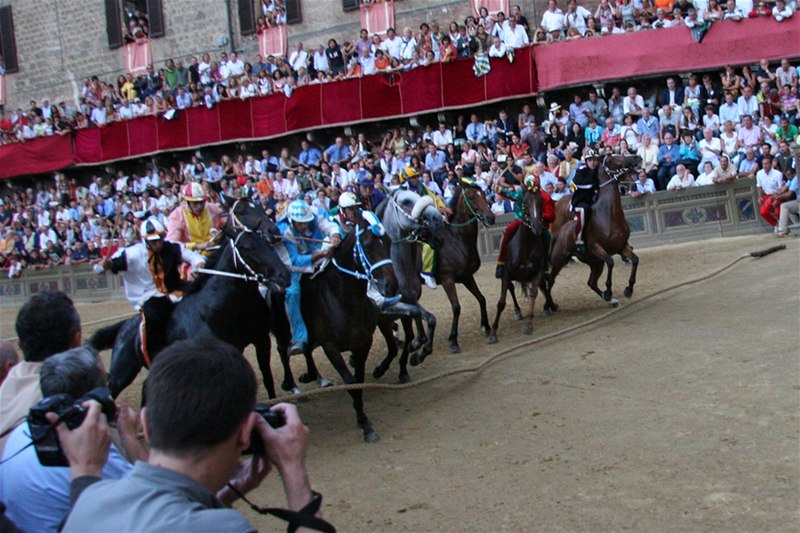
We headed to the unusually shell-shaped town square, the Piazza del Campo which is famous for hosting the Palio horse race. I hope you don’t mind, but I’m going to take a few moments to tell you about this unusual horse race which began in medieval times and has been featured in many movies over the years; you might remember this from the 2008 James Bond movie, Quantum of Solace.

File:Mossa lg palio provenzano 2007 (83).jpg

Source: Wikipedia

Before the race begins, there is a magnificent pageant, the Corteo Storico, which attracts visitors and spectators from around the world. The race is comprised of ten horses and riders, bareback and dressed in the appropriate colours, representing ten of the seventeen contrade, or city wards. Three times they encircle the Piazza del Campo, on which a thick layer of dirt has been laid,  and the race usually lasts no more than 90 seconds. It is not uncommon for a few of the jockeys to be thrown off their horses while making the treacherous turns in the piazza, and it is not unusual to see unmounted horses finishing the race without their jockeys.  What makes this race rather unique is the fact that the jockeys not only try to win, but also try to prevent the other racers from winning by any means possible.  Also, it is the horse that wins the race, not the jockey.  Finally, the winner is the horse that comes in first and the loser is the one that comes in second.  It’s all or nothing with this race.

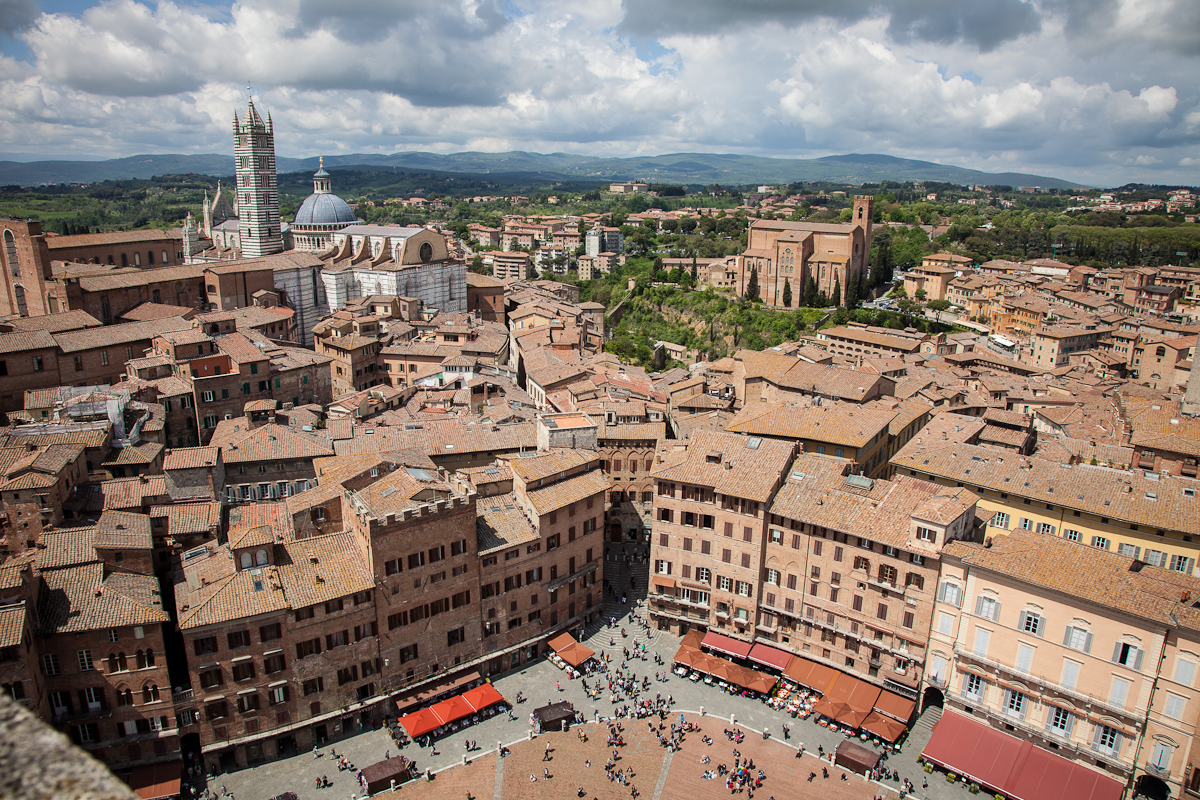
Piazza del Campo is also home to the Palazzo Pubblico and the Torre del Mangia.  I regretted not going to the top of the Duomo in Florence, especially after my friend Marc mentioned  in one of his comments on the blog that this had been a highlight for him when he visited Florence.  So I was determined to go to the top of the Torre del Mangia which promised and delivered beautiful views of the red rooftops of Siena and the rolling Tuscan countryside beyond.  We also visited the museum in the Palazzo Pubblico which features an amazing series of frescos (which means a mural that has been painted directly on a plaster or stone wall) by Ambrogio Lorenzetti (I never heard of him before but maybe you have) that focus on the theme of good government and the results of good government versus bad.  These frescos showed scenes of day to day life in 14th century Siena – just fascinating!  What was even more impressive was the building itself, a testimony of medieval architecture.  Unfortunately, photos were not permitted in the Palazzo.

View of tower from the palace courtyard.

Narrow staircase to the top of the tower.

Only one person at a time could go up or down.

View from the tower.- Siena and beyond

View of the Duomo from the top of the Bell Tower.

Tuscan countryside beyond the Duomo.

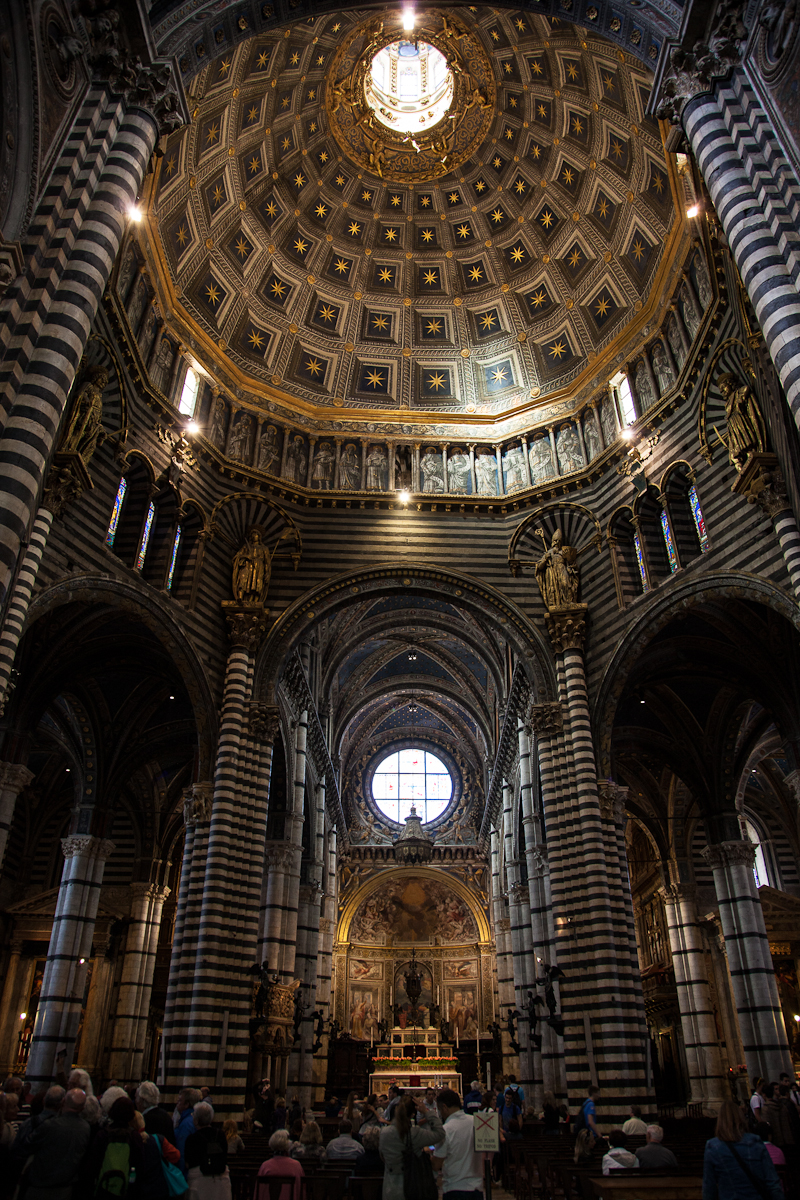
The construction of Siena’s cathedral, or Duomo, began in the 12th century and is a great example of Italian Romanesque-Gothic architecture.  It reminded me of a smaller version of the Duomo we visited in Milan (remember, the one where we walked the rooftop).  It is unusual for a cathedral in that its axis runs north-south. This is because it was originally intended to be the largest cathedral in the world, with a north-south transept and an east-west nave. After the completion of the transept and the building of the east wall (which still exists and may be climbed by the public via an internal staircase) the money ran out and the rest of the cathedral was abandoned.

Duomo interior

We bought the OPI SI PASS (12 euro) which includes admission to six monuments and attractions associated with the cathedral, including access to the panoramic terrace  on the east wall (mentioned above).  It was a long, full day by the end of which I had reached my capacity to retain any more information.  I must admit that our visit to the cathedral and associated attractions was pretty much a blur to me but we have some great photos that will tell the story even if I can’t.

Museo dell'Opera: Stained glass window removed from the Duomo during WWII for fear it would be destroyed.

The Battistero at the back of the Duomo.

It was while we were on the terrace that tragedy struck.  A gust of wind came out of nowhere and blew Chris’ cherished hat onto the rooftops below. This was the ball cap that Chris had bought a few days before we began our trip and I didn’t realize how attached he was to it.  I watched as he went through all the stages of mourning – denial (maybe another gust of wind will blow it onto the street so I can get it), anger (why did that damn wind blow at that moment), bargaining (if only I had taken my hat off, if only I had tightened it, if only…..) and finally acceptance (my hat is gone).

When we arrived back in Sinalunga we decided to take the local bus back to Trove.  With an hour to kill before the bus came, we enjoyed a couple of glasses of vino in the train station bar that also serves free snacks each night at 7:00. This was probably our fourth time in this bar in a week (first a drink with Ugo on arrival, drinks with Barbara when we did our laundry/grocery run, lunch with Barbara when Chris ran errands with her). The bartender recognized us, and treated us like we were locals.  It was a great way to end the day!


Note:  Chris has commissioned his buddy Kaj in Ottawa to find a replacement ball cap, or rather, to find the exact hat.  Good luck Kaj, you’re a good man to help out your friend this way!


Toiling under the Tuscan sun

On our second day at Trove, Ugo gave us a crash course on vine pruning and staking.  He was leaving the next day for a week-long tour and the old vineyard was in desperate need of attention.  Chris got some driving lessons on the tractor, and a lesson on how to empty the poop bucket in Ugo’s absence. I may have mentioned that already, but it’s worth another mention as I must admit, I was pretty impressed that Chris accepted this job without complaint.  And so our work began.  We worked hard on that first Saturday and again on Sunday in response to the urgency of the task at hand.  Good progress was made and by Monday the vines had been pruned quite ruthlessly as per our instructions (I’ve got my fingers crossed that we didn’t do any permanent damage) and we had begun to clear the rows of debris from previous seasons.

The new vineyard with the olive grove in the background.

There are two vineyards – one that is about a hundred years old and a newer one that is about 40 years old.  In a good year, the vineyard might yield about 1,000 litres of wine but in some years, they get nothing for one reason or another; last year it was the birds who came and ate all the ripe grapes just before harvest time! They use the wine for their own consumption only.  They also have two olive groves that yield the most delicious olive oil that again they use for themselves.

Part of the old vineyard.

We pruned the old vineyard as Ugo had already pruned the newer vines.  But the entire vineyard, old and new, needed to be cleaned up of old debris and that task took us a couple of days of back breaking effort.  Chris drove the tractor up each row and I followed behind collecting all the twigs and placing them in the tractor bucket.  After a while we changed our tactic as quite frankly I was doing all the hard work and Chris was just sitting on the tractor waiting for me to finish.  We got into a routine where he would drive the tractor about fifty feet ahead and then together we collected the old vines.  No reason why I should be the only one breaking my back!  We then put all the dead branches into a huge pile that we will burn one day soon.

Our pile of debris - what a bonfire it will make!

At this point, we had already had a discussion with Barbara who had outlined the tasks she wanted us to do and their respective priority.  She also shared the details of their schedule for the month of May and it was at this time that we learned that they would both be gone for a 10 day period doing tours and we would be left to hold down the fort.  Once we were finished in the vineyard (number one priority), Chris had a list of jobs to do including refinishing some old windows and furniture.  My job would be the garden – weeding it and then planting the vegetables. It was a large garden, completely over run with weeds.

By mid-week, we were pulled from the vineyard (we only had the staking left to do) as other tasks became more pressing.  One day, we all went into town to do laundry, grocery shopping and some miscellaneous errands.  And then Chris was recruited to assist in getting the house back in order – moving things around, hanging pictures, etc.  Meanwhile, I started in the garden tackling the heavy weeds and pruning the bushes near our patio.  There was another tour scheduled for the following Monday which included a cooking lesson at the end of the week so Barbara was under the gun to get the house in order by then.

Collecting wood.

I’ve mentioned tours a few times and should probably offer an explanation.  Barbara and Ugo run a tour company, Tuscany Under The Skin, that focuses on walking tours in Tuscany.  Springtime is one of their busiest seasons and this year was no exception. We were offered the opportunity to join in some of the local walking tours the following week which gave us incentive to work more than our required hours that first week.

By the end of the week, we were physically exhausted and were so grateful for a rainy, cold Sunday which gave us a good excuse to light the wood stove, and have a cozy movie day, giving our weary, aching bodies a much needed rest.  We didn’t realize how soft we had gotten these last few months! We had spent much of the week on our own, what with Ugo away on tour, and Barbara distracted with getting her house back in order and working on upcoming tours, work she had fallen behind on. It was obvious that Chris had made a good impression on Barbara as she kept complimenting him on his many talents but it wasn’t clear to me where I stood.  Frankly, I often felt like “hair in the soup”, like my presence was just being tolerated.  It was a strange situation to be in, one that caught us off guard.  We chalked it up to their distraction with their renovations and their tours, and I did my best not to take it too personally.

Our arrival at Trove

Arriving almost two hours late isn’t the best way to make a first good impression, but the train from Rome was delayed, which caused us to miss our connection in a small town called Chiusi.  At least we were able to phone our hosts to let them know of our delay, thanks to the generosity and friendliness of a fellow traveller.  Luca, a dentist from Naples, was on his way to meet a friend in Siena from where they were going to begin a three day pilgrimage route on their bikes.  They were planning to stay in a convent along the way.  I couldn’t help but notice that I seem to keep bumping into pilgrims these days.

When we finally pulled into Sinalunga, Ugo was waiting for us and welcomed us warmly.  We piled our stuff into his car, and we got our first introduction to this small town (population around 12,000) as Ugo did a few errands before heading out to the farm which is called Trove, just 10 km south.

View from the farm

The countryside in this area which is about 50 km south of Siena is breathtakingly beautiful marked by lush rolling hills dotted with geometrical vineyards and olive groves, old stone farm houses with laneways lined with tall slender dark green cypress trees, and fields awash with wild poppies and streaked with yellow canola.  This is the same luscious landscape used for movie sets like “Under the Tuscan Sun” and “The English Patient”.  In fact, the monastery where some of the English Patient was filmed is a stone’s throw away and a place we plan to visit sometime later this month. The farm is nestled between two medieval hill towns – Castelmuzio and Petroia both of which are within easy walking distance from the farm.

As we approached the farm, Ugo explained how they were in the middle of some renovations that they decided to do rather spontaneously and as a result, things were a little upside down.  Although we assured him that we have lived through renovations and would be fine, I couldn’t deny the sinking feeling that settled in my gut.  What had I gotten us into?

After meeting Barbara, Ugo’s wife, we were shown to our “quarters” and given a tour around the house and the property.  The farm dates back to the 14th century although the house has “only” been around for a couple of centuries.  It is an authentic, unrenovated stone farm house that has seen very few changes over the years.  Barbara, who is from Australia, and Ugo who is Italian born and who grew up in Lucca which is just north of Florence, bought the farm in the early 70’s but only started living here full time 14 years ago.  Before that, they lived in Australia where they raised their son and worked in the film industry.  About 20 years my senior, this hardworking couple would give people half their age a run for their money.

Entrance to our “suite”.

Necessary improvements have been made to the place over time – like fixing the roof and replacing some of the windows – but they did not make any significant changes until now.  They have electricity but no indoor plumbing (more about that in a minute).  As part of the renovation project, a new kitchen was installed with running hot and cold water. The first indoor plumbing! The floor in the main living area was reinforced and retiled – a major undertaking that was necessary to prevent the whole floor from collapsing.  A new bathroom is also part of the renovation project but it won’t be ready for a while, at least not while we’re visiting.

As is typical of these old farm houses, the main living space is on the second floor.  The house has four bedrooms, living/dining room, a kitchen and a sunroom/storage room; while the farm was operational, as many as five families would have lived here.  Today, it is home to Barbara and Ugo, their dog Merry Moon and their two cats.  And of course they open their home to a steady stream of helpers like us.

Storage area next to our room. One of our first jobs was to get this area cleaned up and organized.

The ground floor would have housed the animals.  You can still see the manger that would hold the animal feed, the sloped floor that allowed the animal waste to slide down into a trough.  Today, Ugo’s workshop, a storage room and the helper’s “suite” is located in this space.  That’s right, we are living in a stable.  Aside from the whitewashed walls, it looks pretty much the same as it would have looked back when it was housing animals.


Our “suite” is one  large room with a small window at one end, a doorway to the storage area along one wall and a door leading to the patio outside on the wall opposite the window.  The floors are tiled in terracotta.  The bed (two twins put together so lots of space) is at the far end of the room along with a dresser, two night tables and two lamps. The other half of the room has a couch, a kitchen table, some cabinets that serve as kitchen storage, a fridge, a cooking stove and a wood burning stove.  The space is very well equipped with all your necessities – bed linens, towels, dishes, pots, etc.  The room has a rustic charm.  We didn’t mind having this little “apartment” to ourselves and we later learned that we would do all our own cooking too which has suited us very well.

Video:  Welcome to our humble abode for the month of May.
 

Outdoor kitchen sink

We couldn’t help but wonder where the bathroom was.  Ugo showed us their toilet system which was a little room next to the storage area that offered two options – you could sit on a toilet seat that was on a bucket, or you could squat over a bucket that was in the ground.  An old fashioned wash basin was in the corner with a clean towel and soap. A bucket of wood shavings sat next to each bucket.  After doing one’s business, you were to throw a scoop or two of the wood shavings into the bucket to neutralize any odor.  Surprisingly, it works as there is no odor whatsoever.  The wood shavings, by the way, come from a harpsichord maker in Castelmuzio.  On our first day at Trove, Ugo showed Chris how to dump the poop bucket into a larger poop bucket which would become Chris’ job during Ugo’s absence. At the risk of sounding sexist, I wholeheartedly agreed that this was definitely a man’s job.

Outdoor shower area

Now we were wondering where do we shower.  Hadn’t we noticed? It was the two buckets stacked in our room along the wall.  Oh, well, we’d have to give that some thought as to how that worked.  The next day, after working in the vineyard under the hot sun, we had no choice but to figure out our bathing system.  This is how it works.  We boil a pot of water on the stove.  We have a tap outside our room, next to a sink.  The tap (cold water only) is connected to town water and is the clearest, most delicious water I have ever tasted from a tap.  But the sink drains into a bucket.  Didn’t I mention this was rustic?  So, we fill a pot from the tap, bring it to a boil on the gas stove, dump it into the larger bucket and then add two more buckets of cold water.  We then stand in the largest bucket and using a plastic pitcher, we pour warm water over our bodies.  We give ourselves a good scrub and then rinse off with more warm water.  Surprisingly, it only takes the three pots of water (one hot, two cold) for both of us to get cleaned up.  Where do we do this?  Well, Barbara suggested we could do it inside, in front of the wood stove since it was still a little chilly when we arrived.  We opted for the outdoors, in the warm sunshine.

Kitchen sink

As I mentioned, after our first day, Barbara proposed that we do our own cooking as Ugo was leaving for a tour (more about that later) and she was swamped with work and seemed quite overwhelmed by the upset the renovation had caused.  She gave us some provisions from her reserves to get us through the first few days.  We have then gotten into the routine of doing a weekly grocery run in Sinalunga where I select our food for the week, and she pays for it.  That is the deal after all – free room and board in exchange for four hours of work a day, six days a week.  She is very generous and urges me to not be shy about getting sufficient provisions. We pay for our own treats and snacks. This past week, we went to the local market held in Sinalunga every Tuesday to get our fruits and vegetables and the local porcini cheese which is absolutely delicious.

We have slipped into a familiar routine where Chris makes the coffee each morning using a mocha pot, then I make breakfast (something hearty since our work is quite physical) and we take turns doing the clean up although it seems Chris does it more often than I do.  I’ve been doing all the cooking which I’ve enjoyed.  It has been a bit of a challenge to cook in such a small space – there is no counter, just the table on which to work.  But we keep our meals simple and it has been working out well.

We have been at the farm for two weeks already and we have been quite comfortable. At first, the nights were cold and we were grateful for the warmth of the wood stove. And we’ve given our new down sleeping bags a good test run before using them on the Camino next month. (Thanks again to Sonja for picking them up from MEC and bringing them with her!) During the second week we had more summer like temperatures and we were grateful for the coolness that comes from the metre thick stone walls.  I would compare our living conditions to camping as you spend a lot of time outdoors, but with some of the comforts of home thrown in like a roof over your head and a bed to sleep in.

I love getting up in the morning and stepping outside onto our patio, feeling the crispness of the morning air, drinking in the beauty and serenity of our surroundings. It’s not a bad way to start each day!