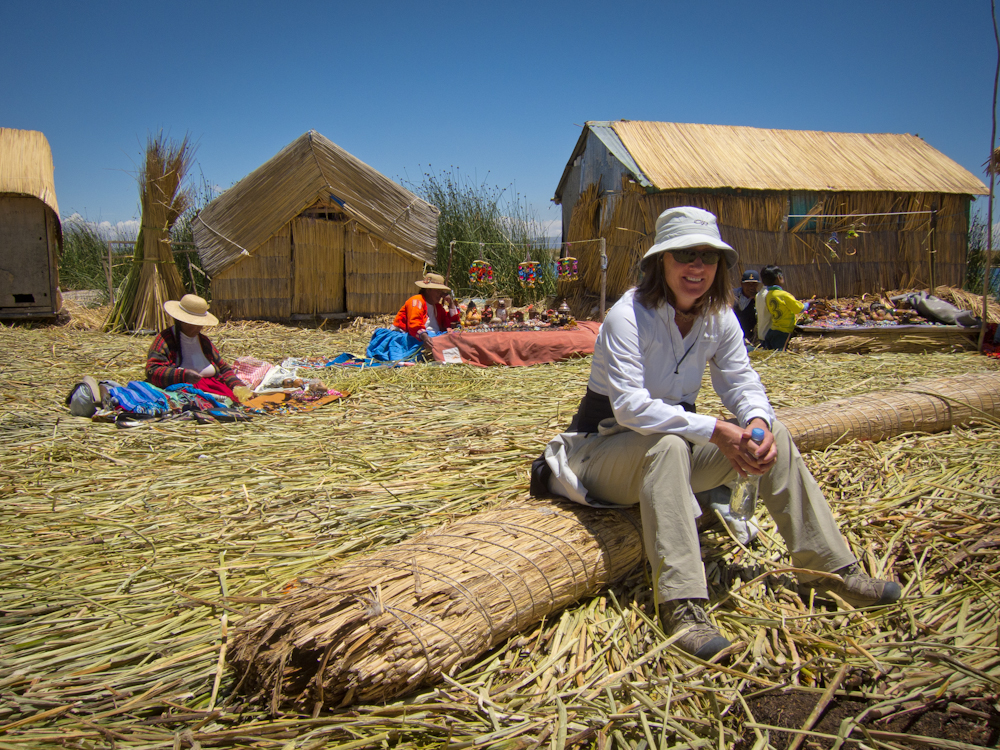
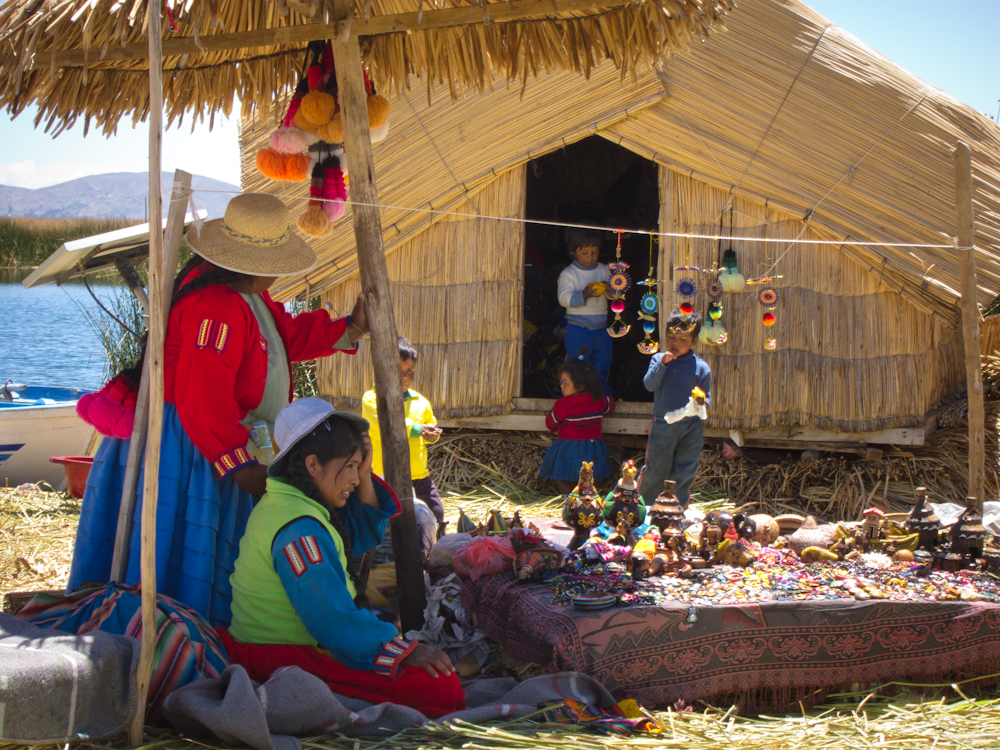
We were a little anxious about doing our first over land border crossing from Peru into Bolivia but based on all the research we had done, we felt confident that we had picked the route with the best reputation for easy crossings – Puna to Copacabana. It was also reassuring to see most of our early morning bus filled with other tourists so we weren’t on our own doing this crossing.
First stop was a few minutes from the actual border where we were told we should exchange our Peruvian soles for Bolivianos. I knew the exchange rates at the border were not the best, but we only had 90 soles to exchange, so it didn’t really make much difference. I proceeded to exchange all of our soles with the exception of my pocket change which amounted to about 4 soles. I reserved this as I had read online about a stupid requirement to provide a photocopy of your passport to the Bolivian immigration official, after he had stamped it. And apparently they didn’t have a photocopier handy, so you would have to go find somewhere to make copies. Turns out this wasn’t required at this crossing, but it was good to be prepared nonetheless.
Speaking of being prepared, the night before, I suggested to Chris that we get a couple of hundred US dollars from the ATM to have with us just in case we needed it – an emergency fund if you will. Part of the reasoning was that ATM’s are so incredibly unreliable here in South America, we didn’t ever want to be stuck somewhere, low on funds and unable to access any cash. Especially heading to a new country, who knew what the banking situation would be like. A case in point: our bank card did not work on any of the 5 ATM’s in Puno. We ended up taking a cash advance on our credit card, and we were limited to $100 US at that! But it turns out that emergency fund was a life saver at the border.
Back to our border crossing saga. After exchanging our money at less than fair rates, we were then taken to the Peruvian immigration offices. We lined up in front of one office where the guy looked at our tourist visa, and stamped it. We then lined up in the building next door to get our passports stamped by the immigration official. Since several buses had arrived at the same time, there were lots of people getting processed. Our bus assistant, Jose, was very helpful making sure everybody from our bus went to the right line ups. Surprisingly, the lines moved quite quickly.
When it was our turn to get our passports stamped, I could tell right away there was a problem. The two officials whispered to each other, then asked us if we spoke Spanish. I said a little, and then he told us in English that we must pay a tax. Why, we asked. We had overstayed our visit in Peru. That’s ridiculous, we said, we’ve only been in Peru for 11 days, we’re allowed to stay much longer. Not so, they said, as they pointed to a “10” scribbled by hand on our tourist card that we received in Lima at the airport. Apparently, the “10” meant we were only allowed to be in the country for 10 days. We thought they were trying to pull one over on us, so we argued with them that the regulations permitted us to be in the country for at least 60 days. After a few minutes of arguing that wasn’t getting us anywhere, I asked – how much is the tax anyways? $1 for every day over the limit. I quickly did the math and realized we were only over by 1 day. Well that meant $1 for each of us. No big deal. We’ll pay the tax even though we think we shouldn’t have to.
 Peru Immigration Office (where all the fuss occurred).
As soon as I agreed to pay the tax, they said if I wanted to pay them, it would cost an additional $10 each, but we could go to the bank and pay the $1 tax, get a receipt and then come back to get our passport stamped. Where was the bank? They pointed outside, to the left. We found our bus attendant Jose (the guy in the blue striped shirt in the picture above) and asked him if he could help us out, plus we wanted to make sure the bus and our packs didn’t leave without us. He said we could take a taxi to the bank – it was just a few minutes away – but the bank was closed. Great. That was helpful.
So we had no choice but to go back into the Immigration office. Jose came with us to try to hurry things along. While we were going through this, another guy was also pulled aside and they were trying to get $15 out of him. I asked the Immigration officer if we can pay in Bolivian soles – no, only Peruvian soles or American dollars. Well, we just exchanged all our money to Bolivian soles. We did have our $100 US emergency fund but didn’t want to play that card yet.
For some reason, the guy then reduced our fee to $1 each (maybe just to shut us both up and get us out of there or maybe he thought we didn’t have the money to pay the fine). I offered my 4 soles, but he insisted it should be 6 soles. I pulled out 2 american dollars in coins but they wouldn’t accept this either -had to be bills. Finally, we took out a $20 US bill, and asked for change – which surprisingly they gave to us. All I can say is thank goodness we had that emergency fund as I’m not sure what would have happened otherwise.
Unfortunately, the other fellow was not so lucky. I think he really pissed them off when he took his camera out and threatened to take pictures. He was forced to pay the full amount if he wanted out of the country. All three of us were convinced we had been scammed by corrupt officials.
We finally got our passports stamped so we could leave the country. We then walked over to the Bolivian side and got our passports stamped again along with a 30 day tourist visa (we checked this time). Aside from the tax “scam”, the crossing was really simple. We left our bags on the bus, and the bus met us on the Bolivian side.
 The road to Bolivia.
 Crossing the border.
 We’re in Bolivia!
 Another line up for Bolivian customs which were a breeze.
And now for the part of the story I hate to admit…….we were wrong! Apparently, when you enter Peru, the amount of time you are allowed to stay is at the complete discretion of the Customs Officer who processes you at your entry point – the Lima airport in our case. They normally give 30, 60 or 90 time limits, but in our case, they only gave us 10 days. I think the guy must have been in a bad mood or something. It turns out that if you exceed the time you are permitted to be in the country, you have committed a criminal offence. That’s right. We were criminals as far as the Peruvian officials were concerned. It is well documented that the $1 a day tax is the levy imposed for such criminal behaviour. However, the $10 fee that was waived is clearly not an official tax. I don’t know how I missed all this information in my research before we entered the country. I am usually quite thorough, reviewing our government’s website as well as registering our whereabouts with Foreign Affairs.
But here’s the thing. When you’re being rushed through customs on entry, the guy is looking at your passport and tourist card, then quickly stamping everything and scribbling something on your tourist card and waves you on. You think everything is fine, however, it’s the scribble on the tourist card that indicates how many days you are allowed in the country. If that number does not align with the number of days you plan to be in the country, then you must ask the official to change the number. Hopefully he agrees because he doesn’t have to change it. As soon as you walk away from his desk, that number is sealed and you have no opportunity for recourse – you must leave the country within the number of days on your card or you become criminals, like us. Unfortunately, it was these finer details that alluded us. Still, I feel quite bad about losing our cool with the officials when we were exiting. Aside from the extra $20 “administration fee” they were trying to scam coerce out of us, they were really just doing their jobs and following their rules.
For me this was a good lesson. We need to be extra diligent reviewing the entry and exit requirements of each country we visit. And we need to keep our cool even if we think we’re being scammed by corrupt officials. A small reserve of American dollars can go a long way to getting you out of a pickle. At the end of the day, I think it’s better to pay off the official rather than end up in jail, or worse.
Travel Tip: When entering Peru, check the number written by the Customs Agent on your tourist card. If it doesn’t cover the number of days you plan to be in the country, ask, beg or plead with the agent to change the number. Otherwise, be prepared, on exit, to pay a tax of $1 per day you exceed your limit. Don’t kick up a fuss, just pay the damn tax.
Travel Tip: When travelling in South America, be prepared in case your debit card does not work at any of the local ATM’s. Some suggestions:
- Try to get money before you really need it, for example, the day before you need to pay your hostel bill. This way, you have a couple of days to try to get money from the bank machines. There is no rhyme or reason when your card will work. One day it works; they next day it doesn’t. One hour it works; the next hour it doesn’t.
- Carry a Mastercard or Visa credit card with you for emergencies. This has saved us more than once when we just couldn’t get our debit card to work. It’s expensive to take cash advances – a hefty $7.50 transaction fee is not uncommon, plus any fees your credit card company tacks on for the international transaction.
- Carry a small reserve of American dollars for emergency purposes, including paying off corrupt officials. At least you’ll be able to stay out of jail, or pay your hostel bill before leaving town.
Stay tuned for our next encounter with government officials – this time with the Brazilian Embassy in La Paz. Things didn’t turn out at all the way we thought they would.
Interested in learning a little bit about Bolivia – where it is, its currency, a little about its geography and economy and a few other interesting facts? Follow the “Bolivia” link on the top left side of the website under “Where are we now” or just click here to make it easy.
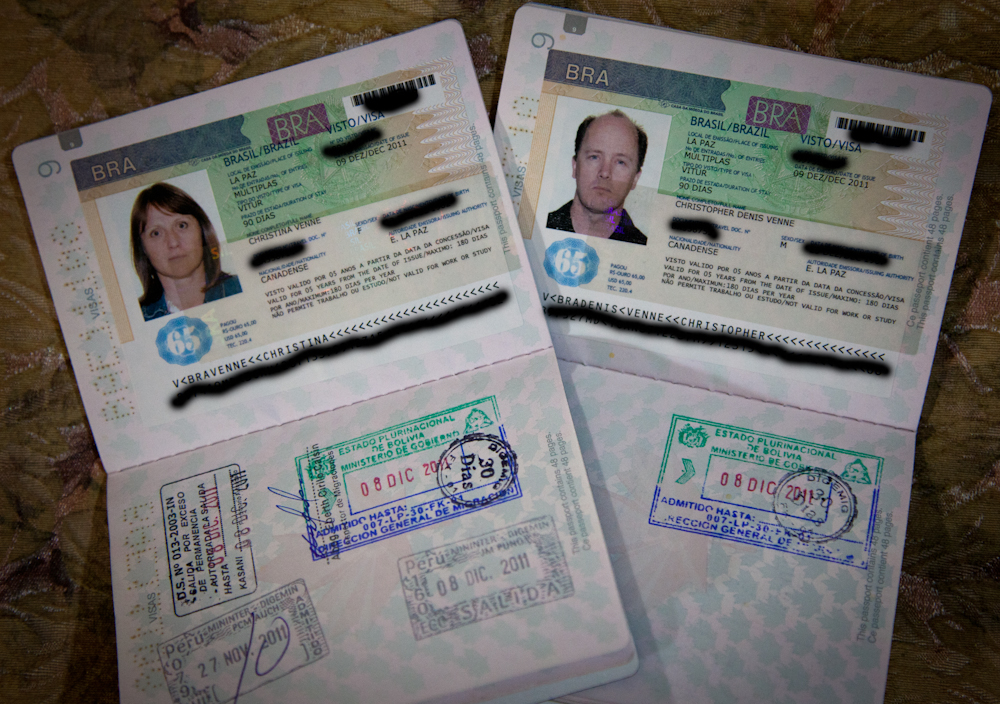 The main reason we came to La Paz was to get our Brazilian visas, a pre-requisite for Canadians travelling to Brazil. We’re taking our transatlantic cruise from Sao Paola in March, so we needed to make sure we secured our visas in advance. We anticipated needing a week in La Paz to allow for the visa application to get processed. There was limited information on line about the process so we didn’t know quite what to expect.