January 2012

We’re at the end of the world in Ushuaia

Last Sunday we arrived in Ushuaia, the southern most city of South America nicknamed “the end of the world”.  This slogan is well used throughout the city, appearing on clothing, menus, tourist attractions, road signs, etc.

It took about ten hours by bus to travel from Punta Arenas.  While it was a long trip to take on a bus with regular seats (no camas or semi-camas), the scenery made the daytime trip worthwhile.  For many miles, the land was as flat as a pancake, with not a single tree in sight.  Large sheep ranches called “estancias” occupied the land, making me think that this might be what the Australian outback looks like (I’ll let you know if this is true next year when we travel there 🙂
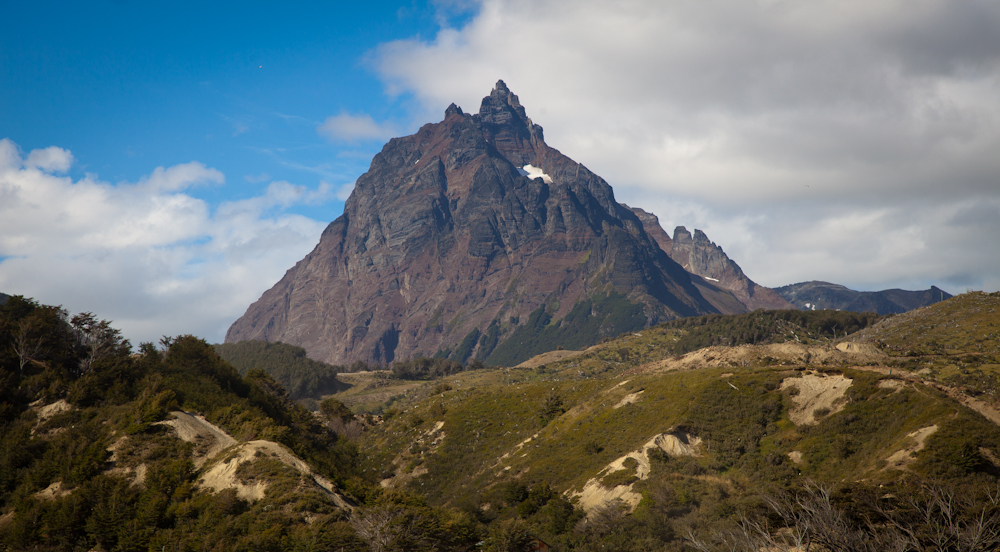
As we approached Ushuaia, the landscape changed quite abruptly; the flat plains in Chile turned into rolling hills which then became snow-capped mountains. This was our first up-close glimpse of the Patagonia mountain range and we were duly impressed.  We passed through the Chile – Argentinian border easily; our bus driver collected our passports and we waited while he got them all stamped, both the exit stamp from Chile and the entry stamp into Argentina.  Not much in the way of security as the immigration/customs officials didn’t even see our faces or our baggage.
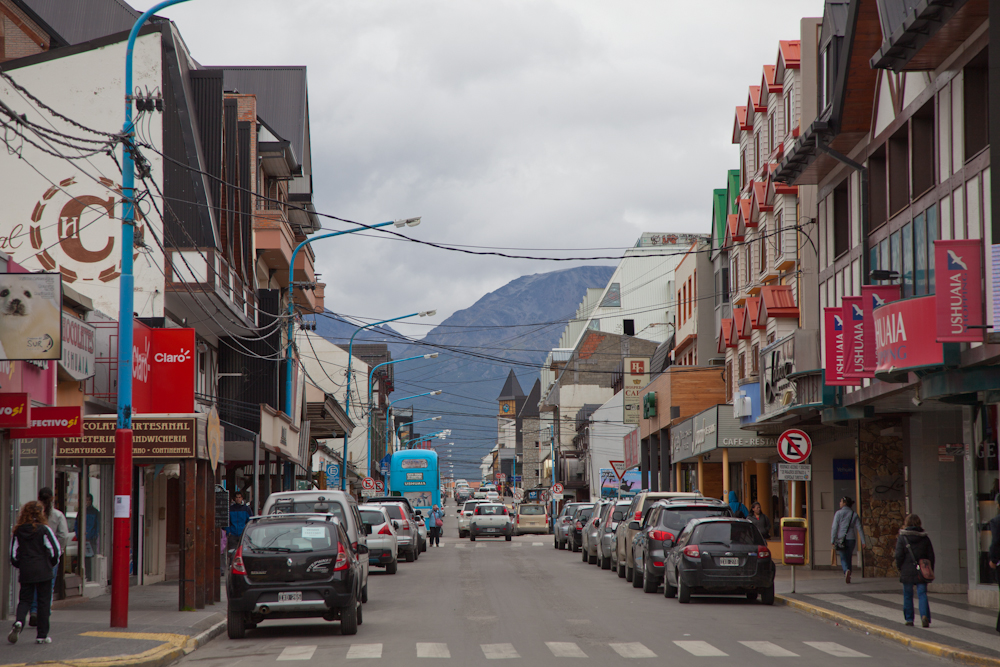
Ushuaia, a former penal colony, is a sizeable city with a population close to 60,000. The main economic activities of this region are fishing, natural gas and oil extraction, sheep farming and eco-tourism.  It has a very busy port servicing both shipping vessels and cruises.  This is summer time in Ushuaia and the peak of the tourist season and everything was priced accordingly, much to our dismay. The streets were crowded with tourists, and accommodations were filled to capacity, making it very difficult to secure a bed to sleep in. This city reminded us of Banff, especially the main street with lots of expensive clothing stores, souvenir shops, and restaurants.  It had a vacation resort feel to the place.

The town with Martial Glacier in the background.
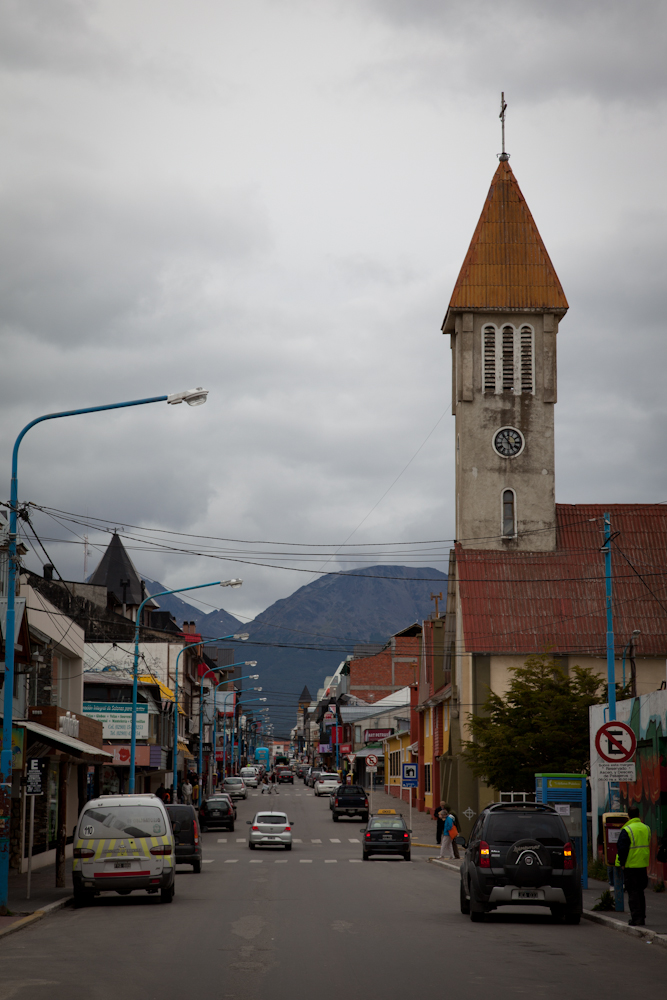
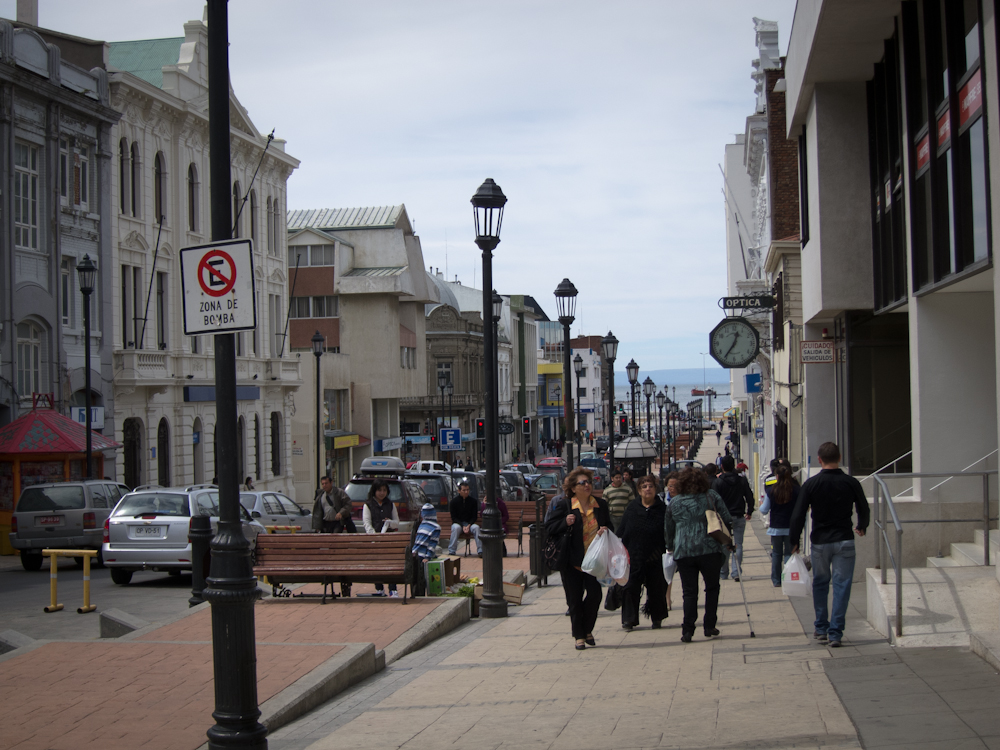
Downtown Ushuaia

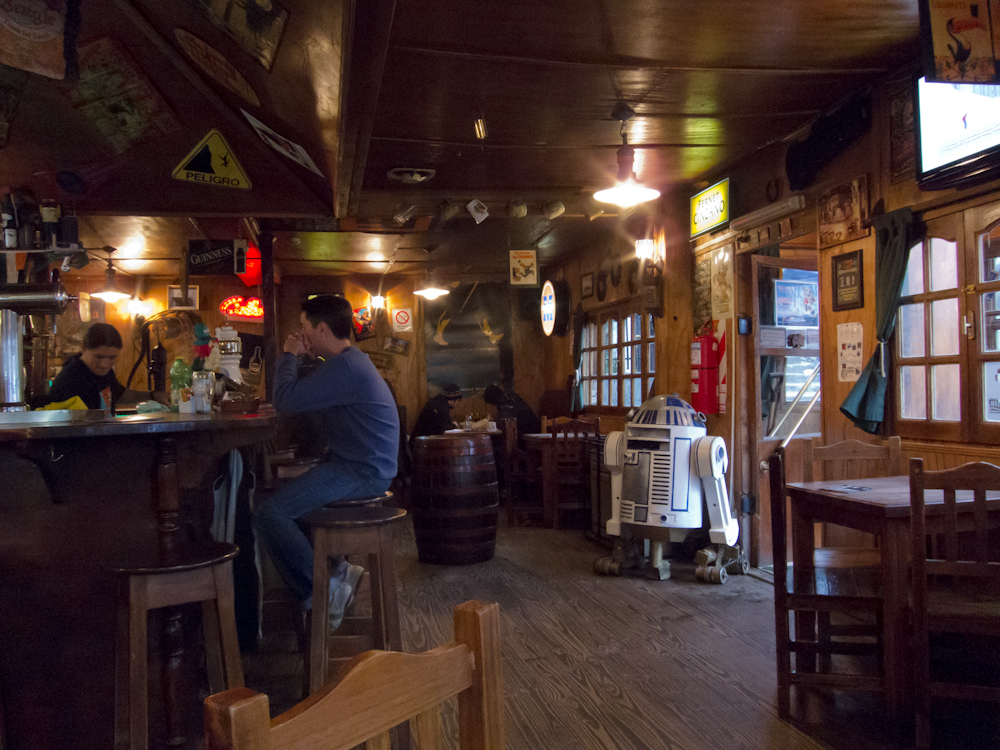
The Dubliln Irish Pub that did not serve Guinness – blasphemy!
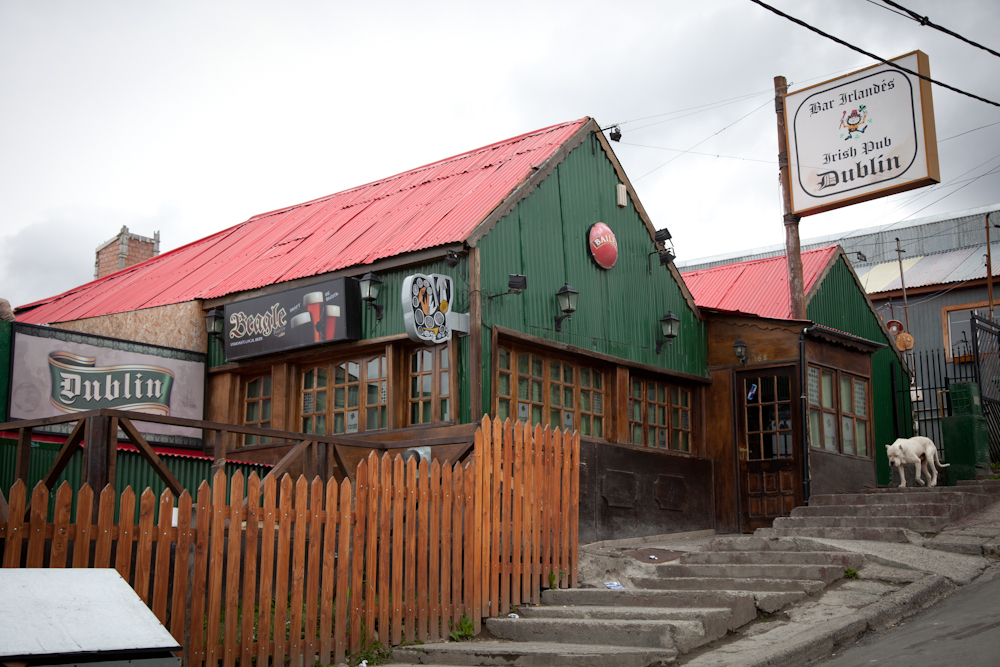
Outside view of the Dublin Pub – one of the few
restaurants with reasonable prices.  The homemade
draft was hit or miss too. 

Argentinians love their meat.  A BBQ spit was a common
sight in the front window of restaurants.  We sampled
this type of cuisine at an all you can eat buffet at
La Estancia one night.  The meat was  good (lamb and beef) 
but the rest of the food was mediocre. 

Throughout the week, we stayed in three different places out of necessity. First we stayed at the Drake Hostel which didn’t overly impress us, especially the fact that there was no housekeeping during the three days we were there.  Next was a night in a private home, a neighbour of the bed and breakfast, La Maison de Ushaia, where we spent our last two nights. The private home gave us a bed to sleep in, but the home reminded me of someone who had a serious hoarding issue.  I was glad it was only one night.  The bed and breakfast was lovely although the entire household (4 generations of women) was getting over nasty colds which we hope we don’t catch.  We’re not big fans of bed and breakfasts mainly because of the lack of privacy and this one was no exception.  Still, the owner’s daughter, Soulange, went out of her way to make us feel comfortable, and to give information about things to do and where to eat.  She even satisfied Chris’ curiosity about ritual of matte when she showed us how this peculiar tea is prepared and then how the communal cup is passed around the table.  It’s a very common Argentinian ritual, reminding me of the British and their afternoon tea.
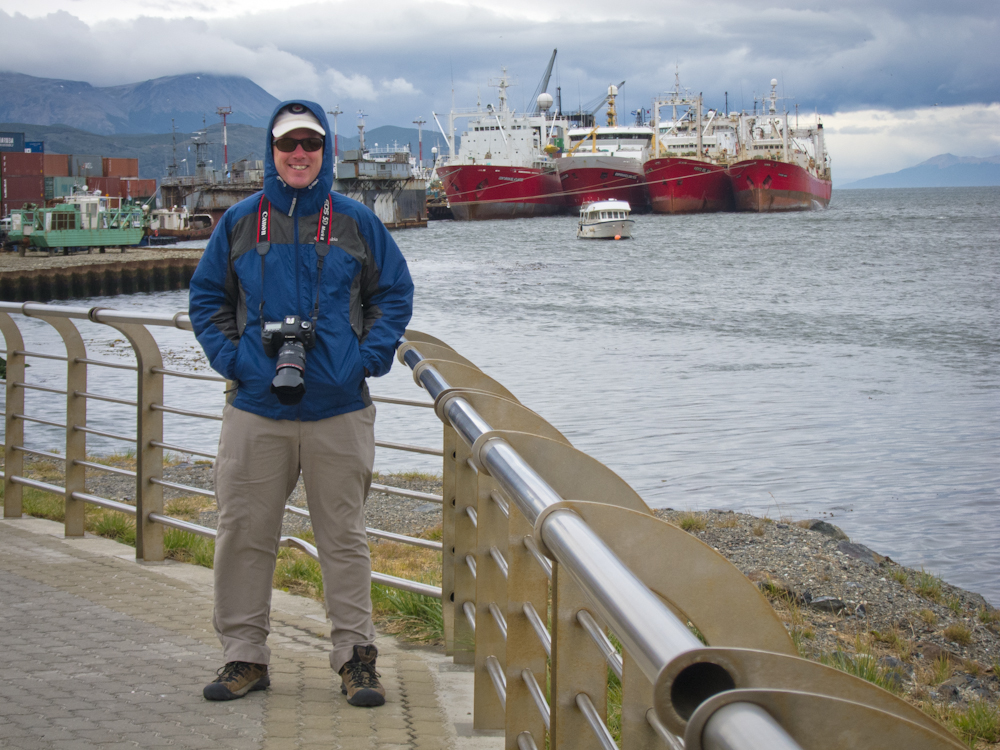
Bundled up down at the port.  It was interesting watching the ships come
and go each day – both the large cruise ships making a port of call in Ushuaia and
the much smaller Antarctica expedition ships beginning their cruises from here. 
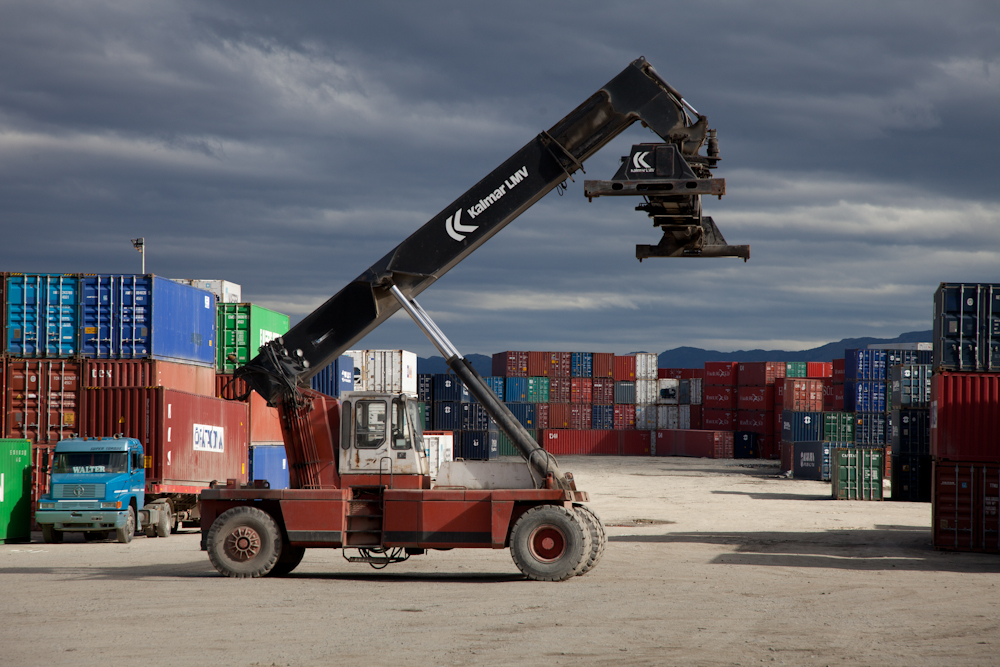
So many shipping containers.

We were quite taken aback by the ridiculous prices being extorted from tourists. Here’s some examples: $25US for two small loads of laundry; $45US per person to hike in the Tierra del Fuego National Park (transportation and park entrance fee), $4US for a thimble full of coffee, $12US for breakfast (coffee, juice and toast) , $12US for half a ham and cheese sandwich, $75US and up for a hostel room (double with shared bathroom).  Just for the fun of it, Chris priced his camera in a local store and was appalled to see it going for just shy of twice the Canadian retail price.
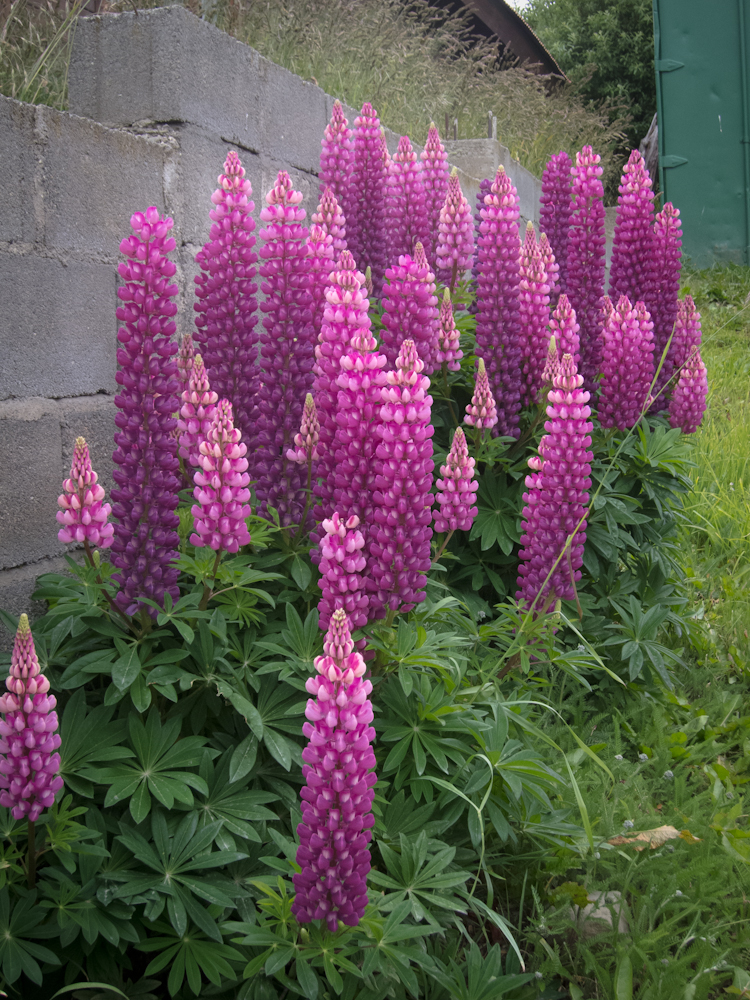
Brilliant lupins of every imaginable colour grow in abundance.
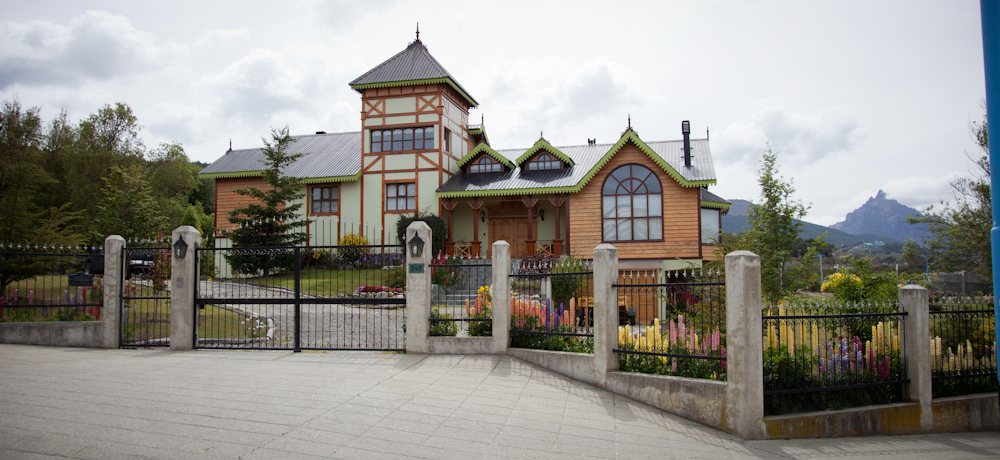
One of the prettiest houses and gardens we saw in town,
just a few houses down from our B&B. 

We came to Ushuaia with the desire to find a last minute deal on a 10 or 11 day cruise to Antarctica. These cruises are ridiculously priced and even the last minute prices are outrageous in our view.  But, we rationalized the expense thinking that it was unlikely we would ever be here again, and we both really wanted to see Antarctica.  So when we arrived, the first order of business was to find a cruise.  I had already sent out about a dozen or so emails a few days earlier to tour agencies in Ushuaia enquiring about availability on upcoming ships.  We were discouraged to learn that all the 10-11 day cruises for the next three weeks were completely filled and most tour companies had waiting lists of 5-6 people for each of these ships. It wasn’t looking good.

We then learned that there were some deals on two ships leaving this week but they had longer itineraries (19 days) which included stops on the Falkland Islands, Georgia Islands and Antarctica.  Of course, longer cruises means larger price tags.  We debated our options – long cruise leaving this week, short cruise leaving in 3 weeks, or no cruise at all.  In the end, we booked ourselves on the 112-passenger Sea Spirit with Quark Expeditions for a 19 day cruise.  All week, I’ve been giddy with anticipation for this cruise. We leave tomorrow – hopefully we have some internet access so I can keep the blog up to date – otherwise you’ll hear from us in about 3 weeks.
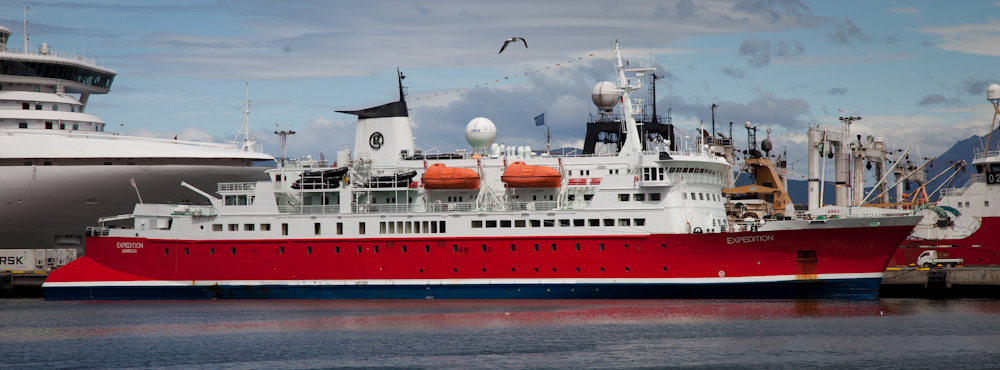

This Gap cruise left yesterday – this was the other 
19 day cruise available this week.  Hope we made the right choice. 
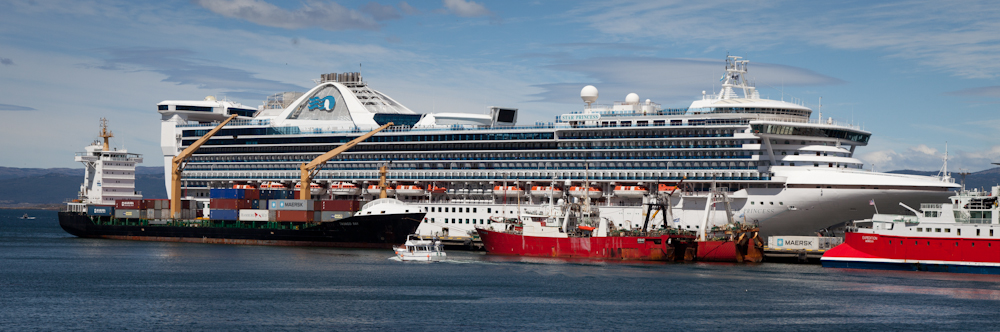
The Star Princess cruise ship – look at the size difference
compared to the Gap expedition ship to the right.  The
large cruise ships don’t stop in Antarctica for
environmental reasons – they just pass by it.

It’s a busy shipping port too. 

We again experienced the kindness of strangers here in Ushuaia.  Alicia was the agent through whom we negotiated our cruise.  When we met her at her home mid-week to finalize the paperwork, we got to know her story a little over a bottle of Argentinian wine.  We were immediately impressed with how she came to Ushuaia ten years ago and built up her business and her reputation from scratch. She’s a real go-getter, very genuine, modest and down to earth. We found her to be inspiring.  I think she was equally impressed with our story.  It’s funny how you just hit it off with some people.  Well, after completing the paperwork, and the first bottle of wine, she spontaneously invited us to stay for dinner. As she prepared the steak, and I made a salad, Chris cracked open the second bottle of wine.  It was our first home made dinner, in somebody’s home since we left Canada. We really appreciated her hospitality.
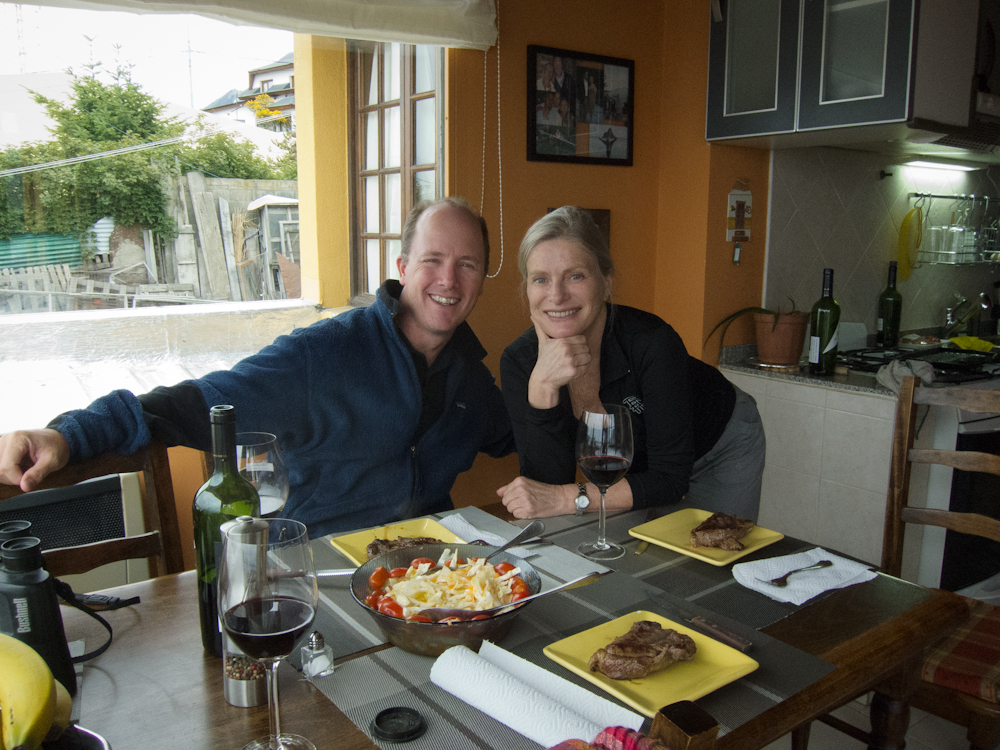
Chris and Alicia in her kitchen at dinner time.

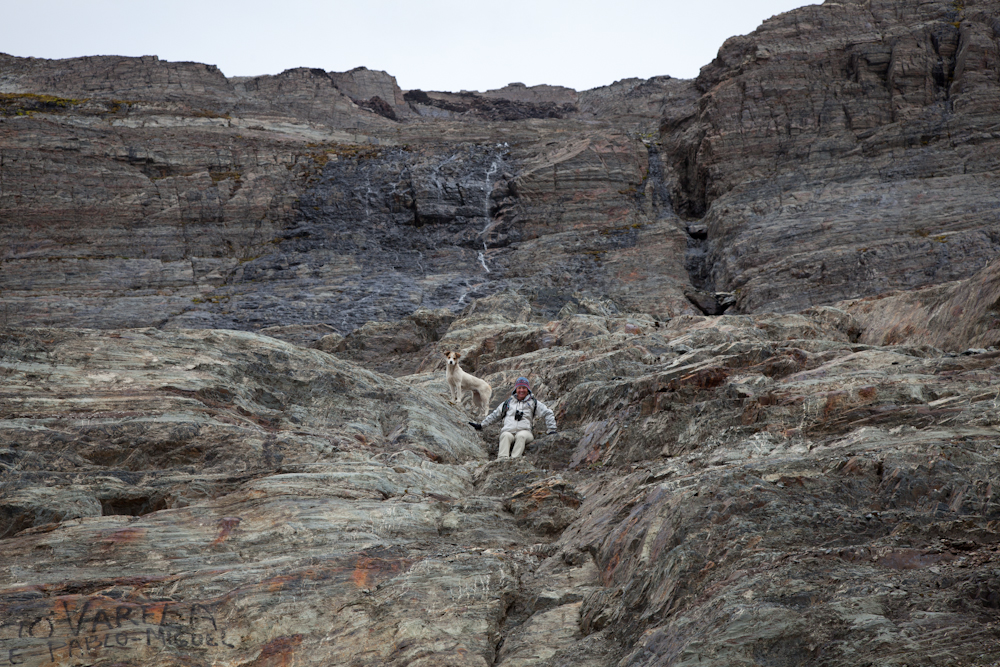
Besides securing the cruise, and draining our bank account, we’ve just been hanging around in Ushuaia this week, taking it easy and getting to know the town and area a little bit. One day we hiked to Martial Glacier which gave us another good work out.  The hike wasn’t particularly challenging or strenuous, but it was all up hill and then down hill as we were climbing yet another mountain.  We felt our legs for a few days afterwards.  At the glacier, we were rewarded with spectacular views of Ushuaia and the Beagle Channel far below as well as the surrounding rugged mountains.  Once again, we had a canine companion all the way up and all the way down….he was a cute mutt that reminded me of a dog my brother David once had. I don’t know what it is, but we seem to attract dogs when we go hiking. There were plenty of other people on the trail, but this dog singled us out and remained with us for our entire hike.  Of course, we shared our lunch with him – so maybe he just knew how to pick ’em.
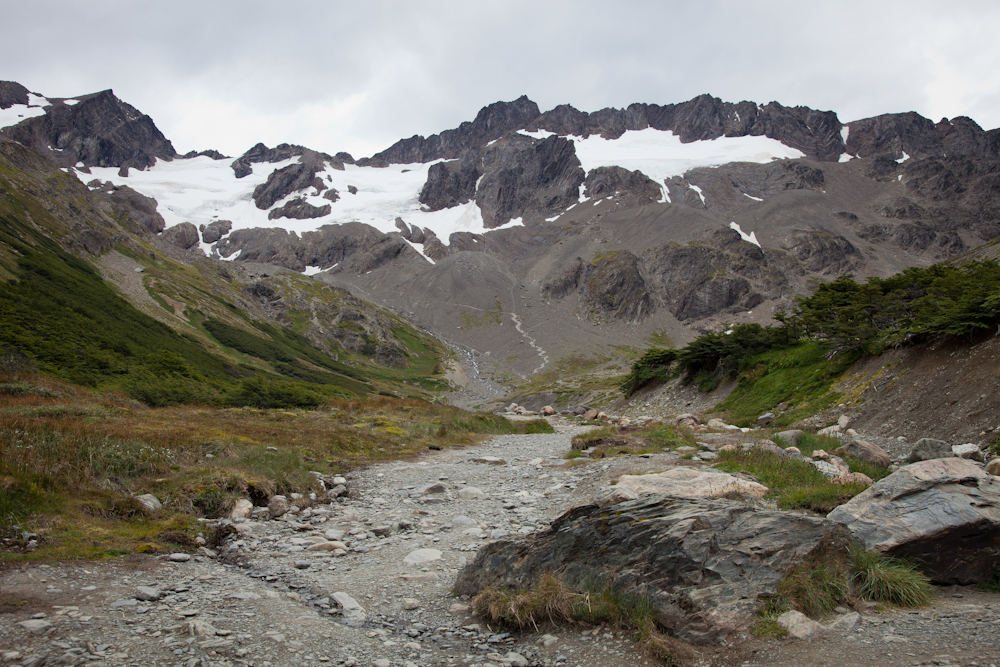
On the way up to the glacier, in the distance.

Still not there….the hard part was yet to come.
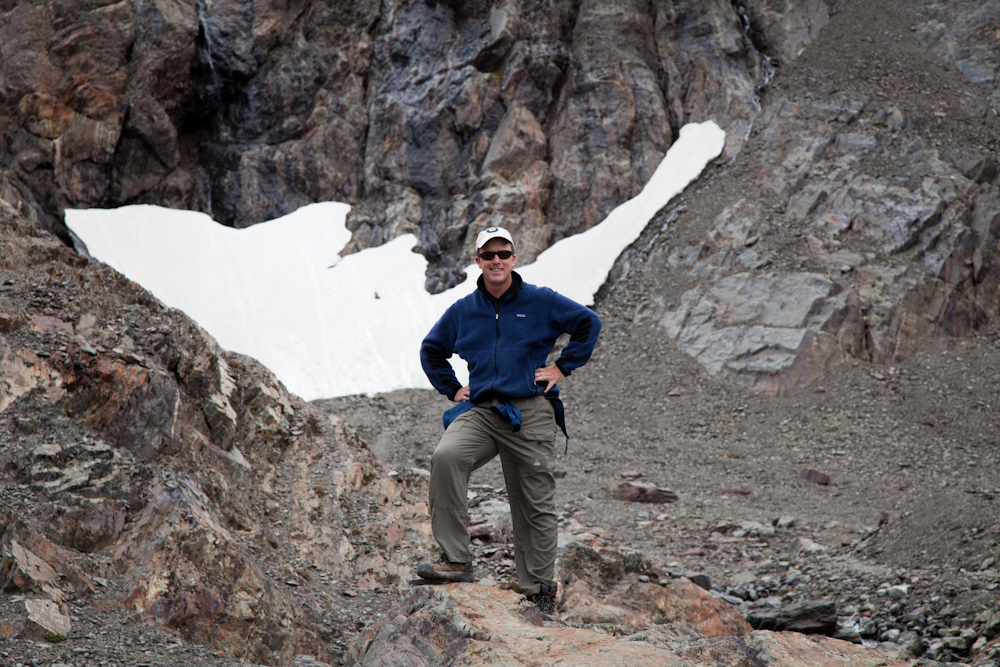
We reached the snow, but the glacier was still above us.
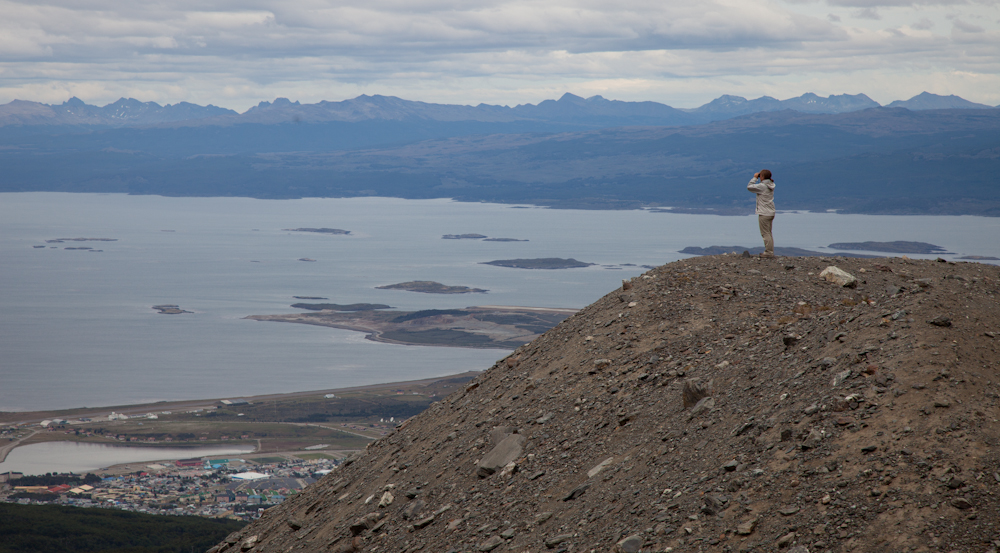
Checking out the view of the Beagle Channel and Ushuaia below.
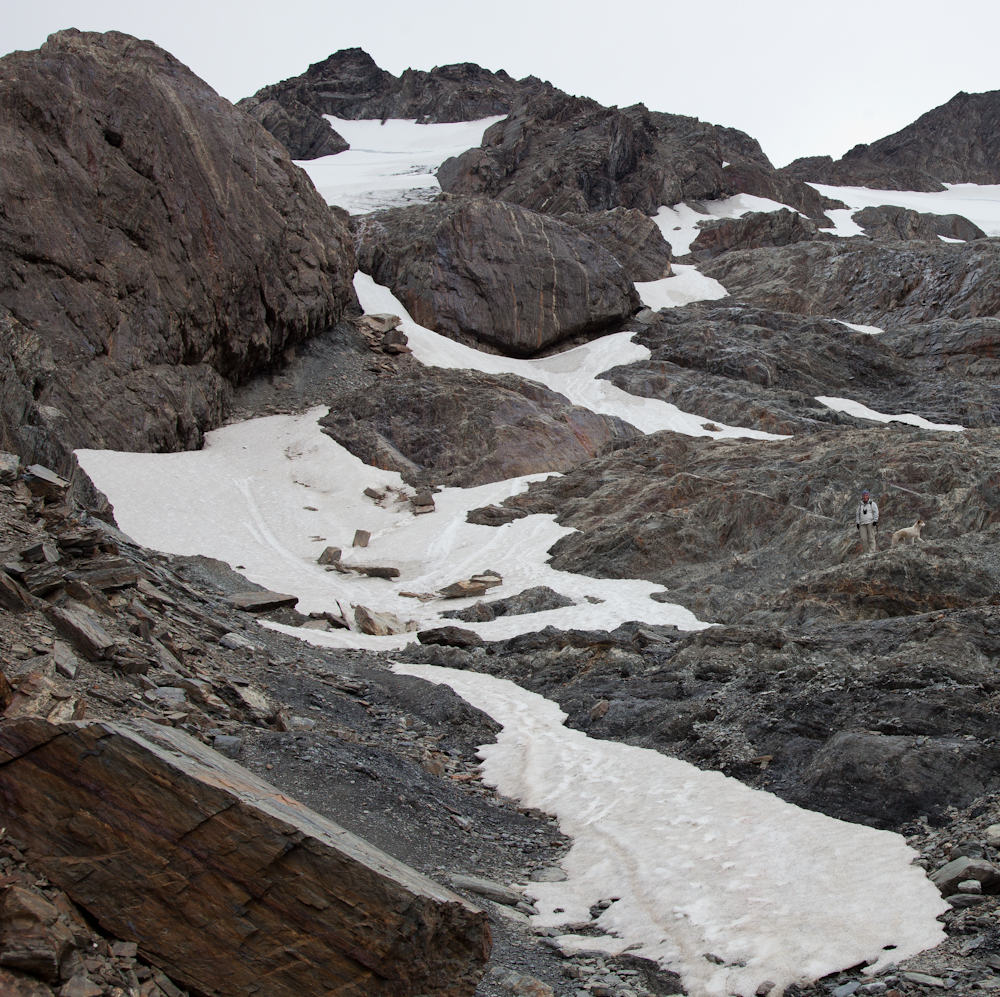
Where’s Christina?  At the glacier, with our new canine friend.
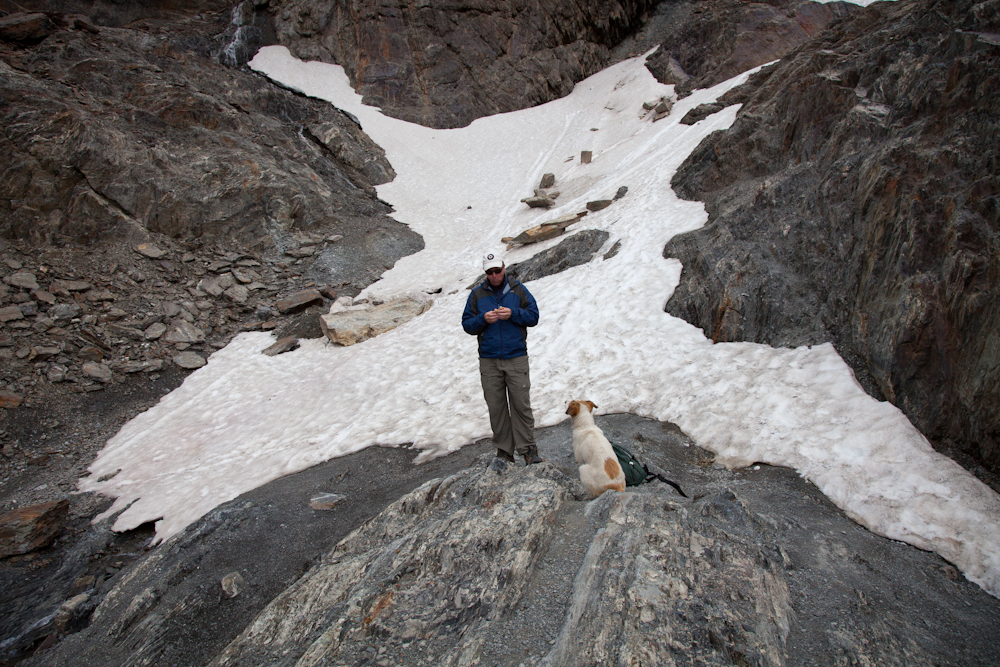
Having a bite to eat.  How could we resist sharing our lunch
with our polite and patient friend? 
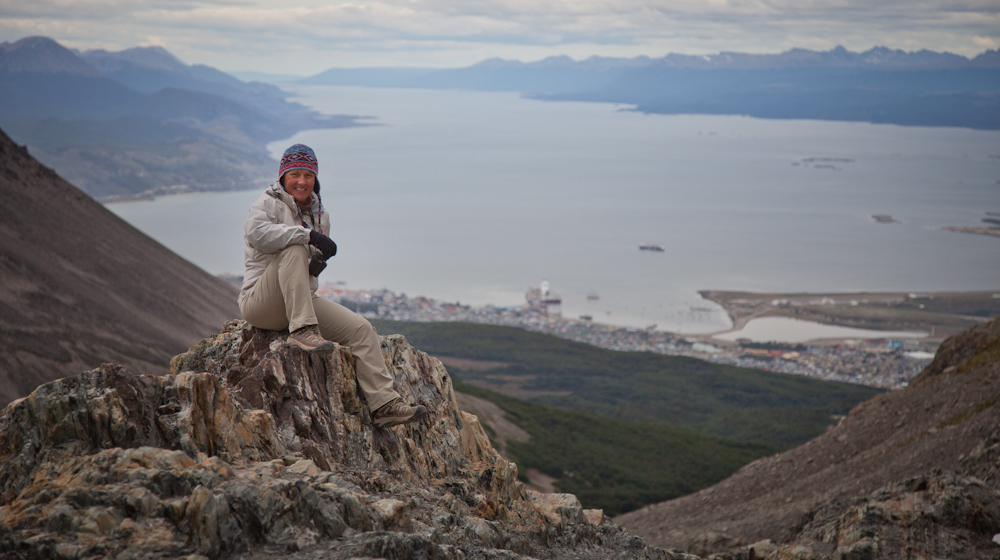
Can you believe this view?

Our faithful guide leading the way up.

Typical mountain flora clinging to the rocks.

Another day, we went to Playa Larga, a lovely beach  along the Beagle Channel about 4 km east of town. We took the local bus there, but since we didn’t think to ask about getting back, we couldn’t figure out where the bus stop was and had to walk most of the way back into town (after already hiking for 3 hours) until we were able to flag down a taxi.  Mental note:  ask for directions for both ways next time!
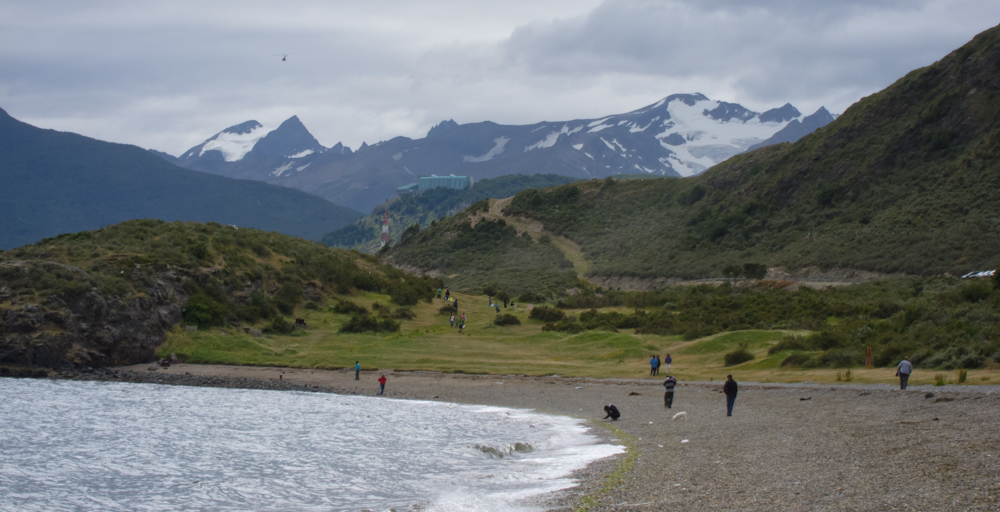
Playa Larga – can you see the helicopter that passed by?
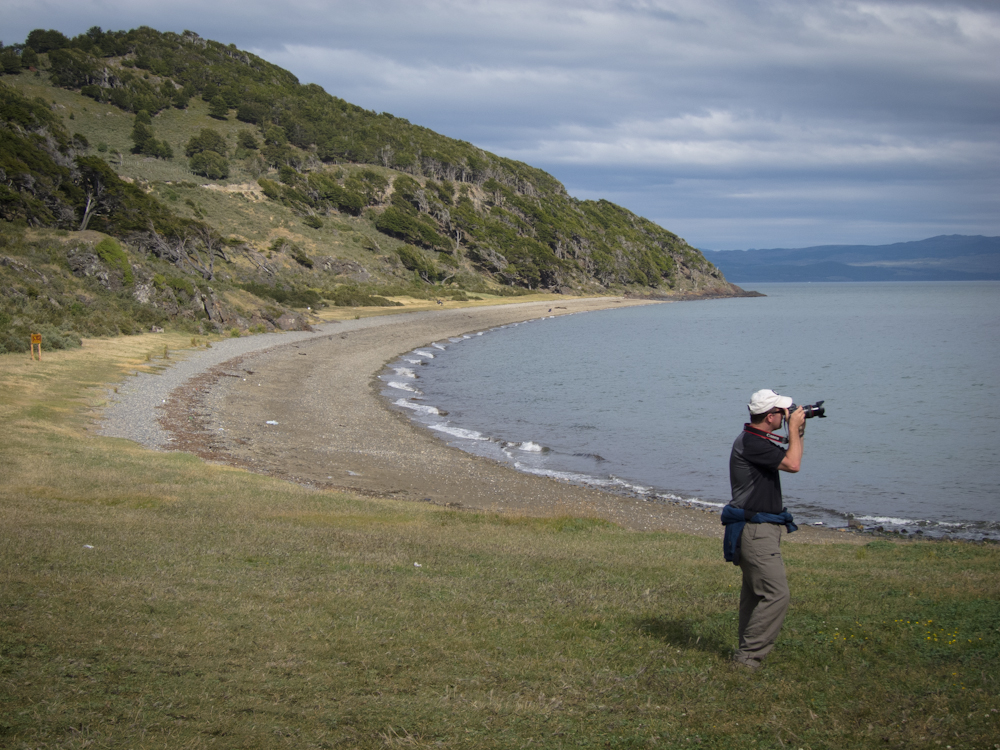
Chris taking a photo of a gray fox (below).
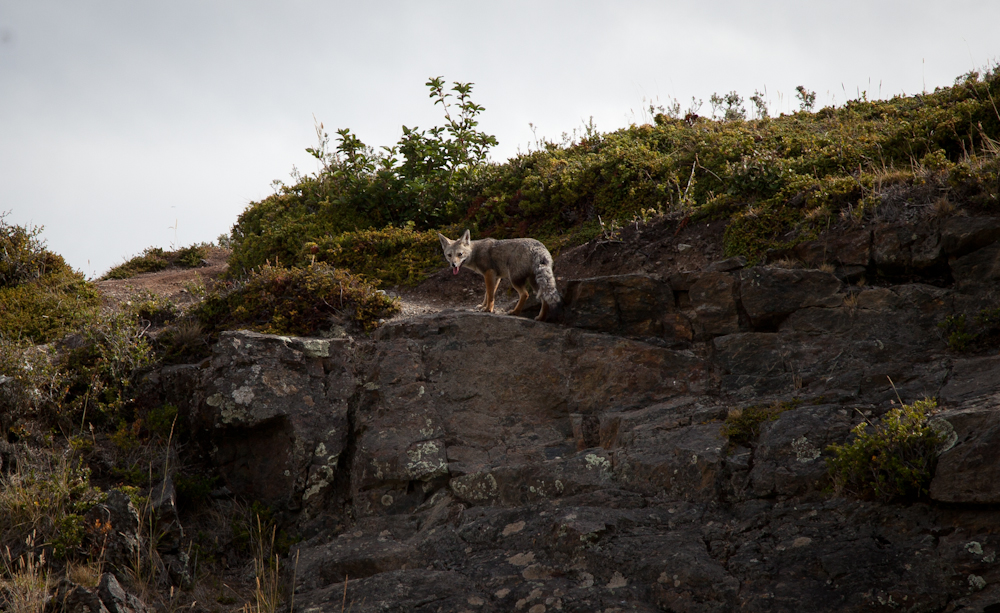
This gray fox was the only animal we saw on all our hikes.
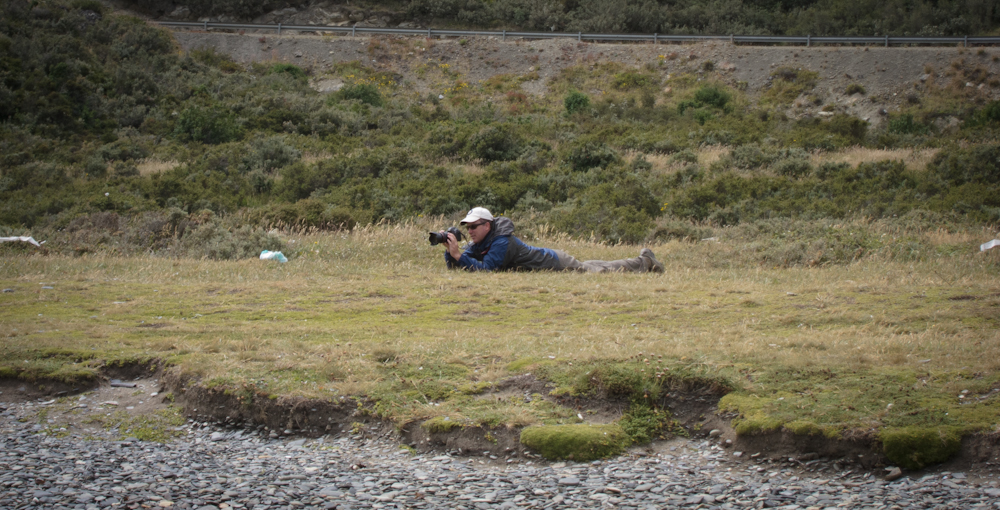
Photographer at work but what has captured his rapt attention?
Before I answer I must tell you a story.  A few years ago, we were having dinner with our old neighbours Chris and Nancy when my Chris shared a pet peeve with us:  why do people leave dirty diapers lying around all over the place? All three of us looked at Chris like he was nuts. We had no idea what he was talking about. But then, the next time we got together, Nancy and her Chris both remarked how they too were now seeing dirty diapers everywhere.  And even I have to admit, I too have seen many dirty diapers discarded in the strangest of places every since Chris alerted me to this phenomenon. Throughout South America, we have seen plenty of dirty diapers but I think the weirdest place was in Quito, Ecuador where we noticed a dirty diaper wedged in a tree. Who does that?? Of course, Chris now takes a picture every time he sees a dirty diaper in a weird place and sends it to our friends. Sure enough, while walking along this beach, we saw yet another dirty diaper on the ground.  There was no other garbage anywhere on the beach – just a single, dirty diaper.
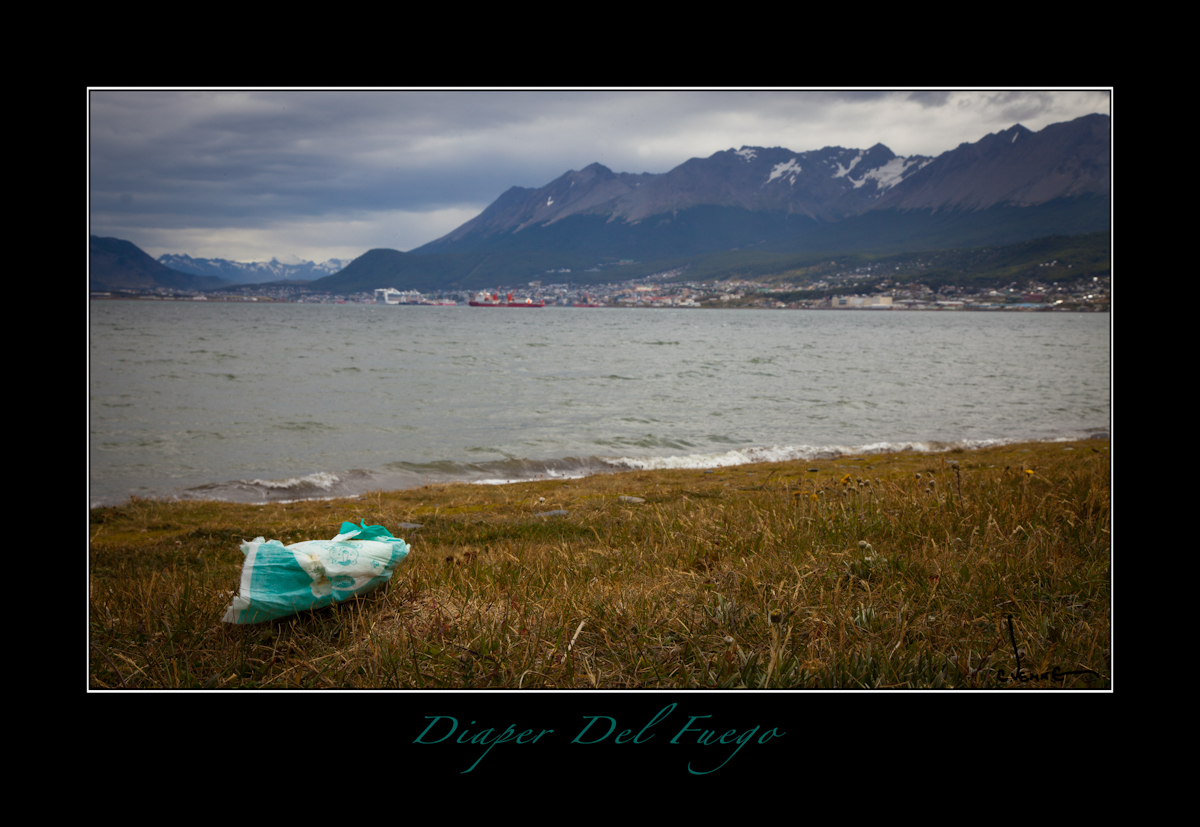
 Chris takes his dirty diaper pictures quite seriously as you can see.  Who knows, maybe Chris will compile a coffee table book on the subject – anyone have any suggestions for a title?
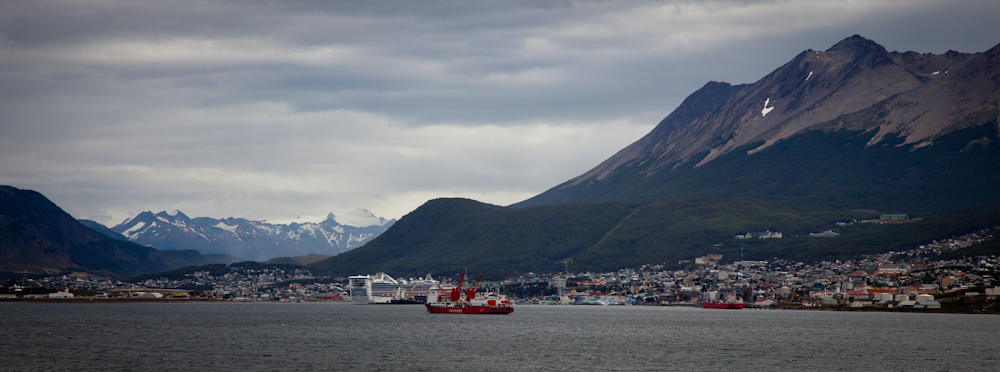
View of Ushuaia from the beach.

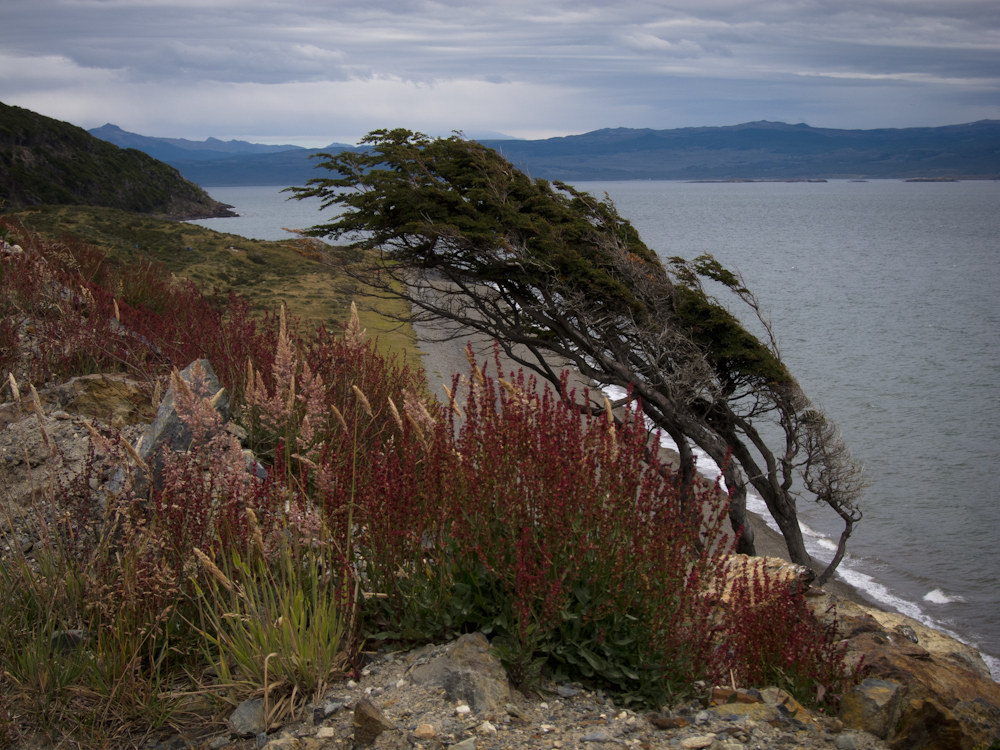
Which direction does the wind blow?

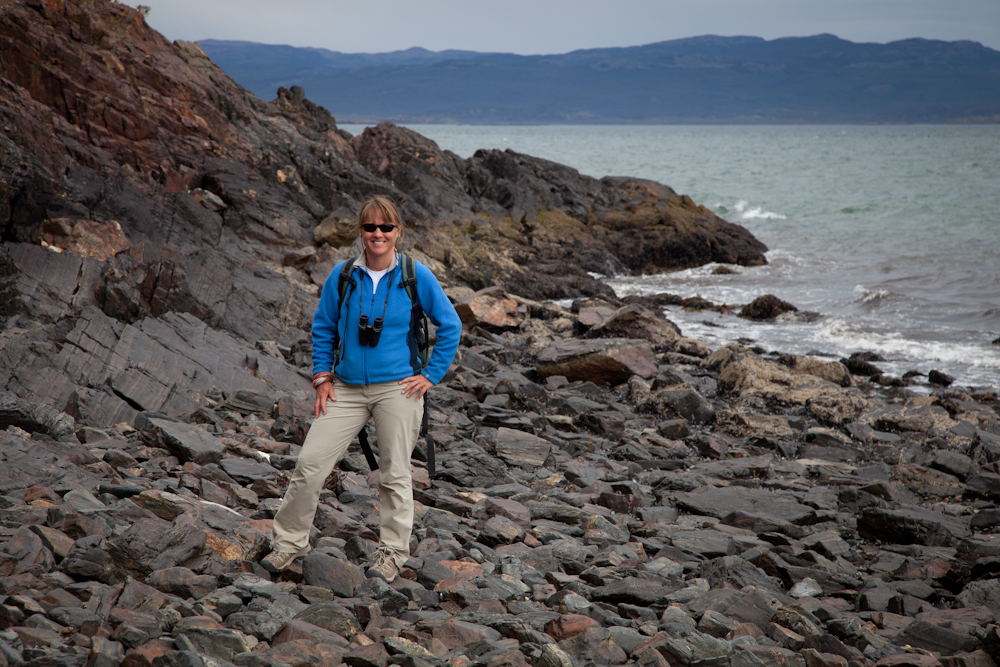
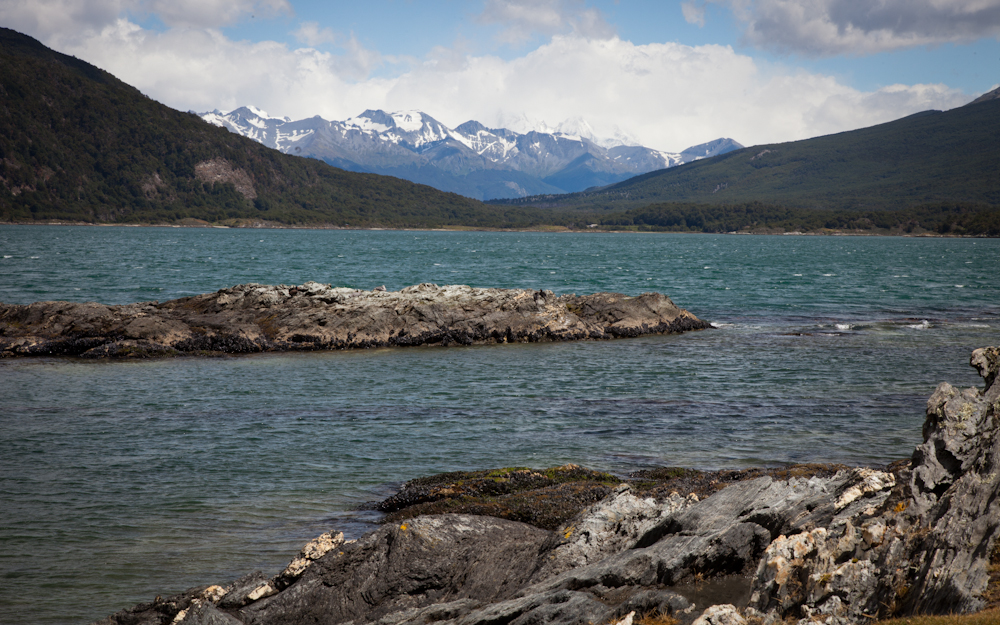
Hiking along the shores of the Beagle Channel, one of
three navigable passages around South America between
the Pacific and the Atlantic oceans.  The other two are
the Straits of Magellan and the Drake Passage.

 Enjoying the moment, and the view!

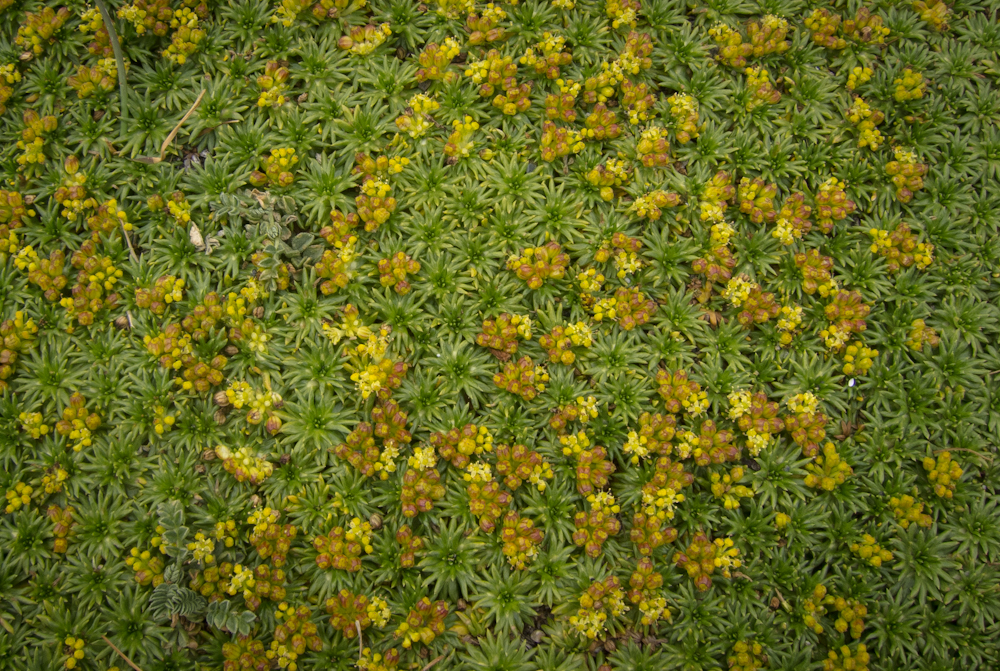
Moss-like plant growing on the rocks near the shore.

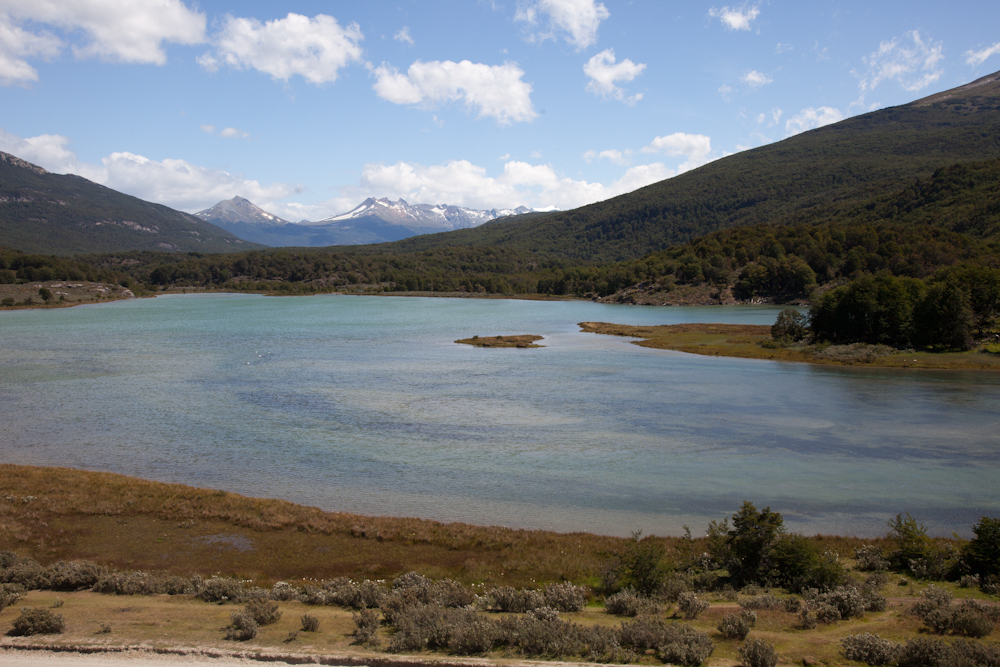
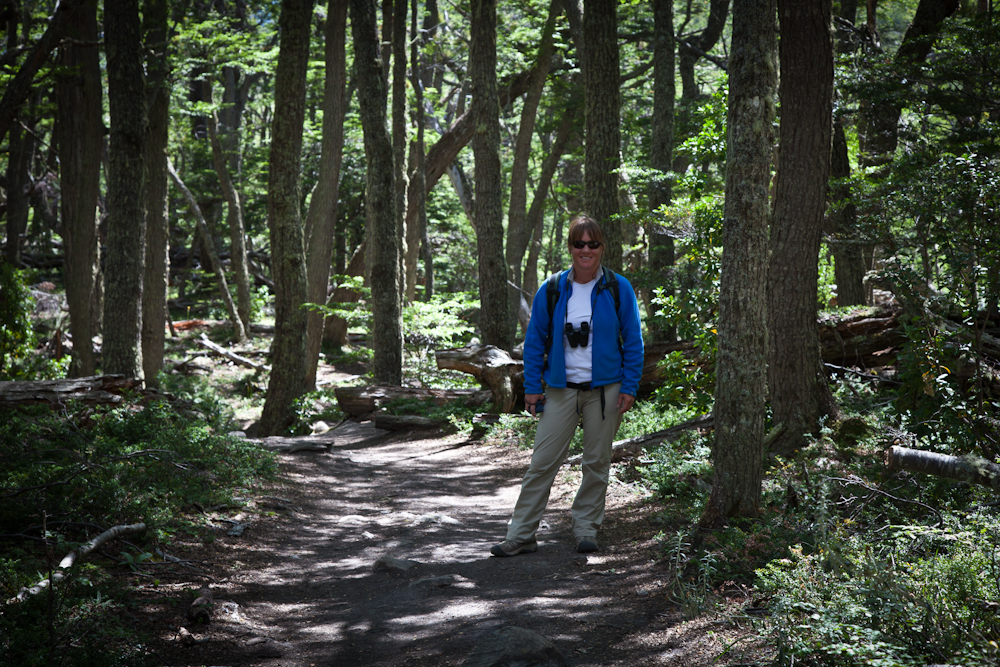
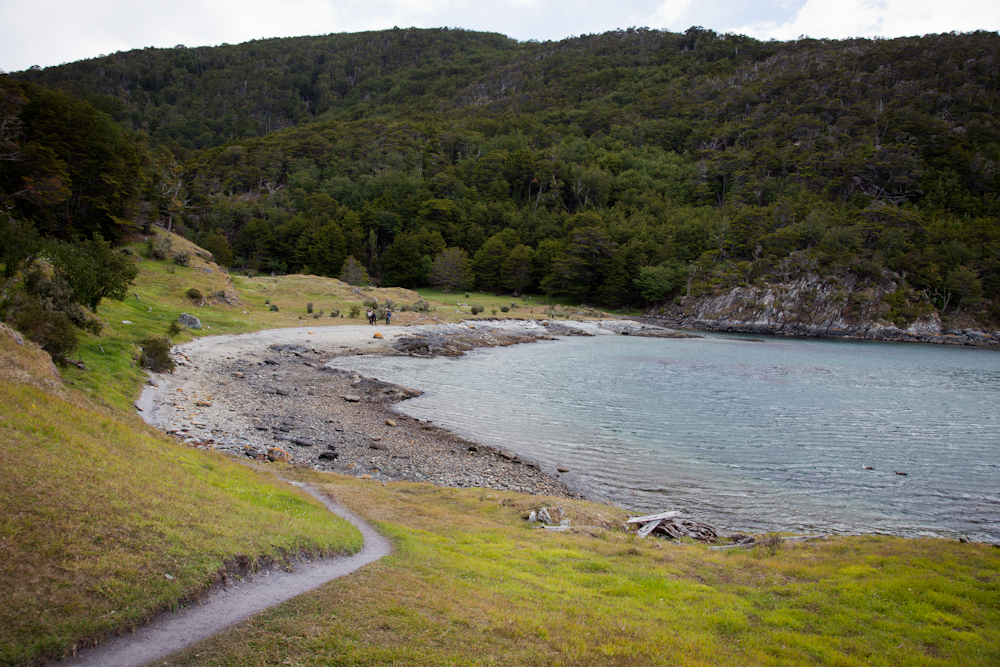
Finally, we spent an afternoon hiking in Tierra del Fuego National Park, the southern most national park in the world.  Once we recovered from the shock of the cost of getting there (85 pesos each, about $21.25US) and the daily park entrance fee (also 85 pesos each), we did enjoy hiking the Costera trail that followed the coastline of the Beagle Channel for about 8 km.  We saw some beautiful and varied scenery of majestic, snow-capped mountains, dense forest, pretty meadows and rugged beaches.
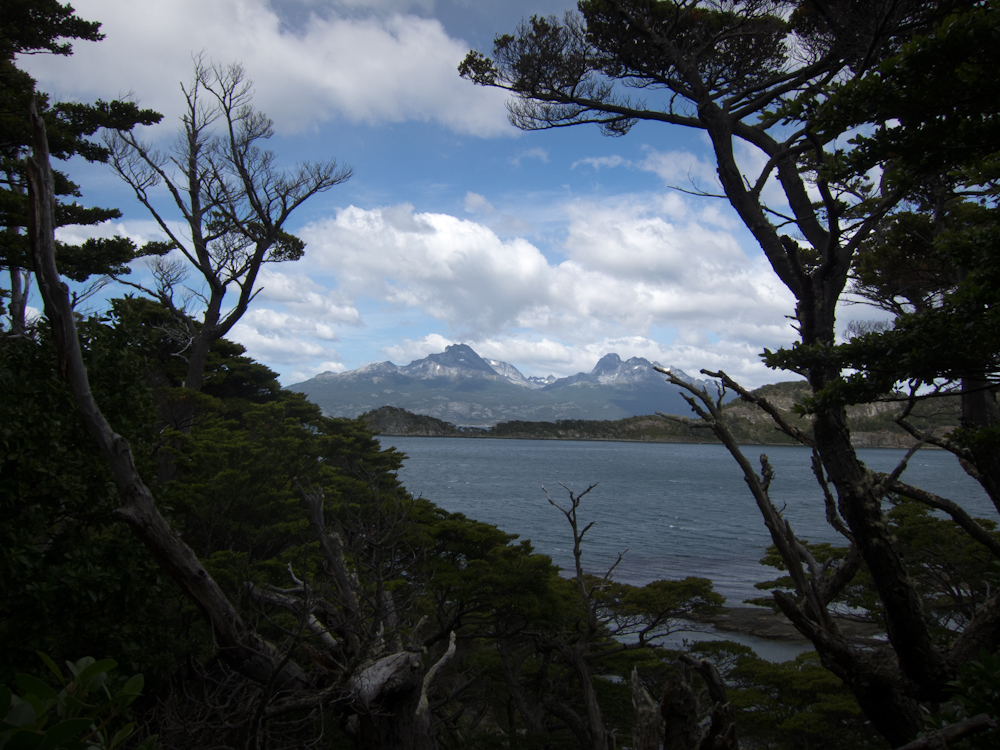
The weather in Ushuaia is quite unpredictable.  We were surprised with the mild temperatures when we arrived, probably mid-teens during the day.  Most days have been a mix of sun and cloud, some days more windy than others.  The air is cool so when the sun is not out and the wind picks up, it’s time to put on the wooly hat and mitts, and add a layer or two.  When hiking, we were always prepared for any type of weather and it was not uncommon to strip down to our t-shirts only to bundle ourselves up with fleece, windbreaker, hats and gloves all within a couple of hours.  It rained hard one night, and we’ve had some very slight, barely noticeable sprinklings of rain during the day.  Again, we’ve been lucky as far as the weather is concerned.  We’re also enjoying the long days.  As I finish off this post at 10:45 pm, the sun is just starting to set.  It seems our bodies have adjusted accordingly and we are going to bed much later and sleeping in each morning until around 9:00 which is quite late for us.  It’s strange how daylight affects your natural rhythms.  We’re even eating dinner later, 9:00 or later each night.  But that may just be because we’re in Argentina where many restaurants close after lunch and don’t even open until 8:00 at night.

Tomorrow we board the Sea Spirit and we’re off to sea for 19 days of adventure.  I hope we have calm seas – well maybe one storm just to see what it’s like – and clear weather.

Sea SpiritSea Spirit with Quark Expeditions
http://www.quarkexpeditions.com/sea-spirit 


Isla Magdalena: Home to 120,000 Magellanic penguins

I wanted to be wowed, and Isla Magdalena delivered with its breeding colony of more than 120,000 Magellanic penguins.  This small, uninhabited island lies inside the infamous and important Magellan Strait at the southern end of South America, at the tail end of Patagonia and just north of Antarctica. Not only was I impressed by the sight and sounds of this magnificent penguin colony, I felt humbled by the rugged beauty surrounding me and very privileged to be a spectator to mother nature’s wonders. The rawness of the landscape, the sweep of the sea, the softly undulating hills, and the thousands of penguins made it a wonderous sight.
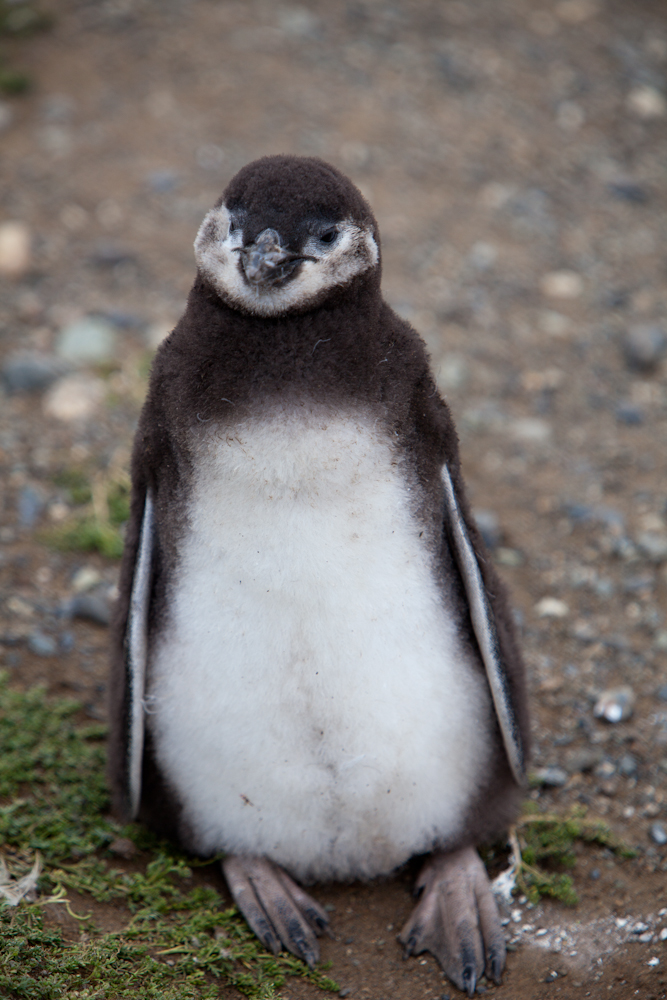
The Magellanic penguin is named after the 16th-century Portuguese explorer, Ferdinand Magellan who circumnavigated the world.  These penguins are found only in southern South America and the Falkland Islands. It’s a medium-size penguin with a black back, a white stomach, and two distinctive black bands between the head and chest.  Click here to learn more about this amazing bird.

In 1983, Isla Magdalena was declared a protected national monument, Los Pingüinos Natural Monument, and its only occupants are park rangers there to protect and monitor the penguin population, as well as educate the human visitors who drop in.

As we reached the island late in the afternoon, after 2 hours at sea, we were astonished by the sheer number of penguins on this island. Everywhere you looked, there were penguins. At this time of year, the eggs have all hatched and the chicks are about 6 weeks old – cute, cuddly fur balls that you just wanted to pet and take home with you.  Each adult pair had two chicks.  Nests were dug into the side of the sandy hills and offered safe refuge and shelter for these little families. Penguins are quite territorial and possessive about their nest, shooing away any non-family member who dared to venture too close, including us humans. I even had my ankles pecked as I inadvertently got too close to a nest taking a picture of another family close by.

The cacophony on the hills was deafening but we learned that all this noisy barking served a purpose: penguins identified each other audibly which makes sense when you think about it since they all look alike. How else are they going to find their family when they come home after a day of fishing if not to yell out, Mary, where are you?  Turns out, they recognize each other by their bark!

Lots of penguins (slide show)
%%wppa%%
%%slide=8%%
%%size=400%%

As we walked along the marked pathway, penguins were everywhere.  They waddled in front of us, behind us, beside us, quite indifferent to our human presence.  We were enthralled by their antics including hillside brawls, personal grooming, and open displays of affection.  Now this is an island worthy of a top ten rating for places to see before you die…at least in my humble opinion.

Come for a walk through the penguin colony (video)


Baby it’s cold down here

As we stepped off the plane in Punta Arenas last Thursday, we were greeted with a definite chill in the air.  Maybe not as cold as Canada, but definitely the coldest weather we have experienced so far. Daytime temperatures were in the mid-teens if the sun was out, probably closer to ten when it was cloudy. At night, it dipped below zero.  Is anybody feeling sorry for us yet?  I didn’t think so.

As we pulled up to our hostel, La Estancia, the peeling paint and faded sign did not exactly exude warmth and comfort.  On the inside, more peeling paint, worn out carpets and creaking floor boards gave us a sinking feeling.  But all this changed when we met Alejandro, or Alex, the hostel owner.  He warmly greeted us and made us feel so welcome. He helped us get oriented and even made all the arrangements for our tour to a penguin colony the next day (more about that in a separate posting).

Our spotless room was very large with three comfortable single beds (we pushed two together to make a king sized bed – luxury), all covered in thick blankets and down duvets.  We had a TV with English channels (unheard of to date) in our room in addition to WiFi. The towels were extra large and extra thick, another rare indulgence. Each room had newly installed heaters and the common areas were also heated; a must in this climate, but not a very common sight in Chile.  We had access to the kitchen, including a fridge.  To top it off, they served unlimited, extra large mugs of real, filtered coffee with breakfast.  We couldn’t remember the last time we had real coffee in a hostel.  Instant Nescafé is the South American favourite. All this to say, you can’t always judge a book by it’s cover.  All of a sudden, this old, worn out 1920’s era house felt warm and cozy like a comfy old pair of slippers.  It served as an excellent base from which to explore the area.

Punta Arenas is the largest city south of the 46th parallel south with a population greater than 154,000. The city is vibrant and modern.  In the summer (which is now) the city can get dangerously windy to the point where city officials put up ropes in the downtown area to assist with unique wind currents created by the buildings.  It was rather calm during the few days we were there with a mix of sun and cloud each day. When it was cloudy, it felt a lot like a day in late October in Ottawa….brrrrrr. Unlike Ottawa, we are enjoying very long days – it doesn’t get dark until about 10:45 at night and dawn begins around 4:30 in the morning.  It’s deceiving and a little disorienting at times.

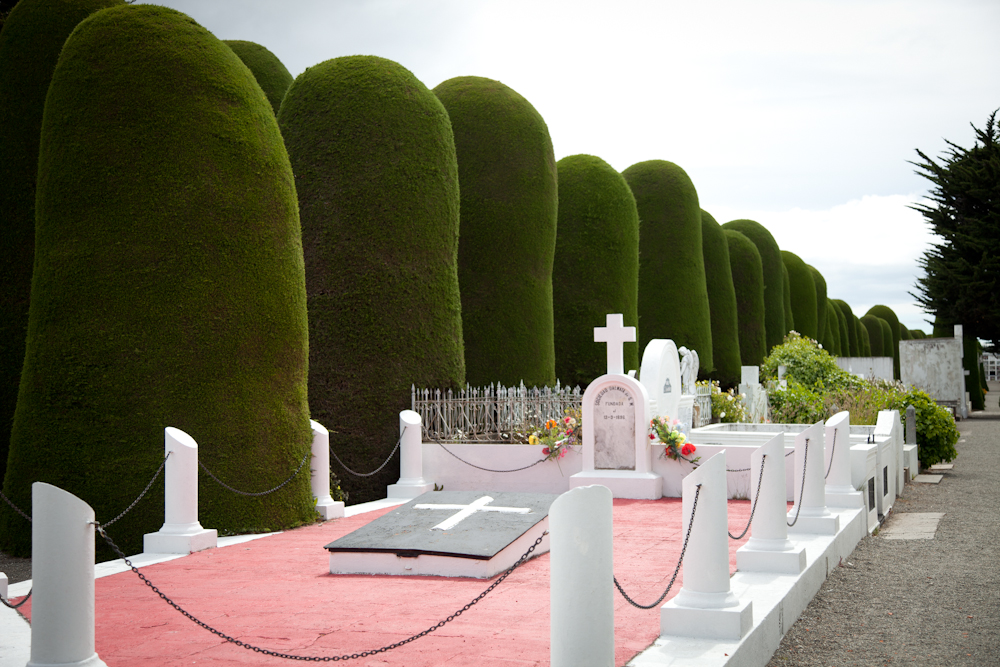
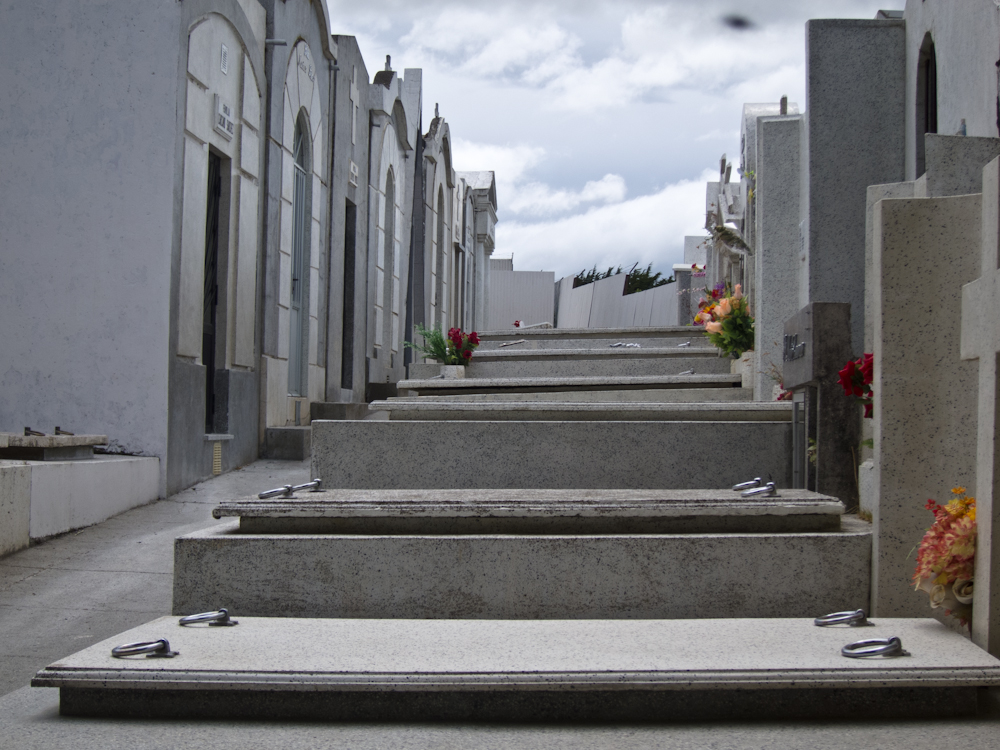
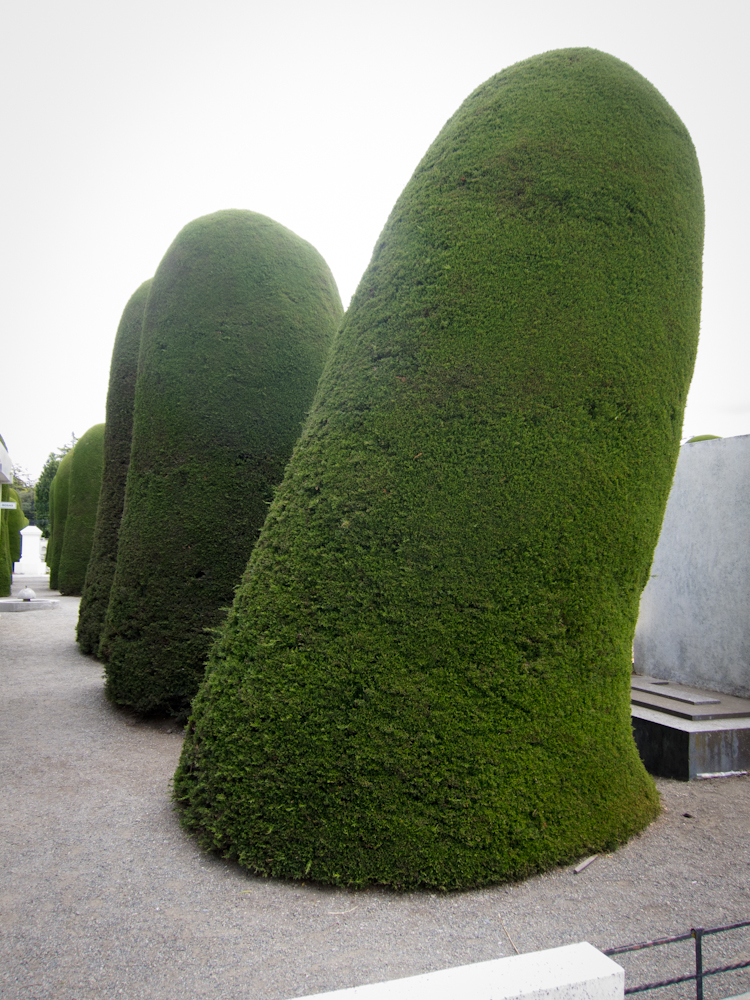
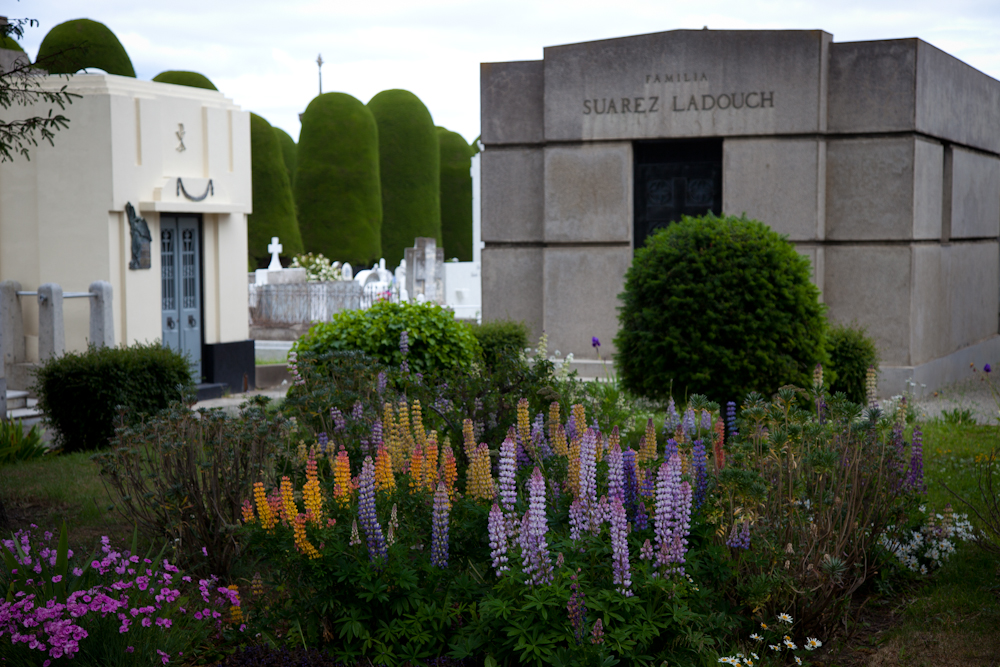
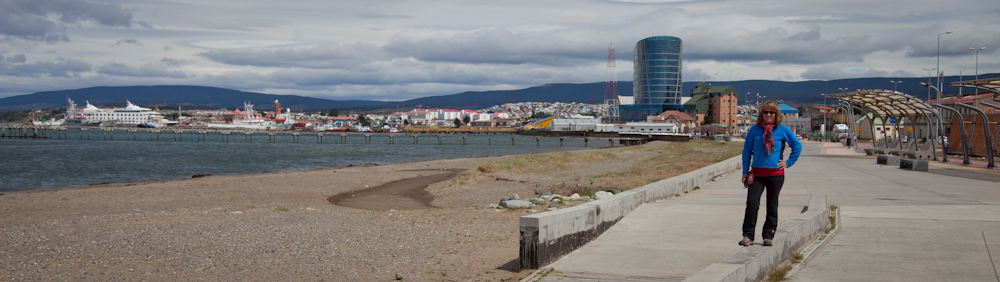
We spent some time exploring the city, wandering around the harbour and malecon as well as the Plaza des Armas. The cemetery in Punta Arenas resembled the one we visited in Guayaquil, Ecuador and is similarly called the White City.  It was impressive.

Perfectly trimmed European Cypress trees stood like sentries in the city cemetery.

Tombs in the municipal cemetery which was founded in 1894.

These European Cypress trees were perfectly manicured,
even though they were not always perfectly straight.

We were surprised to see flowers such as lupins and roses growing
abundantly everywhere around town – on the side of the road,
in people’s gardens as well as here in the cemetery. 

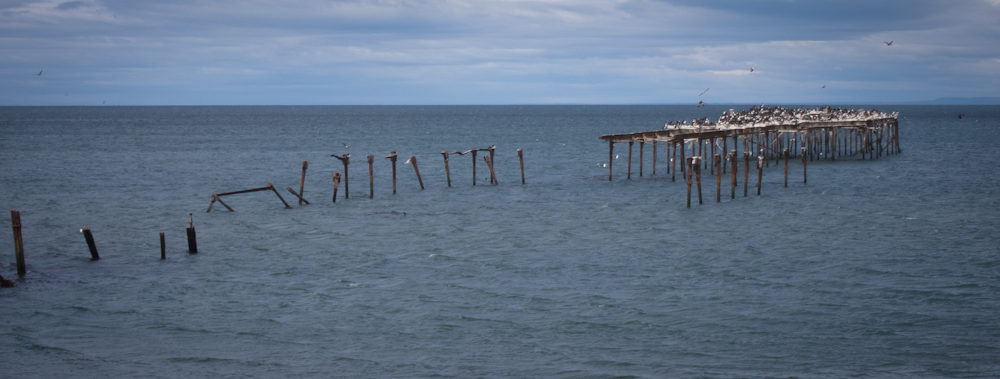
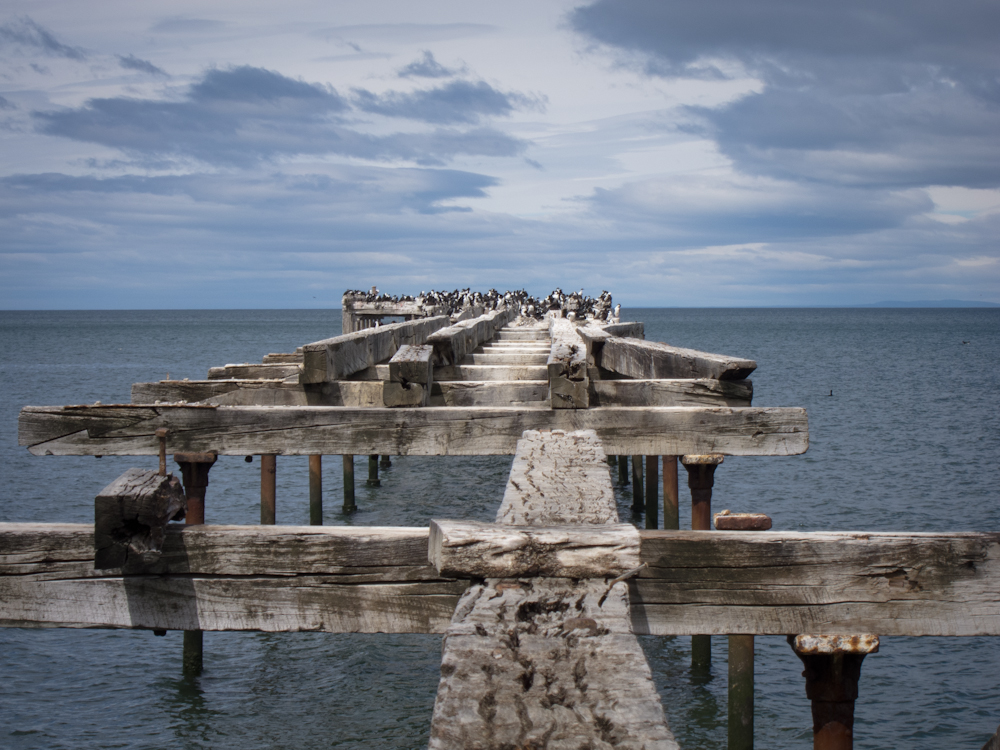
This old dock had seen better days but it made a
great perch for hundreds of seagulls.

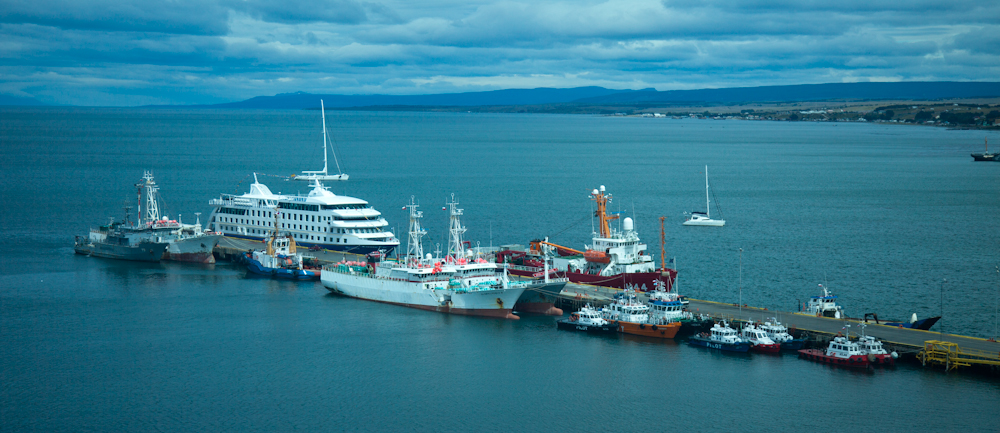
Boats docked in the port.

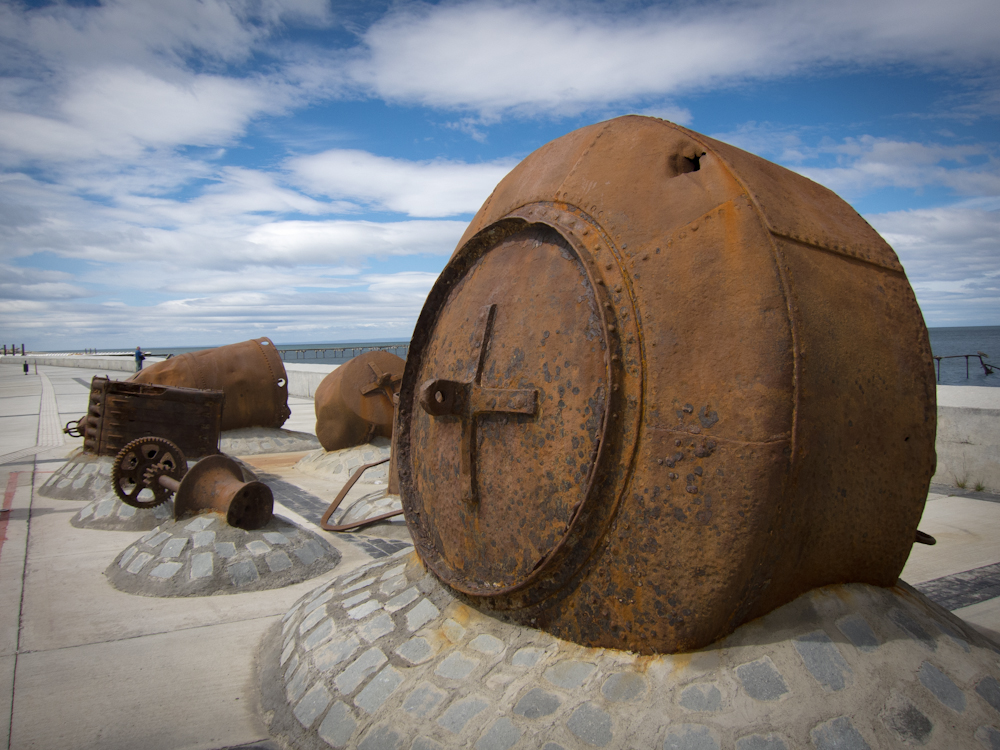
A nautical monument in honor of the past.

As I walked along the old beams of this dock for a short distance
over the deepening sea,  
the strong wind sent ripples
along the surface of the water below making me a little

dizzy and wobbly, but I kept going and I didn’t fall in! 

Originally we had planned to stay in Punta Arenas for just a day to visit the penguin colony and then head north to Puerto Natales from where we would organize ourselves for our camping trip in Torres del Paine National Park.  Unfortunately, a forest fire has been burning in the park since just after Christmas. This has caused quite a raucous here in Chile since we are now in high season and that park attracts millions of tourist dollars at this time of year.  An Isreali tourist is being blamed (and charged) for starting the fire, an action he is vehemently denying.  This is serious stuff – the tourist has been detained and if found guilty will go to jail and be ordered to pay a fine.  Right now, part of the park has been re-opened but the fire continues to burn and fire fighters are still working day and night trying to put it out. We think it is still a precarious situation since any change in wind direction or strength could put the rest of the park, and tourists, in danger again.

So, we’ve decided to hold off on visiting the park, and go to Ushuaia, Argentina instead.  We will then circle back to Torress del Paine in a couple of weeks if the fire situation is resolved. At least we have the luxury of time on our side.


Side trip to Chiloé

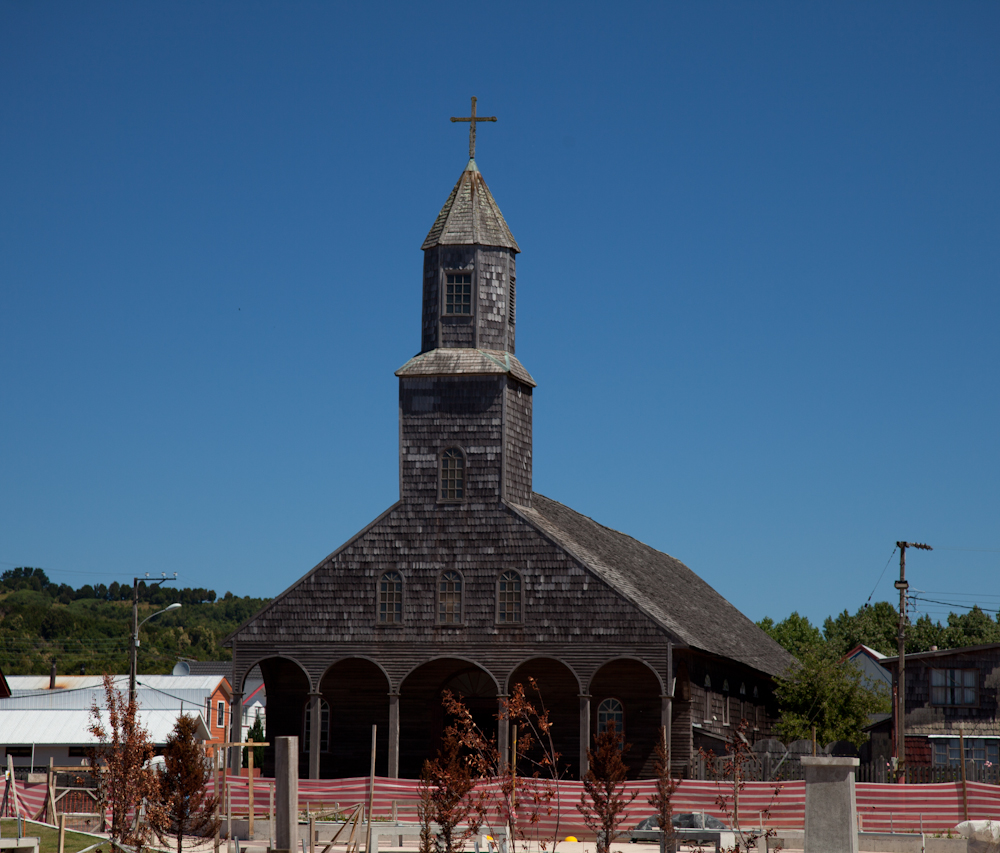
Listed as one of the top ten islands to see before you die by Yahoo Travel, we were compelled to spend a few days exploring the Island of Chiloé which is separated from mainland Chile by a 30-minute ferry ride across the Chacao Channel.  The island is renowned for its sixteen wooden churches which have UNESCO World Heritage status.  The churches are clustered around the capital, Castro on the island’s east coast.  The traditional palafitos (houses on stilts), distinctive folklore, mythology, cuisine and unique architecture contribute to the island’s appeal.

The island is 190 km (118 mi) from north to south, and averages 55–65 km wide (35 to 40 mi).  Chiloé is located about 80 km south west of Puerto Montt which was the city from which we were flying to Punta Arenas on January 5th.  We decided to reduce our stay in Pucón in order to have a few days to explore this island, which was again recommended as a “must see” by many travellers we have met.

On January 1, we travelled from Pucón to Chiloé, with a bus transfer in Puerto Montt.  When we took the ferry across, we were delighted to see dozens of dolphins swimming alongside the boat, breaching right in front of us.  We even saw a few penguins bobbing to the surface now and then. Closer to shore, we spotted a group of sea lions sunning themselves on a wooden raft. And then we caught a glimpse of a flock of black necked swans, creatures I have never seen before.   What an unexpected spectacle!

We spent the first two nights in Castro, followed by two nights in Ancud, a town on the north west part of the island. Again, we enjoyed perfect weather: warm, sunny, cloudless days.  Considering that for 75% of the year, this island is shrouded in mist and rain, we were incredibly lucky.

View from our hostel, El Mirador (white building to the left of Chris) in Castro.
Our room faced the water offering a gorgeous view, but the hostel
itself was old and worn out and wreaked of stale smoke.
It reminded Chris of his grannie’s house when he was a kid.

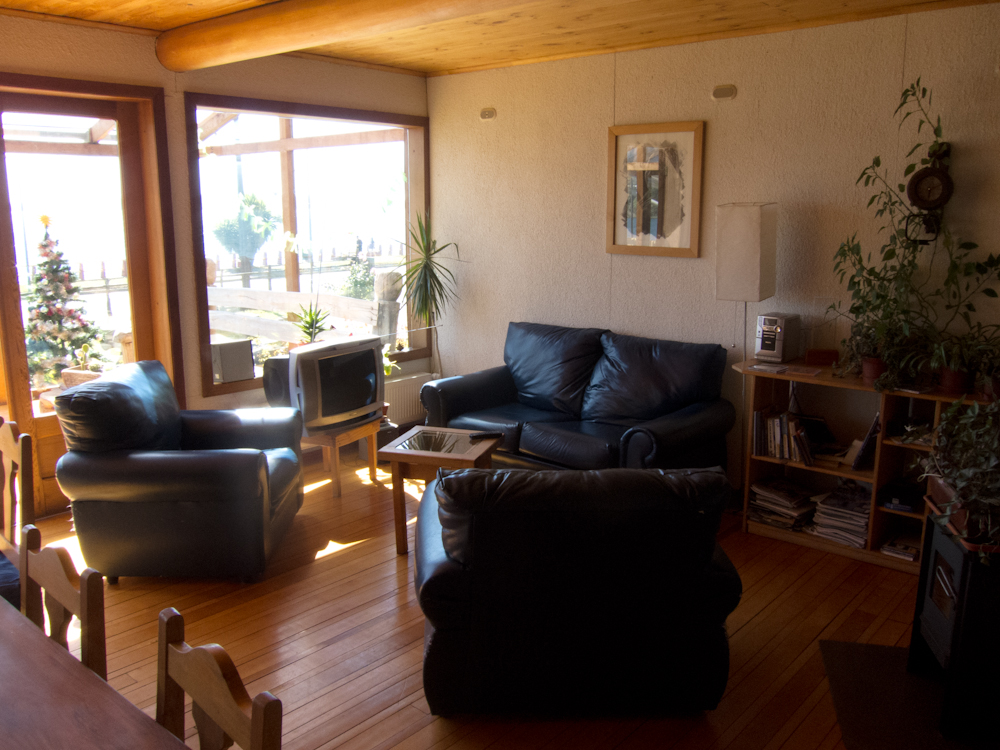
Out hostel in Ancud, Nuevo Mundo, was lovely – huge room (queen bed) with
cathedral ceiling with large bay window overlooking the water.
This hostel had the cleanest kitchen we have seen so far
and offered beautiful and comfortable common areas. 

Nuevo Mundo on the inside.

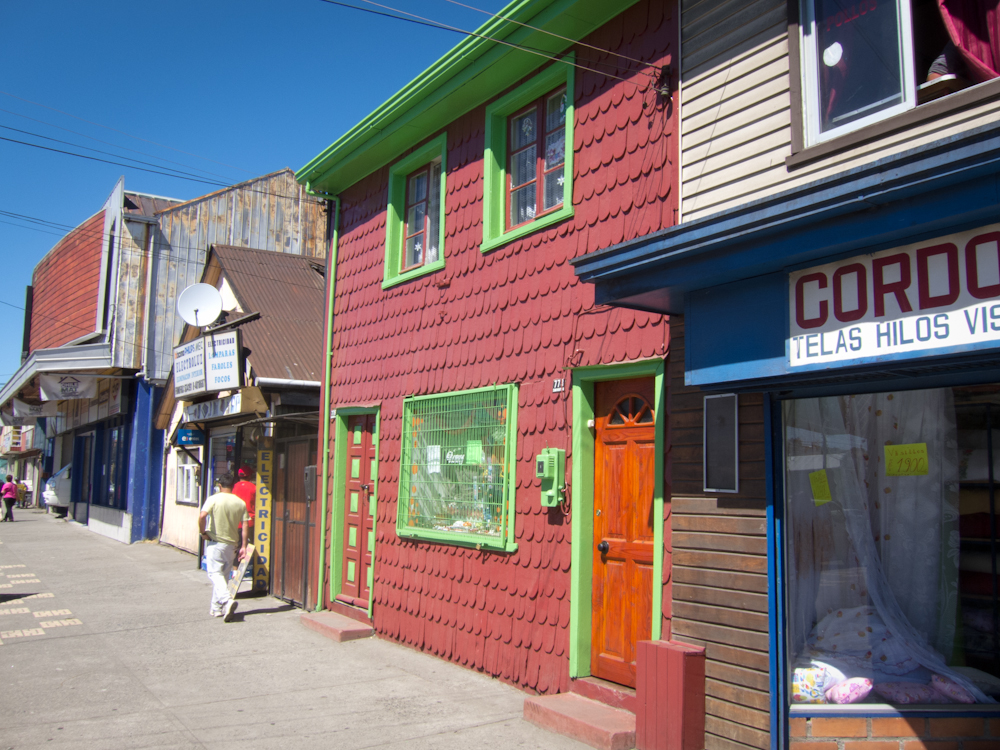
Throughout our visit on the island, I kept trying to figure out what all the fuss was about. Sure, it had lovely, picturesque landscapes of rolling hills, meadows of wild flowers, healthy livestock grazing contentedly…… but it really could have been anywhere in rural Ontario as far as I was concerned.  The little towns and villages that dotted the coast reminded me of Atlantic Canada. Again, very pretty, but also very similar to home.  Of course, we observed subtle differences like the unusual patterns of shingles used as siding on the houses.

A typical house on the island.

One of the famous churches; this one was in Achao, a small fishing village
we travelled to by local bus for an afternoon.

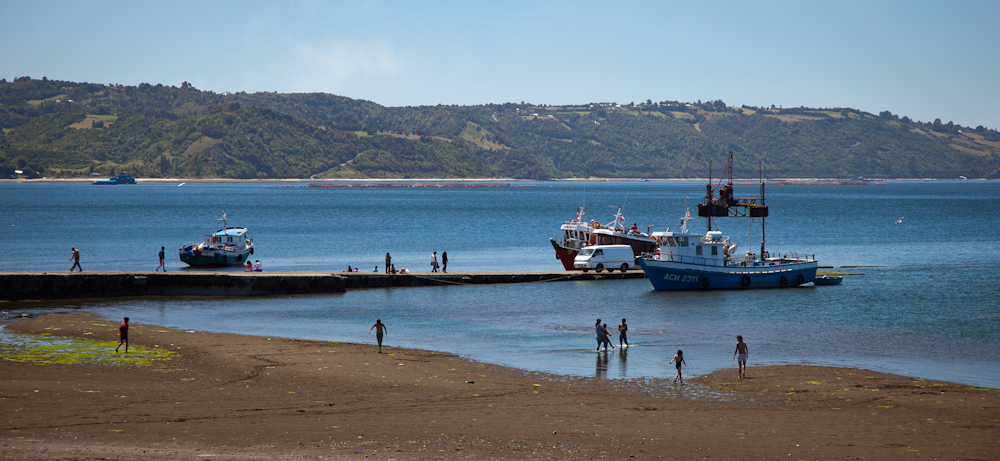
The pier and beach in Achao while the tide was out.

Colourful houses on one of the main streets in Castro.

A common scene when the tide was out.

Many of these boats were badly in need of repair.

Chris was fascinated by the technique being used to repair this boat:
one guy wedged string between the new boards using a hammer and chisel,
and the other guy applied some sort of a putty or seal on top,
followed by a thick coat of paint.

The language was different too, in fact, completely different from mainland Chile which left me puzzled and frustrated in equal measure.  Ordering food became such an ordeal – I could not understand the menu and then I could not understand the waitress who tried to explain the menu – towards the end, I resigned myself to eating salmon for several meals because that is all I could recognize on the menu. I know, no sense of culinary adventure, but what can I say, sometimes, I just want to eat something remotely familiar. We did get our fill of seafood and enjoyed a few local dishes that were very good.

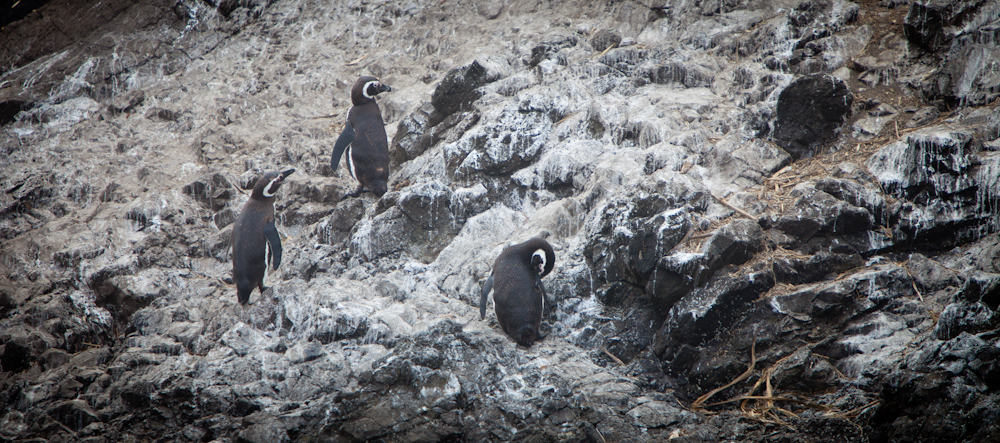
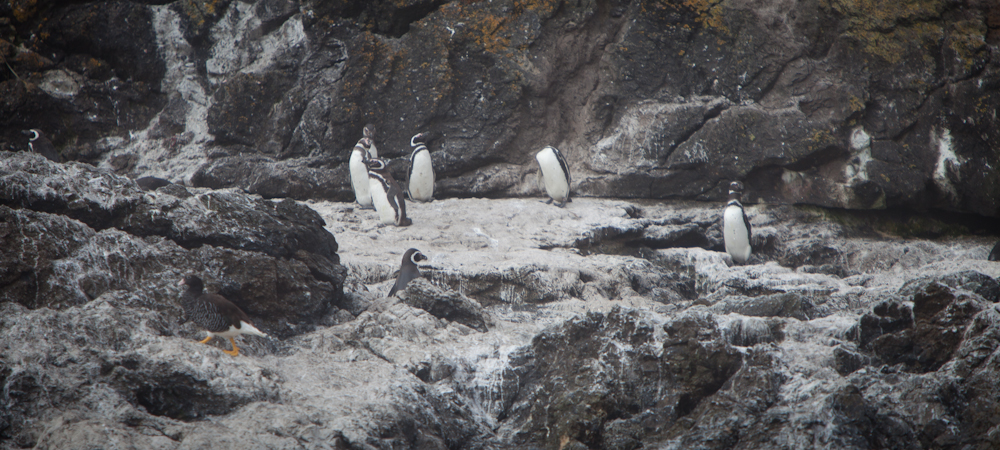
Perhaps a visit to the cove of Puñihuil, home to two types of penguins, Humboldt and Magellan, would knock our socks off.  We were certainly amazed by the sudden change in weather as we approached the western side of the island.  Within minutes, we went from warmth and sunshine to heavy mist and cold wind.  This shift in weather completely changed our impression of the landscape; suddenly it all looked very mystical and mysterious.  Maybe our grand weather was a curse after all!

We spent about twenty minutes in a small boat visiting three tiny islets just off the shore line where we observed a few dozen penguins along with a variety of birds.  This may have been impressive if we had never seen penguins before; perhaps the Galapagos Islands have forever ruined us.

A short video of our visit to the penguin colony.  


While we didn’t feel the magic of Chiloé, it was a very pretty island and our few days meandering around the island were relaxing and quite enjoyable.  On Thursday morning we left bright and early to head back to Puerto Montt where we would catch our flight to Punta Arenas, located in the southern most region of Chile.

Example of the palafitos, houses on stilts,
with a flock of black neck swans in the foreground.  

These swans are smaller than the swans we have at home
with distinctly black necks and white bodies.
Unfortunately, I think they had all dunked their heads in the water just as I took this picture!

A new year, a new look!

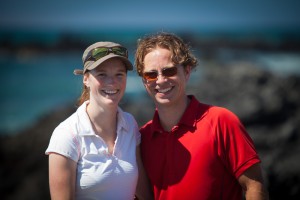
A big thanks to our friend Daphne in Holland (pictured to the left with her boyfriend Jasper) who customized the header on our website with personalized images from our recent travels.  We think she did an awesome job and we’re thrilled with the new look. Daphne is a young web designer with clearly lots of talent.  She did this on her own initiative and sent it to us as a gift.

If you’ve been following our travels, you may recall that we met Daphne and Jasper while on our Galapagos cruise which seems like ages ago.  They were the young couple that joined us on the second day of the cruise.  It was Daphne who took all the great underwater shots when we were snorkelling.  We hit it off with them right away and ended up spending time with them after the cruise too.  In fact, we kept running into them so often that we jokingly accused each other of stalking.  It was downright bizarre when we ran into them weeks later while watching the Mama Negra parade in Latacunga.   Such a small world out there.

Thanks again for a wonderful gift; it’s one we’ll enjoy all year long!

Happy New Year!

I think we’re going to remember the last day of 2011 for quite some time as it’s not every day you climb to the brim of an active volcano that is covered in snow, and then slide all the way down on your bum. But I’m getting a little ahead of myself.

We arrived in Pucón last Thursday morning after a pleasant 10 hour (780 km) overnight bus ride from Santiago.  Pucón was added to our itinerary on the recommendation of many travellers we have met over the last couple of months.  We’re glad we listened to the advice of so many strangers.  As we neared Pucón, we felt like we were travelling in Ontario cottage country; it all looked so familiar, from the landscape to the types of trees to the style of houses.  It was like the mirror image of Ontario in the Southern Hemisphere.  We felt so at home.

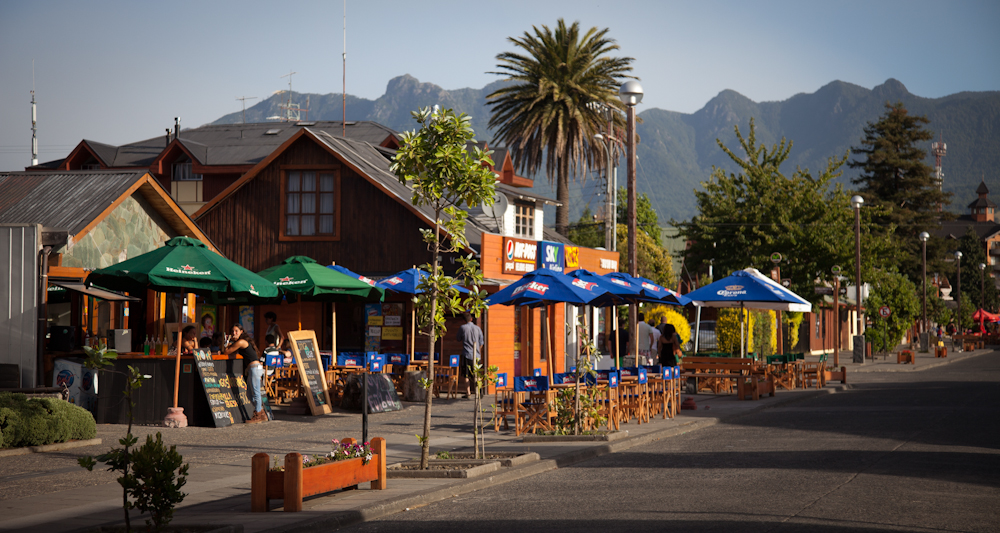
The town of Pucón reminded us of Banff in the summer time.  This was obviously a tourist mecca that offered outdoor enthusiasts plenty of options. In the winter, people flock here for the outstanding skiing and in the summer, for the biking, rafting, hiking, kayaking, fishing, birdwatching – you name it, you could do it here.  Located on the shores of a huge lake, it offered swimming and boating too. The beach was made of coarse stone that resembled gravel, but that didn’t stop the tourists from sunbathing and swimming.  The town was bursting with restaurants, bars, and boutiques, and gorgeous flowers everywhere.  We loved this place, the energy, the atmosphere, the whole look of the place.

We settled into our hostal, called Ecole, which we loved – felt like we were in a cottage with our pine panelled room. We spent Thurday exploring the town and checking out the adventure options.  We decided we would go mountain biking on Friday and then hike the Villarrica volcano on Saturday.

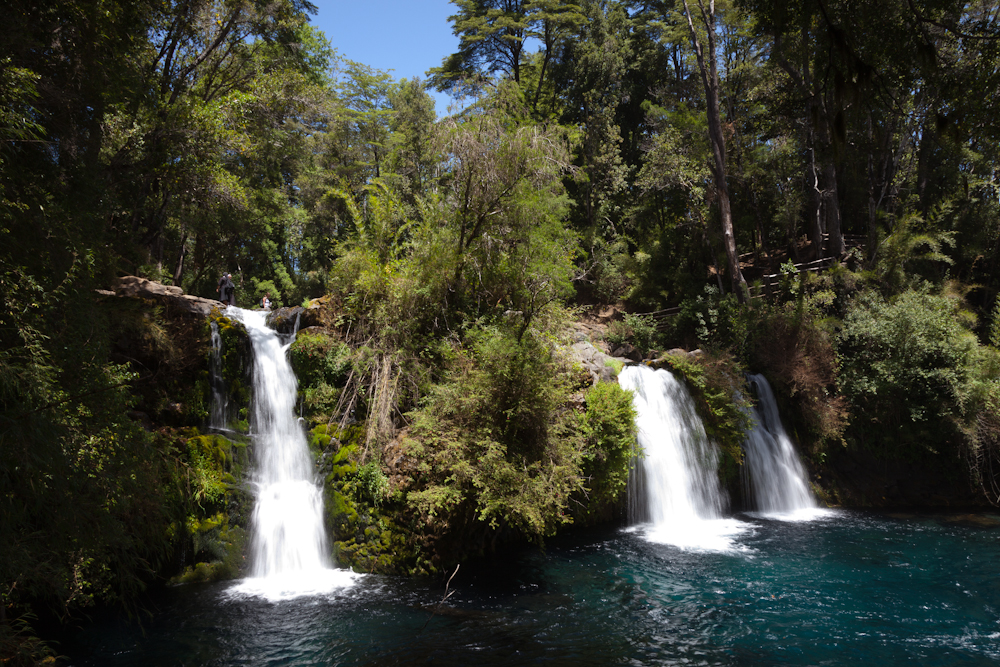
Little did we know our cycling route would be so strenuous that we could barely walk our bikes up many of the hills – probably not the wisest thing to be doing before a major hike.  Our goal was to cycle to the Caburgua waterfalls, supposedly an easy 20 km bike ride from town, or at least that was how Chris understood it when he got directions.  But first, we got lost and went about 5 km down the wrong road.  Getting lost seems to be something we do quite easily these days, whether on foot or on a bike!

Once we found our way, we enjoyed the stunning views – snow capped volcanoes served as a backdrop to picturesque meadows with sheep and horses grazing contentedly.  We were exhausted by the time we reached the waterfalls and wondered if we could somehow hitch a ride back to town like we had done on our Baños bike trip – but no such luck. We were pretty exhausted by the end of the day – it was much more challenging that we expected and we were wondering if we were doomed for our hike the next day.

The water was icy cold – too cold to swim.

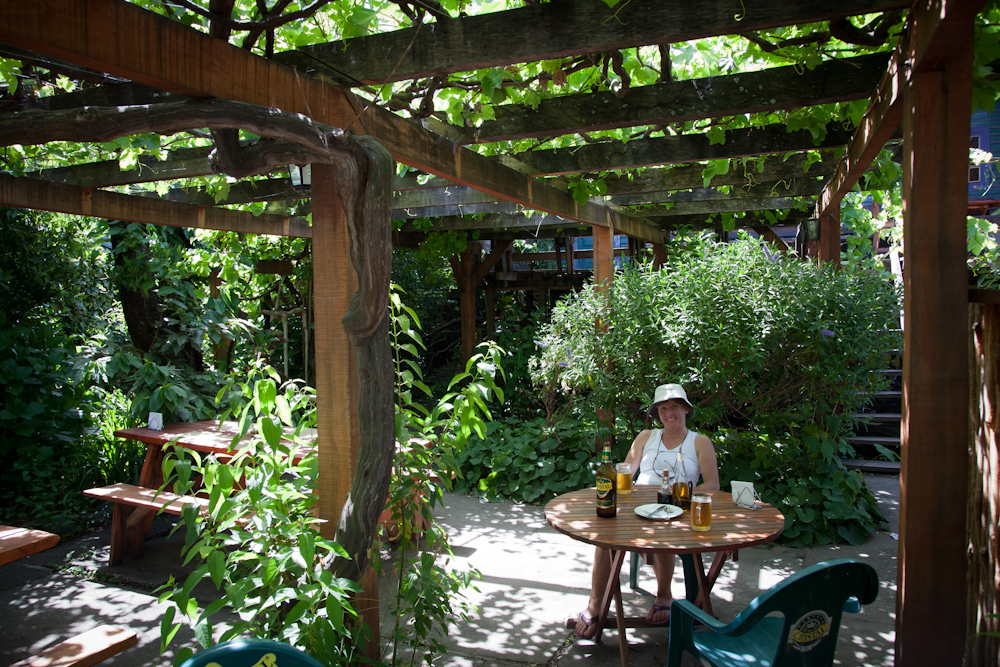
Back at our hostel, enjoying a well deserved “cerveza” after the bike ride.

After biking, we headed over to the shop to get suited up for the big hike.  There we learned we were part of a large group – close to thirty people plus all the guides.  The next morning, we met at the shop at 6:45 am and by 7:30 we were at the base of the mountain trekking to the chairlift.  Taking the chairlift was optional but highly recommended; everyone in the group took advantage of this option.  We were surprised at how high we already were once we got off the chairlift.  We donned our helmets and listened to the instructions on how to use our ice pick to stop ourselves in case we lost our footing and started to slide down the mountainside out of control, a visual I didn’t really need.

A hot day ahead of us!

I’ve never used an ice pick before!

There were lots of other groups on the mountain that day which I wasn’t too thrilled about. It was downright crowded.  Guess it was to be expected as this was one of the most popular activities and it was the last day of the year.  We started the hike in single file, ascending at a slow, steady pace.  The first half was actually quite easy – we found the pace very slow and the slope was not too steep.  And our footing was quite secure in the snow.  All that changed in the second half when the pace remained the same, but the slope became much more vertical.  We were all huffing and puffing as we reached the top.  Imagine walking up flights of stairs for over 4 hours steady – you’d be huffing and puffing too.

Feeling good at our first rest stop – but we’ve barely begun.

Hordes of tourists making the trek.

About half way there.

Can you believe this slope?

Peanut butter and jelly sandwiches – yummy!

Caught with my mouth full.

Spectacular scenery even though visibility was obscured by the continuing
ash being spewed by a nearby volcano that had erupted six months ago.

Having fun with the ice pick.

It got very steep near the top.

We were warmed by the hot air emanating from the mouth of the volcano as we peered into the caldera. Toxic fumes took our breath away and seared our lungs forcing us to retreat a few feet, gasping for some clean air to breathe. As I walked along the rim of the caldera (leaving Chris behind), I was astounded by the views both within the caldera and the gorgeous 360 degree vistas in front of me.  You could clearly see the lava flows from previous eruptions, not to mention more volcanoes and mountains in the distance.

We made it!

Peering into the caldera.

The rim of the volcano.

The view from the top.

After celebrating our achievement and the end of the year with champagne, we prepared ourselves for the descent – which would happen on our bums for the most part.  Imagine a luge, you know the kind you see during the Olympics.  Imagine the track the luge travels on.  And imagine the speed it goes and the way it slides from side to side as it builds momentum. Now, forget about the luge – our bodies were the luge and when we needed more speed, we sat on little plastic sleds. Our ice picks and our own strength served as the brakes.  The tracks were like tunnels of snow carved into the mountainside.

We did a test run without the sleds, where we all slid down the first set of tracks at a pretty decent speed, but nothing too scary.  It was a blast.  I felt like I was ten years old again. There were four or five more segments to go, each of varying length and slope. It took a little bit of practice to get your form (sitting upright, knees bent and feet together – total ab workout), and to handle your ice pick without gouging yourself, but after the first leg, I felt confident that I could manage the rest.

After the second segment, I was terrified.  I was going so fast down that hill and using every ounce of my strength to try to slow myself down, I thought my arms were going to fall off.  At one point, I was airborne after careening over a huge mogul, landing off the track, creating my own track as I continued to barrel full speed ahead down the mountain. I was sure death would follow next, but somehow I managed to get myself back into the track without seriously injuring myself.  I have to say, that segment scared the crap out of me, and with arms aching with fatigue,  I didn’t think I had the strength needed to keep death at bay on the next segments.  I mustered up my strength and courage to keep going and was relieved that nothing was quite as daunting as that second segment, and the rest of the way down turned out to be a lot of fun, with only minor moments of fear and terror.

That hike and slide down the mountain did me in.  I barely had energy to get showered up and eat dinner before I crashed in bed at around 7:00 pm.  Chris followed closely behind.  We had set the alarm for 11:00 pm thinking we would get up and get out and join the New Year’s Eve celebrations; but when the alarm rang, we both awoke, mumbled we were both tired, turned the alarm off, rolled over and slept til the morning.  Happy New Year everybody!

Video of our trek to the top of Villarrica Volcano.