October 31, 2011

Galapagos Islands Cruise Day 6: Playful Dolphins!

James Bay, also known as Point Egas on the island of Santiago was downright crowded as we shared the small bay with five other boats (none as nice as ours was our collective assessment).  The plan today was to let all the other boats go ahead of us, a strategy that served us well.  This meant a later breakfast and a more leisurely start to the day – no one complained on this point.

In the dinghy, we saw the first sighting of a Nazca Booby which is similar to the Blue Footed Booby except, you guessed it, his feet are not blue.

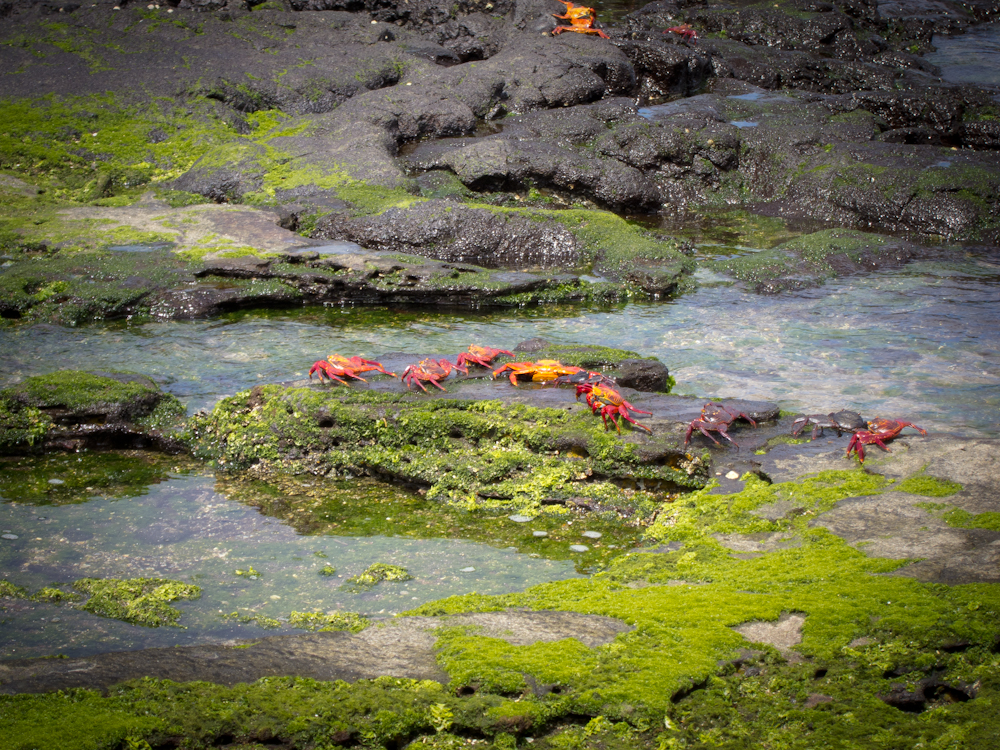
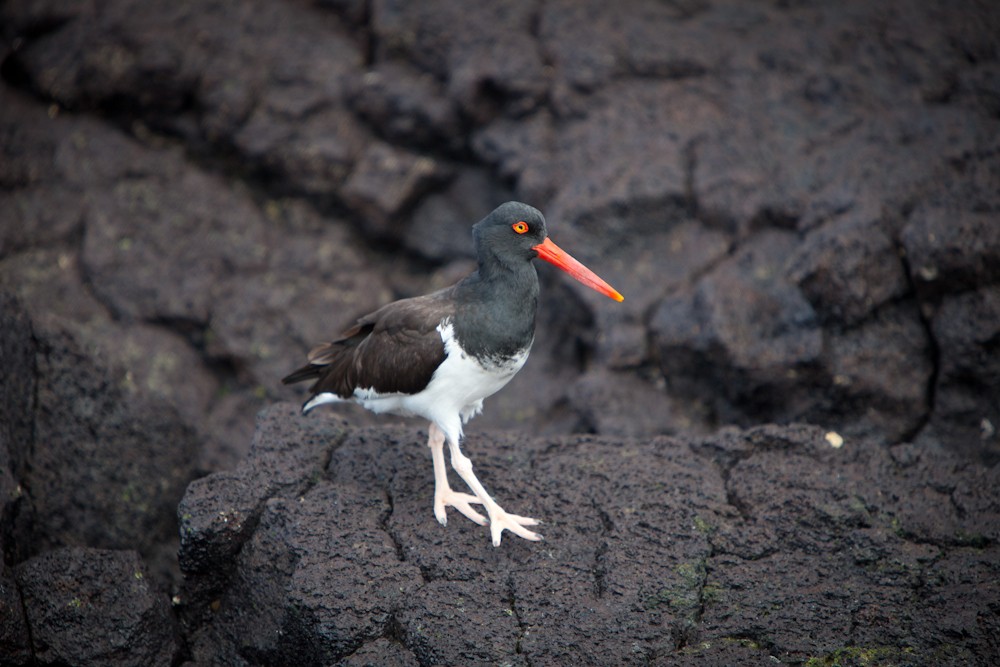
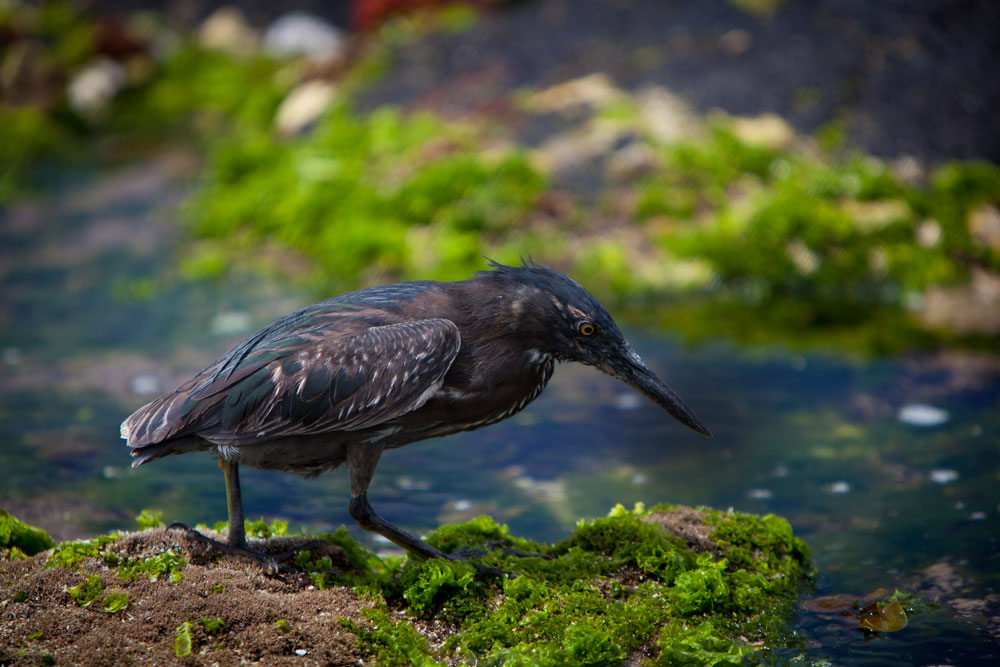
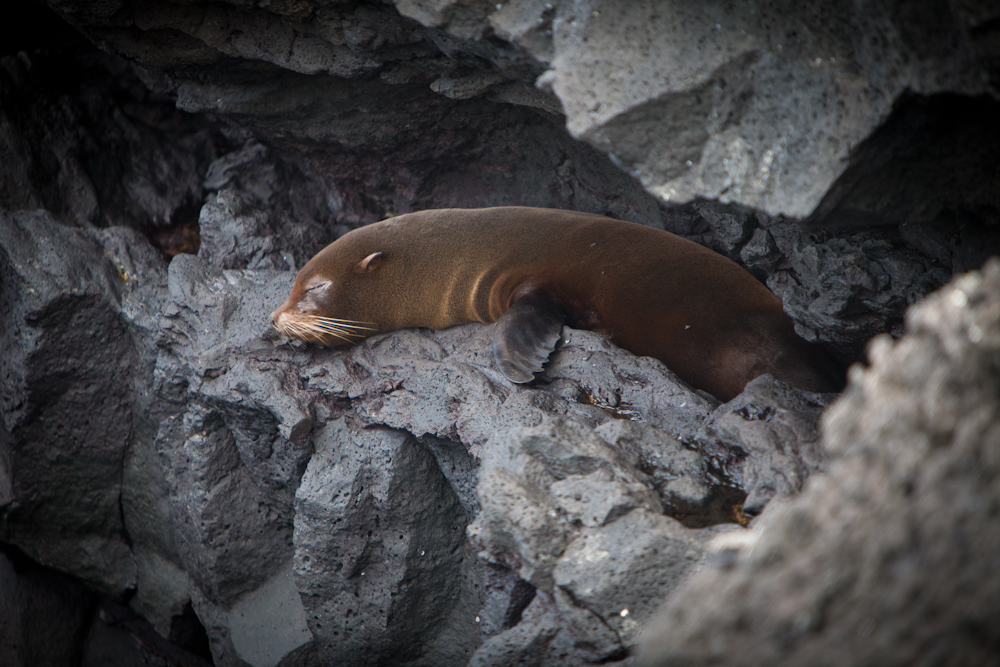
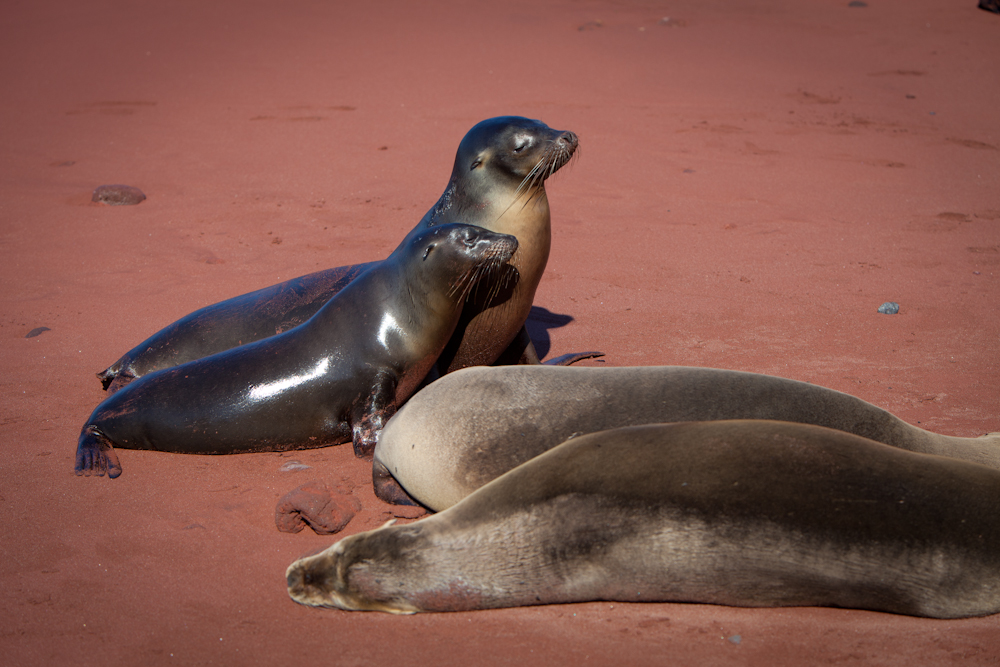
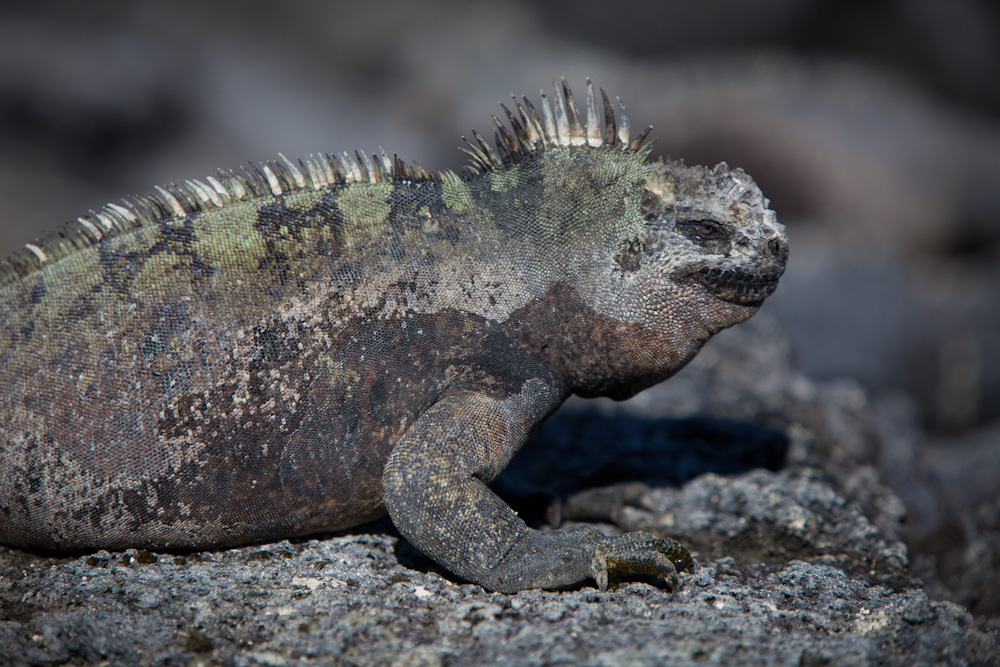
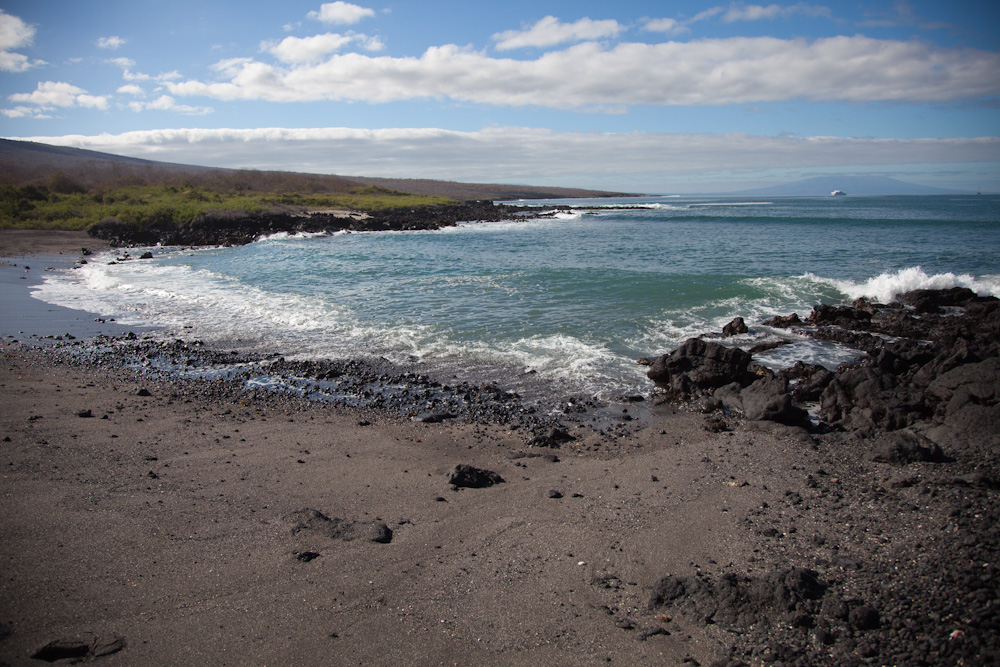
After a dry landing, we explored the tidal area like children on a school trip.  The highlight for me was watching three pups playing in a shallow pool of water.  This was also our first sighting of the Galapagos Fur Seal which is really a sea lion in spite of its name.  We also saw plenty of marine iguanas, sea lions, crabs, and sea turtles.  By now, our group was quite adept at naming birds: look, there’s another oyster catcher, oh and look at that great blue heron.  A few new birds were sighted: the lava heron, the plover, and the white crowned heron.  A few in the group saw two sea lions mating but Chris and I missed most of the show as we were distracted a distance away.
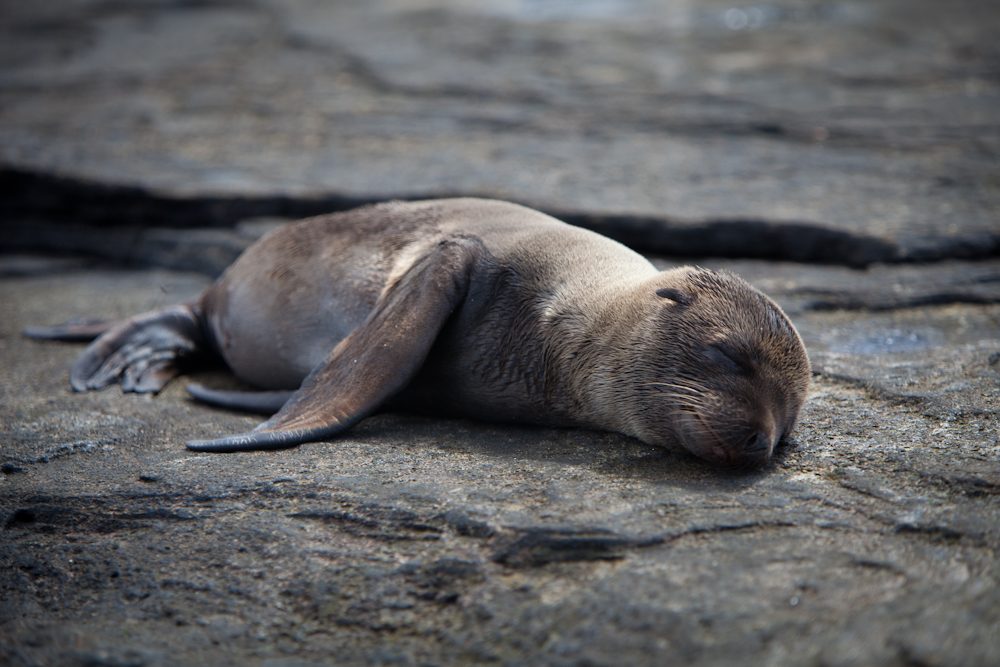

One of the few Fur Seals we saw on this island.

Back at the beach, I was happy to see most of the groups had already departed and the remaining stragglers were wrapping things up.  This meant we had the snorkel site just off the beach to ourselves.  The water was much warmer here and the fish more colorful.  Several sea lions decided to take a swim while we snorkeled.  When one passed by a group of us, Laura, the youngest in our group and a very strong, powerful swimmer took off as fast as she could but there was no competition, the sea lion disappeared out of sight leaving Laura, breathless, in its wake.

I was once again impressed to see Wim, the four year old, swimming side by side with his parents, fearlessly dipping his masked face into the waters.  This little fellow has been a real trouper on this trip.  He has participated in every activity and has shown an interest and curiosity in his surroundings that seems beyond his years.  Not once have I heard him complain or whine, even when the heat has been unbearable and the walks have been strenuous.

The same could be said about all the passengers.  Consider this:  we came together as a group of international strangers, from diverse backgrounds, of varying ages ranging from 4 to 60ish confined to a small boat for eight days.  What are the odds that we would all get along?  I am always curious about group dynamics and this has been no exception.  While some patterns of behaviour were predictable – we all started to sit at the same place at the dining table after day 2, other interactions surprised me.  While two couples were already friends, they did not isolate themselves from the group or limit their contact with others.  To the contrary, they seemed to embrace the opportunity to extend their circle.  Seven of the thirteen passengers spoke English as their second language (very well I might add); yet I never found language to be a barrier, except perhaps with Wim who could only speak German.  He quickly attached himself to Laura, who also spoke German.

As the days passed and we became more familiar and comfortable with each other, the laughter and fun increased.  Here it was day 6 and there were no signs of people getting on each other’s nerves at least none that I could see.  Mind you, if Stephanie mentions her incessant craving for French chocolate one more time, I think someone might be tempted to toss her overboard.  Chris on the other hand has managed to avoid the wrath of the group as he consistently lags behind trying to get that perfect photo by promising everyone copies of the best of his photos.  This was a great group to be with.

After lunch we headed to Rabida, a small island south of Santiago, and most of us retired to our respective cabins for a little siesta time.  Suddenly the emergency bell rang out and we all rushed out of our cabins to see what was up.  Dolphins!  We hurried to the middle deck, binoculars in hand to get a better look.  The captain circled back to where they were first spotted, and after a few minutes the dolphins were back swimming playfully at the front of the boat. 12-15 large dolphins danced in the waves in front of each of the catamaran’s keels.  They switched from side to side, sometimes jumping out of the water in the middle.  They kept just in front of the boat, as if in a race.  Whenever a dolphin jumped – sometimes as high as six feet in the air – we all clapped and cheered in appreciation.  There was one white dolphin that stood out in the crowd – turns out he was an albino dolphin, very rare, in fact the crew had never seen one before!  And then, they were gone as quickly as they had appeared.

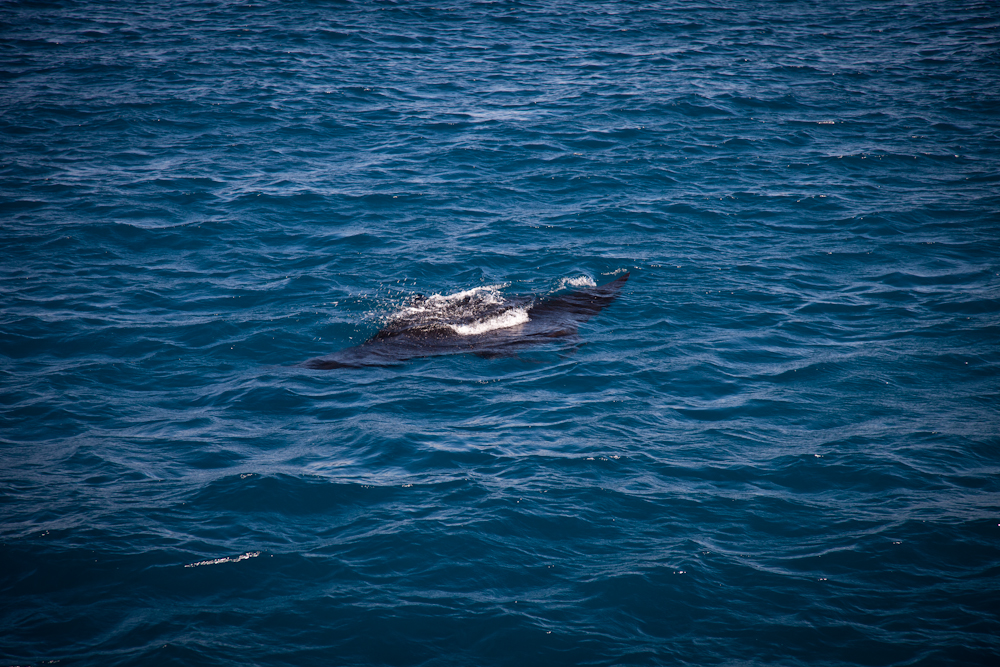
As we scanned the horizon looking for more dolphins, we spotted the manta rays.  These huge creatures floated near the surface and occasionally lifted a fin, appearing almost like a shark.  You could see the dark shape from quite a distance and occasionally a manta would get quite close to the boat.  We joked that we could just skip Rabida and hang out in the open seas as there seemed to be a lot to entertain us.
Rabida is a red island formed millions of years ago by a volcanic explosion that reached the mantle of the earth.  It reminded us of Prince Edward Island.  We were greeted by more sea lions as we made a wet landing on the beach.   Again, a lot of people were already on this island, so we kept our distance and let the other groups stay ahead of us.  During a short walk, we challenged ourselves to find new birds and were rewarded for our efforts.  Tim, with his eagle-like eyes, spotted a grey cuckoo (pictured below), a rare sighting even for our guide.

Snorkeling in Rabida was from the beach, similar to the morning excursion in James Bay.  The water was very murky from the red silt being churned up by the waves and visibility was almost zero for about fifty feet.  We swam along the rocky edge and as we got further out, visibility improved and we began to see much of the same sea life as was saw in the morning.  The water was warm and the fish were colorful and plentiful.   Although we didn’t see anything new this time, there was still a lot to look at.

Another great dinner, an after dinner briefing and then off to our cabins.  Chris and I have been trying to get our studying done for the next three dives of our Advanced Certification course.  It’s a challenge as we’d rather be doing other things, like writing the blog, editing photos or just relaxing or sleeping.  Ah well, it’s a necessary evil. I’ve done two chapters, just one more to go.

Galapagos Islands Cruise Day 5: Swimming with penguins!

As the first group of several to land this morning on Punta Espinoza which is on the youngest island, Fernandina, our guide Enrique did his best to keep a good distance between us and the other groups.  On this island we saw so many marine iguanas that they were becoming commonplace to us – yeah, yeah, another marine iguana.  But we had to be careful as these creatures blended into the rocks so well that it was easy to step on one if you weren’t careful.

Sea lions stole the show on this excursion, especially the mother with her young nursing pup.


It was remarkable to see a majestic hawk swoop down onto a branch within ten feet of our group and remain there as we snapped pictures and took video.   He was within twenty feet of the mother sea lion and her pup and we all hoped he wasn’t sizing up his next meal.

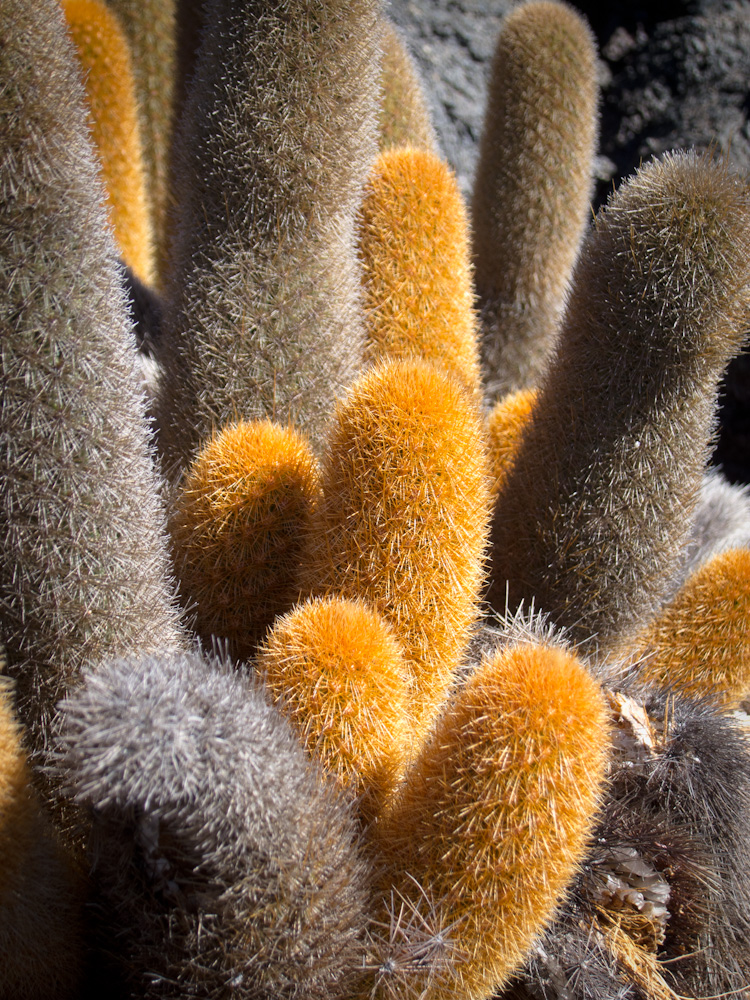
 A gentle breeze cooled us as we continued to walk along the lava rock towards the volcano, making this walk much more enjoyable compared to yesterday’s blistering heat.  Mangrove trees lined the edge of the ocean.  As we moved inland, the Lava Cactus seemed to be the only vegetation to thrive.  In fact, the lack of life both vegetation and animals, at least to our untrained eyes, was noteworthy.

Next stop was Punta Vincente Roca on the northern tip of Isabella Island where we joined three other boats, two of which were dive boats.  As the boat travelled to the next location, we enjoyed some down time on board.

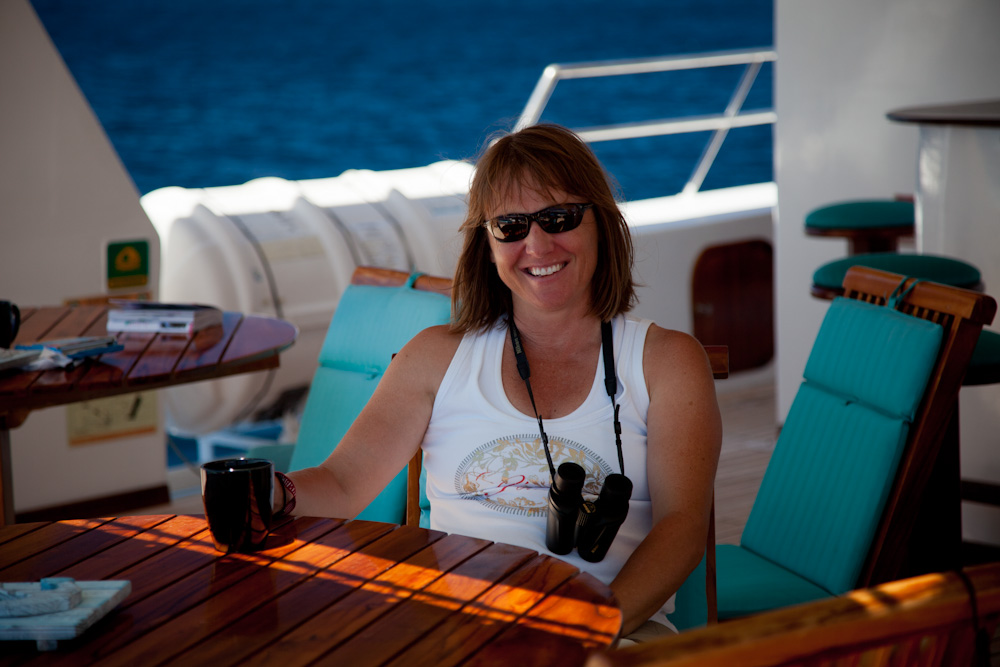
Barb and Tim, a pharmacist, relaxing on board.

Punta Vincente Roca was our next snorkeling site and I am so glad I didn’t miss this one.  On this trip, Chris and I have gotten into the habit of using our diving skills and signals while snorkeling such as maintaining close contact with your buddy (in fact we hold hands).  I have also noticed that I am a much more confident snorkeler now that I also dive.  I apply with ease the skills that I learned through diving like clearing my mask and snorkel.  Snorkeling is part of our daily routine on board, so I am glad I am enjoying it.

We were in the basin of a crater that had collapsed into the sea millions of years ago and which now formed a sheltered bay, close to a stony beach, and surrounded by walls of rock.  Our guide directed us to stay close to the shore and to simply float effortlessly in the surge.  This area was renowned for sea turtles and today was no exception.

At one point, we found ourselves surrounded by twelve large sea turtles, all of us floating in unison with the surge.  We were at one with the turtles!  It’s no wonder there is so much sea life as food is plentiful; hundreds if not thousands of tiny fish engulfed us.

Suddenly, a penguin torpedoed past us.  He was so fast he was gone before we fully realized we had just seen our first penguin in the water.  More penguins shot out of nowhere and darted around us.  We watched one little fellow feeding directly below us only to have him suddenly shoot vertically to the surface directly in front of our faces.  We watched a couple of penguins playing on the surface.  Dafne, the only person with an underwater camera, was desperately trying to capture them on film – and she succeeded!

To top it off, a sea lion caught a fish on land and then dove in right in front of us, eating his fish as he swam by us.  Incredible!  Now this was what I was hoping for in the Galapagos Islands!

Next we toured the bay from the dinghies, exploring a deep cave, and discovering all the birds clinging to the cliffs above.  We saw many blue footed boobies, bobby tern, pelicans, penguins and flightless cormorants.  A group of about eight or ten Galapagos penguins decided to swim alongside our boat, bobbing to the surface every now and then so we could track them.  I tried to capture them on video but they were so fast it was next to impossible.  Still, it was a thrill to travel alongside them.

It was here that I saw a Mola Mola Sunfish for the first time.  In fact, I saw three of them.   They were swimming close to the surface letting us catch a glimpse of them.    Mola Mola is the heaviest known bony fish in the world. It has an average adult weight of 1,000 kg (2,200 lb). The species is native to tropical and temperate waters around the globe. It resembles a fish head with a tail, and its main body is flattened laterally. Sunfish can be as tall as they are long when their dorsal and ventral fins are extended.

Photo courtesy of oceansunfish.org

We had a lot of distance to cover as we were travelling around the northern tip of Isabela and onto the eastern side of the island.  We celebrated as we passed the equator, by gathering in the captain’s bridge to take photos and enjoy a complimentary cocktail.  Our time in the Northern Hemisphere would be limited to a few hours before we returned to the Southern Hemisphere without fanfare.  We were warned that this passage was going to be long (6 hours) and rough.  As a precaution, we had our briefing before an early dinner that night.

The sea did indeed get a little rough, but nothing we couldn’t sleep through.  Not one of the passengers has been sea sick so far, probably in part due to the relatively calm waters as well as the fact that our yacht is a catamaran which makes it more stable.


Galapagos Islands Cruise Day 4: Whales!

Chris and I awoke before dawn at 4:30 and headed to the top deck to see the crescent moon on the horizon and the star filled sky.   The yacht was still anchored in Elizabeth Bay and would be setting off again at 5:00 am.  By the time we lifted anchor, the clear sky had clouded over with dark, ominous clouds.  We thought perhaps our luck had run out  the seemingly endless sunshine enjoyed thus far was now over.  As the yacht sailed north to Urvina Bay at a steady pace of 10 knots per hour, the sky ahead brightened and by breakfast we were enjoying full sunshine again.


We did our first wet landing this morning, where the dinghy lands on a beach and we all get out in knee or hip deep water and make our way to shore.  Theoretically, this is a rather straight forward process.  Today, however, the waves were quite high and timing was everything.  After several failed attempts, we made it to shore and everyone jumped out as quickly as possible fearing the waves would pull us back to sea.

Once we were secure on land, a hawk surprised us with a sudden visit on the beach and provided an excellent photo opportunity as he hopped about in front of us.

The search for land iguanas began.  At first we noted the holes dug by the iguanas and soon enough we met our first one on the path.  It is remarkable that we can get so close to animals and they don’t appear to be fearful whatsoever.  Even the birds come close and stick around for a while allowing everybody to take pictures.


Back on the beach, the plan was to go snorkeling but our guide recommended against it.  Not only was it dangerous as the waves crashed into the rocky shore, the visibility would be poor as well.  A few in the group went for a swim instead.  Chris and I opted to stay on shore and walked along the beach.  The coarse, black and white sand was so different from the fine powder we had seen on other beaches. Chris took advantage of this time to take some photos of our group.

Enrique, our capable and knowledgeable guide.

Dafne and Jasper from Holland.  Dafne is a web designer and Jasper introduced himself as a fireman but we later learned his work involves a lot more.  For instance, he is also a rescue diver and paramedic.

Laura, the 18 year old student from Germany.  She is enjoying her “gap” year travelling and volunteering before she goes to medical school next year.

Jasper kindly took many pictures of Chris and I together – I think he liked playing with Chris’ camera!

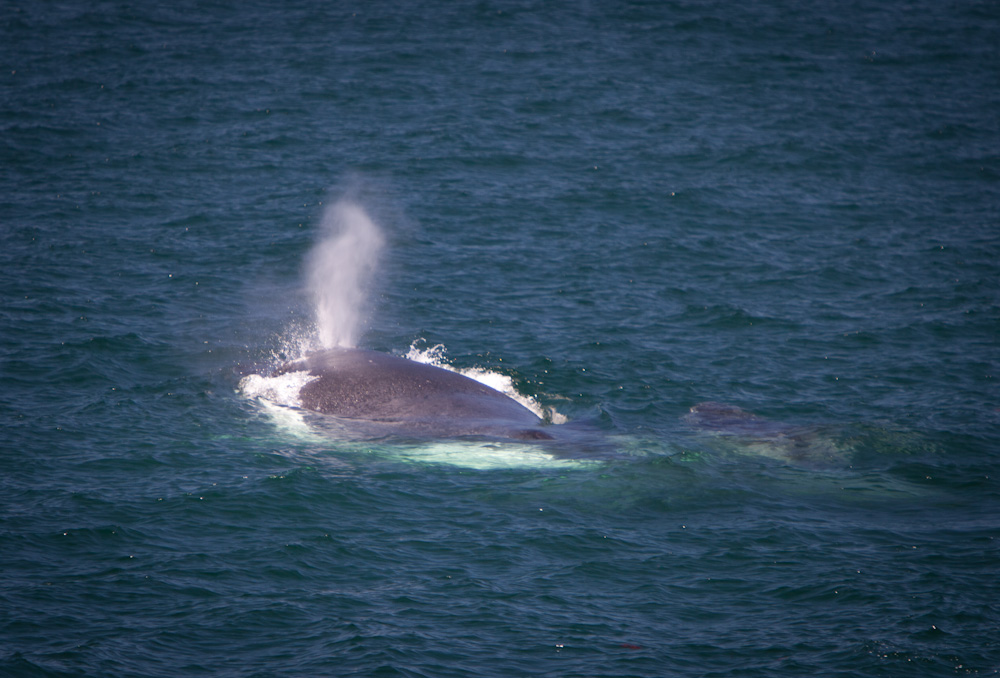
We were once again on the move, continuing north to Tagus Cove where we would eat lunch and spend the afternoon snorkeling and kayaking.  Along the way we spotted a humpback whale and her calf in the distance.  We tracked her for a while but then lost sight of her as we headed into the protected cove.  After lunch, she was spotted again and the captain and crew obliged us with a whale chase, taking up anchor and pursuing the whale, much to everyone’s delight.  All the guests were on the upper two decks, cameras and binoculars in hand.  We tracked the mother and calf  as they swam in unison, coming up now and then to the surface, but unfortunately not breaching.  On board, there was a steady play by play – here she comes, there she goes as we all tried to get a good look and an equally good picture. She treated us a few times with a great view of her fluke (tail fin) as she slapped it down into the water.  This was better than a siesta any day.

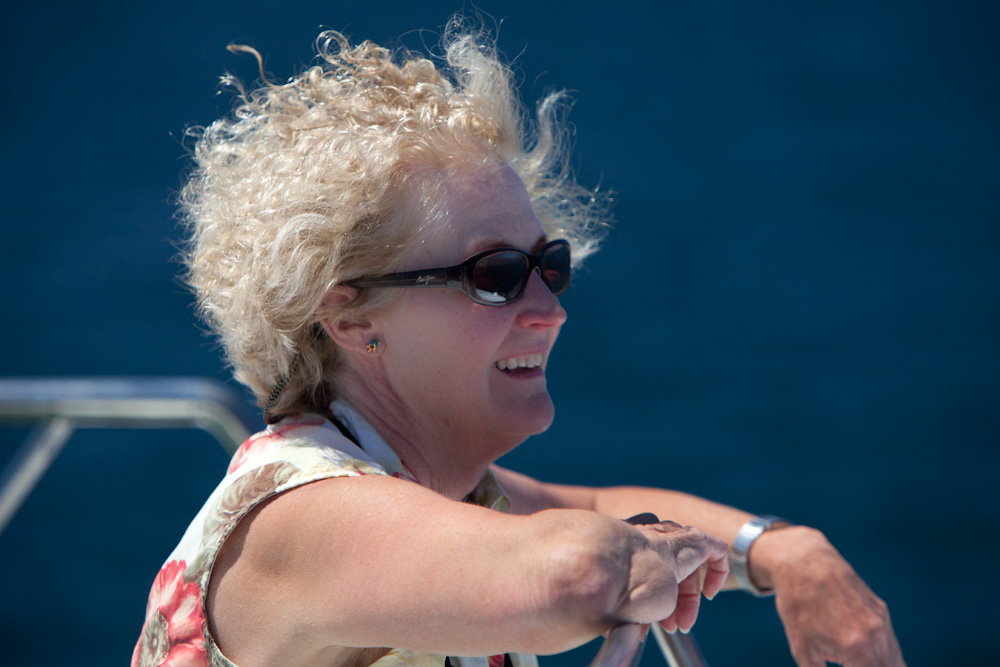
This candid shot of Rick (with his wife Babs in the background) seemed to capture the essence of Rick in all his exuberance and expressiveness.  His friends confirmed that this was classic Rick, who, by the way is a financial advisor.

Babs, a retired occupational therapist who worked with special needs children, was captured enjoying the moment and the view in this candid shot.

Finally, we turned around and headed back for the cove to resume our scheduled activities: lunch, snorkeling and kayaking.  Chris and I decided to stay on board; I was feeling pretty lousy from my cold and I think Chris just felt like relaxing.   We shared the middle deck with Barb who, like us, decided to spend the afternoon reading and relaxing.  Enjoying a drink on deck surrounded by beauty was not the worse way to spend an afternoon.

Barb, a property manager, enjoys the middle deck and a good book while the others are off snorkelling and kayaking.

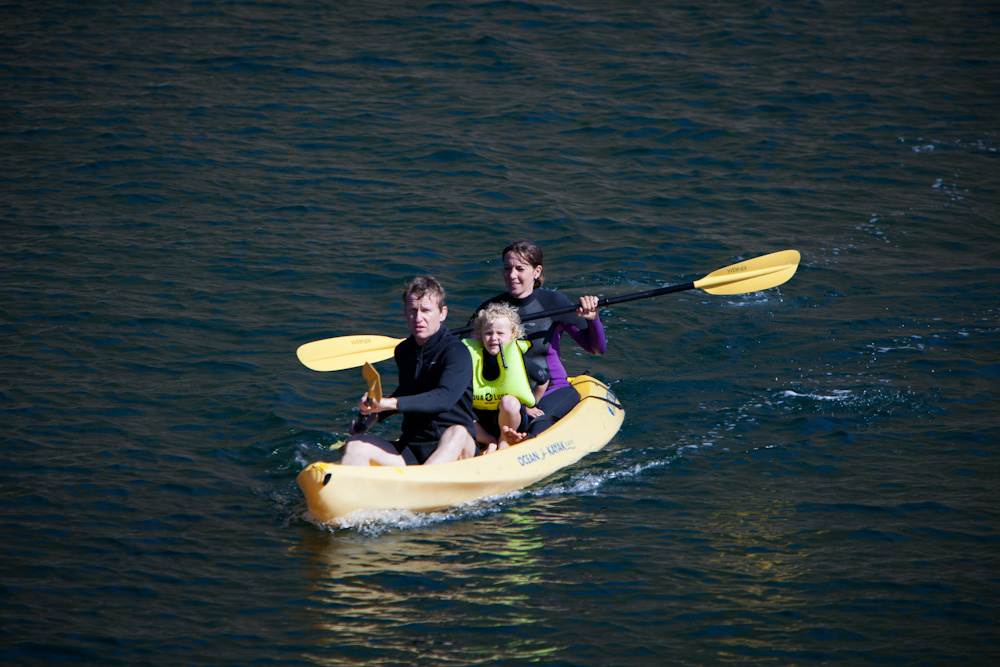
Olof, Christiana and Wim, the family from Germany, explored the bay in the kayak.

Later in the afternoon, we once again loaded into the dinghies for a hike to the edge of Darwin Lake.  As we left the yacht, a sea lion decided to check out our catamaran and jumped up onto the first step, and then continued up the stairs to the lower deck at the encouragement of the crew.

It was a dry landing along the rocky shore and a steep walk to the beginning of the trail with several sea lions sunning in our path.  We were on the hunt for four birds:  the Darwin Finch, Vermillion Fly Catcher, Large Billed Fly Catcher and the Carpenter Finch.  We ascended slowly under the glaring sun surprised at the intensity of its rays this late in the day. Several lookouts offered spectacular views of Darwin Lake and the ocean beyond.

We spotted many Darwin Finches and a few Mockingbirds but the other birds eluded us.  The final lookout gave us a spectacular view of Wolf Volcano, the highest peak in the archipelago at a height of 1,707 m (5,600 ft).

We descended as the sun was setting and in the dusk we caught a fleeting glimpse of a Large Billed Fly Catcher, but this little bird was too fast for us to capture in a photo.  Now that the heat of the day had passed, there was a lot more birds flitting about along our path, but the Vermilion Fly Catcher and Carpenter Finch remained elusive.

As we made our way back to the dinghies, we had to manoeuver around a very large sea lion who was laid out along the stairs directly in our path.  It took some coaxing, but we finally convinced him to let us pass.  A couple of more sea lions tried to intercept us as we walked down the rocky slope.


Back on board we followed the now very familiar routine: rest and clean up before dinner followed by a briefing by Enrique for the next day.   After dinner, a few stayed up to play cards or read, but Chris and I retired early to our room.  I was feeling pretty lousy today because of my cold and it was for the first time since leaving Canada I yearned for home, not necessarily my home, but the comforts of a home where I could just lie in bed and recuperate.  I figured a good night’s sleep would be the best cure.