 Yesterday afternoon, we stumbled upon La Ciudad Blanca (the White City) located at the foot of Cerro del Carmen. Our discovery began when we observed a funeral procession leaving a church. As a large group of mourners walked behind the coffin bearers, we assumed they must be heading towards a cemetery. Our guide book confirmed that we were indeed in the vicinity of the city’s cemetery. Frommer’s described the cemetery in this way: “The cemetery has some impressive above ground marble tombs and mausoleums in a variety of styles ranging from neoclassical Greco-Roman to baroque to Moorish. The tombs are spread across a vast hillside area and connected by paths and even streets. The cemetery was opened in 1843 and has become a major emblem of the city.” This was enough to peak our interest to seek out the cemetery but in the end this description hardly did justice to what we saw.


At the main gate, vendors sold beautiful flower arrangements, a typical sight at the entrance of many large cemeteries. However, this cemetery was anything but typical as we discovered immediately inside the gates. Six three-story buildings – they looked like apartment buildings – flanked a majestic walkway that lead to a large alter and cross. Each building housed hundreds of stacked vaults. I stopped counting after seeing 20 such buildings, each of which had four corridors on each floor. Each corridor had 24 vaults on each side, 4 vaults high. I thought this was the extent of the cemetery which is why I tried to calculate how many vaults resided in these buildings.


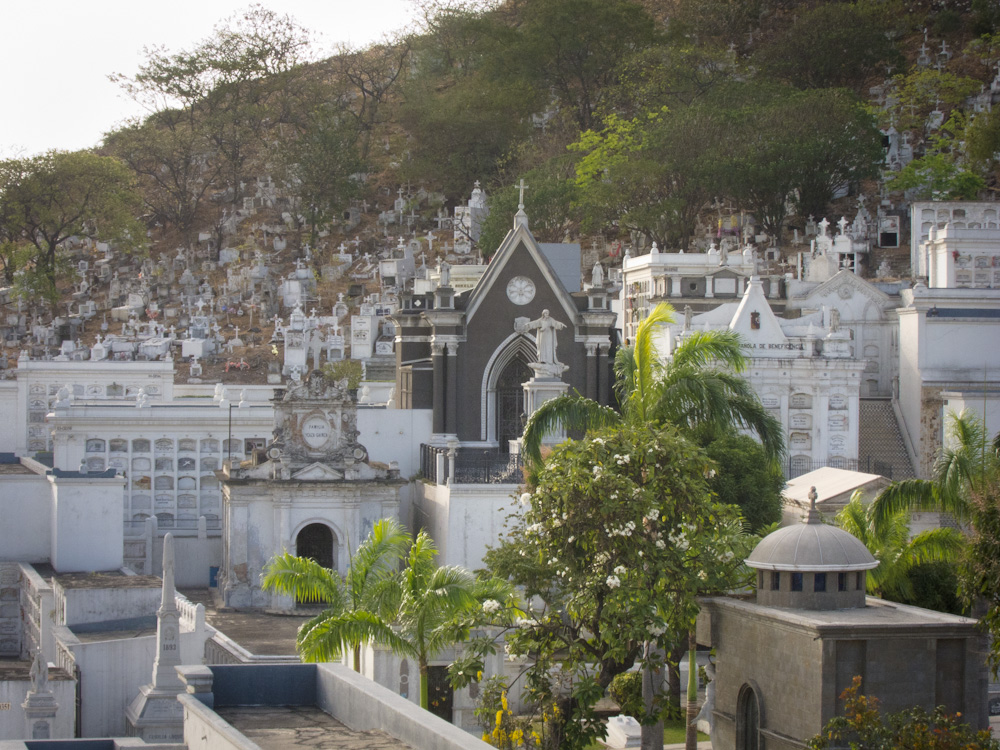 However, as we walked past the “apartments”, we were stunned by what we saw – an entire city of tombs lay before our eyes. As Frommer described, there were many architectural styles to these tombs. Once could easily forget that this was a cemetery as it looked more like a museum of beautiful statues and reliefs. The cemetery is indeed like a city of the dead, as there are main avenues, side streets, and stairways connecting each area.


There were large, beautiful family mausoleums along the main boulevard. Each one was distinct. As we walked amongst these mausoleums, the beauty and tranquility engulfed us.

The back of the cemetery is reserved for foreigners and was originally called “Protestant Cemetery”. There is a 200 foot separation between this area and other sections of the cemetery to ensure the “souls do not mix”. A few meters behind is the Jewish cemetery, distinguished by their graves on land and the Star of David on gravestones that are written in Hebrew. I also noticed another area of Jewish tombs (similarly distinguished by the Star of David), on the roof of one of the “apartments” (see above photo).
This was truly a remarkable and unique cemetery. What an impressive way to end our tour of Guayaquil.
