A new low in Israel

During our week in Jerusalem, we squeezed in a couple of day trips that we organized ourselves using public transportation which is very easy to use, affordable, reliable and comfortable.  We spent half a day exploring the ruins of Masada which is Israel’s most popular paid tourist attraction, we indulged in an afternoon floating 423 metres below sea level in the Dead Sea, and we ventured over  the border to Palestine to spend a few hours exploring Bethlehem.

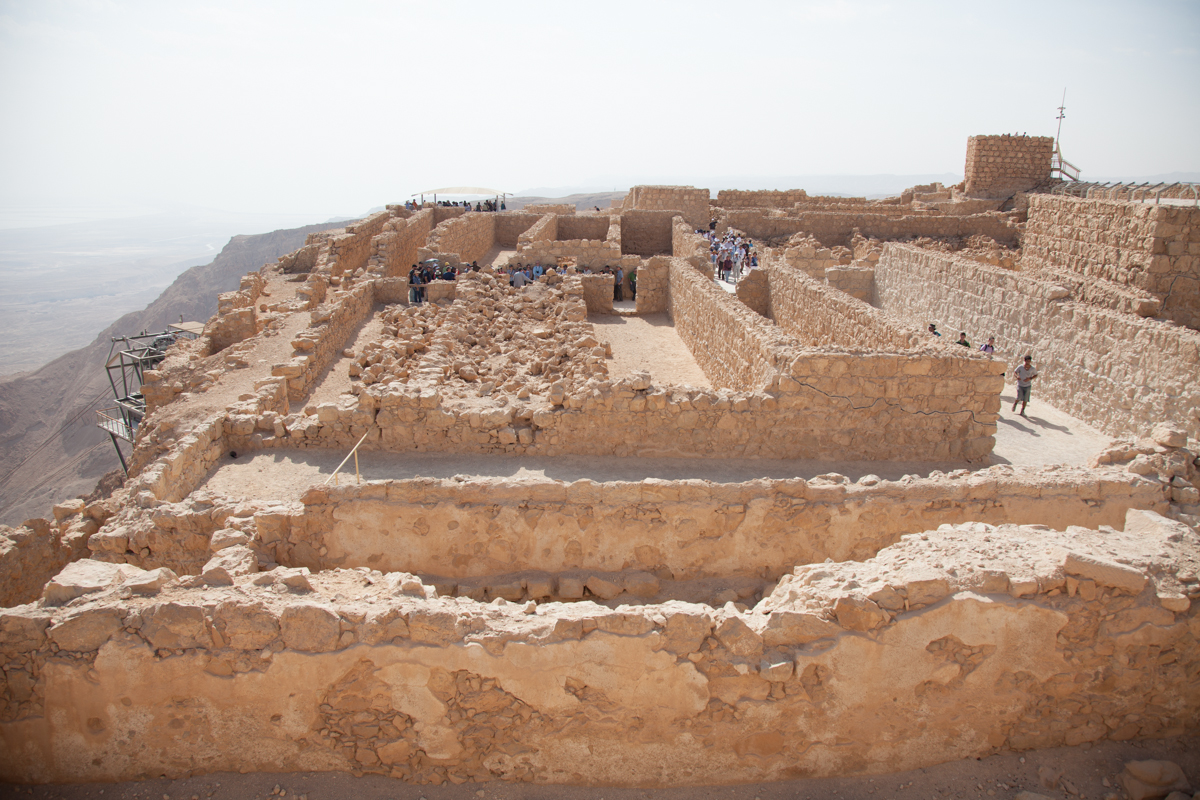
Masada is an ancient fortification on top of  an isolated rock plateau on the eastern edge of the Judaean Desert, overlooking the Dead Sea.  This is the place where 960 Jewish extremists known as the Sicarii committed mass suicide after being holed up here for months under seige by the troops of the Roman Empire.  This all happened shortly after the Second Temple was destroyed in 70 CE.

When we arrived at about 9:30 in the morning, it was already close to 40C making the decision to walk up the mountain or take the cable car an easy one to make. The air-conditioned cable car whisked us to the top in just five minutes giving us lots of time to explore this impressive archaeological site on the mountain top.  The audio guide that we purchased in addition to our entrance fee tickets was one of the best we have ever heard and well worth the extra cost.  As we walked through the ruins, the narrator explained what each area was, as well as provided a captivating history lesson.

Aside from the infamous seige and mass suicide, I knew very little about this site.  According to the 1st century Jewish Roman historian, Josephus Flavius, Masada was fortified by Herod the Great between 37 and 31 BCE as a refuge for himself in the event of a revolt.   We saw the remains of the two grand palaces at opposite ends of the hill top, Roman bath houses, the synogogue built by the rebels, the elaborate water system including huge cisterns, and many storerooms.  There was enough water and food stored on this hill top fortress to support an army for many months, even years.  So why did the Jews commit suicide?

In 72 CE, the Roman army established camps at the base of Masada (the remains of which are clearly visible to this day), laid siege to it and built a circumvallation wall. They then constructed a rampart of thousands of tons of stones and beaten earth against the western approaches of the fortress and, in the spring of the year 74 CE, moved a battering ram up the ramp and breached the wall of the fortress. On the eve of their capture after a 3 year siege, Josephus dramatically recounts the story told to him by two surviving women. The zealots – almost one thousand men, women and children – led by Eleazar ben Ya’ir, decided to burn the fortress and end their own lives, rather than be taken alive by the Romans.

View from the East side where the cliffs are 400 m high.

Dead Sea in the distance.

Massive store houses held years’ worth of provisions.

Ramp on the Western side built by the Romans.

Remains of one of the Roman camps where thousands of
soldiers 
lived while the city lay under siege. 

At the base of the mountain there is also a museum, admission to which is included with the audio guide. Although the museum is rather unique in that it provides a theatrical re-enactment of the siege of Masada along with a few artefacts, I didn’t find it offered much value.  If you’re short on time, it could easily be skipped.

View of cable car from the top.  We decided to walk down – a thirty minute
descent that wasn’t too hard but it was extremely hot. 
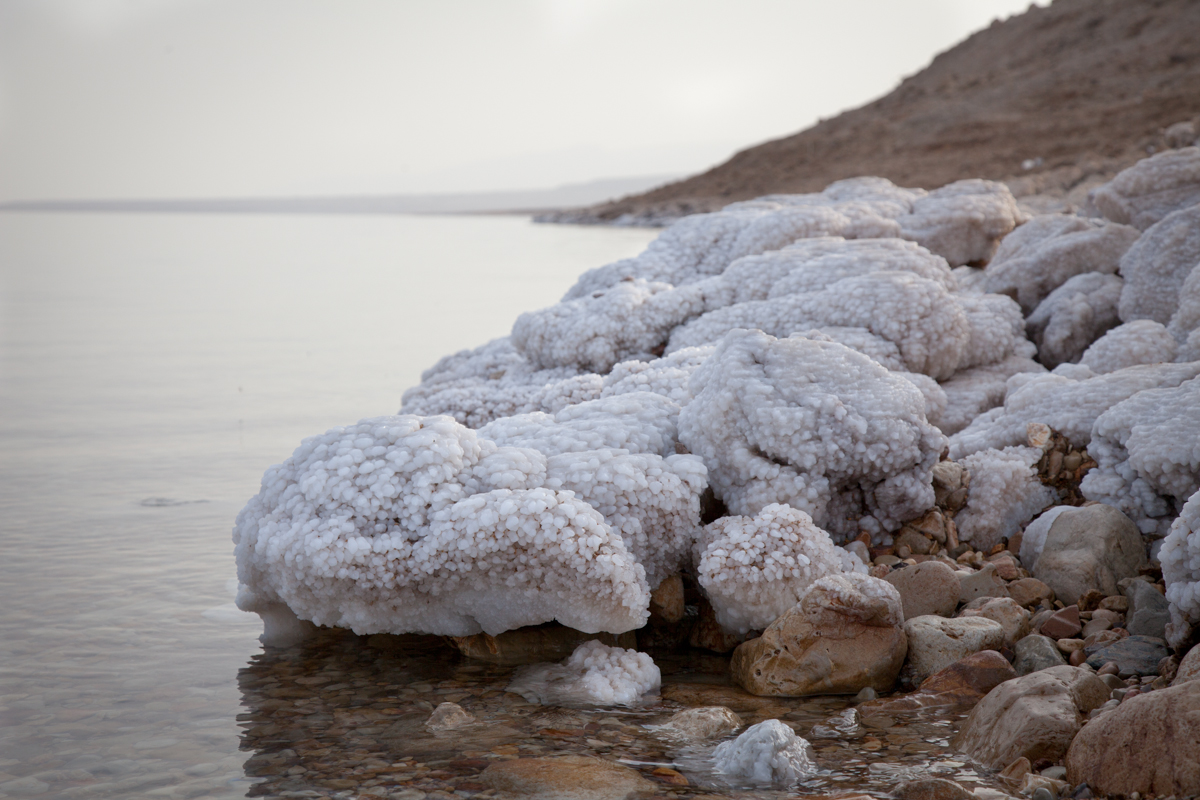
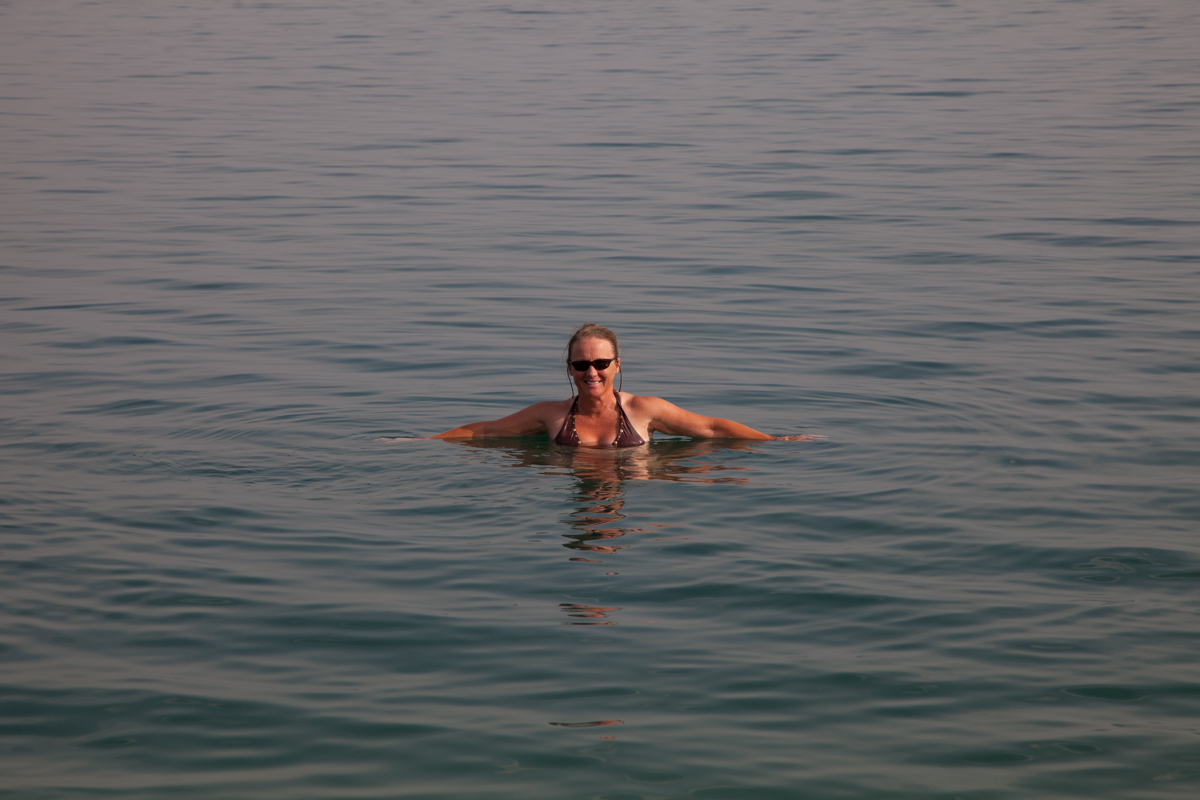
After a full morning at Masada, our next stop was the Dead Sea, earth’s lowest elevation on land, and thus our “new low” in Israel. People have been coming to the Dead Sea for millennia to avail themselves of the therapeutic effects of the water and air in this region.  There are many beautiful resorts all along the Dead Sea, but we decided to visit it on a budget and go to a public beach instead.  Besides, we thought we’d just have a quick dip to see what all the fuss was about, and then head back to Jerusalem.  Little did we know that we would float in the Sea for several hours, even luxuriating in a natural mud bath which left our skin feeling as soft as a baby (although rather stinky I might add), before returning to Jerusalem at sundown.
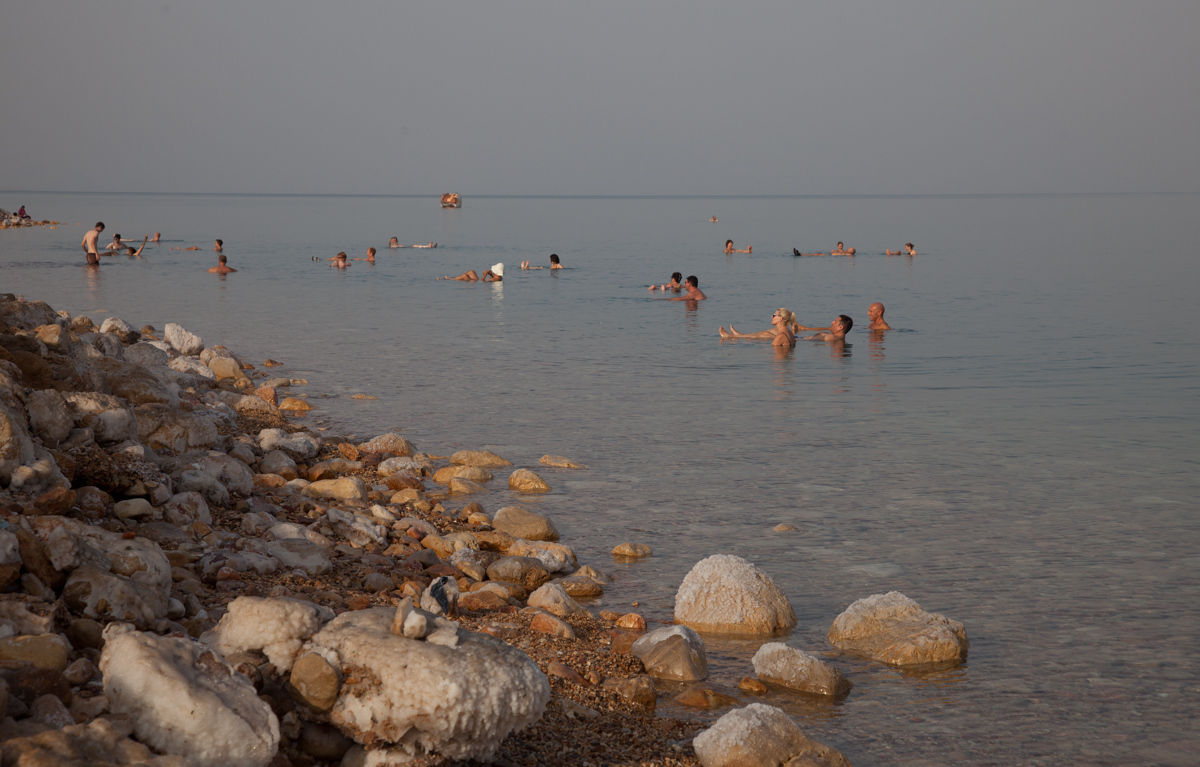
So, do you really float in the Dead Sea?  Yes, like a cork!  It felt like you had a life preserver on making it very difficult to swim properly.  The water is so salty (8.6 times saltier than the ocean) that you must use extreme caution not to get any water in your eyes.  After losing my balance, I splashed a mere drop or two of water into my eyes causing extreme pain, and forcing me to seek relief with a rinse of fresh water.  Floating around effortlessly in the calm water was so relaxing, we could have spent many more hours there.

Video:  Floating in the Dead Sea

Our final excursion was a visit to Bethlehem, the birthplace of Jesus.  In my fertile imagination, I had conjured up a place that looked like a country village with sandy streets where donkeys and oxen were still used for transport.  Instead, we were dropped off on a busy thoroughfare in the middle of this city with a population of about 25,000 people, of whom the majority are Muslim, but it also has one of the largest Palestinian Christian communities.  Located on the central West Bank, just south of Jerusalem, it has been governed by the Palestinian National Authority since 1995.

Bethlehem’s economy is tourist driven, and the main attraction that brings in throngs of tourists each year, peaking during the Christmas season, is of course the place where Jesus was born.  The Church of the Nativity stands in the center of the city — a part of the Manger Square — over a grotto or cave called the Holy Crypt, where Jesus supposedly was born.  We had been duly warned that there would be hordes of tourists and long lines to enter the Holy Crypt, and sure enough, the tour groups were out in full force.  Luckily, people who were not in  tours were allowed to avoid the long lines altogether and enter through the exit, two at a time.  We again saw people venerating this site by kneeling down and kissing the stone upon which the manger supposedly laid.

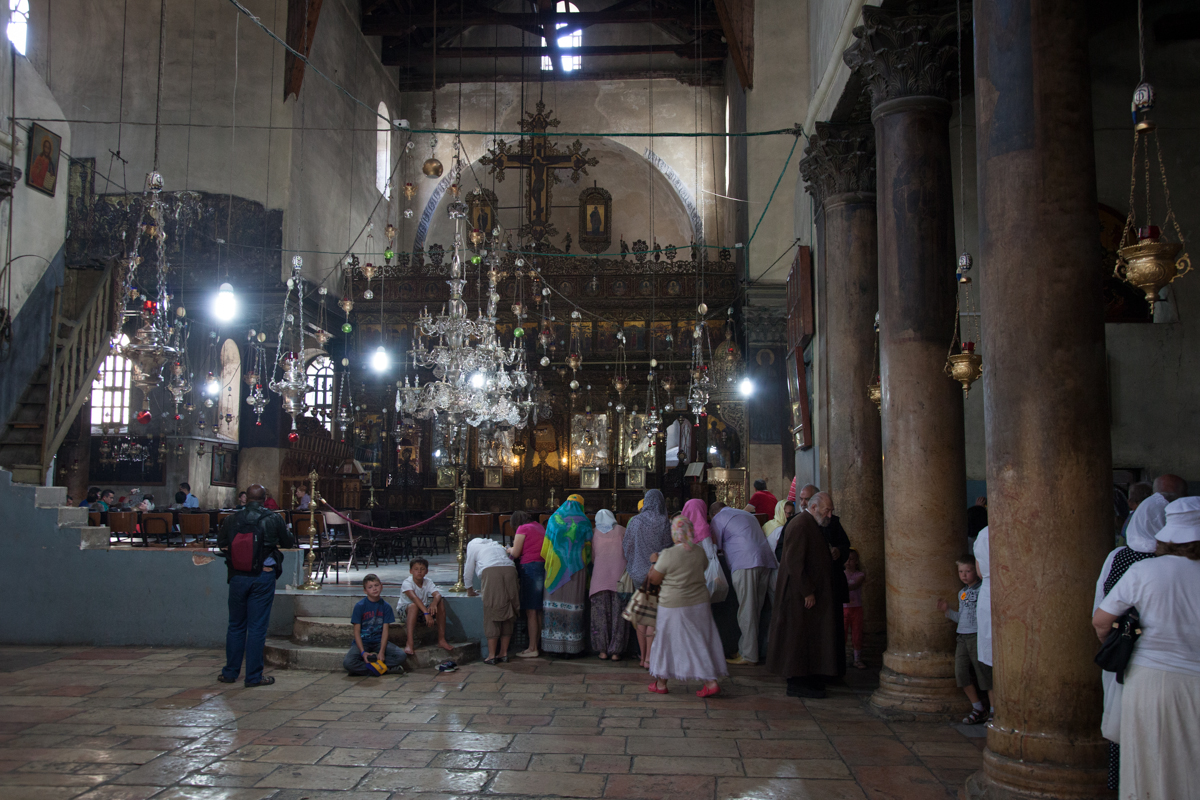
Manger Square

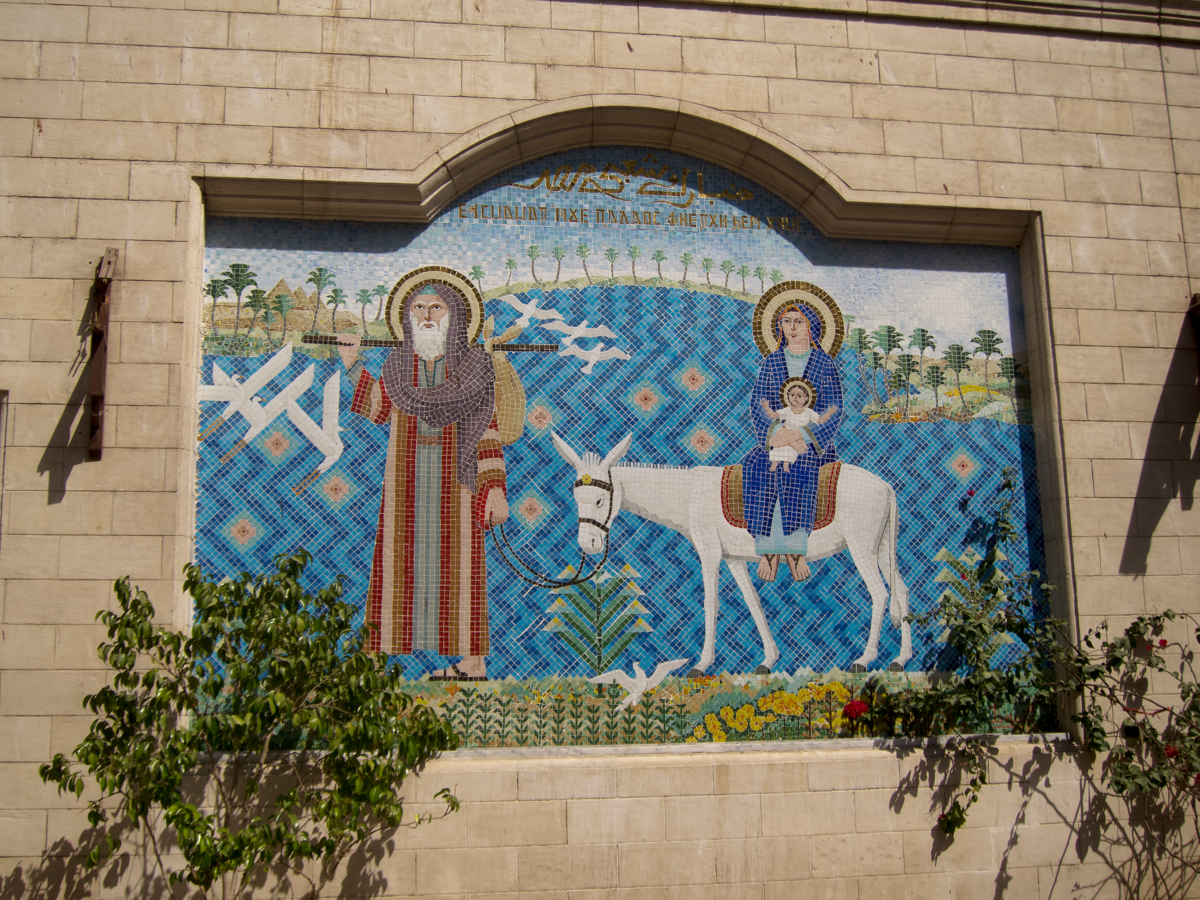
Around the corner from the church on a street of the same name, is the Milk Grotto where the Holy Family took refuge on their flight to Egypt.  Legend has it that Mary stopped to breastfeed Jesus here, and when she spilt some milk it turned the stone of this cave a “white stone” color.

We had our own little miracle on the road from Bethlehem when we stumbled upon a Starbucks. Our mouths salivated at the thought of a good cup of coffee, something we haven’t had for months, but our hopes were dashed when we realized the coffee shop we were staring at was called Stars and Bucks.  They still made a damn fine cup of coffee, quite possibly the best we’ve had in the Middle East, and a delicious milk shake concoction of ice cream, fresh fruit, nuts and dried fruits which we thoroughly enjoyed after our coffee.

While we were in Bethlehem, we walked to the wall that divides Israel and Palestine. At 8 metres in height, the concrete, graffiti painted wall is a formidable presence.

When returning by bus from Palestine to Jerusalem (Israel), we passed through one check point where our passports were examined carefully.  The Palestinian woman who sat beside me on the bus expressed clear disdain for the guards manning the checkpoint.  She told me in her limited English that I should tell all my friends at home what trouble the Israelis were causing the Palestinian people as exemplified by the border crossing we were passing through.

I must admit that I am quite ignorant about the complex political situation in this region and it is something I will research more fully as our short visit to Israel has certainly piqued my interest.  My one regret during our visit was that we did not take a guided tour that may have given us some insight into both the Israeli and Palestinian perspectives of the complex issues that impact their daily lives.

A visit to the Holy Land

Jerusalem is a holy city to three major religions (Judaism, Christianity, and Islam), and is one of the oldest cities in the world.   It is the holiest city in Judaism and the spiritual center of the Jewish people since the 10th century BCE, the third-holiest city in Islam (next to Mecca and Medina)  and it is also home to a number of significant and ancient Christian landmarks.  You don’t have to be religious to appreciate the intriguing history of this city.

We stayed at Abraham’s Hostel, one of the best hostels we have stayed in so far in our journey around the globe, even though we had to spend the week in a 4-bed dorm because it was booked solid.  This is also the largest hostel we have been in with close to 300 beds.  This place was designed with the international traveller in mind offering many on-site services like a functional, well equipped kitchen, self-service laundry machines, a bar complete with happy hour, separate tv room with large screen tv, a tour operator, not to mention the daily tours and events on offer.  The hostel attracts a diverse clientèle from young backpackers to small families to older folks like us.  There’s room for everyone in this clean, modern, purpose-built hostel.

Even though I am no longer religious, I do have a pretty good knowledge of the bible from my Jehovah’s Witness upbringing.  I must admit that when we arrived in Jerusalem, I was immediately filled with a sense of awe and wonder that I was actually in a place that held so much historical significance. Mind you, it does take some imagination to connect the stories in the bible with the modern day locations of where bible events were supposed to have taken place.   For instance, the bible says Jesus was killed on the Hill of Calvary and buried in a tomb close by. Well, today, you can visit Jesus’ supposed place of death and burial which is claimed to be inside the Church of the Holy Sepulchre, apparently the most holy Christian place on earth.

We spent the week visiting as many sites as we could both within the city and a few side-trips beyond.  Here’s some of the highlights of what we saw in Jerusalem this week.

Old City

Just 15 minutes walk from our hostel, we went to the Old City several times throughout the week.  On the first visit, we joined a walking tour which gave us a good overview of the four main quarters: Jewish, Christian, Muslim and Armenian.  The Old City has a large local population of mixed religions in each quarter.  The winding streets and narrow alleyways are clogged with homes, shops, tourists and locals.

The Old City is home to several sites of significant religious importance: the Temple Mount and its Western Wall for Jews, the Church of the Holy Sepulchre for Christians, and the Dome of the Rock and al-Aqsa Mosque for Muslims.

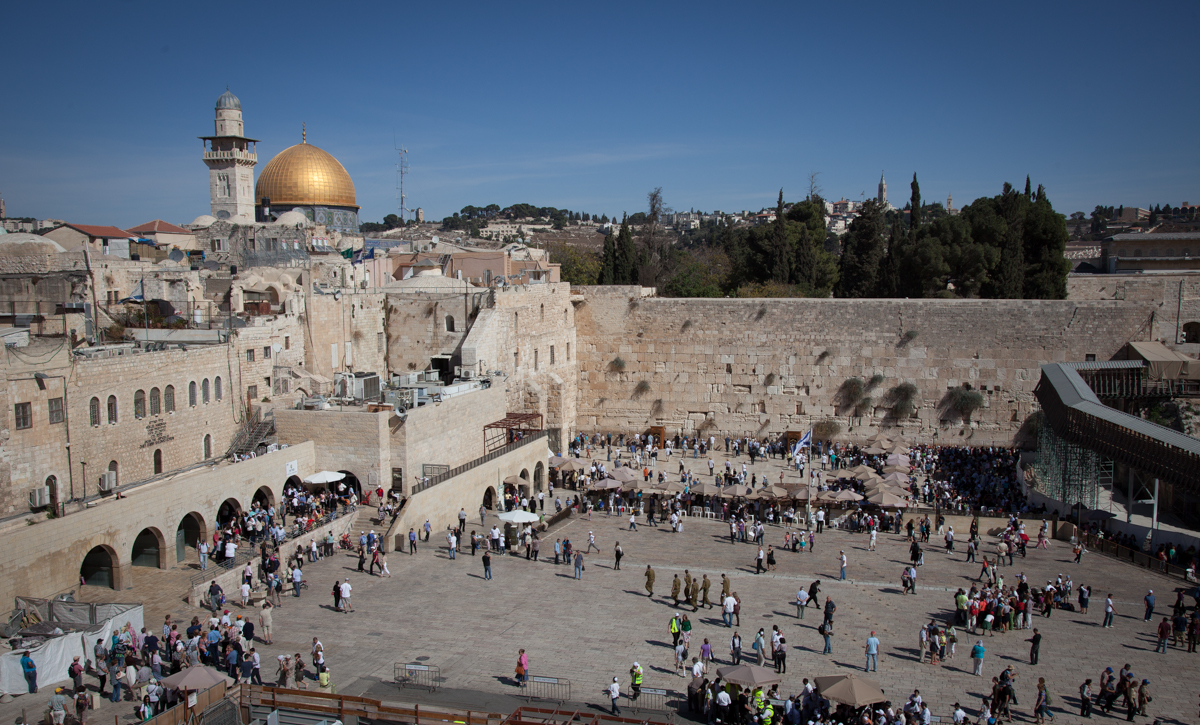
Both the Temple Mount and the Western Wall filled me with an overwhelming sense of awe because of all the history that has occurred on these sites.  The Western Wall, also called the Wailing Wall, was much smaller than I had imagined it to be.  Divided by gender, two thirds of the wall is reserved for men, and one third for women.  This is where people of all faiths come to pray, often quite passionately.  One morning, we spent about an hour, sitting on our respective sides, watching those around us.  I found it to be a very emotional, moving experience as I watched people pray so intensely and with such conviction, some even crying out their supplications to their God.  The rock wall was riddled with tiny pieces of paper with prayers, stuffed into every crack.

Today, the Dome of the Rock sits in the middle of the Temple Mount which is where Solomon’s Temple used to be, as well as the rebuilt Temple from Jesus’ day.  Tourists are permitted to go to the Temple Mount during limited hours, which means there is always a long line-up, usually over an hour long.  As much as we hate line-ups, I’m glad we didn’t miss this opportunity to visit the Temple Mount.  Non-Muslims are not permitted in the mosque, which is the third most holy mosque in the world for Muslims (behind Mecca and Medina) but it was still interesting to walk around the site, which was much larger that I expected.

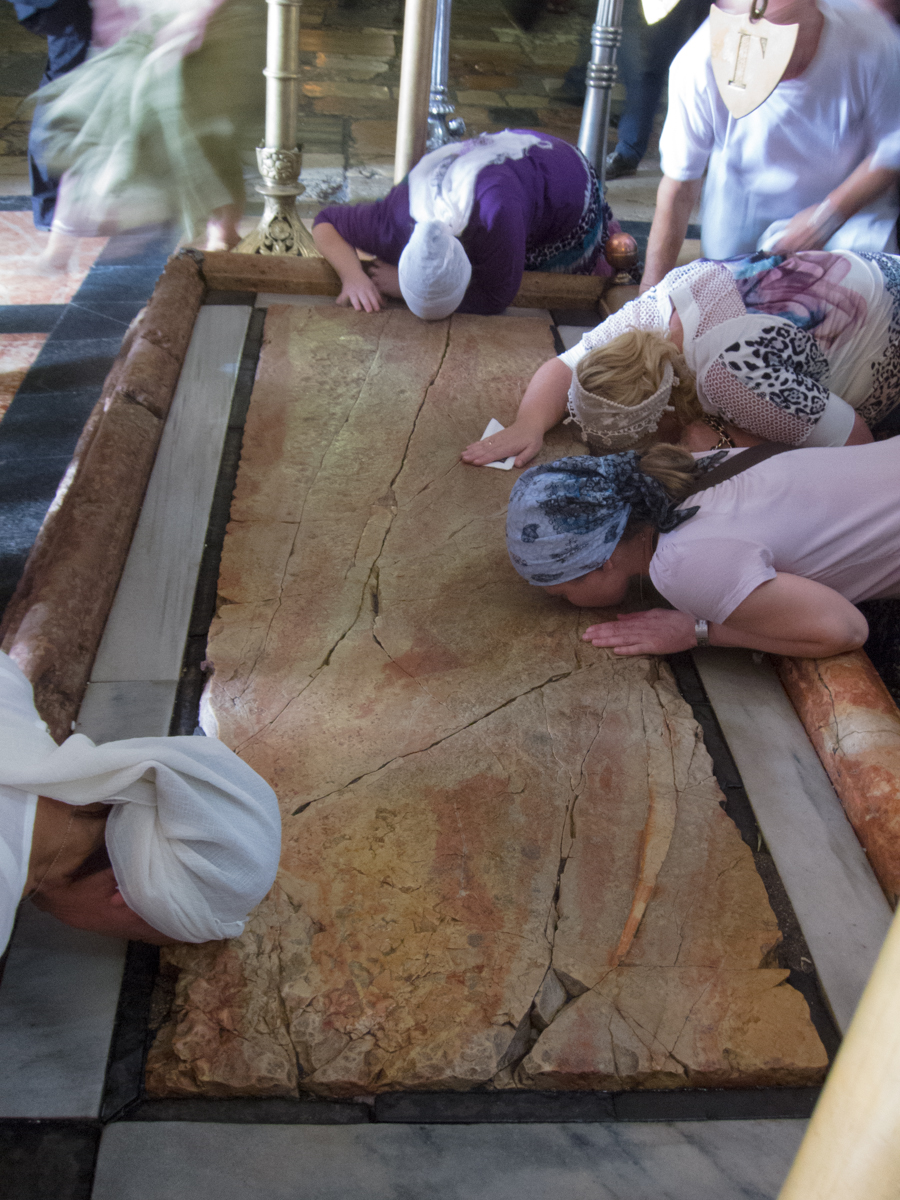
The Church of the Holy Selpuchre is venerated as the site of the Hill of Calvary where Jesus was killed, and it is said to also contain the place where Jesus was buried (the Sepulchre).  Many pilgrims travel from afar to visit this important Christian site.  The church was incredibly crowded with long line ups to the most holy places within.

Between all these holy sites, there are alleyways and winding narrow streets that are full of shops selling everything imaginable, especially religious icons.  You can tell which quarter you are in by the merchandise in the shops.

Mount of Olives and Garden of Gesthemane

When I read that the olive trees in the Garden of Gesthemane are over 2,000 years old, I really wanted to visit this garden at the base of the Mount of Olives, to walk amongst the trees that would have supposedly witnessed the fervent prayers of Jesus and his disciples the night before his death.  Today you can walk around the perimeter of the garden, but not amongst the trees which are safely secured behind a fence.  Of course, not everybody agrees that this is the actual garden where Jesus  prayed before his death, nor do all experts agree that the trees are 2,000 years old.  Again, it takes some imagination, and I suppose some faith, to believe these locations match the bible stories.

View of the Old City from the Mount of Olives

The Yad Vashem (Holocaust) Museum 

We spent a full day at the Yad Vashem Museum which was profoundly moving as we walked through the history of the Jewish nation, from bible times to modern times, with an emphasis of course on the Holocaust.  Within this broader historical context, it was possible to understand how deeply rooted anti-Semitism has been over the centuries and it helped me to understand how such hatred as well as apathy played a role in causing humanity to fail to help the plight of the Jews during the Second World War.  The museum is housed in a beautiful building in a peaceful, garden like setting, offering a place for quiet reflection after visiting the museum.

Israel Museum

The Israel Museum is the largest in all of Israel and is home to the most extensive collection of biblical and Holy Land archaeology in the world.  A uniquely designed monument called the Shrine of the Book, houses the Dead Sea Scrolls along with artefacts discovered at Masada.  Next to the Shrine is the Model of Jerusalem during the Second Temple Period, before it was destroyed in 70 CE.  The scaled model was amazing, a large reconstruction of the topography and the architectural character of the city as it would have been during Jesus’ day.

Food, food, food

The Mahane Yehuda Market was just around the corner from our hostel, making it an easy stop on our way home after each day of sightseeing.  It was here we enjoyed delicious bagels, reminding us of those from the Bagel Shop in Ottawa, the best baklava we’ve ever had, as well as cheese, olives and fruits and vegetables.  We cooked our own food most nights and haven’t eaten so well in quite some time.

Each Friday evening at sunset, our hostel hosts the Shabbat meal where everyone pitches in to help with the preparation and clean up afterwards.  Before the meal, candles are lit and a blessing is recited over the wine.  There is another blessing recited over two loaves of challah (bread).  Then everyone digs in.  This was our first Shabbat experience, one that we enjoyed very much.

During our week, we made a couple of side trips venturing into the West Bank and Palestine using public transportation which I will tell you about in the next post. But first we must fly to our next destination – Kuala Lumpur, Malaysia.  We’re leaving around 2:00 this afternoon and we’re expected to arrive tomorrow at 1:00 pm.  See you there!

The wonders of Petra

We made the long, arduous journey to Jordan with the express purpose of visiting Petra, one of the world’s most famous archaeological sites. Recognized as a World Heritage Site by UNESCO in 1985, it was also named one of the Seven New Wonders of the World in 2007.  But for many people (myself included), Petra was made famous by the movie, Indiana Jones and the last Crusade, released in 1989.

Petra dates back to around the 6th century BCE when it was the impressive capital of the Nabataean kingdom.  Then the Romans absorbed it into their empire around 106 AD, and they continued to expand the city.  A catastrophic earthquake in 663 AD destroyed most of the buildings and the ingenious water management system.  By the time Saladin conquered the Middle East in 1189, Petra was long abandoned and forgotten for many centuries.

It wasn’t until the early 19th century when Western explorers and historians discovered this ancient city, and another century would pass before real excavations would begin, in 1929.  Today Petra is Jordan’s major tourist attraction, generating about 80% of the country’s tourism income.

Our first day in the modern town of Petra began with a typical middle eastern breakfast at our hostel (Cleopetra Hotel) – boiled eggs, humus, tomatoes, cucumbers, flat bread, cheese, butter, jam, tea and instant coffee.  Our hostel also offered a bagged lunch for a mere 3 JOD (about $4.50 CAD) which we took advantage of both days we were there.  The hostel was very clean, and the beds super comfortable, making our stay in Petra very enjoyable.  They offer a free shuttle service to the entrance of Petra, and they also can arrange any tours or transportation you need while in Petra.  We would definitely recommend this hostel to other budget travellers.

At breakfast, we met a Canadian couple (Jim and Sophia) who we immediately hit it off with.  They had just arrived from Jerusalem where they would return after spending two days exploring Petra.  Turns out, we had reservations at the same hostel in Jerusalem, on the same day….how’s that for a coincidence.

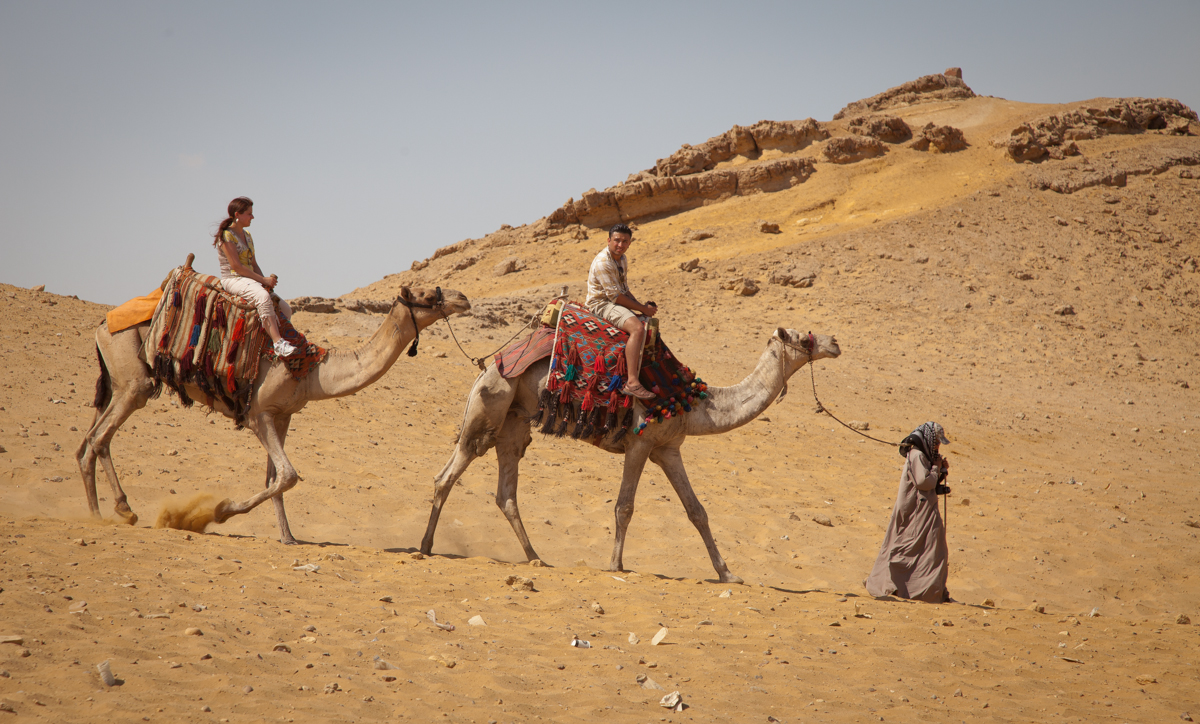
By the time we arrived mid-morning, the sun was already high in the sky and very hot, although the ambient temperature was a comfortable low-20’s Celsius.  The site was crowded with throngs of tourists including many large tour groups.  Motorized vehicles are not permitted and the site is huge, about seven square miles.  If you get tired, you can travel by camel, donkey, horseback , or horse and buggy.  I loved watching the camels with their long, gangly legs plodding along silently on their oversized, thickly padded feet.  They looked so graceful yet goofy at the same time.

Video:  Camels in Petra

Entrance fees are steep, 50 JOD for a one-day ticket, or 55 JOD for a two-day pass.  We opted for the two-day pass because of all the recommendations we had read on-line to give yourself more than a day to fully explore the site.

On the first day, we hit all the major sites, and on the second day we hiked to the High Place of Sacrifice.  Here are the highlights.

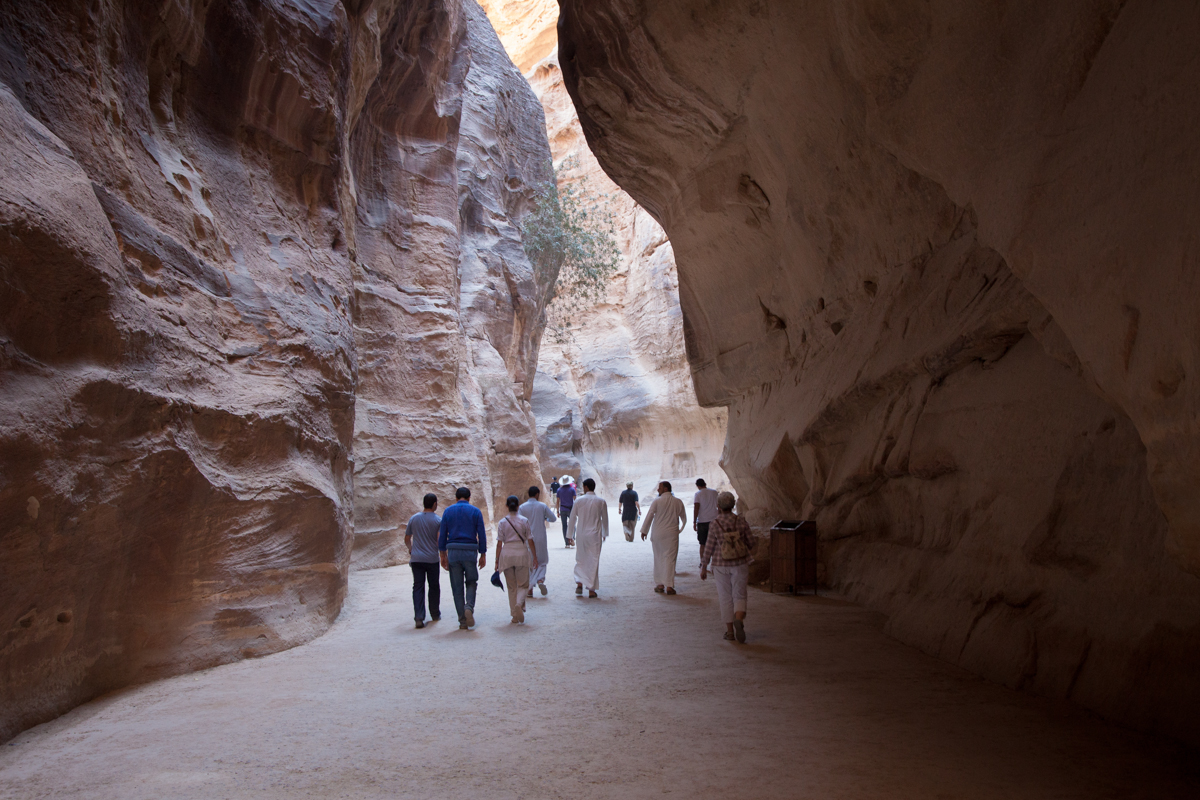
The Siq: Our journey began with a two kilometre long trek,, winding through a sandstone canyon that featured colorful and unusual patterns in the rock walls. You can still see the remains of the terracotta pipes built into the sides of the canyon that were used in Roman times as part of an extensive water system that made it possible to live in this arid land.

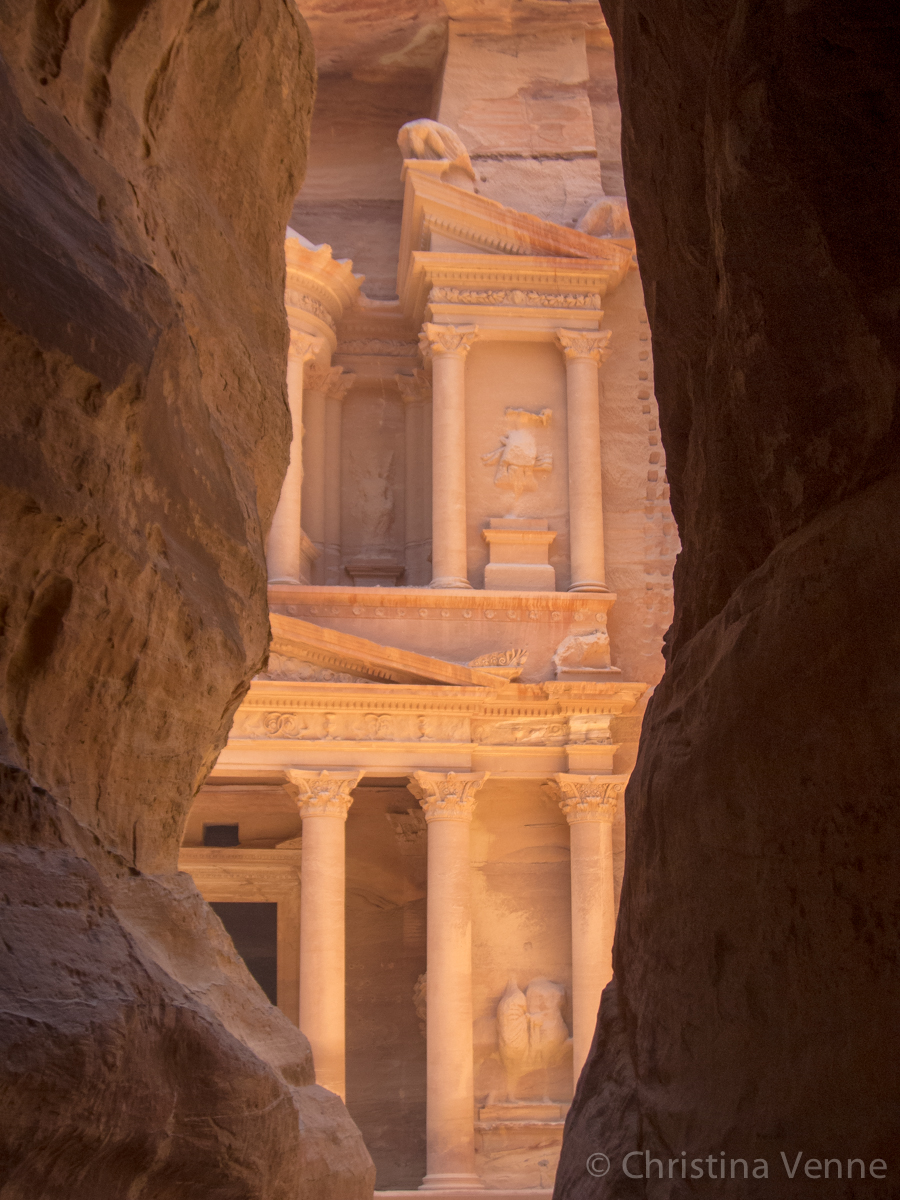
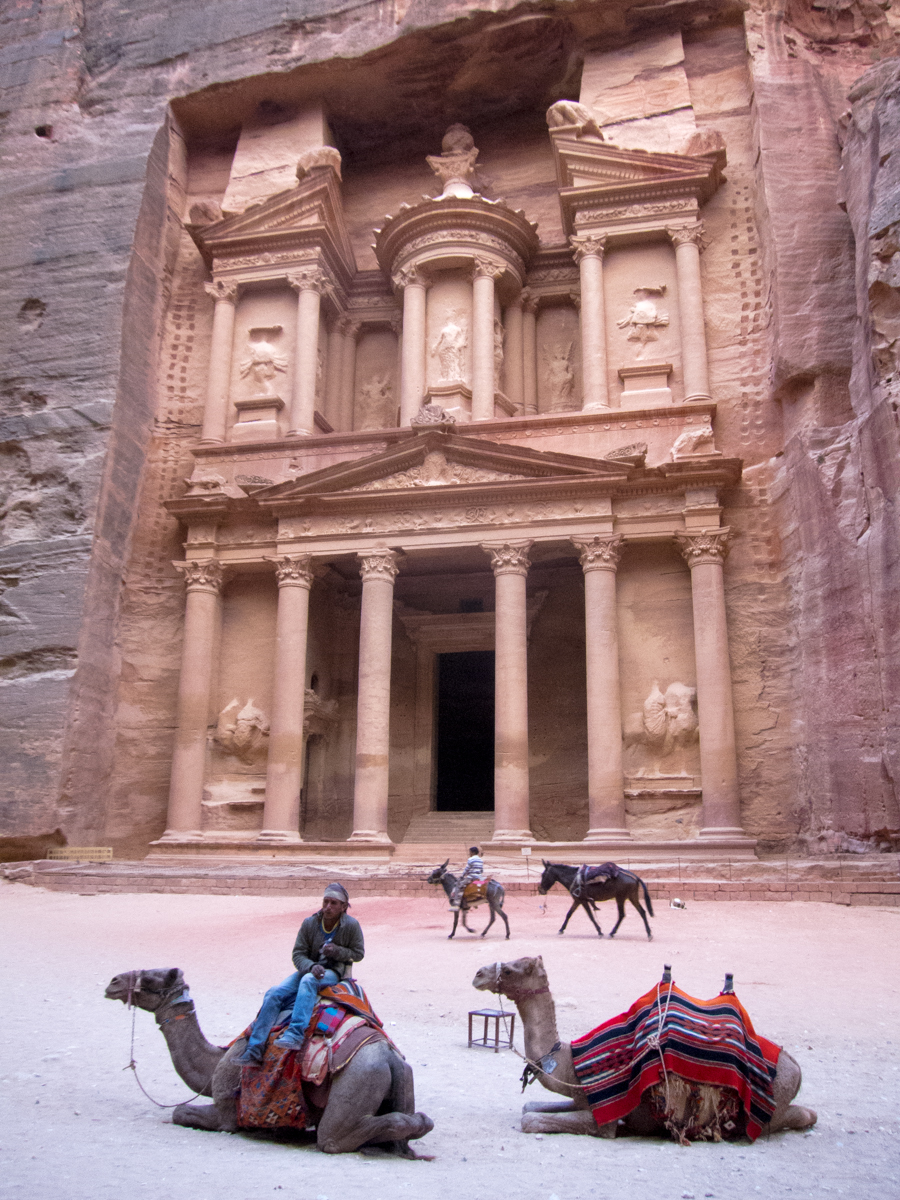
The Treasury:  At the end of the Siq, through the cracks of the narrow rocks, you catch your first glimpse of this is stunning edifice carved into the sheer mountainous rock face. Leaving the gorge, you enter a natural square where you now see the colossal, overwhelming façade of the Treasury in all its majestic glory.  Too bad there were so many tourists crowding the area when we first arrived.  Later in the day, it was far less crowded and much more enjoyable to view in the shadows of the late afternoon sun.

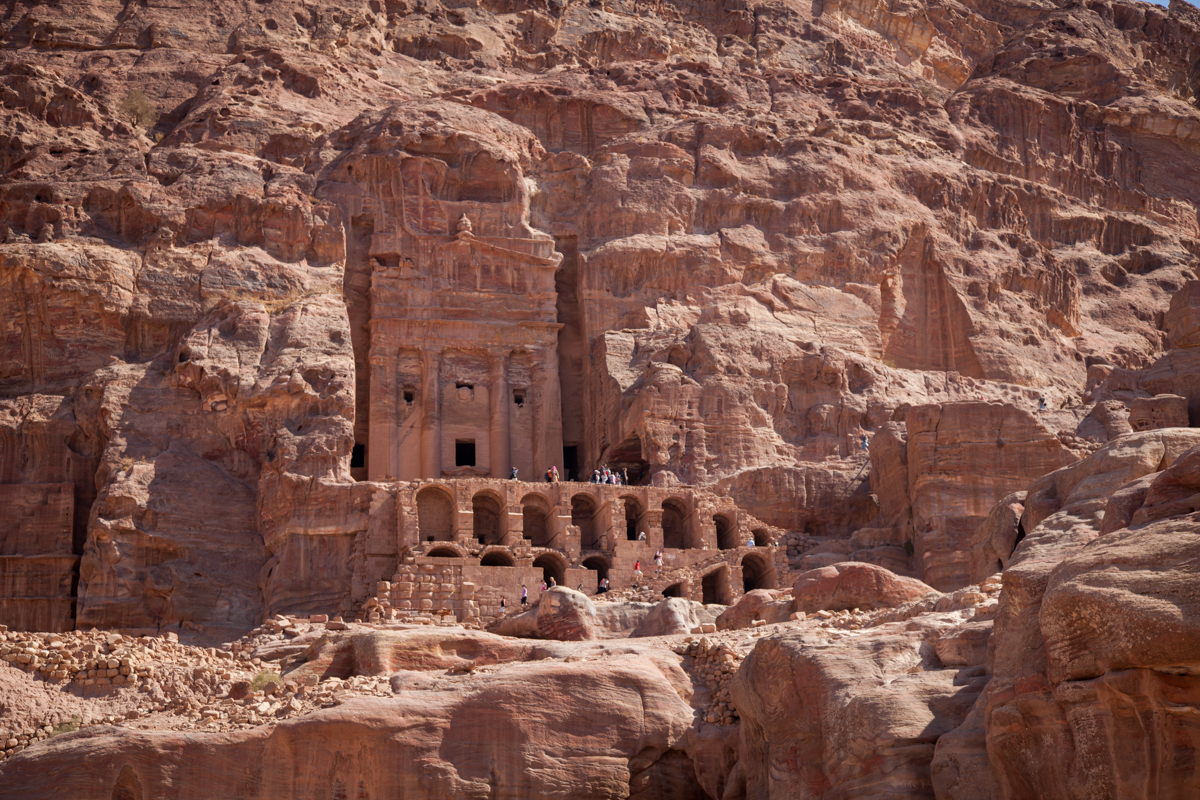
The Colonnaded Street:  For several more kilometres, you follow what was once a grand boulevard ornamented with a double row of columns, along which you can see the remains of ancient buildings, tombs, a 7,000 seat amphitheatre, temples and much more.

At the end of our first day, as we made our way back through the boulevard, the sound of a choir reached our ears.  We thought perhaps there was a recording being played in the royal tombs in the distance, and I jokingly said perhaps it was a passing choir who decided to test the acoustics of the tomb.  Well, the ethereal voices drew us to climb to the royal tombs, even though we were dead tired and were ready to call it a day.  Much to our surprise, there was indeed a choir singing the most beautiful music imaginable, their voices being carried far and wide.  It turns out, they were in Jordan for a choir festival and decided to take advantage of the ethereal setting to practice for their performance scheduled the following day.  What a special treat!

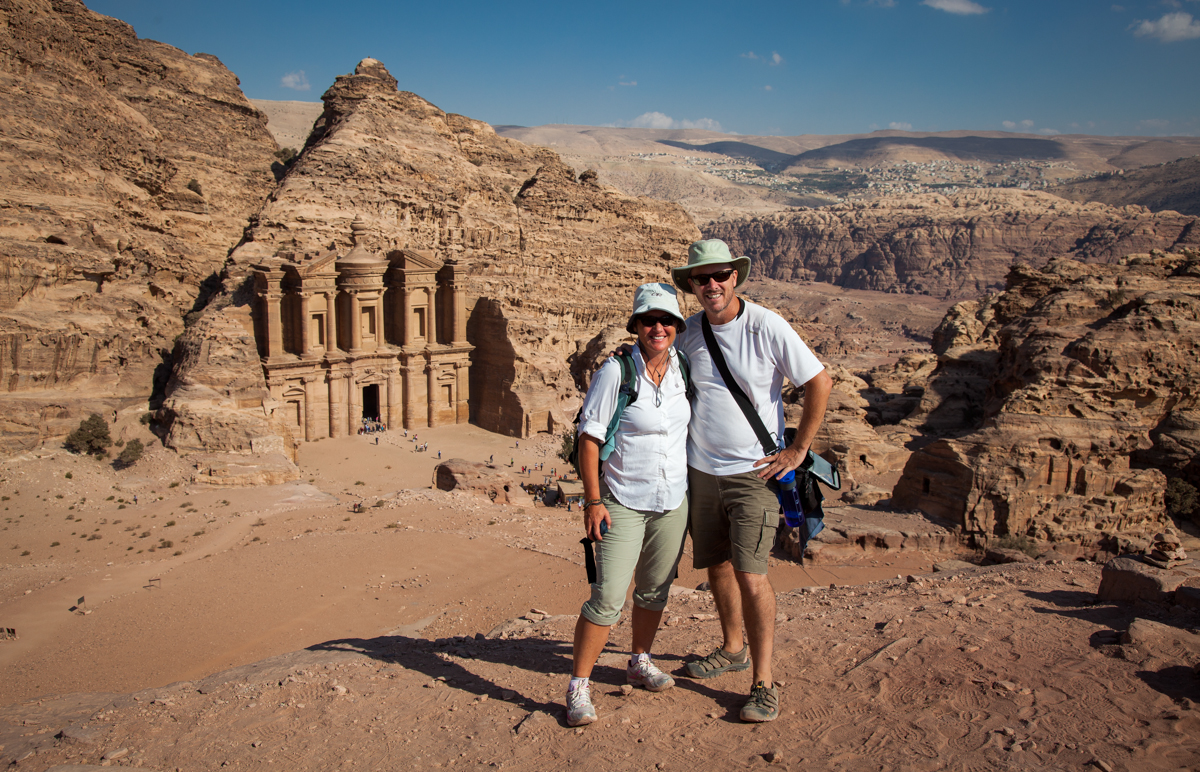
The Monastery: At the end of the boulevard, you begin the 850-step trek to the Monastery, tucked away, high in the mountains.  After climbing for about an hour, we entered a large courtyard area where the imposing Monastery stood, a beautifully carved building literally cut out of the side of the mountain.  It is huge, even the doorway is several stories high.  Interestingly, the name of this site does not accurately reflect its purpose; it was probably a temple.  It may have been named the Monastery because of its remote location.  This was my favourite site in the entire ancient city because of its isolation on the mountain top, the wonderful 360 views we enjoyed and the peacefulness that I felt looking down at this magnificent testament to an ancient peoples while perched on a hill top on the opposite side of the courtyard.

High Place of Sacrifice:  On our second day, we hiked to the High Place of Sacrifice, another moderately challenging hike up 700+ steps to the top of another mountain.  There on the mountain top, we were rewarded with the remains of an ancient place of worship along with spectacular views of the lost city below.  The hike down the back side of the mountain offered new sites that were completely hidden from the main boulevard where we had walked the day before. Very few people chose this longer route down the mountain, and we enjoyed peaceful, solitude for much of the way.

After our first day in Petra, we were exhausted from over eight hours of hiking in the hot, desert sun and minimal sleep the night before.  Earlier, we had made plans to have dinner with Jim and Sophia and I think we all thought it was going to be an early night.  Little did we know that we would quite literally run into the Canadian ladies we met on the Ferry the day before who were staying at the hotel where we decided to have dinner.  We ended up having a party of ten at dinner, enjoying one of the best meals we’ve had in a while.  Not surprising to me, we all ran into each other on our second day at Petra (the ladies’ first day), because it just happens that way sometimes.

On Sunday, we left Petra for Jerusalem at 8:00 am, about a half hour after Jim and Sophia.  They were planning to take the southern route via Eliat, while we had opted for the northern route via Amman.  Since we were all travelling to the same hostel in Jerusalem, we jokingly challenged each other to a “mini amazing race” to see who got there first.  Much to our surprise and relief, our journey to Jerusalem went smoothly.

It took three hours to reach Amman by bus (5 JOD each), including a 15-minute bathroom stop along the way.  From the bus station, we hired a taxi (21 JOD) to take us to the King Hussein/Allenby Bridge where we passed through the Jordanian customs without queues or issues of any kind.  A special bus (5.30 JOD) transported us to the Israeli side, where we went through five distinct checkpoints (each with their own queue) before clearing customs.  It was crowded and chaotic on the Israeli side, but it only took us an hour and a half to get through which we thought was pretty good.  Now that we were on the Israeli side, it was a simple matter of exchanging some of our Jordanian money for Israeli Shekels so that we could purchase our bus tickets (38 shekels each) to Jerusalem which was only an hour away.  We were dropped off near the Damsacus Gate, which was about a half hour walk from our hostel.  Unfortunately, we made a few wrong turns and it took us close to an hour, arriving around 4:00 pm.  As we finished checking in, Jim and Sophia arrived, having had an equally easy and incident free travel day.

A long journey to Jordan

The distance between Dahab, Egypt and Petra, Jordan is a mere 210 km as the crow flies.   But we weren’t travelling as the crow flies; no, we were taking a bus to Nuweiba, a ferry from Nuweiba to Aqaba and a taxi from Aqaba to Petra.  Our bus from Dahab was scheduled to leave at 10:30 on Thursday morning, and we estimated a conservative arrival time of about 5:00 pm, giving us plenty of time to settle into our hostel before heading out to visit Petra at night, something that is  permitted only twice a week (Thursday and Monday nights).  This is how our day unfolded.

We arrived at the Dahab bus station by 10:00, giving us plenty of time to purchase our tickets (15 EGP each).  Our bus departed at about 11:15 am, 45 minutes late.  Enroute to Nuweiba, we were stopped at a security checkpoint where an armed policeman boarded the bus and asked all passengers to present their identification.  There was only about six tourists on board, the rest of the passengers were locals.  One guy was hauled off the bus for reasons unbeknownst to us, delaying us for half an hour, which put us into Nuweiba at about 12:30.  We weren’t too worried as we believed the ferry didn’t leave until 3:00 pm so we had plenty of time to buy our tickets, go through customs and get on board.

The bus dropped us off at the Nuweiba Bus Station and we walked towards the sea where we assumed (correctly) we would find the port.  It took a little wandering about amongst the filthy streets of Nuweiba before we found the ticket office that was well signed, except only in Arabic.  The foreigner price for ferry passage is a steep $75US, or 940 EGP for two tickets.  At least we were taking the fast ferry that should get us across in about an hour.

Garbage in front of the entrance to the port.  Sadly, this 
was not an uncommon sight in Egypt. 

The place to buy ferry tickets.  All signs were Arabic
making it difficult to figure out where to go. 

Getting our ferry tickets.

After clearing customs without any issues, in spite of having over extended our Visa by about a week (well within the 15 day grace period), we joined a small group of foreigners in a decrepit, filthy waiting area about the size of a football field.  There was a group of five older ladies who we discovered were also Canadian,  two Australian men, one woman from the UK but who is living in Cairo, and one young man born in Israel but currently living Berlin.  We had plenty of time to kill, so why not get to know our travelling companions? The Canadian ladies were travelling as part of an organized tour.  Michelle, the UK lady from Cairo, told me she had been robbed the night before and lost all her valuables, except her passport.  She was meeting her fiance in Jordan, who had arranged her passage from Jordan.  I shared with her my food and drink as she had no money to buy any provisions.  We didn’t get to know the guys from Australia quite yet, but the young lad from Berlin, Benyamin, befriended us and decided to hang out with us for the rest of the journey.

At about 2:30 pm, we were transferred by bus over to the ferry, about a kilometre away where we now lined up – men in one line, women and children in the other – and waited for another half an hour, under the scorching sun.  Finally, we were allowed to board only to be detained in the car cargo area for another hour.  At least we were out of the sun.  When we were permitted to go upstairs, we figured we would be leaving at any moment.  Wishful thinking!  At the Jordanian Customs desk on board, we reluctantly surrendered our passports so that they could be processed, and visas issued when we landed in Jordan.

As the sun set over the mountainous horizon, our hopes for visiting Petra that night began to fade  as quickly as the fading light.  What could be causing our delay?  Turns out we were waiting for the drivers of the transport trucks that were being loaded onto the cargo ferry next to us all afternoon.  For whatever reason, the drivers could not accompany their trucks, they had to board the passenger ferry with the rest of us.  At 6:30 pm, we finally headed out and didn’t arrive in Aqaba until 9:30 pm.  So much for the fast sailing.  There was a time change as well, so now it was really 10:30 at night.

I hate arriving in a place in the dark, especially when we don’t have transportation lined up in advance, as was the case in Aqaba.  When we collected our passports, we were pleasantly surprised that we didn’t have to pay for our Visas (usually 20 Jordanian dinari each which is about $30 CAD).  Apparently, Aqaba is a “free zone” which means you can come and spend your money in the city for 48 hours without having to pay for a visa.

On arrival, the Canadian ladies were met by their tour guide and were whisked away for a night in Aqaba.  Michelle’s fiance was waiting for her at the exit.   The remaining foreign passengers – the two Australians, Benyamin and us – were all going to Petra so we decided to stick together to find transportation.  Of course, as we exited the port building, the taxi drivers were right there waiting to pounce.  These guys were really aggressive.  There were only two taxis in the parking lot each with a very small car, charging 60 EGP each, more than double what the going rate should be.  There was another guy who offered us a mini bus for 70 EGP, but it turns out he didn’t even have a car of his own.  He was just brokering on behalf of the taxi drivers who didn’t speak English very well.

Things got a little heated when Benyamin called one of the taxi drivers a liar and a crook.  These guys were yelling at us, as if the louder they talked, the better their deal would seem to us.  Michelle and her fiance came by and offered to take us all downtown to get a better taxi, but we wouldn’t all fit in their car.  The taxi drivers were enraged that we might go with them, and went off to fetch the police.  Turns out Michelle’s fiance was friends with both of the police officers, so much to the taxi drivers’ dismay and my relief, they didn’t do anything.

Finally, we decided we would walk to a main road where we had hopes of finding  a taxi that wouldn’t rip us off.  The only problem was we didn’t know where the hell we were or how far it was to the centre of town,.  And it was getting late, about 11:15 pm by now.

As we started to walk, one taxi driver drove up ahead and then stopped in front of us, blocking our path, insisting we must take his taxi.  Then the old guy in the minibus and the taxi broker did the same thing.  We said we would take the minibus for 60 EGP, which we knew was a fair price.  No, the broker insisted the price was 70 EGP.  I think everybody was getting a little hot headed, because after doing the math, we were dickering over a mere three bucks each extra.  But, it seems everybody was digging in their heels leaving no room for common sense.

We kept walking, and then the mini bus driver came up beside us, without the broker, and agreed to 60 EGP, so we piled in and headed off to Petra.  We were surprised that it took another 2 hours to get there as we were under the erroneous impression Petra was only 30 minutes away.  Our driver contacted our hostel to get directions and to let them know we would be arriving late.  The three guys didn’t even have a room booked for the night, so they were very lucky to learn that our hostel had a cancellation on a triple room, so at least they had somewhere to sleep.

The bus pulled up in front of our hostel at 2:00 am.  It took us 16 hours to travel 210 km!  But it was well worth it, as we discovered the next day when we visited Petra.

A piece of paradise in Dahab, Egypt

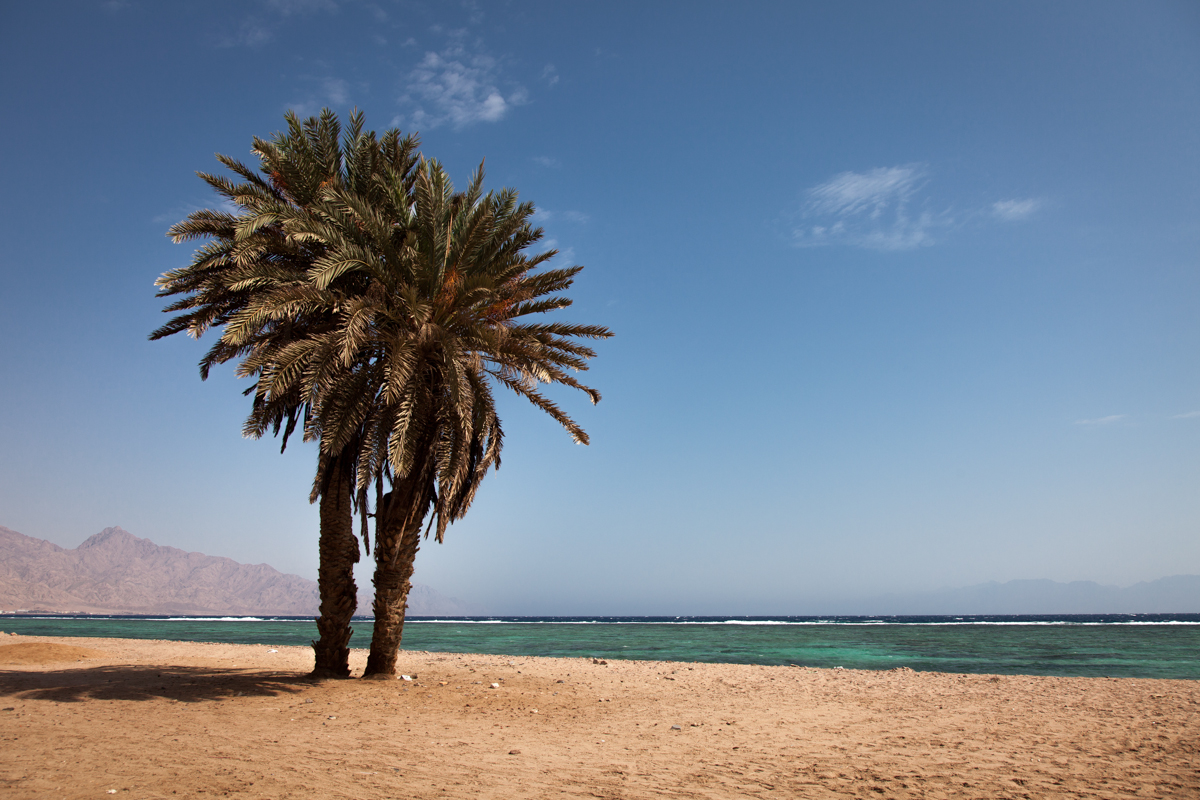
It was love at first sight.  The aquamarine waters, the gentle sea breeze, and the cloudless skies were the perfect setting for the cozy hotel we booked ourselves into at the last minute ten days ago.  We’d love to stay another month but it’s going into high season and everything is booked, not to mention the fact that we’re already well into the 15-day grace period permitted on our Tourist Visa.

Dahab is a small town located about 80 km northeast of Sharm el-Sheikh, which is a larger, popular resort city with a population of 35,000.  We flew into the airport outside of Sharm el-Sheikh from Cairo and didn’t so much as set foot there.  Instead, we loaded our gear into our pre-arranged taxi and headed straight for Dahab.  We weren’t interested in staying at one of the monolithic, all inclusive resorts that attract hordes of European and Russian tourists.

From what we had read, Dahab sounded more our style.  It used to be a Bedouin fishing village, but is now a tourist town, reportedly offering some of the best diving, snorkelling and windsurfing in the world.  The number of dive shops is staggering, with over 50 dive centres competing for your business.  There is plenty to do in this piece of paradise, or you can easily do nothing at all, whatever suits your fancy.

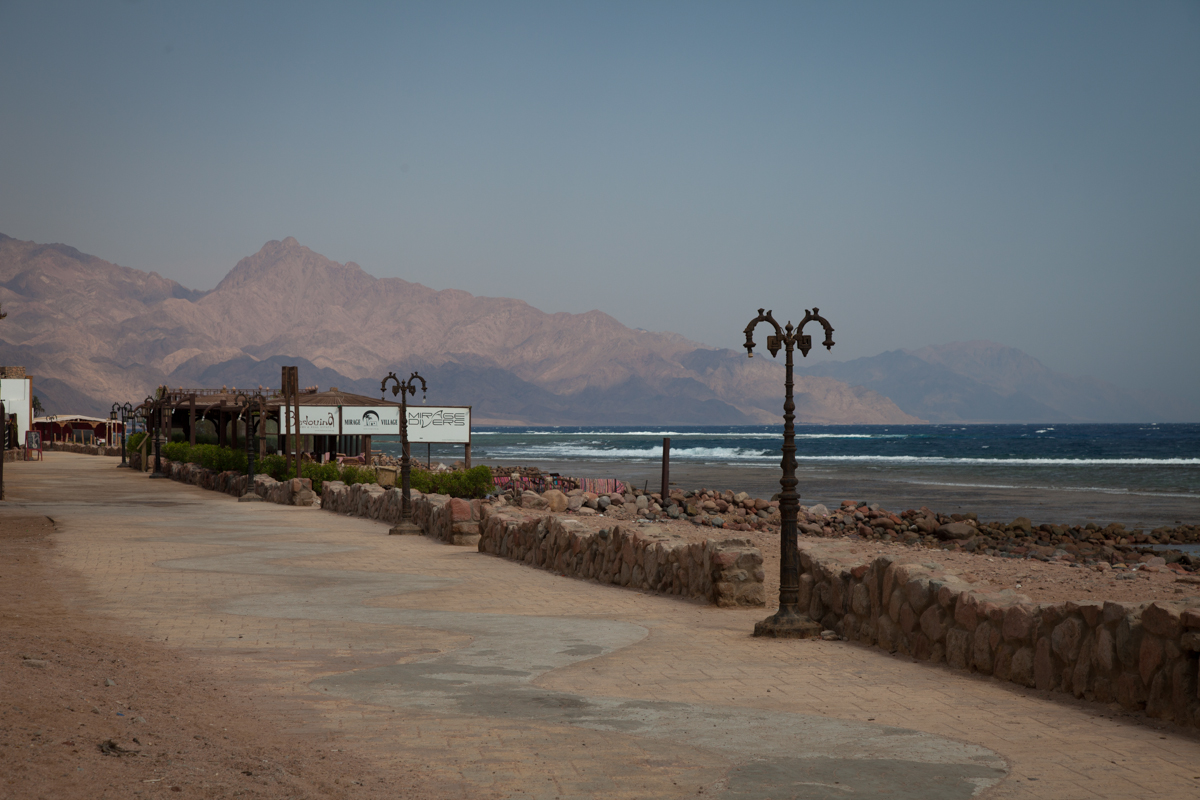
There is a paved boardwalk that extends over three kilometres connecting the three main areas around Dahab:  Masbat, which includes the bedouin village Asalah, in the north where we are staying; Mashraba, south of Masbat which is more touristy with lots of hotels, restaurants and shops; and Medina  in the southwest where there are a few large chain hotels near the Laguna area, famous for its excellent shallow-water windsurfing.  The boardwalk has offered us a perfect running route early in the morning before the heat sets in.  At night, it is aglow from the exotic looking lanterns and tiny christmas lights shining from all the restaurants lining the pathway.

We’ve been staying at the El Primo Hotel, a small nine room establishment overlooking the sea in the popular area called Eel Garden, about a ten minute walk from the centre of town.  Emily, the young German owner, exudes warmth and hospitality making her guests feel comfortable and at home from the moment we arrived.  Our room is bright, colourful and cheerful, a nice change from the bleak, grim places we’ve been in lately.     Each room is air conditioned, with private ensuite  and a balcony overlooking the sea, with the faint outline of the hills of Saudi Arabia in the distance.  A hearty breakfast is included too.  The price is a little steep compared to what we have been paying in Egypt, 300 EGP per night (about $50 CAD).  Even though we’re paying more than we usually do, we think we’re getting good value for our money.  This place is spotless, comfortable, the perfect place to chill by the sea.

View from our balcony.  

The days have blended into each other in a blur of restful bliss.  We haven’t really done too much of anything to be honest.  Sure, we snorkel almost every day, sometimes for hours at a time as the entire coastline is one amazing coral reef, teaming with a variety of colourful fish and gorgeous coral.  By mid afternoon, the sea is as flat as a pancake making it the perfect time to head into the refreshing waters.  In the heat of the day, it is best to retire to our air conditioned room for a siesta, or relax in the bedouin style area by the edge of the water, letting the gentle sea breeze cool us off.  This place has inspired me to start writing a book and that has kept me busy each day as I can barely keep up with the words that are just spilling out of me.  Who knows if anything will come of this project, but since I have always wanted to write a book, it feels good to be fulfilling this lifelong dream for once and for all.

It hasn’t been completely perfect as both Chris and I have each had a bout of stomach upset, the most severe we’ve experienced since beginning our travels.  It is difficult to pinpoint just exactly what has made us sick as we are eating in the same restaurants, usually the same food, and we got sick on different days.  Just as well, so we could take care of each other as it really knocked us off our feet for a couple of days each.  Now that we’re feeling better, we’ll eat at the restaurant at our hotel which dishes up lovely, Egyptian cuisine that we know we can trust.

When you’re staying in one place for a while, you start to notice things that you might otherwise overlook.  For instance, we’ve noticed a lot of Russian women here, with young blond children and babies, but very few men.  Apparently, there has been something of a Russian invasion in recent years, with Russians buying up much of the prime real estate around town.  The women are deposited here with their children, for what purpose one can only surmise or speculate, and the men are back home somewhere in Russia.  Sadly, these local Russians have made something of a reputation for themselves with their scantily dressed women, and naked babies that defecate wherever they wish, making them unwelcome in most establishments, including our own hotel.   The other thing that is noticeable is that there are very few local Egyptian women around.  Either they are all at home out of tourists’ sight, or they are somewhere else.  I have no idea.

We’re feeling better now, and getting ready to move on in a couple of days.  We’ll be travelling to Petra, Jordan via bus and ferry on Thursday. 

In spite of the sign we saw camels and horses
walking along the boardwalk everyday. 

An incident at the Giza pyramids

As tensions flared, erupting into riots and demonstrations in Tehrir Square on Friday afternoon, we witnessed an incident at the pyramids in Giza that caught us off guard and made us realize how quickly situations can escalate and how important it is to stay alert to your surroundings and to avoid large gatherings of any kind.  I’ll tell you more about what happened later, but first let me share with you how we managed to have the most amazing experience at the most touristy attraction in Egypt.

There are 93 pyramids in Egypt, the three most famous being those in Giza, which is now a suburb of Cairo.  I had read about how there are condos and fast food restaurants right next to the pyramids so I guess I was expecting the worse.  It really isn’t as bad as that sounds as there is still a good buffer of desert around the site.

These are probably the most visited pyramids, maybe even the most visited tourist site in all of Egypt.  It is also a magnet for pushy Egyptians looking to make a buck off or rip off (depending on your perspective) tourists by hawking their cheap souvenirs, camel rides, horseback rides, as well as guide services.  When people talk about going to Giza, they often talk about their negative experience getting hassled and hustled which seems to overshadow the visit to the pyramids themselves. For this reason, many guide books recommend taking an organized tour so that you are somewhat buffered by these tenacious hawkers.

But we hate going in large tour groups and so did our new friend Felippe, a fellow long term traveller from Chile who we met at our hostel.  One evening, we talked about our respective plans to do the pyramids independently.  Felippe went the day before us and when we saw him that night, he looked exhausted and disappointed with what had transpired earlier.  “I am Chilean”, he said, “I should be able to deal with these hustlers, because Chile is full of them! But they got me, they got me good!”  He then shared his story with us.

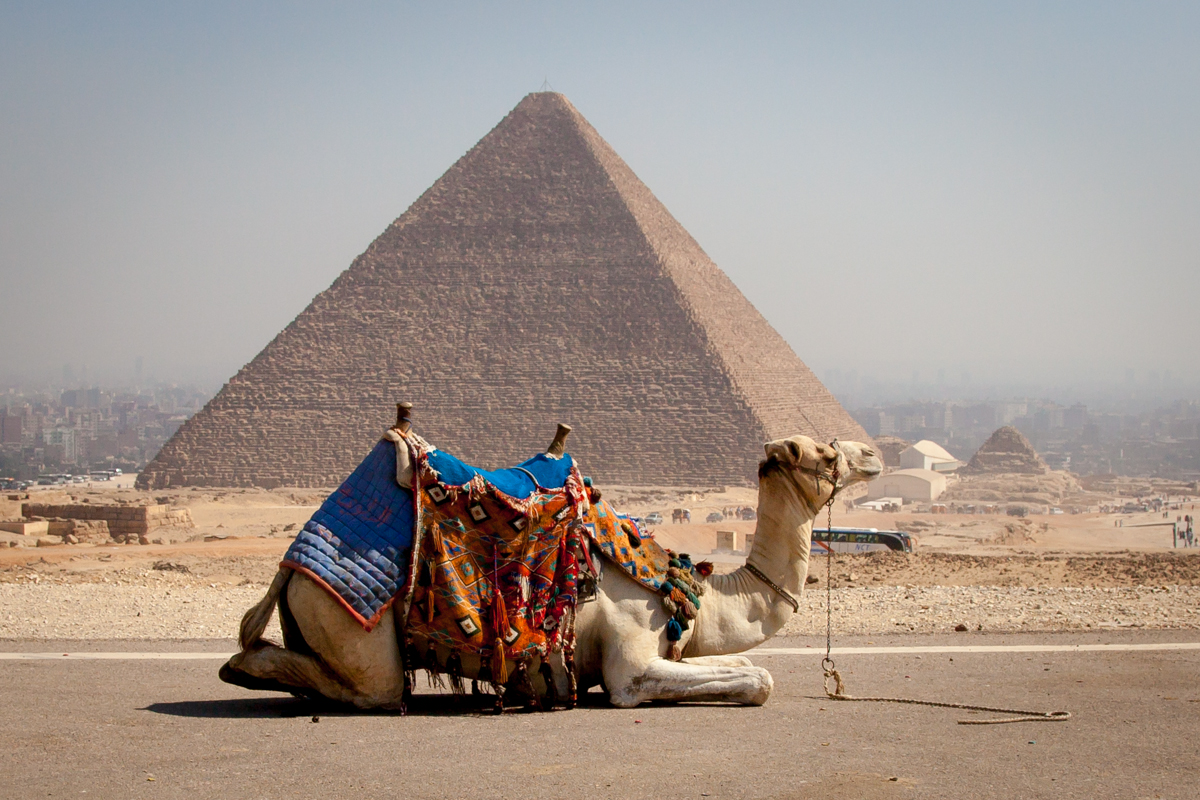
He took the metro to the Giza station and then grabbed a taxi for the short ride to the Pyramids.  With plans to visit two other pyramid sites that day, he arranged for the taxi to wait for him. Instead of going to the entrance where you purchase your entry ticket, he was deposited on a side street where he was quickly accosted by tour operators and guides.  They told him all kinds of lies like you can’t visit the pyramids alone, it’s too far to walk so you need to hire a camel or horse, you need a guide, etc. etc.  He was duped into buying a “package” that included his entrance fee, a camel ride and a guide.  At 80 Euros, but he knew it was too much, but he felt trapped.  The whole experience left a bad taste in his mouth, although he was really happy to get his photo on a camel with the pyramids in the background – we all joked that it was one expensive photo.  He subsequently had some problems with his taxi driver who wanted to charge him more than the agreed price.  He ended up going to just one other site before calling it a day, completely exhausted and fed up with the whole hassle of it all.  It just wasn’t worth it.

So what were we going to do?  After much debate, we decided we would try it on our own as well, feeling a little bit more prepared with the knowledge of what happened to Felippe.  We figured we have been dealing with these hawkers for three weeks now, surely we could handle this.  Felippe had misgivings and gravely wished us the best of luck.  I promised him I would write our tale in the blog so he would know how it turned out – good or bad.  Here is our story.

Before I continue, I should warn you that you’ll need some time to read this tale as I do go on a bit.  I hope you don’t mind.  Maybe go and get a cup of coffee or tea, or go to the bathroom now, because this is probably one of my longest written posts to date.  Or you can just skip to the bottom to see the photos.  But I do hope you take the time to read our story as it was quite an experience to go through and maybe we can help others who, like us, want to see the pyramids on their own terms and not be held hostage by an organized tour, or worse, by the army of hawkers that have taken over the site.

As I mentioned in the last post, we unexpectedly had to leave our hostel on Friday morning, the morning we were planning to visit the pyramids.  We had already booked our flight to Dahab for Saturday morning, so we had to go to the pyramids that day, no matter what.  Our original plan was to take the metro and bus avoiding any taxi hassle. We did some research so we knew what bus number we needed.  I suspected the bus numbers might only be in Arabic, so I carefully wrote down the Arabic numbers (0-9) in my note book as reference.  The only thing I wasn’t sure about was if the numbers were to be read left to right or right to left.  We’d have to figure that out on the fly.

But all that changed when we switched hotels that morning. We flagged down a taxi in front of our hostel, and amazingly our taxi driver took us to our new hotel using the meter, directly and quickly.  Wow, a taxi driver you can trust.  Imagine that!  He didn’t speak a word of English so at the hotel, we had the desk clerk tell him to take us to the Giza Pyramids by meter.  He agreed so off we went.  We felt relaxed, confident that we had found perhaps the only honest taxi driver in Cairo.  What a nice feeling to be able to sit back and let our guard down because we didn’t have to worry about being scammed by our taxi driver. Then I noticed he passed the bridge that had a sign to the Giza pyramids.  Hmmmm…..that was weird.  Well, maybe there was more than one way to get there.  But as we were heading straight back downtown from where we had originally come, I started to get suspicious.  Remember our driver speaks no English, so it’s not like we could ask him where the hell he was going.  Finally, he pulls up to the “Pyramisio Hotel” which is nowhere close to the pyramids and points to it as if this is where we had asked to go.  Bullshit.  He knew we wanted to go to the pyramids.  This is such a classic taxi scam – taking you to the wrong address – I couldn’t believe this guy did this.  Well, there goes his tip!  Chris used his mad, firm voice and motioned with his hands that we want to go to the pyramids in Giza not this damn hotel.  Ohhh, he looked all surprised, as if to say, you mean THE pyramids.  So now our guard was back up and we were mad which actually served us well for what came next.

Our taxi was immediately accosted as we entered the road that lead to the entrance gate.  It is not uncommon for these unscrupulous characters to jump right into your cab, or block your passageway.  At the first onslaught, we locked our car doors, rolled up our windows, and yelled out of the front windows “La, la, la” (no, no, no) in really angry voices, and we motioned to our taxi driver not to stop, to keep going straight ahead.  I think we scared the shit out of him.  Then the next wave came up to us, and a guy with a bunch of horses tried to block our way, well we yelled even louder to everybody to get out of our way, and for our taxi driver to keep driving.  Amazingly, they cleared out and we proceeded to the gate.  We congratulated ourselves for getting to the ticket entrance relatively unscathed.  Our fare cost us 70 EGP (about $12 CAD) which included the ride to the hotel in the suburbs and the unnecessary detour to the Pyramisio Hotel which we figured cost us an extra 20 pounds.  Still, not too bad when you consider our hostel offered to arrange a car and driver to take us there and back for five times that amount (350 EGP).

Now that we had our tickets (60 EGP site entrance and 30 EGP tomb entrance each), we knew we would have to deal with another onslaught as soon as we passed through the entrance gate.  We had a simple strategy.  Ignore them.  Speak not a single word to them.  No smiles, no eye contact, act as if they did not exist.  This might seem extreme and pretty rude and really it is under normal circumstances.  But these were not normal circumstances.  You have to understand that these people will harass you for an hour if you let them, they just won’t leave you alone until they have worn you down so badly that you give in and buy something just to get rid of them.

Amazingly, our strategy worked.  I’m telling you, this was not for the faint of heart.  You had to be as ruthless as they were.  But after a couple of minutes trying to engage us, and being met with a wall of silence and a glazed over look that did not even acknowledge their presence, they quickly gave up and moved on to easier prey.

Now we could focus on the reason for being here.  The pyramids.  The first thing I noticed was how massive they were.  Up close, you can see how the stones were laid in perfect alignment and it boggles the mind as to how this was accomplished over 5,000 years ago.  There are three main pyramids and three smaller ones.

  • The most famous Pyramid in Egypt is the Great Pyramid of Khufu.  It is the biggest, tallest and most intact, and the only remaining one of the Seven Wonders of the Ancient World.  Until the Eiffel Tower was built in 1889, this Pyramid was the tallest building on earth, originally measuring 146.5 m high. Today it measures 137 m in height, the missing 9m were stolen by the Ottoman Turks in the 15th century to build houses and mosques in Cairo.  The four sides face the four cardinal points precisely angled at 52 degrees. It contains around 1,300,000 blocks ranging in weight from 2.5 to 15 tons each.  It’s square base has sides measuring 230 m and covers 13 acres!  Like I said, it is huge.
  • Khafre’s Pyramid (the middle one) appears larger than the Great Pyramid but is is merely an illusion because it stands on a higher part of the plateau.  Today it is 134.5m tall (originally 136m) with sides equalling 214.5m, a surface area of 11 acres and an angle of 53 degrees.
  • The smallest of the three main pyramids was built by Khafre’s son, Menkaure.  It is relatively tiny, just 65.5m tall (today 62m), with sides equalling 105m angled at 51.3 degrees.  Unlike the other two pyramids which were constructed entirely of limestone, the first 15m of this one was built from pink granite which came all the way from Aswan.
  • The three small pyramids next to the Menkaure Pyramid are believed to have been built for Menkaure’s wife and children.
  • The Great Sphinx is probably one of the most recognizable constructions in history.  It was sculpted from soft sandstone and would probably have disappeared long ago if it hadn’t been buried in sand for so many long periods in its history.  The body is 60m long and 20m tall. It faces the rising sun and was so revered that a temple was built in front of it.

We walked around each of the pyramids getting a good, close view of each side.  Then we headed out into the desert where the tour buses were taking the tourists to see the pyramids from afar.  We continued to walk further into the desert, maybe half a kilometre from the pyramids, stopping on a hilltop that offered a magnificent view. Here I sat for over an hour marvelling at the panorama of these magnificent, iconic structures. I was completely alone (Chris was off taking photos). It was so peaceful far away from the crowds – no vendors, no tourists, just me and the pyramids.  The hot sun seared my back, but I felt cool and comfortable on the breezy hilltop.

At 11:30, the city of Cairo erupted into a symphony of prayer; it was time for the noon prayers which are broadcast over loud speakers from every mosque in the city.  I was surprised I could hear it in the distance.  It was as if the city was singing.  Here I was in one of the most touristic sites in Egypt enjoying complete solitude as I soaked in the magnificent view and atmosphere.  Nothing short of magical.  (Sorry Felippe, I’m sure you didn’t want to hear this!)

As we made our way towards the exit where we would see the infamous Sphinx, we became aware of a sudden change in our surroundings.  People were talking loudly in excited voices and there was tension in the air.  We looked around to see what could be the reason when a truck came barrelling towards us, the driver and passengers screaming at the top of their lungs.  As it passed, I turned to see a man lying on the back of the truck, his chest bloody red.  What the hell was that all about, we wondered.  Maybe someone fell off a camel or horse, I speculated.  But then, cars and horses with their carriages all started to turn around and come back up the hill.  We stopped in our tracks about half way down the hill, realizing something was terribly wrong at the bottom, about a couple of hundred feet ahead of us.  A police truck was lying overturned on its side, and a small car sat in ruins next to it.  What happened?  Was it a bomb? An accident? A terrorist attack? Another truck came screaming by, this one with two bodies on the back.  Were they injured or dead?  Without understanding the language, we had no idea what was going on.  Locals were running down the hill, some in tears, a large crowd gathering near the overturned vehicles.  There was screaming and yelling and as the crowd swelled, the noise escalated.  This was no place for us, so we quickly turned around and headed to safer ground where we could exit through the entrance.

As we left the area, we saw two police trucks arrive, full of police men.  Further on, we saw some police men getting kitted up in riot gear.  We still don’t know what happened as there was nothing reported on the news.  I must admit it shook me up a little.  This incident occurred suddenly and it was easy to see how one could find themselves in the wrong place at the wrong time.  It was a good reminder to be cautious and aware of one’s surroundings at all times.

We made our way back to our hotel via mini bus which we flagged down on the main road and metro for a total cost of 4 EGP, about 60 cents CAD.  Total cost for the day:  254 EGP or about $42 CAD.  What a great day visiting one of the greatest sites in the world!

Are you curious about how we are doing after one year of travel? I’ve written all about it – how we’re getting along, how we’re managing our money, what our plans are for the future and what are some of the biggest challenges facing us right now.  Read “Checking in at 12 months” located in the Travel Diary widget on the column to the left.  


Exploring Cairo, old and new

With only three days at our disposal, we limited our explorations to the downtown core of Cairo and focused on a few of the most interesting and important sites.  We used the metro system when we ventured a little further afar and found it to be a reliable, safe, cheap and fast way to get around. One metro trip costs 1 EGP, or about 15 cents CAD.  The underground system is comparable to any similar system we have used in other cities with one very noticeable difference.  Each station has signs along the platform that say “Women Only”.   We puzzled over these signs and quickly learned what they meant when we entered a car full of women who cried out in unison – women, women.  Clearly, no men were allowed on the cars that stopped between the “Women Only” signs.  Ahhh, mystery solved!

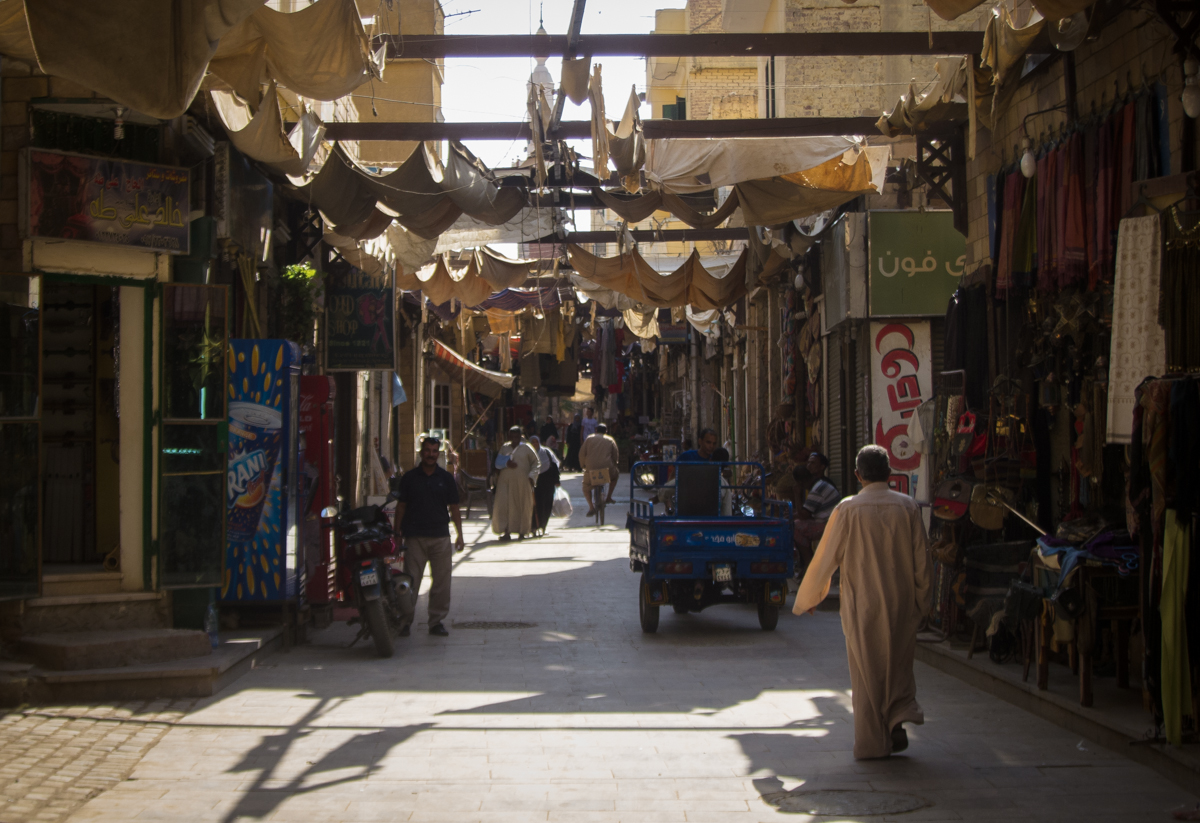
During the day, the down town core is dirty, chaotic, and noisy with people busily going about their affairs.  But every night, the area is transformed into a festive, fun, almost carnival like atmosphere. At sunset, vendors start setting up stalls in the already crowded streets, selling everything imaginable.  The shops are illuminated like bright Christmas trees.  There are balloon vendors, and popcorn carts just like a country fair in Canada.  The people fill up the sidewalks, walking slowly from window display to window display, pausing to admire the goods.  The restaurants are abuzz with customers.  I loved walking around at night watching all the families going about their business.  We were never bothered or felt ill at ease.  People were friendly towards us, often saying “Welcome to Egypt” as we passed by. One night, we were approached by a young woman, a university student who was interviewing tourists to find out their experience in the down town area.  She wanted to know if we felt safe, if we were being harassed, etc.  We gladly answered her questions and she was so appreciative.  It did raise an interesting question though: where are all the tourists?  They are noticeably absent, yet we knew there are tourists around as we see busloads of them when we visit the tourist sites. I surmise they are probably cloistered away in their Western style hotels far away from the real Egyptian life. They are missing out on so much, in my opinion.
A papyrus paper making demonstration.

The Egyptian Museum

 The Egyptian Museum in down town Cairo is reputed to be have one of the best repositories of Egyptian antiquities in the world.  Now that we had visited the temples and tombs in Upper Egypt, I was thrilled to have the opportunity to view some of the treasures from that region, especially the infamous gold treasures from King Tut’s tomb.  They strictly enforced the “no camera” rule, so we have no photos to share.  But there are plenty on line if you are interested.

The museum is a relic in its own right, dating back to 1902.  The architecture is beautiful, with high ceilings and lofty spaces designed to showcase a plethora of antiquities.

The museum is filled to the rafters, yet apparently only a fraction of the 120,000 piece collection is on display.  Each item has been catalogued, yet most exhibits are not labelled which was frustrating at times. The labels that do exist, seemingly with no rhyme or reason, were small type-written notes on faded paper looking as old as the museum itself. All the display cases are the old-fashioned kind, the ones made of heavy wood with dusty glass shelves, relics of a bygone area.  Each cabinet is secured with a flimsy, rusted out lock. Many cabinets were simply secured with thin piece of twisted wire.  At least the treasures, including the stunning 11 kg solid gold death mask and the two innermost golden anthropoid coffins from King Tut’s tomb were segregated in a separate, highly secure room.  I found it quite incredible that the security was so minimal in a museum that housed such a vast collection of invaluable ancient artefacts.

The museum sure could use a good cleaning as most exhibits are buried under a thick layer of dust. Yet in spite of its tired, faded, old fashioned appearance, there was a charm to this unpretentious museum that made it a pleasure to explore.

The museum is vast; you could easily spend a day here if you had the stamina for it.  I personally get overloaded after about 3 hours in a museum.  After a couple of hours, we took a lunch break and then returned later in the afternoon for a couple more hours.  It was good to break it up this way and we had no problem re-entering the museum with our ticket.  We opted not to pay the extra 100 EGP per person to visit the Royal Mummies display.  They had plenty of other mummies on exhibit so I didn’t feel the need to see more.  Again, a quick google search will yield many photos of these mummies if you’re interested.

Old Cairo and the Coptic Museum

Old Cairo was known to the Greeks, Romans and early day Christians as Babylon, but this should not be confused with the Mesopotamian city of the same name.  This was the original fortified town around which the rest of the city grew.  It is now home to the Coptic community who form about 15 percent of Cairo’s population.  The “Copts” were one of the earliest peoples to adopt Christianity.

We found our way to this area by metro, our first venture using the underground system. Egyptians are very similar to South Americans in that they will give you directions even if they don’t have a clue where you are going.  They just want to be helpful. So it shouldn’t have surprised us when we were given wrong information, from the Information Desk no less.  After two wrong stops, we were finally directed to the correct station (Mari Girgiss in case you happen to be there) by a kind gentleman who took the initiative to help us out as we were puzzling over our map.  We knew we were in the right place by the groups of tourists milling about the streets.

To be honest, we had no intention of going to the Coptic Museum, but we were both desperate to use the bathroom and we knew the museum would have decent toilet facilities. Of course, after buying the admission ticket, we felt compelled to at least do a quick spin through.  Again, no cameras were allowed, so we have no photos to share.  This museum gives you an excellent idea as to what the interior of a 5th, 6th or 7th century church would have looked like.  The most prized collection is the “Nag Hammadi Codices”: 1,200 papyrus pages bound together as books – the earliest books with leather covers found to date.  These Coptic writings date to the 4th century and offer a rare insight to early Christianity.  We learned a lot about the early Coptic Christians and I was particularly interested to see how many of the practices and symbols from Egyptian mythology was adopted by those early day Christians, most notably the symbol that represented life to the Egyptians was transformed into a Coptic cross.

There are many churches, mosques and a synagogue clustered within the ancient walls of Old Cairo.  We followed alleyways (and the tour groups) to find our way around and explore these diverse religious centres. The whole area is steeped in history.  For example, the spring next to the Ben ‘Ezra Synagogue is supposedly where Mary stopped to wash Jesus, and where Pharoah’s daughter found baby Moses in the bullrushes.

The Citadel

On a hill overlooking Cairo sits the Saladin Citadel, a medieval Islamic fortification that has been well preserved to this day.  This complex houses the Mosque of Mohamed Ali, the Mosque of El-Nasser Mohamed, the Military Museum and the El-Gouhara Palace.

The location offered a fantastic view of Cairo which extended as far as they eye could see.  We could even see the Giza Pyramids in the far distance.

Many students of various ages were touring this site on the afternoon of our visit.  We were approached by a few groups who wanted to have their picture taken with us.  One group of female university students approached me while I was sitting on the Mosque floor just taking in the atmosphere.  One girl in particular spoke English quite fluently.  She approached me rather shyly and said hello.  She was very interested in where I came from and where I had been in Egypt and what I thought of her country.  There was no ulterior motive, she was genuinely interested in learning about me.  We have been engaged several times like this, usually by young people and it always leaves me with such a warm feeling.  These interchanges make me feel very welcome in this country.

Footnote:  A map on the wall of the Egyptian Museum indicated a room that contained the famous Rosetta Stone.  This unique ancient artefact provides the key to our modern understanding of Egyptian hieroglyphs because the stone contains inscriptions of the same text in three different scripts: Ancient Egyptian hieroglyphs, Demotic script and Ancient Greek.

We weren’t exactly sure what we were looking for, in terms of size or shape but surely something of such historical importance would be prominently displayed and well labelled.  We scoured the room and verified the map twice. There was nothing to indicate which stone was the Rosetta Stone if it was there at all.  One stone, tucked away in the far corner of the room, had three distinct scripts inscribed on it.  This stone was displayed in a an upright position, in a very shabby wood case that resembled the photo below.  Did we find the Rosetta Stone or was it just a replica?

File:Rosetta Stone.JPG

Photo of the Rosetta Stone courtesy of Wikipedia.

A subsequent internet search indicates the Rosetta Stone has been a prized possession of the British Museum since 1802.  Yet some on-line descriptions of the Egyptian Museum state the Rosetta Stone resides there.  The official site for the Egyptian Museum in Cairo says nothing about the Rosetta Stone, so my money is on the British Museum, but that doesn’t explain the stone we did see. That remains a mystery!

Bed bugs – a blessing in Cairo

My stomach tightened into a knot as we entered into the train station at 4:30 on Monday morning and  I saw the train that would take us to Cairo.  It was old, dirty, and marred with  cracked and broken windows.  The first class coach was marginally better, at least it had air conditioning and large, reclining seats, although it was still pretty grimy and grungy.  But when compared to the second class coach, I’m glad we splurged and paid the extra $10 CAD (total price per ticket: $21 CAD) for first class.  Most tourists travel this route at night on the sleeper train which costs more ($60 CAD + depending on what type of seat you purchase) and I was beginning to see why.  In fact, the day train has only recently become available to tourists.  In the past, it was limited to Egyptians only.

We weren’t alone for long…it filled up
pretty quickly as we stopped in every village along the way. 

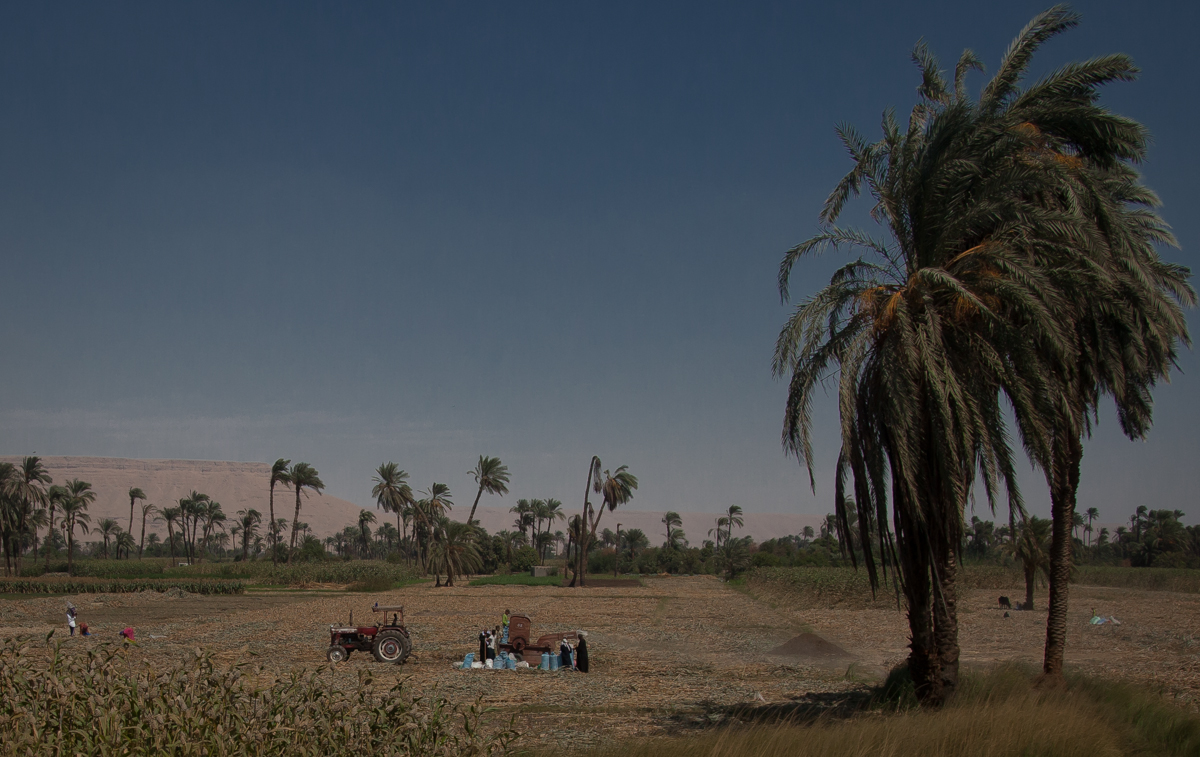
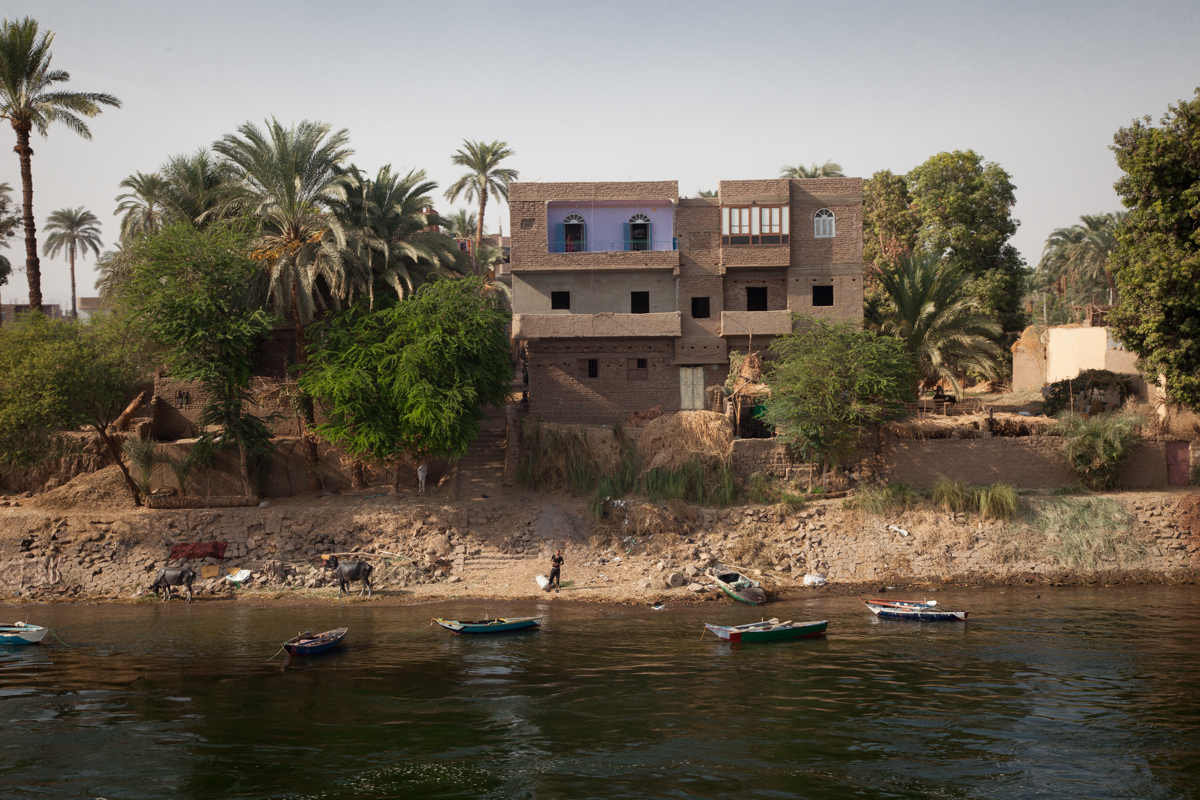
The train left on time and 14 hours later we arrived on schedule in Cairo.  Those fourteen hours were spent bumping and swaying slowly along a rickety old track that snaked through the Nile Valley, stopping in every town along the way.  So much for being on the express route! The scenery was consistent and quite beautiful – men and women along with the odd donkey or two, manually labouring in their lush fields of corn, sugar cane, and cabbage.  There are two growing seasons for all crops in the Nile Valley, except sugar cane which takes a year to grow.  It looked like it was harvest and planting time.  The rural landscape was interrupted now and then by small villages, larger towns and a few cities which all looked very much the same as the towns we have already visited.  Surprisingly, we travelled in relative comfort – we even had food and beverage service of which we availed ourselves, at least for drinks.  We declined on the food as the canteen area looked pretty sketchy. There were a few precarious moments, though, when the train and the tracks did not seem to align and I was certain we were goners.  But, we got there in one piece, which is all that really matters at the end of the day.

Sadly, garbage is everywhere.

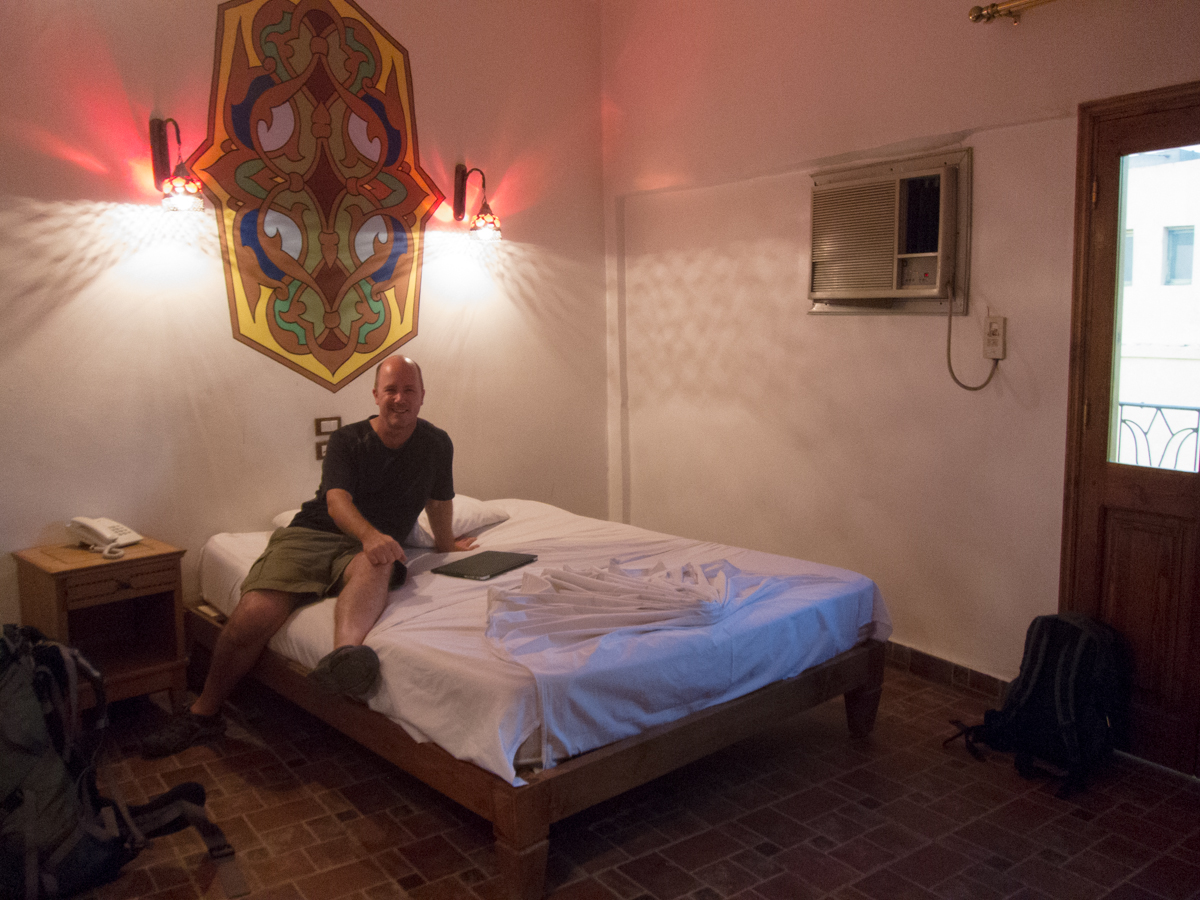
Before I tell you about Cairo, just a word or two about our weekend in Aswan.  We stayed at the Keylany Hostel which had very good Trip Advisor reviews.  I don’t know if it was because we had been spoiled on the luxury boat for five days, but we found this hostel to be quite grungy even though our room was adequate with comfortable and clean beds, and a usable bathroom.  It had an archaic air conditioner that was noisy as hell but it worked reliably.  We spent three nights here in spite of the grim surroundings.  The town of Aswan came alive at night in the bazaar which was just around the corner from our hostel.  But walking through the market was an exercise of determination to avoid all the shopkeepers who were very obnoxious and persistent, often blocking our way to try to force us into their shop.  We’re getting really good at ignoring these pesky irritants.

View from the front door of our hostel one morning.

A feast for under $10.

Food was a challenge in Aswan.  Our breakfast at the hostel was better than we expected – real filtered coffee, fresh fruit juice, fruit salad, Egyptian pancakes with jam, and toast.  Finding food for the rest of the day was difficult.  On Friday, their holy day, everything was closed and we resigned ourselves to lunch at KFC – yes, they have KFC in Aswan.  With a recommendation from our hostel, we reluctantly ate dinner at a rather grimy looking local restaurant in the market.  The food turned out to be plentiful and tasty and very cheap (about $6 CAD) and most importantly, we didn’t get sick afterwards.  The next day we ate at another restaurant that apparently is a historic icon in Aswan (why our hostel didn’t recommend it in the first place is beyond me) and it was much better in every respect albeit more expensive by Egyptian standards (a mere $10 CAD for the entire meal).

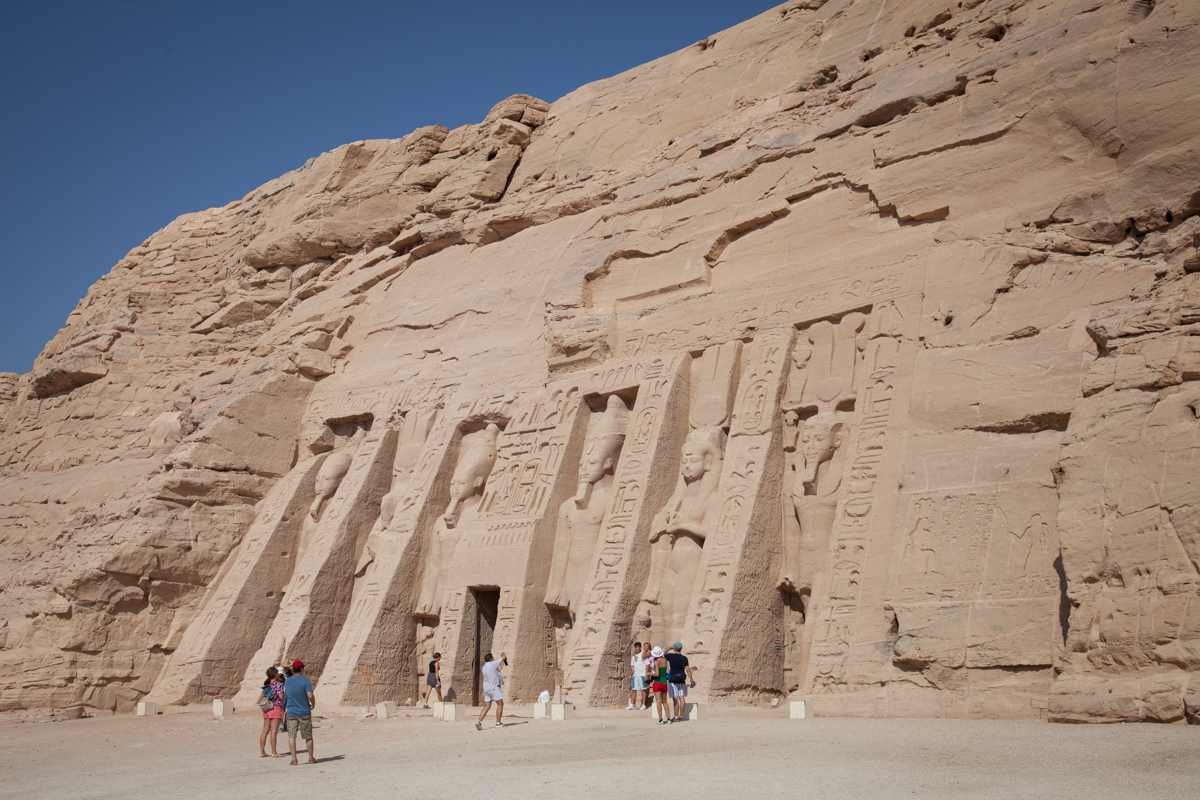
Although we had had our fill of temples this past week, we had already arranged a visit to Abu Simbel through the tour agency in Luxor.  This meant a ridiculously early morning start on Sunday, getting picked up at 3:15 am, spending the next hour picking up other people from different hotels, and then travelling in a very cramped, uncomfortable mini bus for 3 hours in order to get to the site by about 7:15 am.  The site was incredibly impressive, and certainly worth the visit.  The fact that this site had been completely relocated to higher ground in the 60’s when the High Dam was built made it all the more extraordinary.  They literally moved a mountain.

It took a couple of days to get our bearings in Cairo, it is such a huge, chaotic city.  As the capital of Egypt, it is the largest city in the Arab world and Africa, and its metropolitan area is ranked 11th in the world with a population of 17.5 million spread over 453 square kilometers.  This is the largest city we have visited so far.

We stayed in the Milano Hostel located right in the down town core.   We were a little intimidated at first as we ventured out to explore our neighbourhood.  Everywhere you looked, the streets were clogged with cars and people, day and night.  In every direction, there was a constant gridlock, often bringing traffic to a standstill.  I don’t know how anybody gets anywhere in a car.  It takes nerves of steel to cross a street, when the traffic is moving that is – you must boldly walk into traffic and trust they will yield to you.  But if you dare hesitate, they don’t give you a second chance and you’re left stranded in the middle of the street as they go around you.  For a while, I waited for a local to step foot into the oncoming traffic and then trailed closely behind.  But we quickly got the hang of it and soon we were walking into 5 lanes of oncoming traffic without breaking a sweat.

There were no signs of protests or unrest while we were in Cairo until Friday (more about that later).  Our hostel was a 15 minute walk from Tehrir Square where all the recent demonstrations have taken place, including the one on Friday.  We feel very safe and comfortable walking around this area day and night.  The shopkeepers don’t even hassle us as they seem more interested in serving their local clientèle than bothering with us tourists. I even went shopping and bought myself a dress without any problems whatsoever.

It’s been a bit of a rigmarole with our hostel.  In spite of their best intentions to make us feel welcome and comfortable, we had problems with this hostel right from the start.  First, nobody met us at the train station as promised.  They did, however, pay for our taxi from the train station to the hostel.  When we finally arrived late on Monday night, we were given a room facing a busy street which was extremely noisy.  Add to this, the ensuite bathroom was ridiculously small, so small in fact that the shower hung over the sink and toilet.  We weren’t quite sure where you were supposed to stand to take the shower.  You could literally sit on the toilet, brush your teeth into the sink and have a shower all at the same time.  Seeing as we were planning to stay in Cairo for a week, we complained, something we rarely do.  We insisted on a better room or we would be going elsewhere.  The next day we were given a new room that was still quite noisy but it had a half decent bathroom, and they offered us a better breakfast after Chris complained about that too.  I have to give them credit for trying to make us feel comfortable and for addressing our concerns.  On our third day, they offered us an even better room which we gladly accepted only to find it infested with bed bugs – something we discovered after we had moved all our stuff over and spent the afternoon napping.  We quickly moved back to our old room which was bug-free as far as we could see.  In spite of these issues, there were positive things about this hostel that made it worth staying – the beds were very comfortable, we had modern, quiet air conditioning, and it was clean.  And it goes without saying that the location was excellent – walking distance to the Egyptian Museum and metro, plenty of restaurants around, and lots of shopping.

Imagine, with all the places we have stayed, this is the first encounter with bed bugs and luckily we saw them before they saw us, or so we thought.

I thought this was the end of the story, but there is more.  When I woke up on Friday morning I was covered in bites, that’s right, bed bugs! That was the last straw.  We packed up our bags and we were out of there first thing in the morning.  We took a taxi to a southern suburb (Maadi), where we found a room at the Hotel Pearl, thanks to a recommendation by Steve, the manager at Roots Camp where we were diving a few weeks ago.

Ironically, this was the day riots and demonstrations broke out down town, apparently right near  our hostel.  If we had still been staying there, we would have walked right into all the commotion later that afternoon when we returned from our trip to the Giza Pyramids.  We avoided the entire down town situation thanks to a bad case of bed bugs, but we did have our own excitement at the pyramids in Giza that day which I’ll tell you about later.

The temples and tombs of Upper Egypt

Since arriving in Luxor a week ago, we have been immersed in ancient Egyptian history, mythology and culture.  Luxor is a bustling city of about a half a million people with an economy heavily reliant on tourism.  Since the revolution in 2011, the annual number of tourists has dropped dramatically with an equally dramatic impact on the locals.  Everywhere we went, we were received warmly and with gratitude that we were visiting the country.  Our tour guides especially thanked us for coming as they have been particularly hit hard by the lack of tourists.  We have felt very comfortable and safe everywhere we have gone.

Our transportation to Luxor was arranged through Roots Camp using their van and driver.  Gone are the days when you need special permission and a security convoy to traverse the desert.  Nowadays, since the revolution, tourists can travel quite freely, but are still restricted to travel during daytime hours, except for the overnight Aswan – Cairo train.

Governmental authorization in the form of the above document is
required whenever transporting tourists.  
There are many checkpoints as you
pass through each village.  Occasionally, but quite rarely, we were stopped and
the above documentation had to be presented.   It is the responsibility of the driver
to ensure he has such documentation in order. 

For our brief stay in Luxor, we selected Nefertiti Hotel, a small, family-run hotel that had great reviews online.  At 175 EGP per night (approximately $25 CAD) including a complete breakfast, we didn’t exactly have high expectations.  What a pleasant surprise when we arrived.  Nefertiti is a simple hotel with clean, modestly decorated, but comfortable rooms with air conditioning and ensuite bathrooms.  A delicious and substantial breakfast is served on the rooftop terrace which offers terrific views of the Nile River and Luxor Temple which is across the street.   The hotel has a restaurant (Al Sahaby Lane Restaurant and Aladin Cafe) and a travel agency (Aladin Tours) as well.  Food was typical Egyptian cuisine and was very tasty.  In fact, we ate all our meals at the restaurant.  We arranged some tours through Aladin Tours and we were very pleased with all the arrangements made, including our very enthusiastic tour guide Hassan.  The best part of this hotel was the people.  From the minute we arrived, we felt like we were visiting family who only had our best interests at heart.  I was really happy we decided to stay in a local hotel rather than one of the large, recognizable chains. Nice to know our tourist dollars were going directly into the pockets of the locals.

An early morning hot air balloon ride over the West Bank area of Luxor was well worth the 350 EGP per person price tag.  Our hotel made all the arrangements including transportation.  We flew with a company called Sindbad and would definitely recommend them. There was barely a breeze as we floated over the fertile land along the Nile. It was such an interesting perspective to look down at the farmland, the desert, some ancient temples and local villages as day broke and the sun  awakened.

The only negative experience we have had thus far has been dealing with the aggressive shopkeepers who persistently try to entice you into their shops by any means possible.  At first we tried to be polite – we would smile and say no thank you, or la shokran in Arabic, but this only seemed to encourage them more.  Some would try to engage you in a conversation – lady, where are you from?  And their favourite joke when you replied Canada would be to say, Ah, Canada Dry.  Ha ha.  We soon realized that answering them made matters worse.  Finally, we found the best way to handle these aggressive vendors was to walk with a purpose, avoid eye contact, not to look at the merchandise, not to speak to them, basically ignore them.  It felt rude at first, but once we saw how effective this was, we saw it as a matter of survival.  It’s too bad they are so aggressive because there were shops I would have liked to visit, but wouldn’t dare to even slow down to take a peek.

Video: The Shopkeeper Obstacle Course

Our 5-day Nile cruise was arranged through Seshat Travel, another local tour agency recommended to us by the managers at Roots Camp.  We honestly weren’t sure what we were signing up for when we purchased the cruise – it was last minute, and we didn’t have much time to do any research about the tour company or the ship.  Well, you can imagine our surprise when we walked onto the Amarco I, a luxurious five star boat, by any standard.  We had a large room, with floor to ceiling picture window, ensuite bathroom with a full bath, and of course air conditioning.  The food was top notch, the service was impeccable and the amenities were great especially the sun deck and pool.  Travelling at just one quarter of its 120 person capacity, and with a staff of 60 there was a 2:1 ratio of staff to guests.  We were treated like royalty.  To top it off, we had our own private guide throughout the full cruise. Mohammed, a trained Egyptologist with a decade of guiding experience, accompanied us to all the sites, managed all the transportation, and showered us with his wealth of knowledge.

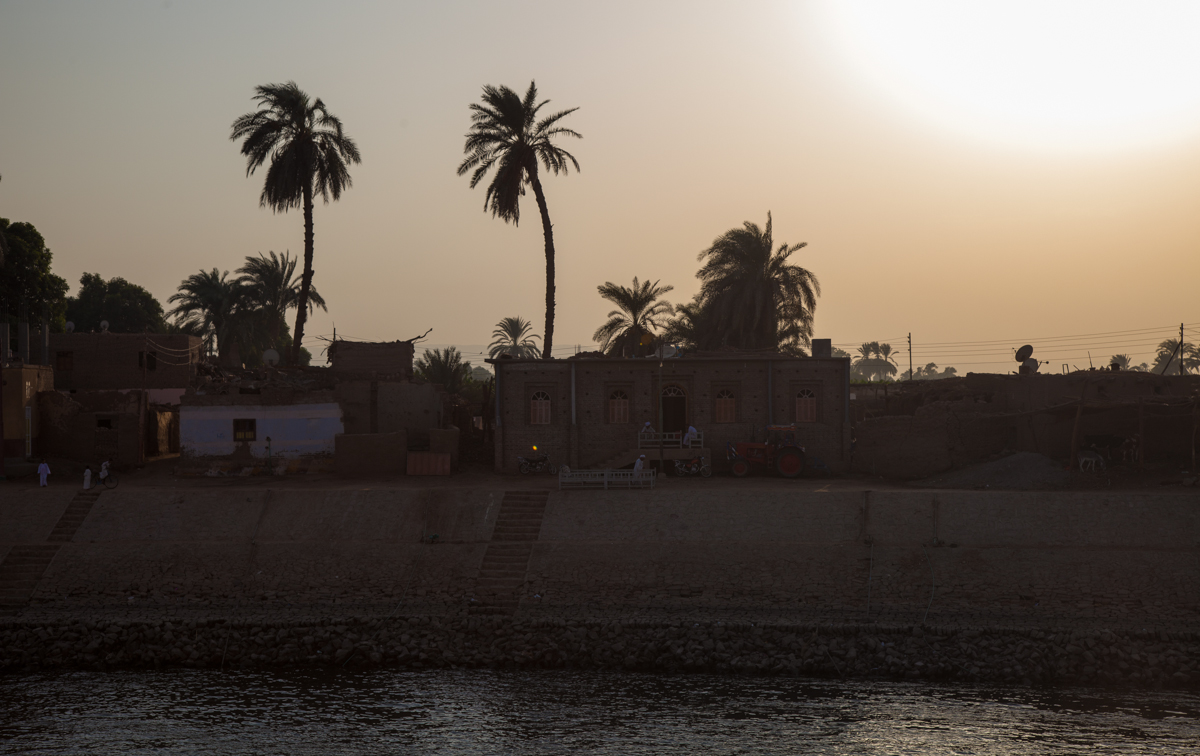
Cruising down the Nile between Luxor and Aswan is a very peaceful experience and one I would recommend to anyone visiting Egypt.  The pace is leisurely as the boat is not sailing all the time; afterall, we travelled a mere 200 km.  The Nile River is calm, making for the smoothest sailing imaginable.  You could easily forget you’re on a boat. The first night was spent docked in Luxor and the last night we were docked in Aswan turning our boat into more of a floating hotel.  Each day, we visited significant historic sites.  When we were sailing, we spent most of our time on the upper deck, cooling off in the pool, reading and enjoying the passing scenery: the lush, fertile Nile valley outlined by golden desert hills in the background.  Sunsets were glorious; a golden globe sinking into the West Bank of the Nile each evening.

Even on the ship we were harassed by vendors in row boats.
They would align themselves with each passing ship and
then throw a rope to attach themselves to the ship.
Once secure, they would yell “hello” over and over again
until people looked over from above.  They then proceeded
to show the clothing they had for sale, very cheap, very cheap.
I have no idea how they completed the transaction as it
didn’t appear to me that anybody was buying anything. 

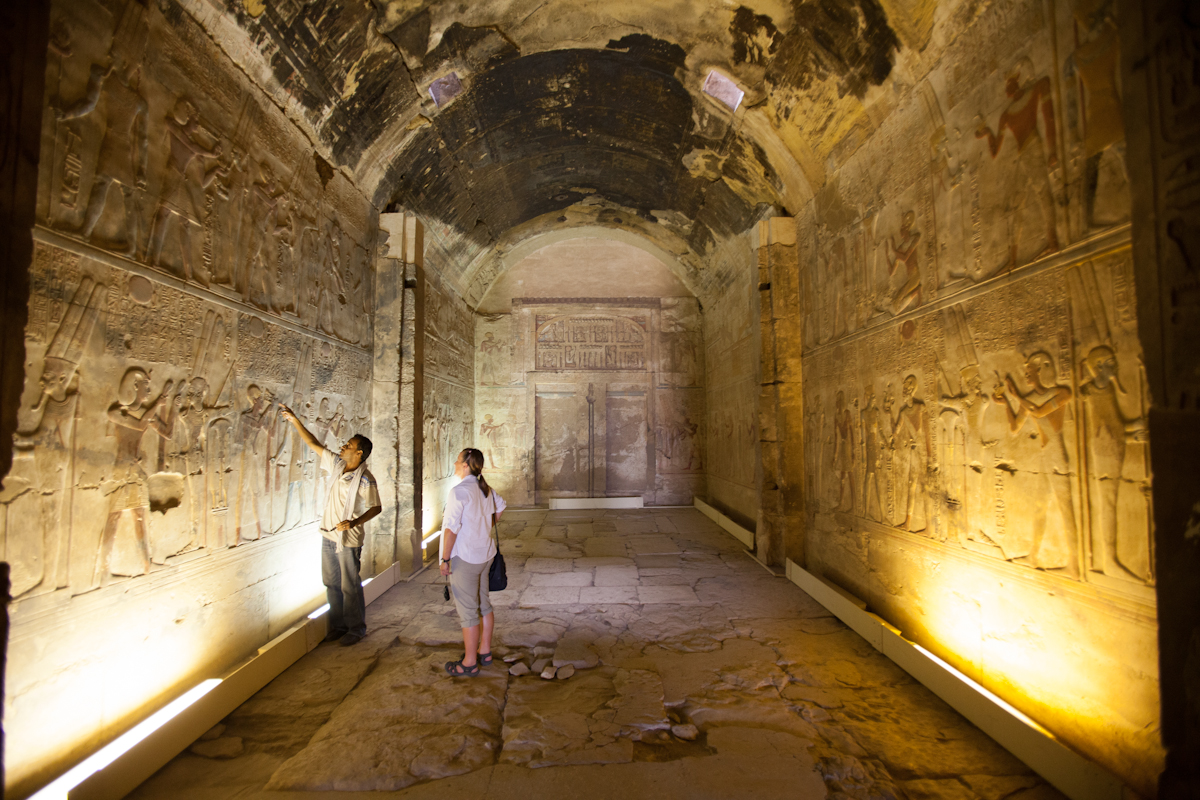
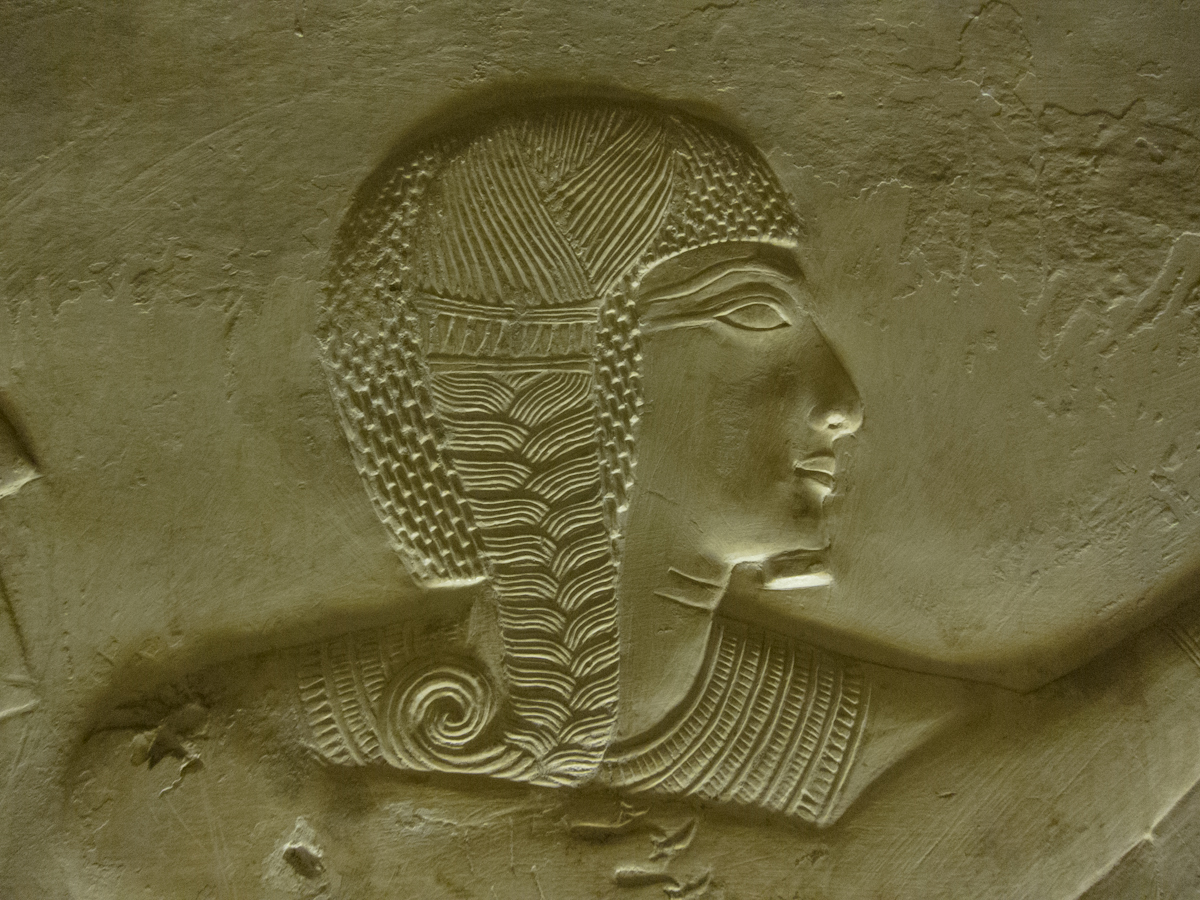
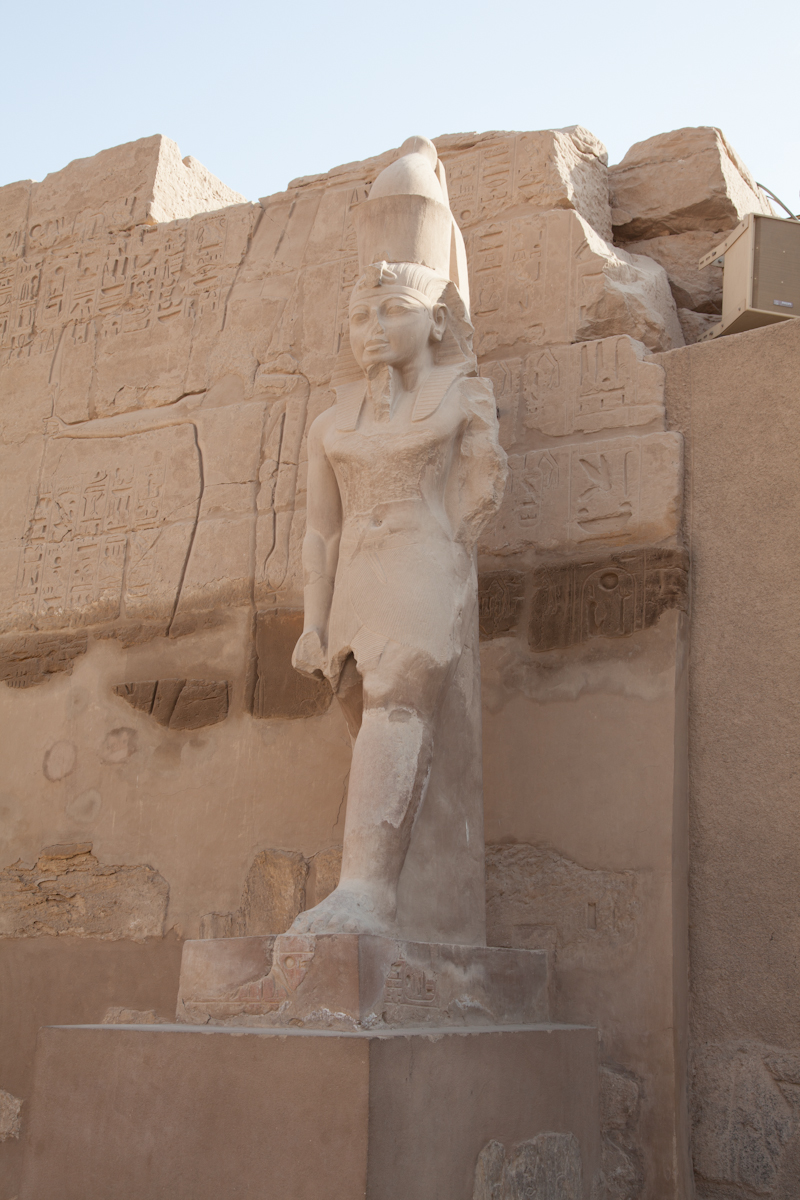
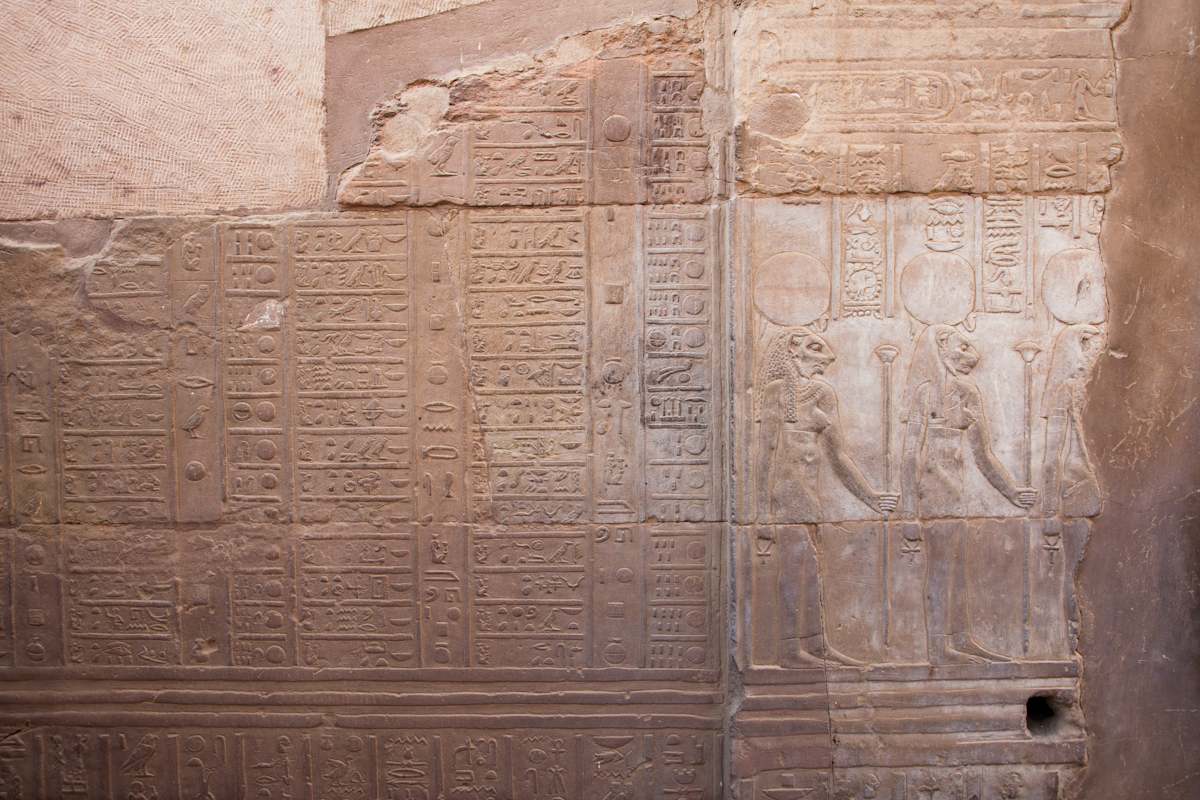
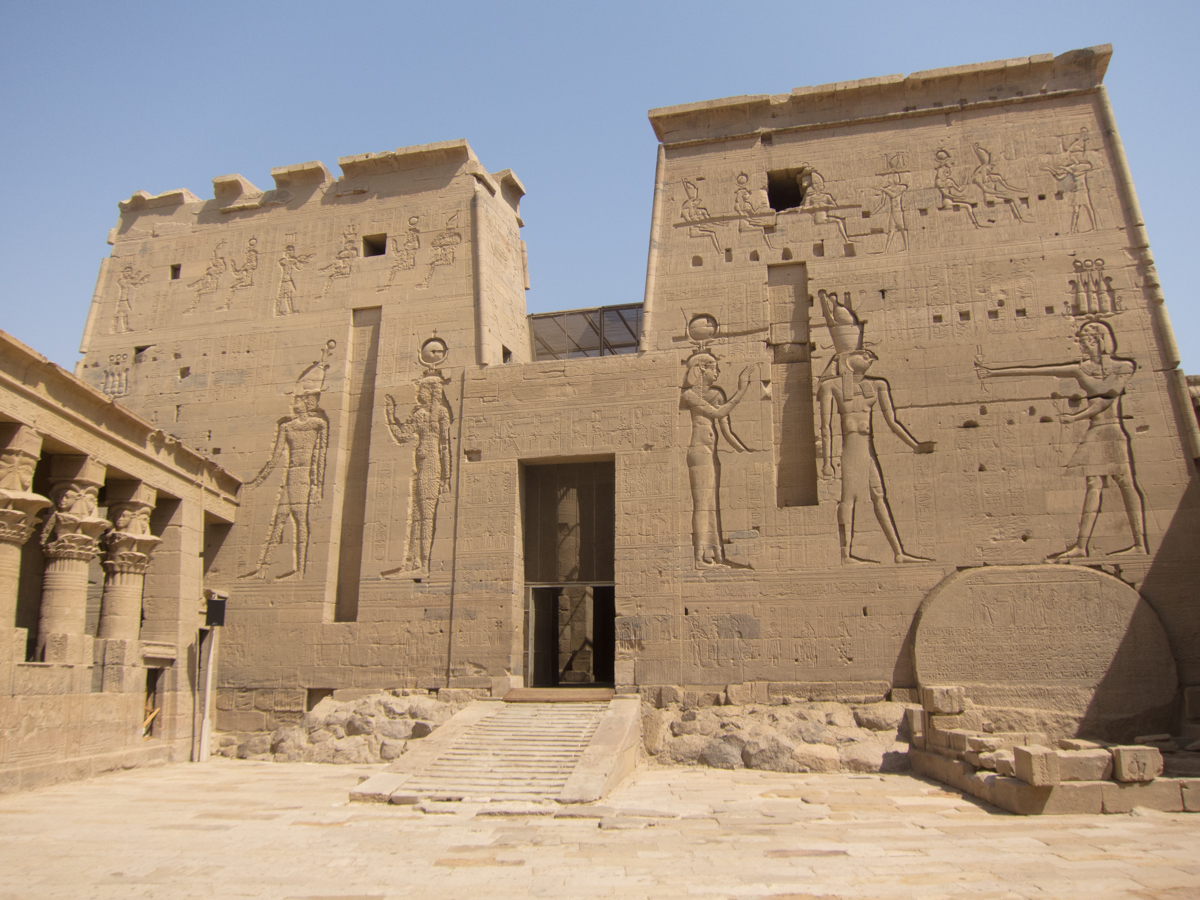
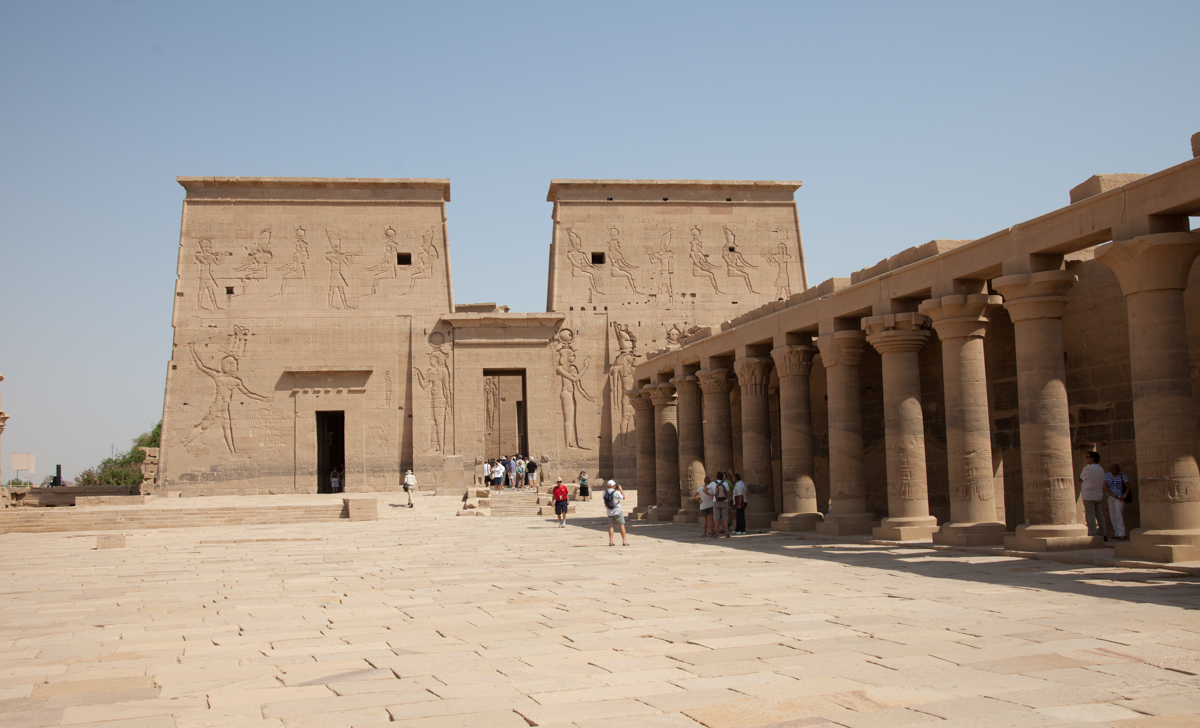
Over the course of a week, we have visited a total of fourteen sites in or around Luxor and Aswan, as follows:  Dandara Temple, Abydos Temple, Workers Tombs, Noblemen Tombs, Habu Temple, Karnak Temple, Luxor Temple, The Valley of the Kings (three tombs), Valley of the Queens (Queen Haptushput’s Temple), Edfu Temple, Kom Ombo Temple, The Unfinished Obelisk, The High Dam, and Philae Temple.

These temples are mind-boggling in their grandeur, their size, and their decoration. We pondered how these ancient civilizations accomplished such magnificent engineering feats.  The burial tombs were incredible from the modest yet highly decorative and very colorful workers’ tombs, to the grandiose tombs of the kings.  What a privilege to walk through the remains of ancient civilizations.

Dandara Temple:  One of the best preserved temples in Egypt, dedicated to the god Hathor.

On the way to Dandara, this was a common scene
in the small, agricultural villages.

Very few tourists were at the temple the day we visited.
This temple is a couple of hours north of Luxor and therefore
not as easily accessible.  We hired a private guide and car for the day.  

This temple is renowned for its colorful decorations still intact after
so many centuries.  The ceiling at the entrance  has been partially restored
showing to the left 
what it looked like before being cleaned. 

Abydos Temple:  This temple, dedicated to Seti I, is famous for a chronological listing in the form of cartouches of most of the Egyptian pharoahs from Menes until Ramesses I, Seti’s father.

Our guide, Hassan (hired through Aladin Tours) passionately
shared  his knowledge with us.  It was a lot to take in!

Deir el-Medina: Commonly referred to as the “workers tombs”, this is an ancient village which was home to the hundreds of artisans and their families who worked on the tombs in the neighbouring Valley of the Kings during the 18th to 20th dynasties.  The chief workers were buried here in elaborately decorated tombs.  Our guide was not permitted into the tombs with us.  Instead, a local brought us down and described some of the pictures that decorated the walls of the tomb.

Entrance into one of the worker’s tombs.

Video: Inside the worker’s tomb

Noblemen’s Tombs:  Located close to the workers’ tombs in the Valley of the Kings on the West Bank of the Nile, these were burial places of some of the powerful courtiers and persons of importance of ancient times.  The tomb we visited reminded me of a small temple; it was highly decorated but the colours were not as vibrant as those found in the workers’ tombs.

Habu Temple:  Located on the West Bank, close to the Valley of the Kings, this was the mortuary temple of Ramesses III, during the New Kingdom period.  Mortuary temples were designed to commemorate the reign of the pharaoh for and by whom it was built.

Karnak Temple:  This was our first site as part of our cruise itinerary, with our new guide, Mohammed.  This vast complex is located right in Luxor, on the East Bank, about 3 km from the Luxor Temple.  It is reputed to be one of the largest ancient religious sites in the world and the second most visited site in Egypt, next to the pyramids in Giza.

Luxor Temple:  Also on the East Bank, this temple is located in the middle of Luxor.  Remnants of the sphynx avenue are still visible.  This was a 3 km ceremonial route lined with sphynx statutes  connecting Luxor Temple and Karnak Temple.  The government has plans to restore the entire boulevard, but first must relocate many businesses that exist on top of the ancient site.

The Valley of the Kings (three tombs):  For nearly 500 years, between the 16h and 11th centuries, tombs were constructed for the Pharoahs and powerful nobles of the New Kingdom.  Recent discoveries in 2005 and 2008 of new chambers and tombs brings the total number of tombs to 63.  This was the principal burial place of major royal figures. The tombs vary in size but all are decorated with scenes from Egyptian mythology giving insight into the beliefs about the after life and the funerary rituals during that time.  Over the centuries all the tombs have been opened and robbed, but you still get a sense of the grandeur, opulence and power of the Pharoahs.  Unfortunately, cameras were strictly forbidden and had to be left in the car, much to our disappointment.  Below is a shot from the parking lot, showing the natural forming pyramid shape under which the tombs were dug.

Hatchepsut’s Temple:  This was a mortuary temple of Queen Hatchepsut, one of the most successful female Pharoahs in Egyptian history.  Hatshepsut’s reign was much longer and prosperous than other female Pharoahs.  She is known for her work establishing international trading networks as well as her many building projects.  This temple is also located on the West Bank close to the Valley of the Kings.

Temple of Edfu:  This relatively new temple dating back to the Ptolemaic period between 237 and 57 BCE was dedicated to the falcon god Horus.  The inscriptions on its walls provide important information on language, myth and religion during the Greco-Roman period in ancient Egypt.  The temple is located in the city of Edfu.

Our transportation to the Temple of Edfu.  Below are scenes
from Edfu City as we travelled by horse and carriage to the temple. 

Temple of Kom Ombo:  Located in the city of Kom Ombo, this temple had an unusual double design: two of everything (entrance, courts, halls, sanctuaries) which were dedicated to two sets of gods.

The Unfinished Obelisk:  In a stone quarry just outside of the city of Aswan lies a huge obelisk that is nearly one third larger than any ancient Egyptian obelisk ever erected.  If it had been finished, it would have measured 42 m around and weighed nearly 1,200 tons.  Seeing the obelisk lying on its side, chiselled out of a bed of granite makes one wonder how these ancient civilizations managed such super human feats.  How did they cut these mammoth stones and then transport them many kilometres away?  While there are many theories, the answers to these questions remain mysteries to this day.

The High Dam:  When the Low Dam, built in 1902 almost overflowed in 1946, the British administration decided a second dam should be built 7 km upriver. At the height of the cold war, Egypt decided to partner with the USSR, and the High Dam was built between 1960 and 1970.  This dam provides the ability to control floods, provide water for irrigation, and generate hydroelectricity, in fact, it supplies 60% of the nation’s electricity needs.

Philae Temple:  When the High Dam was built, the dam flooded a large area, causing the relocation of over 100,000 people and submerged archaeological sites.  One of these sites, Philae Temple, was completely dismantled and relocated to a nearby island as part of a UNESCO project.

Shops on the way to the boat to Philae Temple.

Chris getting hassled by a vendor.

View from the boat on the way to Philae Temple.

After fourteen sites, we are officially “templed” out.  Maybe you are too after reading this post 🙂 Time for a little break in Aswan where we are spending the weekend before heading north to Cairo by train on Monday.

Market day in El Quseir and dolphins in the Red Sea

Diving in the Red Sea was everything we were hoping for and then some.  Over the eight days at Roots Camp, we dove on four days plus Chris did a night dive.  We saw beautiful, colourful coral like we have never seen before.  There was an abundance of fish of all sizes, as well as sea turtles and, much to our amazement, dolphins.  That’s right.  During one of our dives, a group of 10 blue nosed dolphins slowly swam by us, within a couple of metres.  They seemed as curious about as as we were of them.  In fact as the group passed, one turned around to take another look at us and for a moment it looked like he was coming back to play, but in the end he continued on with the rest.  It is was quite something to see dolphins in their natural habitat and in such close proximity.

Creating my own shade in between dives where we had to wait
an hour, usually at mid day under the scorching sun.
My little “tent” proved quite effective.

Most people who stay at Roots Camp dive every single day.  There really isn’t much else to do if you’re not diving so we had to find ways to entertain ourselves on our non-diving days.  It wasn’t difficult.  There was the beach with comfy loungers and umbrellas which we had to ourselves whenever we wanted. No need to rush in the early morning to reserve a chair.  We had the beach all to ourselves at any time of the day.  We spent several evenings lying on the beach star gazing to the gentle sound of waves lapping onto the shore.  The sky was always clear but the bright moonlight limited the number of stars we could see.  And of course there was the house reef where we could snorkel at leisure.

A Praying Mantis – the only one we saw.

I was quite content to lounge around the beach, reading my book all day long (thank goodness for my Kindle) but Chris was drawn to the construction site like a bee to honey.  There was a large crew working on several new chalets and they were under a tight deadline to complete three units before guests arrived on Friday.  Chris was certain they wouldn’t be done in time (for the record, one was completed by 11:00 pm Friday night) and he checked on the crew’s progress each day, keenly interested in their construction techniques and a little aghast by the lack of safety on the work site.  I think Chris was in his element when Steve, the camp manager, asked if he would like a small project to do, one that would require the use of power tools.  And so Chris took on a small woodworking project – a decorative piece of wood to fill in the gap at the top of a door frame.  Chris agreed to build two of them.  In his design, he decided to get creative and add a mosaic element, or I should say, he decided I would add the mosaic to the frame he was building.  I was less than enthusiastic to be drawn into his project because mosaics are a lot of work, they require special tools of which we had none, and they take a lot of time to create.  Seeing Chris’ enthusiasm and happiness working in the workshop, I reluctantly agreed to help out.  I smashed all the tiles with a sledge hammer, my only tool, and created both designs.  But time was running out so I enlisted Chris to help out with the final execution – cementing the tiles down and grouting.  I must admit to some satisfaction when Chris commented on how much work and how difficult it was to do the mosaics, he had no idea they were so hard to do.  And to his credit, his mosaic turned out pretty good.  And so we left our mark, good or bad, on Roots Camp.

When Clare, the other camp manager (and Steve’s wife) told us she was going to the market in El Quseir to purchase all the fruit and vegetables for the camp, she invited us to come along, I jumped at the opportunity to explore a local, non-tourist market.   Chris was reluctant to venture back into town as he hated being harassed by all the shop keepers and still didn’t feel comfortable in his surroundings.  But in the end, he came along to support me as it is much better for a woman to be accompanied by a man when in public.  The market was busy and the produce was abundant.  Everything is shipped in from Luxor since nothing grows locally.  Live animals like sheep and chicken were also sold at the market.  It was a great place to people watch.  I noticed most of the women  were dressed  in heavy black garments, covered head to toe.  I wondered how they coped with the heat.  The men wore airy, light colored galabeyas which seemed much more sensible in the heat.

As our week wore on, more and more guests arrived until the camp had reached full capacity on Friday night.  What a difference from the first seven days when there were only three other guests.  Chris and I preferred the peace and quiet we enjoyed earlier in the week, although when a large group of French guests invited us to join them for cocktail hour, we didn’t mind one bit 🙂

We thoroughly enjoyed our time at Roots Camp and diving with Pharaoh Dive Club and would recommend both whole heartedly.  The staff at Pharaoh Dive Club were professional, experienced and went out of their way to make sure we had a good diving experience.  At Roots Camp, we ate well and abundantly all week, enjoyed clean facilities, slept in comfy rooms even though we were mere “hut dwellers”, and made some new friends to boot.  All in all it was a great experience.

Video: El Quseir

This afternoon we travelled to Luxor by private vehicle organized by Steve, the camp manager.  There isn’t much between El Quseir and Luxor – miles and miles of dirt, stone, and sand. As you approach Luxor, the first thing you notice is the greenery – trees and grass and then the land turns agricultural.  It truly is an oasis in the middle of the desert.  We will be in Luxor until Monday and have a full program lined up between now and then, thanks to the capable and helpful Tour Agency associated with our hotel, Hotel Nefertiti.  We’ll be sure to tell you all about it in the days to come.  On Monday, we embark on a five-day Nile cruise down to Aswan.  We will be visiting many temples and important archaeological sites along the way.  We will spend next weekend in Aswan and then we plan to travel to Cairo by train.  But I’m getting a little ahead of myself.  Right now, I must finish off this post as we have a very early start tomorrow.