christina

Galapagos Islands Cruise Day 3: Penguins!

Our yacht travelled for six hours during the night and we awoke on the western side of Isabela at Punta Moreno.  There were five volcanos in plain view sharing a common barren topography.

Breakfast was served at 7:00 am after which we headed out for our first excursion.  On our way to Punta Moreno we observed the Flightless Cormorant (a bird that cannot fly as its name implies), sea lions, sea turtles, Blue Footed Boobies, and to my personal delight, penguins.  The penguins were swimming so we only saw their little heads as they bobbed to the surface now and then.

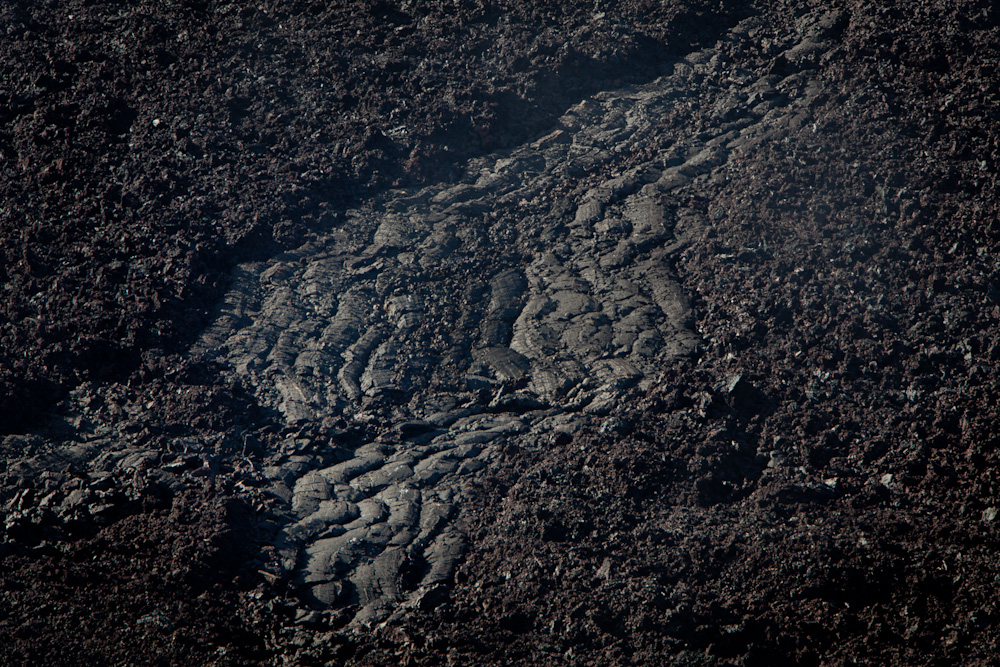
We landed on volcanic rock and went for a walk.  The sun beat down on us and the lava rock heated us from below – it was sweltering and it was only 8:15 in the morning.  As we traversed the swirling black lava flow, our footsteps crunched loudly over the brittle rocks as if we were walking on broken porcelain dishes.  The landscape was beautiful in its desolate starkness.


Three sea turtles were swimming in a natural pond fed by sea water that flowed through volcanic tunnels below us. A few in our group were lucky enough to observe a white tipped shark in the same pond.


Near the end of our walk we came across a smaller pond that was a sanctuary for birds.  It was a beautiful oasis of vibrant green reeds of grass, contrasting sharply against the barren, blackish brown volcanic rock.  Stephanie and Laura got down to the water edge for a closer look.


While waiting for the dinghies to arrive, nature entertained us as a sea lion wrestled with a large fish it had caught.  A pelican swam close by, perhaps hoping to get a free lunch.  Overhead, a frigate swooned back and forth until suddenly he dove towards the sea lion and tried to grab the fish.  The sea lion was not prepared to give up his lunch so easily.  There was some commotion and splashing and in the end, the frigate left empty handed and the sea lion continued to play with his catch.  Undeterred, the tenacious frigate came swooping down, again and again trying to steal the fish, but the equally stubborn sea lion would not let go.  The pelican, perhaps wisely, stayed out of the way and watched the competition from a safe distance.

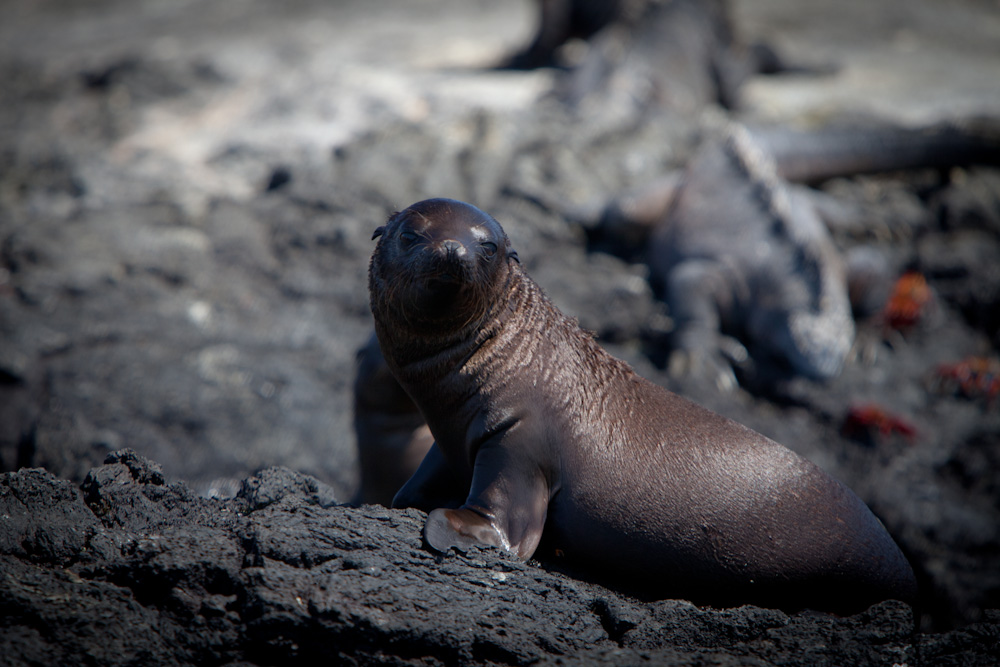
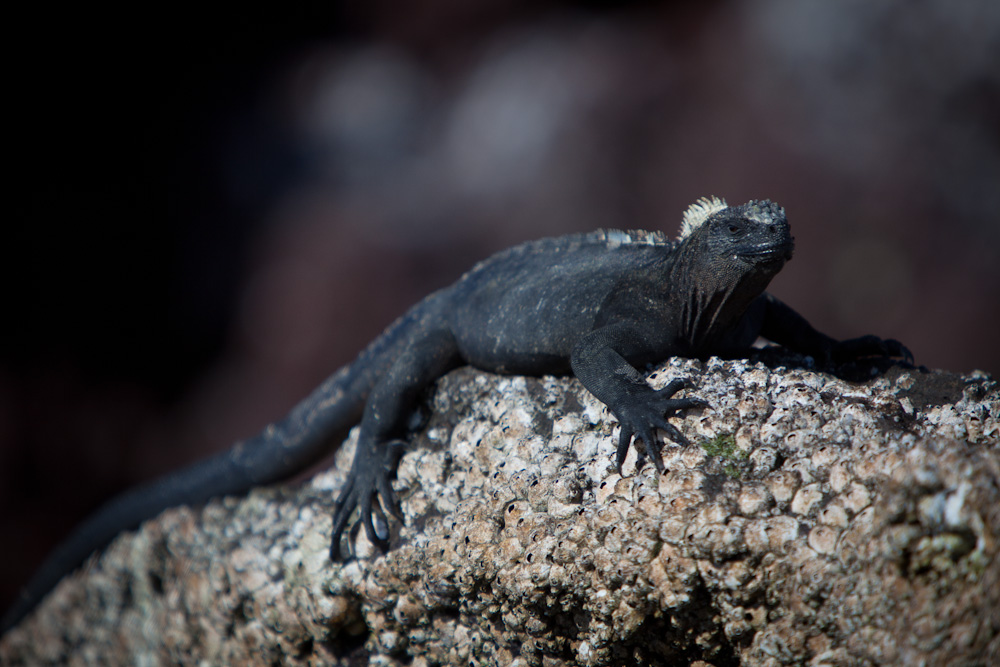
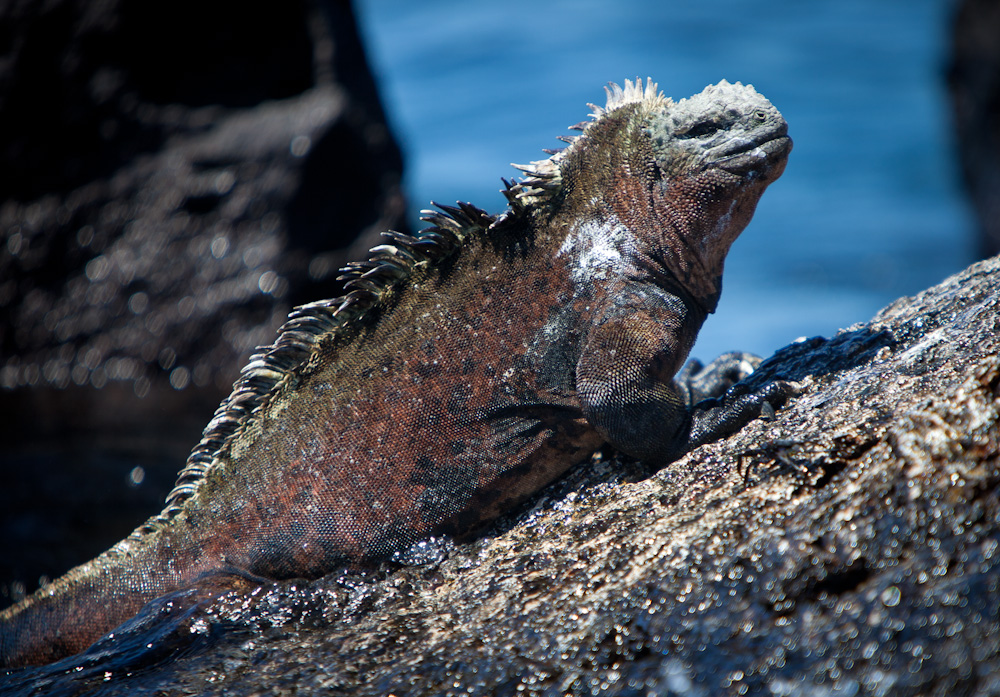
From the dinghy, we toured an outcropping of volcanic rock where penguins, huge marine iguanas (the biggest in the Galapagos Islands),  many Blue Footed Boobies, baby seals, and sea lions sun bathed in peaceful harmony.  I fell in love with penguins when I first saw their charming antics at the Biodome in Montreal many years ago.  The Galapagos Penguin is the only penguin that lives north of the equator in the wild; it can survive due to the cool temperatures resulting from the Humboldt Current and cool waters from great depths brought up by the Cromwell Current.

The average size for the penguins is 49 centimetres (19 in) and 2.5 kilograms (5.5 lb). They have a black head with a white border running from behind the eye, around the black ear-coverts and chin, to join on the throat. They have blackish-grey upper parts and whitish underparts, with two black bands across the breast, the lower band extending down the flanks to the thigh. Juveniles differ in having a wholly dark head, greyer on side and chin, and no breast-band. The female penguins are smaller than the males, but are otherwise quite similar.  The Galapagos Penguin is the third smallest species of penguin.

I was thrilled to see penguins in the wild – and felt enormously blessed for having this chance to witness the beauty of nature first hand.  Others in our group expressed similar sentiments; I think we all recognized the special place we were in.

We snorkeled today from the dinghy along a string of rocks.  The surge was strong, the visibility was low and the water a little cool, but we still saw lots of sea turtles and myriads of schools of fish.  Some even saw a penguin swimming in the water, and a commerant diving in to catch a fish.

We had spaghetti for lunch with two salads – our first spaghetti since Canada.  The pasta was served with two types of sauces: carbonera and tomato with meat along with freshly grated parmesan cheese. Dessert was a creamy strawberry mousse.  The food is plentiful, nourishing and tasty.  It is such a treat to have everything taken care of – no decisions to make, no worries if the food is safe to eat, no wondering if the water has been purified.

I feel we are quite pampered on this yacht beyond just the food.  For example, when we come back from snorkeling, we put our fins and masks into our designated bags, and our wet suits get dropped into a messy pile on deck.  The crew takes care of rinsing them and hanging them to dry as we go off to relax.  When we go out snorkeling, clean towels are at our disposal.  Every time we leave the boat, the cabin crew pass through our cabins and freshen them up, making beds, opening windows, replacing towels, removing garbage.  There is nothing for us to do but eat, follow the excursion schedule, relax, and sleep.  This is a life I could easily get used to!

After lunch, we had a few hours to relax as the boat lifted anchor and headed north to Elizabeth Bay which is located at the most narrow point of Isabela Island.  Once we reached the bay there was time to swim from the boat and then we were off to explore the coastline in the dinghies.  We began at an outcropping of rocks and were treated to myriads of Blue Footed Boobies, a few more penguins, masses of marine iguanas and a multitude of diverse birds.  We then traversed the open waters towards the coast.
It was surprising to see the coast open up into a mangrove of small waterways.  Out of the wind, this protected area was a haven for sea turtles, sea lions and many birds.  We spent a couple of hours, paddling quietly through these streams, listening to our guide tell us all about the animals and vegetation.  I was impressed with the depth of his knowledge and his versatility to switch from one subject to the next as we peppered him with questions.  He graciously split his time between the two dinghies so all could benefit from his expertise.

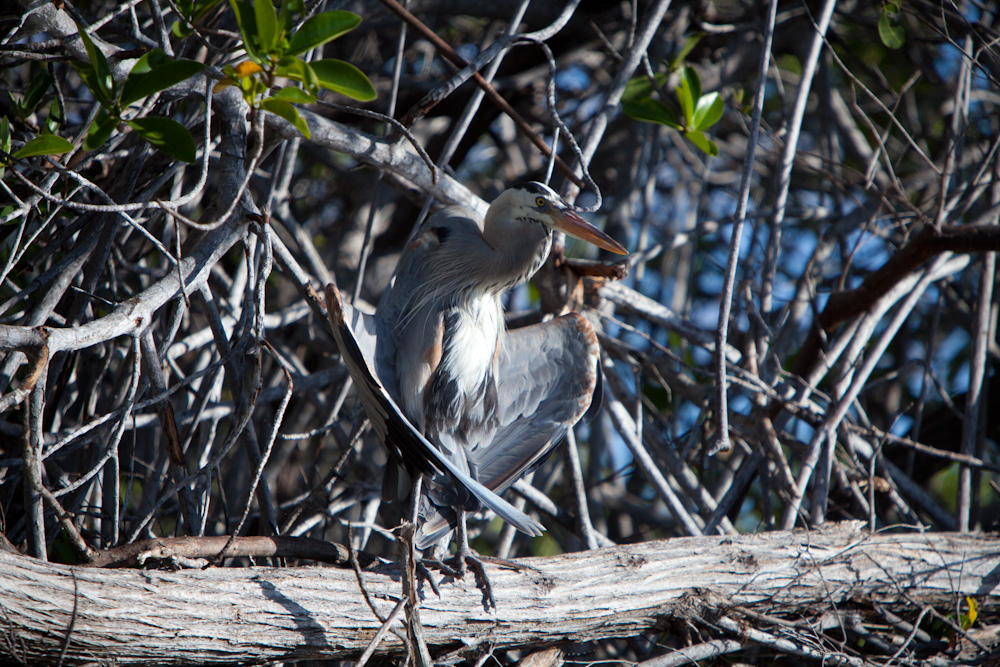
We saw many sea turtles in these shallow waters as well as a variety of birds – finches, warblers, herons, and pelicans.

A gorgeous sunset rewarded us as we returned to the yacht.

We were greeted with juice and snacks to tide us over until dinner which was again served promptly at 7:00.  After dinner, we were briefed about our activities planned for the next day and the route that the boat would take while we slept.  Such post-dinner briefings were now part of our daily routine.

Galapagos Islands Cruise Day 2: White Tipped Sharks!

We awoke under calm, sunny skies to find ourselves anchored at Puerto Vilamil, the main town on Isabela Island.  The wake-up call sounded at the crack of dawn (5:45) in order to allow us to visit Los Tintoreras, a small island next to Isabela Island upon which cruise ship passengers are only permitted to land between 6:00 and 8:00 in the morning.  Thankfully, coffee and biscuits were served before loading into the dinghies, making the early start a little more bearable.

I couldn’t believe that I awoke with a head cold – how’s that for timing?  I’ve been healthy as a horse ever since leaving Canada, and now I get sick.  Within minutes of getting up, Chris moved his head in such a way that caused something in his shoulder to misalign, causing shooting, stabbing pains that forced him to lie down immediately.   This has happened before and we knew it would take days to heal.   Great!  There was nothing we could do but rely on our trusty little pharmacy bag to manage the symptoms so that we wouldn’t miss a minute of the day’s activities.

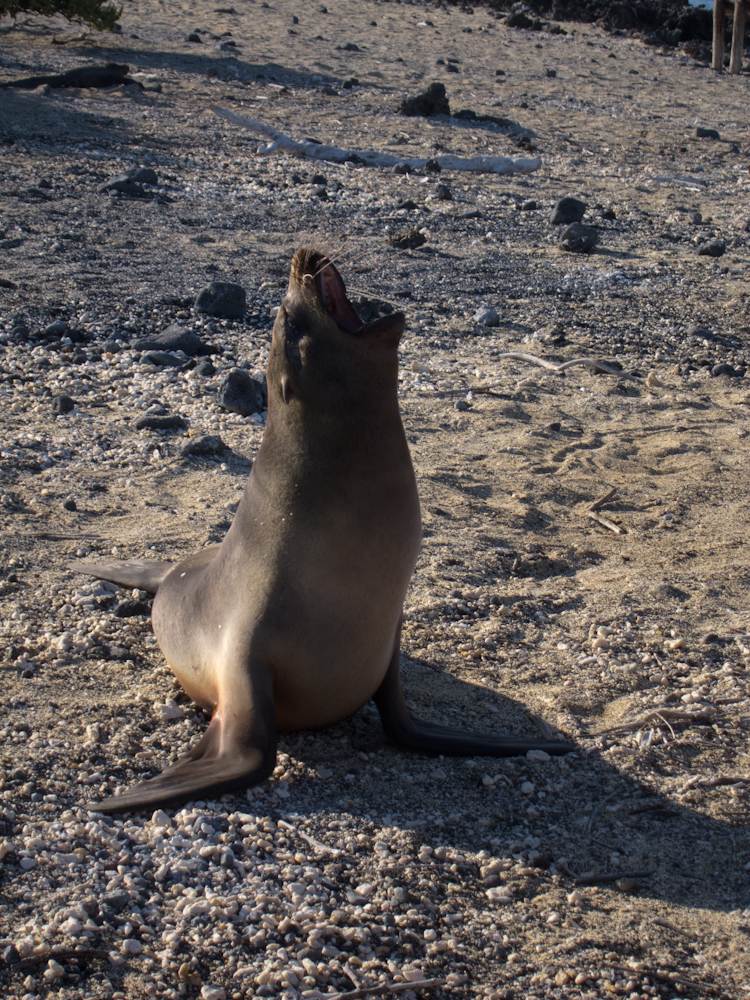
At the boat landing, we were greeted by a sea lion who was lounging on the bench meant for visitors. Undeterred, Laura made herself comfortable, and offered a great photo opp next to the sea lion.  Sea lions are plentiful through the Galapagos Islands and are not fearful of humans whatsoever; this would be the first of many encounters.  There are two species of sea lions on the Galapagos: Galapagos Sea Lion and Galapagos Fur Seal.  “Fur Seal” is rather misleading because these are also sea lions, although this species is less commonly seen.

Los Tintoreras offers a unique and safe way to see white tipped sharks as they congregate in the shallow waters of a crevice. The white tipped shark is so named because of a distinct white tip on their dorsal fin and tail.  There were dozens of sharks sleeping on the bottom of this shallow pool of water and a few were swimming gracefully back and forth from one end of the crevice to the other.  The sharks come to this protected area to rest and sleep.


Marine iguanas similar to the ones we saw at Tortuga beach in Puerto Ayora were sun bathing along the walls of the crevice.


A small path wove through volcanic rock washed white with bird poop, leading to a beach area where we saw several more sea lions.


On our return, we saw our first Blue Footed Booby – a large sized bird that has, not surprisingly, baby blue feet.

Back to the yacht for breakfast and then a briefing as to the next activities:  a visit to the Wall of Tears, a stop at the lagoon to see flamingoes followed by snorkelling.  After another dry landing, we boarded an awaiting bus.  The bus that would provide our transportation for the day was nothing more than a truck with open air, wooden benches padded with very inadequate cushions.  As we bounced along the bumpy roads, our backs complained vigorously, louder for some than others.  Those with back issues (Chris included) soon made their way to the first row of seats and those of us with more spinal resilience remained in the back taking one hit after another for the team! Thanks to Enrique, our guide, for the photo of our bus.

The Wall of Tears was built by prisoners of a penal colony that was established in 1946 to house Ecuadorian criminals.  The wall served no useful purpose other than to give the prisoners something to do – a task that required carrying heavy lava rocks from the beach to the wall, a distance of over one kilometre.  This was where “the strong cry and the weak die”, a common saying amongst islanders.  The penal colony was built on the remains of a US Naval base that had previously been established in this location during the second world war.


The Galapagos Mocking Bird was a common sight throughout the Galapagos Islands.


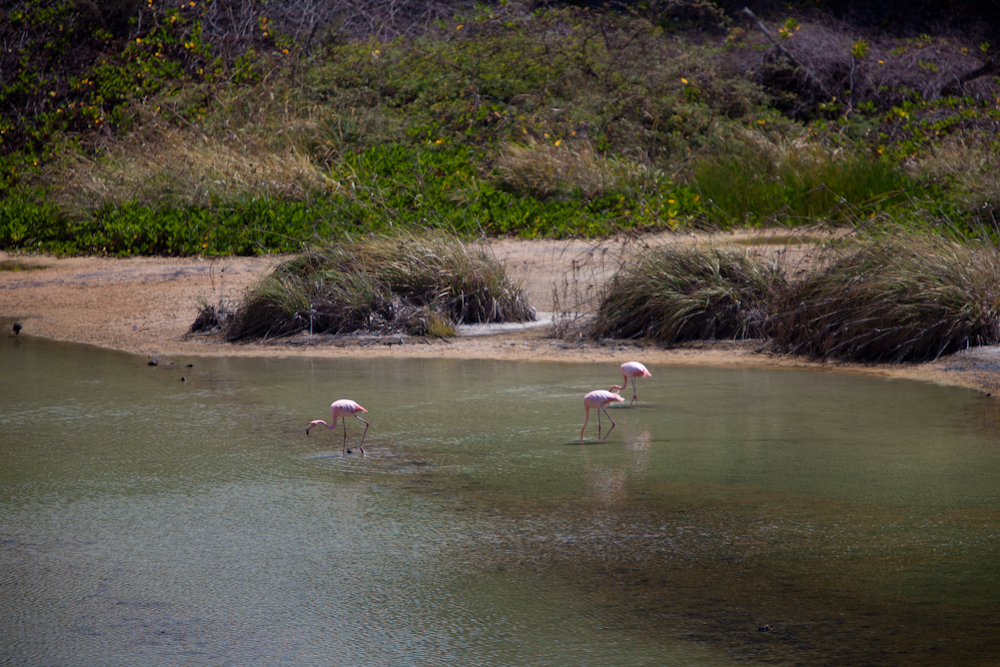
At the lagoon, there were five flaming pink flamingoes.  We could not get very close as we were on a cliff overlooking the lagoon.  These were beautiful, graceful creatures – my only wish was that there were more of them!


We had to walk through a mangrove to the snorkeling site.  Mangroves are dense and quite impenetrable so it was an interesting walk along a man-made boardwalk that felt like we were in the middle of the mangrove.  Mangroves are a common site along the edge of water areas.

Snorkeling was good but not fantastic.  The bay was very calm, visibility was good but the water was rather fresh – good thing we all had wetsuits. We saw three sea turtles and three sting rays along with lots of little, colorful fish.

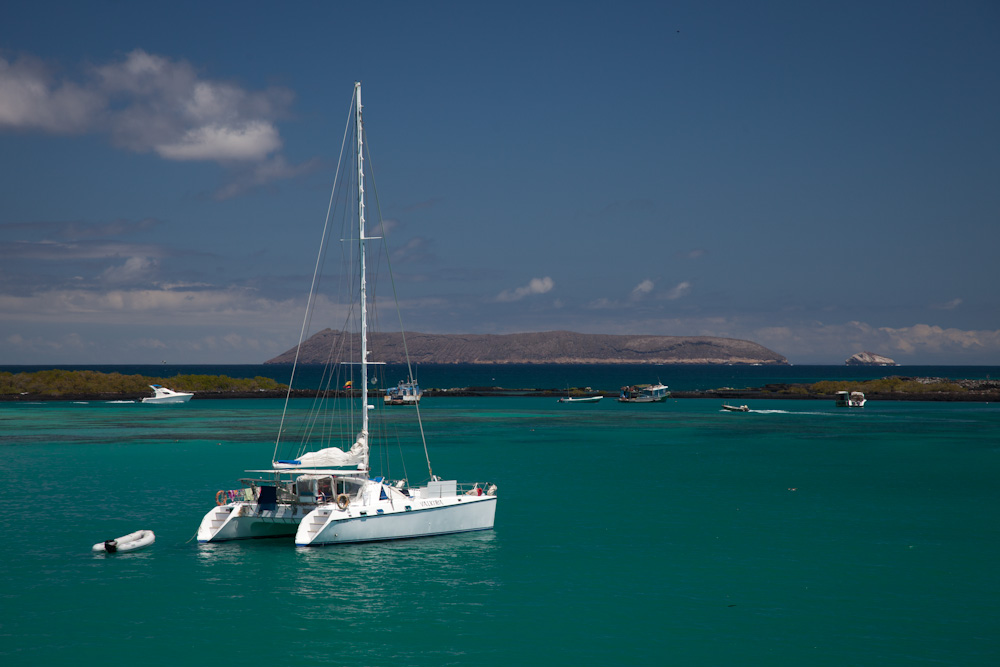
Lunch was served on the middle deck and was quite delicious.  It felt so indulgent and luxurious to be eating lunch in such serene and beautiful surroundings.  The first two meals were somewhat of a disappointment – mediocre at best – but perhaps this lunch was a sign of better food to come.  After lunch we had a couple of hours to relax.  Most guests retired to their rooms for a siesta.  We lounged in the sun for a while on the top deck and then also made our way back to our cabin for a brief power nap.  As I was lying on the top deck I tried to articulate the experience and the best I could come up with was that it felt as though I was sitting within a postcard.  Laura and Stephanie heartily agreed with that description.  The photo below captures the view from the top deck.

In the afternoon, we again did a dry landing, piled into our back-breaking bus and headed to the highlands for a hike to the Volcano Sierra Negra, the largest volcano in the archipelago and one that is still active – the most recent eruption was in 2006.  It was a 30 minute hike to the edge of the crater.  At the top, the clouds danced along the edge, descended into the basin below and then dissipated as they reached the other side.  One minute the entire area was obscured by clouds and then suddenly the view would open up again.

 When we returned to the boat, we were greeted by two new passengers: Dafne and Jasper, a young couple from Holland.  They had just arrived in the Galapagos Islands that morning and had enquired about available tours in the early afternoon in Puerto Ayora.  There were still five seats available on our boat.  But in order to join us, they had to take a boat taxi which departs daily from Puerto Ayora at 2:00 pm to Isabela Island in order to intercept our boat which would be leaving at midnight.  They quickly made arrangements and arrived on our boat shortly after 4:00 pm.  Now that’s what I call flying by the seat of your pants!

By dinner time, everyone was feeling pretty tired; after all, it had been a long, full day of activities. On top of that, both Chris and I were not feeling well.  After dinner, Chris and I headed to bed and slept for almost 10 hours straight.  Some choppy seas woke me during the night but I found the rocking motion to be soothing and was soon rocked back to sleep.


Galapagos Islands Cruise Day 1: Tortoises!

Preamble and Disclaimer:  This is the first of eight posts that I composed while Chris and I sailed the Galapagos Islands on a luxury catamaran yacht. At the end of each day, I wrote about that day’s excursions and highlights.  I have not listed every single bird or animal we saw but have tried to be as accurate as possible with the descriptions I do provide.  I’m sure each of the other eleven passengers on board have their own story to tell; this is my perspective of our voyage.  I invite any fellow passengers who read this blog to share their thoughts about our trip – and offer any additions, corrections or just plain commentary they may wish to make.  Of course, photography credit goes for the most part to Chris, although I did manage to take the odd decent pic that may make it into the blog.  Underwater photos were taken by one of the passengers, Dafne (thank you for sharing).   Hope you enjoy our voyage!

The route we followed was the primary reason we picked this cruise in addition to the fact that it still had seats available at the last minute, and we got a reasonable price for the trip. The map below illustrates our voyage and can be used with the text to track where we are each day.

We sailed on the Anahi, also known as Journey 1.  Click here for the specs of the catamaran if you’d like to know more about our sailing vessel. Note that we have no affiliation with this website – I have provided this link merely to provide info about the ship.

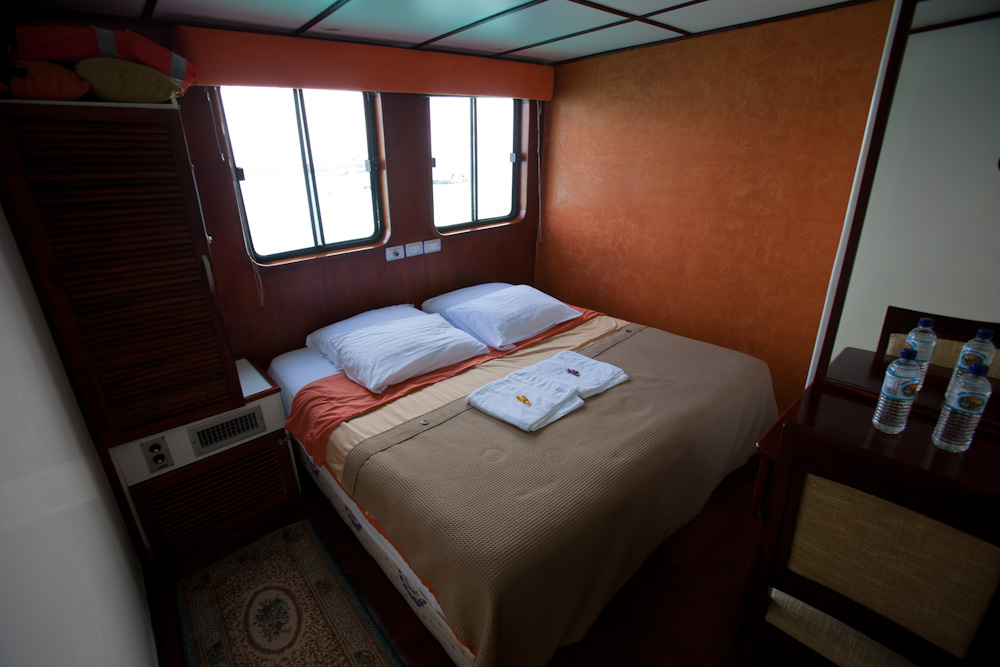
Our cruise officially began when a private dinghy picked us up from the port in Puerto Ayora and whisked us to our yacht anchored in the bay.  As the first passengers to arrive, we had time to unpack and settle into our lovely and surprisingly spacious room (with king size bed I might add) and explore our new “home”.

Within a half hour our fellow voyagers boarded and introductions were made:  Rick and Babs and their friends Tim and Barbara from Washington State, USA; Laura an 18-year old from Germany; Stephanie a 28-year old from France; and Olof, Christiana and their 4-year old son Wim (short for William and pronounced “Vim”) from Germany.

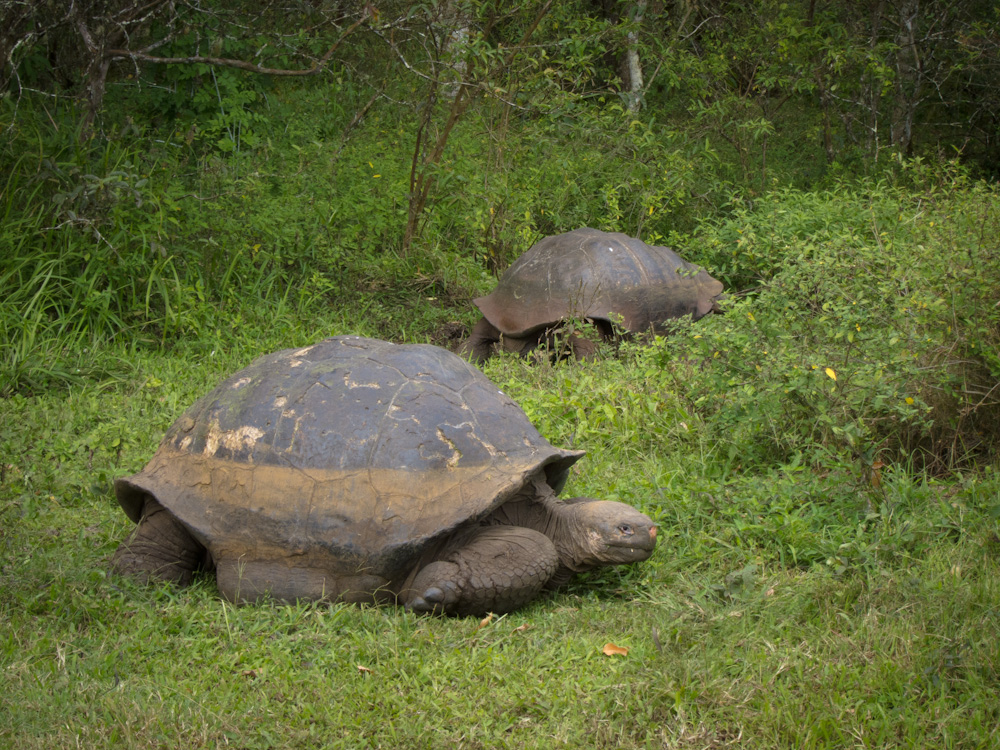
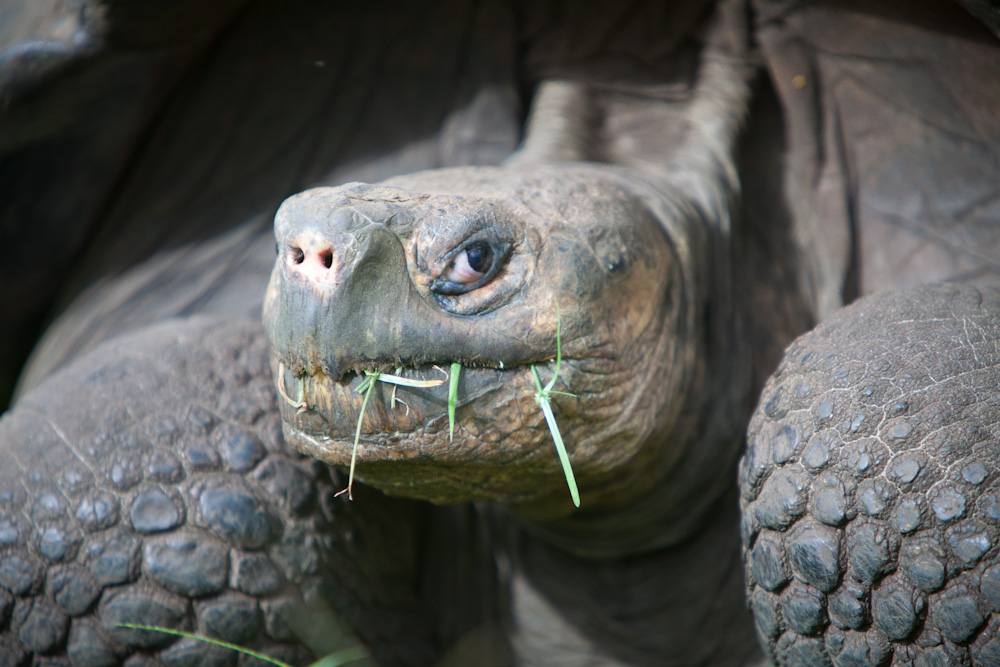
After our first meal on board, served buffet style, we were taxied back to shore for a dry landing in Puerto Ayora.  This became a daily routine.  Back on land, we boarded an awaiting bus and headed to the highlands where we saw huge turtoises at the Rancho Primicias, a private farm where wild tortoises roam free.  The guy who bought this piece of land in the 60’s had no idea at that time when tourism was non-existent that he was sitting on a future goldmine.  Now, there is an agreement between the ranch owner and the National Park to permit tourists to visit the farm (for a fee of course).  There were dozens of tortoises scattered throughout the farm; everywhere you looked, there was one or more.  It was possible to get very close to these remarkable creatures, although they let you know if you were too close by ducking their heads back into their shells with a warning grunt.  Nobody knows how old these creatures are but they are known to live up to 200 years.
Next we made a brief stop at a lava tube tunnel that was formed millions of years ago; as lava flowed, the outer part of the stream got cold and hardened, but the liquid magma within continued flowing. When the flow ceased, empty tubes were left behind. I was surprised at how large this natural tunnel was. Chris remarked that it reminded him of a mine.

Throughout the afternoon, our guide Enrique shared his wealth of knowledge with us about everything from the history of the Galapagos Islands to the flora and animal species that live here.  Tim and Rick, the Americans, seemed very knowledgeable about birds and were constantly trying to identify the birds they saw.

We had about a half hour to spend on our own in the town which for some of the other passengers would be the only time spent in Puerto Ayora so this was their time to pick up souvenirs.  Our private dinghies were waiting for us right on cue when it was time to go back to the yacht where we had a few moments to relax before a complimentary cocktail and an introduction of the crew members.  There are eight crew members, one guide and eleven passengers on board.

Dinner was served promptly at 7:00 and then to our surprise all the guests retired to their rooms. Most had travelled from the mainland today and so understandably were quite tired.  We lounged around in the sitting area enjoying the comfortable leather couches and within an hour we headed to bed too.  We were still anchored in port and would be leaving at midnight.  Sure enough, the engines roared to life on schedule, waking us both up.  We peered out our window into a cloudless, starry night and were enticed to go to the top deck to star gaze from the comfortable lounge chairs.  The brilliant stars of the Southern Hemisphere formed constellations unknown to us.

First impressions of our first day:  pinch me, this must be a dream!  I have never been on a boat this size before and have virtually no boating experience whatsoever – I don’t think large cruise ships count.  I can now understand the lure of the open seas – it is a wonderful experience to be gently rocked to sleep by the motion of the boat and equally exciting to wake up in a new location each morning.  And this yacht is spectacular.  Is this a dream?

Arrival in the Galapagos Islands

The Galapagos Islands welcomed us with sunny blue skies and warm temperatures on Tuesday afternoon.  The easy two hour flight was followed by a tedious and inefficient debarkation process that took almost as long as the flight! It began before we landed when the flight attendants went through the cabin opening the overhead luggage racks and spraying insecticide throughout the cabin.  We were assured this was harmless to our health – but really, what else are they going to say?  I held my breath as they passed me to avoid breathing in the intoxicating fumes.

Once on land, we all lined up to receive a piece of paper that permitted us to be on the islands after our personal information was typed into a computer (very slowly I might add).  We then went to the next agent who took our $100 national park entrance fee.  And then we had our personal bags inspected.  We waited for our luggage which had been removed from the plane and was now being sniffed by dogs.  All these precautions are necessary to ensure nothing is introduced into this special ecosystem.   Once our bags were deemed safe, we lined up yet again to have someone inspect each piece of luggage against our baggage ticket to ensure each person had the correct piece of luggage.  One person handled this process for the entire plane load of people – it took a while!  We then went onto a shuttle that took us to a water taxi that took us to a bus.  The bus brought us into Puerto Ayora in about a half an hour.  Throughout this process we marvelled at the color of the water – the purest aquamarine I have ever seen.  Not surprisingly, since these islands are volcanic, the landscape was quite barren with volcanic rock everywhere.

Puerto Ayora is located on the southern shore of Santa Cruz Island and is the most populated town in the Galapagos with a population of more than 10,000 inhabitants.  The town is home to a bank, several ATM’s, schools, hotels, restaurants, clothing stores, hardware stores, grocery stores, marine stores, tourist shops and night clubs. The Charles Darwin Research Centre is situated here as well – more about this in a future post after we visit it. Puerto Ayora emergency medical facilities include a new hospital opened in 2006 and the island’s only hyperbaric chamber – a comforting thought since we are planning to do some diving here.

In a true spirit of adventure we arrived in Puerto Ayora without any reservations whatsoever.  First order of business was to find a place to stay which proved to be quite an easy task since we are still in low season.  We settled on Hotel Espana, a fairly large hostel with spacious, clean and comfortable rooms at economy rates ($25 per night per room).

After settling in and having some lunch, we made the rounds of the many tour agencies in town to see what last minute deals were available.  We had two weeks to plan out and we were completely flexible.  Did we want to do a land based trip with day trips to the various islands?  Or visit the islands by a cruise boat?  Would that be a 4-night, 5-night or 8-night cruise?  Luxury or economy?  So many decisions.  Unfortunately we did not have internet connection at our hotel at this time as they had problems with their router (which Chris subsequently resolved – my hero) so we were limited with the information we received from these agencies.  By the middle of the next morning we had our itinerary figured out, the highlights of which were an 8-night luxury cruise (yes we blew the budget again) and getting our advanced diving certification which involved 5 dives.  We would have time in between to do a couple of day trips to islands we don’t see on our cruise as well as to do some things on our own.

With the itinerary figured out, the fun could now begin.  On Wednesday afternoon we walked the 2.5 km to Tortuga Bay, the largest and quite possibly the most spectacular beach in the archipelago.

The path took us through a cactii forest featuring the giant cactii, the only species of opuntia cactus in the world that grows like a tree.  This cactus is able to hold copious amounts of water and grow directly on volcanic rock.  The opuntia forest is home to the cactus finch which pollinates its flowers, feeds on its nectar and builds nests within its protective branches.  We saw these little birds flitting about everywhere and were surprised at how close they came to us.

We walked along the white, powder fine sand, dipping our toes into the clearest water I have ever seen.  The first beach has a strong under current and swimming is not permitted; however it is an idyllic spot for surfing and sure enough, as we were leaving the beach at around 4:00, the surfers began to arrive.


Beyond the main beach is a small lagoon which is ideal for swimming.  The water was calm, clear, and refreshing.

The marine iguana, a species unique to the Galapagos, intrigued us.  Their habitat is sub-tidal and inter-tidal where they find their food:  green and red algae.  Above the tidal line, they bathe in the sun and rest in order to have energy to find appropriate locations to build their nests and lay their eggs.   We saw them walking along the beach (quite oblivious to us), swimming in the ocean, and sun bathing on the lava rocks.

The group of iguanas below were sunbathing along a walking path.  We had to walk around them to get by – they didn’t seem to mind at all although they were spitting a lot.  We found out later they do this to get rid of the salt in their mouths.

As we strolled along this gorgeous expanse of paradise, we began to realize how special these islands are and how fortunate we were to be visiting them.  This is truly a once-in-a-lifetime experience for us.

City of the dead

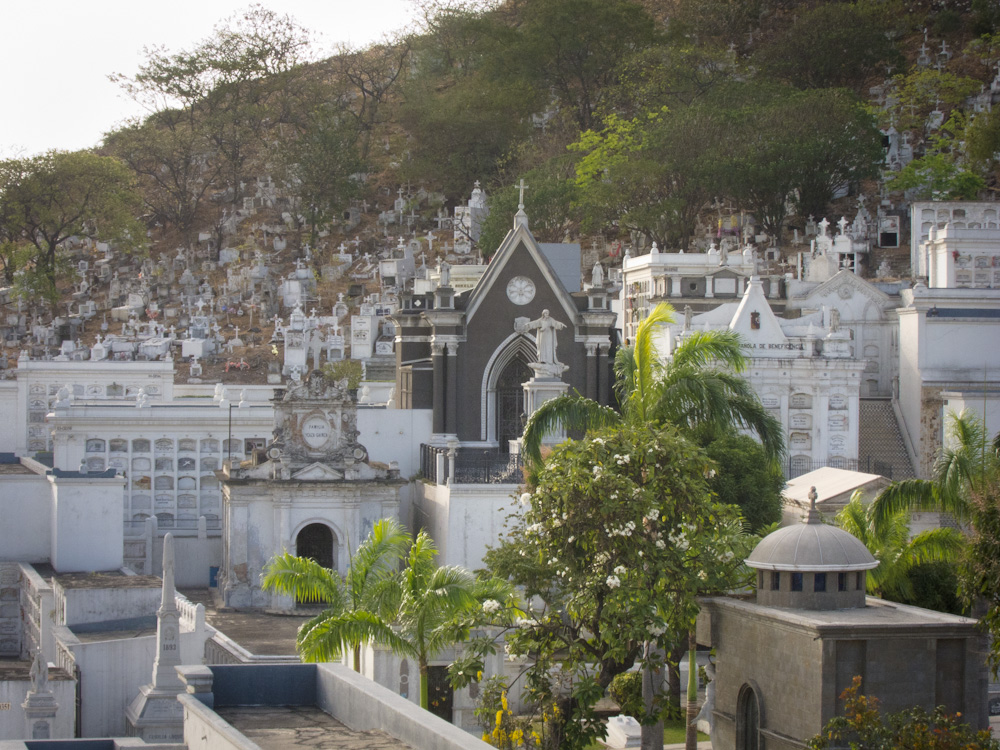
Yesterday afternoon, we stumbled upon La Ciudad Blanca (the White City) located at the foot of Cerro del Carmen.  Our discovery began when we observed a funeral procession leaving a church.  As a large group of mourners walked behind the coffin bearers, we assumed they must be heading towards a cemetery.  Our guide book confirmed that we were indeed in the vicinity of the city’s cemetery.  Frommer’s described the cemetery in this way:  “The cemetery has some impressive above ground marble tombs and mausoleums in a variety of styles ranging from neoclassical Greco-Roman to baroque to Moorish.  The tombs are spread across a vast hillside area and connected by paths and even streets. The cemetery was opened in 1843 and has become a major emblem of the city.” This was enough to peak our interest to seek out the cemetery but in the end this description hardly did justice to what we saw.

At the main gate, vendors sold beautiful flower arrangements, a typical sight at the entrance of many large cemeteries. However, this cemetery was anything but typical as we discovered immediately inside the gates. Six three-story buildings – they looked like apartment buildings – flanked a majestic walkway that lead to a large alter and cross.  Each building housed hundreds of stacked vaults.  I stopped counting after seeing 20 such buildings, each of which had four corridors on each floor.  Each corridor had 24 vaults on each side, 4 vaults high.  I thought this was the extent of the cemetery which is why I tried to calculate how many vaults resided in these buildings.

However, as we walked past the “apartments”, we were stunned by what we saw – an entire city of tombs lay before our eyes.  As Frommer described, there were many architectural styles to these tombs.  Once could easily forget that this was a cemetery as it looked more like a museum of beautiful statues and reliefs.  The cemetery is indeed like a city of the dead, as there are main avenues, side streets, and stairways connecting each area.


 There were large, beautiful family mausoleums along the main boulevard.  Each one was distinct.  As we walked amongst  these mausoleums, the beauty and tranquility engulfed us.

The back of the cemetery is reserved for foreigners and was originally called “Protestant Cemetery”.  There is a 200 foot separation between this area and other sections of the cemetery to ensure the “souls do not mix”.  A few meters behind is the Jewish cemetery, distinguished by their graves on land and the Star of David on gravestones that are written in Hebrew.  I also noticed another area of Jewish tombs (similarly distinguished by the Star of David), on the roof of one of the “apartments” (see above photo).

This was truly a remarkable and unique cemetery.  What an impressive way to end our tour of Guayaquil.

Sightseeing in Guayaquil

Guayaquil (pronounced why-a-keel) is the largest and most populated city in Ecuador with about 2.3 million inhabitants in the city and nearly 3.1 million in the metropolitan area.  The city is situated on the western bank of the Guayas River which flows into the Pacific Ocean.  Because of its location, Guayaquil is the center of Ecuador’s business and manufacturing industries, and boasts the nation’s principal port.  We observed first-hand the results of recent urban regeneration projects designed to transform Guayaquil into a first-class international tourism destination and business center for multinationals.

We arrived at the Hotel Ramada early Friday afternoon and were pleased to find our room overlooked the Malecon and the river.  Although the hotel was rated 4-star, we wisely lowered our expectations as we suspected, and it was confirmed, that hotel ratings are not universal.  A 4-star rating in Ecuador is definitely not equal to a 4-star rating in Canada.  That aside, we were very happy with the quality and amenities of this hotel.  The location was fantastic – on the north end of the Malecon within easy walking distance to all attractions.   Our room was spacious, clean, secure and air-conditioned –something we were very grateful for as temperatures each day were in the 30’s before humidex.

We began each day with a hearty breakfast buffet, included with our room rate.  This was the best breakfast so far with real coffee – believe it or not, while Ecuador grows, produces and exports coffee beans, it is not uncommon to be served a coffee-like drink instead of the real thing.  So when we get a good cup of brewed coffee such as the coffee we enjoyed each morning in Guayaquil, we really appreciate  it – ahh, sometimes it’s the simple pleasures that can make such a difference.  The buffet also included a variety of fresh fruit juices, fresh fruit, hot food (scrambled eggs, meat, pancakes), ceviche (which is usually served as an appetizer before dinner), selection of breads and pastries, yogurt and dry cereals.  It was plentiful, and varied each day.   And it held us until late afternoon too.

The pool, sauna and steam room have been a daily, refreshing delight. We managed to do some of our Spanish lessons while relaxing by the pool.  Speaking of Spanish lessons, our Spanish is deplorable.  I would have thought that by now we would be making great strides but every day is a struggle to make ourselves understood.  Our vocabulary is still so limited and it seems the words we need to communicate have not yet been learned.  Add to that, our brains are like a sieve.  Guess it must be our age or something but we will practice a phrase or two in advance when we know we’re going to be in a certain situation, and unless I write it down, good luck remembering it.  It’s hard to teach old dogs new tricks.

Over the past few days, we have strolled the Malecón 2000 many times.  This is a 2.5 km boardwalk overlooking the Guayas River.  Several of the greatest historical monuments in the history of Guayaquil can be seen along its length, as well as museums, gardens, fountains, shopping malls, restaurants, bars, food courts, the first IMAX theater in South America, as well as boarding docks where several embarkations offer both daytime and nighttime tours up and down the Guayas River. It is one of the largest works realized in Guayaquil and it is considered a model of urban regeneration by global standards, having been declared a healthy public space’ by the Pan-American Organization of Health (POH) and the World Health Organization (WHO).

The Malecon was a magnet for families and young couples, especially on the weekend.  All day long, people strolled slowly along the boardwalk, frequently enjoying ice cream cones along the way. We think eating ice cream cones must be a national past time – something Chris has heartily endorsed in his daily routine.  The sound of children playing in the parks and the sight of parents sitting on benches nearby gave a wholesome, lively feeling to the area.  I noticed a common sight amongst families with young babies.  The baby would be wrapped in a lovely blanket – pink for a girl, blue for a boy – and either the mother or father would lovingly carry the baby in their arms as they walked along the Malecon, proudly parading their new offspring for the world to see.  It always brought a smile to my face when I saw these young parents carrying their often newborn babies in this way.   The Malecon offered a lot of amusement for young children – a little train that travelled back and forth along the board walk, face painting, electric cars, and several large playgrounds to name just a few.

Police presence was strong both along the Malecon as well as throughout the downtown core, making us feel very safe even at night.  We also noticed how clean these areas were, in sharp contrast with the rest of Ecuador.  Obviously the local government was making tremendous efforts and was having success in transforming Guayaquil’s reputation from a dirty, unsafe city to a city that was safe and welcoming to tourists.   It reminded me of a similar transformation that was achieved in Manhattan in recent years.

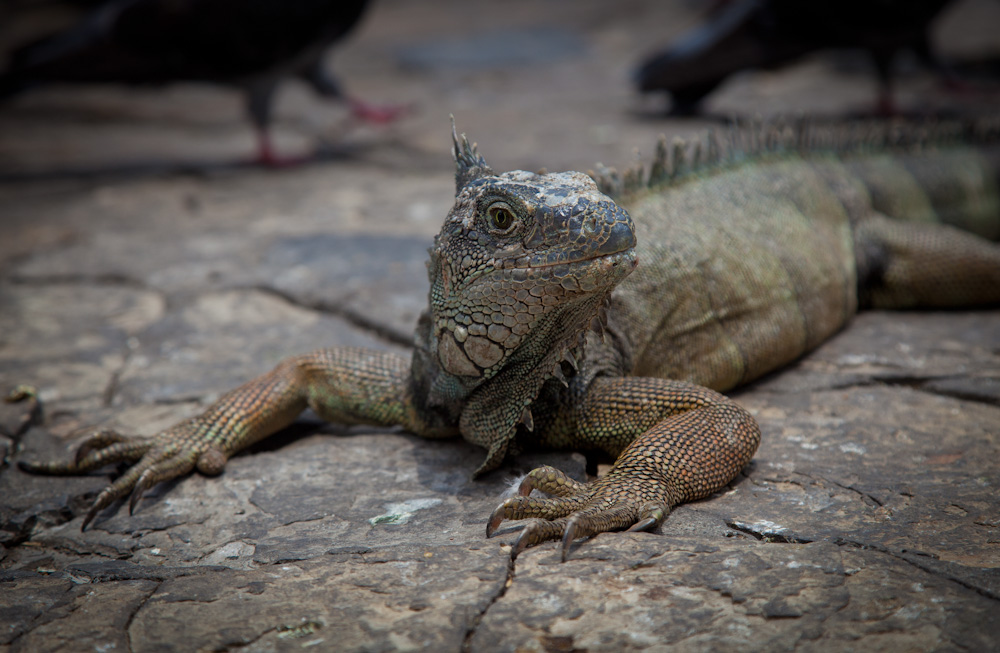
Now in tourist mode, we visited four museums all of which were in Spanish which meant breezing through them rather quickly.  We wandered through a few churches.  We were intrigued by Parque Seminario (also known as Parque de Las Iguanas or Iguana Park) which is home to many iguanas, some of which approach 5 feet in length. Tourists and locals alike often feed the iguanas mango slices from park vendors. There is also a pond filled with colourful Japanese Tilapia and turtles. An equestrian statue of Simón Bolívar is located in the centre of the park.  As we paused to get a closer look at these pre-historic looking creatures, there was a sudden large splatter of green goop that fell from the sky right next to us, spraying each of us a little – what the hell was that?!?  We looked up to see the trees above laden with iguanas who seemed quite content to poop wherever and whenever they pleased.  Yuch!  We quickly made our way to the edge of the park, outside of the firing range of these pooping iguanas.  It was quite a sight to see hundreds of iguanas in a park in the middle of a city.  I still don’t know why they are here or where they came from.

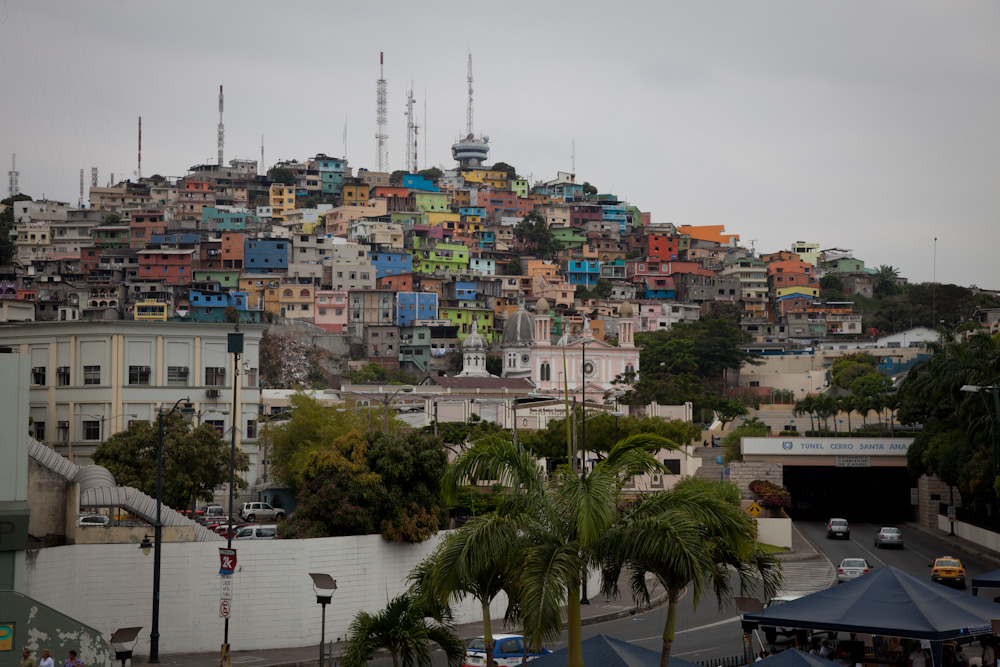
The historic neighbourhoods of Las Peñas & Cerro Santa Ana have been refurbished into an idealized version of a quaint South American hillside village, all brightly painted homes and cobblestone alleyways. If you peek inside an open door or window, however, you realize it’s just for show as residents still live their everyday lives as they would elsewhere in the city.


The 456 steps of Cerro Santa Ana (each numbered) lead past dozens of refurbished, brightly painted homes, cafés, bars and souvenir shops, and up to the hilltop fort, Fortín del Cerro (‘Fort of the Hill’).  Cannons, which were once used to protect Guayaquil from pirates, aim over the parapet toward the river and are still fired today during celebrations. We climbed the lighthouse for a spectacular 360-degree view of the city and its rivers.


We have thoroughly enjoyed our cultural respite in Guayaquil and feel recharged, refreshed and ready for the next leg of our journey.

Hot, hot, hot

It’s hot, hot, hot and sunny – perfect beach weather.  Too bad we’re not at the beach!  We are now in Guayaquil with a few days to kill before we catch our flight to the Galapagos on Tuesday.  The last few days did not go exactly as planned, but I guess that is bound to happen now and then.  You may recall that we were planning to go to Montanita to spend a few days in this beach town.

We arrived in Montanita early Wednesday afternoon under cloudy skies (nothing new there).  Once we got ourselves organized with our packs, we set out to check a few hostels that looked promising on line.  Along the way, a friendly gringo approached us and offered to show us the way as he was heading in the same direction.  We didn’t think anything of it, accepted his offer, and chatted with him as we made our way to the various hostels, breaking some fundamental safety rules in the process.  It is a well- known scam at bus stations for someone to befriend you, offer to carry your bags, help you load them onto the bus only to steal them when you’re not looking, because the bus guy thinks the bag belongs to your “friend”.  It was only later that we thought of this and wondered if we were going to be victims of a similar scam and find ourselves robbed when we returned to our hostel.  Thankfully, this was not the case, and Zachery from the peach state of Georgia was nothing more than a friendly guy doing a good deed for the day.  I must admit though that we had some anxious moments wondering if we were at risk.

Montanita is renowned for its surf which is much bigger and stronger than Canoa. This is not the place to learn to surf as the waves are pretty intimidating and there is a strong undertow.  I missed my chance to take surfing lessons in Canoa due to a combination of bad weather and sore legs from horse back riding. But surfing will have to wait.  This town is also known as a party town where young people flock to party the night away indulging in both legal and illegal pleasures.

We picked a hostel (Kundalini) on the edge of town, away from the bars and discos in an effort to ensure a good night’s sleep.  As we walked around town looking for a place to eat, I had an uneasy feeling about this place.  The town itself was quite charming in a laid back, beachy sort of way.  The streets were lined with shops that sold surf related stuff as well as little kiosks selling everything from hand-made jewellery to the typical tacky beach souvenirs.  The locals were a blend of Ecuadorians and foreigners who have made Montanita their home.  Apparently it’s quite common for young foreigners to come for a visit and then never leave.

Why was I feeling so uneasy?  Clearly we stuck out as different – not just being foreigners, but let’s face it, we aren’t young and we aren’t hip.  Perhaps it was just an over active imagination on my part, but regardless, I wasn’t feeling very secure.

And then the weather turned on us, for the worse.  It got colder and started to drizzle – not the best beach weather for sure.  As we watched the surfers from the hammocks on our balcony we decided that this place was not for us – in the morning we would leave for Guayaquil.

We’ve come a long way since our first bus trip in Quito.  We’re no longer nervous about bus travel although we remain vigilant and cautious on travel days.  Not knowing where the bus station is or when the bus is coming doesn’t really faze us anymore.  We know we’ll sort it out when the time comes.  We headed towards the main street in Montanita looking for a bus station or bus stop.  I had read about the direct CLP bus but had no idea where to catch it or what the schedule was.  By chance, we walked by a group of people with luggage who obviously were waiting for a bus.  Turned out this was the CLP bus station and the bus to Guayaquil arrived as we were buying our tickets ($5.50 each). Good luck with the buses again. This was the most comfortable bus we have been on thus far.  It was air conditioned, the seats were well padded, a movie entertained us, and it only stopped a couple of times along the way, arriving in Guayaquil in less than three hours.

The bus station in Guayaquil is the biggest bus station I have ever seen – I thought we were at the airport when we pulled in.  We grabbed a cab to the northern suburbs where many well reviewed hostels are located.   We arrived at our first choice only to find they only had dorm beds available.  We actually debated the merits of this option – this hostel was quite lovely perched up on a hill with an amazing view of the city, it had a swimming pool and the property was very secure.  On the down side, the dorm room was in the basement and looked more like a jail cell with eight twin beds/bunk beds which meant we could be sleeping with six strangers; we would have to lock up our belongings in the lockers at all times; the cost was high at $15 per person (at least by the standards we were used to); the hostel had no restaurant and was in an isolated location so finding food and getting around might be a problem.

We decided against the dorm room, and headed over (by taxi) to another hostel (Nucapacha) in the same area.  This one had great reviews online, also had a pool, and showed plenty of vacancies.  But when we arrived, they only had twin rooms with shared bath available (and with cold showers we learned later).  The rooms were bare bone. Our room had two single beds and a  bunk bed.  The mattresses were made of soft foam, and there wasn’t even a blanket on the bed, just a thread bare sheet.  There was absolutely nothing else in the room except for a noisy fan.  I felt we had sunk to a new low.   To its credit, the hostel was clean, and the common areas weren’t too bad (mind you that lovely pool was closed for cleaning which it sorely needed).  I had concerns about the security of the rooms – there were no closets to lock our things in, and the locks on the doors and window were very flimsy.  Again, I did not feel safe.  I don’t like this feeling.  I can put up with basic accommodations, as long as they are clean and secure.  We took the room for one night and then evaluated our options.  I must admit I was feeling discouraged.

We did have options.  We could stay put for the next five days and suck it up and hope our stuff was safe.  We could leave town and go somewhere else such as Cuenca for a couple of days.  We could look for another hostel and hope it was better (I now realize you can’t put too much weight in the on-line reivews and pictures). We could find a nice hotel (this is a big city with lots of nice hotel chains) and indulge in a little bit of luxury for a few days.  It didn’t take us long to choose the latter option:  4 nights at the four star Ramada Hotel right on the waterfront.  Afterall, we always said we reserved the right to check into a nice hotel when we felt we needed it!

Relaxing in an oasis

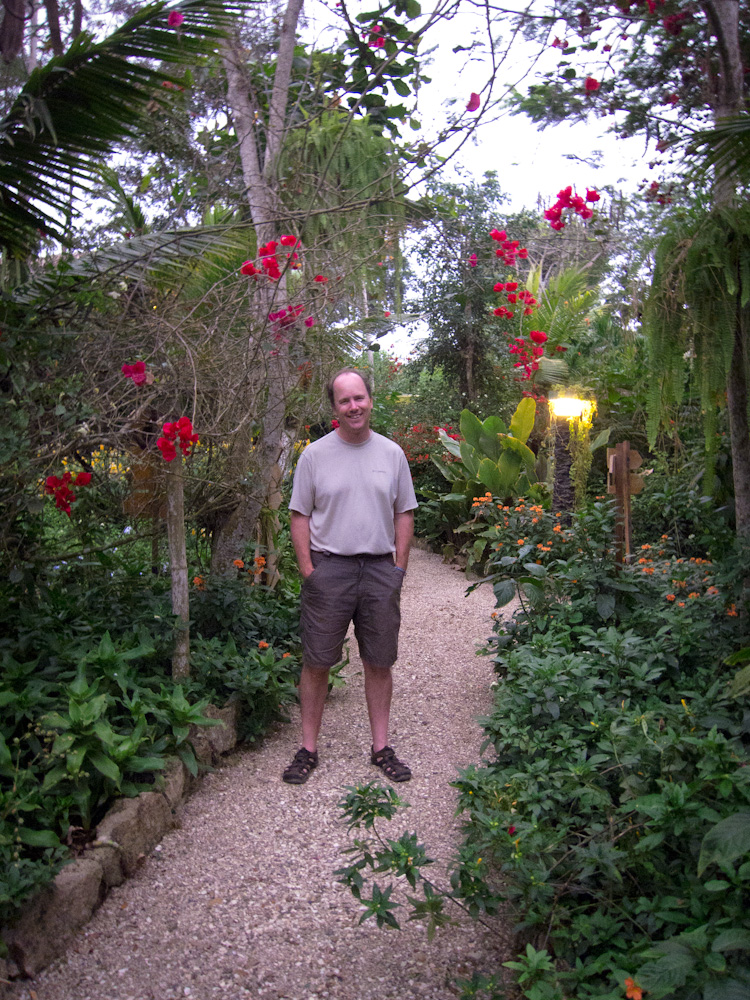
Yesterday was a “chill” day.  We slept in, had a leisurely breakfast in town, did some writing, photography, and generally just goofed off.  Our hostel is a beautiful place to just kick back and relax.  This has been the best hostel we have stayed in to date. The hostel is located on the north edge of town, engulfed in a lush, tropical garden that contrasts sharply with the bleak, dry vegetation that prevails along the coast during the dry season.

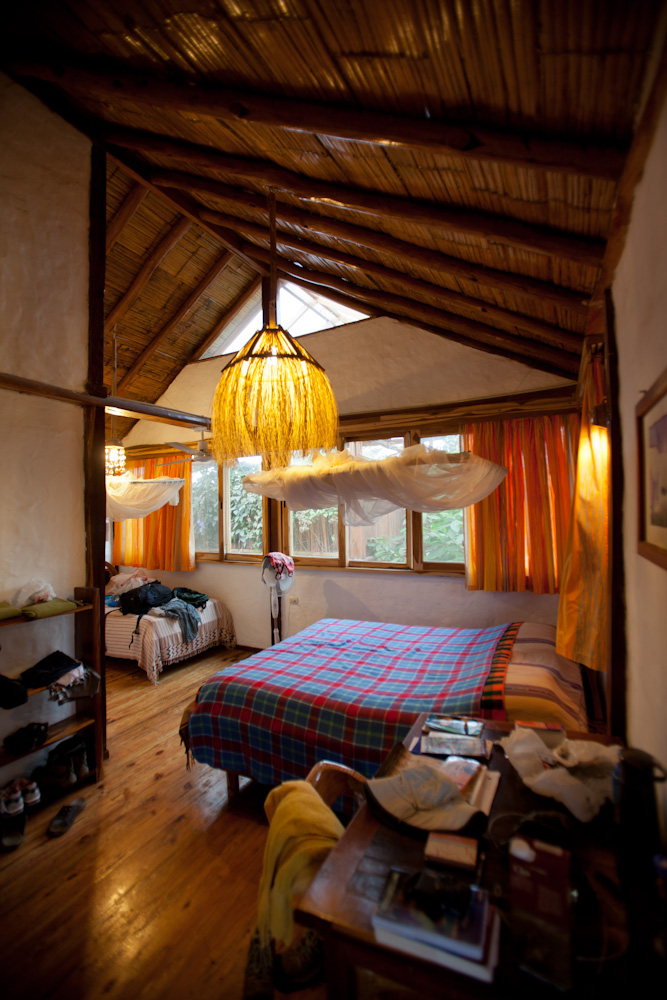
We spent the first couple of nights in a private cottage (photo to the right) which was lovely, but then we had to switch to a different room because the cottage was already booked.

Our second room was larger, the bed more comfortable, the shower hotter, and being on the second floor of a four-unit chalet made us feel like we were in a tree house.

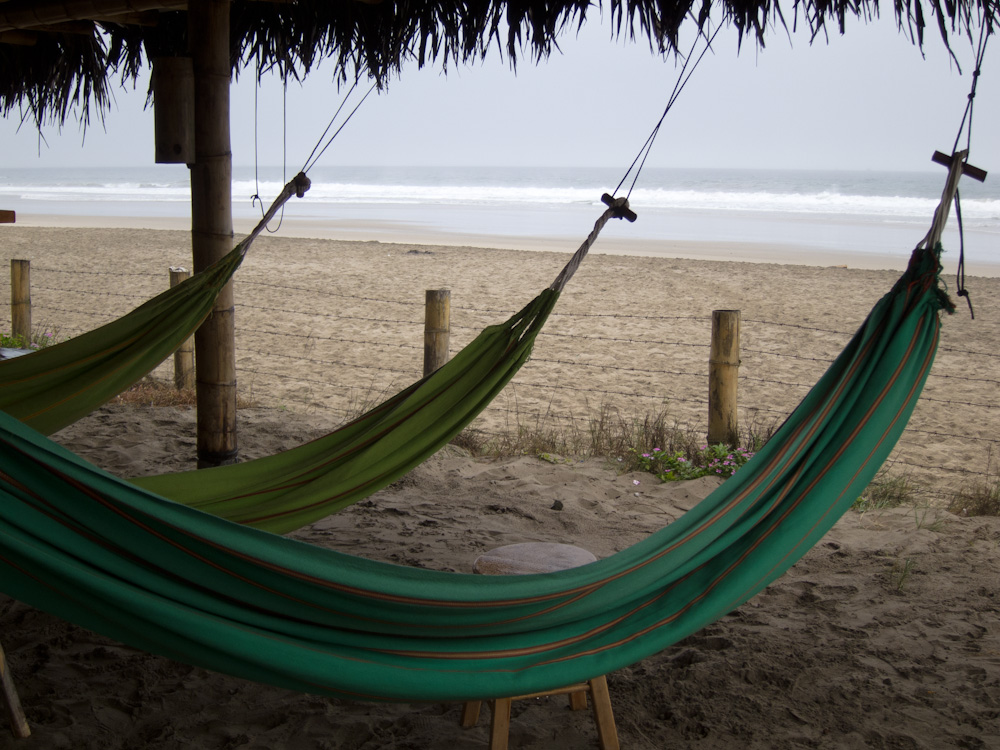
The best part was our private balcony with a view of the ocean and two lovely hammocks that invited us to just relax.

We don’t think we fared to badly in the room switch.


The hostel owners are environmentally conscientious and “save the whales” information is everywhere, including the t-shirts worn by all staff.

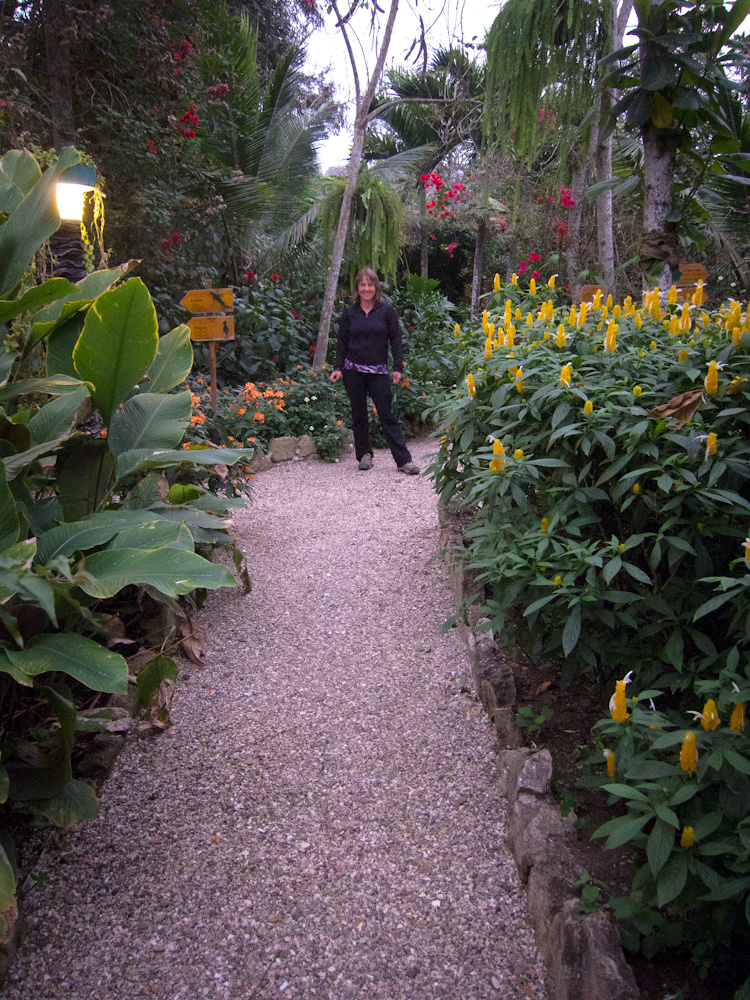
The other unique features of this hostel include the amazing gardens and the artistic handiwork that appears everywhere, from the toilet seats to towel racks to the architecture of the main lodge.  I’m by no means an expert, but I think these gardens outshine the Botanical Gardens in Quito by a mile.

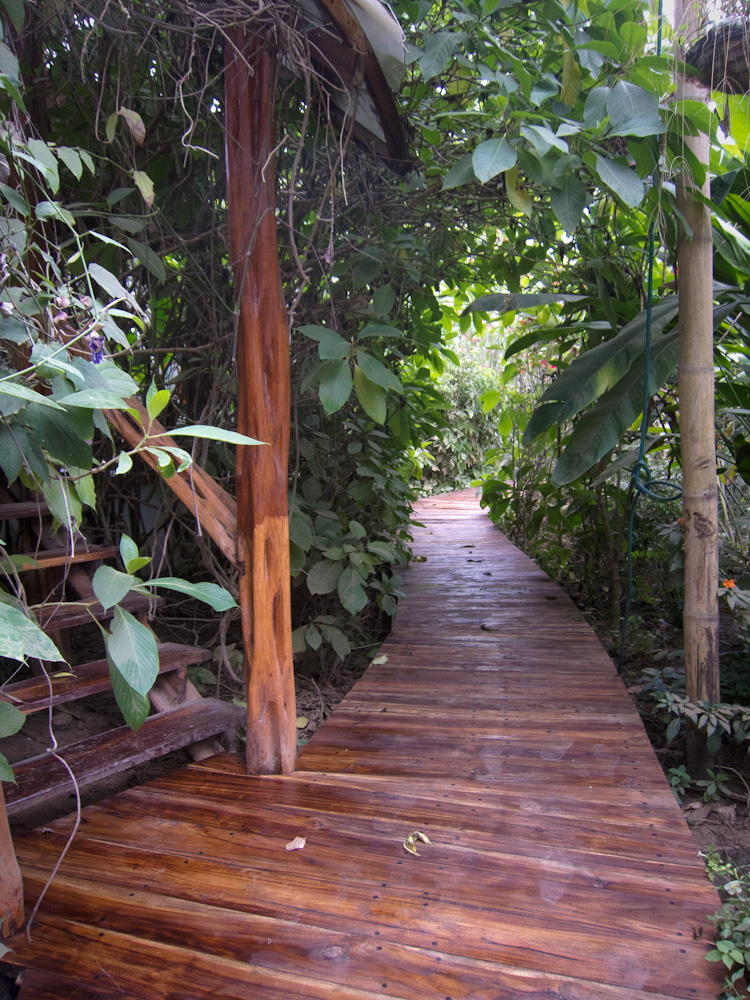
In the photo below, Chris is standing at the entrance of a second story deck equipped with multiple hammocks – a perfect place for a siesta.  Notice the woodworking detail on the floor.

Another feature of this hostel, believe it or not, were the resident dogs.  We have seen hundreds of dogs throughout our travels in Ecuador – dogs are everywhere and usually have free reign to roam wherever they please.  We have seen all kinds of dogs – good, bad and downright ugly and mangy.  The four dogs in this hostel are gorgeous and the one remaining pup (out of a litter of 10 – all of which have found new homes) is adorable.  Check out this video of the puppy playing with mom.

We did some “work” yesterday – sort of.  It was laundry day.  There are laundry services everywhere in Ecuador and Puerto Lopez was no exception.  It costs $7 or $8 to do a week’s worth of our laundry.  Money well spent in our opinion.  So far, we have only done laundry by hand once while we were in the hostel in Canoa.  The rest of the time we have used laundry services wherever we are and we have always been quite happy with the results.  Mind you, it is always a little unsettling as you drop off all your clothes to a little hovel or shack that happens to have a washing machine on site.  You don’t get a ticket or a receipt or anything to prove that they have your clothes.   I’m always amazed and relieved when we return at the end of the day to find our clothes fresh and clean, and all neatly folded and ready for us.

We also made some plans for the next leg of our trip – Galapagos Islands.  We have booked our flight for next Tuesday and we will be on the islands for 2 weeks.  The current plan is to find a hostel and do day trips to the various islands.  However, we might consider a boat cruise for a week if we find a good last minute deal.  Eduardo and Paola are planning to go in December and highly recommended basing ourselves on Isabela Island, something we are seriously considering.  We still have a week to figure things out, and even then, we really only need to know where we want to stay the first night or two.  At least our flights are now booked and we feel we got a pretty good deal:  $560 return for both of us, including taxes.  There is a national park entrance fee of $100 per person that we must pay at the airport before we leave.  It will be an expensive couple of weeks, but we think it will be well worth every penny.

We must be in Guayaquil in one week’s time so we have some time to explore the coast a little more fully.  We have decided to leave our wonderful hostel today and head down the coast to Montanita. After that, we may go to Salinas.  As you may have noticed, we are not making plans too far in advance.  This gives us the utmost flexibility.  This approach is working out really well for us so far.  We find that we are planning our itinerary based on the input we receive from people along the way.  For instance, we weren’t planning on going to Montanita, but based on Eduardo’s recommendation, we will stay there for a few days.
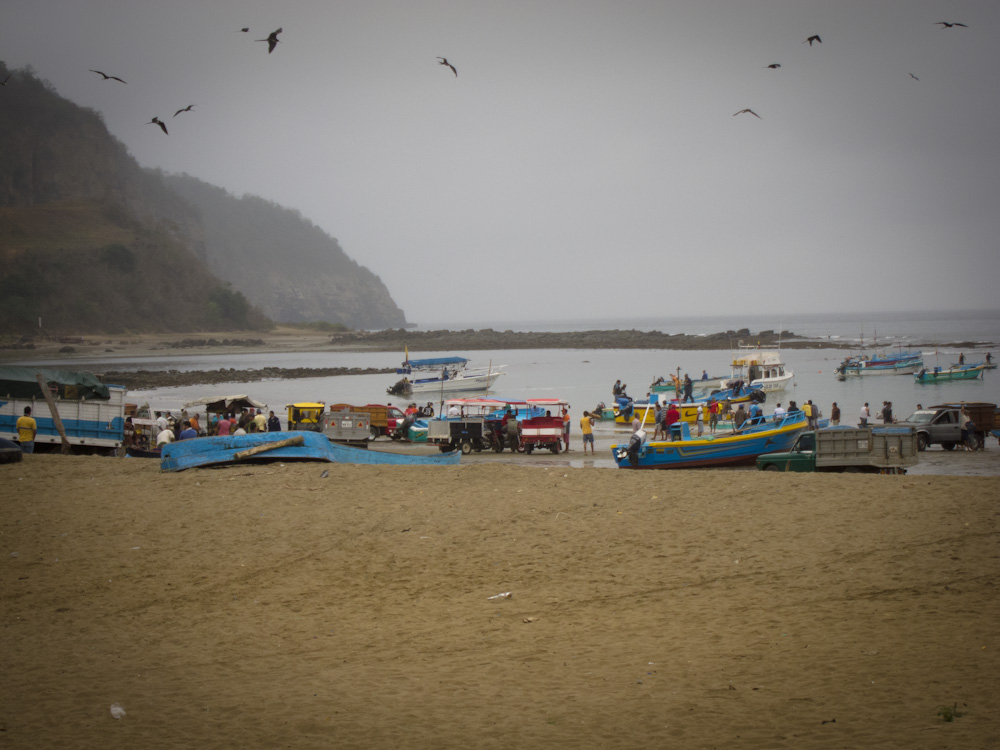
The following is a collection of photos of the town of Puerto Lopez that have been taken over the past few days.  Enjoy!

Los Frailes Beach

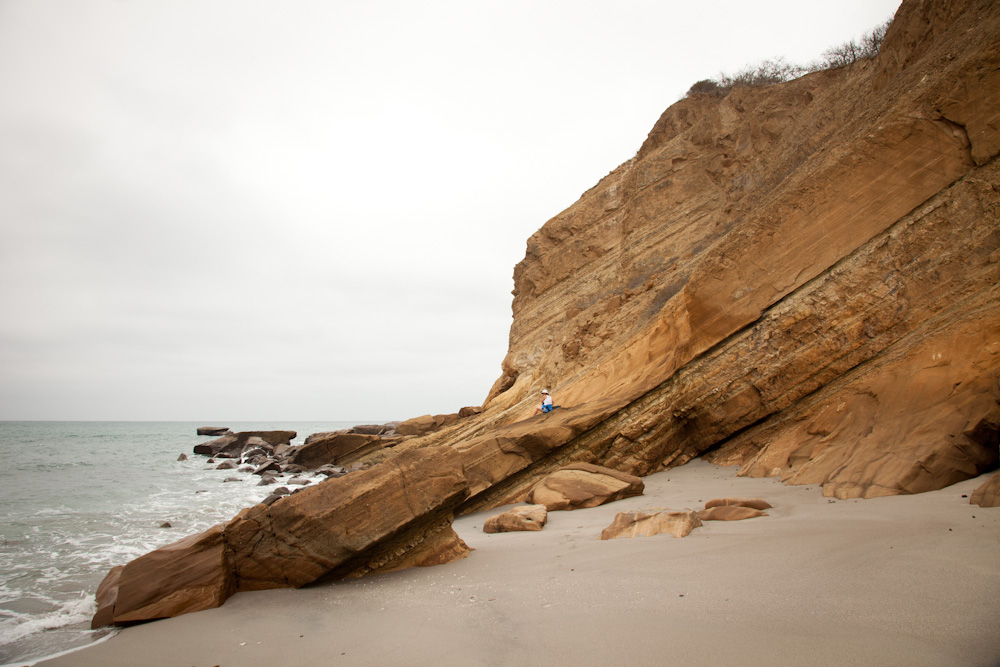
Under a blanket of heavy, low clouds, we headed out to Los Frailes beach by taxi on Monday morning, with our diving friends, Eduardo and Paola.   When we arrived at 10:00 in the morning, we had the entire beach to ourselves.  Los Frailes beach, with its large, sweeping expanse of sand framed by high bluffs, is one of the most pristine stretches of coastline in Ecuador. Part of the protected Parque Nacional Machalilla since 1979, the beach is only a small part of the 55,000 hectares of coastal land home to a variety of marine life such as dolphins and sea lions, over 200 species of birds, howler monkeys, anteaters, deer, squirrels, iguanas, and lizards.

We are in the dry season here on the coast and everything looks dead – very similar to winter in Canada.  However we have been told that by January when the rainy season begins this area will look lush and tropical.  Hard to imagine that right now.  Since arriving on the coast almost two weeks ago, the weather has been the same every day – cloudy with temperatures in the low 20’s and very little rain.  We have only had one day of sunshine while we were in Canoa.  This is definitely not lying on beach weather but it is very comfortable for hiking and sleeping.  During the rainy season (January – May), it is very hot and sunny during the day and then torrential rains pour down each night.  The rainy season coincides with the high tourist season.

We headed north towards a trail that would take us through a dry forest to a lookout at the top of the bluff.    The path meandered through unique dry forest vegetation with bottle-shaped trees adorned with heavy spines, spindly cacti, and fragrant trees up to a clearing that provided spectacular views of the coastline.  We only saw a few birds, mainly vultures and pelicans.  We encountered no other wildlife.  We continued our hike to a neighbouring beach, Playa La Tortuguita where spiky rock formations jutted out of the turquoise waters and large crabs scurried along the rocks.

In spite of the weather which was a little on the cool side, Paola was determined to go for a swim and bravely went for a quick dip into the cool waters.  Chris and I were content to stay warm and dry and enjoyed taking photos of the beautiful scenery.

Throughout the morning, we learned so much about life in Ecuador while conversing with Eduardo and Paola.  We were surprised to learn that they pay similarly high income taxes (pro-rated per income like us) but they don’t feel they get much for their taxes.  Ecuadorians must pay for their own health care although both were fortunate to have private insurance through their employers.  All schooling must be paid for privately, even the lower grades.  Getting a mortgage depends as much on who you know as it does on your ability to pay the mortgage.  And interest rates are very high – about 8 percent for a mortgage, although the government has introduced some programs to make it more affordable.  There are no social safety nets in place like employment insurance or maternity benefits.  Even today, it is typical for a middle class family to have at least one maid and perhaps a gardener.  Day care facilities are common just like in Canada.  Iam always fascinated to learn how people live and it’s so interesting to see both the commonalities and the differences in our respective countries.

The morning passed quickly and soon we had to head back to Puerto Lopez as Eduardo and Paola had to catch their flight back to Quito later in the day.

Back in Puerto Lopez, Chris and I decided to wander around town for a while, people watching and taking more pictures.  We met up with our friends a little later on for lunch at Patacon Pisa’o where we enjoyed a special dish of crisply fried plantains topped with a choice of toppings such as squid, shrimp, fish or a combination of seafood.  It was delicious.

As the afternoon came to a close, it was time say good bye to our friends. We hope they come to Canada one day and we would welcome the opportunity to share our beautiful country with them in the way they shared their country with us.