November 1, 2011

Hammerhead sharks and more

Diving in the Galapagos Islands is a dream for most divers and was one of the main reasons I worked so hard to get my Open Water Certification before we left Canada. Diving here can be very challenging with the strong currents and cold temperatures.  As new divers, we are keenly aware of our limitations and it was with this in mind that we decided to sign up for the Advanced Certification course.

The course involves 5 dives, each of which develops new skills.  Two dives are mandatory: deep dive and navigation dive.  The remaining three dives can be selected from several specialities.  We chose:  multilevel diving, drift diving and buoyancy control.  The main benefit of taking the course from our perspective would be the one-on-one attention with the instructor.  I figured this was a good insurance policy for staying safe and out of harm’s way.

The dive shop we selected, Academy Bay, offered a competitive rate for the course and making arrangements in English with the Australian shop owner, Alice was straightforward.  Our instructor, Freddie, spoke English quite well (as his second language) and we felt confident that at least communication would not be an issue.   However, I did observe that this dive shop was rather disorganized in the way they handled the equipment (for example, they brought the wrong size wet suit for Chris) and lax when it came to following PADI procedures.  For instance, we were assigned our home work which we did, but only reviewed it with the instructor after the dive, not before.  We presented our PADI certification after the dive, and we never did get around to signing any medical or legal release forms.  They seemed content to take our word at face value.

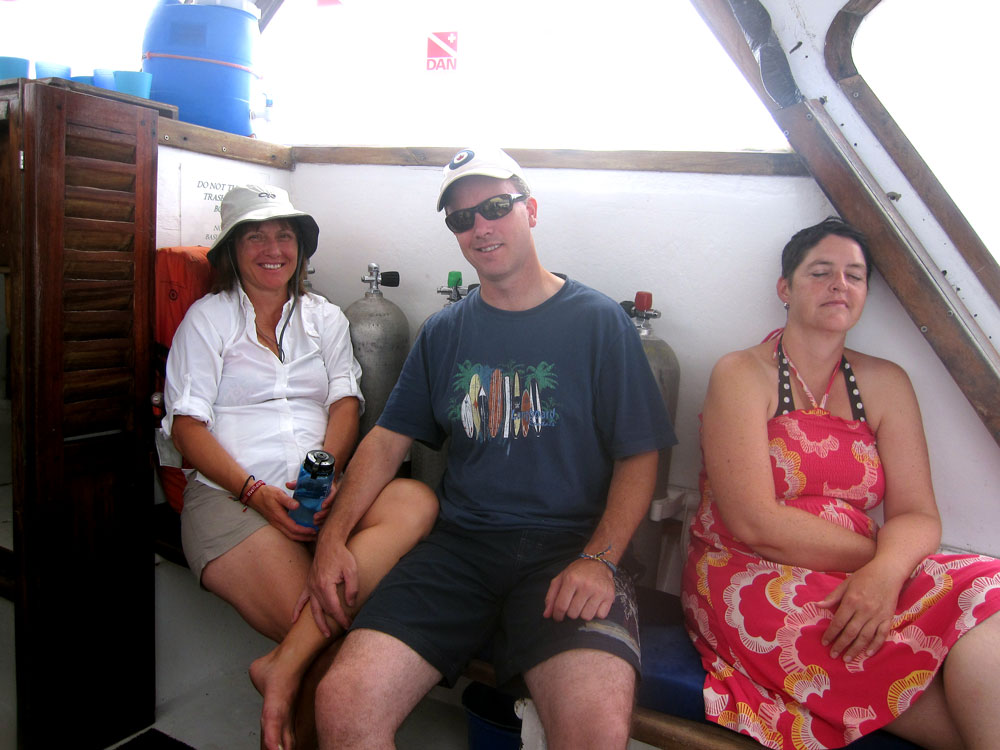
Before our cruise, we did our first two dives.  The destination was Gordon Rocks which is reputed to be one of the most difficult dive sites in the Galapagos.  Frankly, I was terrified at the thought of diving here as I had read many, many warnings online about the dangers of this particular site. However, both Alice and Freddie assured us that conditions could be very safe (no current) or hazardous (strong current) and we would only know when we got there.  They would not let us go in the water if the current was strong.  And there was an alternate site close by if we needed it, Las Plazas. To help calm my fears, Alice decided to dive with our group that day, offering to accompany us if we dove at Gordon Rocks, a gesture I greatly appreciated.  In the picture below, I look surprisingly calm – I think at this point I had resigned myself to my fate.  I just hoped that this day, which happened to be our 9th wedding anniversary, would not end in calamity.
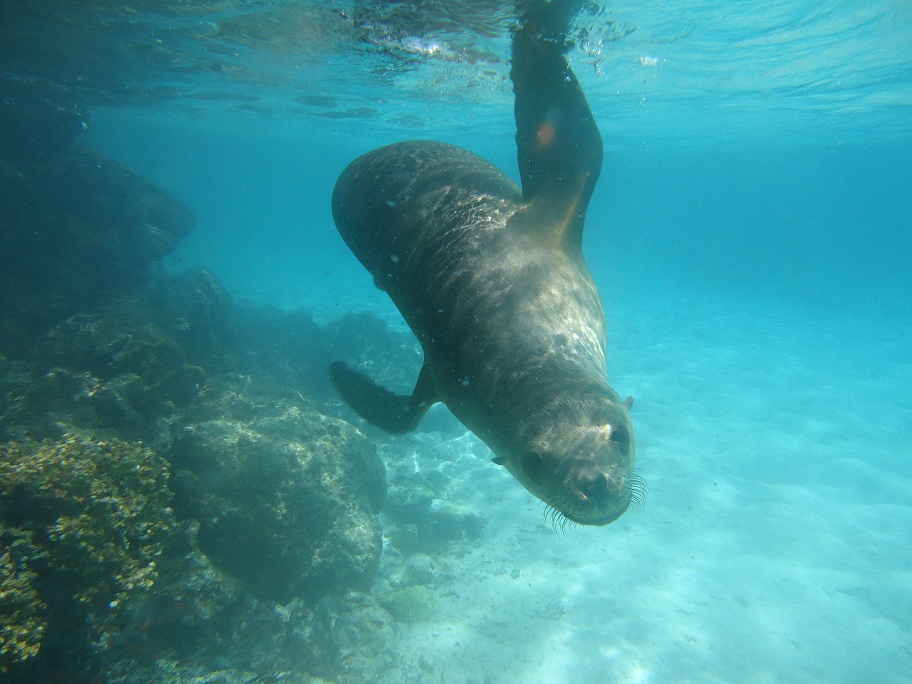
It turned out to be a very calm day at Gordon Rocks, but I was still not confident to do our first dive at that location, so we let the other divers go ahead as we snorkelled with sea lions. When they came up, the other divers confirmed there was very little current and they had an amazing dive where they saw hammerhead sharks, the Bola Bola Sunfish, and lots of rays.  The photo below is the Sunfish they saw.

At Las Plazas, the current was quite strong – stronger than Gordon Rocks today – go figure.  The plan was to just let the current take us along and when we were out of air, we would surface and the boat would pick us up.  At times we hung on to the rocks to slow us down a bit.  This was supposed to be our multi-level dive so we went down to about 24 m for ten minutes, up to 16 m for ten minutes, and then did the rest of the dive at about 12 m.  This could easily have been our drift dive.  We saw our first hammerhead shark on this dive!


Our second dive was at Gordon Rocks.  By now the water had become quite choppy, and there was a small current, but nothing we couldn’t handle.  I was still a little nervous so Alice joined us to give Freddie a hand in case he needed it; this helped calm my nerves.  This was supposed to be the drift dive so again we just let the current take us, grabbing onto rocks to slow us down a bit.

On this dive we saw a huge school of barracudas directly in front of us – it was awesome.  When we ended the dive, the sea was really rough.  It tossed us about as we were getting our gear off before climbing back into the boat.  It was too much for my stomach – as soon as I got on board I proceeded to feed the fish as I vomited over the side of the boat.  I was fine once the boat started moving, but until then, all I can say is that the fish were well fed that morning.

All in all, the first dive day was a resounding success.  First, we survived. Second, we accomplished our skills, and finally, we saw some pretty cool things underwater.  I don’t think I’d go so far as to say I had fun – I still find diving to be an exercise of determination to conquer my anxieties and fears.  But I was happy after the dive and enjoyed a feeling of accomplishment.

We did our second dive day after we ended our cruise.  Jasper and Dafne, our new friends from the cruise, also came along for this dive.  The dive was planned off the coast of Floreanna, an island about a 1.5 hr boat ride from Santa Cruz.  We had three dives planned:  deep dive, navigation dive, and buoyancy dive.

Right from the start, things went wrong.  First, we were told our instructor was ill and was not going to come with us. We later learned the real story: the dive master on this boat (Luis) refused to allow our instructor on board.  As far as he was concerned, if anyone was going to do any teaching, it was going to be him.  We were assured he was competent and could speak English.  Again there was some disorganization with the gear – scrambling to find the compasses for our navigation dive, and tossing in two dive computers and the underwater camera at the last minute (only after we observed they were missing).

As soon as we left the harbour, the engine started to make strange noises – not something you want to hear as you’re heading out to open seas.  The captain ignored the engines and kept going full throttle ahead for about a half hour until the engines started to sputter.  He took a look at the engines and decided to keep going at a much slower speed.  The 1.5 hour trip took us 3.5 hours!  Poor Dafne – it took all her concentration not to throw up as the boat rocked in the high waves.   I was fine as long as we kept moving forward.

Finally, we got to our dive site.  Luis gave us the dive briefing and seemed to ignore the fact that we were doing the Advanced Course today.  After orientation, we took him aside and reminded him.  He tried to brush us off saying we would all dive as a group.  We insisted that we had paid for the course and we expected to dive exclusively with our instructor and to do the exercises as outlined in PADI.  He grudgingly conceded and assigned the group to the other dive master and the instructor-in-training who were on board. We also pointed out that we were supposed to be doing our deep dive first not our buoyancy (this is directly from PADI), and again he minimized this and said it was only a guideline.

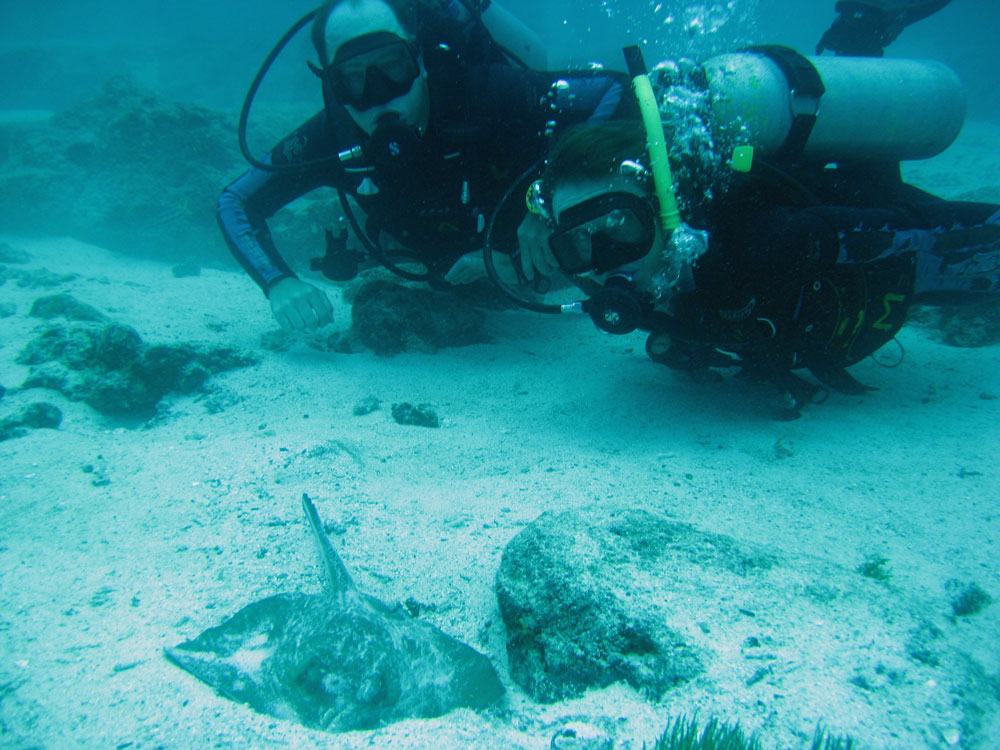
So off we went on our first dive.  To his credit, Luis did teach us some good buoyancy skills and took the time to make sure we were properly weighted.  I did the entire dive without needing to adjust the air in my BCD, just using my breath to go higher or lower.  It was great.  Luis knew the site well and found all kinds of interesting things for us to see, including lots of sharks, turtles, and mantas.  It was a good dive.
I was a little curious as to the logistics of our third dive since the other divers were only doing two. So once on board, I asked Luis how it was going to work.  He explained we would go back into the water immediately, and do our navigation exercises at 5 m depth.  It would take ten minutes to complete.  This was not what we expected – we were told we would have three dives with three tanks.  Well they didn’t have enough tanks for us to do a third dive.  So we did the navigation exercise – but only after we discovered one of the compasses did not work.  Chris and I did the exercise together with the one working compass.  We did a straight line out and back, followed by a square and then a triangle.  It was all very rushed.
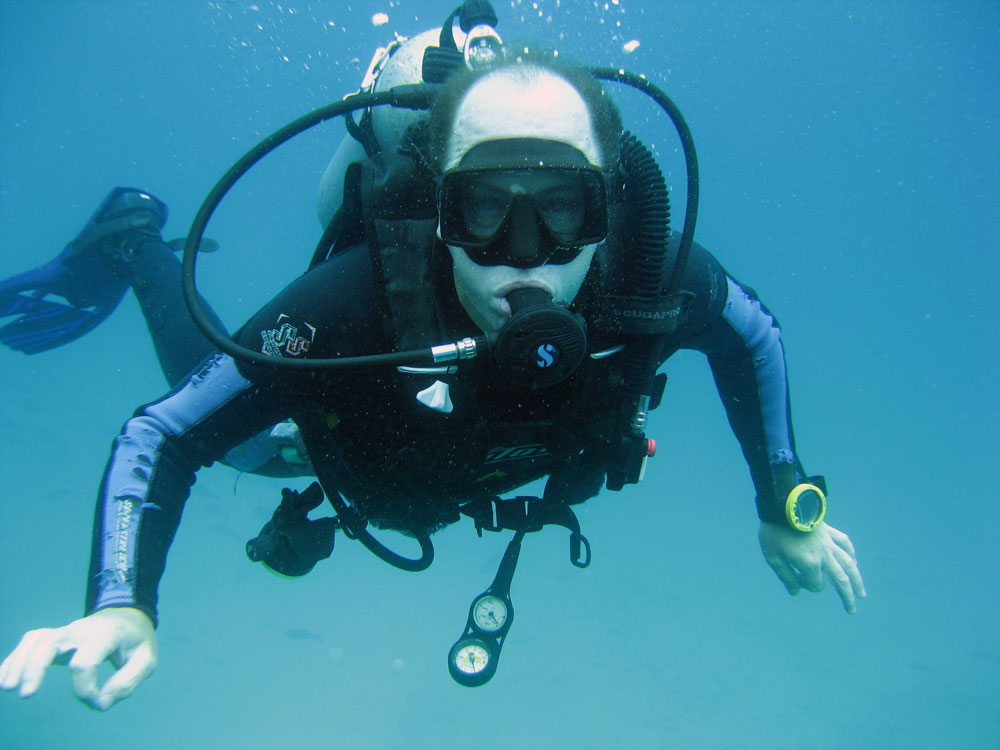
The third dive was our deep dive.  The plan was to go to 30 m and then Luis would do a couple of tests with each of us to check our cognitive ability at that depth.  Didn’t quite turn out that way.  We descended to 34.4 m with Luis casually looking behind at us now and then giving us the OK gesture to which we responded OK.  We stayed at that depth briefly – not more than ten minutes – and then ascended to about 18m where we stayed until we ran out of air.  That was our deep dive – he explained later that he could see we were fine and didn’t think we needed to do the exercises.  This guy was just too much!

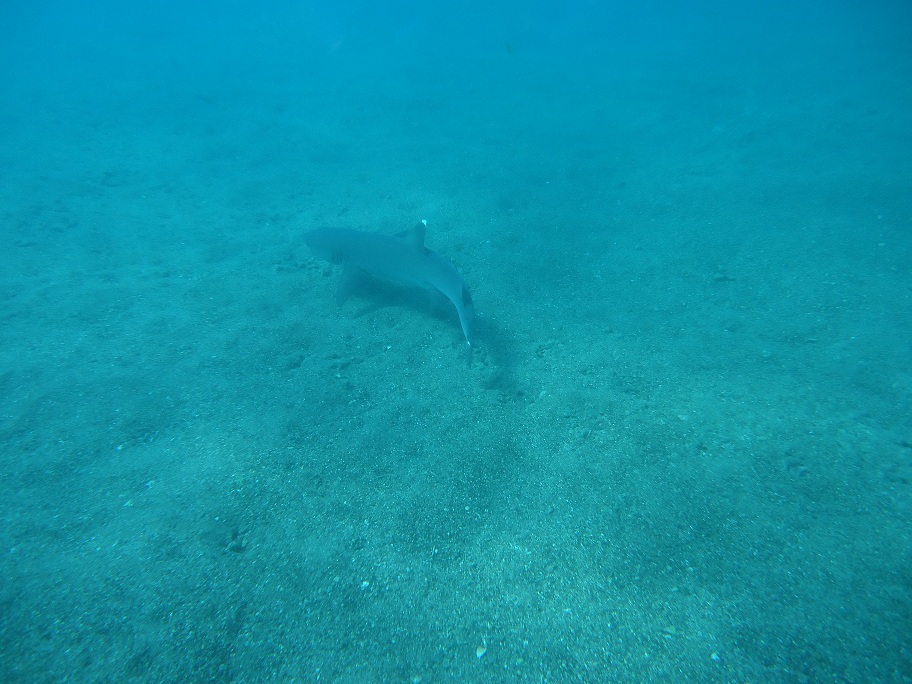
There was a lot of current on this dive, so at one point we hung on to some rocks to slow us down.  Here we stayed for about ten minutes fascinated by the sea life passing us by – all swimming against the current.  We saw our first Galapagos Shark while perched on these rocks.  And then another, and another, and another.  They were within a couple of feet of us.  I saw Chris madly snapping pictures.  There were turtles, and huge schools of fish, all around.  It felt like we were watching an underwater movie – except we were in it!  Absolutely amazing!  Chris even took some video of us hanging onto the rocks watching the sharks swim by.


While we were diving, the captain took apart the engines to clean and repair them – a rather unsettling sight to see knowing we had a long trip back to Santa Cruz.  By the time we finished our dives it was about 3:30 – we had been out since 7:00 in the morning and had been given nothing but water and an apple.  We expected to be given lunch at some point, but because we were so delayed, the captain decided to go back as soon as we had finished our dives.  We pulled into Santa Cruz at 5:00 pm at which time the crew prepared our lunch – just a little late!  We were famished.

The two dives we did this day were absolutely fantastic in terms of the conditions (excellent visibility) and the sea life we saw. From the course perspective, it was pretty half-assed.  We studied all the required course material in advance and we were ready and confident to do all three dives.  While we did accomplish the necessary skills for certification, we felt we were gypped out of a full dive and we were appalled to see the lackadaisical teaching approach by this instructor.  Add to that the poor condition of the boat and the lack of refreshments on board, and I can tell you, we were not happy customers.

Back on dry land, after hearing our miserable tale, Alice was sympathetic and empathetic and compensated us for the way things turned out.  In the end, we got our certification and had a few great dives.  All’s well that ends well.

Galapagos Islands Cruise Day 8: Birds, Birds, Birds

Our final stop was at North Seymour which is a small islet north of Baltra with typical arid vegetation including prickly pear cactus, palo santos trees and salt bushes. The visitor trail on North Seymour is approximately 2 km in length crossing the inland of the island and exploring the rocky coast. Along the way the trail passes colonies of blue-footed boobies and magnificent frigate birds.

We landed for our walk very early (6:00 am) because we had to be back in Baltra and off the boat before 9:00 am.  By now I think we were all a little bit tired as the schedule each of the past 7 days has been packed full of activities.  Regardless, this stop was well worthwhile as we were able to see so many birds up close.

In spite of the early start, there were groups already on the trail – ahead and behind us.  Our guide kept us moving at a good pace so as not to collide with the other groups.

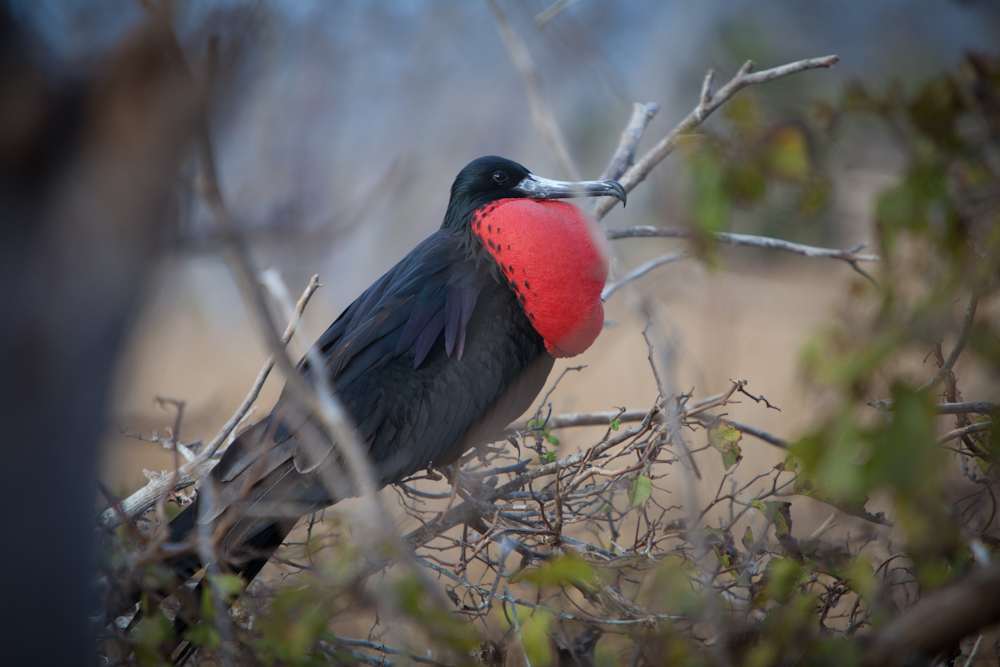
We had the opportunity to see the inflated red pouch of the magnificent frigate bird, a large black bird with a long wingspan, and a hooked beak; it is extremely fast and has excellent vision.  We had seen these birds throughout our voyage but this was the first time we saw them with thier large red pouches on their necks fully inflated. During mating season the males throw back their heads, inflate the pouch (sometimes to the size of a soccer ball), and shake trying to capture the attention of female frigates.

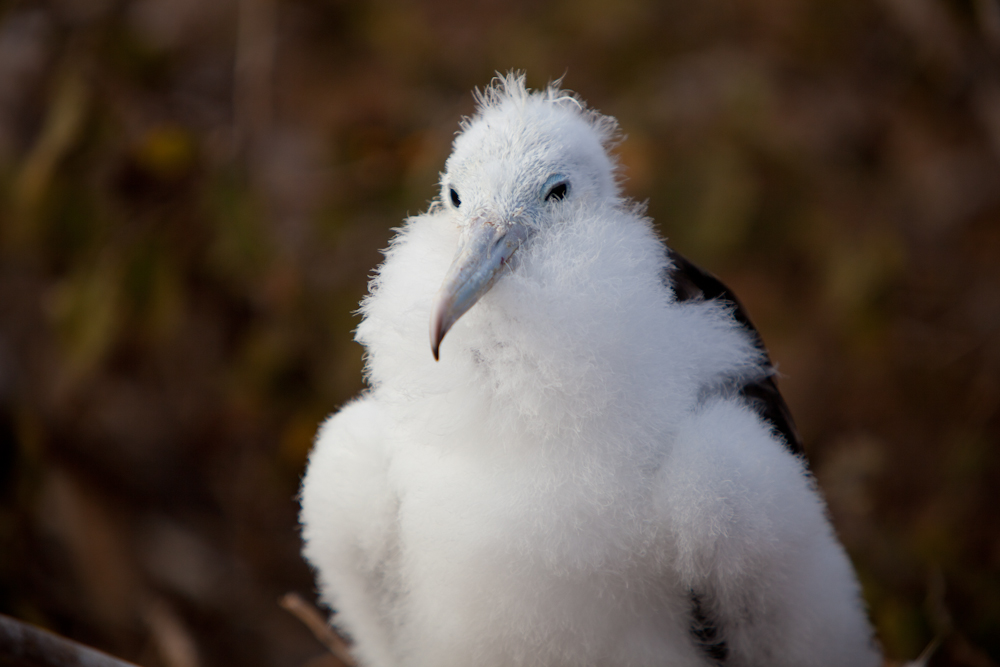
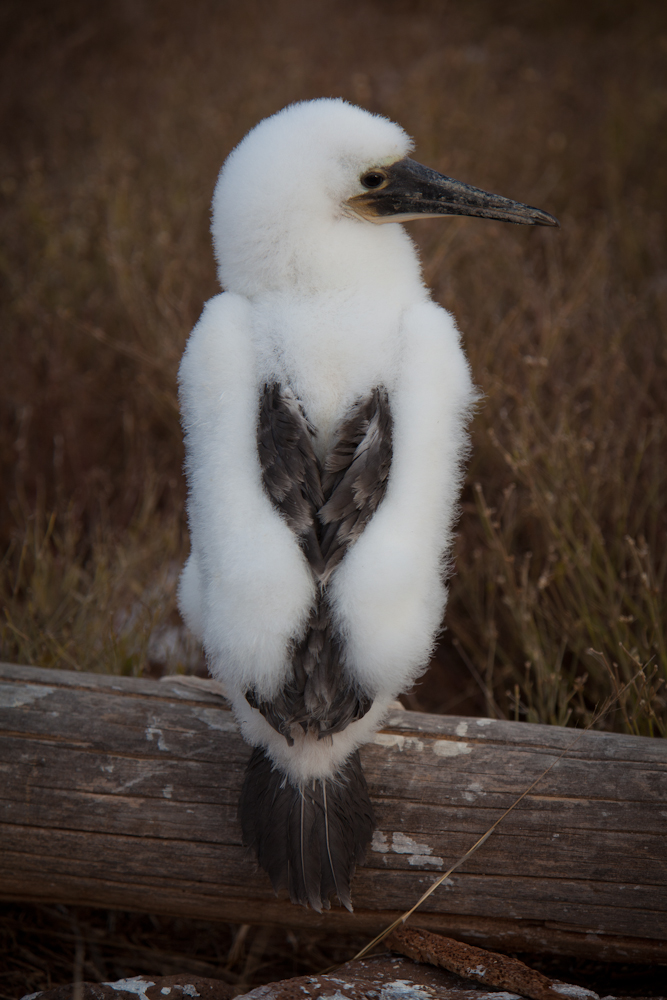
Boobies and frigates have an interesting relationship. Sharing the same nesting area on North Seymour, blue-footed boobies nest on the ground making their nests from the twigs of the palo santos trees, while the magnificent frigate bird nests just above them in the salt bushes.  We saw several baby blue-footed boobies which are fluffy, white puffs of feathers – absolutely adorable.  Sadly, we saw a few dead ones as well, victims of nature – the mother sometimes lays two eggs but only nurtures one baby leaving the other one to die.

Blue-footed boobies are great at fishing. Hunting off-shore, the boobies dive from mid air into the sea in order to catch fish. Successful, they return to the island with their prize to feed their young. Frigate birds named for the warships once used by pirates are the pirates of Galapagos birds. In contrast to the booby, frigates are poor fishers.  Their bodies produce very little oil for their wings and they are not waterproof. Unable to spend time in the water fishing they must rely on food stolen from other birds to feed themselves and their young.

Unable to spend time in the water fishing they must rely on food stolen from other birds to feed themselves and their young. When a booby or red-billed tropicbird returns from a successful fishing trip the frigatebird will swoop down and molest the bird until it drops its catch. The frigate then plucks the food from the air, feeding itself and its young from the stolen loot. Frigatebirds on North Seymour rely on the fishing success of the blue-footed booby for their survival.
Of course, any walk on an island in the Galapagos would not be complete without sea lions, and North Seymour was no exception.  To our left, the sea lions basked on the lava rocks along the ocean edge, and to our right, the birds were nesting in the low lying vegetation.
Once we were back on board, we enjoyed our final breakfast as the boat travelled to our final destination, Baltra. We were dropped off on Baltra Island which is where the airport is located.  It is typical for people to fly into the Galapagos Islands, board their cruise ship, and then head home directly after their cruise.  Only four in our group were flying out this morning; the rest of us made our way back together to Puerto Ayora where we were all spending a few more days.  We would bump into each other many times over the following days.  In fact, it became a joke between us and Dafne and Jasper as we kept running into them, eating most meals together, and after each one, saying good-bye as if it would be the last.  It was the longest good bye ever.  We even travelled to the airport on Tuesday with them and then said a final good-bye.  We hope they will visit us in Canada one day as we really had a lot of fun with them.

And so came to an end our wonderful 8 day cruise in the Galapagos Islands.  Hope you enjoyed the trip!


Galapagos Islands Cruise Day 7: Snorkelling with Sharks!

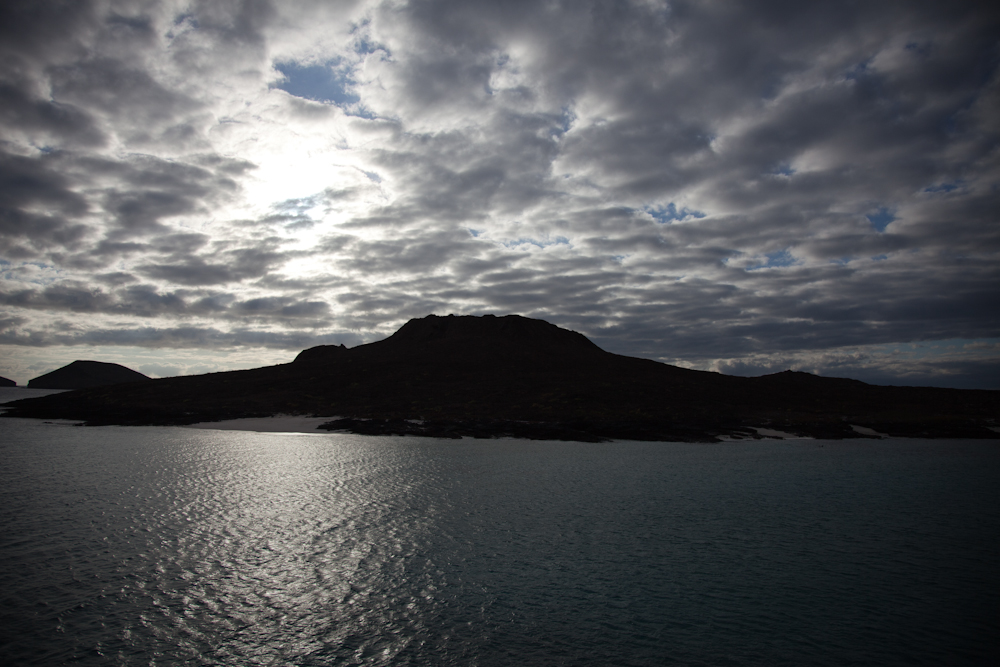
The clouds have overtaken us.  I awoke this morning surprised to see we were still anchored in the bay at Rabida Island and disappointed by the overcast, gloomy sky.  Considering this is our final full day at sea and every day thus far has given us perfect weather, one can hardly complain.  As I enjoyed my morning coffee perched high on the top deck, the boat headed off to Chinese Hat Island, so named because it looks like a Chinese hat. This tiny island just off the south eastern tip of Santiago Island is less than a quarter of 1 sq km in size.

As the anchor was dropped, the sun came out as if on cue and the rest of the day remained warm and sunny.   After breakfast we headed to the island for a walk, the first group to land today.  Enrique was well organized and very knowledgeable about the other boats at each island and did a great job insulating our small group from the crowds that sometimes overwhelmed an island.  A welcoming committee of several sea lions greeted our boats as we made a wet landing.

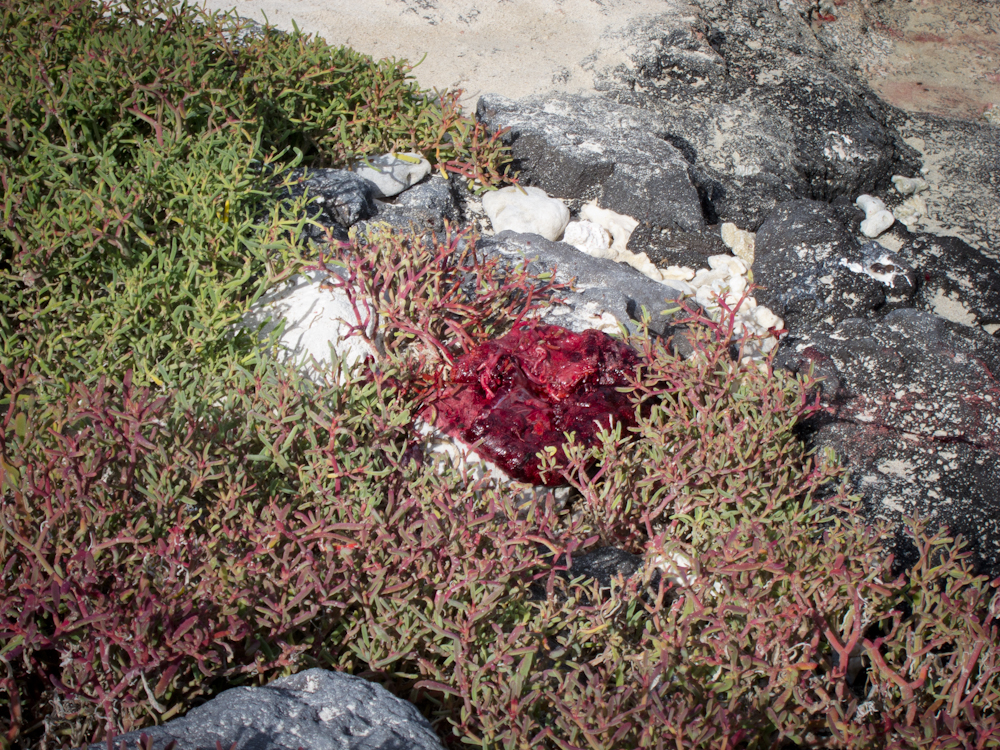
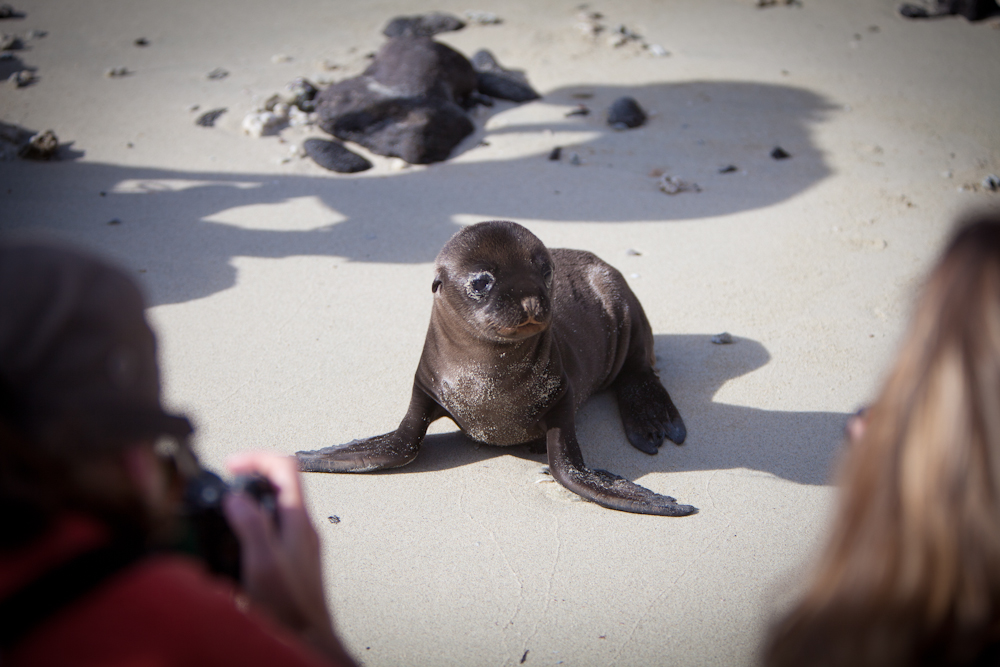
The highlight this morning was a sea lion with her newborn pup, estimated to be only a few hours old.  The blood on the rocks where the birth took place was still fresh, as was the bloody trail from the birth site to her present resting place.

A hawk watched from a close distance, its bill and talons stained red from the blood of the placenta he had been feasting on only a few feet away.

We marvelled at the miracle of birth, at how this mother sea lion had carried her pup for an eleven month gestation period, had carefully selected this birthing location, and was now resting with her newborn. When we returned from our walk, both mom and pup were awake and moving slowly along the sand.  Another pup, perhaps a week old, was checking out the new kid in town and we were told that within a week both would be playing together.

While travelling in the dinghies, we again witnessed thievery on the high seas.  A Blue Footed Booby dove powerfully into the water and resurfaced with a good sized fish in its mouth.  This was by now a common sight, except this time a frigate swooned in unexpectedly, snatched the fish right from the Booby’s mouth and then swallowed it whole without hestitation.  A few feet away, a pelican took careful note of the commotion.   Suddenly, the frigate spit out the fish (probably because it was too large) which was still intact and swoosh, the pelican dove in, snatched the fish and flew away victorious.    This was the second time we saw the cunning and calculated manoeuvers of the pelican and the frigate’s cleptomanic tendencies.

Snorkeling in this location was great.  As we drifted along the rocky edge of this island, we were amazed to see a white tipped shark!  Visibility was excellent and there were many large schools of colorful fish.  Chris and I decided to go kayaking for a while – once Chris recovered from overturning the kayak that is.  I wisely let Chris get on the kayak first so he was the only one to go under.  I had learned from previous canoeing experience with Chris (nothing more needs to be said on the subject).  There wasn’t much to see from the kayak; the fast moving current gave us a good upper body workout as we cut across the channel to the yacht.  That was our first and last kayaking experience in the Galapagos Islands.  Later we learned that some sea lions decided to play with Dafne and Jasper, even blowing bubbles in their faces.

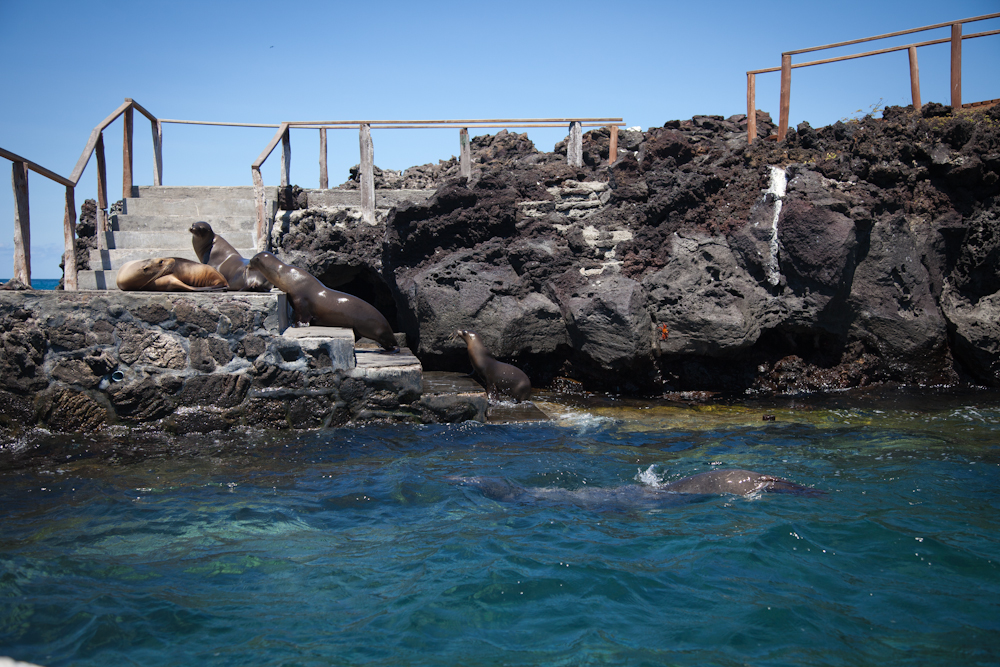
Bartolome Island was our next destination.  To stay ahead of the crowds, we ate lunch as we travelled to the island.  This island is a popular day-trip destination and so it was not surprising to find several boats already in the bay.  There is a spectacular lookout point, accessed by a man-made boardwalk and steep set of stairs. But of course, before reaching the stairs, we had to make it past yet another welcoming committee of friendly, playful sea lions.  In this case, we were refused passage on the stairs and had to walk on the rocks to get around them.  They must think they own the place or something!

Did I mention the stairs to the lookout?  There were a lot of them – a couple of folks with bad knees or backs wisely opted out of this excursion.  It was a long climb to the top in blistering heat.

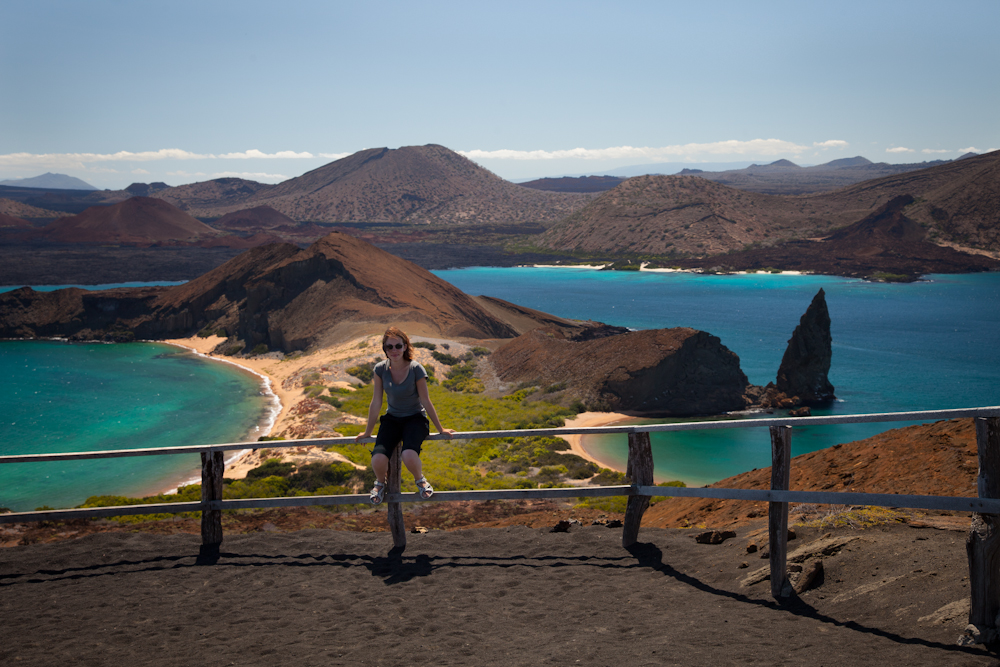
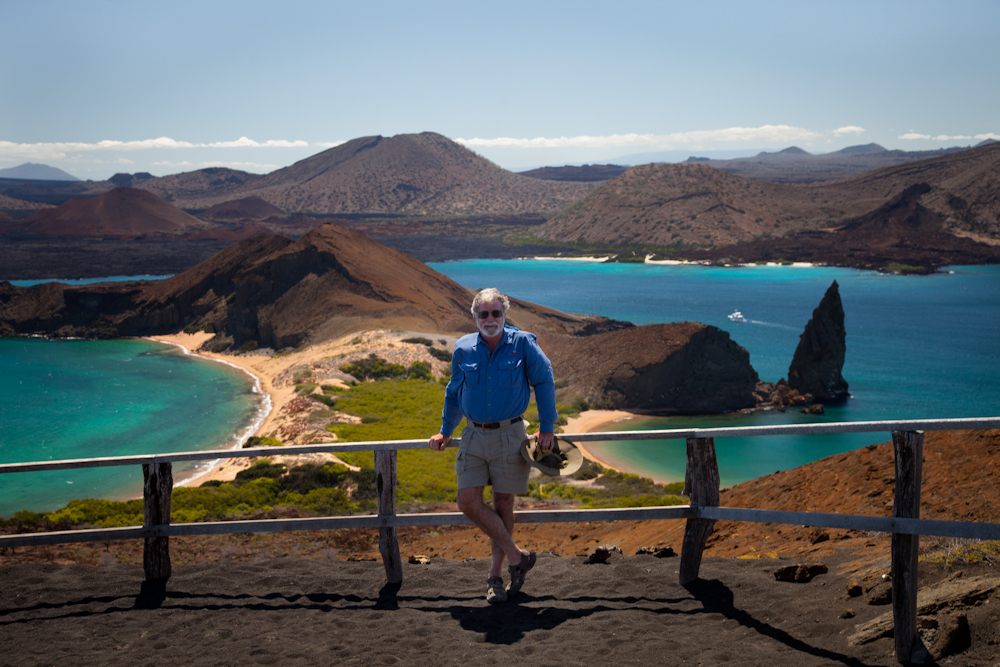
We were rewarded with a postcard worthy view from the top.  And of course, everybody wanted their picture taken. If this view looks familiar, it’s because this scene is commonly used to advertise Ecuador and the Galapagos Islands. (Sorry Babs, but the picture with you and Enrique was too blurry to include in the collection below.)

We snorkeled from the beach along the rocky shoreline at the base of the infamous Pinnacle Rock.  The schools of fish seemed much larger here; at times we were surrounded by hundreds of fish, often finding ourselves in the middle of a school swaying back and forth harmoniously in the surge.  As we explored the rock formations we searched for new and interesting marine life; a water snake was the only new discovery this time.  On the other side of the Pinnacle Rock, we saw our second White Tipped Shark of the day and several from our group dashed off after it.  Again the sea lions were out to play.

A short walk to the other side of the island ended our visit to Bartolome.  We now travelled to North Seymour amidst the choppiest waters so far.  A few of us perched ourselves on the cushioned seats at the back of the middle deck, swaying back and forth as our boat plowed through the swells.  It was difficult to walk as the boat tipped precariously from side to side.  A flock of about eight frigates decided to join us and flew directly overhead for quite a while giving us an excellent view of their undersides.  It reminded us of the dolphins swimming alongside the boat a few days ago.  Apparently frigates can fly for up to two days straight!

By now, we all knew, word for word, Enrique’s announcements before each excursion:  “Ladies and Gentleman……..we will be going in the dinghies for a walk in 10 minutes.   Please bring nice shoes or sandals, water, sun screen, hat, insect repellant, and a rain jacket.  Thank you.”

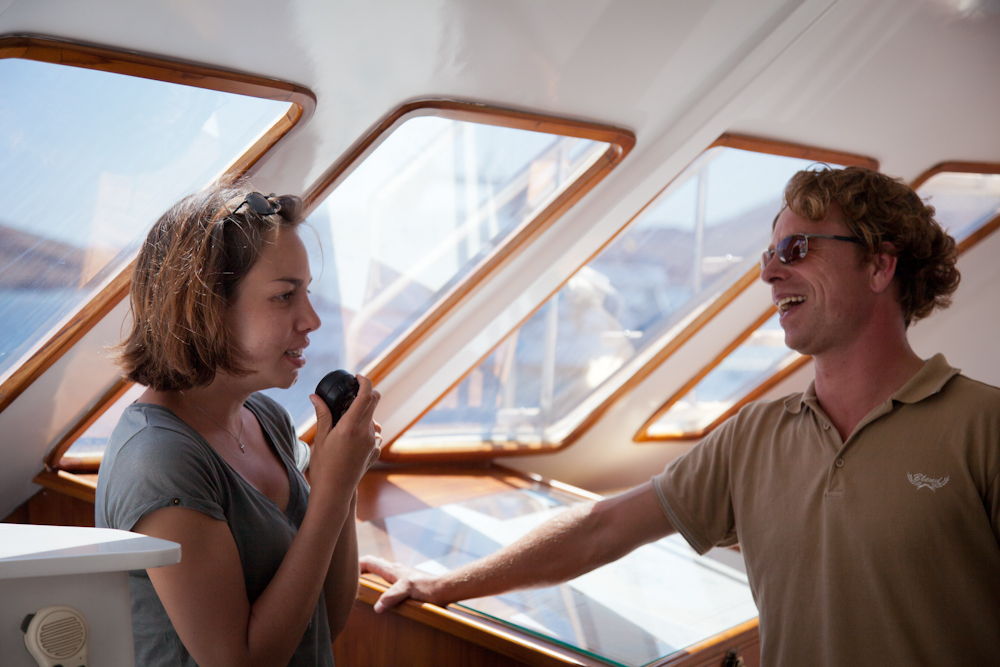
To our amusement, Stephanie decided to take over the microphone and make an announcement on Enrique’s behalf.

Before dinner we watched a slide show compiled by Enrique with both his photos and those contributed by some of the passengers, Chris included.  It was a great opportunity to reflect and relive some of the more special moments of the trip.  After dinner, we exchanged email addresses and compared notes, filling in some of the gaps or missing details in my story.  Invitations were extended by our new American friends to visit them in Spokane or to join them at their ski condo in the mountains if we ever found ourselves in their neck of the woods.  It’s great incentive to learn how to ski!

The night concluded with a farewell cocktail shared with the crew and passengers.  We expressed our thanks and appreciation for all the work the crew did to make this voyage so enjoyable and memorable.