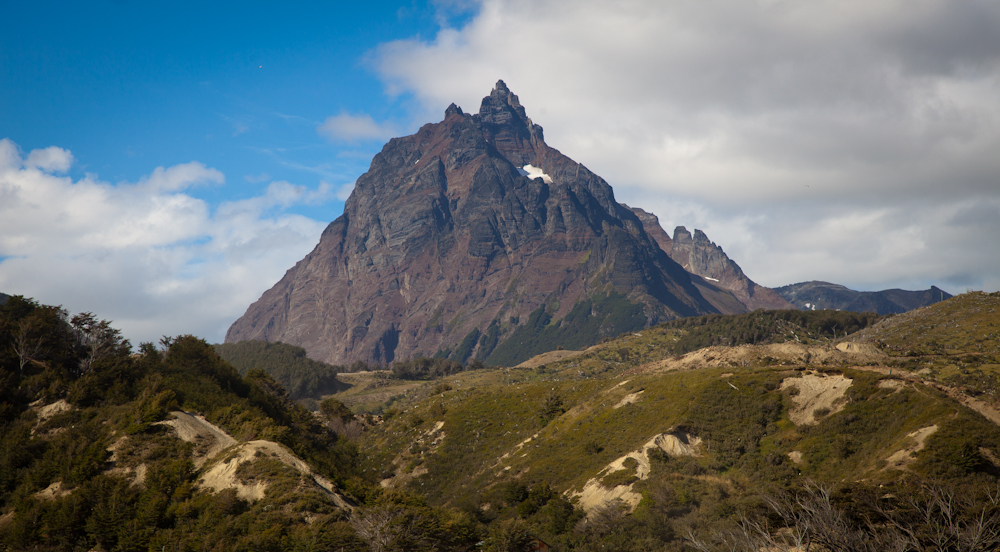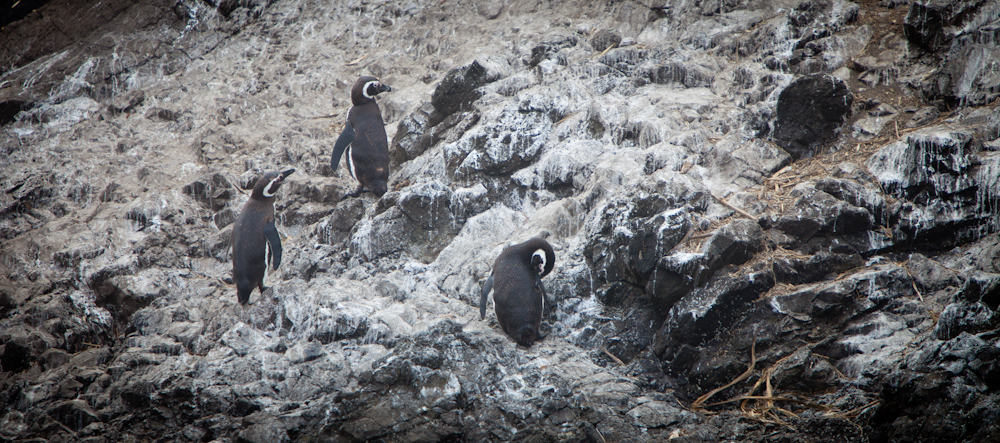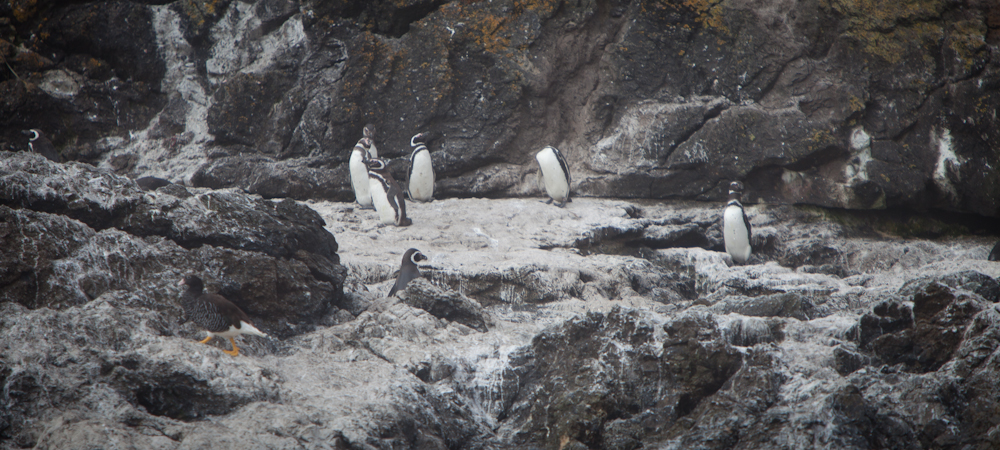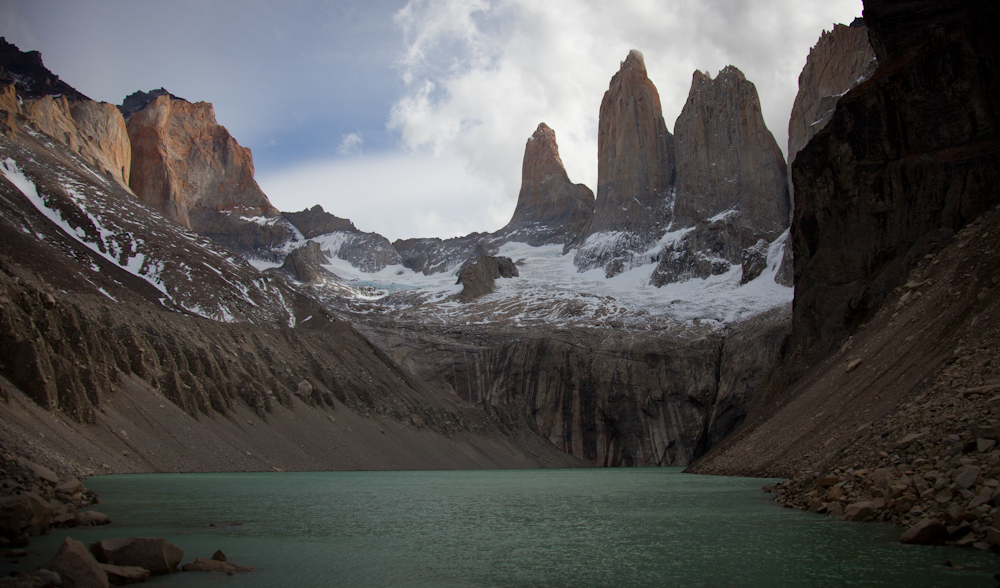
Torres del Paine in all its glory and ferocity

Our hopes for hiking the “O” circuit in Torres del Paine were immediately dashed upon arrival at the park entrance when a park ranger informed us that the north west trail near the infamous Gordon Pass was covered in knee-deep snow and another blizzard was heading that way in just three days – exactly the time we would be reaching that part of the trail.  Reluctantly we adjusted our plans and decided to hike the “W” trail instead which was easily done in six days.  We had sufficient supplies for eight days of trekking, so we could take our time and enjoy ourselves.  In the end, we covered a little more than half the “W” in 5 days/4 nights.

Map of the trail:  Red line represents the “W”.
The circuit, also known as the “O”, includes the red and grey lines.

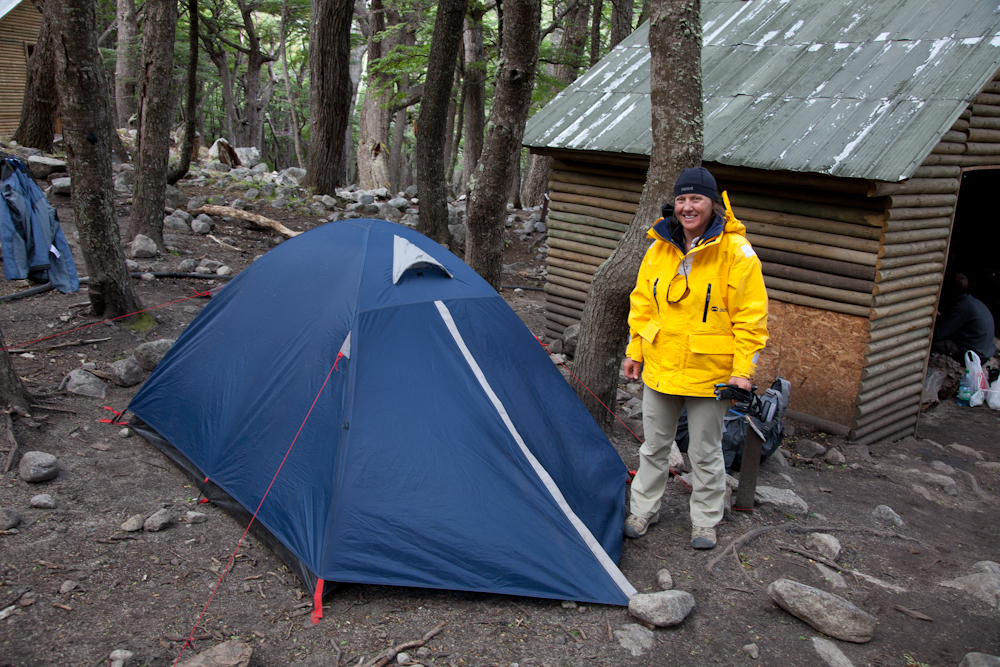
We arrived in the park around noon and set out shortly thereafter towards Campemento Torres which was only 1.5 hours away according to our map; this was the right arm of the “W” in the map above.  Our spirits were high in spite of our heavy packs but as the trail to Camp Torres steepened, my body resisted heartily.  My hips screamed in pain as we climbed the difficult trail.  Chris grumbled behind me – this was going to be a long eight days.  At least the weather was great – sunny with some clouds, a little bit of wind, and good hiking temperatures, around 18C.  Three hours later we arrived at the free camp, a lovely spot nestled in the trees about a 30 minute trek from the infamous “Towers”.  We quickly learned the estimated times on our map did not correspond with our hiking pace, not even close.

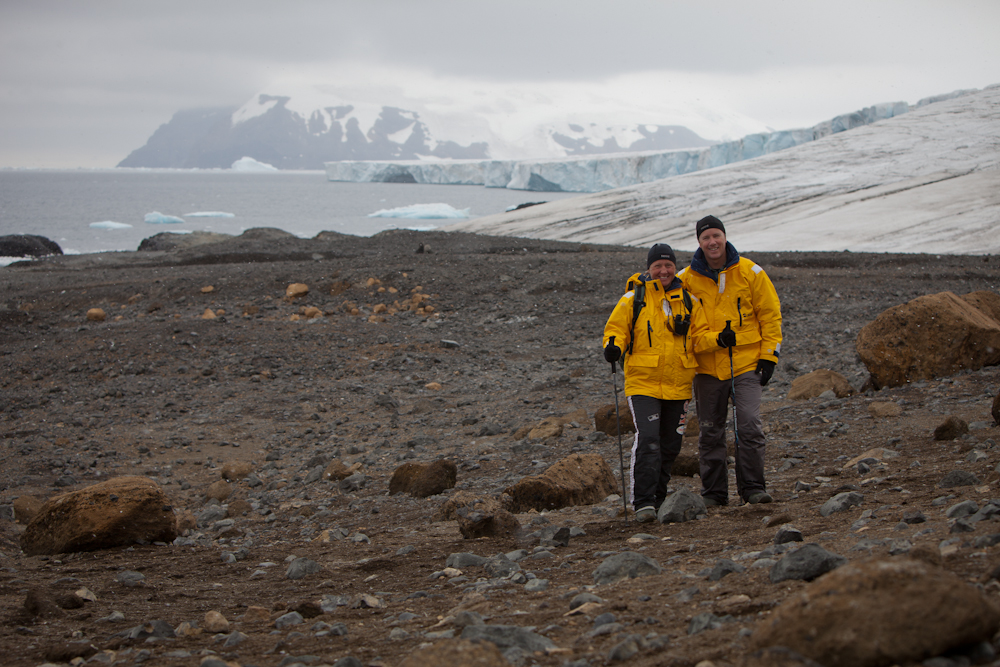
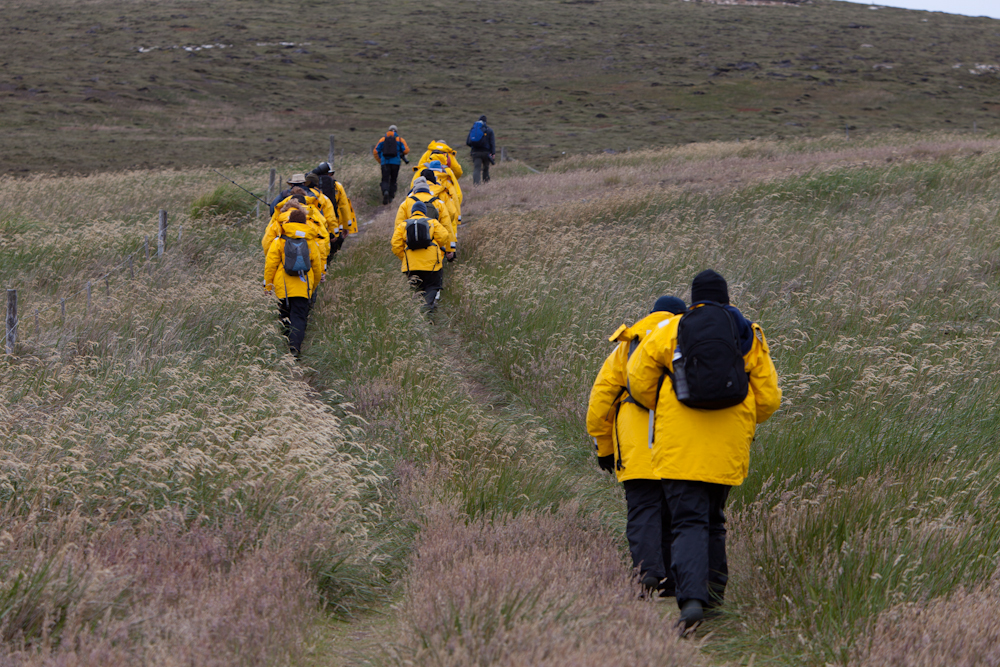
After setting up our little tent, and having lunch, we decided to trek up to the “Towers” while the weather was good.  The steep climb, probably the hardest on the entire trail, was a lot easier without our packs on our backs.  We were rewarded at the top with good visibility and a clear view of the “Towers”.   The wind had picked up when we were at the top and I was happy to have brought my bright yellow Quark expedition shell from our Antarctica cruise.  I nestled in amongst some boulders for protection and enjoyed the scenery for a while.

The “Towers” in Torres del Paine

That night, the wind howled through the trees above us, but we were well protected in the forest and our tent held up well.  It must have dipped to a few degrees above zero during the night, and I was cold in my sleeping bag in the early morning hours.  My parka doubled up as blanket over my lower extremities with my feet tucked into the hood, and my fleece kept my upper torso toasty.

We had a long day of trekking ahead of us on Day 2: 1.5 hrs back down the way we had come, and then 4 hrs west to the next camp, at Refugio Cuernos.  The winds were stronger as we began our trek down the mountain side, causing us to stop more than once to let the winds abate rather than risk being blown off the moutain side.

As we veered west, the terrain changed to an easier, hilly path that was quite enjoyable.  Our muscles were still resisting and our packs still felt heavy but I was comforted with the knowledge that our packs would lighten as we consumed food each day; we just had to resist the urge to hasten the process by eating more than the rations allotted for the day.

Along the trail we played “cat and mouse” with a few other younger couples who were heading in the same direction.  A camaraderie formed amongst us so that by the time we reached our first daunting river crossing, we worked together to figure out the best way to cross it. I’m not talking small streams that you cross in a couple of steps.  These were at least 20 feet across, with fast moving water rushing down with no clear way to navigate across.  For one such river, Chris and I changed into our hiking sandals, rolled our pants past our knees, and carefully walked through the frigid, ankle-deep glacier water.  We did quite well until the last river crossing.  After watching several people, Chris included, cautiously walk across large rocks, I followed suit.  At the last rock, a combination of legs that were too short and a strong, untimely gust of wind threw me off balance so that I missed the rock ahead and fell forward face first.  Luckily, I had my walking poles to brace my fall, leaning most of my weight into my left pole and angling my body so that I landed on my stomach on the large rock ahead, with both the camera bag which dangled from my hip and my back pack safely out of the water.  The only wounds incurred were my pride and my left walking pole that snapped in two under the force of the fall.  I counted myself lucky as it could have been a much worse outcome.
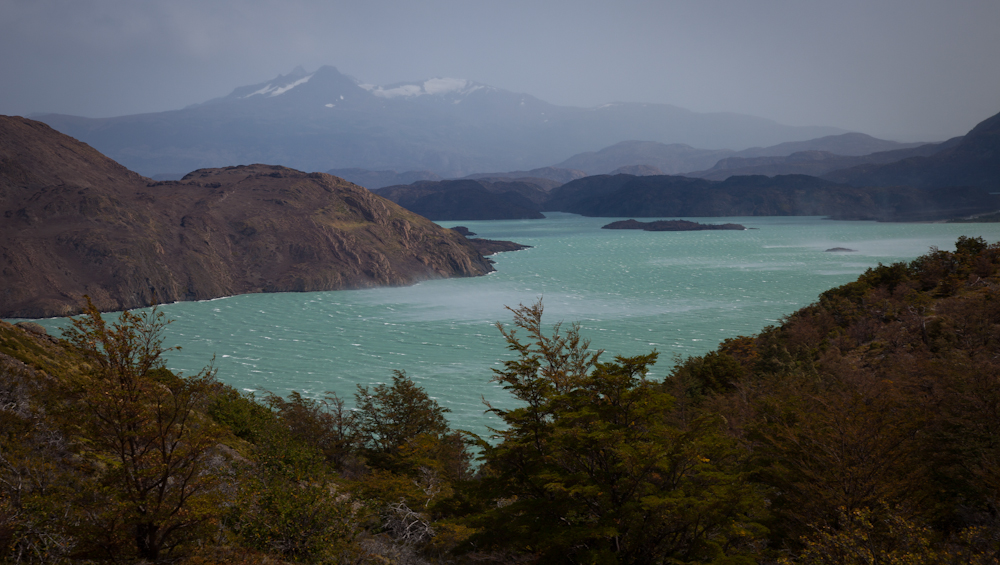
I was in good spirits all day, in spite of the heavy pack and the river fall.  The scenery was beautiful in every direction, the trail was manageable, and the weather was beautiful – sunny, around 18C, still windy but not like the early morning gusts on the mountain side.  But when we reached a sign that indicated we were only half way to the camp when I thought we were almost there, I hit a low, feeling like it was never going to end.  And then it got worse, much worse.

Out of nowhere, the winds picked up.  Before we knew it, we were dealing with gale force gusts of wind that literally knocked you off your feet.  And these gusts were unpredictable, coming at you suddenly, from any direction.  At this point, the trail hugged the side of a mountain, with a steep drop off  to the lake hundreds of feet below.  We started to recognize when a gust was coming – we could see the wind whipping up the waves in the lake below, next we heard the howl and then the wind would hit with a vengeance, soaking us with the mist from the lake.  We were exposed on this part of the trail and there was no where to seek shelter so we would all crouch low on the trail, sometimes on our stomachs and grab anything within our reach, tree roots or strong branches, hanging on literally for dear life so as not to be blown off the trail.  One guy ahead of us, was lifted off his feet and blown ten feet off the trail, luckily into some bushes and not down the side of a cliff.  Chris got thrown roughly against some rocks, bruising his arm, leg and a couple of ribs.  His camera got pretty banged up too.  It was frightening and slow going as we struggled against this wind for about three hours.  This was our first taste of the notorious Patagonia winds.

We arrived at Refugio Cuernos at around 4:30 pm, completely exhausted.  Luckily we found one of the last camp sites and somehow managed to set up our tent under these ferocious winds.  Tents were snapping in two, and blowing away all around us.  We weighted our tent down with six large boulders – as heavy as we could carry – inside the tent.  We piled boulders all round the tent pegs on the outside. We then huddled inside our tent wondering what the night would bring.  We were grateful for the military dinners provided to us by our B&B hosts, a  surprisingly tasty beef stew.  It was like magic watching the pouches heat up in a special plastic bag to which we had added a few tablespoons of cold water.  We would have gone hungry that night if we didn’t have these emergency provisions.  Our tent swooshed and swooned as the wind howled and swirled around us but it stayed in one piece and kept us dry even though it rained hard all night.

Others were not so lucky.  At around midnight, as we made our way to the bathroom, we were shocked to find about 30 people huddled next to the Refugio exposed to the elements; either their tents had collapsed, blown away, or there were simply no more sites available upon which to pitch a tent.  We were angered that the Refugio refused to allow this overflow into the building – there was plenty of space to make temporary beds on the dining room floor yet these unfortunate souls were locked out and had no option but to endure the night outdoors.

Since the next open camp site was more than 8 hours away, we decided to stay at Refugio Cuernos for two nights so that we could spend a day hiking into the French Valley (the middle arm of the “W”), reputed to be one of the prettiest spots in the park.  Amazingly, Day 3 was completely still, the lake as flat as a pancake, not even a ripple on the lake that had deluged us just the day before.  And it was stinking hot and humid. What crazy Patagonian weather. It took us over 2 hours to get to the French Valley even without our packs, and then we headed up the valley, but we didn’t get too far; I think we were still quite fatigued from the previous day.  During this hike, we learned that Campemento Italiano, at the base of the French Valley, was now open so that would be our destination on Day 4 – an easy 2 hour hike retracing our steps back to the French Valley.
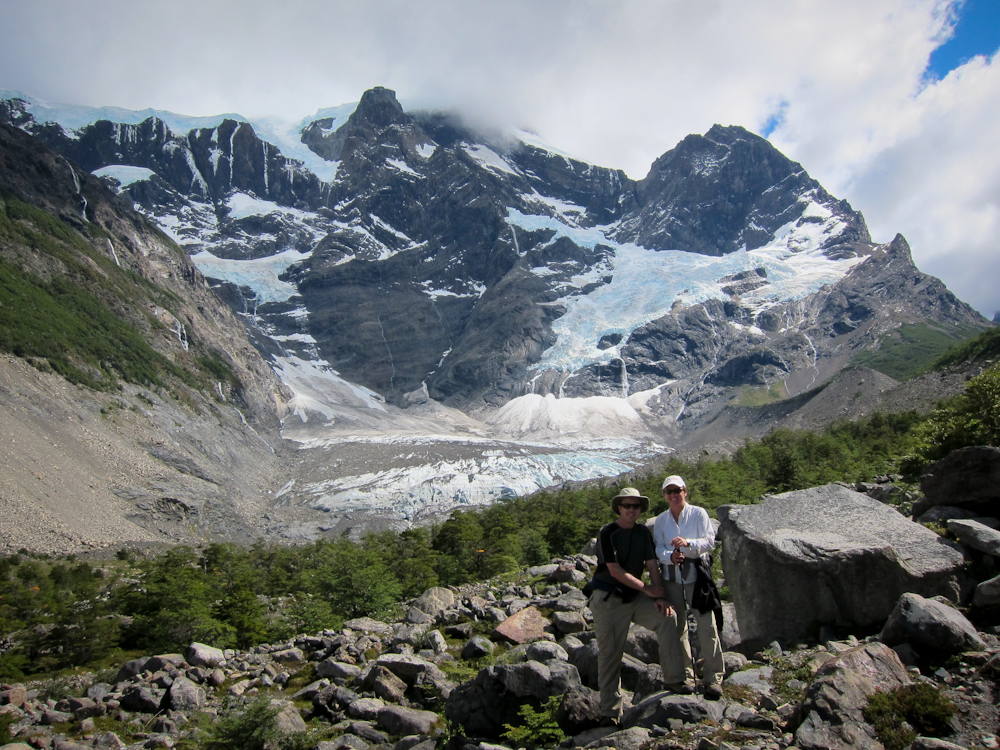
Heading into the French Valley.  The glacier behind us
was continuously calving, causing thunderous roars and sending
avalanches of snow down the mountain side.  

Refreshing, icy cold water was readily available from the mountain streams.
The water was crystal clear, no need to treat or filter. 

That water was cold!

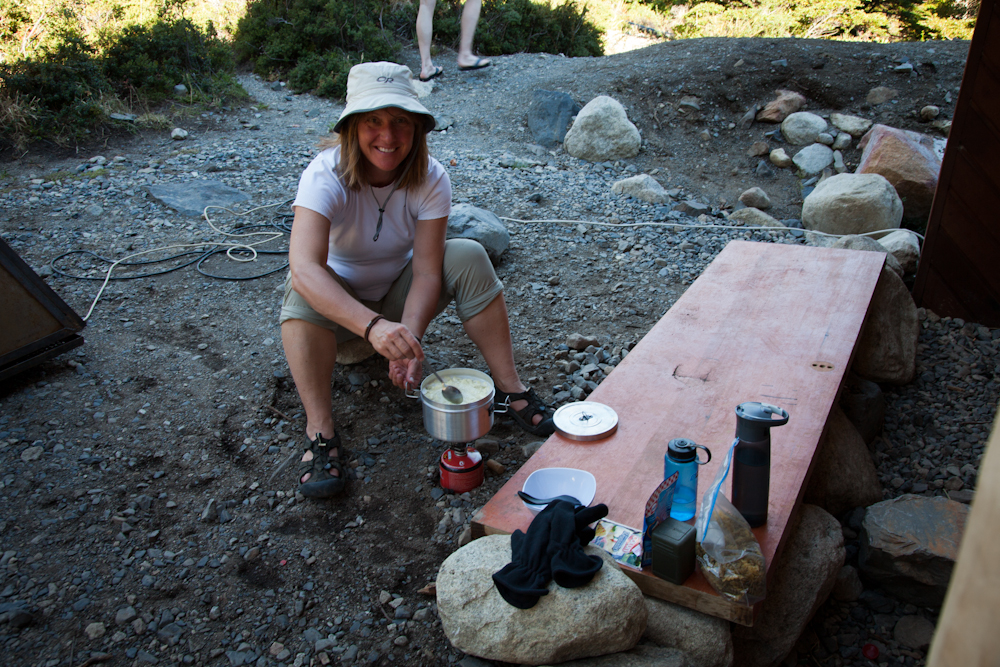
Preparing a pasta dinner at Refugio Cuernos on Day 3.
We splurged for a bottle of wine that night too! 
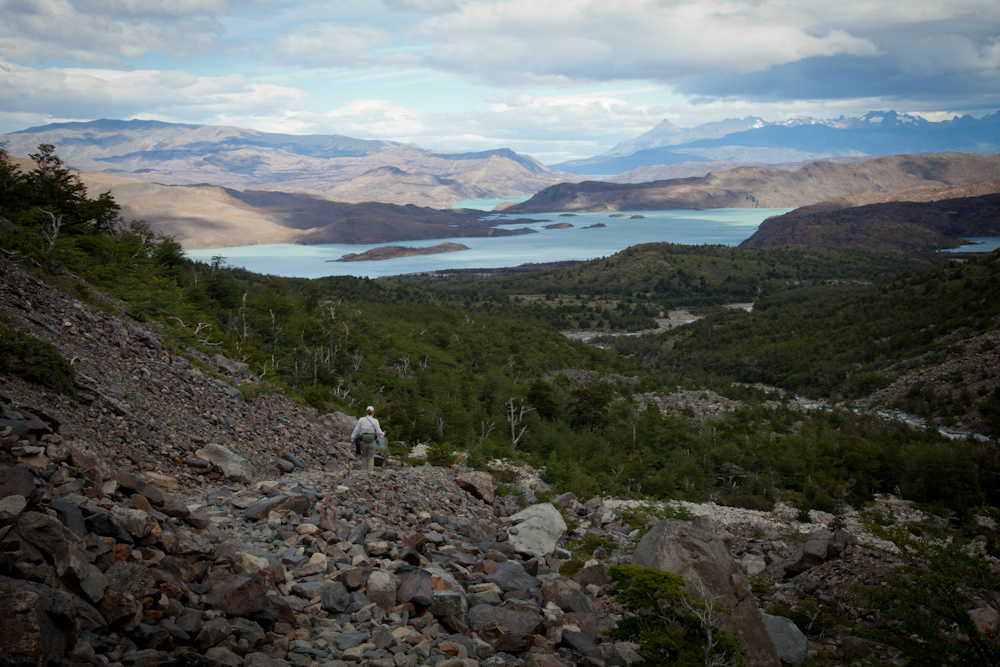
Day 4 was another beautiful day, a little cooler, but still clear and sunny and a mild breeze, just enough to cool us off.  I was feeling great physically, my body was no longer resisting the trek, and I was feeling very energetic and strong.  My pack was much more manageable too, probably five pounds lighter by now. We made great time to Campemento Italiano (less than two hours) where we left our stuff (we weren’t allowed to set up until after 5:00 pm) and headed back up the French Valley, this time reaching the look out which offered gorgeous views.  The weather was once again changing and we could see rain clouds rolling in so we decided to make our way back to camp to set up before the rain hit. This was my favourite camp ground, nestled in the trees, alongside a raging river.

At the lookout in the French Valley.

Steep trail heading up the French Valley.

Campemento Italiano: My favourite campsite
(ours is the blue tent to the left).

It got really cold that night, probably close to zero.  We wore all our clothes including hat and mitts to keep ourselves warm.  It rained that night, but again our tent kept us dry.  Chris had a rough night, finding it difficult to breathe deeply with his bruised rib. 

There was a chill in the air the next day, our fifth day on the trail.  The plan was to trek 6 hours to Refugio Gray, or the camp ground 1 hour beyond if we had the energy.

Refugio Pehoe in the distance surrounded by a charred landscape.

First we would pass Refugio Pehoe which was also the location to catch the catamaran out of the park. There was no camping allowed here as this area was completely destroyed from the recent fires. The fire came within a meter of the Refugio but the main building was miraculously spared.


It was surprising to see pockets of green vegetation
that had somehow been spared the ravages of the fire.

A distinct line where the fire stopped.
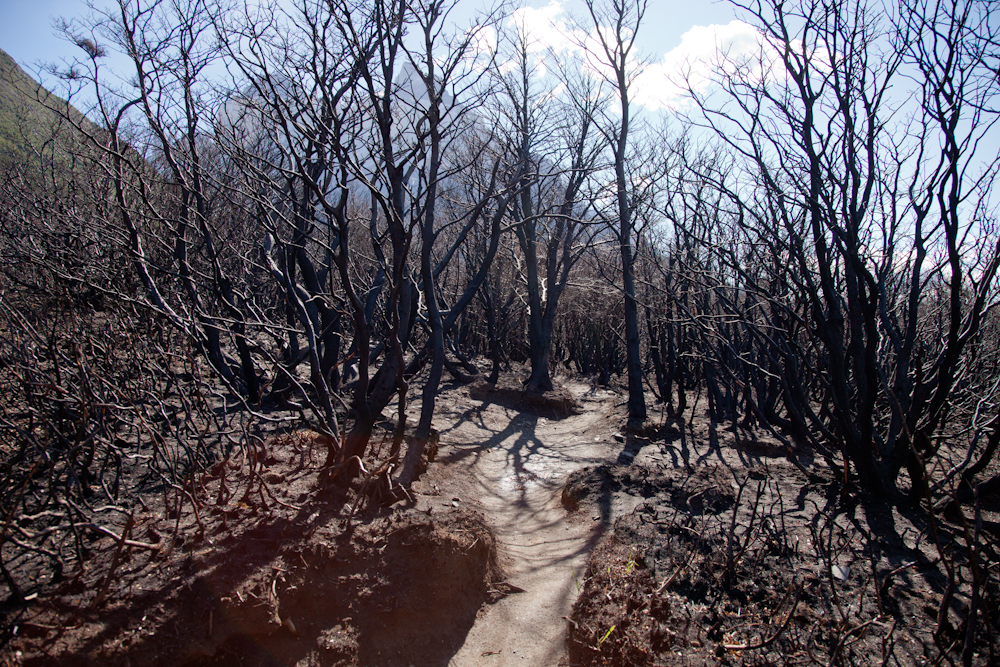
It was sobering as we entered the scorched forest, eerily still, nothing but charred skeletons of trees remaining.  The smell of burnt wood permeated the air.  It was really sad to see the devastation caused by careless human actions.

This was supposed to be an easy hike to Refugio Pehoe, but the wind was picking up again and it was biting cold.  As we reached the Refugio, walking into steady 50 km winds that were pelting us with dirt and charred debris, we saw the 12:30 catamaran heading into shore.

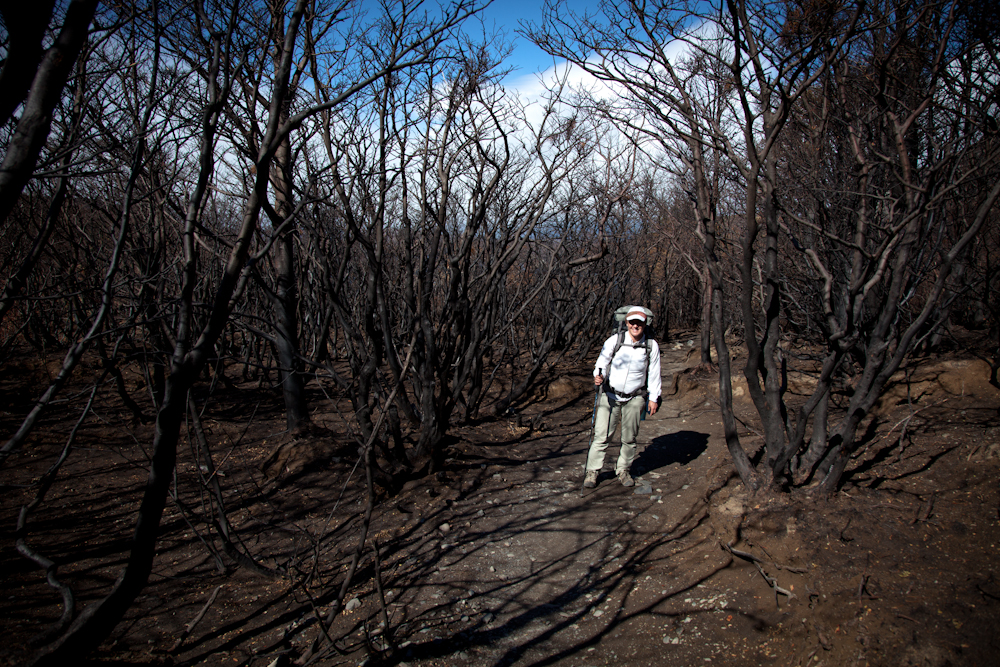
The thought of hiking 4-5 more hours into this biting wind through a scorched forest suddenly lost its appeal to both of us.  When I suggested perhaps we should call it a day and catch the catamaran, Chris agreed wholeheartedly, and I think he was secretly relieved that I didn’t want to push on.  And so concluded our 5 day, 4 night trek through Torres del Paine.

Although we didn’t stay in the park as long as we intended, I was proud of what we accomplished especially considering this was our first trekking experience.  We learned a lot for next time – the importance of keeping our packs as light as possible (forget the binoculars and the video camera), what food works best (we loved the cured salami that we snacked on for the first 2 days),  and generally what we’re capable of (we are old and we are slow).   This park lived up to its reputation for gorgeous scenery, but I was a little put off by how busy the trail was and how congested the camp grounds were at night.  There seemed to be a lot of confusion and mis-information within the park as to what was open, etc. but that may have been a by-product of the forest fires and not truly reflective of how the park is normally run.  I think we’re spoiled in Canada with all the wide open spaces we can enjoy and the beautiful, well run national and provincial parks at our disposal.

We’ve been back in our cozy B&B for a few days, resting up, having our laundry done and getting ourselves organized for our next trekking adventure to Fitz Roy Mountain (Cerro Fitz Roy), located in Parque National Los Glaciares (on the Argentine side of Patagonia). We’re travelling back to El Calafate today where we’ll spend the night and then head out to El Chalten tomorrow where we will begin our next trek. So we’ll be offline again for about a week.  Next stop is Buenos Aires where we will stay in an apartment for two weeks. We’re looking forward to returning to the warmth and sunshine (it was 25C in BA today).

Video:  Newbies Trekking in Torres del Paine
 

Antarctica Cruise Part 3: Reaching the Peninsula

After South Georgia, a full day at sea gave us all some much needed down time to relax, recharge and for many, to sort through the thousands of pictures taken thus far.  As the trip progressed I was polling some of the more avid photographers to see how many photos they were taking.  Chris was looking mighty good with his measly couple of thousand photos as compared to some who were close to 20,000!

I succumbed to the cold I had been fighting for a few days and welcomed the opportunity to rest.  Some were suffering from the effects of the increasing swells on the open water but we were assured these were still considered calm waters; it usually was much worse.  Others took the opportunity to stand on the lookout for whales which were noticeably absent thus far.  We did catch a glimpse of a few humpback whales off in the distance, and a pod of about ten orcas which was pretty cool.

During this part of the voyage, we travelled to the South Orkney Islands, Elephant Island, the tip of the Antarctica Peninsula, and the Shetland Islands.

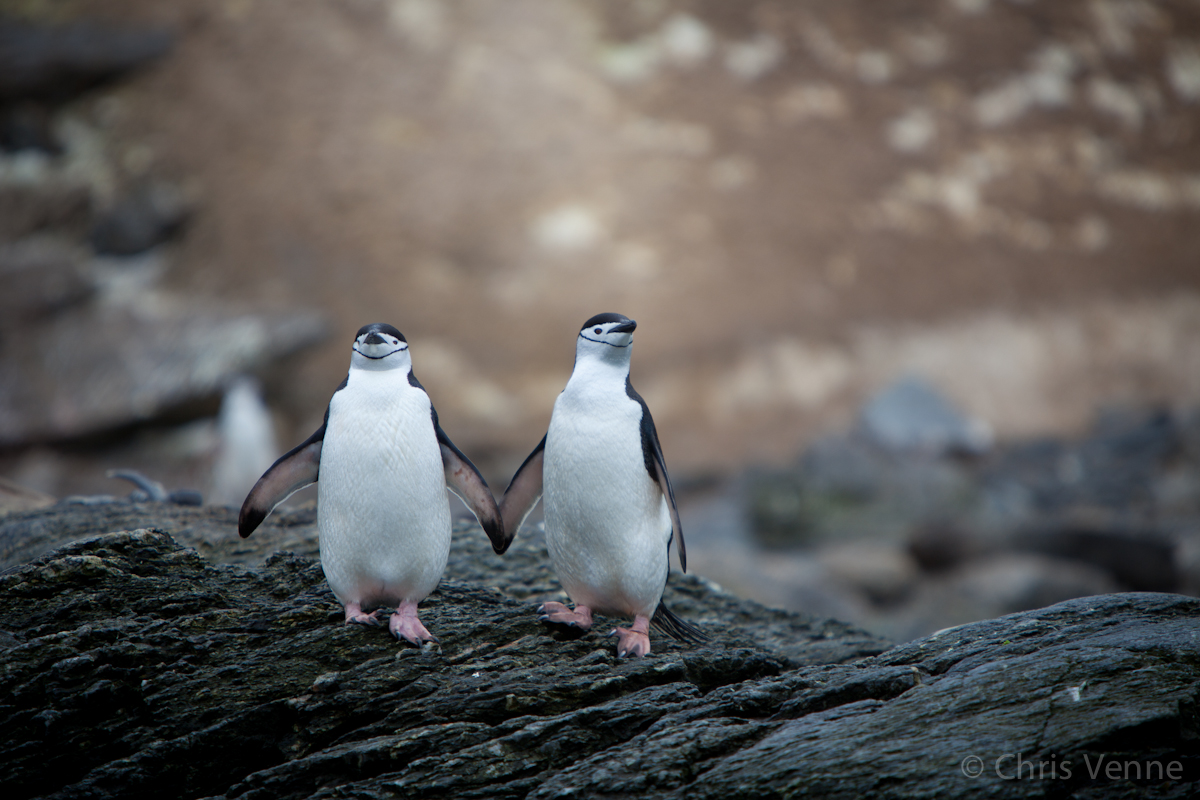
Chinstraps holding hands. Chris' favourite shot of the trip!

We interrupted our second day at sea with an excursion to Sandefjord Bay which lies between the west end of Coronation Island and Monroe Island, which are part of the South Orkney Islands.  We were still more than 600 km from the northeast tip of the Antarctic Peninsula so our journey was far from over.

The South Orkney Islands is a group of four main islands in the Southern Ocean of which Coronation Island is the largest measuring 48 km long.  The total area of the archipelago is about 620 square km of which about 90 percent is glaciated.  It was, therefore, not surprising to see all the ice in the water presenting a rather challenging landing for our zodiac drivers.  We enjoyed some beautiful scenery and observed a large colony of chinstrap penguins. After touring the colony on land, we took to the seas and explored the bay via zodiac.

A tricky landing!

A Weddell seal.

Chinstrap penquin covered in pink poop!  

I think this is a Weddell seal.

The scenery at Sandefjord Bay.

Video:  Tricky zodiac landing in the ice.

By now, ice bergs of all shapes and sizes formed an intricate part of the changing landscape.  I marvelled at these naturally formed sculptures, veritable works of art.  Our next stop was Point Wild on the northern coast of Elephant Island.  This was a hostile site comprised of a long, narrow ridge of boulders under high, vertical rock cliffs and the likelihood of landing here was extremely low; this became our one and only failed excursion.  However, history buffs were satisfied to get a good look at this site from the ship.  As  I mentioned in Part 2, it was on this spit of land between the boulders and cliff face where Ernest Shackleton’s crew of twenty-two men set up camp under a life boat when their ship Endurance sank in the Weddell Sea.  The stranded party was led by Frank Wild (Shackleton’s right hand man), for whom the site is named.  Shackleton and a few of his men made the infamous 800 mile voyage back to South Georgia to get help and returned to rescue his men with the vessel Yelcho four months later in August 30, 1916 – in the middle of winter.  A bronze bust of Yelcho’s Captain, Luis Pardo Villalon has been erected commemorating this historical event.  I’m afraid this historic site was lost on me that day as I was spending the day in bed recovering from my head cold.  I did manage to drag myself outside for a very brief glimpse of the rocky shoreline and the monument before returning to the refuge of my cabin.

Elephant Island

Paulet Island which is located in the Weddell Sea was an intriguing site to visit.  Not only did it hold historical significance, it was also home to 100,000 breeding pairs of Adelie penguins.  Sheathbills, skuas, and blue eyed shags also breed on this site. This was where Captain Carl Anton Larson and his 19 men and the ship’s cat were marooned during their 1901-1904 expedition after their ship, Antarctic, sank.  The remains of their stone hut are a testament to their resourcefulness and fortitude. This was another historic tale of courage, exceptional leadership and just plain good luck.  If you’re interested, click here to read a brief account of this story.

The remains of the hut built by Carl Larson and his crew on Paulet Island 

Today this remote island it is overrun by a large colony
of adelie penguins and their chicks.

As we approached Paulet Island in the zodiac, we observed a beehive of activity along the beach.  Thousands of adelie penguins were lining up along the shore, several feet thick.  As more penguins crowded onto the narrow beach, we held our breath in anticipation.   Suddenly, a collective cry arose from the swelling crowd.  And then one penguin dove in; that was all it took to trigger a wave behind him as a couple of dozen or so penguins quickly followed suit.  But then they stopped.  We were expecting the entire beach to plunge into the waters but that didn’t happen.  Once a small group had gone to sea, that was it; the remaining penguins reorganized themselves to fill in the gaps and to allow more room for the new arrivals.  Then they would start to cry out again and the whole process would repeat itself.  There was a continuous stream of activity as penguins marched to the shoreline, gathered in expectation, began their squawking and then dove into the sea in small increments.  Now and then a predator seal swam close along the shoreline on the lookout for a tasty snack.  The penguins would immediately sense the danger and react in unison retreating several feet away from the shore as if pulled by a string.  They would cautiously return to the shoreline after a few moments, but seemed hesitant to dive in.  We could have stayed all day watching these entertaining penguins.

Video: One, two, three…..GO!
 

Penguins collect pebbles to build their nests.  As you walk around the colony, you can see evidence of these nests everywhere.  But what was really amusing was the way in which penguins shamelessly steal pebbles from each other to build their nests.  Its not as if there aren’t enough pebbles to go around. More than once, we saw one penguin busily collecting pebbles for his nest and as soon as his back was turned to get a new pebble, another penguin would steal a pebble from his nest and take it a few feet away to another nest.

Video:  Adelie penguins building a nest on the remains of the stone hut built by Captain Larson and his men.  Watch closely to see if you can detect the thieving penguin.


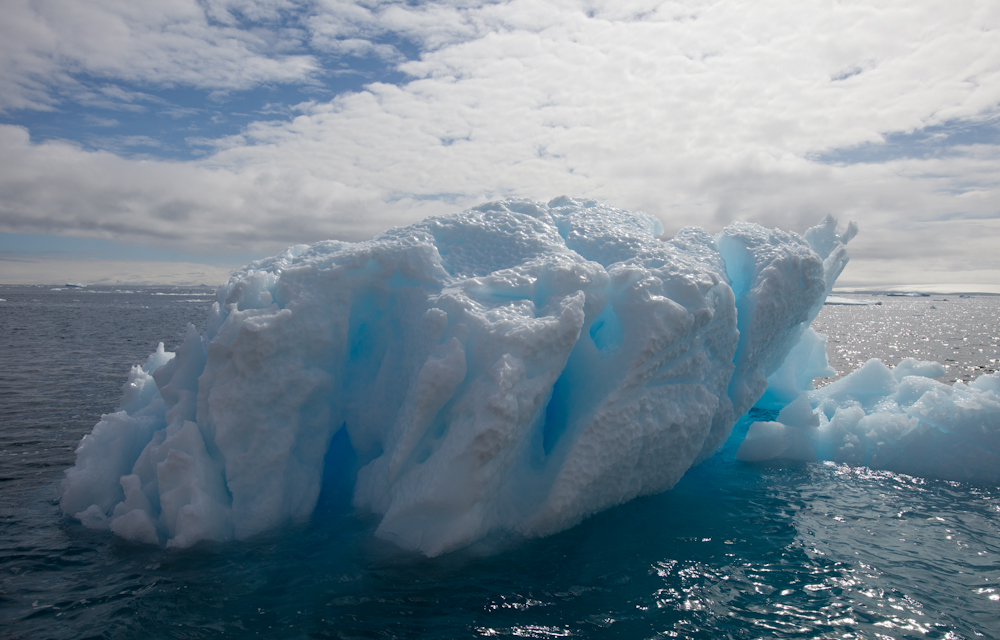
Icebergs were an integral part of the landscape now and I was simply mesmerized by their beauty.  We spent some time cruising in the zodiacs in the area known as “iceberg alley”.  I was envious of the kayakers who had the opportunity to paddle amongst these magnificent sculptures.

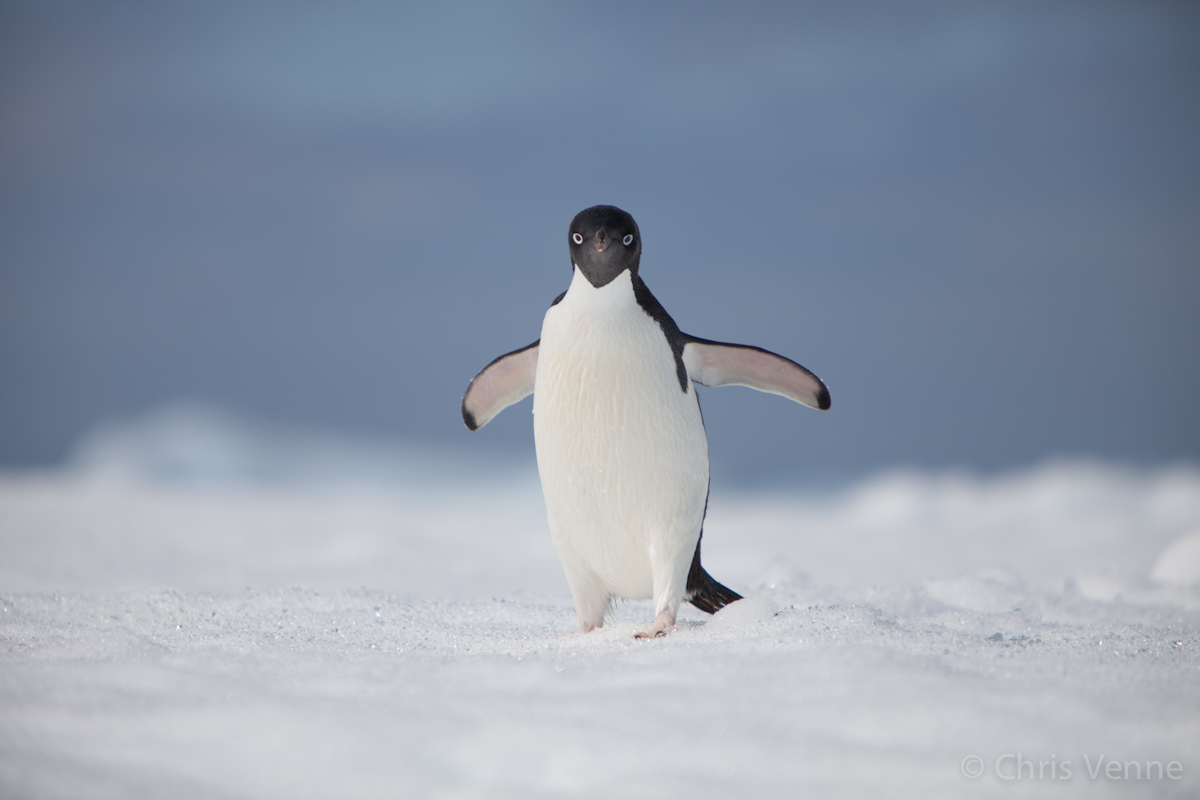
Adelie penguin on the ice.

The lovely pink hue of this ice berg is caused by penguin poop.

Survival of the fittest: this bird snatched a young adelie chick
and devoured it right before our eyes.

Later that same day, we landed on Devil Island which lies in a small bay southeast of Vega Island in the Weddell Sea.  This island is long and narrow with two peaks which appear as horns, offering exceptional views on a clear day.  As luck would have it, we arrived on a sunny, warm day – perfect conditions for the challenging hike to the peak.  At the top, we were richly rewarded with views of Cape Well-Met on neighbouring Vega Island.  I found a quiet spot on the mountain ridge and soaked up the view for as long as I could, long after everybody else had descended.  This was one of those tranquil moments on this trip where I could enjoy some rare solitude and simply absorb the serenity and beauty surrounding me.

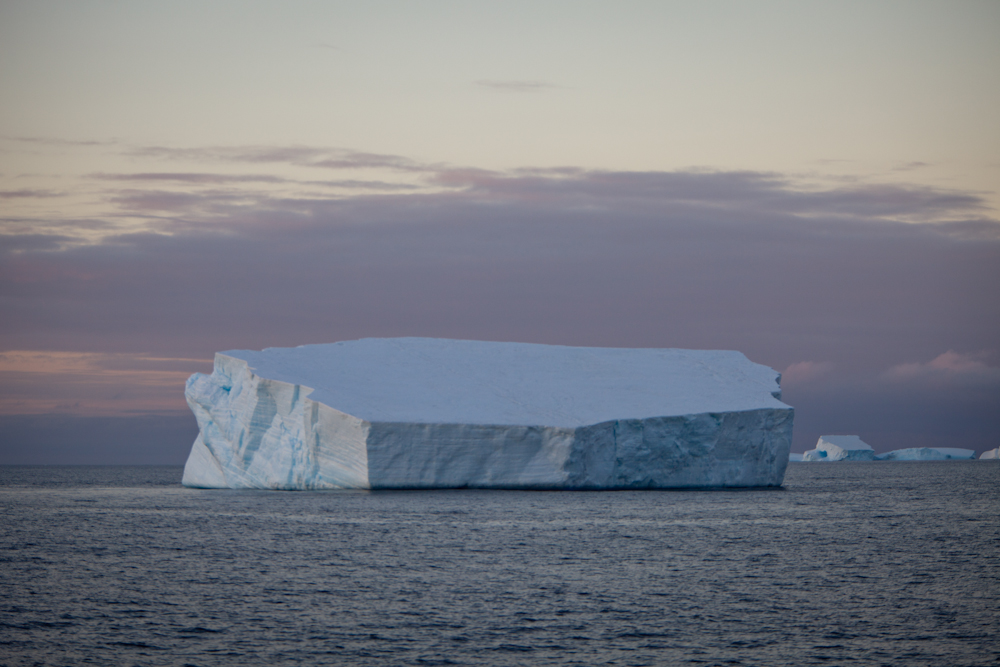
On the way to Devil Island, the shelf iceberg in the
background was the largest iceberg we saw,
easily measuring three times the length of our ship. 

Video: Heading straight for the biggest iceberg – shouldn’t we be turning??
 

Enjoying the solitude and the view from the top of Devil Island.

View from top of Devil Island.

Christina with Tricia amongst the penguins on Devil Island. Tricia was one
of my favourite people on board.  She was a feisty 72-year old
woman, travelling on her own, and she participated in everything
(including the polar plunge!)  with a fierce independence that inspired me.
She has travelled the world, about 110 countries at
last count, and she generously shared many travel tips.  

We were hanging out in the bar one night (did I mention we had an open bar for the entire duration of the trip?), when something caught our eye on the horizon in the fading light.  Whatever it was, it was swimming back and forth along side the ship with its huge head above water.  Turns out it was a southern right whale, skimming the surface using its baleen to sieve for krill.  It was such a strange sight to see and it really got the expedition guides excited as nobody had ever seen this behaviour before.

Video:  Southern right whale feeding
 

Finally – we landed on the coldest, driest and windiest continent – Antarctica! Our landing on the Antarctic Peninsula seemed somewhat anticlimactic after all the wondrous sights of the past two weeks.  We landed on Brown Bluff, an exposed section of a glacial volcano, which lies 14.5 km south of Hope Bay on the eastern side of the Tabarin Peninsula. We saw snow petrels and pintados nesting on the bluff face; adelie and gentoo penguin colonies littered the beach.  The chicks were inquisitive; if you were so inclined to sit on the beach, in no time one or more chicks would make their way over to check you out often snuggling right up to you as if you were their mother.

Landing on Brown Bluff – Antarctica!

A fellow “steerage” passenger, Andrew, striking a pose on Antarctica.

A zodiac excursion in Kinnes Cove, a small bay indenting the western end of Joinville Island just south of Madder Cliffs offered fantastic up close views of beautiful ice bergs.  Sure, we saw lots of penguins and plenty of Leopard and Weddell seals sleeping on the ice bergs, but it was the ice bergs that simply took my breath away.  The variation in size, formation, color, and texture was astonishing.  Some were larger than our ship! These natural beauties reminded me of the stunning ice sculptures meticulously carved out byinternational  teams of artists during the Winterlude festival in Ottawa in February each year.

Our final day of excursions brought us to Whaler’s Bay on Deception Island and Hannah Point on Livingston Island, both of which are part of the Shetland Islands.  Whaler’s Bay is actually located in the caldera of an active volcano.  Instructions were given should an eruption occur:  get back on the ship and leave immediately (really?   I would never have thought to do that!)  As its names suggests, this bay was once home to a thriving whaling station at the turn of the century, the remains of which are rusting away on the beach today.  While many walked around these old relics for the morning, I joined a small energetic group who hiked to the top of a ridge from which you could see Livingston Island on one side and the Antarctic Peninsula on the other.  We again enjoyed perfect weather conditions and great visibility.

View heading down towards Whaler’s Bay (left).

We could see the Antarctic Peninsula in the distance (behind me)
from this lookout.

Remains of the whaling station.

Buildings deteriorating over time.

View of the whaling station from the ship.

Hannah Point was teeming with wildlife: Chinstrap penguins (about 1,500 breeding pairs), gentoo penguins (about 1,000 breeding pairs), a couple of macaroni penguins, a variety of other birds (blue-eyed shags, snowy sheathbills, kelp gulls, pintados, skuas and southern giant petrols), and elephant seals.  We were captivated by the sight of a small Gentoo chick that had inadvertently walked on top of an elephant seal.  Interestingly, when at sea, elephant seals are predators to penguins but on land they all get along just fine.  Still, it was a little disturbing to watch this fluffy chick in such a precarious situation.  After quite some time, the chick walked along the seal’s body, onto its head and then hopped onto the sandy beach.  He somehow managed not to get swept away at sea and returned to the safety of higher ground.

 Elephant seals lounging around on the beach.

Hey, you don’t look like my mother!

Our final two days at sea were spent travelling through the notorious Drake Passage.  The seas did swell during this crossing, but it was tame compared to stories told by the crew.  Chris and I along with three other passengers from the “steerage” deck (our nickname for Deck 2 where our cabins were located), received invitations to sit at the Captain’s table for the final dinner.  I am still perplexed as to how and why the steerage gang received invitations, but we all accepted the honour and thoroughly enjoyed the experience.

Dinner at the Captain’s table on the last night at sea. 

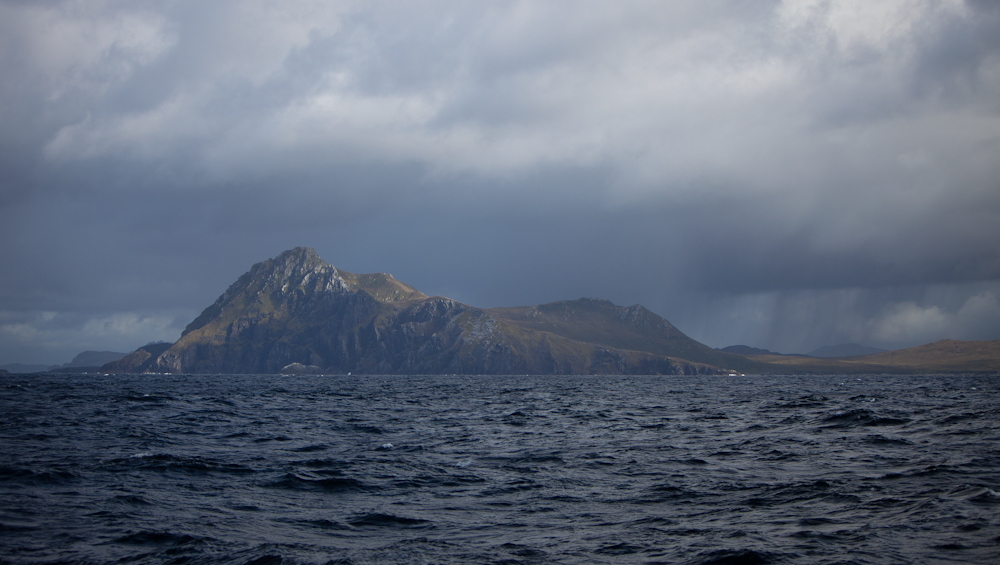
The final morning of our passage through the notorious Drake Passage brought us in sight of Cape Horn, the southernmost tip of South America.  Our captain had navigated the ship somewhat off course to avoid several storms thus taking us into the Pacific Ocean off the south west coast of Chile.  We then turned east and headed towards the Beagle Channel.  The Drake Passage is dreaded by most travellers as it has a reputation for severe weather and corresponding seas.  For the most part, the seas were relatively calm during our voyage through the Drake.  Aside from some swells during one night, and some small pockets of precipitation when we neared Cape Horn , it was clear sailing all the way back to Ushuaia!

Cape Horn,  the southern most point in Chile, South America

Patagonia here we come

At the end of our Antarctica cruise last Wednesday, we flew to El Calafate because this was the fastest, most direct way to get to Puerto Natales which is where we would get ourselves organized for our big trek in Torres del Paine.  We were pretty tired after our cruise and needed a few days to just chill and get caught up on our blog.

We spent four nights at Hosteria Patagonia which was the most inhospitable accommodations we have endured thus far.  The establishment was quite new and the rooms were spacious and comfortable enough, and the place was absolutely spotless (just trying to be fair). The problem was in the way they ran the place – more like a prison camp than a hostel – rules for everything, such as forbidden to open the fridge without authorization.  I was chastised repeatedly (in Spanish of course) for all my transgressions – going into the kitchen to clean my dirty dishes (I know, the nerve of me), for putting a sweater on a railing to dry, for using the microwave without permission, etc. etc.  Ah well, the town was booked solid, so moving wasn’t an option.  We sucked it up, what else can you do?

Hosteria Patagonia looked good on the outside,
and even the inside too; too bad it was so unwelcoming.
Notice the two beautiful lavender bushes in front of me –
lavender grows prolifically here in this inhospitable climate. 

During the four days we spent in El Calafate we did a couple of interesting activities, namely, a “mini trekking” tour to Perito Moreno Glacier and a visit to the recently opened Glaciarium, a museum about glaciers.  We just couldn’t resist visiting the world’s largest reserve of fresh water!

The mini-trekking tour included transportation to Perito Moreno Glacier which is located in Los Glaciares National Park. We learned that this was one of a very few number of glaciers in the world that maintained its size over the years – it extends and contracts but remains a fairly constant size. The terminus of the Perito Moreno Glacier is 5 kilometres (3 mi) wide, with an average height of 74 m (240 ft) above the surface of the water of Lake Argentino. It has a total ice depth of 170 metres (558 ft).  This glacier is renowned for the rupture that occurs every few years.  It is due for another rupture at any time.  Click here if you’re curious about what the rupture is all about.

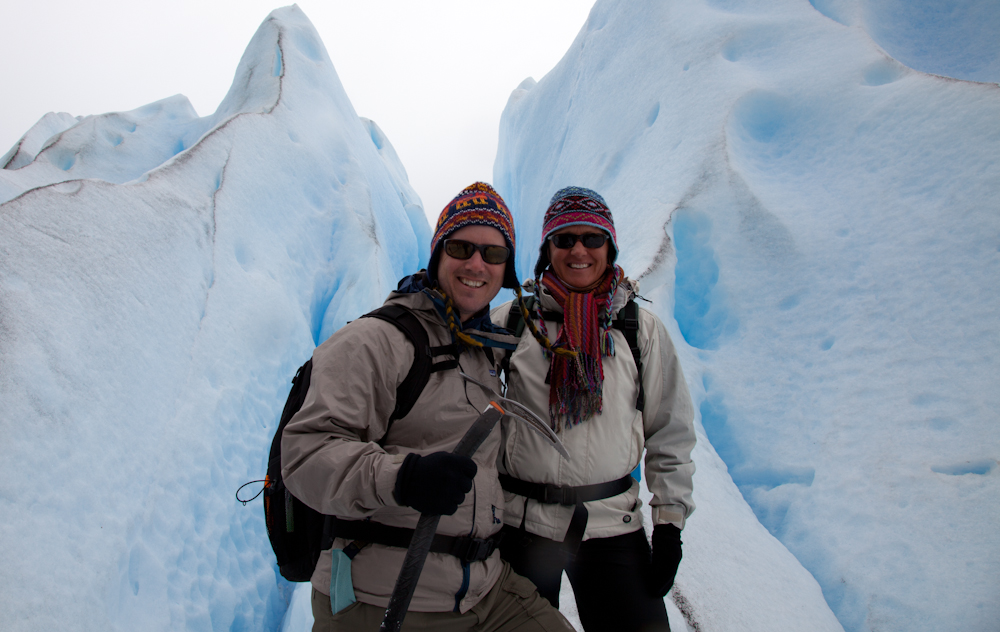
In the morning we walked along the walkways to observe the north end of the glacier. Every now and then we would hear an explosion as the glacier calved and huge chunks of ice cascaded to the lake below.  In the afternoon, we took a boat ride along the south face and then, after lunch, hiked with crampons for a couple of hours on the glacier itself. We continued to hear the glacier and see it calve several more times.  It was an amazing experience.

(Coming Soon) Video:  Walking on a glacier with crampons.

The Glaciarium Museum was very modern and the exhibits were well presented.  Since all exhibits and videos were offered in both Spanish and English, we learned a lot more about glaciers during the couple of hours we spent there. Located in an open field a few kilometres outside of town, the building rattled and shook under the force of the Patagonian wind – I thought the whole thing was sure to collapse at any moment.

We arrived in Puerto Natales on Sunday afternoon by bus, passing through the Argentina/Chile border once again without any problems.  We lucked in on our accommodations this time; a lovely B&B called Pire Mapu Cottage.  It is a little two bedroom guest house with two bathrooms, common kitchen and living area.  The owner, Brendon (an ex-Brit) and his wife, Fabiana (who is Chilean), have completely and lovingly renovated this house and just opened it up for business this season.  It is a charming home, with so much attention to detail that you feel like you’re visiting a friend’s cottage.  They have thought of everything to make their guests feel comfortable and at home, such as a well equipped kitchen, flat screen tv’s (with english stations) hanging on the walls of each bedroom, the fluffiest towels in South America, home baked cookies and tea to greet you. I could go on and on.  As soon as we stepped into the house, we booked a third night on the spot.  And we were tempted to stay even longer.

The service they offer is impeccable.  They picked us up at the bus station and bent over backwards making sure all our needs were taken care of throughout our three night stay.  For example, when Chris asked where he could find a barber in town, they insisted on driving us to the hair salon and Fabiana served as translator to explain the new hairdo Chris wanted.  I think he looks awfully cute in his new “do”.

Our cottage mates on the first night were a couple of ladies from the US (Deb and Lisa) who were heading out early in the morning to go trekking in Torres del Paine for two nights.  We really hit it off with them and decided to collaborate on dinner that night.  Well, actually they did all the grocery shopping and pretty much most of the cooking; Chris did the clean up.  I didn’t do a heck of a lot, but nobody seemed to mind.  We had a wonderful meal – those girls know how to cook – and great conversation over three bottles of Chilean wine.  We talked into the wee hours of the morning.  They were so relaxed about their trek; this was their fourth week of trekking in various parts of Patagonia so I guess they were pretty organized (unlike us).

Breaking bread (and drinking wine) with new friends.

The next night we had the cottage to ourselves, with the owners popping in now and then to check if we needed anything.  One more comment about the cottage – they served one of the best breakfasts we’ve enjoyed thus far in South America.  Home made bread, eggs, ham, cheese, juice, two types of brewed coffee, and toast.  It kept us going til late in the afternoon.

Typical breakfast at Pire Mapu with the
hosts at work in the kitchen behind me.

We have spent the last couple of days still working on the blog (I hate it when we get behind because it is so much work to get caught up) and getting ourselves organized for our big trek.  We have decided to do the “Circuit” which is an 8-day trek – on our own, no guide or group.  Not only did we not have any camping equipment with us, we have never done this kind of camping before.  We’ve camped a lot, but always car camping.  I have to admit, I’m a little nervous – especially with a very bad weather forecast for the next few days (blizzards and very high winds – yikes!).  I’m most perplexed about the food we need to bring.  With regards to the camping equipment, we had planned on renting it all here in town until we ran into a couple of Finnish lads who were selling all of their equipment on a street corner. They had bought it all two weeks earlier in Ushuaia and were now finished with their camping trip.  We bought the whole kit and caboodle – tent, sleeping bags and sleeping mats – for $100.  All we needed was the kitchen equipment. Now we’ll be able to do a couple of more hiking/camping trips in El Chalten and Bariloche before heading to Buenos Aires – that assumes, of course, we survive this one.

Busy blogging, and organizing the trek,
while enjoying home made beef stew.

This afternoon we heard the weather forecast for the next few days:  Bad.  Very bad.  And late this afternoon guess who showed up at the cottage?  Deb and Lisa returned one day early because the weather was so bad.  So who knows, we may be back sooner than we planned.

Optimistically, we’ll be off-line again for the next 8-9 days.  Wish us luck – I’m sure we’re going to need it!  Before I sign off, just a heads up that we’re almost finished Part 3 of the Antarctica post but I’m afraid we ran out of time and it will have to wait until we get back.  Chao!

Eight days of trekking food.
It was a challenge finding the right food for a trek here
so you just had to be creative when you don’t find things
like protein bars or healthy granola bars.  Chris loved
the improvisation with the snickers bars 🙂 


Antarctica Cruise: Part 2 – South Georgia Island

After two days at sea travelling through unbelievably calm waters with low winds, the Island of South Georgia came into view.  We spent a total of four days exploring this icy paradise, home to millions of sea and land birds, penguins, and seals. History came alive as we walked in the footsteps of explorers of the past.

We were blessed with consistently good weather during these four days allowing us to enjoy two daily excursions.  It is common for ships to be limited to only one or two excursions in total because of inclement weather such as high winds, large sea swells, or blizzards.  Kayaking in South Georgia is rare; yet our group enjoyed two kayaking excursions!  In case you were wondering, we did not kayak during this trip.

The kayaking group was limited to 16 people and all the spots were filled by the time we bought our tickets. There was one cancellation and Chris and I discussed whether or not one of us should go for it. Since we both wanted to do it, and we would both be very jealous if the other one did it, we decided for the sake of marital harmony we would both decline.

Before stepping foot onto South Georgia, all passengers were required to follow stringent biosecurity procedures designed to ensure we did not inadvertently transfer plant life from one location to the next.  We attended vacuum stations where our packs and outer clothing were scrutinized and vigorously cleaned.  Every time we left the boat, we walked through a disinfecting solution and every time we returned to the boat we were required to scrub out boots and lower pants as well as any equipment that may have touched the ground such as tripods or walking poles.

Here’s a brief summary of some of the memorable moments and highlights of the places we visited on South Georgia.

By zodiac, we cruised the calm waters in the Bay of Elsehul, on the northwestern extremity of South Georgia, and were rewarded with terrific views of three species of albatross birds (black-browed, grey-headed, and light-mantled sooty), three species of penguins (king, macaroni, and gentoo), as well as blue-eyed shags, several species of petrels (including giant, cape and lesser snow), prions, southern elephant seals and fur seals. The haunting wails and piercing cries of the medley of wildlife formed a symphony of sounds that will forever be in my memory.

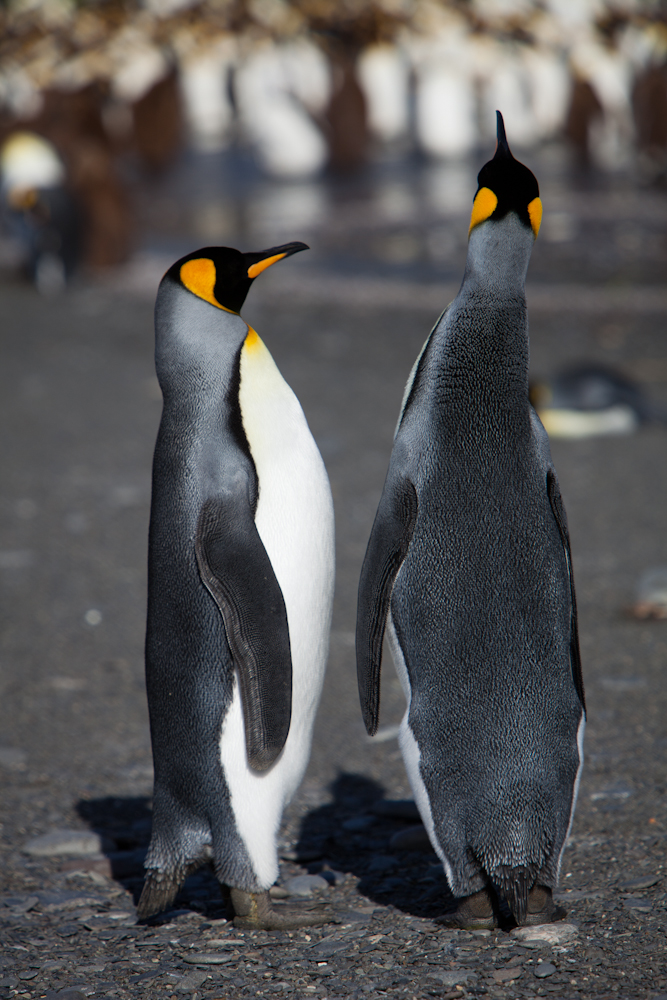
Our first sighting of king penguins – what a thrill!
And look at all those fur seals.

On the beach: elephant seals, fur seals, king, macaroni and gentoo penguins.

Video:  Nature’s symphony

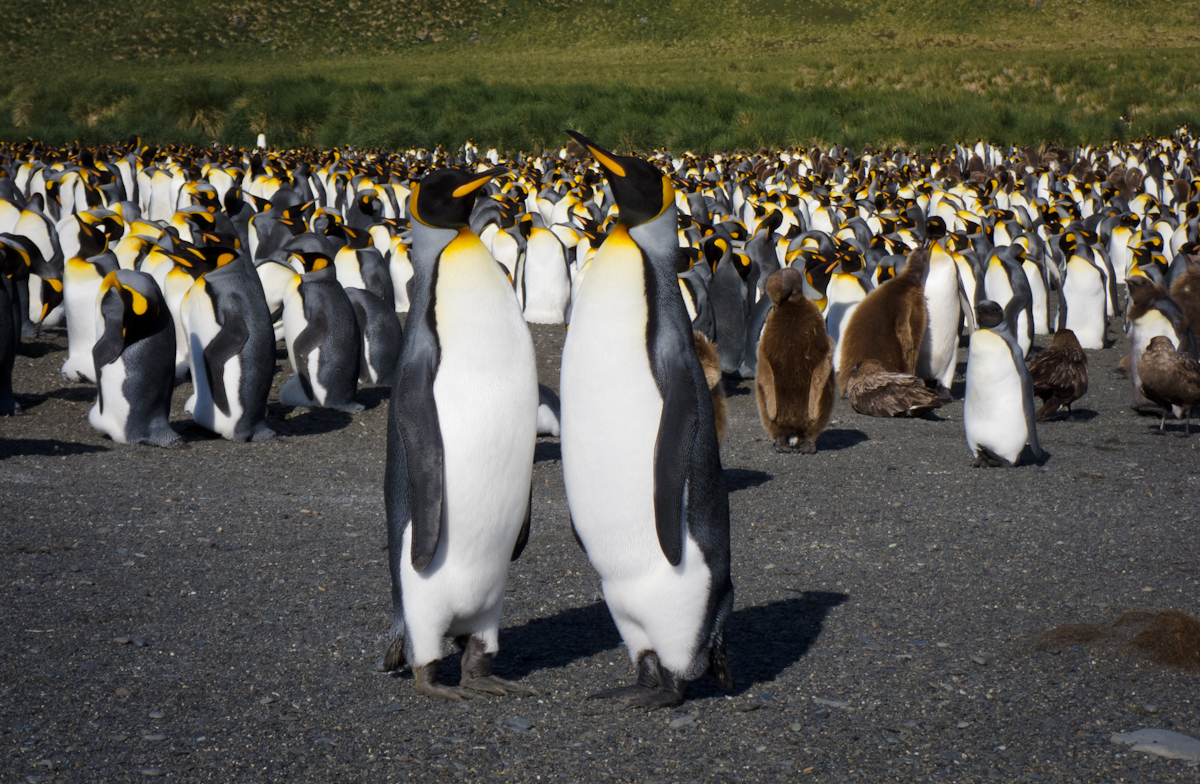
Salisbury Plain, on the southern shore of the Bay of Isles, 50 km from the western tip of South Georgia is home to the second largest king penguin colony on the island with an estimated 60,000 breeding pairs that swells to about 250,000 individual penguins during the molt.  This location marked our second excursion and our first real introduction to king penguins, certainly on such a massive scale.  Immediately upon landing, there were king penguins as far as the eye could see.  In the distance the full colony stood in all its glory.

But first, we had to manoeuver our way through vast groups of fur seals who were not always happy to see us.  The pups were absolutely adorable, inquisitive, friendly and very playful, and entertained us to no end.  In contrast, the male fur seals were very territorial and could be vicious and quite aggressive; we were chased more than once if we happened to unwittingly venture into a male fur seal’s domain.

Video:  All the action on Salisbury Plain

The sight and sounds and yes, even the smell of so many king penguins in one location was thrilling and awe inspiring.  But nothing compared to the experience of sitting quietly on the ground and having a small group of penguins come up to check you out, often pecking at your boots or your pants.  These wondrous creatures exhibited no fear of humans, but seemed to be as curious about us as we were of them.

Video:  Chris bonding with the chicks.

Chicks marched about in search for their mother, squawking incessantly as if to say: I’m hungry, I’m hungry, I want my mommy now.   And the mothers (or fathers for that matter as both are responsible for the chick) once found (a seemingly miraculous feat in and of itself), seemed quite unaffected by their chick’s plaintiff cries, often walking around for some time, with their little chick trailing behind squawking at the top of their lungs.   She would feed her chick in due time, when she was ready and not a moment sooner.  We learned later that this behaviour served an important purpose; as the chick chased after its parent for food, it’s wings and legs were strengthened, preparing it for life at sea.

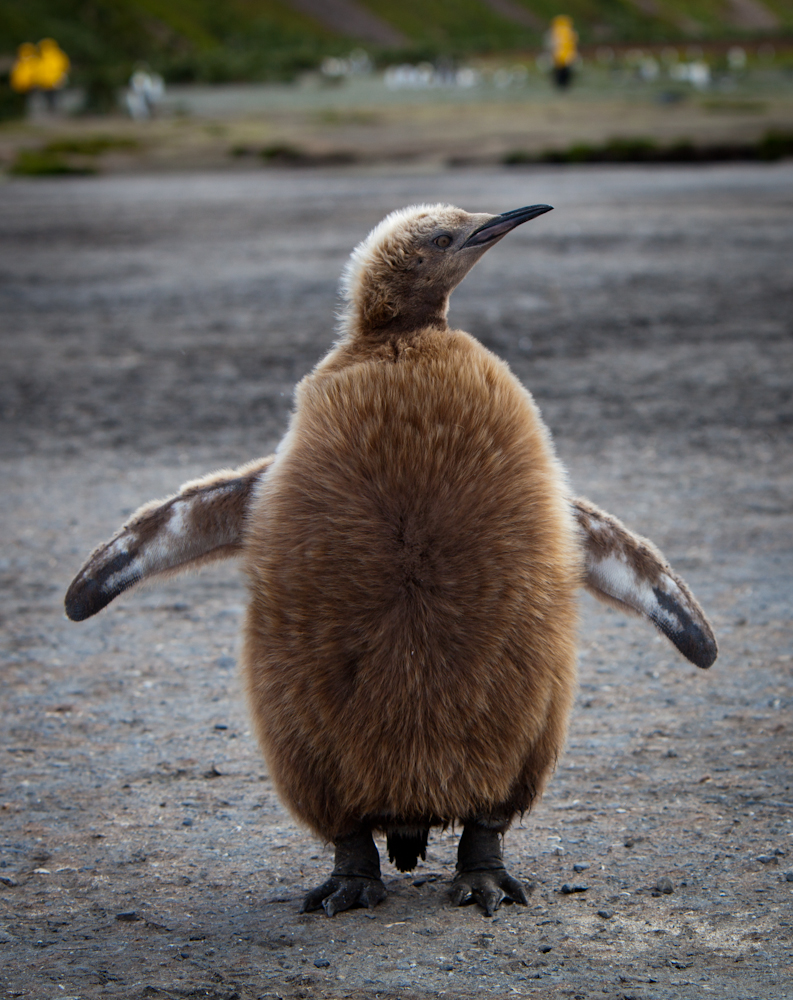
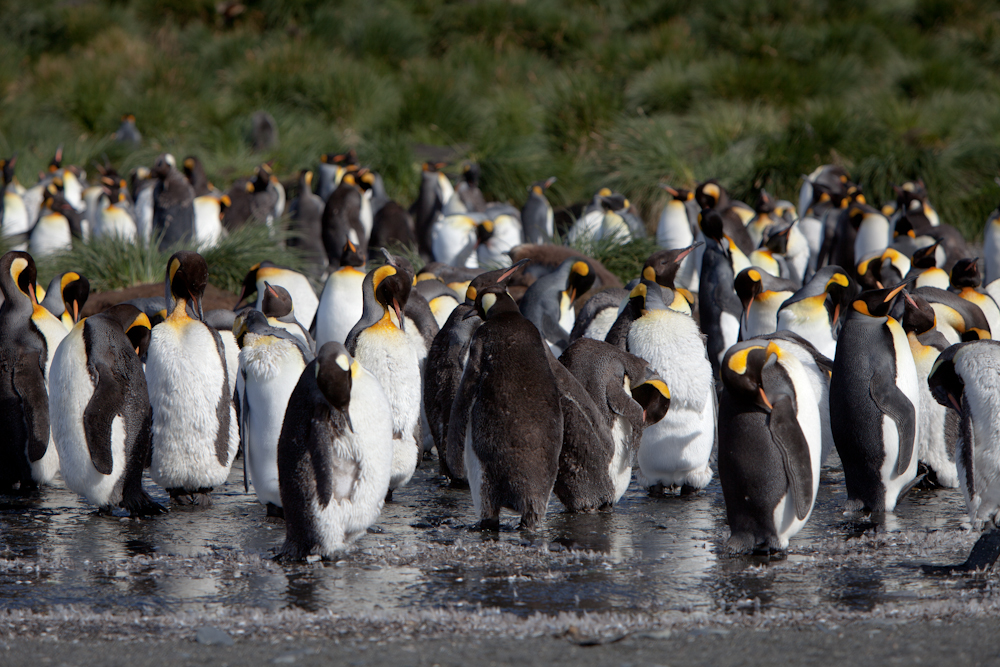
The colony was going through the molting period where they shed their feathers and replace them with new ones.  Molting occurs once each year, usually after the breeding season.  This is an essential function because feathers wear out during the year; they become worn out when penguins rub against each other, come in contact with the ground and water, and regularly preen (clean, rearrange, and oil) their feathers.  The new feather grows under the old one, pushing it out. The old feather does not fall out until the new one is completely in place. The molt is patchy and can give individual penguins a scruffy look.  During the molt, feathers lose some of their insulating and waterproofing capabilities, and penguins stay out of the water until their plumage is restored to optimum condition.  Because penguins don’t enter the water to feed during a molt, they fast. Before their molt, they build a fat layer, which provides energy until the molt is over.   The younger chicks looked cute and adorable cloaked in fluffy brown feathers like a fur coat, but the older chicks and juveniles looked downright ugly.  Lucky for us, the colony had swollen in size because of the molting period. 

Prion Island is a site of high environmental sensitivity and exceptional conservation value as it is one of a few rat-free tussac islands remaining along the rat-infested South Georgia coastline.  Rats were inadvertently introduced hundreds of years ago and surprisingly have thrived in this harsh climate.  They are a huge threat to bird populations.  South Georgia Heritage Trust is a non-profit organization involved in many projects on the island, including an ambitious rat eradication program, that if successful will result in a restoration of bird populations by 10-100% in coming years.

South Georgia Pipit

This was the site of our third excursion.  Following a slippery boardwalk through the tall tussac grass, mindful of the many fur seals in our path, we reached the breeding site of the wandering albatross and were delighted to see several beauties sitting on their nests close by.  One bird opened its expansive wings giving us the opportunity to admire the beautiful 3-4 m wing span up close.  These birds are huge and it is rare to see them in such close proximity.  We also saw our first endemic South Georgia pipit which looked much like a sparrow.  The pipit is the Antarctic’s only song bird, and South Georgia’s only passerine, and one of the few non-seabirds of the region.  While this bird didn’t really look all that special, it is threatened mainly because of the high rat population.  So it isn’t surprising that the South Georgia Heritage Trust chose this little bird as their poster bird in their campaign to eradicate rats.

The Wandering Albatross has the largest wingspan of any
living bird,  averaging from 2.51–3.50 m (8.2–11.5 ft),
with a mean span of 3.1 m (10 ft) in one colony.

Fur seals amidst the tusac grass bordering the boardwalk.

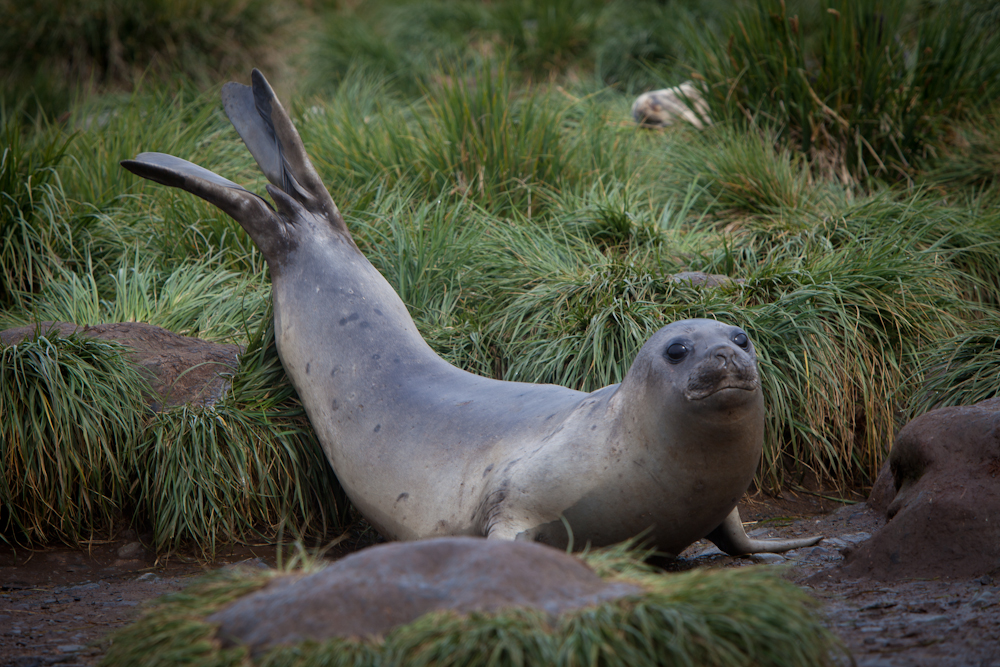
A young elephant seal on the beach.

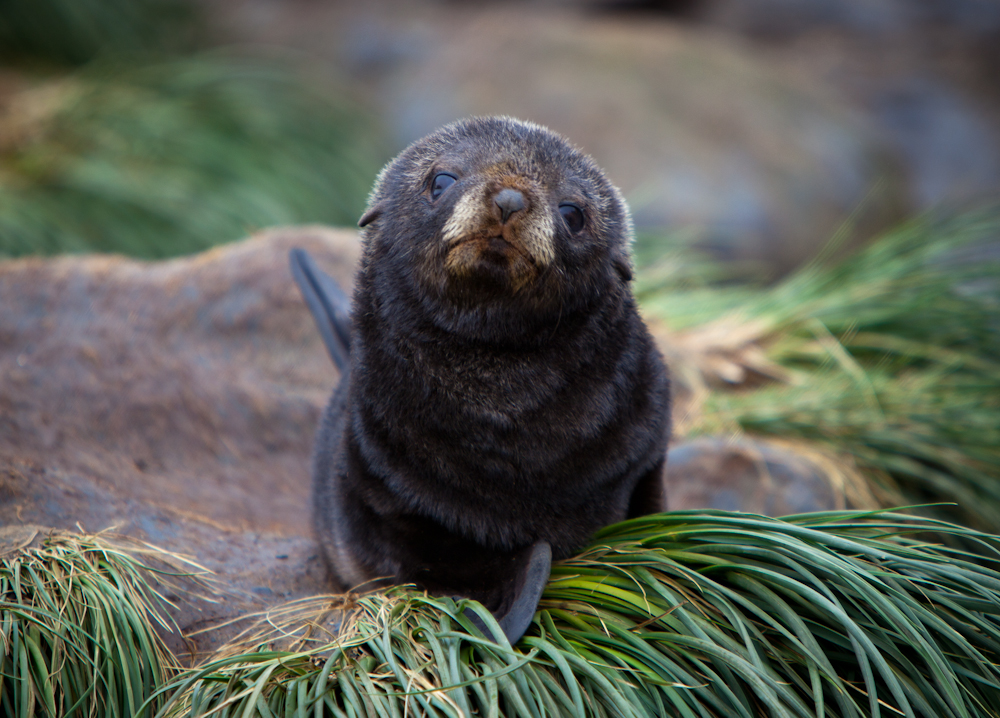
Fur seal pup – isn’t he a cutie!

A zodiac cruise around Hercules Bay, located 2.5 km northwest of Cape Saunders, offered spectacular views of the towering cliffs that encircled this miniature fjord.  The kayakers had the opportunity to explore the bay at a more leisurely pace.  We saw plenty of macaroni penguins along the rocks that hugged the base of the cliffs and fur seals and elephant seals covered the beach.  But no reindeers were to be seen that afternoon.

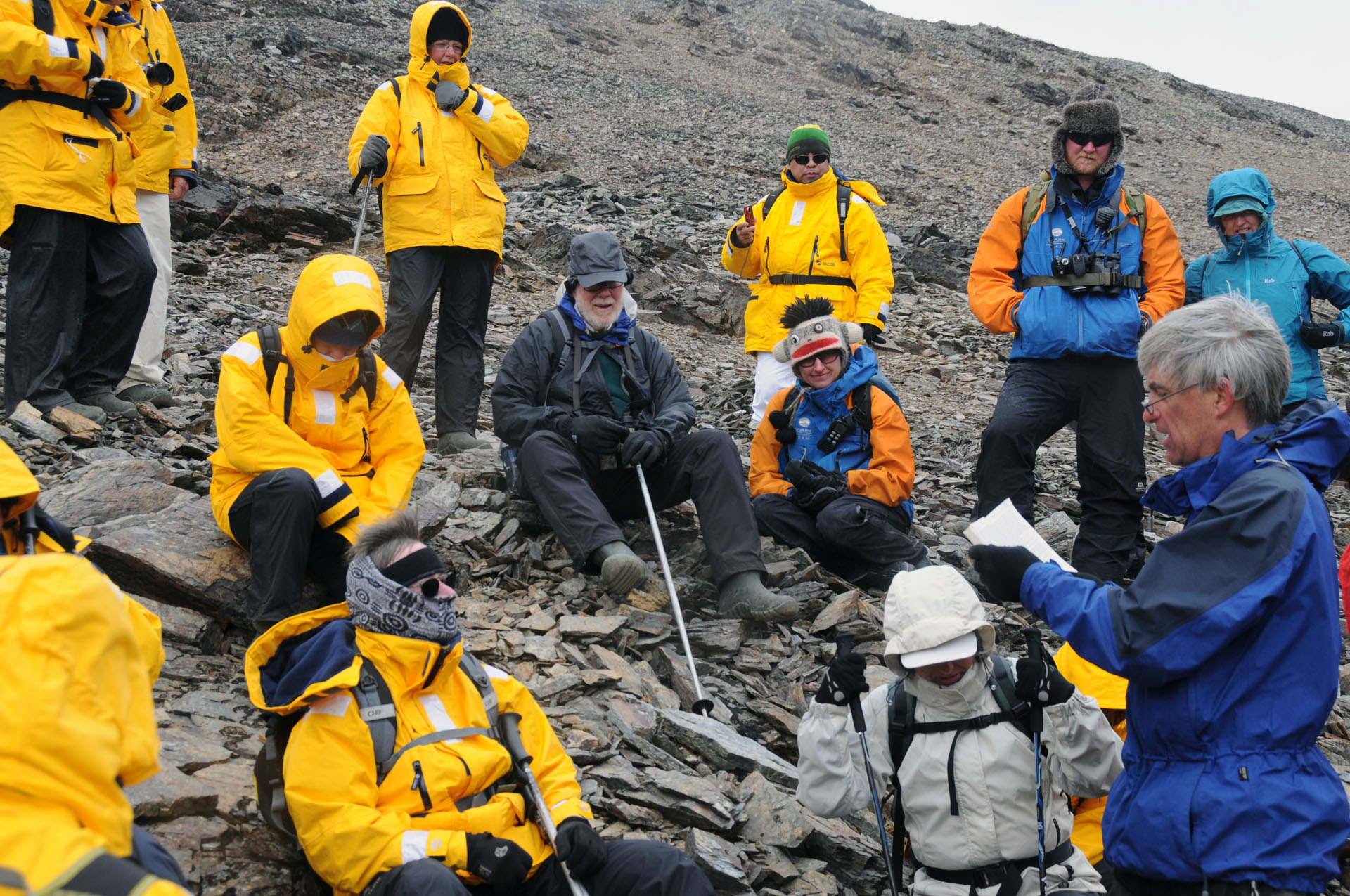
Our visit to Stromness, an old whaling station, began at Fortuna Bay.  As we hiked 5.5 km to Stromness, we paused now and then to listen to Damien our historian, read passages describing the historical crossing by Sir Ernest Shackleton and his small team in 1915.

For those of you not familiar with this piece of history, this is basically what happened. Shackleton and his crew were on their way to Vahsel Bay where they were going to attempt the first ever land crossing of Antarctica,  an epic transcontinental voyage through the South Pole.  His ship, Endurance, became stuck in the ice and eventually sank by the crushing ice.  Shackleton and his men spent months in makeshift camps on the drifting ice, until they were able to reach the inhospitable, uninhabited Elephant Island by lifeboats (we visited this location later on).  Shackleton and five of his men travelled 800 miles to South Georgia in a small vessel (the replica was in the South Georgia Museum in Grytviken) where they landed at Fortuna Bay.  We sailed these same seas and I have no idea how Shackleton found South Georgia, let alone Fortuna Bay – it would have been like searching for the proverbial needle in a hay stack. Once they landed at Fortuna Bay, cold, tired, and starving, they then traversed the frozen land (it was winter) and found their way to Stromness.  From here they mounted a rescue party and went back to rescue the men waiting on Elephant Island without a single loss of life.

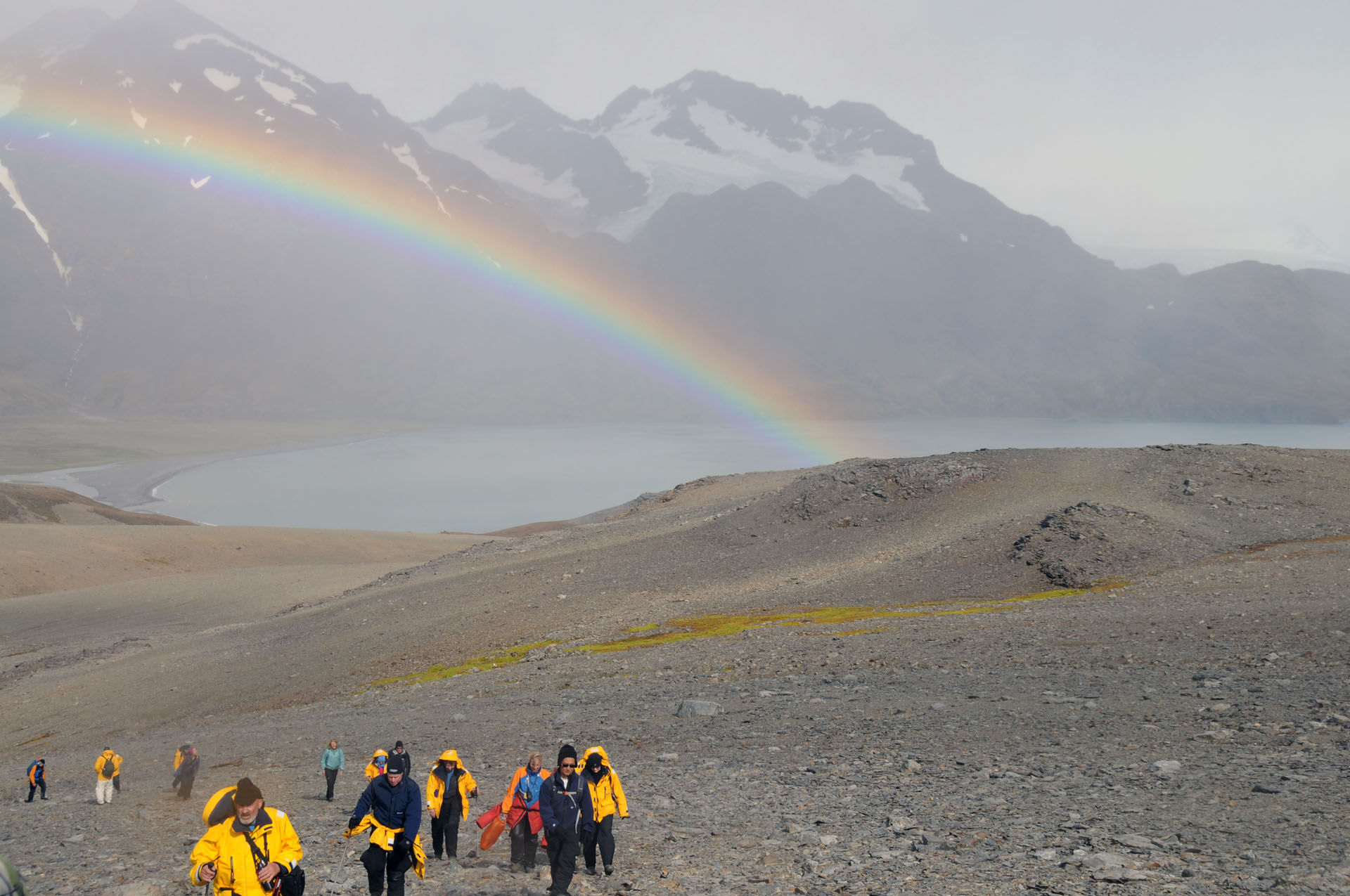
Rainbow over Fortuna Bay

As we made our way up to the mountain pass through which we would get to Stromness, a perfect rainbow arched over our ship in the bay. At the top, the fierce wind was was strong enough to knock you down.  Approaching Stromness, an old whaling station, we saw our first herd of reindeer, which had been introduced at the turn of the 20th century as game for hunting.  The reindeer are considered a nuisance and will also be eradicated as part of the rat eradication program described earlier.

Where’s Chris and Chris?

Christina (right) and fellow passenger, Gail, lagging behind
the group as we head for the mountain pass. 

Hiking the rather steep path down into Stromness.

The remains of Stromness whaling station are now home
to a myriad of wildlife: king penguins, fur seals,
elephant seals, and a large variety of birds. 

It was a warm day for the hike, so I wisely decided to
wear lighter clothing rather than the yellow, Quark-issued
parka, which, by the way, was ours to keep.

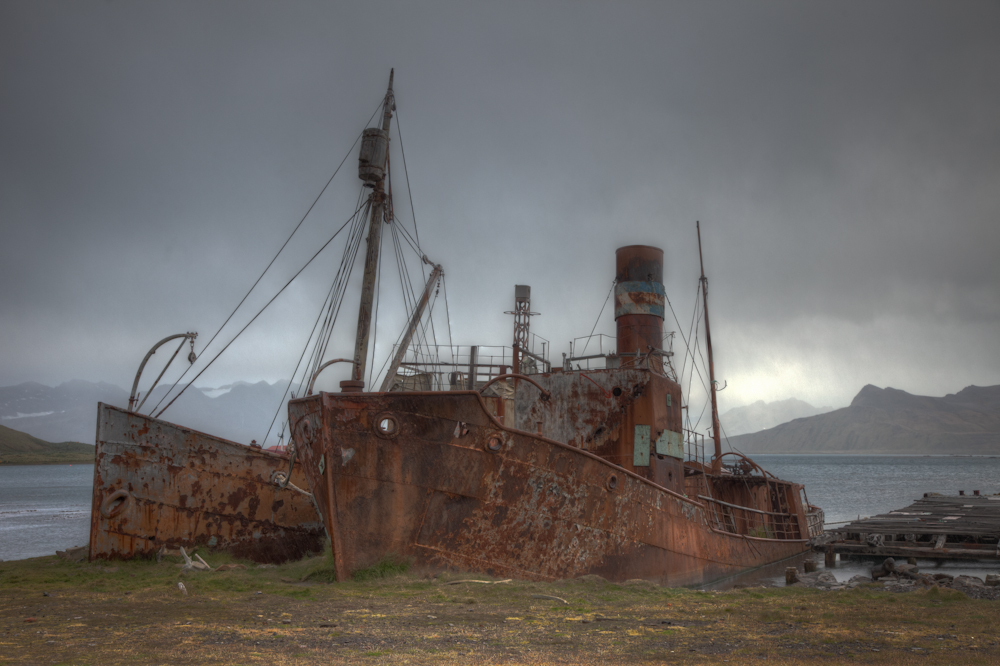
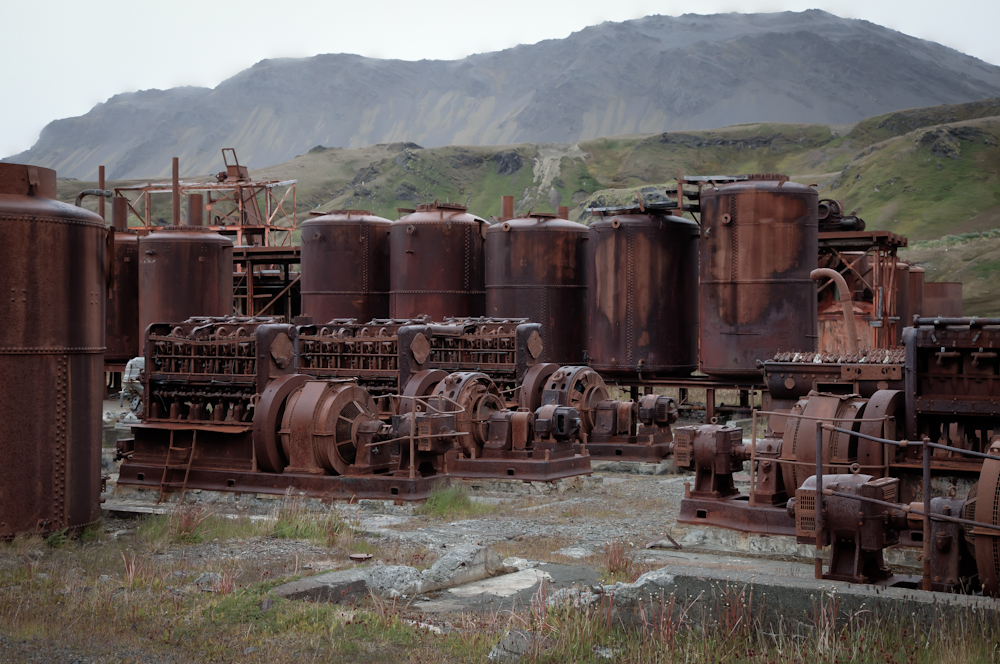
Grytviken is home today to a small research centre, a museum and it serves as the UK administrative centre for South Georgia and the South Sandwich Islands.  But ghostly remnants of the past are visible everywhere. This was the location of a large whaling station which operated from 1904 to 1966.  Today, all that remains are the rusted out remnants of the equipment and buildings as well as a few shipwrecks in the bay.  At its peak, the size of operations was surprisingly (at least to me) large; sadly, it was hugely successful, with 195 whales taken in the first season alone. The whaling industry of South Georgia grossly overexploited stocks and had cruel methods of killing. According to the South Georgia Heritage Trust, in the whole of the Antarctica region some 1,432,862 animals were taken between 1904 and 1978, when hunting of the larger species ceased. Probably the largest whale ever recorded was taken at South Georgia; it was a blue whale processed at Grytviken in about 1912, with a length of 33.58 meters.

South Georgia Museum in Grytviken

The South Georgia Museum at Grytviken offered a glimpse into the past with displays covering a variety of subject areas such as the discovery of the island, the sealing industry, maritime and natural history, as well as the 1982 Falklands War.

Dahlia (from Toronto) is standing below
a wandering albatross at the entrance of the museum.

Shackleton’s grave is found in the cemetery at Grytviken.  On November 27, 2011, the ashes of Frank Wild who was Shackleton’s “right hand man” were interred on the right hand side of Shackleton’s grave. We paid our respects and homage to these courageous explorers of the past with a toast at their graveside.

Shackleton’s grave

Engraved on the back of Shackleton’s grave,
is a quote by Robert Browning:
“I hold that a man strive to the uttermost
for his life’s set prize.” 

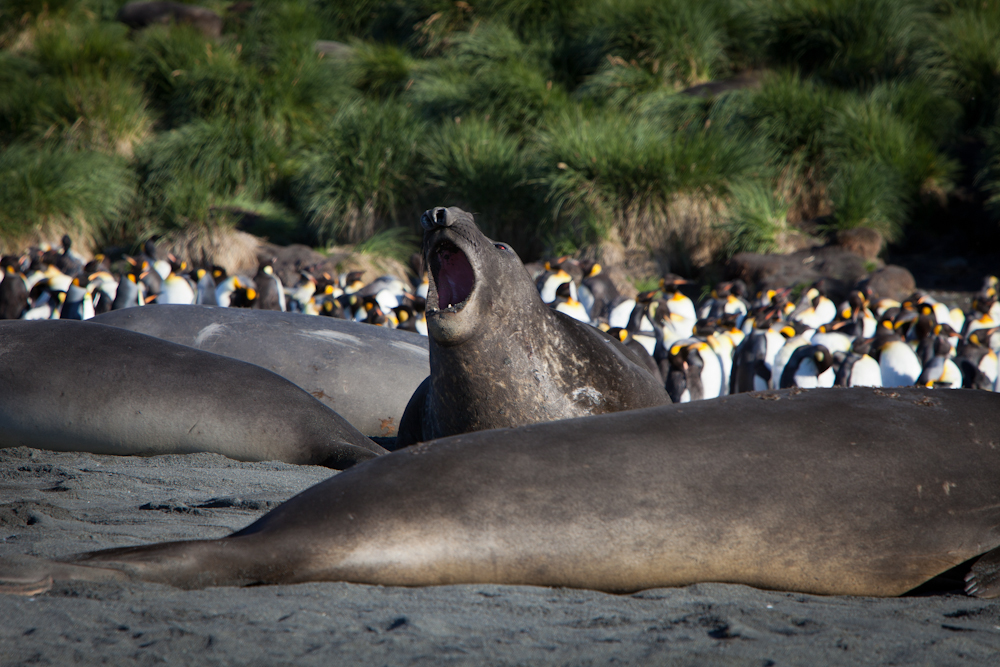
On our final day in South Georgia, we awoke to brilliant sunny skies and calm seas which made our trip to Gold Harbour all the more memorable.  We visited another colony of king penguins – about 25,000 breeding pairs in total, and a much smaller colony of Gentoo penguins – about 300 breeding pairs in total.  Elephant seals dominated the beach landscape.  These huge, blubbery animals were quite a sight to observe.  It took an enormous amount of energy for them to move their bodies a few feet before they would collapse in seeming exhaustion.  Similarly, they sparred vigorously and often violently with one another for a few minutes, only to suddenly collapse onto the sand unable to sustain their effort any longer.  It was actually quite comical to observe.

Fur seal tangled in a blue fishing net. Our guides tried to get the
net off the seal, but didn’t succeed; the little guy
kept running away frantically.

 Elephant seals on the beach with king penguins in the background.

Molting king penguins.

Molting king penguin up close.

Video:  Elephant seals sparring
 

Southern giant petrols patrolled the beaches in search of feeding opportunities. One such opportunity presented itself as a king penguin inadvertently exposed her egg allowing a quick thinking and quick moving petrol to swoop in and knock the egg away from its mother before proceeding to crack open the egg and eat the contents.

King penguin checking its egg.  

I found it interesting how we humans seem to be emotionally attached to the penguin and not sympathetic at all to the needs of the petrol.  He has to eat too, you know.

As the day progressed the weather deteriorated raising concerns that we might miss our final excursion planned at Cooper Bay, located at the southeast extremity of South Georgia.  Luckily we were able to visit this location, both on land and via zodiac cruise, affording us a rare close up view of a macaroni penguin colony, as well as the chinstrap penguin, so named because of a thin black line below its chin.  The kayakers were even able to get out for a second time to explore the rocky shoreline.  The color and formations of the rocky cliffs were outstandingly beautiful.


Macaroni penguin

Chinstrap penguin

We caught our first glimpse of ice bergs just before we left South Georgia as our ship entered the Drygalski Fjord which was shrouded in mist and low lying fog.  A sudden blizzard added to the mysterious landscape.  We lamented the poor visibility that prevented us from seeing majestic glaciers and ice capped mountains, shadows of which we could detect beyond the fog.  Just as we reached the end of the fjord, miraculously the fog lifted to reveal the true beauty of the fjord.  This was a taste of what was to come.

Drygalski Fjord

Antarctica Cruise: Part 1 – Falkland Islands

We were an unusual sight as we boarded the Sea Spirit with our packs on our backs, without a doubt the only backpackers amongst this well-heeled crowd.  We settled into our suite – yes, we had a beautiful suite that included a bedroom area with a king bed, dresser and two portholes, a living room area with couch, chair, television, and of course a private bathroom  – this was a luxurious amount of space compared to hostel living! A welcoming cocktail in the bar on the upper deck gave us our first opportunity to meet some of our fellow travellers.  It would take a while to meet each of the 100 or so passengers and even longer to remember everybody’s names but we had plenty of time, almost three weeks at sea.   We pushed off around 6:30 pm under sunny skies and with calm seas along the Beagle Channel, an omen of the weather to come.

Our first port of call was the Falkland Islands.  I knew little about these islands other than a faint recollection of the war that occurred in the early 80’s.  Luckily for me, it would take a day at sea to reach the Falklands and this time was spent listening to several lectures about the history, geology, and zoology of these fascinating islands.  Time was also spent doing the mandatory safety drill as well as a zodiac briefing.

Our first day at sea went something like this:  breakfast, lecture, snack, lecture, lunch, lecture, snack, cocktails at the open bar, zodiac briefing, dinner and more drinks.  By the end of the day, we were exhausted!  This would become our routine, more or less during the days at sea.

We spent two days on the Falkland Islands; one day visiting New Island and Carcass Island and the second day in Port Stanley.

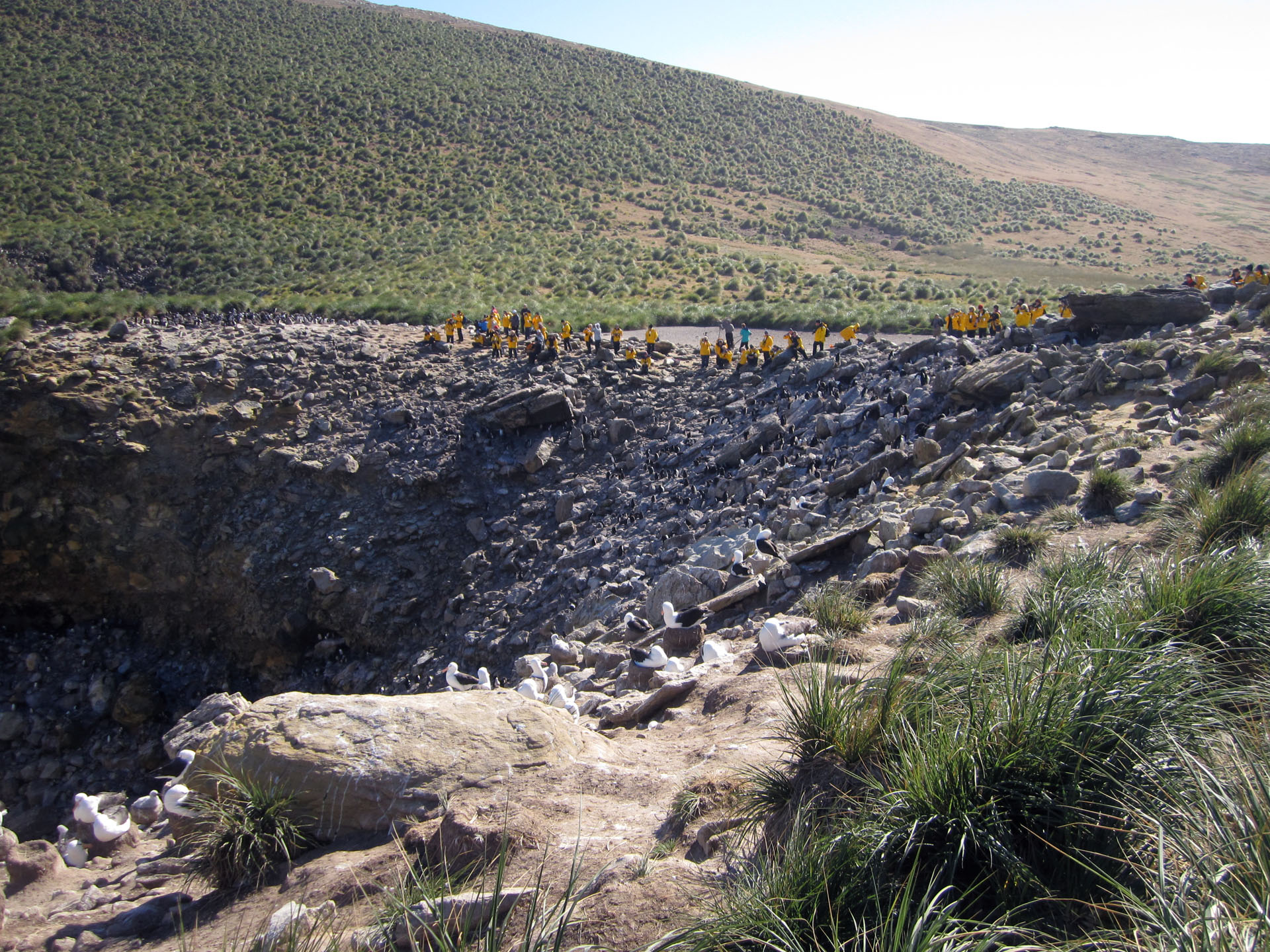
New Island, located on the western side of the Falkland Islands, was our first stop.  A kilometre long stroll inland led us to a thriving rock hopper penguin rookery. The rock hopper penguin is easily recognizable by the long, wispy, yellow feathers above their eyes and the crew cut on the top of their head. It is smaller than the Magellanic penguin, and their habits seemed quite different; for instance, the Rock Hopper chicks congregated together away from the adults, rather than clinging to their parents as the Magellanic chicks did.  It was remarkable to observe the rock hopper penguins, cormorants, and black-browed Albatross and their chicks co-habiting in peaceful harmony.  Now and then a predator such as a blue eyed shag, would swoop down and threaten to snatch a young chick.  All were safe on our watch!  We spent three hours observing and photographing these fascinating subjects.

Observing the rock hopper colony on New Island.

Black browed albatross on nest with chick.

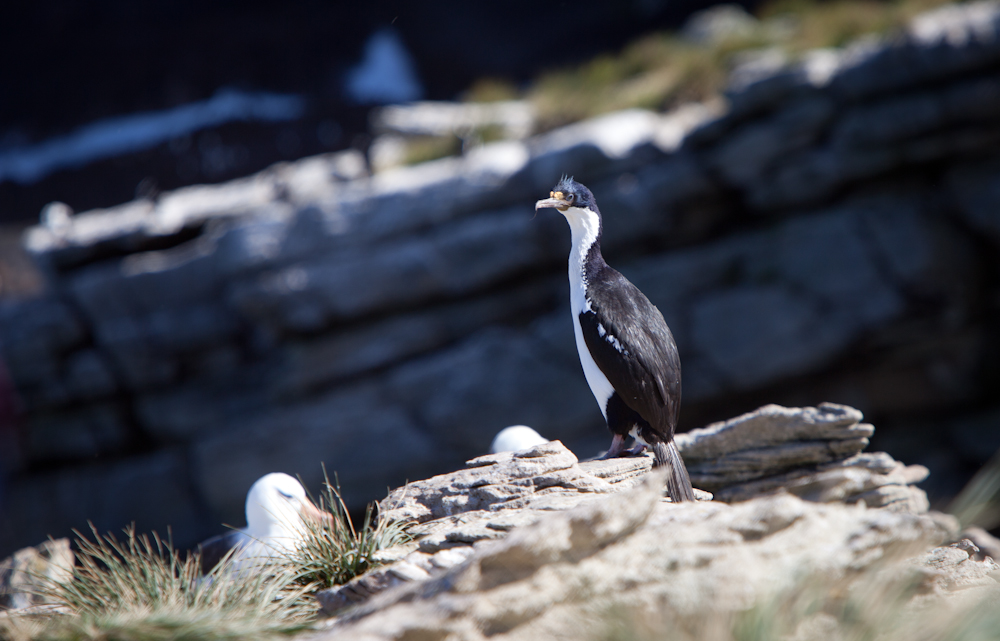
Lonely cormorant.

Cormorants on nest with chicks amidst the colony.

Rock hopper penguin with chicks.  Notice the little guy 
flaked out on the rock in the background. 

It was fascinating to watch the colonies of the different species:
the albatrosses 
with their huge wing spans flew in large circles
overhead while their fluffy grey chicks laid in their elevated 
nests on the cliffs;
the rock hopper chicks walked around looking for 

their parents; and the cormorants were busy building their nests.
We could have 
stayed all day, it was so interesting. 

At this point in the trip, Chris was suffering from lens envy in a big way.  Usually Chris is the king of the proverbial photographic castle, but here, his few lenses were dwarfed by some pretty serious equipment and equally serious and talented photographers.

Examples of some of the photography equipment
and serious photographers on board.

Carcass Island, located on the northern tip of the west side of the Falkland Islands was our second stop for the day.  This area reminded us of Isla Magdalena, Chile where we saw the large breeding colony of Magellanic Penguins, but this was on a much smaller scale.  Still, we observed the adult pairs with their pairs of chicks staying close to their nests in the ground.  We also saw a colony of gentoo penguins  – our first encounter with the gentoos.


Christina walking amongst the tall tusac grass towards the magellanic
penguin colony.  
You had to be careful as there were nests hidden in the grass
and it would be easy to step on one if not watching carefully. 

Two magellanic penguins close to their nest.

Gentoo penguin with colony in background.

Typical landscape of the island.

We passed a beach with sand as white and fine as refined flour, contrasting sharply against the aquamarine colored sea.  From here, we could see large groups of penguins swimming close to shore, purposing out of the water just like miniature dolphins and whales.  I plunked myself down on the sand and just watched.  A few gentoo penguins approached, as curious about me as I was about them.  I watched them and they watched me – it was magical.  I could have stayed there all afternoon, but we had a 3.5 km walk ahead of us and a schedule to keep.   

Tusac grass along the edge of the beach.  These grasses reminded me
of the ornamental grasses we plant in our gardens in Ottawa,
although these were on a much larger scale. 

Magellanic penguins on the beach.

Gentoo penguins on the beach.

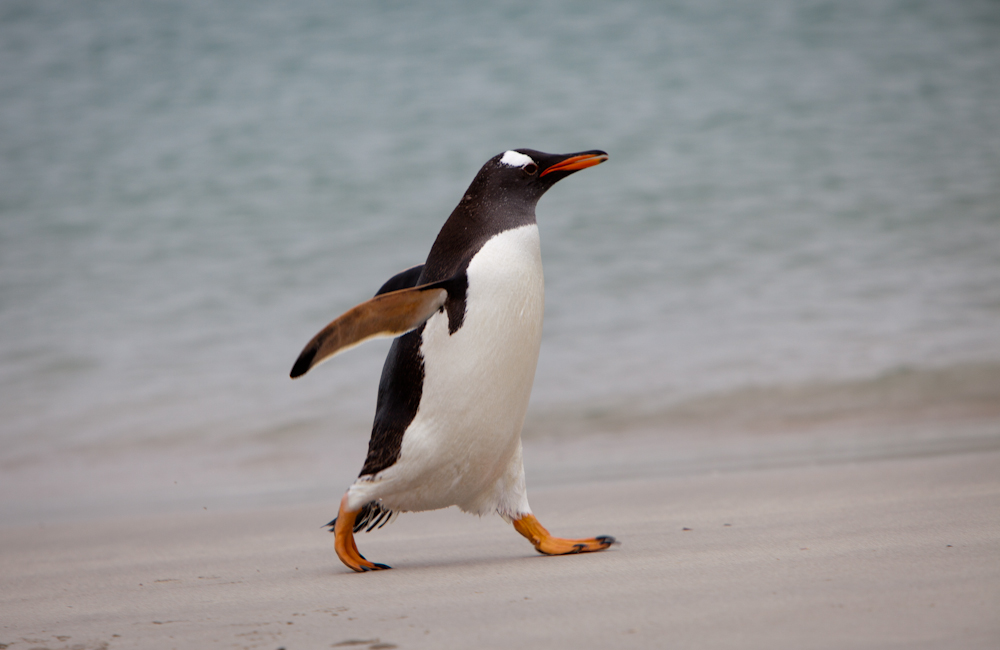
Gentoo penguin in a hurry.

Heading out on our 3.5 km walk with 
promises of an English Tea waiting for us at the other end.

Video synopsis of our first day in the Falkland Islands.

Rob and Lorraine, the only inhabitants of the island, and who also run a B&B, provided a spectacular English Tea. I assume everything was made from scratch; it’s not like there was a local bakery they could call up.  Imagine preparing afternoon tea for 100+ guests.  You’d better make sure you don’t run out of sugar or anything else for that matter – no neighbours from which to borrow, and no grocery store around the corner either.  Rob and Lorraine have been the sole residents on this island for over 20 years!  Apparently, it is quite popular to fly directly to the Falkland Islands from London, and then island hop staying in isolated B&B’s along the way.  Not only did we enjoy a piping hot mug of tea, but we indulged in delicious, home made scones with fresh cream, tarts, and a variety of delicate cakes and squares.  I could not imagine living in such a remote location, let alone being the only inhabitants on the entire island!

We awoke the next day to find ourselves docked at Port Stanley, the capital of the Falkland Islands, with a population of about 1500.  We were given a few options of how to spend the day – walk to a place called Gypsy Cove or go to town to visit the museum and the shops.  It was a free day to spend as we chose.  Chris and I decided to go for a run to Gypsy Cove – about 10 km out and back.  I had run the previous two mornings at the crack of dawn on the ship deck, and was really enjoying the opportunity to run again.  We haven’t been running much lately – too busy hiking mountains – and it felt good to get back into that routine.

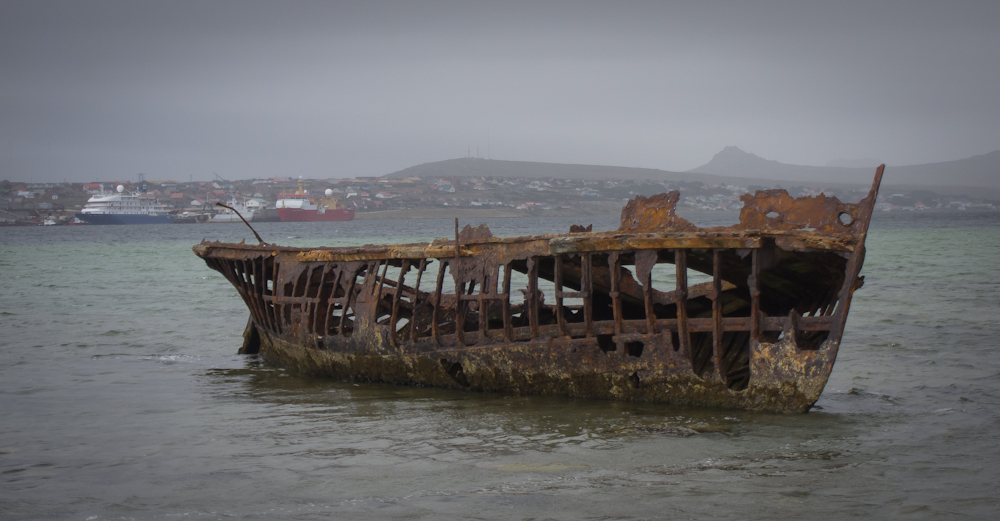
It was a rather ordinary run to the cove on a dirt road, passing by an industrial area and what looked like a quarry in the distance.  Probably the most interesting sight was the two ship wrecks in the bay – the Plym and the Lady Elizabeth, as well as the areas that were fenced off with warnings of the possible presence of land mines, visible reminders of the war in 1982.


These warnings were posted everywhere – too bad penguins can’t read!

The cove was very pretty with powdery fine white sand and emerald waters.  A lone King Penguin was molting on the beach.  We found ourselves alone at the cove with the park ranger, giving us an opportunity to chat with him a bit about what it was like to live on the Falklands.  He described a way of life that was typical of any rural setting.  Children were sent off to England for secondary and post-secondary school and often did not return as there were few opportunities on the Islands.  His family had been on the island since the mid-1800’s.

Later that morning, after getting cleaned up on the ship, we explored Port Stanley.   The town looked like a typical English seaside village.  People spoke with English accents, and drove on the “wrong” side of the road.  There was a charming museum chock full of a startling array of artifacts on every subject imaginable.  It presented a glimpse into what life would have been like back when Port Stanley was established in the early 1840’s as well as a poignant account of the sequence of events before, during and after the Argentine invasion in 1982.  I was touched by the personal letters on display written by residents during this difficult period of time.


Falkland Islands

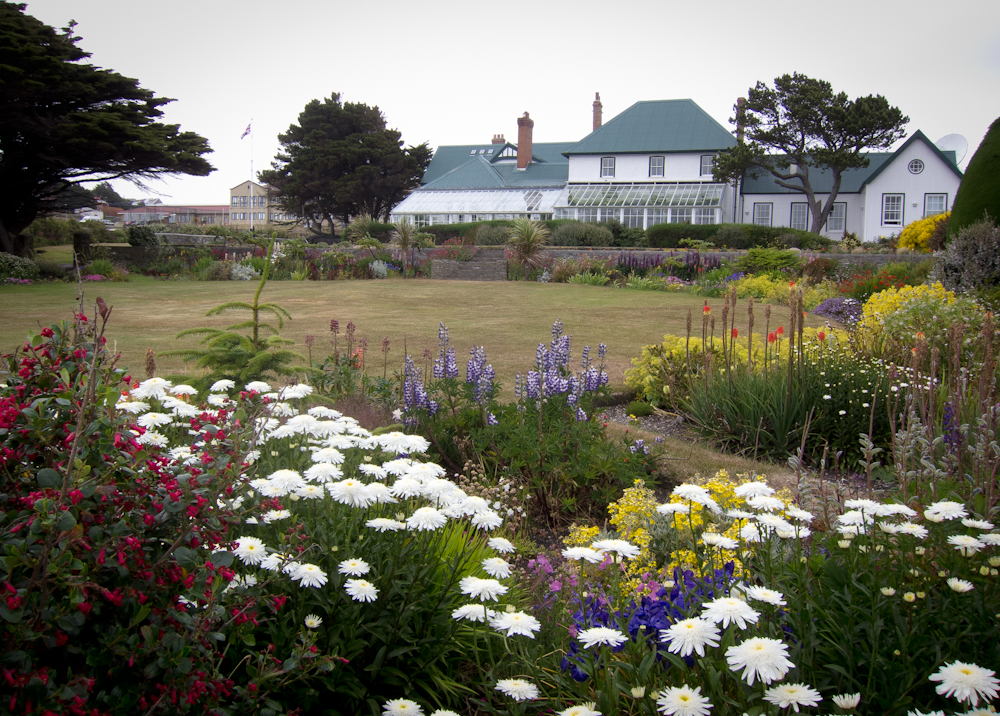
Gardens in front of the Governor’s residence.  

Houses along the main street facing the Sea in Port Stanley.

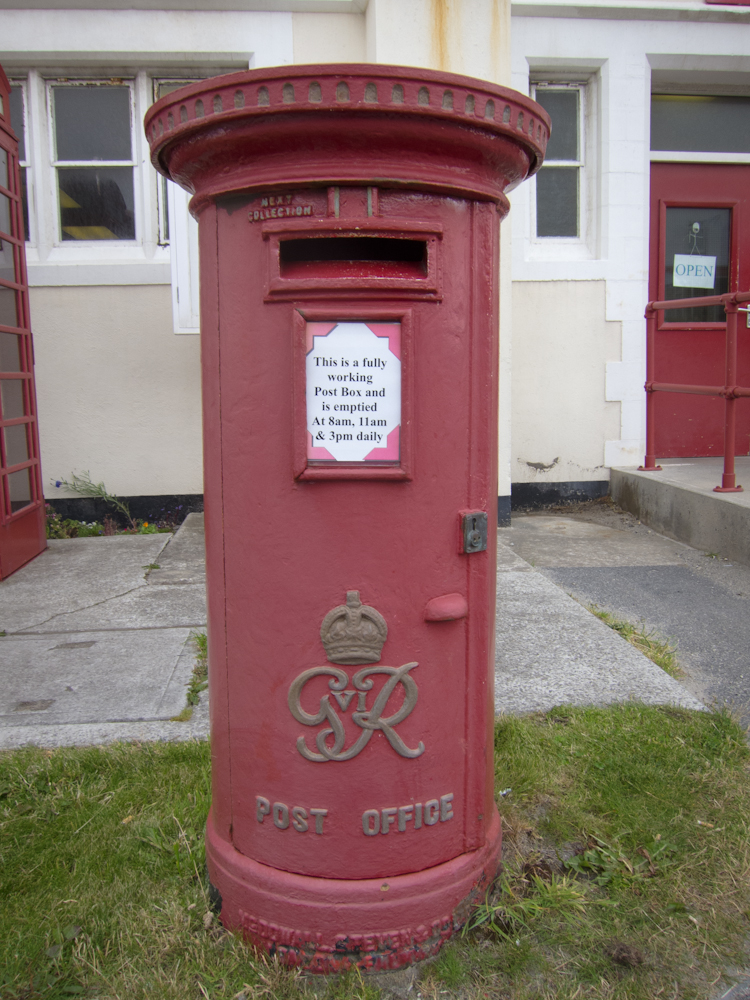
Post office box on the main street in front of the Post Office.

Typical row of cottages.

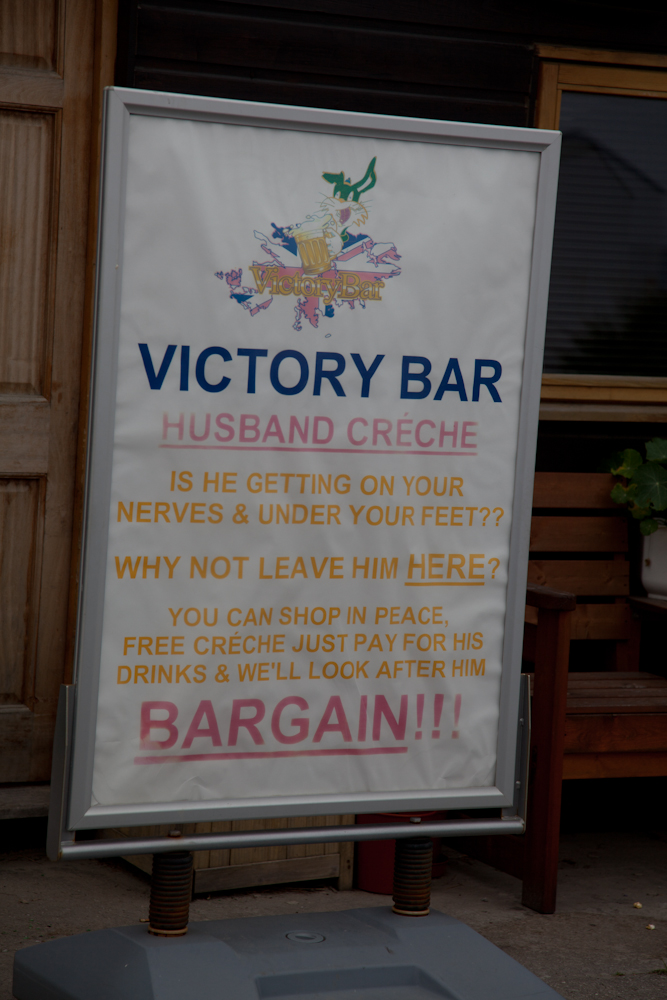
A little British humour.

There were many historical monuments like this one
honoring the men who lost their lives defending the Falkland Islands. 

Many lovely gardens to admire.

The walls of this Anglican church are adorned
with memorial plaques of residents who have passed away. 

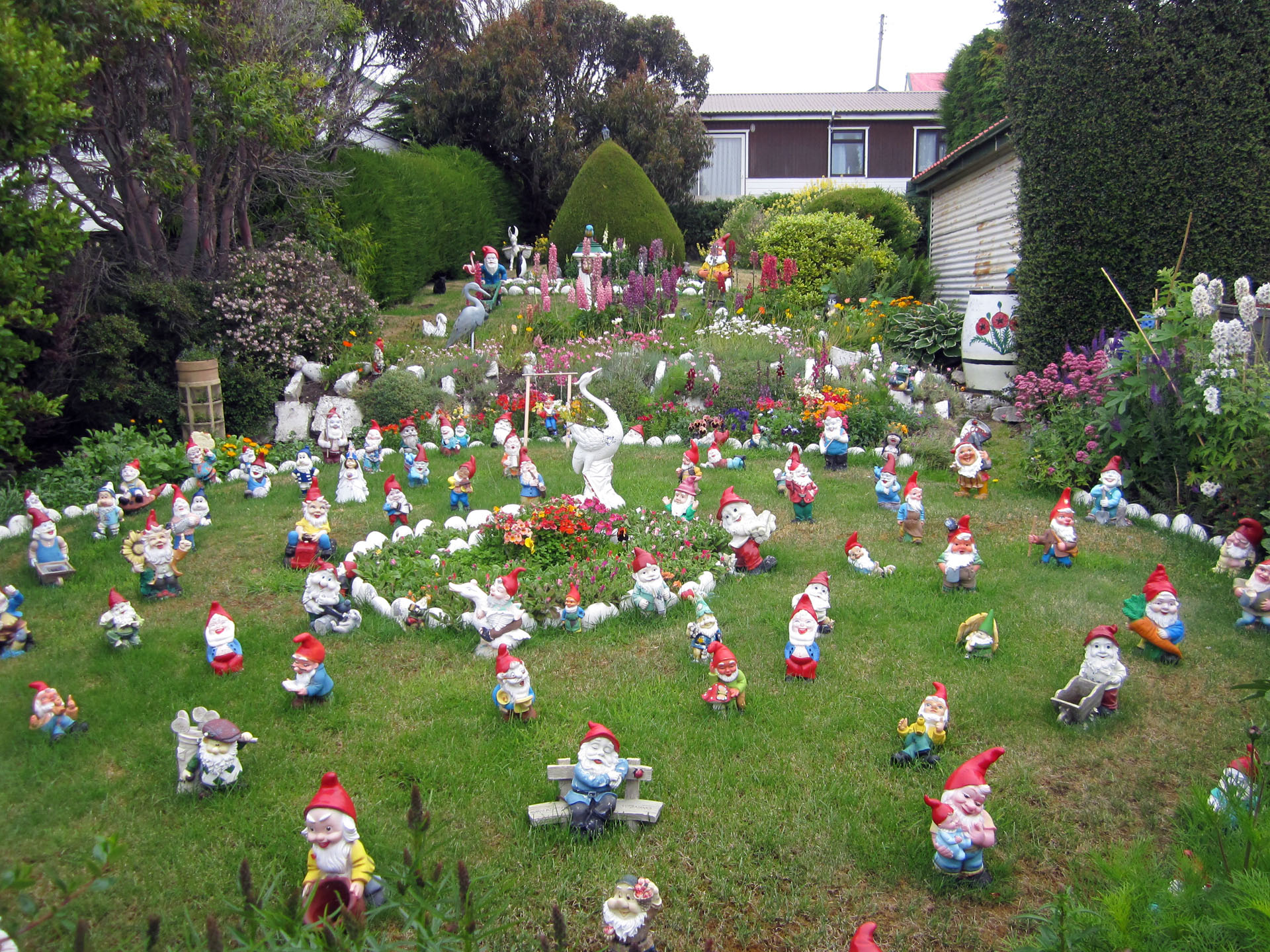
This garden has gained notoriety – I wonder why?

Another wreck, the Jhelum, at Port Stanley.

After visiting Port Stanley I had a greater understanding of its history and an appreciation for the reasons the British chose to vigorously defend this remote island; I’m sure the fact that there may be oil off shore has nothing to do with it.    


Antarctica Cruise: A perfect voyage

We’re back on dry land in El Calafate and we’re taking a few days to catch up on our email and our blog, and most importantly, our laundry.   In the next three blog entries, I’ll share the highlights of our Antarctica experience with as many photos as I can manage to load.  Don’t worry, we’ll cull through the 2,000+ photos Chris took so that you only see the best of the best.

If any of you, besides my mom, have been anxiously awaiting our return, desperate to know how we are doing and how our trip went, I can sum it up in one word:  Fantastic.  For the rest of you, here’s a quick wrap-up of the past 18 days.

We travelled to the Falkland Islands, South Georgia, and Antarctica where we marvelled at astounding landscapes, witnessed a plethora of wildlife, and walked in the footsteps of courageous explorers of the past.   After spending hours upon hours watching hundreds of thousands of seven different species of penguins (Magellanic, Gentoo, Macaroni, King, Adelie, Chin Strap, Rock Hopper), I think I’ve finally reached my saturation point.  Just for the record, there was one sighting of a young Emperor penguin (March of the Penguins) looking rather forlorn in the middle of a Gentoo colony but I did not personally see it.


Weather will make or break your Antarctica experience.  When the winds are fierce and the seas are high, not only will you be unable to step foot on land, but you will be feeling so poorly you will wish you were dead.  Luckily, we enjoyed perfect weather for the entire duration of our 18 day cruise: the seas were calm, the wind was light, precipitation was minimal, and sunshine was plentiful.  Such idyllic conditions allowed us to participate in a total of 18 land / zodiac excursions and for a lucky few, nine kayaking excursions.   Our expedition leader reported this was an all-time record during his 17 years of expedition experience!

Our ship was luxurious by any standards, but especially for an Antarctica cruise.  The food was good, plentiful and familiar, and the service impeccable.  There were about 100 passengers on board supported by a crew of about 75.  The expedition team comprised of twelve guides from a variety of backgrounds, each offering a unique area of specialty. During the four sea days, our guides offered interesting and informative lectures covering a range of relevant subject areas all designed to educate us about the ornithology, marine biology, geology, history and zoology of the places we would visit.

The majority of passengers were from the UK, United States and Australia in almost equal measure, followed by Canadians (11), New Zealanders (4), and the remaining dozen came from various other countries.  After four months struggling with Spanish, it was such a delight to converse with our ship mates in English.  It became quickly apparent that this was a well-travelled crowd and we took complete advantage of the situation to hear about the exotic and wonderful places discovered and recommended by others.  It was impossible to absorb all the information and I’m hoping that I can further exploit our new friendships via email in the months to come to collect travel tips and recommendations from around the world.  The majority of passengers were older than us but don’t be fooled into thinking this was a sedentary crowd.  I was impressed by the high level of participation in all activities, even the most strenuous hikes that I found challenging.  It was a little disappointing, however, that only 29 courageous (some might say foolish) souls jumped into the frigid Antarctic waters for a polar plunge (ourselves included).

Well, I think that gives you the gist of our trip.  It was nothing short of spectacular in every possible way.   Stay tuned for the details over the next few days.  In the meantime, click here if you’d like to read the fascinating history of the discovery of Antarctica.

The Polar Plunge in Antarctica.  Water temp: -0.5C

We’re at the end of the world in Ushuaia

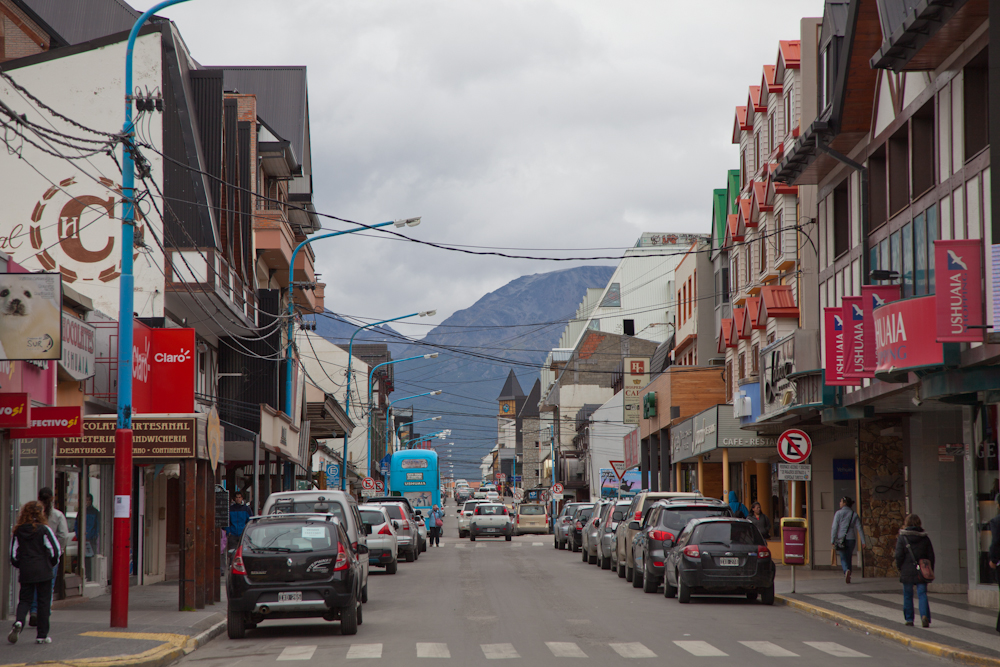
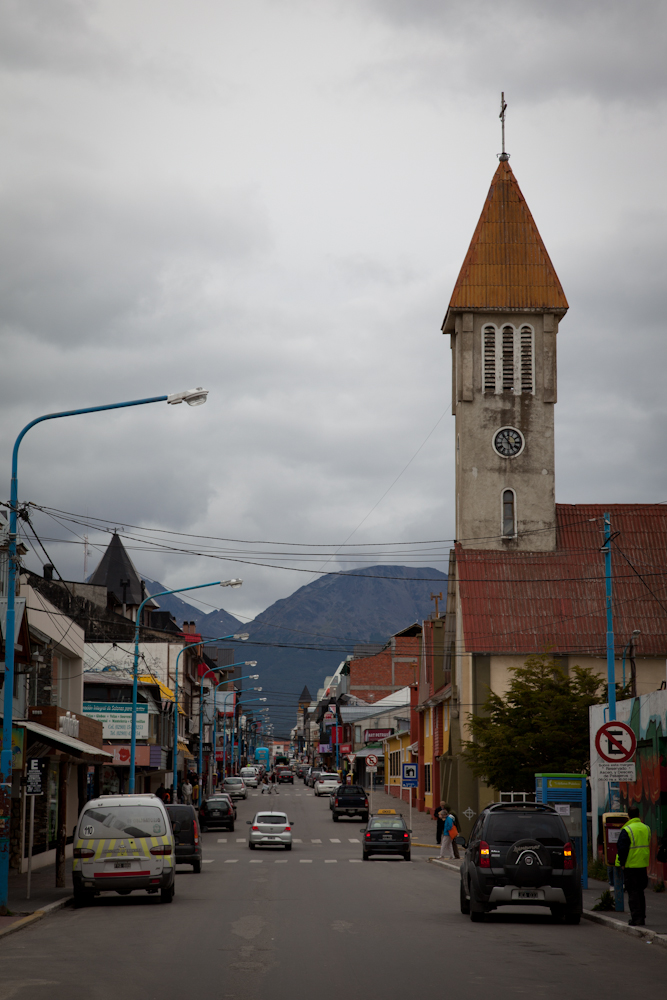
Last Sunday we arrived in Ushuaia, the southern most city of South America nicknamed “the end of the world”.  This slogan is well used throughout the city, appearing on clothing, menus, tourist attractions, road signs, etc.

It took about ten hours by bus to travel from Punta Arenas.  While it was a long trip to take on a bus with regular seats (no camas or semi-camas), the scenery made the daytime trip worthwhile.  For many miles, the land was as flat as a pancake, with not a single tree in sight.  Large sheep ranches called “estancias” occupied the land, making me think that this might be what the Australian outback looks like (I’ll let you know if this is true next year when we travel there 🙂

As we approached Ushuaia, the landscape changed quite abruptly; the flat plains in Chile turned into rolling hills which then became snow-capped mountains. This was our first up-close glimpse of the Patagonia mountain range and we were duly impressed.  We passed through the Chile – Argentinian border easily; our bus driver collected our passports and we waited while he got them all stamped, both the exit stamp from Chile and the entry stamp into Argentina.  Not much in the way of security as the immigration/customs officials didn’t even see our faces or our baggage.

Ushuaia, a former penal colony, is a sizeable city with a population close to 60,000. The main economic activities of this region are fishing, natural gas and oil extraction, sheep farming and eco-tourism.  It has a very busy port servicing both shipping vessels and cruises.  This is summer time in Ushuaia and the peak of the tourist season and everything was priced accordingly, much to our dismay. The streets were crowded with tourists, and accommodations were filled to capacity, making it very difficult to secure a bed to sleep in. This city reminded us of Banff, especially the main street with lots of expensive clothing stores, souvenir shops, and restaurants.  It had a vacation resort feel to the place.

The town with Martial Glacier in the background.

Downtown Ushuaia

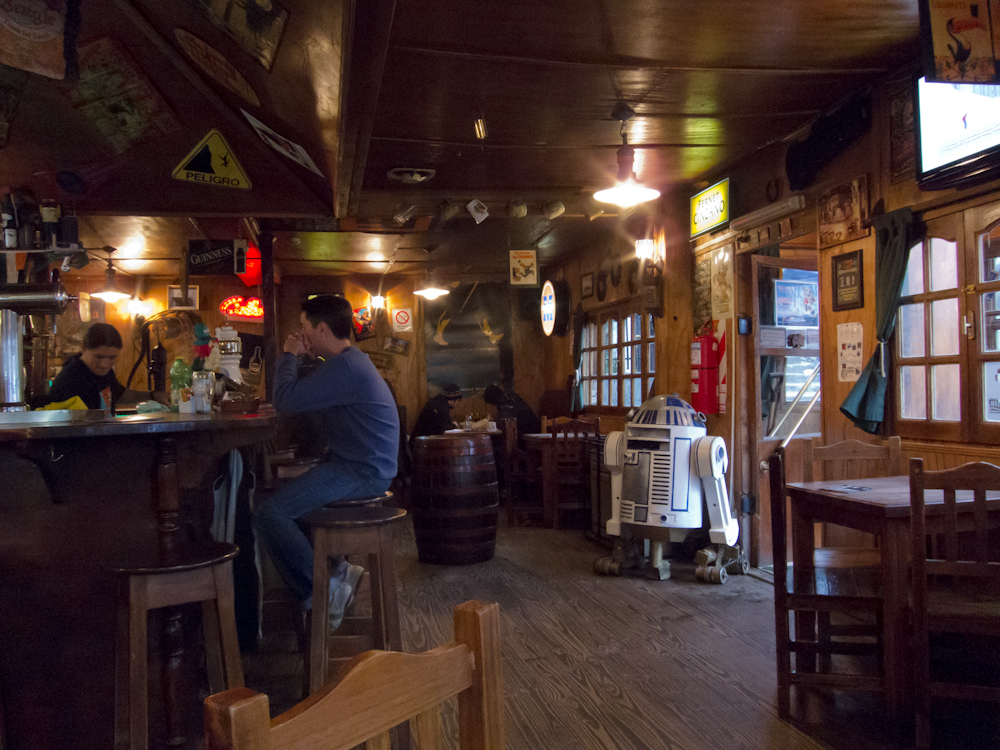
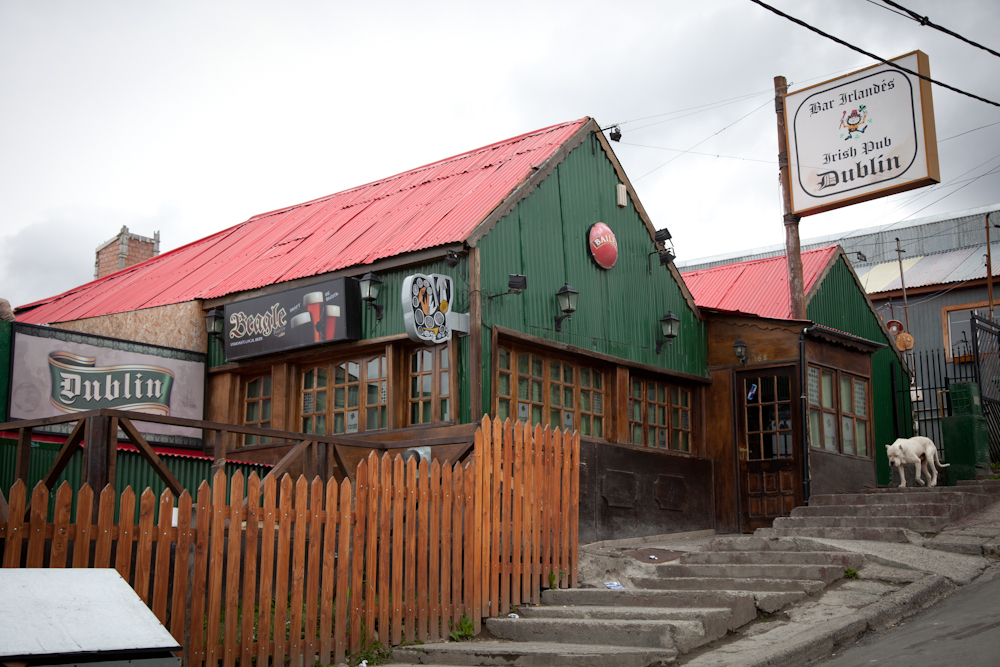
The Dubliln Irish Pub that did not serve Guinness – blasphemy!

Outside view of the Dublin Pub – one of the few
restaurants with reasonable prices.  The homemade
draft was hit or miss too. 

Argentinians love their meat.  A BBQ spit was a common
sight in the front window of restaurants.  We sampled
this type of cuisine at an all you can eat buffet at
La Estancia one night.  The meat was  good (lamb and beef) 
but the rest of the food was mediocre. 

Throughout the week, we stayed in three different places out of necessity. First we stayed at the Drake Hostel which didn’t overly impress us, especially the fact that there was no housekeeping during the three days we were there.  Next was a night in a private home, a neighbour of the bed and breakfast, La Maison de Ushaia, where we spent our last two nights. The private home gave us a bed to sleep in, but the home reminded me of someone who had a serious hoarding issue.  I was glad it was only one night.  The bed and breakfast was lovely although the entire household (4 generations of women) was getting over nasty colds which we hope we don’t catch.  We’re not big fans of bed and breakfasts mainly because of the lack of privacy and this one was no exception.  Still, the owner’s daughter, Soulange, went out of her way to make us feel comfortable, and to give information about things to do and where to eat.  She even satisfied Chris’ curiosity about ritual of matte when she showed us how this peculiar tea is prepared and then how the communal cup is passed around the table.  It’s a very common Argentinian ritual, reminding me of the British and their afternoon tea.

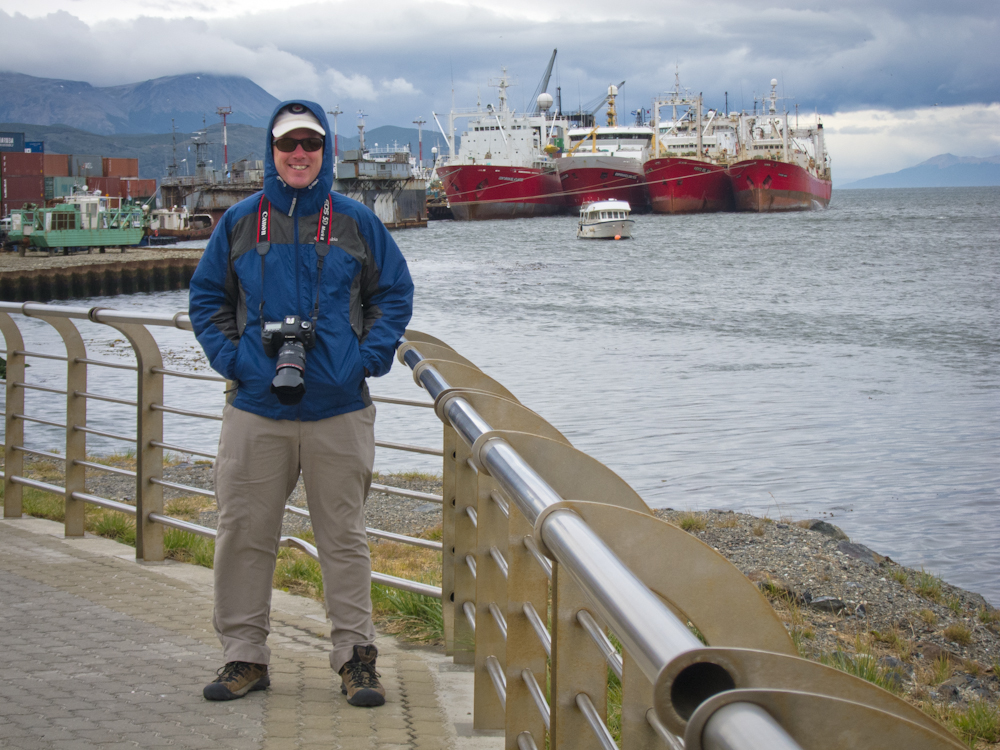
Bundled up down at the port.  It was interesting watching the ships come
and go each day – both the large cruise ships making a port of call in Ushuaia and
the much smaller Antarctica expedition ships beginning their cruises from here. 

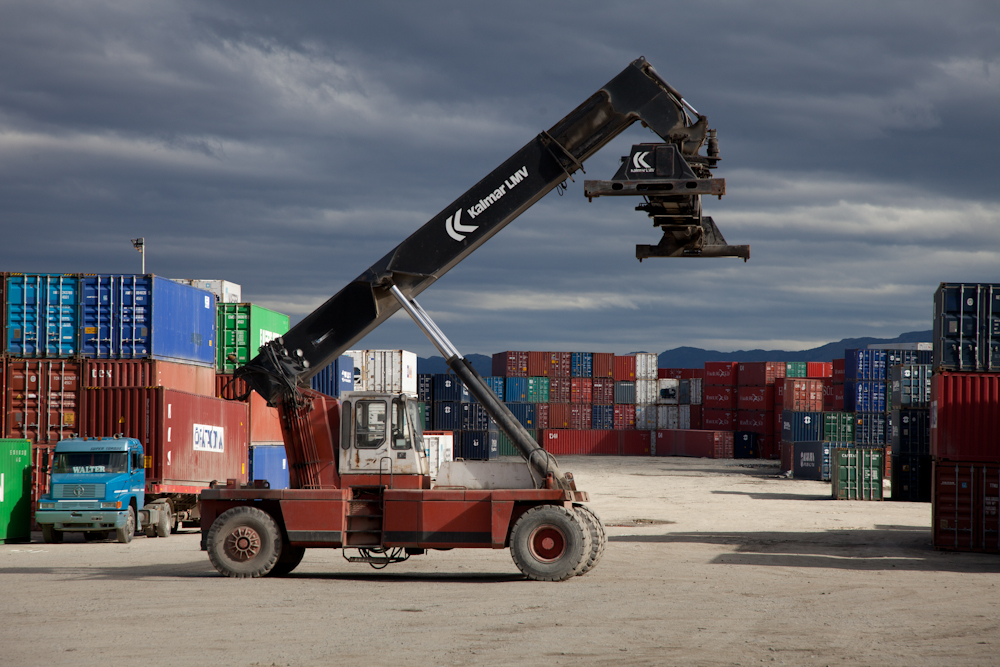
So many shipping containers.

We were quite taken aback by the ridiculous prices being extorted from tourists. Here’s some examples: $25US for two small loads of laundry; $45US per person to hike in the Tierra del Fuego National Park (transportation and park entrance fee), $4US for a thimble full of coffee, $12US for breakfast (coffee, juice and toast) , $12US for half a ham and cheese sandwich, $75US and up for a hostel room (double with shared bathroom).  Just for the fun of it, Chris priced his camera in a local store and was appalled to see it going for just shy of twice the Canadian retail price.

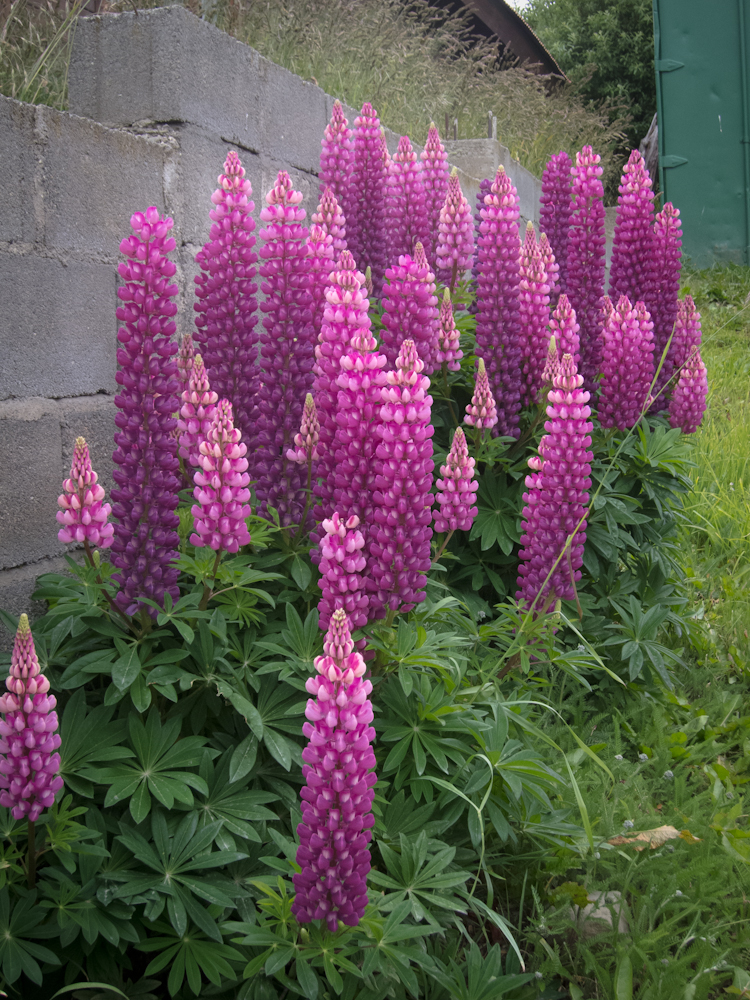
Brilliant lupins of every imaginable colour grow in abundance.

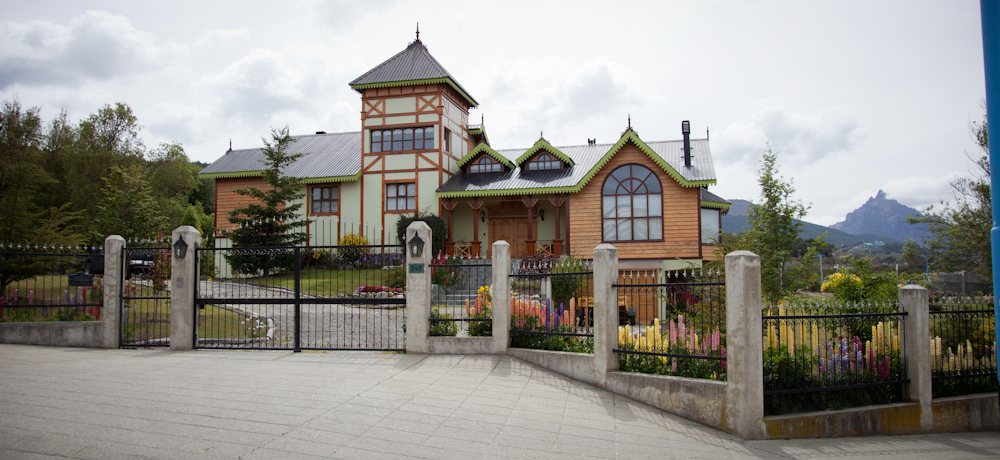
One of the prettiest houses and gardens we saw in town,
just a few houses down from our B&B. 

We came to Ushuaia with the desire to find a last minute deal on a 10 or 11 day cruise to Antarctica. These cruises are ridiculously priced and even the last minute prices are outrageous in our view.  But, we rationalized the expense thinking that it was unlikely we would ever be here again, and we both really wanted to see Antarctica.  So when we arrived, the first order of business was to find a cruise.  I had already sent out about a dozen or so emails a few days earlier to tour agencies in Ushuaia enquiring about availability on upcoming ships.  We were discouraged to learn that all the 10-11 day cruises for the next three weeks were completely filled and most tour companies had waiting lists of 5-6 people for each of these ships. It wasn’t looking good.

We then learned that there were some deals on two ships leaving this week but they had longer itineraries (19 days) which included stops on the Falkland Islands, Georgia Islands and Antarctica.  Of course, longer cruises means larger price tags.  We debated our options – long cruise leaving this week, short cruise leaving in 3 weeks, or no cruise at all.  In the end, we booked ourselves on the 112-passenger Sea Spirit with Quark Expeditions for a 19 day cruise.  All week, I’ve been giddy with anticipation for this cruise. We leave tomorrow – hopefully we have some internet access so I can keep the blog up to date – otherwise you’ll hear from us in about 3 weeks.


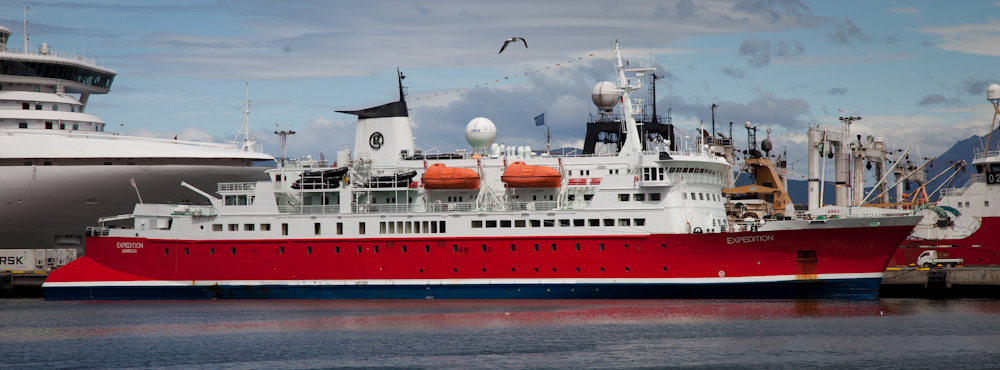
This Gap cruise left yesterday – this was the other 
19 day cruise available this week.  Hope we made the right choice. 

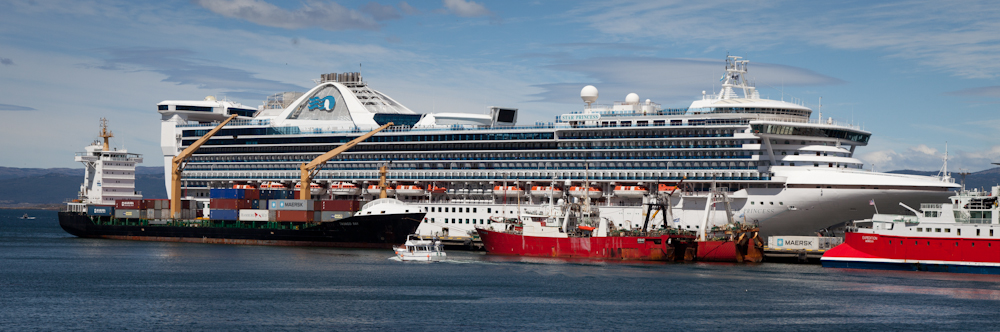
The Star Princess cruise ship – look at the size difference
compared to the Gap expedition ship to the right.  The
large cruise ships don’t stop in Antarctica for
environmental reasons – they just pass by it.

It’s a busy shipping port too. 

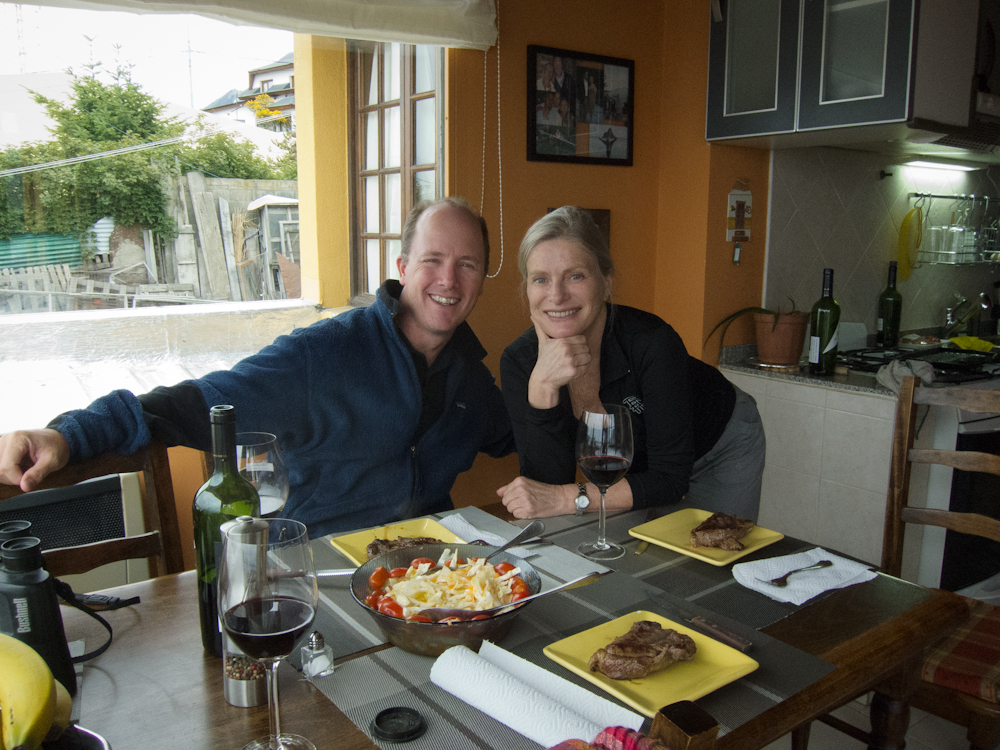
We again experienced the kindness of strangers here in Ushuaia.  Alicia was the agent through whom we negotiated our cruise.  When we met her at her home mid-week to finalize the paperwork, we got to know her story a little over a bottle of Argentinian wine.  We were immediately impressed with how she came to Ushuaia ten years ago and built up her business and her reputation from scratch. She’s a real go-getter, very genuine, modest and down to earth. We found her to be inspiring.  I think she was equally impressed with our story.  It’s funny how you just hit it off with some people.  Well, after completing the paperwork, and the first bottle of wine, she spontaneously invited us to stay for dinner. As she prepared the steak, and I made a salad, Chris cracked open the second bottle of wine.  It was our first home made dinner, in somebody’s home since we left Canada. We really appreciated her hospitality.

Chris and Alicia in her kitchen at dinner time.

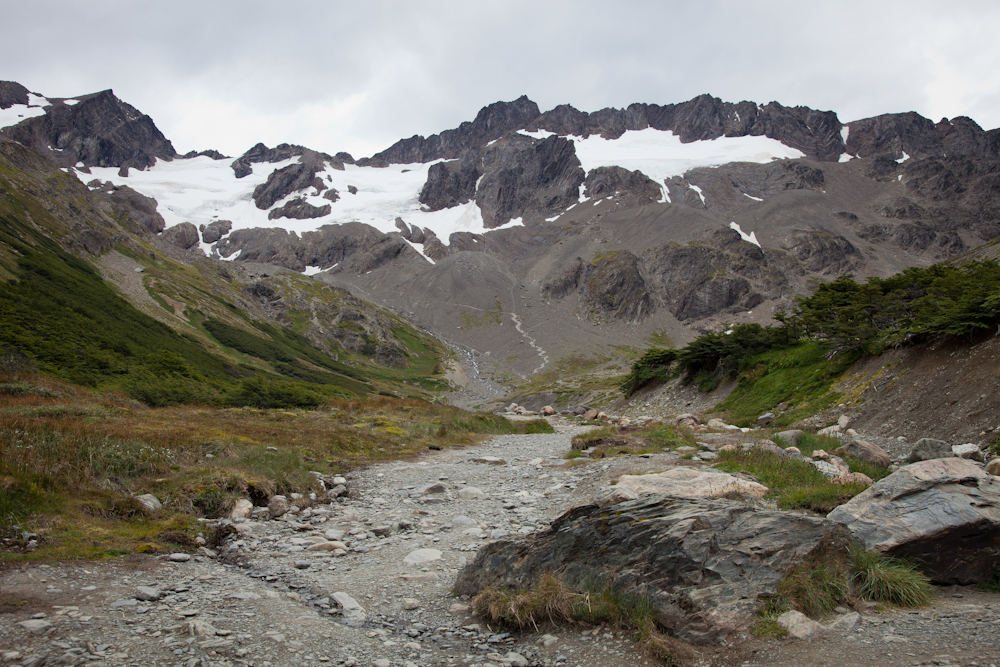
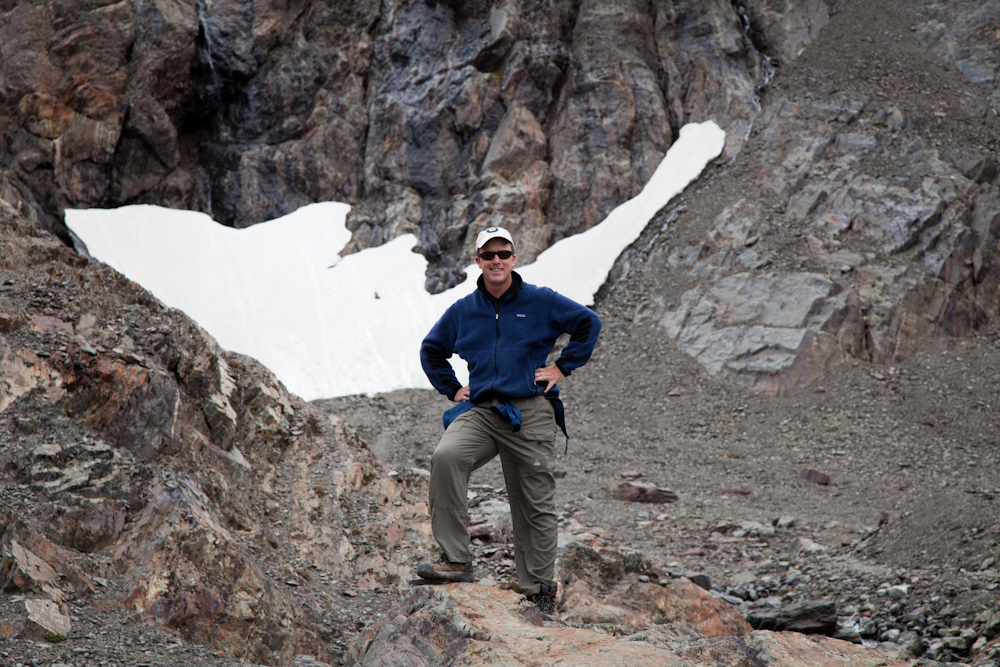
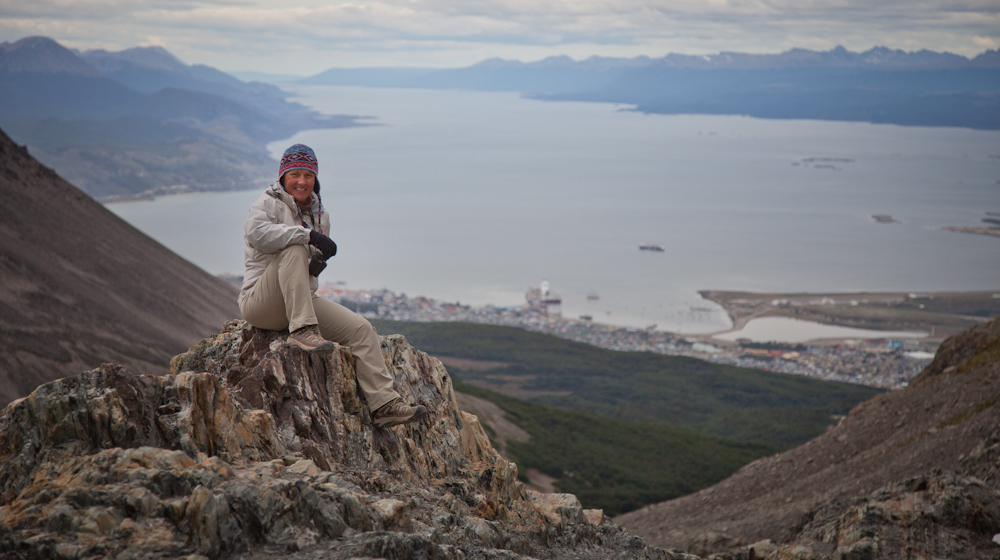
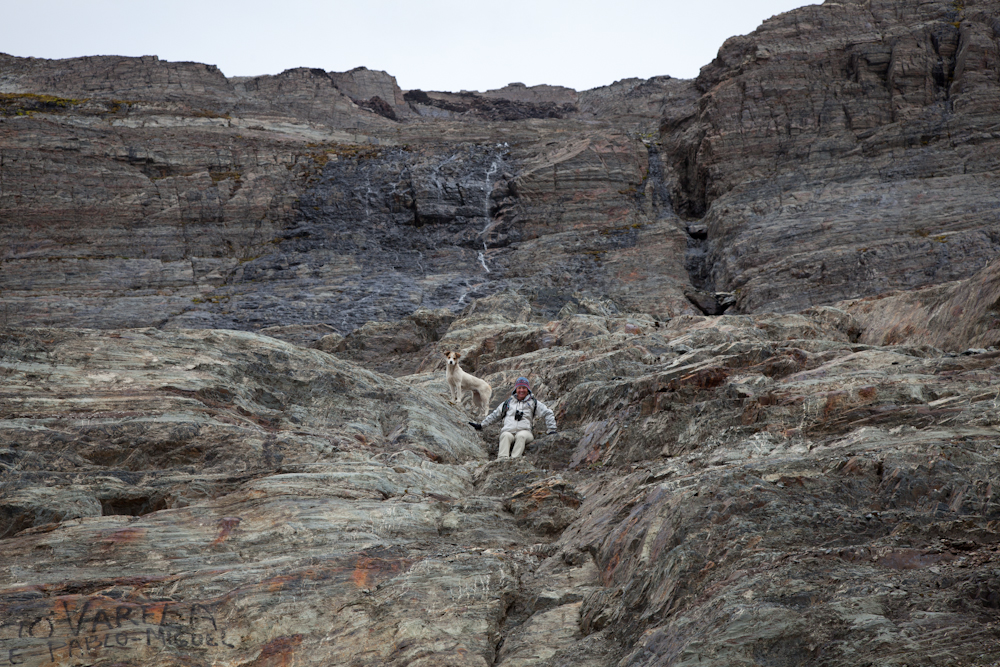
Besides securing the cruise, and draining our bank account, we’ve just been hanging around in Ushuaia this week, taking it easy and getting to know the town and area a little bit. One day we hiked to Martial Glacier which gave us another good work out.  The hike wasn’t particularly challenging or strenuous, but it was all up hill and then down hill as we were climbing yet another mountain.  We felt our legs for a few days afterwards.  At the glacier, we were rewarded with spectacular views of Ushuaia and the Beagle Channel far below as well as the surrounding rugged mountains.  Once again, we had a canine companion all the way up and all the way down….he was a cute mutt that reminded me of a dog my brother David once had. I don’t know what it is, but we seem to attract dogs when we go hiking. There were plenty of other people on the trail, but this dog singled us out and remained with us for our entire hike.  Of course, we shared our lunch with him – so maybe he just knew how to pick ’em.

On the way up to the glacier, in the distance.

Still not there….the hard part was yet to come.

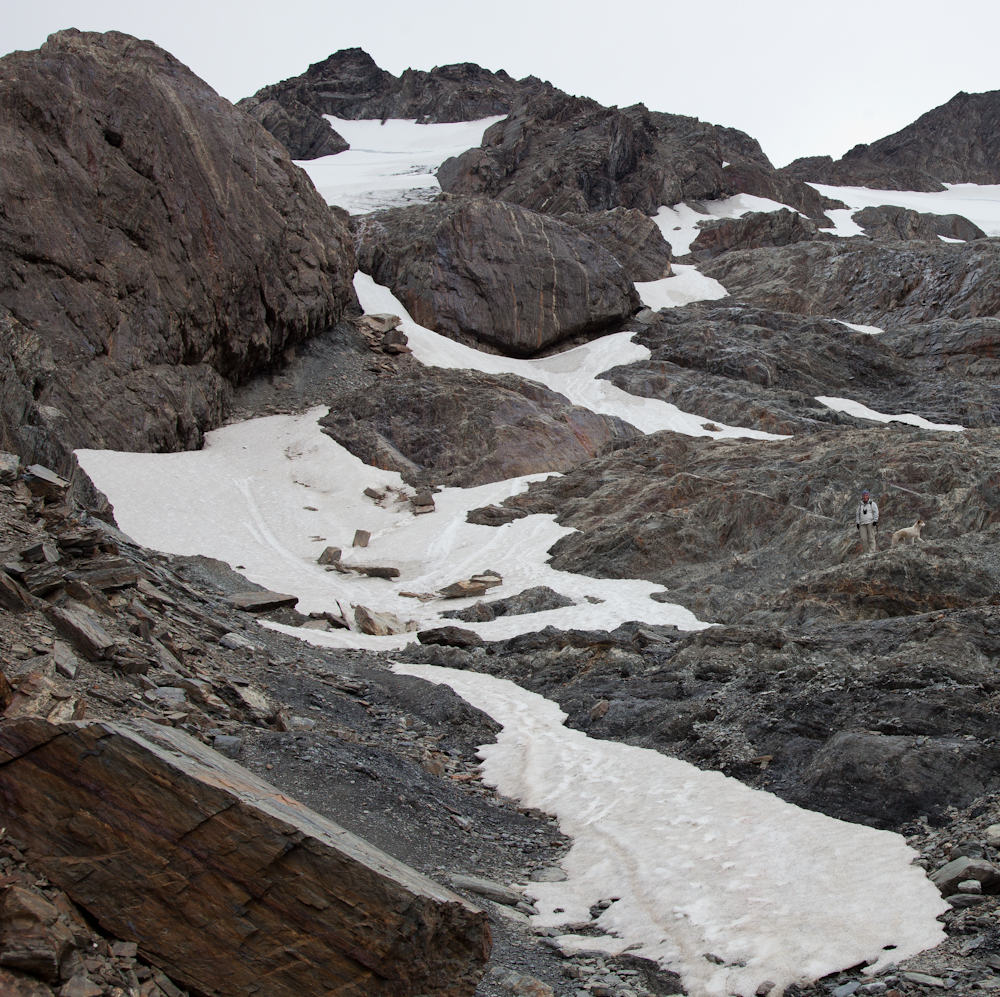
We reached the snow, but the glacier was still above us.

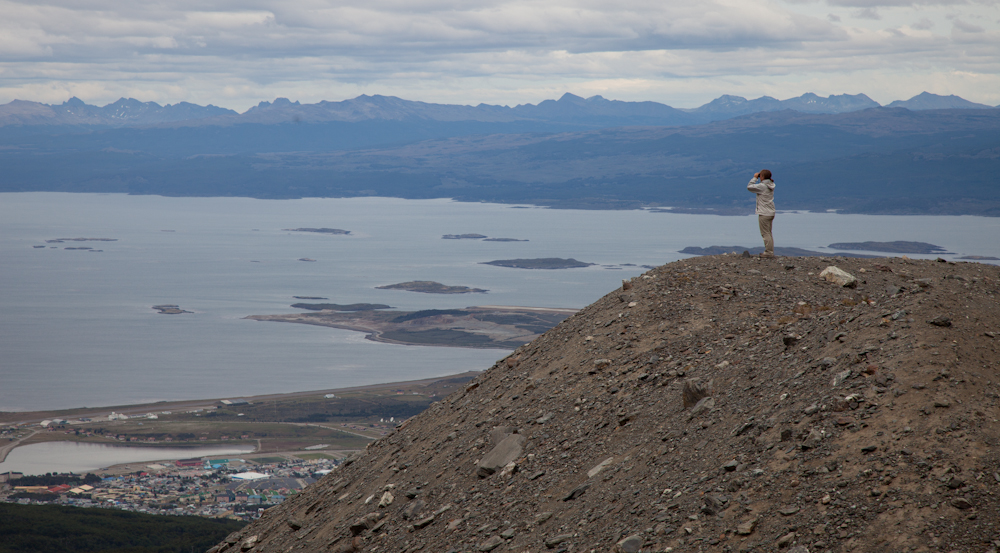
Checking out the view of the Beagle Channel and Ushuaia below.

Where’s Christina?  At the glacier, with our new canine friend.

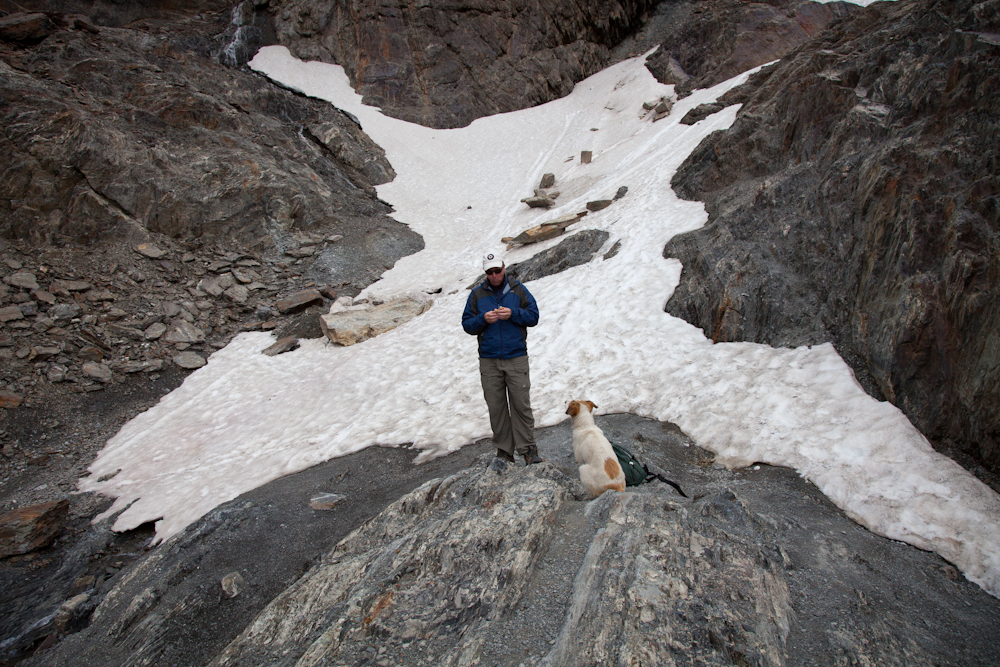
Having a bite to eat.  How could we resist sharing our lunch
with our polite and patient friend? 

Can you believe this view?

Our faithful guide leading the way up.

Typical mountain flora clinging to the rocks.

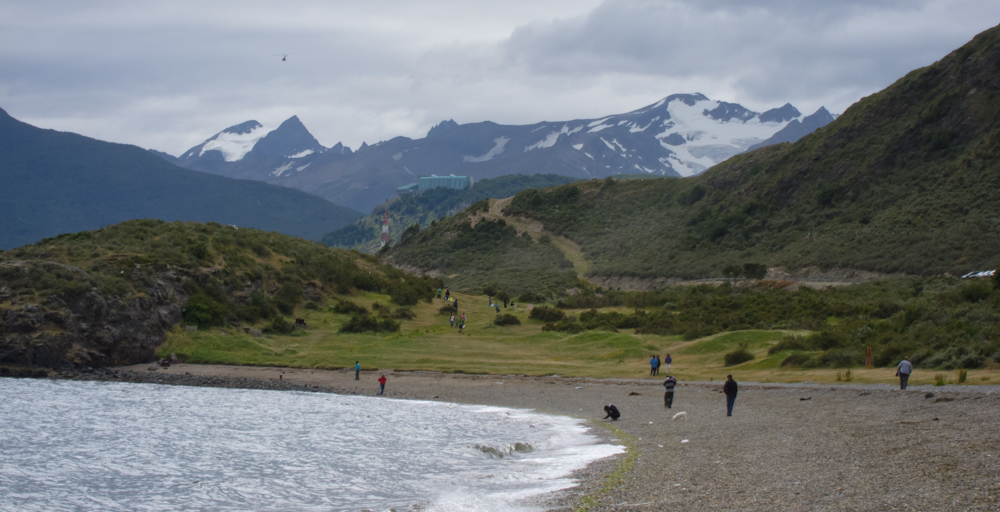
Another day, we went to Playa Larga, a lovely beach  along the Beagle Channel about 4 km east of town. We took the local bus there, but since we didn’t think to ask about getting back, we couldn’t figure out where the bus stop was and had to walk most of the way back into town (after already hiking for 3 hours) until we were able to flag down a taxi.  Mental note:  ask for directions for both ways next time!

Playa Larga – can you see the helicopter that passed by?

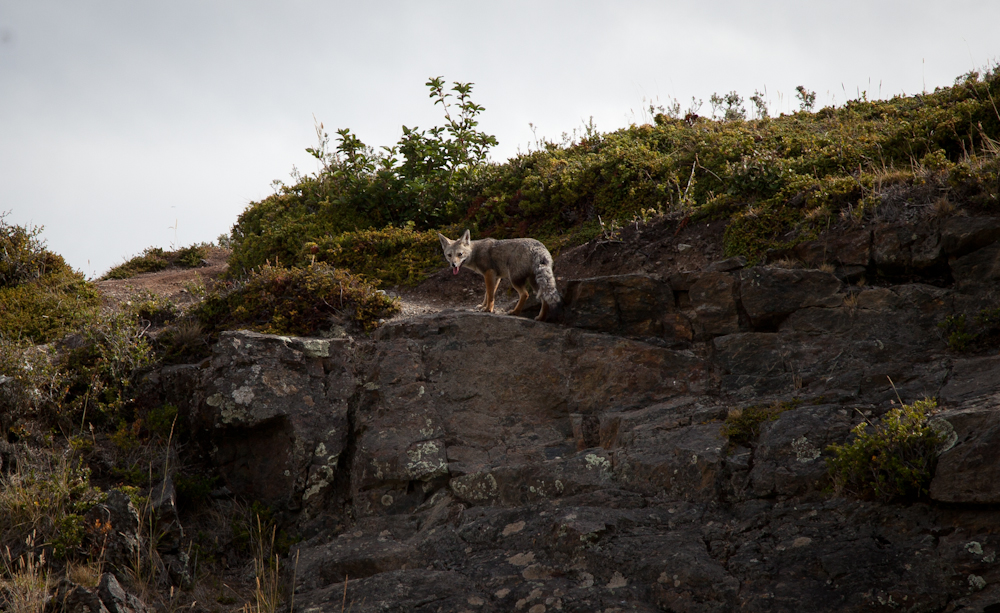
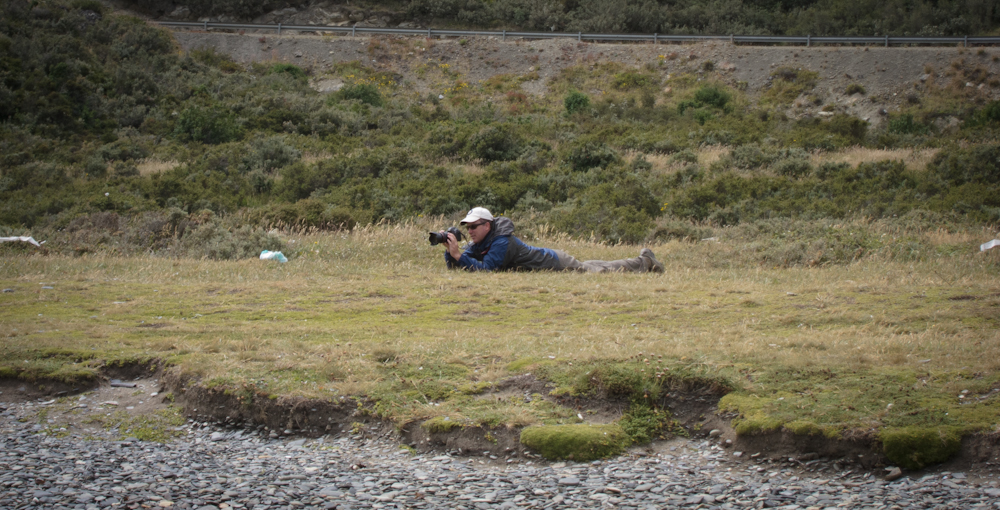
Chris taking a photo of a gray fox (below).

This gray fox was the only animal we saw on all our hikes.

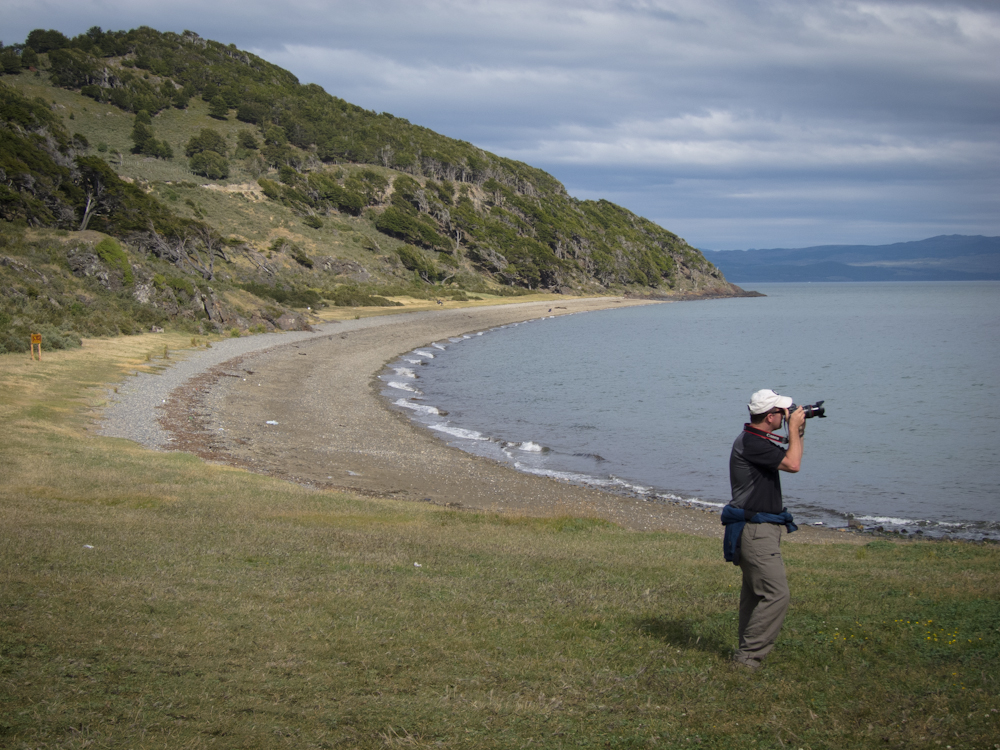
Photographer at work but what has captured his rapt attention?
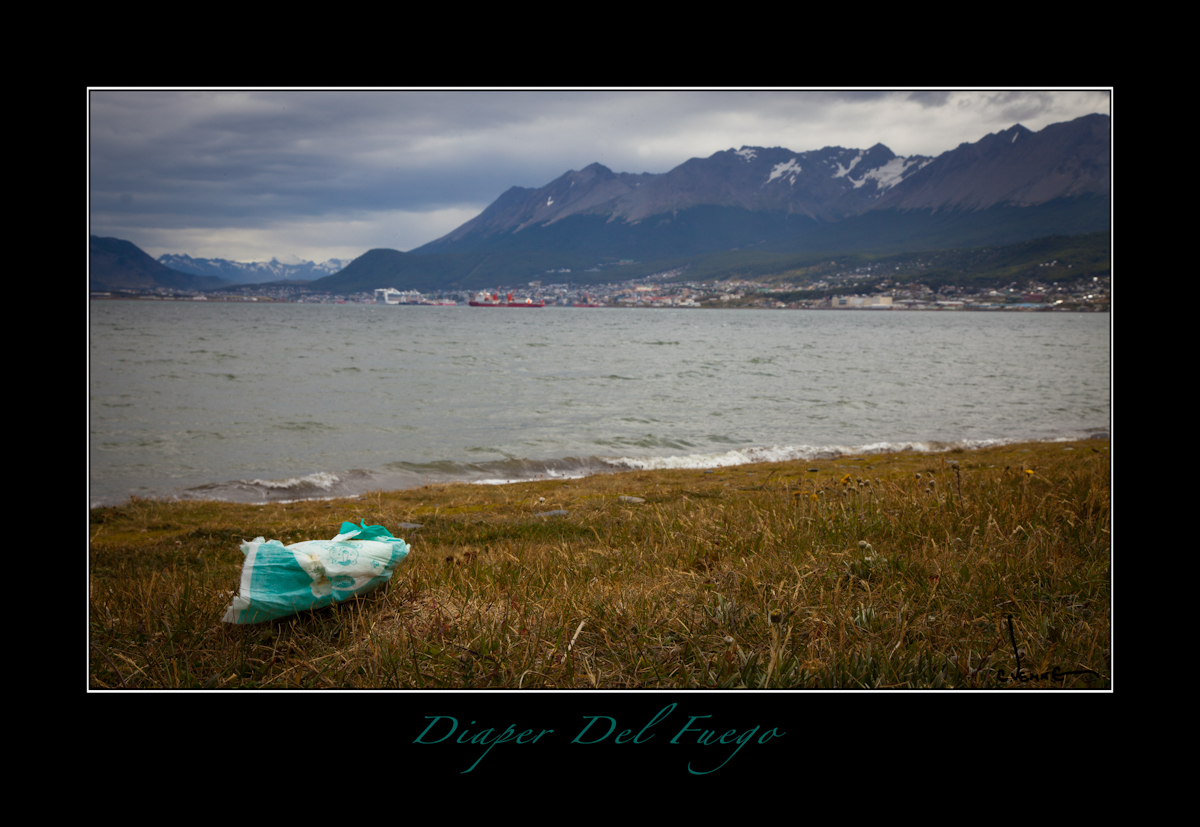
Before I answer I must tell you a story.  A few years ago, we were having dinner with our old neighbours Chris and Nancy when my Chris shared a pet peeve with us:  why do people leave dirty diapers lying around all over the place? All three of us looked at Chris like he was nuts. We had no idea what he was talking about. But then, the next time we got together, Nancy and her Chris both remarked how they too were now seeing dirty diapers everywhere.  And even I have to admit, I too have seen many dirty diapers discarded in the strangest of places every since Chris alerted me to this phenomenon. Throughout South America, we have seen plenty of dirty diapers but I think the weirdest place was in Quito, Ecuador where we noticed a dirty diaper wedged in a tree. Who does that?? Of course, Chris now takes a picture every time he sees a dirty diaper in a weird place and sends it to our friends. Sure enough, while walking along this beach, we saw yet another dirty diaper on the ground.  There was no other garbage anywhere on the beach – just a single, dirty diaper.

 Chris takes his dirty diaper pictures quite seriously as you can see.  Who knows, maybe Chris will compile a coffee table book on the subject – anyone have any suggestions for a title?

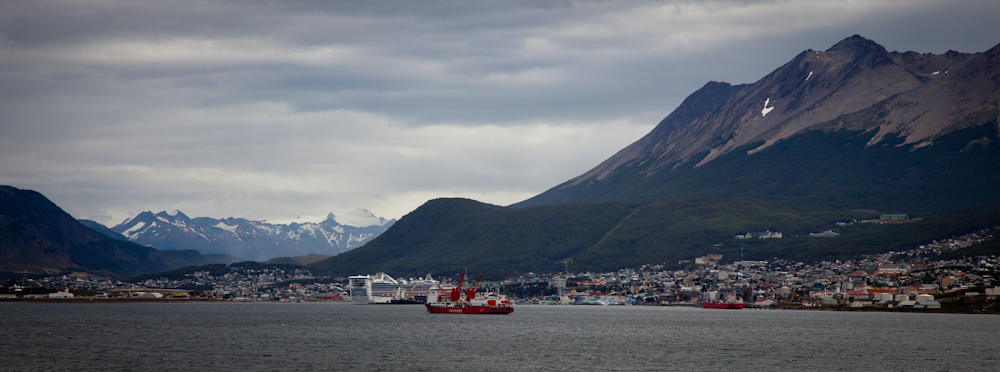
View of Ushuaia from the beach.

Which direction does the wind blow?

Hiking along the shores of the Beagle Channel, one of
three navigable passages around South America between
the Pacific and the Atlantic oceans.  The other two are
the Straits of Magellan and the Drake Passage.

 Enjoying the moment, and the view!

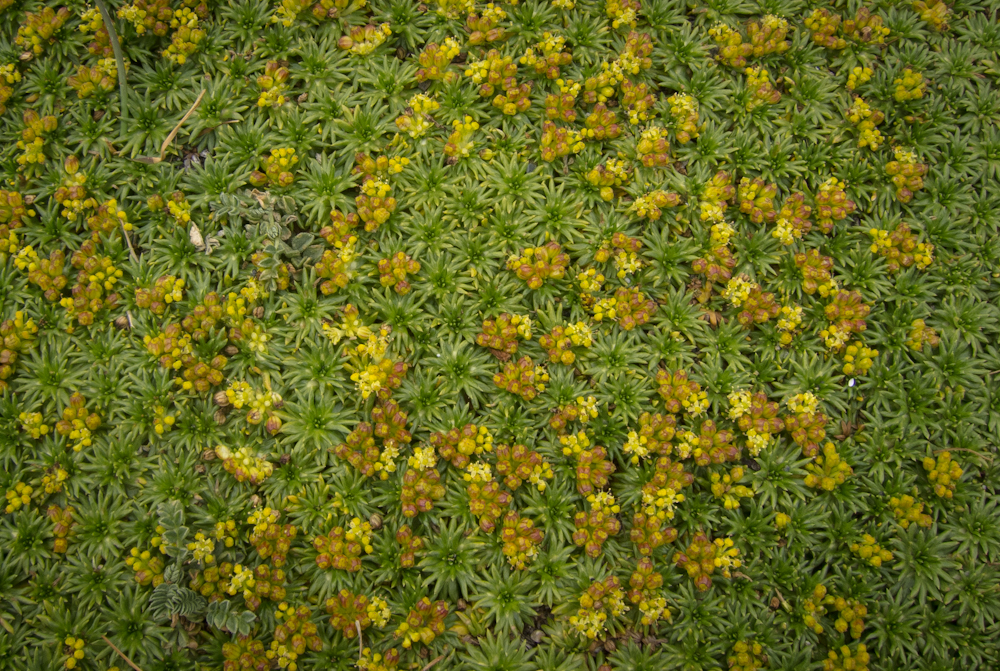
Moss-like plant growing on the rocks near the shore.

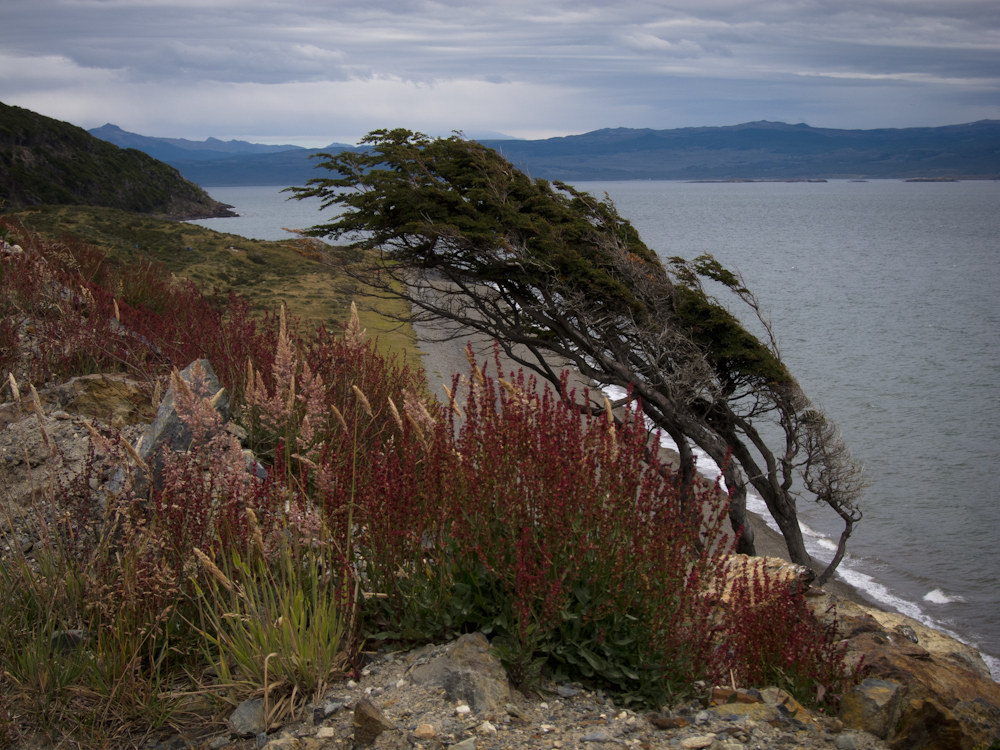
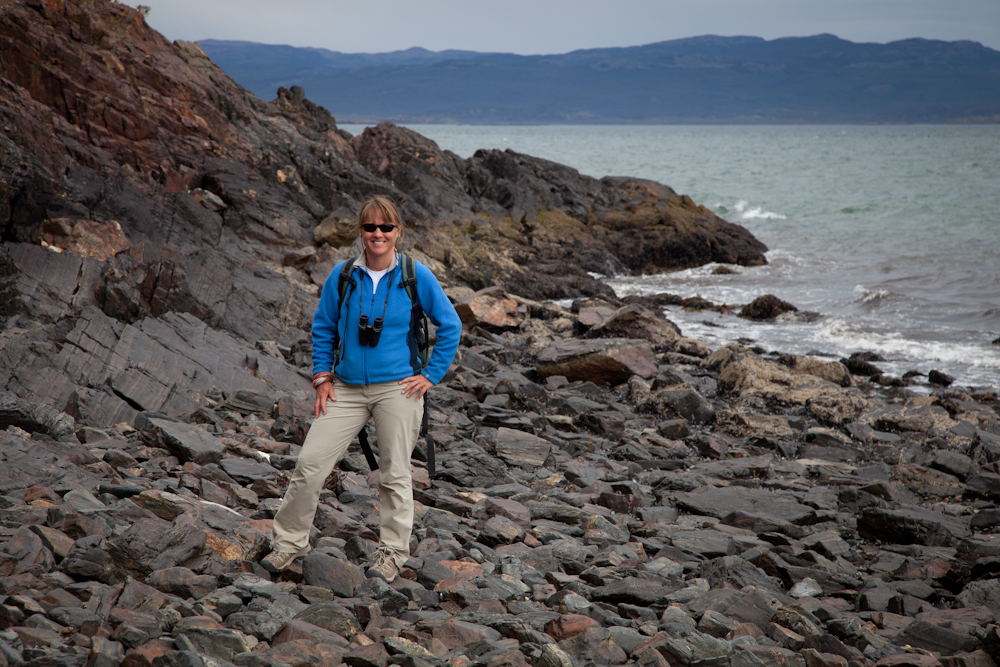
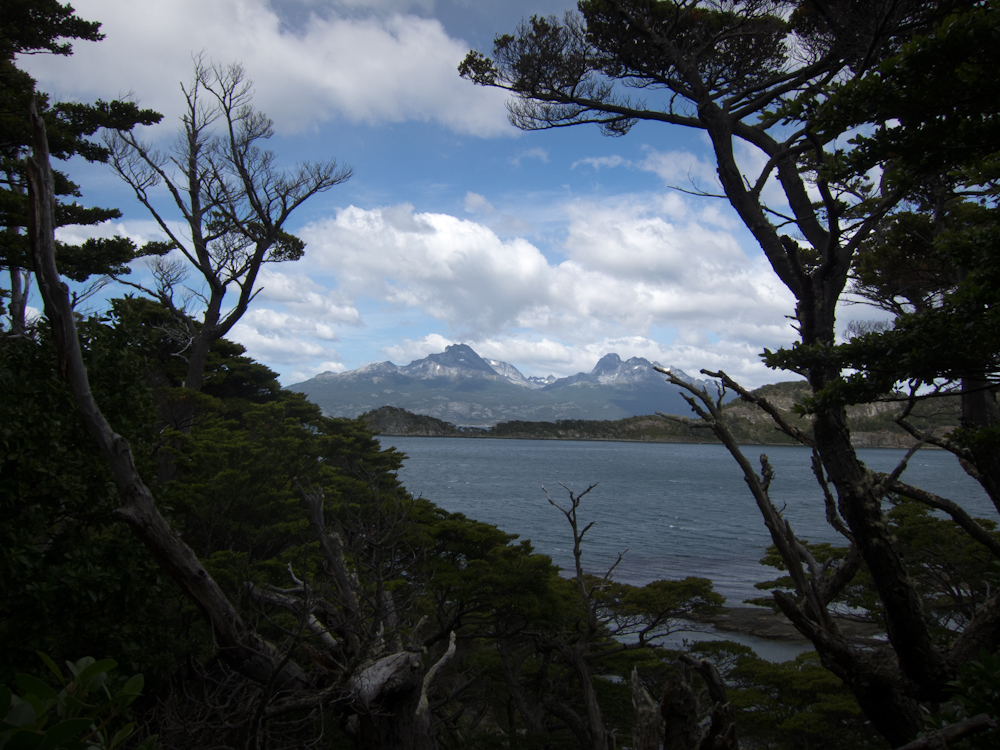
Finally, we spent an afternoon hiking in Tierra del Fuego National Park, the southern most national park in the world.  Once we recovered from the shock of the cost of getting there (85 pesos each, about $21.25US) and the daily park entrance fee (also 85 pesos each), we did enjoy hiking the Costera trail that followed the coastline of the Beagle Channel for about 8 km.  We saw some beautiful and varied scenery of majestic, snow-capped mountains, dense forest, pretty meadows and rugged beaches.

The weather in Ushuaia is quite unpredictable.  We were surprised with the mild temperatures when we arrived, probably mid-teens during the day.  Most days have been a mix of sun and cloud, some days more windy than others.  The air is cool so when the sun is not out and the wind picks up, it’s time to put on the wooly hat and mitts, and add a layer or two.  When hiking, we were always prepared for any type of weather and it was not uncommon to strip down to our t-shirts only to bundle ourselves up with fleece, windbreaker, hats and gloves all within a couple of hours.  It rained hard one night, and we’ve had some very slight, barely noticeable sprinklings of rain during the day.  Again, we’ve been lucky as far as the weather is concerned.  We’re also enjoying the long days.  As I finish off this post at 10:45 pm, the sun is just starting to set.  It seems our bodies have adjusted accordingly and we are going to bed much later and sleeping in each morning until around 9:00 which is quite late for us.  It’s strange how daylight affects your natural rhythms.  We’re even eating dinner later, 9:00 or later each night.  But that may just be because we’re in Argentina where many restaurants close after lunch and don’t even open until 8:00 at night.

Tomorrow we board the Sea Spirit and we’re off to sea for 19 days of adventure.  I hope we have calm seas – well maybe one storm just to see what it’s like – and clear weather.

Sea SpiritSea Spirit with Quark Expeditions
http://www.quarkexpeditions.com/sea-spirit 


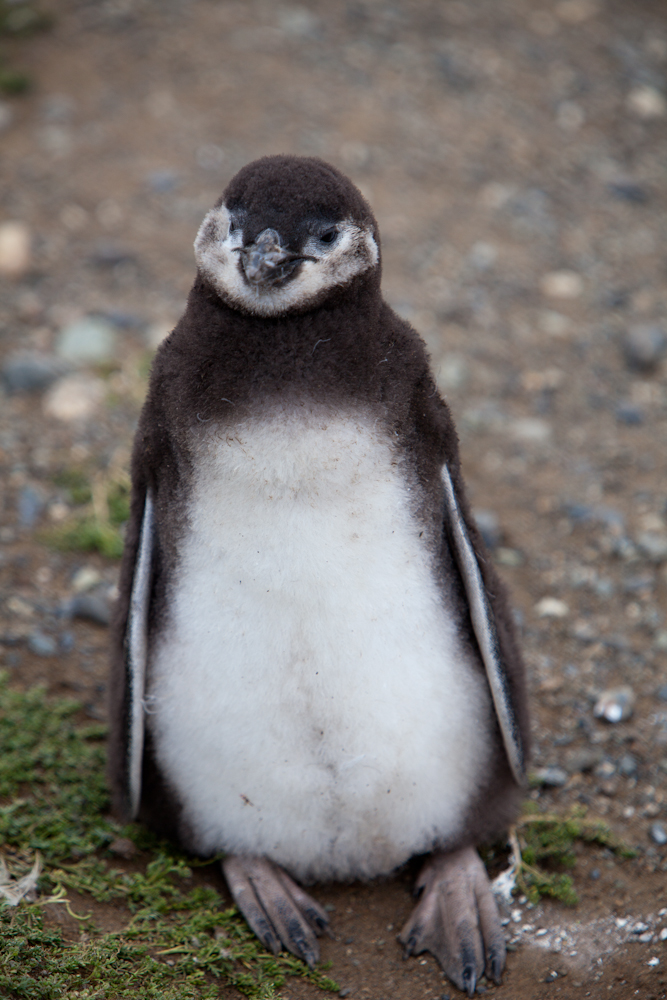
Isla Magdalena: Home to 120,000 Magellanic penguins

I wanted to be wowed, and Isla Magdalena delivered with its breeding colony of more than 120,000 Magellanic penguins.  This small, uninhabited island lies inside the infamous and important Magellan Strait at the southern end of South America, at the tail end of Patagonia and just north of Antarctica. Not only was I impressed by the sight and sounds of this magnificent penguin colony, I felt humbled by the rugged beauty surrounding me and very privileged to be a spectator to mother nature’s wonders. The rawness of the landscape, the sweep of the sea, the softly undulating hills, and the thousands of penguins made it a wonderous sight.

The Magellanic penguin is named after the 16th-century Portuguese explorer, Ferdinand Magellan who circumnavigated the world.  These penguins are found only in southern South America and the Falkland Islands. It’s a medium-size penguin with a black back, a white stomach, and two distinctive black bands between the head and chest.  Click here to learn more about this amazing bird.

In 1983, Isla Magdalena was declared a protected national monument, Los Pingüinos Natural Monument, and its only occupants are park rangers there to protect and monitor the penguin population, as well as educate the human visitors who drop in.

As we reached the island late in the afternoon, after 2 hours at sea, we were astonished by the sheer number of penguins on this island. Everywhere you looked, there were penguins. At this time of year, the eggs have all hatched and the chicks are about 6 weeks old – cute, cuddly fur balls that you just wanted to pet and take home with you.  Each adult pair had two chicks.  Nests were dug into the side of the sandy hills and offered safe refuge and shelter for these little families. Penguins are quite territorial and possessive about their nest, shooing away any non-family member who dared to venture too close, including us humans. I even had my ankles pecked as I inadvertently got too close to a nest taking a picture of another family close by.
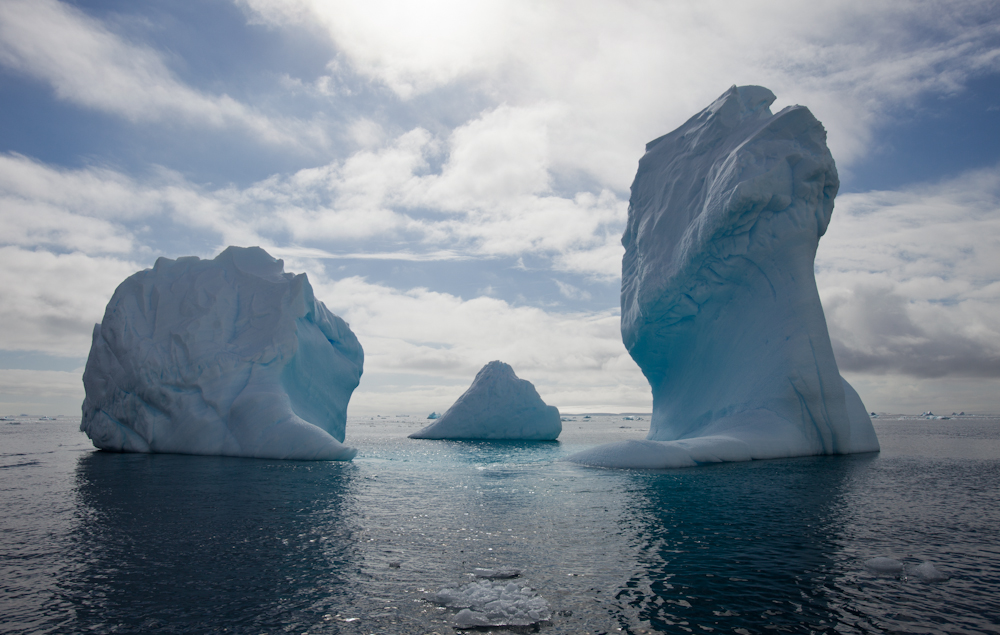
The cacophony on the hills was deafening but we learned that all this noisy barking served a purpose: penguins identified each other audibly which makes sense when you think about it since they all look alike. How else are they going to find their family when they come home after a day of fishing if not to yell out, Mary, where are you?  Turns out, they recognize each other by their bark!

Lots of penguins (slide show)
%%wppa%%
%%slide=8%%
%%size=400%%

As we walked along the marked pathway, penguins were everywhere.  They waddled in front of us, behind us, beside us, quite indifferent to our human presence.  We were enthralled by their antics including hillside brawls, personal grooming, and open displays of affection.  Now this is an island worthy of a top ten rating for places to see before you die…at least in my humble opinion.

Come for a walk through the penguin colony (video)


Baby it’s cold down here

As we stepped off the plane in Punta Arenas last Thursday, we were greeted with a definite chill in the air.  Maybe not as cold as Canada, but definitely the coldest weather we have experienced so far. Daytime temperatures were in the mid-teens if the sun was out, probably closer to ten when it was cloudy. At night, it dipped below zero.  Is anybody feeling sorry for us yet?  I didn’t think so.

As we pulled up to our hostel, La Estancia, the peeling paint and faded sign did not exactly exude warmth and comfort.  On the inside, more peeling paint, worn out carpets and creaking floor boards gave us a sinking feeling.  But all this changed when we met Alejandro, or Alex, the hostel owner.  He warmly greeted us and made us feel so welcome. He helped us get oriented and even made all the arrangements for our tour to a penguin colony the next day (more about that in a separate posting).

Our spotless room was very large with three comfortable single beds (we pushed two together to make a king sized bed – luxury), all covered in thick blankets and down duvets.  We had a TV with English channels (unheard of to date) in our room in addition to WiFi. The towels were extra large and extra thick, another rare indulgence. Each room had newly installed heaters and the common areas were also heated; a must in this climate, but not a very common sight in Chile.  We had access to the kitchen, including a fridge.  To top it off, they served unlimited, extra large mugs of real, filtered coffee with breakfast.  We couldn’t remember the last time we had real coffee in a hostel.  Instant Nescafé is the South American favourite. All this to say, you can’t always judge a book by it’s cover.  All of a sudden, this old, worn out 1920’s era house felt warm and cozy like a comfy old pair of slippers.  It served as an excellent base from which to explore the area.

Punta Arenas is the largest city south of the 46th parallel south with a population greater than 154,000. The city is vibrant and modern.  In the summer (which is now) the city can get dangerously windy to the point where city officials put up ropes in the downtown area to assist with unique wind currents created by the buildings.  It was rather calm during the few days we were there with a mix of sun and cloud each day. When it was cloudy, it felt a lot like a day in late October in Ottawa….brrrrrr. Unlike Ottawa, we are enjoying very long days – it doesn’t get dark until about 10:45 at night and dawn begins around 4:30 in the morning.  It’s deceiving and a little disorienting at times.

We spent some time exploring the city, wandering around the harbour and malecon as well as the Plaza des Armas. The cemetery in Punta Arenas resembled the one we visited in Guayaquil, Ecuador and is similarly called the White City.  It was impressive.

Perfectly trimmed European Cypress trees stood like sentries in the city cemetery.

Tombs in the municipal cemetery which was founded in 1894.

These European Cypress trees were perfectly manicured,
even though they were not always perfectly straight.

We were surprised to see flowers such as lupins and roses growing
abundantly everywhere around town – on the side of the road,
in people’s gardens as well as here in the cemetery. 

This old dock had seen better days but it made a
great perch for hundreds of seagulls.

Boats docked in the port.

A nautical monument in honor of the past.

As I walked along the old beams of this dock for a short distance
over the deepening sea,  
the strong wind sent ripples
along the surface of the water below making me a little

dizzy and wobbly, but I kept going and I didn’t fall in! 

Originally we had planned to stay in Punta Arenas for just a day to visit the penguin colony and then head north to Puerto Natales from where we would organize ourselves for our camping trip in Torres del Paine National Park.  Unfortunately, a forest fire has been burning in the park since just after Christmas. This has caused quite a raucous here in Chile since we are now in high season and that park attracts millions of tourist dollars at this time of year.  An Isreali tourist is being blamed (and charged) for starting the fire, an action he is vehemently denying.  This is serious stuff – the tourist has been detained and if found guilty will go to jail and be ordered to pay a fine.  Right now, part of the park has been re-opened but the fire continues to burn and fire fighters are still working day and night trying to put it out. We think it is still a precarious situation since any change in wind direction or strength could put the rest of the park, and tourists, in danger again.

So, we’ve decided to hold off on visiting the park, and go to Ushuaia, Argentina instead.  We will then circle back to Torress del Paine in a couple of weeks if the fire situation is resolved. At least we have the luxury of time on our side.


Side trip to Chiloé

Listed as one of the top ten islands to see before you die by Yahoo Travel, we were compelled to spend a few days exploring the Island of Chiloé which is separated from mainland Chile by a 30-minute ferry ride across the Chacao Channel.  The island is renowned for its sixteen wooden churches which have UNESCO World Heritage status.  The churches are clustered around the capital, Castro on the island’s east coast.  The traditional palafitos (houses on stilts), distinctive folklore, mythology, cuisine and unique architecture contribute to the island’s appeal.

The island is 190 km (118 mi) from north to south, and averages 55–65 km wide (35 to 40 mi).  Chiloé is located about 80 km south west of Puerto Montt which was the city from which we were flying to Punta Arenas on January 5th.  We decided to reduce our stay in Pucón in order to have a few days to explore this island, which was again recommended as a “must see” by many travellers we have met.

On January 1, we travelled from Pucón to Chiloé, with a bus transfer in Puerto Montt.  When we took the ferry across, we were delighted to see dozens of dolphins swimming alongside the boat, breaching right in front of us.  We even saw a few penguins bobbing to the surface now and then. Closer to shore, we spotted a group of sea lions sunning themselves on a wooden raft. And then we caught a glimpse of a flock of black necked swans, creatures I have never seen before.   What an unexpected spectacle!

We spent the first two nights in Castro, followed by two nights in Ancud, a town on the north west part of the island. Again, we enjoyed perfect weather: warm, sunny, cloudless days.  Considering that for 75% of the year, this island is shrouded in mist and rain, we were incredibly lucky.

View from our hostel, El Mirador (white building to the left of Chris) in Castro.
Our room faced the water offering a gorgeous view, but the hostel
itself was old and worn out and wreaked of stale smoke.
It reminded Chris of his grannie’s house when he was a kid.

Out hostel in Ancud, Nuevo Mundo, was lovely – huge room (queen bed) with
cathedral ceiling with large bay window overlooking the water.
This hostel had the cleanest kitchen we have seen so far
and offered beautiful and comfortable common areas. 

Nuevo Mundo on the inside.

Throughout our visit on the island, I kept trying to figure out what all the fuss was about. Sure, it had lovely, picturesque landscapes of rolling hills, meadows of wild flowers, healthy livestock grazing contentedly…… but it really could have been anywhere in rural Ontario as far as I was concerned.  The little towns and villages that dotted the coast reminded me of Atlantic Canada. Again, very pretty, but also very similar to home.  Of course, we observed subtle differences like the unusual patterns of shingles used as siding on the houses.

A typical house on the island.

One of the famous churches; this one was in Achao, a small fishing village
we travelled to by local bus for an afternoon.

The pier and beach in Achao while the tide was out.

Colourful houses on one of the main streets in Castro.

A common scene when the tide was out.

Many of these boats were badly in need of repair.

Chris was fascinated by the technique being used to repair this boat:
one guy wedged string between the new boards using a hammer and chisel,
and the other guy applied some sort of a putty or seal on top,
followed by a thick coat of paint.

The language was different too, in fact, completely different from mainland Chile which left me puzzled and frustrated in equal measure.  Ordering food became such an ordeal – I could not understand the menu and then I could not understand the waitress who tried to explain the menu – towards the end, I resigned myself to eating salmon for several meals because that is all I could recognize on the menu. I know, no sense of culinary adventure, but what can I say, sometimes, I just want to eat something remotely familiar. We did get our fill of seafood and enjoyed a few local dishes that were very good.

Perhaps a visit to the cove of Puñihuil, home to two types of penguins, Humboldt and Magellan, would knock our socks off.  We were certainly amazed by the sudden change in weather as we approached the western side of the island.  Within minutes, we went from warmth and sunshine to heavy mist and cold wind.  This shift in weather completely changed our impression of the landscape; suddenly it all looked very mystical and mysterious.  Maybe our grand weather was a curse after all!

We spent about twenty minutes in a small boat visiting three tiny islets just off the shore line where we observed a few dozen penguins along with a variety of birds.  This may have been impressive if we had never seen penguins before; perhaps the Galapagos Islands have forever ruined us.

A short video of our visit to the penguin colony.  


While we didn’t feel the magic of Chiloé, it was a very pretty island and our few days meandering around the island were relaxing and quite enjoyable.  On Thursday morning we left bright and early to head back to Puerto Montt where we would catch our flight to Punta Arenas, located in the southern most region of Chile.

Example of the palafitos, houses on stilts,
with a flock of black neck swans in the foreground.  

These swans are smaller than the swans we have at home
with distinctly black necks and white bodies.
Unfortunately, I think they had all dunked their heads in the water just as I took this picture!