
We are heading off for an 8-day cruise on a luxury yacht. We may not have internet connection so may not be posting for a while. We’ll be sure to tell you all about our voyage when we’re online again.
An average Canadian couple breaks free from their conventional lives to discover the world.
We are heading off for an 8-day cruise on a luxury yacht. We may not have internet connection so may not be posting for a while. We’ll be sure to tell you all about our voyage when we’re online again.
 The Galapagos Islands welcomed us with sunny blue skies and warm temperatures on Tuesday afternoon. The easy two hour flight was followed by a tedious and inefficient debarkation process that took almost as long as the flight! It began before we landed when the flight attendants went through the cabin opening the overhead luggage racks and spraying insecticide throughout the cabin. We were assured this was harmless to our health – but really, what else are they going to say? I held my breath as they passed me to avoid breathing in the intoxicating fumes.
Once on land, we all lined up to receive a piece of paper that permitted us to be on the islands after our personal information was typed into a computer (very slowly I might add). We then went to the next agent who took our $100 national park entrance fee. And then we had our personal bags inspected. We waited for our luggage which had been removed from the plane and was now being sniffed by dogs. All these precautions are necessary to ensure nothing is introduced into this special ecosystem. Once our bags were deemed safe, we lined up yet again to have someone inspect each piece of luggage against our baggage ticket to ensure each person had the correct piece of luggage. One person handled this process for the entire plane load of people – it took a while! We then went onto a shuttle that took us to a water taxi that took us to a bus. The bus brought us into Puerto Ayora in about a half an hour. Throughout this process we marvelled at the color of the water – the purest aquamarine I have ever seen. Not surprisingly, since these islands are volcanic, the landscape was quite barren with volcanic rock everywhere.

Puerto Ayora is located on the southern shore of Santa Cruz Island and is the most populated town in the Galapagos with a population of more than 10,000 inhabitants. The town is home to a bank, several ATM’s, schools, hotels, restaurants, clothing stores, hardware stores, grocery stores, marine stores, tourist shops and night clubs. The Charles Darwin Research Centre is situated here as well – more about this in a future post after we visit it. Puerto Ayora emergency medical facilities include a new hospital opened in 2006 and the island’s only hyperbaric chamber – a comforting thought since we are planning to do some diving here.
In a true spirit of adventure we arrived in Puerto Ayora without any reservations whatsoever. First order of business was to find a place to stay which proved to be quite an easy task since we are still in low season. We settled on Hotel Espana, a fairly large hostel with spacious, clean and comfortable rooms at economy rates ($25 per night per room).
After settling in and having some lunch, we made the rounds of the many tour agencies in town to see what last minute deals were available. We had two weeks to plan out and we were completely flexible. Did we want to do a land based trip with day trips to the various islands? Or visit the islands by a cruise boat? Would that be a 4-night, 5-night or 8-night cruise? Luxury or economy? So many decisions. Unfortunately we did not have internet connection at our hotel at this time as they had problems with their router (which Chris subsequently resolved – my hero) so we were limited with the information we received from these agencies. By the middle of the next morning we had our itinerary figured out, the highlights of which were an 8-night luxury cruise (yes we blew the budget again) and getting our advanced diving certification which involved 5 dives. We would have time in between to do a couple of day trips to islands we don’t see on our cruise as well as to do some things on our own.
 With the itinerary figured out, the fun could now begin. On Wednesday afternoon we walked the 2.5 km to Tortuga Bay, the largest and quite possibly the most spectacular beach in the archipelago.
The path took us through a cactii forest featuring the giant cactii, the only species of opuntia cactus in the world that grows like a tree. This cactus is able to hold copious amounts of water and grow directly on volcanic rock. The opuntia forest is home to the cactus finch which pollinates its flowers, feeds on its nectar and builds nests within its protective branches. We saw these little birds flitting about everywhere and were surprised at how close they came to us.


 We walked along the white, powder fine sand, dipping our toes into the clearest water I have ever seen. The first beach has a strong under current and swimming is not permitted; however it is an idyllic spot for surfing and sure enough, as we were leaving the beach at around 4:00, the surfers began to arrive.

Beyond the main beach is a small lagoon which is ideal for swimming. The water was calm, clear, and refreshing.

The marine iguana, a species unique to the Galapagos, intrigued us. Their habitat is sub-tidal and inter-tidal where they find their food: green and red algae. Above the tidal line, they bathe in the sun and rest in order to have energy to find appropriate locations to build their nests and lay their eggs. We saw them walking along the beach (quite oblivious to us), swimming in the ocean, and sun bathing on the lava rocks.

The group of iguanas below were sunbathing along a walking path. We had to walk around them to get by – they didn’t seem to mind at all although they were spitting a lot. We found out later they do this to get rid of the salt in their mouths.

As we strolled along this gorgeous expanse of paradise, we began to realize how special these islands are and how fortunate we were to be visiting them. This is truly a once-in-a-lifetime experience for us.

 Yesterday afternoon, we stumbled upon La Ciudad Blanca (the White City) located at the foot of Cerro del Carmen. Our discovery began when we observed a funeral procession leaving a church. As a large group of mourners walked behind the coffin bearers, we assumed they must be heading towards a cemetery. Our guide book confirmed that we were indeed in the vicinity of the city’s cemetery. Frommer’s described the cemetery in this way: “The cemetery has some impressive above ground marble tombs and mausoleums in a variety of styles ranging from neoclassical Greco-Roman to baroque to Moorish. The tombs are spread across a vast hillside area and connected by paths and even streets. The cemetery was opened in 1843 and has become a major emblem of the city.” This was enough to peak our interest to seek out the cemetery but in the end this description hardly did justice to what we saw.


At the main gate, vendors sold beautiful flower arrangements, a typical sight at the entrance of many large cemeteries. However, this cemetery was anything but typical as we discovered immediately inside the gates. Six three-story buildings – they looked like apartment buildings – flanked a majestic walkway that lead to a large alter and cross. Each building housed hundreds of stacked vaults. I stopped counting after seeing 20 such buildings, each of which had four corridors on each floor. Each corridor had 24 vaults on each side, 4 vaults high. I thought this was the extent of the cemetery which is why I tried to calculate how many vaults resided in these buildings.


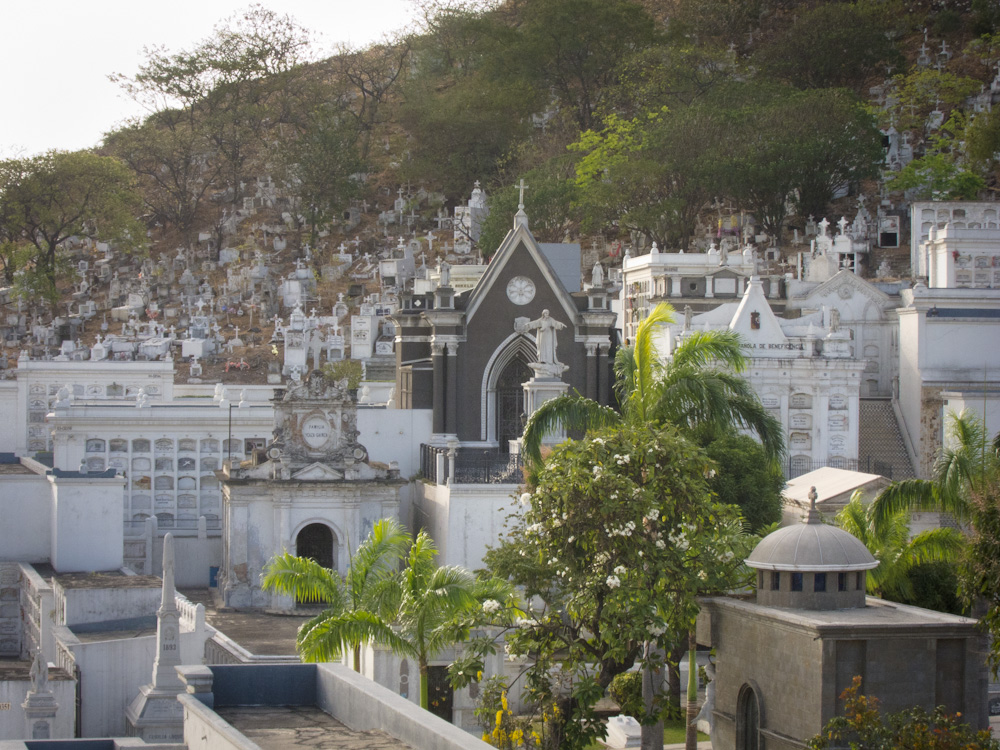 However, as we walked past the “apartments”, we were stunned by what we saw – an entire city of tombs lay before our eyes. As Frommer described, there were many architectural styles to these tombs. Once could easily forget that this was a cemetery as it looked more like a museum of beautiful statues and reliefs. The cemetery is indeed like a city of the dead, as there are main avenues, side streets, and stairways connecting each area.


There were large, beautiful family mausoleums along the main boulevard. Each one was distinct. As we walked amongst these mausoleums, the beauty and tranquility engulfed us.

The back of the cemetery is reserved for foreigners and was originally called “Protestant Cemetery”. There is a 200 foot separation between this area and other sections of the cemetery to ensure the “souls do not mix”. A few meters behind is the Jewish cemetery, distinguished by their graves on land and the Star of David on gravestones that are written in Hebrew. I also noticed another area of Jewish tombs (similarly distinguished by the Star of David), on the roof of one of the “apartments” (see above photo).
This was truly a remarkable and unique cemetery. What an impressive way to end our tour of Guayaquil.

 Guayaquil (pronounced why-a-keel) is the largest and most populated city in Ecuador with about 2.3 million inhabitants in the city and nearly 3.1 million in the metropolitan area. The city is situated on the western bank of the Guayas River which flows into the Pacific Ocean. Because of its location, Guayaquil is the center of Ecuador’s business and manufacturing industries, and boasts the nation’s principal port. We observed first-hand the results of recent urban regeneration projects designed to transform Guayaquil into a first-class international tourism destination and business center for multinationals.
 We arrived at the Hotel Ramada early Friday afternoon and were pleased to find our room overlooked the Malecon and the river. Although the hotel was rated 4-star, we wisely lowered our expectations as we suspected, and it was confirmed, that hotel ratings are not universal. A 4-star rating in Ecuador is definitely not equal to a 4-star rating in Canada. That aside, we were very happy with the quality and amenities of this hotel. The location was fantastic – on the north end of the Malecon within easy walking distance to all attractions. Our room was spacious, clean, secure and air-conditioned –something we were very grateful for as temperatures each day were in the 30’s before humidex.
 We began each day with a hearty breakfast buffet, included with our room rate. This was the best breakfast so far with real coffee – believe it or not, while Ecuador grows, produces and exports coffee beans, it is not uncommon to be served a coffee-like drink instead of the real thing. So when we get a good cup of brewed coffee such as the coffee we enjoyed each morning in Guayaquil, we really appreciate it – ahh, sometimes it’s the simple pleasures that can make such a difference. The buffet also included a variety of fresh fruit juices, fresh fruit, hot food (scrambled eggs, meat, pancakes), ceviche (which is usually served as an appetizer before dinner), selection of breads and pastries, yogurt and dry cereals. It was plentiful, and varied each day. And it held us until late afternoon too.
The pool, sauna and steam room have been a daily, refreshing delight. We managed to do some of our Spanish lessons while relaxing by the pool. Speaking of Spanish lessons, our Spanish is deplorable. I would have thought that by now we would be making great strides but every day is a struggle to make ourselves understood. Our vocabulary is still so limited and it seems the words we need to communicate have not yet been learned. Add to that, our brains are like a sieve. Guess it must be our age or something but we will practice a phrase or two in advance when we know we’re going to be in a certain situation, and unless I write it down, good luck remembering it. It’s hard to teach old dogs new tricks.
 Over the past few days, we have strolled the Malecón 2000 many times. This is a 2.5 km boardwalk overlooking the Guayas River. Several of the greatest historical monuments in the history of Guayaquil can be seen along its length, as well as museums, gardens, fountains, shopping malls, restaurants, bars, food courts, the first IMAX theater in South America, as well as boarding docks where several embarkations offer both daytime and nighttime tours up and down the Guayas River. It is one of the largest works realized in Guayaquil and it is considered a model of urban regeneration by global standards, having been declared a healthy public space’ by the Pan-American Organization of Health (POH) and the World Health Organization (WHO).


 The Malecon was a magnet for families and young couples, especially on the weekend. All day long, people strolled slowly along the boardwalk, frequently enjoying ice cream cones along the way. We think eating ice cream cones must be a national past time – something Chris has heartily endorsed in his daily routine. The sound of children playing in the parks and the sight of parents sitting on benches nearby gave a wholesome, lively feeling to the area. I noticed a common sight amongst families with young babies. The baby would be wrapped in a lovely blanket – pink for a girl, blue for a boy – and either the mother or father would lovingly carry the baby in their arms as they walked along the Malecon, proudly parading their new offspring for the world to see. It always brought a smile to my face when I saw these young parents carrying their often newborn babies in this way. The Malecon offered a lot of amusement for young children – a little train that travelled back and forth along the board walk, face painting, electric cars, and several large playgrounds to name just a few.
 Police presence was strong both along the Malecon as well as throughout the downtown core, making us feel very safe even at night. We also noticed how clean these areas were, in sharp contrast with the rest of Ecuador. Obviously the local government was making tremendous efforts and was having success in transforming Guayaquil’s reputation from a dirty, unsafe city to a city that was safe and welcoming to tourists. It reminded me of a similar transformation that was achieved in Manhattan in recent years.
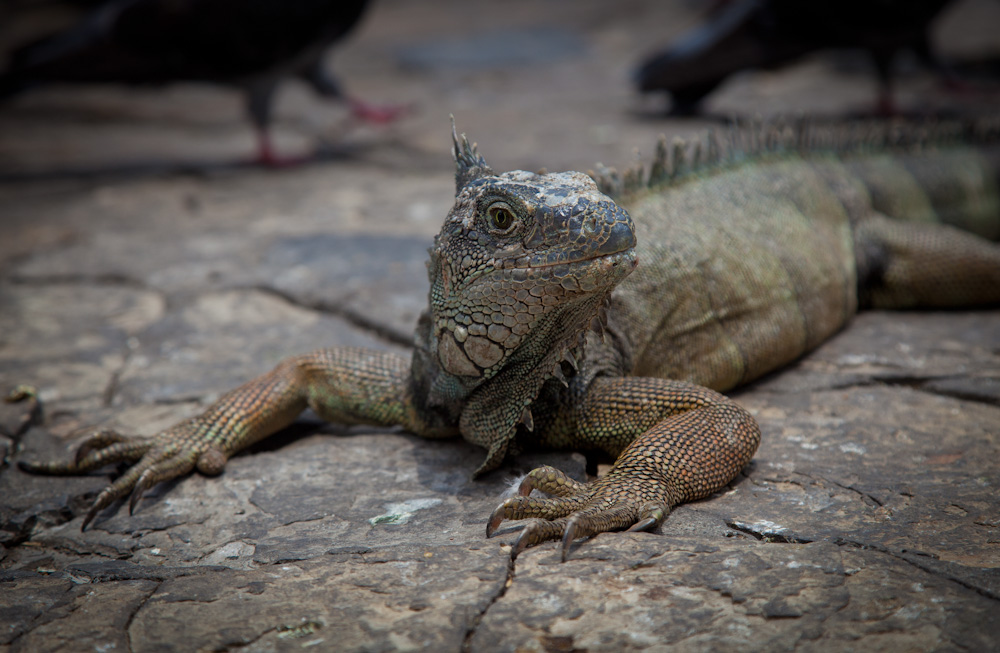
 Now in tourist mode, we visited four museums all of which were in Spanish which meant breezing through them rather quickly. We wandered through a few churches. We were intrigued by Parque Seminario (also known as Parque de Las Iguanas or Iguana Park) which is home to many iguanas, some of which approach 5 feet in length. Tourists and locals alike often feed the iguanas mango slices from park vendors. There is also a pond filled with colourful Japanese Tilapia and turtles. An equestrian statue of Simón Bolívar is located in the centre of the park. As we paused to get a closer look at these pre-historic looking creatures, there was a sudden large splatter of green goop that fell from the sky right next to us, spraying each of us a little – what the hell was that?!? We looked up to see the trees above laden with iguanas who seemed quite content to poop wherever and whenever they pleased. Yuch! We quickly made our way to the edge of the park, outside of the firing range of these pooping iguanas. It was quite a sight to see hundreds of iguanas in a park in the middle of a city. I still don’t know why they are here or where they came from.

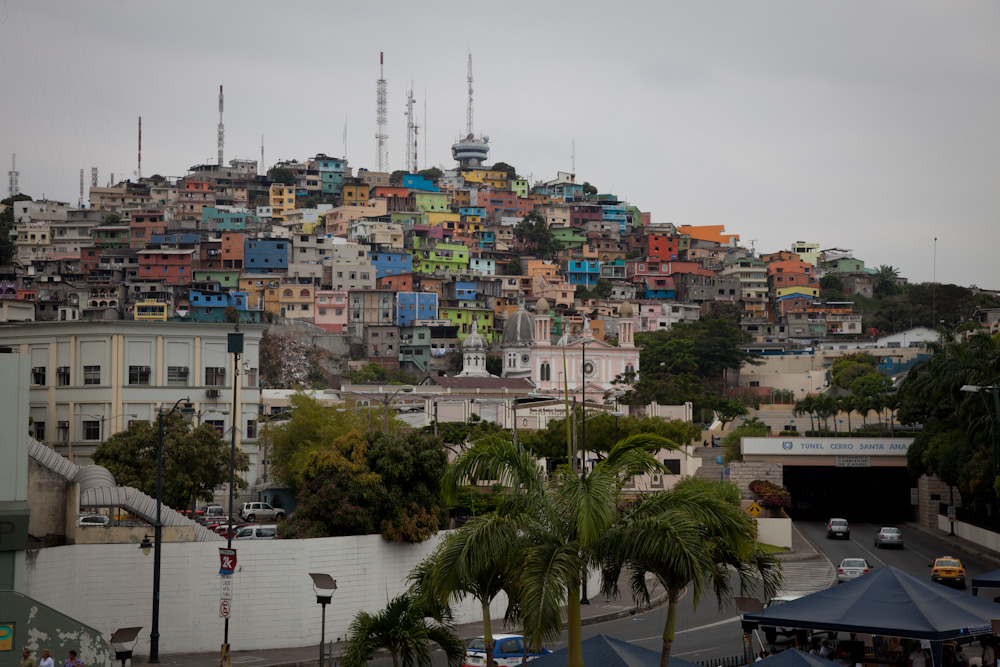
 The historic neighbourhoods of Las Peñas & Cerro Santa Ana have been refurbished into an idealized version of a quaint South American hillside village, all brightly painted homes and cobblestone alleyways. If you peek inside an open door or window, however, you realize it’s just for show as residents still live their everyday lives as they would elsewhere in the city.

The 456 steps of Cerro Santa Ana (each numbered) lead past dozens of refurbished, brightly painted homes, cafés, bars and souvenir shops, and up to the hilltop fort, Fortín del Cerro (‘Fort of the Hill’). Cannons, which were once used to protect Guayaquil from pirates, aim over the parapet toward the river and are still fired today during celebrations. We climbed the lighthouse for a spectacular 360-degree view of the city and its rivers.



We have thoroughly enjoyed our cultural respite in Guayaquil and feel recharged, refreshed and ready for the next leg of our journey.

 It’s hot, hot, hot and sunny – perfect beach weather. Too bad we’re not at the beach! We are now in Guayaquil with a few days to kill before we catch our flight to the Galapagos on Tuesday. The last few days did not go exactly as planned, but I guess that is bound to happen now and then. You may recall that we were planning to go to Montanita to spend a few days in this beach town.
We arrived in Montanita early Wednesday afternoon under cloudy skies (nothing new there). Once we got ourselves organized with our packs, we set out to check a few hostels that looked promising on line. Along the way, a friendly gringo approached us and offered to show us the way as he was heading in the same direction. We didn’t think anything of it, accepted his offer, and chatted with him as we made our way to the various hostels, breaking some fundamental safety rules in the process. It is a well- known scam at bus stations for someone to befriend you, offer to carry your bags, help you load them onto the bus only to steal them when you’re not looking, because the bus guy thinks the bag belongs to your “friend”. It was only later that we thought of this and wondered if we were going to be victims of a similar scam and find ourselves robbed when we returned to our hostel. Thankfully, this was not the case, and Zachery from the peach state of Georgia was nothing more than a friendly guy doing a good deed for the day. I must admit though that we had some anxious moments wondering if we were at risk.
 Montanita is renowned for its surf which is much bigger and stronger than Canoa. This is not the place to learn to surf as the waves are pretty intimidating and there is a strong undertow. I missed my chance to take surfing lessons in Canoa due to a combination of bad weather and sore legs from horse back riding. But surfing will have to wait. This town is also known as a party town where young people flock to party the night away indulging in both legal and illegal pleasures.
We picked a hostel (Kundalini) on the edge of town, away from the bars and discos in an effort to ensure a good night’s sleep. As we walked around town looking for a place to eat, I had an uneasy feeling about this place. The town itself was quite charming in a laid back, beachy sort of way. The streets were lined with shops that sold surf related stuff as well as little kiosks selling everything from hand-made jewellery to the typical tacky beach souvenirs. The locals were a blend of Ecuadorians and foreigners who have made Montanita their home. Apparently it’s quite common for young foreigners to come for a visit and then never leave.

Why was I feeling so uneasy? Clearly we stuck out as different – not just being foreigners, but let’s face it, we aren’t young and we aren’t hip. Perhaps it was just an over active imagination on my part, but regardless, I wasn’t feeling very secure.
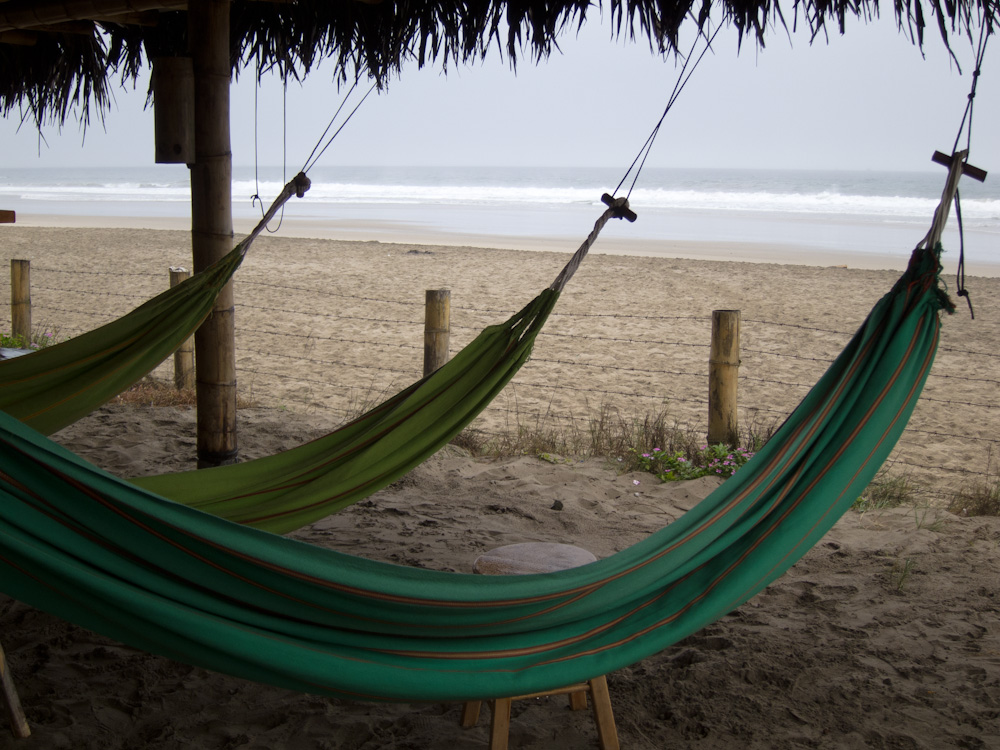
 And then the weather turned on us, for the worse. It got colder and started to drizzle – not the best beach weather for sure. As we watched the surfers from the hammocks on our balcony we decided that this place was not for us – in the morning we would leave for Guayaquil.
We’ve come a long way since our first bus trip in Quito. We’re no longer nervous about bus travel although we remain vigilant and cautious on travel days. Not knowing where the bus station is or when the bus is coming doesn’t really faze us anymore. We know we’ll sort it out when the time comes. We headed towards the main street in Montanita looking for a bus station or bus stop. I had read about the direct CLP bus but had no idea where to catch it or what the schedule was. By chance, we walked by a group of people with luggage who obviously were waiting for a bus. Turned out this was the CLP bus station and the bus to Guayaquil arrived as we were buying our tickets ($5.50 each). Good luck with the buses again. This was the most comfortable bus we have been on thus far. It was air conditioned, the seats were well padded, a movie entertained us, and it only stopped a couple of times along the way, arriving in Guayaquil in less than three hours.
The bus station in Guayaquil is the biggest bus station I have ever seen – I thought we were at the airport when we pulled in. We grabbed a cab to the northern suburbs where many well reviewed hostels are located. We arrived at our first choice only to find they only had dorm beds available. We actually debated the merits of this option – this hostel was quite lovely perched up on a hill with an amazing view of the city, it had a swimming pool and the property was very secure. On the down side, the dorm room was in the basement and looked more like a jail cell with eight twin beds/bunk beds which meant we could be sleeping with six strangers; we would have to lock up our belongings in the lockers at all times; the cost was high at $15 per person (at least by the standards we were used to); the hostel had no restaurant and was in an isolated location so finding food and getting around might be a problem.
 We decided against the dorm room, and headed over (by taxi) to another hostel (Nucapacha) in the same area. This one had great reviews online, also had a pool, and showed plenty of vacancies. But when we arrived, they only had twin rooms with shared bath available (and with cold showers we learned later). The rooms were bare bone. Our room had two single beds and a bunk bed. The mattresses were made of soft foam, and there wasn’t even a blanket on the bed, just a thread bare sheet. There was absolutely nothing else in the room except for a noisy fan. I felt we had sunk to a new low. To its credit, the hostel was clean, and the common areas weren’t too bad (mind you that lovely pool was closed for cleaning which it sorely needed). I had concerns about the security of the rooms – there were no closets to lock our things in, and the locks on the doors and window were very flimsy. Again, I did not feel safe. I don’t like this feeling. I can put up with basic accommodations, as long as they are clean and secure. We took the room for one night and then evaluated our options. I must admit I was feeling discouraged.


We did have options. We could stay put for the next five days and suck it up and hope our stuff was safe. We could leave town and go somewhere else such as Cuenca for a couple of days. We could look for another hostel and hope it was better (I now realize you can’t put too much weight in the on-line reivews and pictures). We could find a nice hotel (this is a big city with lots of nice hotel chains) and indulge in a little bit of luxury for a few days. It didn’t take us long to choose the latter option: 4 nights at the four star Ramada Hotel right on the waterfront. Afterall, we always said we reserved the right to check into a nice hotel when we felt we needed it!

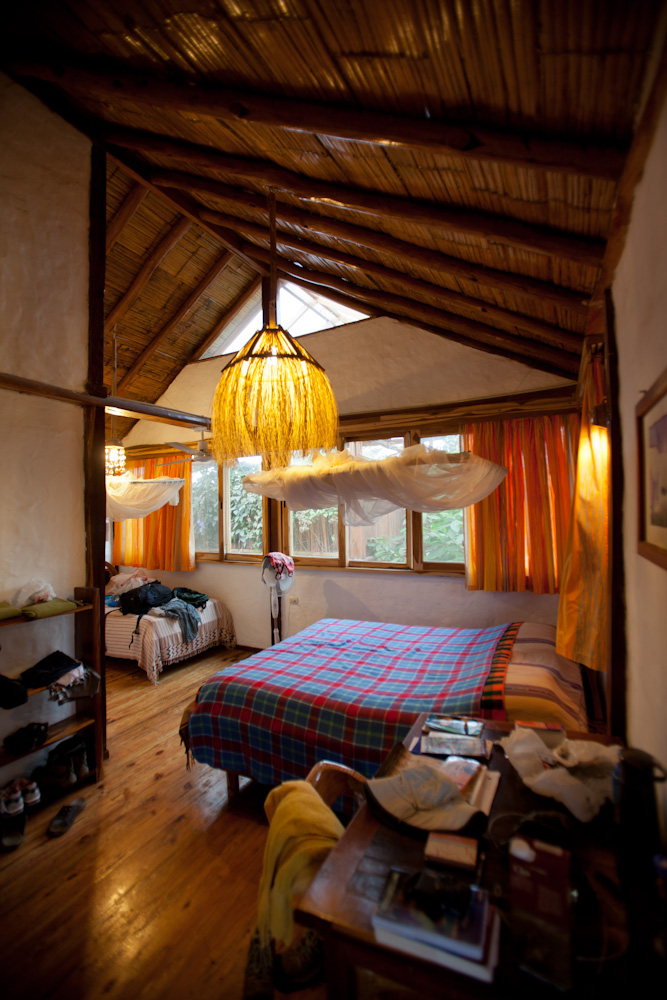
 Yesterday was a “chill” day. We slept in, had a leisurely breakfast in town, did some writing, photography, and generally just goofed off. Our hostel is a beautiful place to just kick back and relax. This has been the best hostel we have stayed in to date. The hostel is located on the north edge of town, engulfed in a lush, tropical garden that contrasts sharply with the bleak, dry vegetation that prevails along the coast during the dry season.


We spent the first couple of nights in a private cottage (photo to the right) which was lovely, but then we had to switch to a different room because the cottage was already booked.
Our second room was larger, the bed more comfortable, the shower hotter, and being on the second floor of a four-unit chalet made us feel like we were in a tree house.
The best part was our private balcony with a view of the ocean and two lovely hammocks that invited us to just relax.
We don’t think we fared to badly in the room switch.


The hostel owners are environmentally conscientious and “save the whales” information is everywhere, including the t-shirts worn by all staff.

The other unique features of this hostel include the amazing gardens and the artistic handiwork that appears everywhere, from the toilet seats to towel racks to the architecture of the main lodge. I’m by no means an expert, but I think these gardens outshine the Botanical Gardens in Quito by a mile.
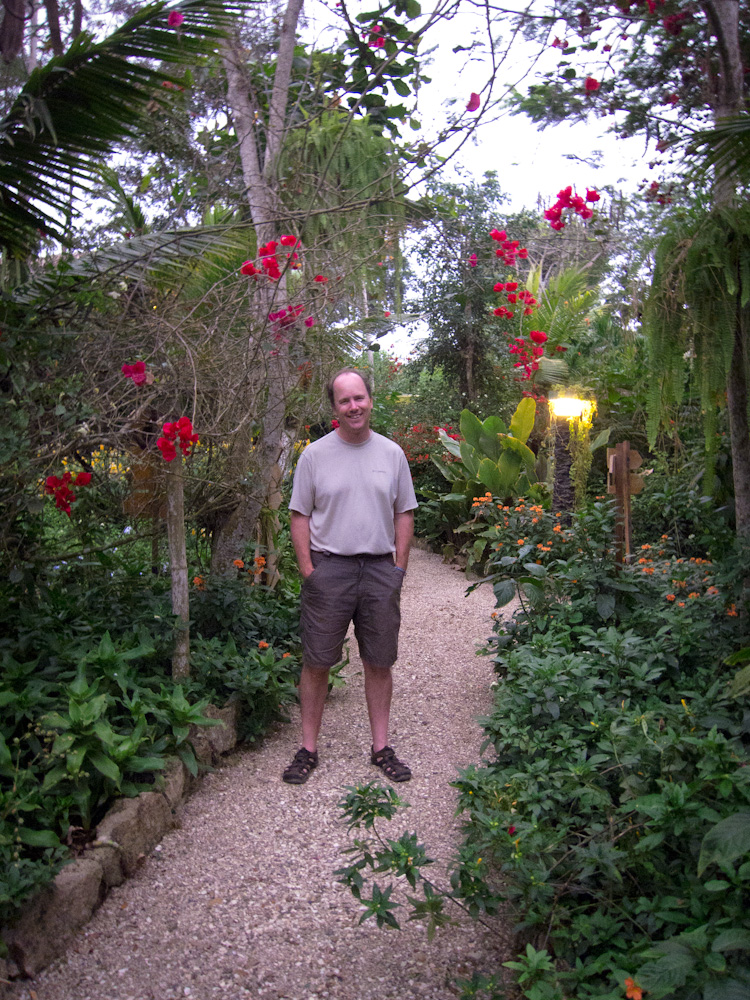
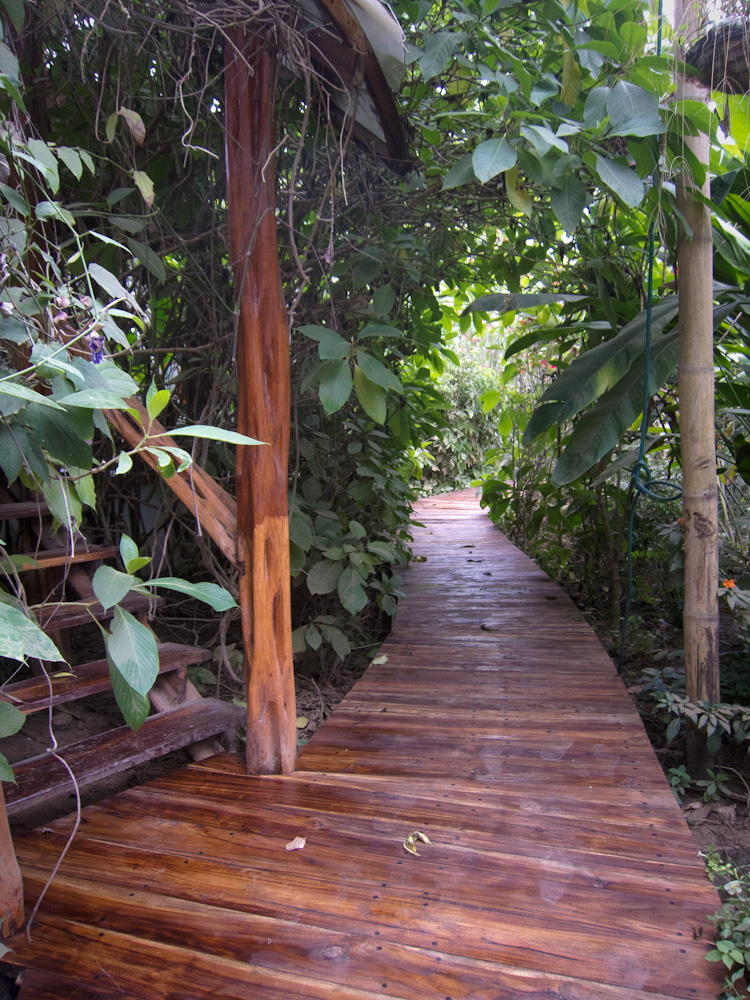
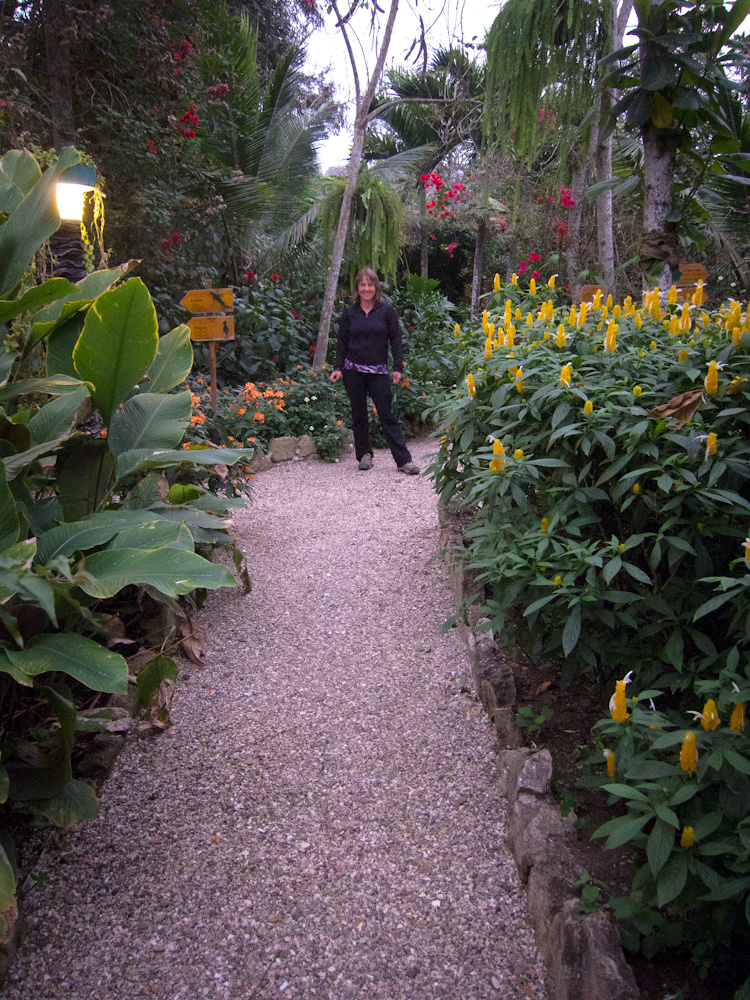
In the photo below, Chris is standing at the entrance of a second story deck equipped with multiple hammocks – a perfect place for a siesta. Notice the woodworking detail on the floor.

Another feature of this hostel, believe it or not, were the resident dogs. We have seen hundreds of dogs throughout our travels in Ecuador – dogs are everywhere and usually have free reign to roam wherever they please. We have seen all kinds of dogs – good, bad and downright ugly and mangy. The four dogs in this hostel are gorgeous and the one remaining pup (out of a litter of 10 – all of which have found new homes) is adorable. Check out this video of the puppy playing with mom.
We did some “work” yesterday – sort of. It was laundry day. There are laundry services everywhere in Ecuador and Puerto Lopez was no exception. It costs $7 or $8 to do a week’s worth of our laundry. Money well spent in our opinion. So far, we have only done laundry by hand once while we were in the hostel in Canoa. The rest of the time we have used laundry services wherever we are and we have always been quite happy with the results. Mind you, it is always a little unsettling as you drop off all your clothes to a little hovel or shack that happens to have a washing machine on site. You don’t get a ticket or a receipt or anything to prove that they have your clothes. I’m always amazed and relieved when we return at the end of the day to find our clothes fresh and clean, and all neatly folded and ready for us.
We also made some plans for the next leg of our trip – Galapagos Islands. We have booked our flight for next Tuesday and we will be on the islands for 2 weeks. The current plan is to find a hostel and do day trips to the various islands. However, we might consider a boat cruise for a week if we find a good last minute deal. Eduardo and Paola are planning to go in December and highly recommended basing ourselves on Isabela Island, something we are seriously considering. We still have a week to figure things out, and even then, we really only need to know where we want to stay the first night or two. At least our flights are now booked and we feel we got a pretty good deal: $560 return for both of us, including taxes. There is a national park entrance fee of $100 per person that we must pay at the airport before we leave. It will be an expensive couple of weeks, but we think it will be well worth every penny.
We must be in Guayaquil in one week’s time so we have some time to explore the coast a little more fully. We have decided to leave our wonderful hostel today and head down the coast to Montanita. After that, we may go to Salinas. As you may have noticed, we are not making plans too far in advance. This gives us the utmost flexibility. This approach is working out really well for us so far. We find that we are planning our itinerary based on the input we receive from people along the way. For instance, we weren’t planning on going to Montanita, but based on Eduardo’s recommendation, we will stay there for a few days.
The following is a collection of photos of the town of Puerto Lopez that have been taken over the past few days. Enjoy!


 Under a blanket of heavy, low clouds, we headed out to Los Frailes beach by taxi on Monday morning, with our diving friends, Eduardo and Paola. When we arrived at 10:00 in the morning, we had the entire beach to ourselves. Los Frailes beach, with its large, sweeping expanse of sand framed by high bluffs, is one of the most pristine stretches of coastline in Ecuador. Part of the protected Parque Nacional Machalilla since 1979, the beach is only a small part of the 55,000 hectares of coastal land home to a variety of marine life such as dolphins and sea lions, over 200 species of birds, howler monkeys, anteaters, deer, squirrels, iguanas, and lizards.
We are in the dry season here on the coast and everything looks dead – very similar to winter in Canada. However we have been told that by January when the rainy season begins this area will look lush and tropical. Hard to imagine that right now. Since arriving on the coast almost two weeks ago, the weather has been the same every day – cloudy with temperatures in the low 20’s and very little rain. We have only had one day of sunshine while we were in Canoa. This is definitely not lying on beach weather but it is very comfortable for hiking and sleeping. During the rainy season (January – May), it is very hot and sunny during the day and then torrential rains pour down each night. The rainy season coincides with the high tourist season.


 We headed north towards a trail that would take us through a dry forest to a lookout at the top of the bluff. The path meandered through unique dry forest vegetation with bottle-shaped trees adorned with heavy spines, spindly cacti, and fragrant trees up to a clearing that provided spectacular views of the coastline. We only saw a few birds, mainly vultures and pelicans. We encountered no other wildlife. We continued our hike to a neighbouring beach, Playa La Tortuguita where spiky rock formations jutted out of the turquoise waters and large crabs scurried along the rocks.

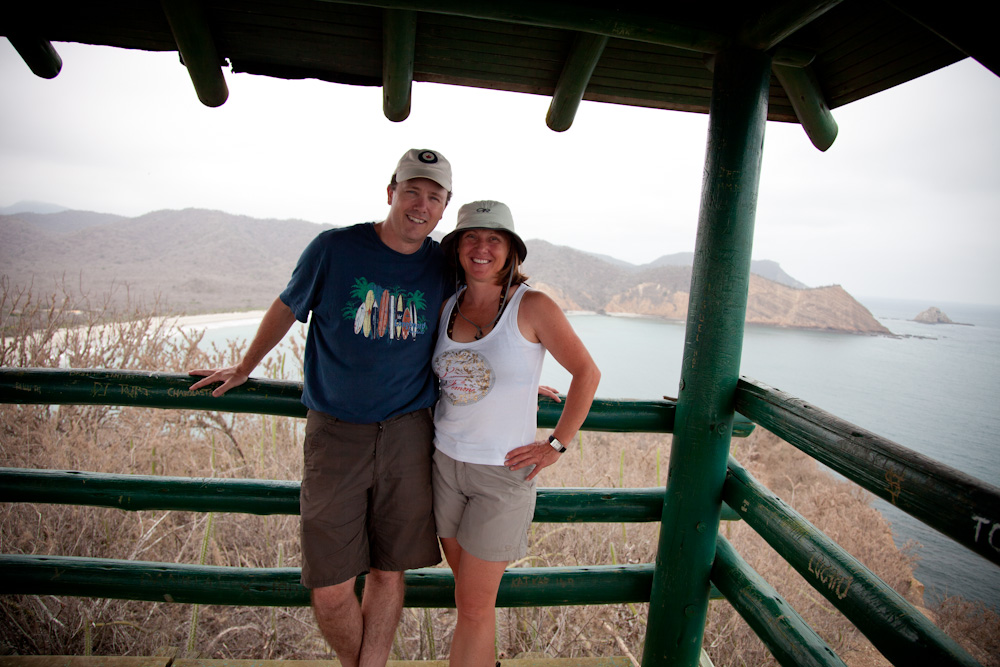

In spite of the weather which was a little on the cool side, Paola was determined to go for a swim and bravely went for a quick dip into the cool waters. Chris and I were content to stay warm and dry and enjoyed taking photos of the beautiful scenery.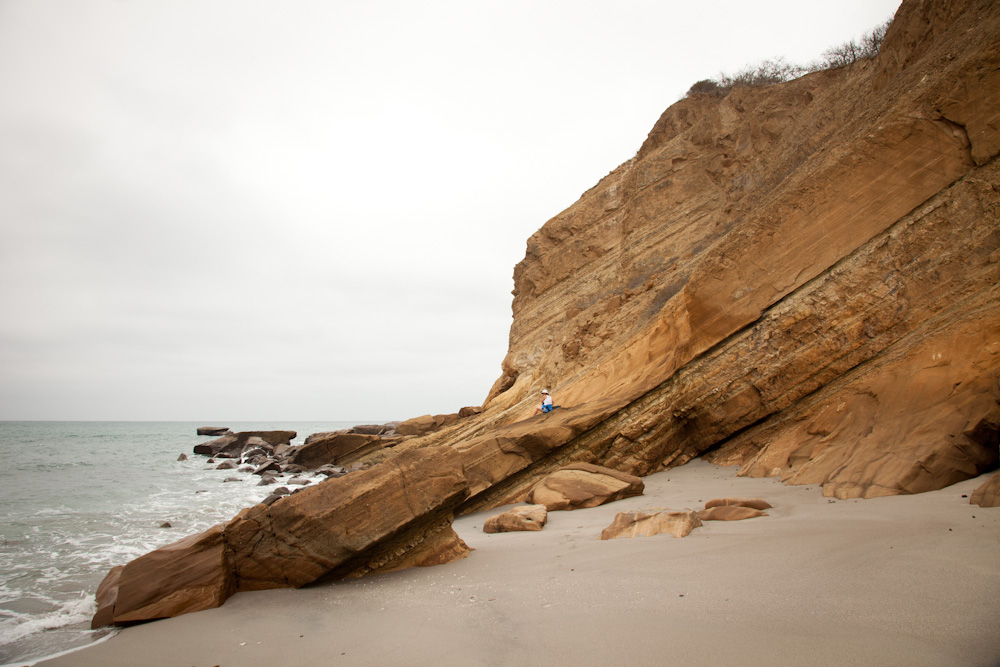
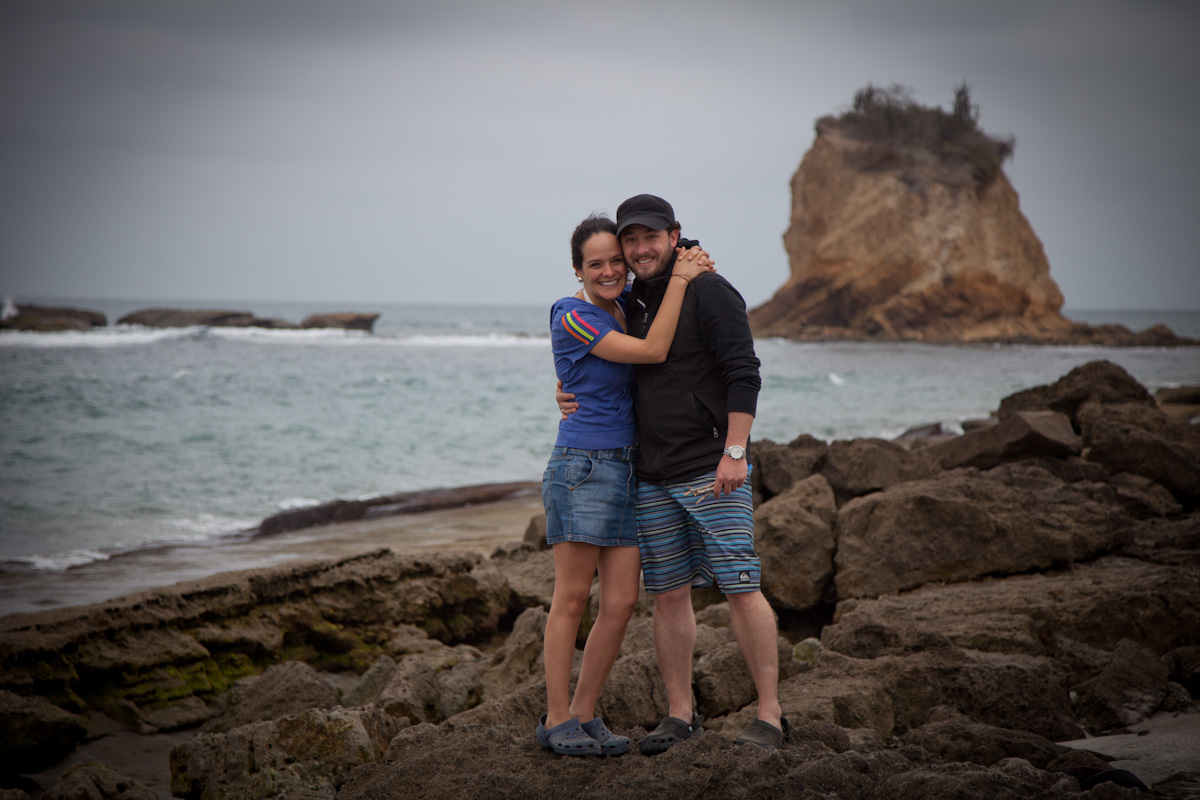 Throughout the morning, we learned so much about life in Ecuador while conversing with Eduardo and Paola. We were surprised to learn that they pay similarly high income taxes (pro-rated per income like us) but they don’t feel they get much for their taxes. Ecuadorians must pay for their own health care although both were fortunate to have private insurance through their employers. All schooling must be paid for privately, even the lower grades. Getting a mortgage depends as much on who you know as it does on your ability to pay the mortgage. And interest rates are very high – about 8 percent for a mortgage, although the government has introduced some programs to make it more affordable. There are no social safety nets in place like employment insurance or maternity benefits. Even today, it is typical for a middle class family to have at least one maid and perhaps a gardener. Day care facilities are common just like in Canada. Iam always fascinated to learn how people live and it’s so interesting to see both the commonalities and the differences in our respective countries.
The morning passed quickly and soon we had to head back to Puerto Lopez as Eduardo and Paola had to catch their flight back to Quito later in the day.
Back in Puerto Lopez, Chris and I decided to wander around town for a while, people watching and taking more pictures. We met up with our friends a little later on for lunch at Patacon Pisa’o where we enjoyed a special dish of crisply fried plantains topped with a choice of toppings such as squid, shrimp, fish or a combination of seafood. It was delicious.
As the afternoon came to a close, it was time say good bye to our friends. We hope they come to Canada one day and we would welcome the opportunity to share our beautiful country with them in the way they shared their country with us.
 On Sunday, Chris and I went on a diving excursion to Isla de la Plata, also known as “Poor Man’s Galapagos”. This was the primary reason why we came to Puerto Lopez. We wanted to get a couple of dives under our belt before we went to the Galapagos. After talking to the various diving operators in town, we settled on Exlporamar, a PADI certified shop that had good reviews online. Luckily for us, they already had a dive scheduled for Sunday with space available.
We arrived at the dive shop before 9:00 Sunday morning to get sized up for our gear. We were really happy to see all the gear was in top notch, nearly new condition. And we met our guide who spoke excellent English. We were still feeling a little nervous about this dive since this was going to be our first dives after getting our open water certification, and our first dives in the ocean. We were joined by four Ecuadorians – Eduardo and Paola, and Eustava and Naty who were doing the last two open dives for their certification. They all spoke excellent English which really helped us get to know each other. We learned that Paola had just found out she was pregnant with their first child and so could not complete her open water dives this weekend.
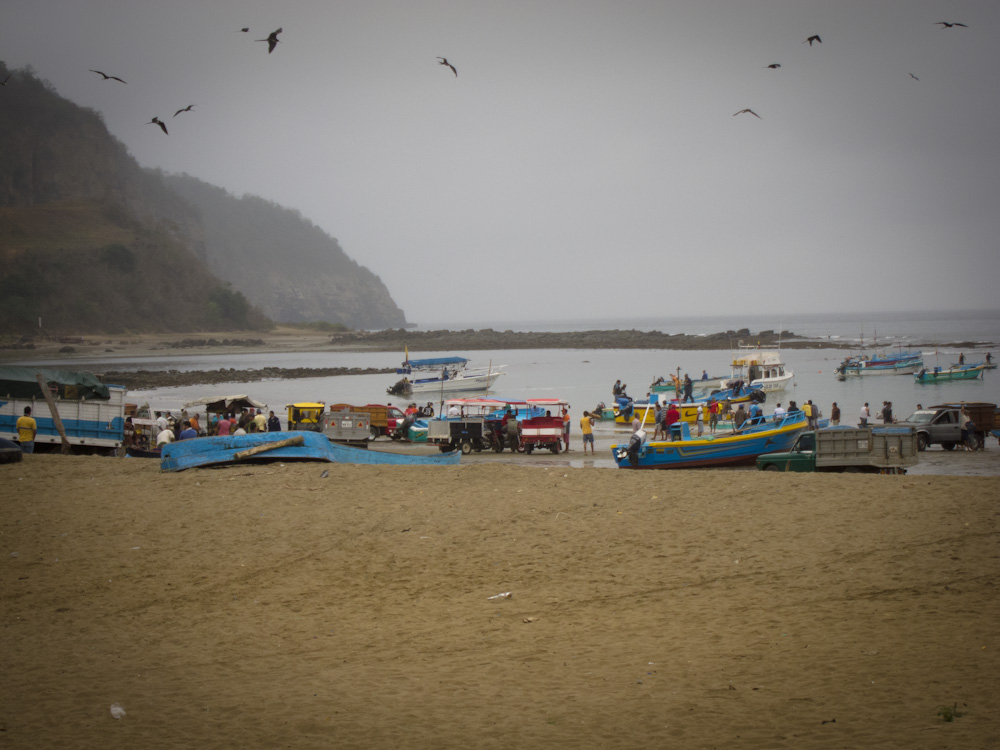
 As we made our way to the boat in the bay, we passed by the local fishermen who were hauling in their early morning catch which included a hammerhead shark, sword fish, and a few other sharks. In the photo to the left, Paola is in the foreground not looking too impressed at the sight of the dead hammerhead shark at her feet; in the background her husband Eduardo is taking a photo of another shark, and Eustava and Naty are looking on.

Once on the boat, we all settled in for the one hour trip to Isla de la Plata which is a small island off the coast of Manabí, and is part of Parque Nacional Machalilla. There is a large diversity of animal species here; for example, several species of booby, including the Blue-footed booby, Red-footed booby, and the Nazca booby. Another species found here is the South American sea lion. Dolphins, like the Pantropical spotted dolphin can be found in the water close by.
As we approached the island, we were required to stop at the park office to pay the park entrance fee: $2.00 per person. If we were landing on the island, the fee would have been $15.00 per person. I must admit, the island wasn’t much to look at from this vantage point – very similar to the coast line, dry forest everywhere.
 We had two dives planned for the day. Our diving instructor, Juam Manuel, gave us the orientation for the first dive and then we suited up and got into the water. This was my first time doing a backward roll off the side of a boat and I managed it with no problem. However, once in the water, I felt a little anxious and needed a few moments to relax my breathing. We then descended to a depth of about 20 feet. We stayed close to our guide, who pointed out interesting fish that often were well camouflaged on the ocean floor. Suddenly, right in front of us loomed a huge creature – we later learned it was a Manta Ray, approximately 5.5 metres in size! Juam also saw a hammerhead shark in the distance – the first he has seen in this location. Unfortunately, we did not see the shark. We were very lucky to see the Manta Ray – Juam said he made over 300 dives before he saw one. Beginner’s luck. Check out this Youtube video that someone took while diving in the same location – it’ll give you an appreciation of the size and beauty of a Manta Ray.
We were amazed by the sea life as we continued to a depth of 60 feet – the maximum depth allowed with our diving certification. At that depth, we passed through a thermocline – a distinct change in water temperature. The water became much clearer and felt frigid even though it was only 3 degrees colder. During this dive, I struggled with my buoyancy which is a skill I really need to work on. It comes with experience I’ve been told. We depleted our air supply in less than 30 minutes – typical for new divers.
 Between dives, we snacked on fruit and muffins, along with water and hot cinnamon tea. The tea was very soothing and restorative as I was feeling a little nauseous after the first dive.
We then headed to the second dive site, had the site orientation, suited up and got back into the water. This time I felt much more confident, no nervousness at all. The second dive followed a coral reef which presented a different variety of sea life. We saw huge sea turtles on this dive, and swam through large schools of colorful fish. It was quite amazing. I had much better buoyancy control on this dive which was a good thing as I was very careful not to inadvertently touch any of the fragile coral reef. Again, we depleted our air supply within a half hour, but by then we were ready to surface. There was some current and surge on this dive, and we found it to be a little tiring as we swam hard against it trying to keep up with Juam who made it look so easy.
 Back on board, we enjoyed a simple lunch of tuna sandwiches and coke. We were entertained by several sea turtles that swam alongside the boat. Our new friends completed their second dive and we congratulated them on their success. They were now certified open water divers like us.
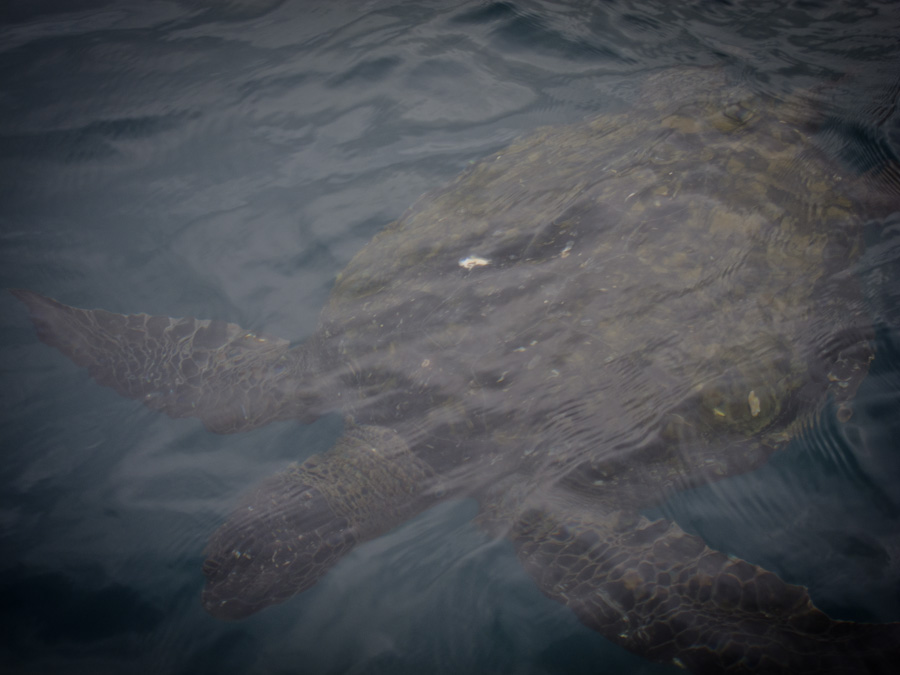
We were all pretty subdued on the trip back to the mainland. Chris and I were really happy that we successfully completed these dives in preparation for the Galapagos Islands. As we left the boat, Eduardo and Paola invited us out for dinner with their friends and the diving instructors.

At dinner, we were the first to arrive at the restaurant and ordered a beer. The restaurant owner came out and said something to us that we did not understand. He gestured strongly, trying to help us to understand. We nodded our heads agreeably and he returned with our beer and two glasses. He poured our beer and took the bottle away. We didn’t really think too much about this. When our friends arrived, they were surprised to see us drinking beer and reminded us of the Ecuadorian law that prohibits the consumption of beer in restaurants after 4:00 on a Sunday afternoon. Our accommodating restaurant owner was more than happy to serve us another bottle of beer, disguised in a juice jug. He then served us rounds of Ecuadorian “tequila” distilled from sugar cane – all on the house. And this while serving three local police officers in his restaurant. I guess there is flexibility with this law.
During dinner we got to know our new friends a little better. Eduardo and Paola are in their early thirties, and as I mentioned, they are expecting their first child. They live in Quito and came to Puerto Lopez for the weekend to complete their open water certification. Both are very well educated and well-travelled – Paola studied business at a university in North Carolina, and then did her Masters in Spain. Eduardo also studied business, followed by two master’s degrees – an MBA and the other related to environmental business management. He is now looking into doing his PhD, possibly in Canada. Paola works in her family’s law practice, and Eduardo works as a Director in a company that develops alternative energy sources. Our diving instructor, Juam, is a biologist who has been invited by Andrea Marshal, known as the Queen of the Mantas, to jointly study the manta. He has plans to pursue his PhD in this area. We gained a greater appreciation for this gentle giant that we were so lucky to see first-hand on our first dive in the ocean. To learn more about the manta ray, check out this BBC video, or this interview with Andrea Marshal about the making of the BBC video.
The other diving instructor, Janko, also lives in Quito with his wife and they too have a baby on the way. He is a martial arts teacher as well as a diving instructor. In the high tourist season (July-August and January-March) he comes to Puerto Lopez on a rotating basis with other instructors. His wife is a Pilates instructor. As the evening came to a close, Paolo and Eduardo invited us to join them the next day for a trip to Los Frailes beach – reputed to be one of the most beautiful beaches in Ecuador. We gladly accepted their invitation.

It seems that over the past month, we have unwittingly managed to sink deeper and deeper into the grunge and dirt of Ecuador. This is the dry season along the coast and as a result, everything – plants, trees, roads, houses – is covered with a thick layer of dust and dirt. The landscape is dreary and drab. The predominant color is the color of dirt. Now and then we will pass through an agricultural area that is fertile; the vibrant colors are a shock to our dulled senses. To make matters worse, Ecuadorians are prolific litterers and garbage is everywhere you turn. For example, a new road is under construction along the coast, parts of which boast an adjacent bike path. One day Chris and I went for a run along this bike path and we were simply disgusted by the garbage that covered the path the entire length of our run.
 The grunge and dirt were starting to get to me by the time we had reached Canoa. After three weeks of hostel living, we were really looking forward to staying in a house with all the associated comforts. I don’t think I had overly grand expectations – I knew the house was still under construction. I was looking forward to some simple pleasures like having a living room to relax in (instead of just a bedroom), having access to a kitchen, and home cooked food.
When we met Andy and Leo last Friday night, we hit it off with them immediately. We had exchanged emails for about 10 days prior and had already established a pretty good rapport. Andy is a Brit who has settled in Ecuador with Leo, an Ecuadorian from Quito. Together they are building a house on the ocean about 10 minutes south of Canoa (that’s a half hour walk along the beach). The two-storey, brick house is designed as two separate units. Each floor has a kitchen, bathroom, living/dining area and bedroom. The major work on the house has been done – walls, windows, exterior doors, roof, plumbing, electrical – are all complete. Now they are left with the finishing details. And that’s where we came into the picture. The plan was for Chris to work on cabinetry in the kitchen, and I was to work in the garden.
Constructing kitchen cabinets without the proper tools did not seem to deter Chris. At his disposal were: a power drill, a circular saw, one hammer, a motely collection of screwdrivers, a dull hand saw, a hand plane, a few used rusted nails, a measuring tape that was almost illegible, glue, and some small pieces of rope. And he had access to the “wood man” at the sawmill who could apparently cut wood to order and to specification. The idea was for Chris to design the kitchen cupboards, come up with all the measurements and give these to the “wood man” who would whip everything up on demand. Then Chris would only have to glue the pieces together and install the finished product. And so Chris began…..
 Once the design was complete, the first order of business was to buy the hardware for the cupboards and drawers as these would impact the final measurements. Off we went to San Vincente and Bahia – two larger towns within about a 20 minute drive. The first hardware store had door hinges and 12 screws – yes, 12 individual screws, and hardware for one drawer – yes, one drawer.

This was not Home Depot, let me tell you. And so began the run-around to try to round up all the hardware required. Four stores later, Chris had what he needed.
T hen it was off to the saw mill to see what type of wood they had and what type of cuts they could do. They could do some of the cuts but not everything. Chris then needed to adjust his design to accommodate the hardware and the wood. We ate ice cream as Chris did his calculations. Then it was back to the sawmill, only to find it closed for lunch. Killed some time doing errands, returned to the sawmill only to find out they had no electricity for the rest of the day and the wood man would not take any more orders. So we went to another sawmill down the road. He too was without electricity but promised to take the order and have it ready for the next morning. After much discussion and many explanations – Chris explaining to Leo who then translated it to the wood man – the order was given and we headed back home. The wood was ready the next day, and cut to specification, although they couldn’t do all the cuts needed for the doors; they couldn’t cut the lengths, nor could they cut the “tongue” part of “tongue and groove” – they could only cut the “groove”.
 Each subsequent day presented its own challenges; for example, two days we had no power at the house. Chris took matters into his own hands and went back to the sawmill and arranged to use the saws himself to make the necessary cuts. Finally all the pieces were cut and ready to be assembled. In parallel to this, Chris was teaching Andy and Leo basic carpentry skills as he knew there would be plenty of work left for them when we left. They were willing and appreciative students. Under Chris’ direction, a frame was built and installed in the cement cupboards to which the doors would eventually be attached.

 You might be wondering what I was doing all week long. Well, I painted the pillars in the front of the house, weeded and cleaned up the back garden and some of the front yard, cooked a few breakfasts, assisted Chris when necessary and did most of the dishes throughout the week. Unlike Chris, I found it difficult to embrace the tasks at hand. The front yard was full of construction debris and required some serious machinery to get it cleaned up before you could even consider starting a garden. The only garden tool at my disposal was a plastic rake with no handle. Leo attached a flexible piece of plastic to the rake head to create a rather flimsy, bendable rake.
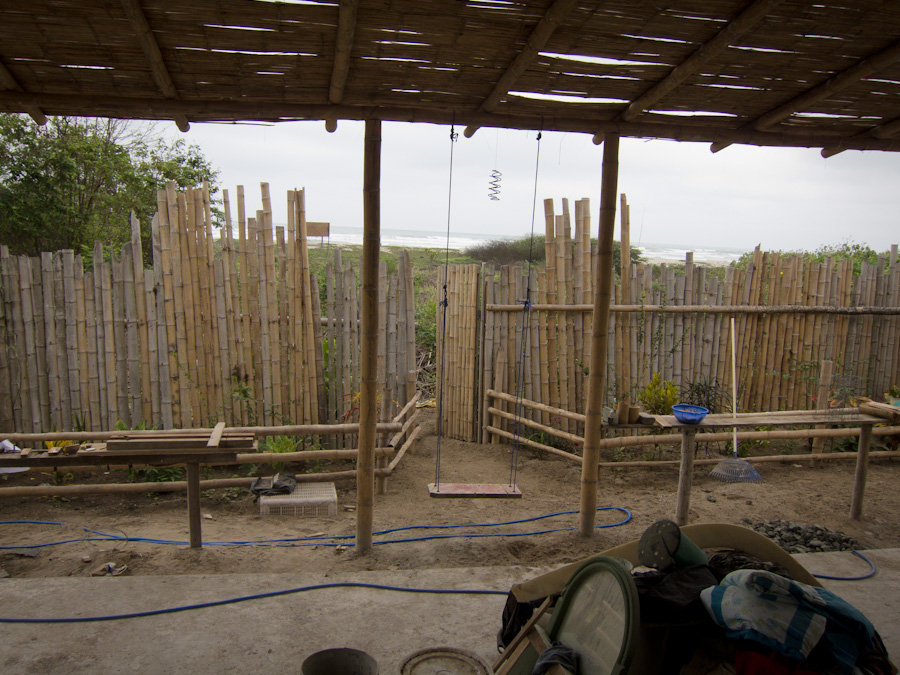
The exterior of the house was still very much a construction zone with materials and tools all over the place. It seemed rather premature to be focused on the garden, in my opinion.

The inside of the house was also in a state of disorder – the result of months of construction and just making do. There was no furniture in the house yet except two beds (ours was very comfortable, in fact the most comfortable bed to date), a plastic patio table and two plastic patio chairs. Their dog, Lucky, was recovering from cancer and had some open wounds. Their cat, Daggy, also suffered from some mysterious open wounds. These animals were indeed lucky to have owners like Andy and Leo who were tending to their ailments and sores with a variety of medicines from the vet.
 We ended each day with cocktails at sunset. Andy prepared his house speciality – Tequila Sunrise – with freshly squeeze orange juice. Chris prepared our summer time favourite – Vodka and Tonic with Lime. Andy fed us well with home cooked meals each day. One morning I made my infamous pancakes (that are now being served at CocoLoco I might add), and I made French toast another morning – a little taste of home.
By the end of the week, one cupboard door was completed and installed, another one was glued and drying, and the remaining cupboards were ready to be glued together. A template for a drawer was also created and was ready to be duplicated for the remaining three drawers.

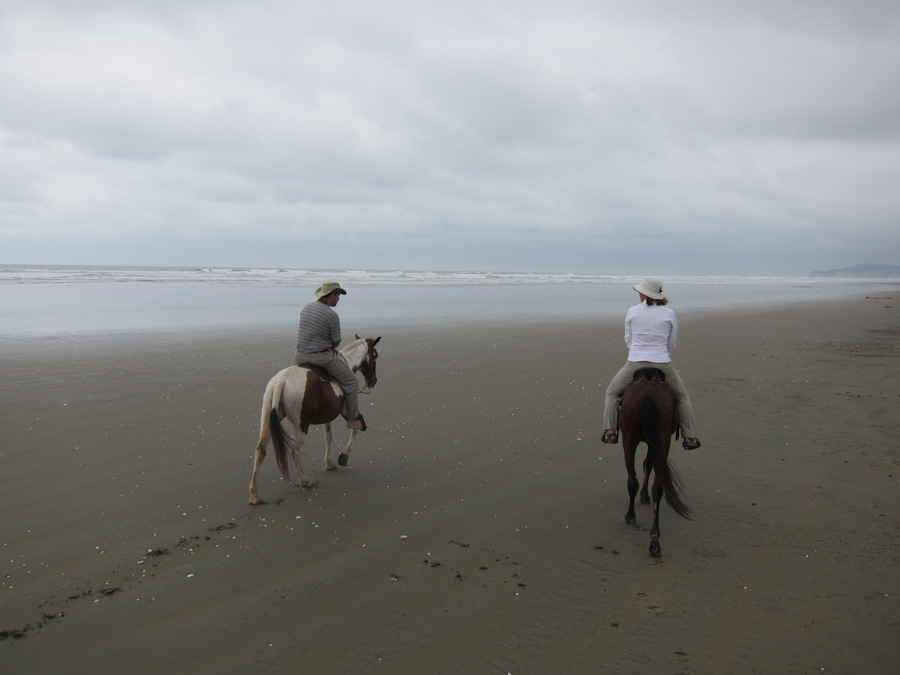
One day we went horse back riding with the owner of the hostel we had stayed in. Neither of us are comfortable on a horse and it took a while to find our groove and our balance; although we never did quite manage to go faster than a trot. Chris went barefoot – not by choice, but by necessity because his sandals did not fit into the stirrups. It was a beautiful ride – two hours traversing hills and valleys of lush, picturesque farmland and then returning along the beach. Our muscles are still hurting from that ride!



What is the final verdict on our first HelpX experience? We couldn’t have worked for a nicer couple. Both Andy and Leo were kind hearted, hospitable, and fun to be around. They certainly didn’t push us very hard, in fact, we probably pushed them harder than they may have wanted. We have a deeper appreciation for the challenges of getting anything done in Ecuador and found the experience to be an eye opener. After working pretty hard for a week, we’ve come to realize that it’s much more fun to stay on vacation and so we aren’t planning any more HelpX jobs for the foreseeable future.
As we travelled on the bus from Canoa to Puerto Lopez I struggled with my feelings. I was tired of the grunge and dirt and grime that surrounded me and didn’t see any respite from it while we were in South America. I fantasized of ways we could leave this continent. Yes, I know, I was feeling pretty negative. I fully expected Puerto Lopez to be more of the same and so you can imagine my surprise, my delight, my relief when we found our current hostel. Tucked away on the north edge of town, directly on the ocean, Hostel Mandala is an oasis of serenity, beauty and cleanliness. We’re going to stay here for a while.
Today we are off to Andy and Leo’s place for the next week. We met them last night and popped over to there house for a few moments before going out for dinner with them. They don’t have internet access at their house, so we will be off line for the next week. We’ll try to check our email when we come into town, so that will be the best way to reach us if you need to contact us.
Next stop on our route will be Puerto Lopez which is a little further south, still on the coast. From there we hope to do some diving at Isla de la Plata, often called the “Poor Man’s Galpagos” since this area is much more accessible (cheaper) and offers a lot of the same natural beauty, birds and sea life. It is reputed to have great snorkelling and diving so this is where I will do my first dive since getting my certification. This will be a trial run before going to the Galapagos Islands.
So we’re off to do some work for a week and we’ll be sure to tell you all about it once we’re back on line. Cheers!
 Print Friendly
