christina

The middle of the earth

On Sunday, we went to “la mitad del mundo” – the middle of the earth.  Ciudad La Mitad del Mundo is a tourist complex set up on the site where, in 1736, French explorer and scientist Charles-Marie de la Condamine made his final calculations to determine the precise equatorial line. With modern GPS technology, apparently he was off the mark by some 180m (600 ft.).

We knew this was going to be a tourist trap, but couldn’t resist the opportunity to do what every other tourist does – get a picture with one foot in the northern hemisphere, and one foot in the southern hemisphere.  Ecuadorians flock to “la mitad del mundo” on Sunday because of the lively entertainment offered all afternoon long.

We had the option to take a tour for $30.00 per person or we could go on our own for a mere .45 cent bus fare and $2.00 entrance fee.  As you may have guessed, we chose the latter option.  We needed to get to La Ofelia bus station in order to catch the bus to “la mitad del mundo”.  Coincidentally, this was the bus station we had gone to last week by mistake when we were trying to get to Otalavo.  At least we knew where we were going this time.

The buses are always crowded which unfortunately makes them a fertile ground for thieves.  One must be extremely cautious as pick pockets run rampant.  Luckily, we haven’t had any trouble thus far.  A fellow student at our school was pick pocketed just last Friday on a crowded bus – she lost both her cell phone and her wallet.

Our bus travelled through gritty, run-down neighbourhoods towards the north end of town.    Along the way, a little girl and boy, no more than five or six, jumped on the bus and broke out in loud song.  They belted that song out at the top of their lungs.  Now that they had everybody’s attention, they got to work selling their candies and marshmallows to amused travellers.  They charmed and harassed and pushed their products on their captive audience with much success.  Imagine our surprise when we returned at the end of the day to find this duo still hard at work – almost eight hours later.  In fact, they spotted us in the line waiting for the bus (we kinda stood out as we were the only gringos around) and I succumbed to their charms and bought some candy from both of them.  I then asked if I could take their picture, and the little girl very seriously and firmly said no.  Gotta respect a kid who knows how to set limits and not be exploited, at least not by tourists.
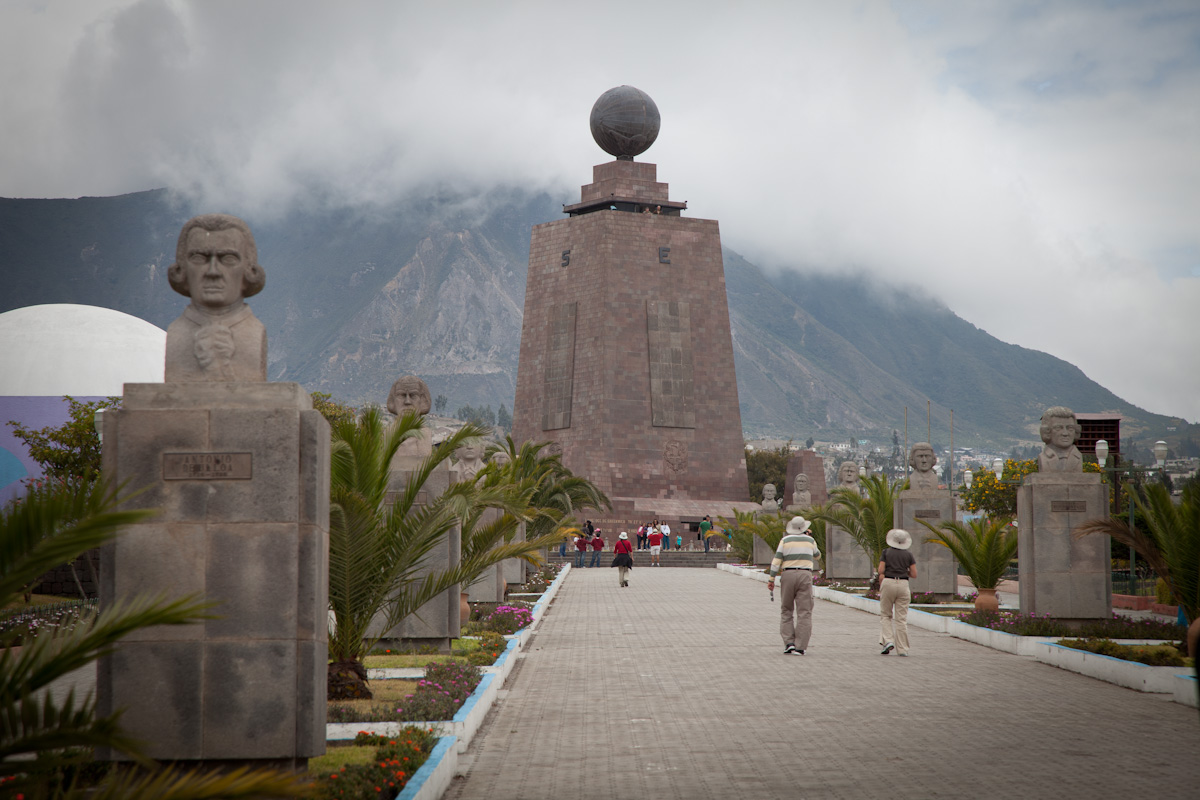
What can I say about “la mitad del mundo”?  We expected it to be tacky and it was.  There is a large monument where the middle of the earth is supposed to be, in front of which is a walkway with a line running down the middle that represents the middle of the earth.  This is where tourists take their picture with one foot on each side of the line, representing the north and south hemispheres.  Of course we had our picture taken too.


A fake village built in a mock colonial style houses souvenir shops and restaurants.  We followed the sound of music to a central plaza where many locals were congregating in anticipation of the afternoon’s entertainment.  Everybody was eating a big bowl of food that was being served by a few women off to the side of the stage.  Chris and I went for a closer look – lunch was comprised of boiled potatoes, cooked carrots and onion, pork and a dish we couldn’t figure out – Chris thought it was lima beans, and I thought it was oysters.I think Chris may have been right.

We opted for a simpler lunch – coffee, grilled ham and cheese sandwich, and homita – an Ecuadorian dish that tastes a little like corn bread – that is cooked in the husk of corn.  Afterall, Chris was just now feeling himself again – we really didn’t want to take a chance of getting sick again.

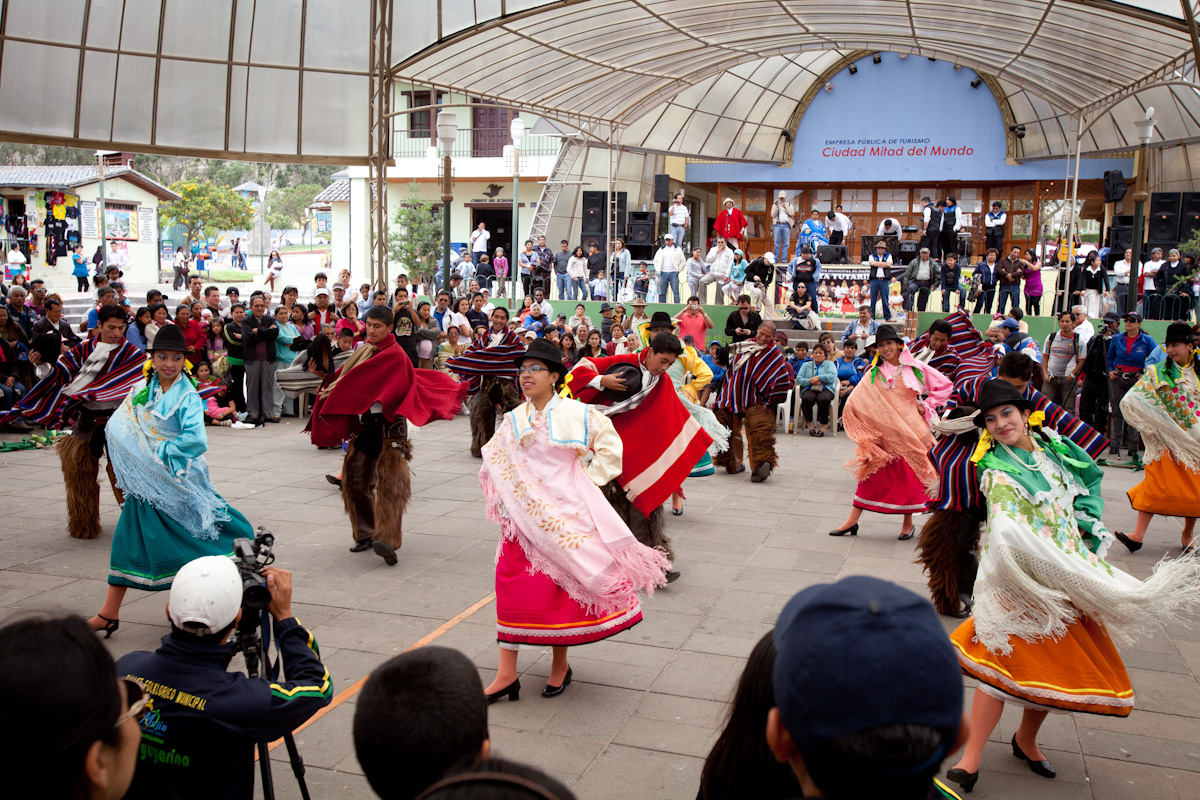
 

We hung around the plaza for a while watching the entertainment and then headed off to a museum that was outside of the official site (according to our research).  Of course there were no signs around so we asked someone for directions and blindly followed the direction they pointed in.


This time the directions were correct and we found a very charming little museum tucked away behind the official site.  The $3 entrance fee included a guided tour in English….it was worth every penny.  Our guide explained the outdoor exhibits which focused on representing various aspects of the lives of indigenous people.


For example, when an important man in the village dies, his wife is buried with him – alive.  She is given a potent drink made from a special plant that will put her into a deep sleep.  The indigenous people believe in life after death so the wife considers it an honor to be buried with her husband – she gets a head start on the afterlife!  I wonder what she thinks when she wakes up in the burial tomb next to her dead husband!


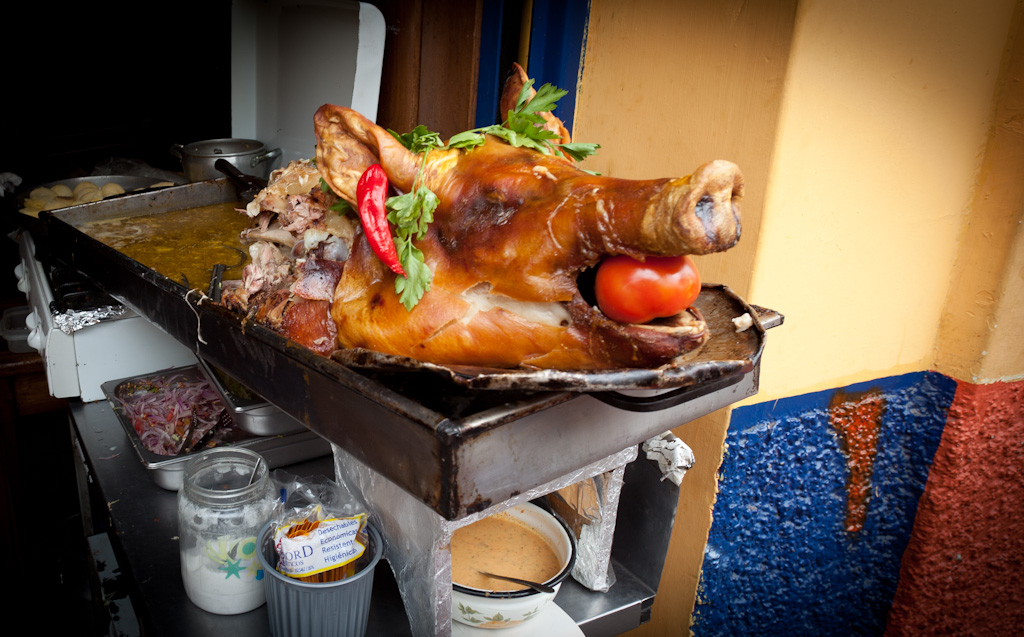
Dinner anyone?  Seriously, this is dinner.  Cuy, or guinea pig, is an Ecuadorian speciality.  That’s right – they eat guinea pigs.  We have not yet had the opportunity to try cuy, but a fellow student described her experience. Apparently the cuy was presented on her plate fully in tact – head, legs, arms – and she had to poke around to find the meat.  Hmm, hmm.

There were also some experiments that demonstrated the uniqueness of being at the middle of the earth.  Oh yes, they too had a line that they claimed was the real middle of the earth.

Here’s the highlights:

Balancing an egg on a nail.  No idea if this is possible anywhere else, but several people, including Chris, were able to balance the egg on the nail.

Water draining from a basin – on the line, the water went straight down, north of the line, the water circled the drain in a counter-clockwise direction, and south of the line, the water circled the drain in a clockwise direction.  We’re not sure what to think about this one.
Check out the video on YouTube:
Upon our return to Quito, we learned that the city had been deluged with such a fierce storm that the airport was closed for several hours in the afternoon.  We were glad we had spent the afternoon out of the city where we only felt a few drops of rain.

With regards to the weather in Quito in general, it is predictably unpredictable.  Every day is the same – a little sun, a little cloud, hot when the sun is out, cooler when its behind the clouds, and maybe a rain shower in the afternoon for about a half an hour.  Temperatures during the day are usually around 20C and it dips to around 10-12C at night.  There are two seasons in Ecudaor – winter and summer.  But in the sierra, the mountainous regions where Quito is located, the weather is constant throughout the year.

In search of history

Chris is back in the land of the living. Thank goodness! Yesterday we ventured out together, the first time for Chris since Tuesday.  We decided to stay relatively close to the hostel, just in case.  The destination:  El museo de banco central.  This museum came highly recommended by my Spanish teacher as well as several guide books.   According to Frommer’s (our favourite travel guide book), “this huge and enormously rich museum offers visitors an opportunity to learn about the evolution of Ecuador — its human and natural history, as well as its art. When you see all the artifacts, archaeological finds, and works of art displayed chronologically, you get a profound sense of the country not commonly found in museums that focus on one era or type of exhibit.”

The museum was located across the street from el Parque Elijido, the third-largest park in Quito (after Metropolitan and La Carolina).  The park divides the old part of the city from the modern one. It is known for handicrafts available for sale every Saturday and Sunday, with all pricing subject to negotiation (that is, haggling). Local painters sell copies of paintings by Oswaldo Guayasamín, Eduardo Kingman, and Gonzalo Endara Crow. Otavaleños sell traditional sweaters, ponchos, carpets, and jewelry.

I was a little perplexed as I could not find this museum on our tourist map, but was confident with the directions received from my Spanish teacher on Friday.  Take the trolley to El Parque Elijido (a mere three stops away) and it was the large, mirrored building across from the park.  You couldn’t miss it.  Right.

Off we went, travelling light.  No bulky camera, no backpack.  Just my travel bag with the necessities – water, map, money, small camera, copies of our passports (every person must carry identification with them at all times in Ecuador – it is the law). When we got to the park, we looked all around for the large, mirrored building – nothing in sight.  So we decided to walk the park perimeter – maybe it was on the other side (remember, I didn’t have the address, and couldn’t find it on the map).

Along the way, we asked a police officer for directions.  Yes, you read that correctly.  I can now ask simple questions in Spanish like: Donde este el museo de banco central?  Unfortunately, I have no idea what is said in response!  But the police officer gestured profusely( and confidently I might add) in a direction to the south so off we went – on a wild goose chase.  Ecuadorians are notorious for two things (according to both my Spanish teacher and guide books):  First, they will never admit they do not know where something is and would prefer to give you wrong directions rather than no directions.  Second, they have no sense of how long it takes to get somewhere.  They will always say – just five minutes, when in reality, it could be an hour away.  Well, we experienced the truth of these generalizations first hand.


After wandering around for about an hour, and passing through yet another lovely park (el parque Almeda which boasts a small laguna (lake) and an observatory), we headed back to the park Elijido to continue our original strategy – follow the perimeter of the park.  At this point I was ready to concede that it was entirely possible I had completely misunderstood the directions given by my teacher.


When it began to rain, we sought shelter within the park.  Mental note:  Always bring our rain jackets as the weather in Quito can change quickly.  This was fortuitous as we were now in the park and distracted by the many artisan stalls that were set up, exactly as described in the guide book.  We temporarily forgot our mission, and instead, wandered through the stalls of tacky souvenirs, beautiful jewellery, art work, tapestries, scarves, etc.  My daughter, Alyssa, would have been in heaven! As the rain abated, we followed the sound of a salsa band that was playing live music at one entrance of the park.  Lo and behold, across the street was a Hilton.  Surely the concierge would be able to direct us to the museum.

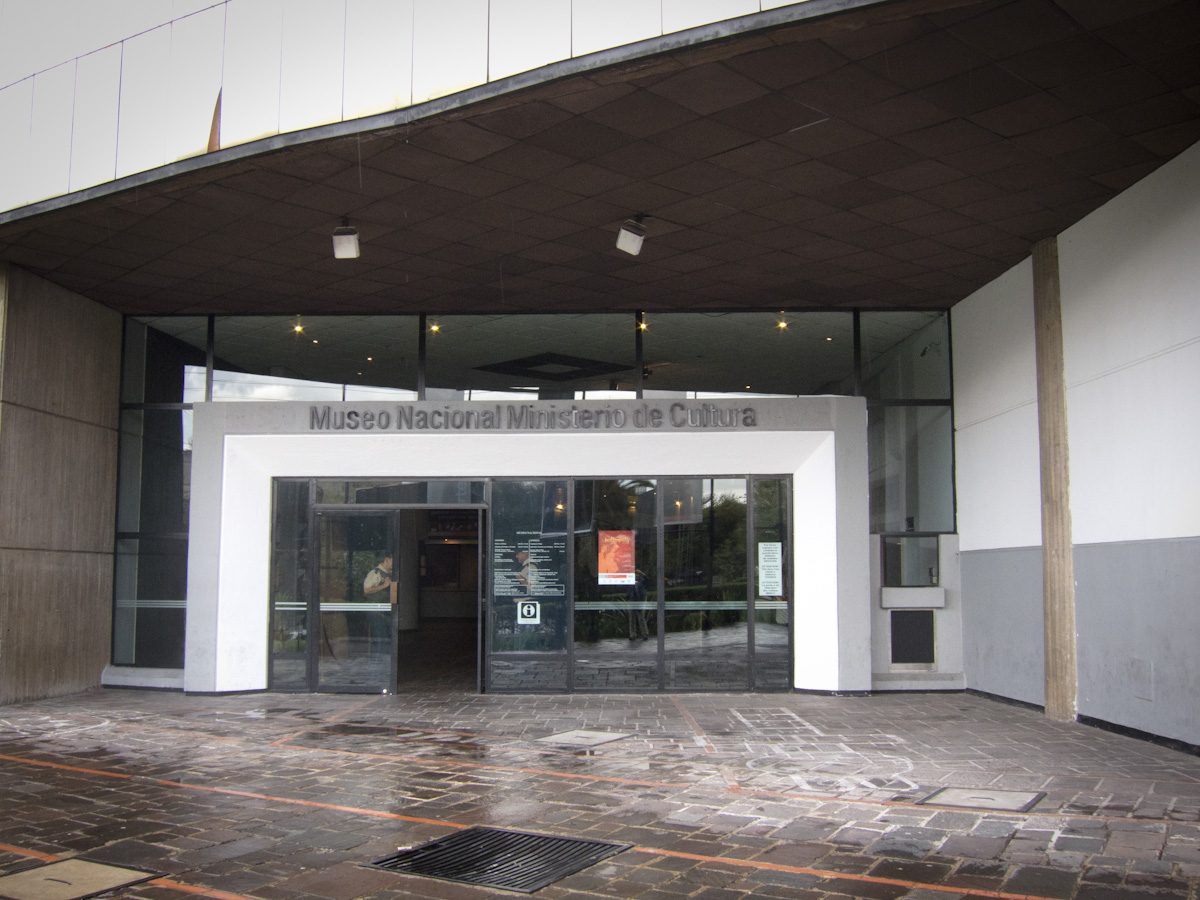
As we entered the Hilton, it felt as if we had walked back into Canada.  Ahhh… the luxury, the comfort, the beauty, the serenity.  We got directions (the museum was only two blocks away), and then decided to stay awhile.  We enjoyed a free cup of coffee and sank into the comfortable chairs in the lobby.  We have not sat in a single comfortable chair all week, and this felt simply divine; such simple pleasures.  After meandering through the hotel and casino, we headed off to the museum and discovered why it was not on our map – the name had changed to el Museo National Minesterio de Culture.

The museum was a wonderful education of the rich history of Ecuador. Displays were presented in both English and Spanish, an opportunity to practice both our reading and comprehension.  Unfortunately only the first floor was open so we didn’t see the art galleries.  Nonetheless, we thoroughly enjoyed the vast archaeological display and were somewhat amused by the apparent pre-occupation the ancient Ecuadorian male had with his genitals (not to mention their egotistical self-representation  – a polite way of saying there were lots of very large penises on display!).  As Chris concluded:  so it was the Ecuadorians who discovered the art of masturbation!

A late lunch at MacDonald’s (I conceded to Chris’ desire to eat something comforting and familiar – after the week he had just been through, who was I to deny him, even though I paid for it later with an upset stomach).  A Big Mac and fries in Quito tastes exactly the same as at home. And it costs almost the same as well.  How’s that for global uniformity?

We walked back to our hostel, stopping in at the J.W. Marriot which is only two blocks away.  Another oasis of decadence that we enjoyed for a little while before returning to our humble abode.

Living in a hostel in Quito

We have been living at the Traveller’s Inn for over a week now and plan to stay until Wednesday. This is our first time in a hostel and we didn’t really know what to expect. We selected this particular hostel mainly based on reviews we read online. It is by no means the cheapest accommodation around, but we hoped paying a little more would mean we would get a little more.  In the Marsical Sucre district of Quito where we are staying (also known as gringo land), hostel rates start at $8 (US) per night per person for a bed in a dorm room with shared bathroom. Usually breakfast is included.

We reserved one week in advance at this hostel through HostelWorld and opted for the matrimonial room (double bed) with shared bath. We thought of it like camping only a little better as we would have an actual roof over our heads. The cost: $11 each per night, including breakfast.

The Traveller’s Inn is a large, old colonial home with hard wood floors, 10 foot ceilings, and simple decor. It is a family run operation. This place is spotless. The wood floor on the main level is polished, yes polished, twice daily. The shared bathrooms are scrubbed top to bottom several times a day. I think the family lives somewhere on the premises and shares the same common spaces.  In many ways it feels more like a bed and breakfast.

On the main floor, there is an office, a living room with TV and large selection of American DVD’s, dining room, kitchen and another sitting area. There are guest rooms on this floor, upstairs, and in the basement. The basement also has a common area with two computers for guests. In addition, there is another building out back where the laundry is located and 4 more rooms that share a single bathroom. We had one of these rooms assigned to us when we arrived.

Our first room was very small – it had a double bed pushed against one wall, a large built in closet next to the bed (only one person could stand in between the closet and the bed at one time), a tiny table at the end of the bed with an old TV on it. On the positive, the bathroom was literally right next door – very convenient even though you had to go outside to use it. Oh, and the room had a mysterious, funky smell to it. And the bed and pillows were as hard as cement. I kid you not. We lasted three nights in this room until we decided enough was enough, we needed more comfort, more space and less stink.

Last Sunday, Chris talked to the owner and got us what is probably the best room(s) in the house for only $8 more a night ($30 for both of us). Thank goodness we changed rooms as two days later Chris got very sick and it would have been unbearable for him (and me) in that little, damp room in the backyard.­

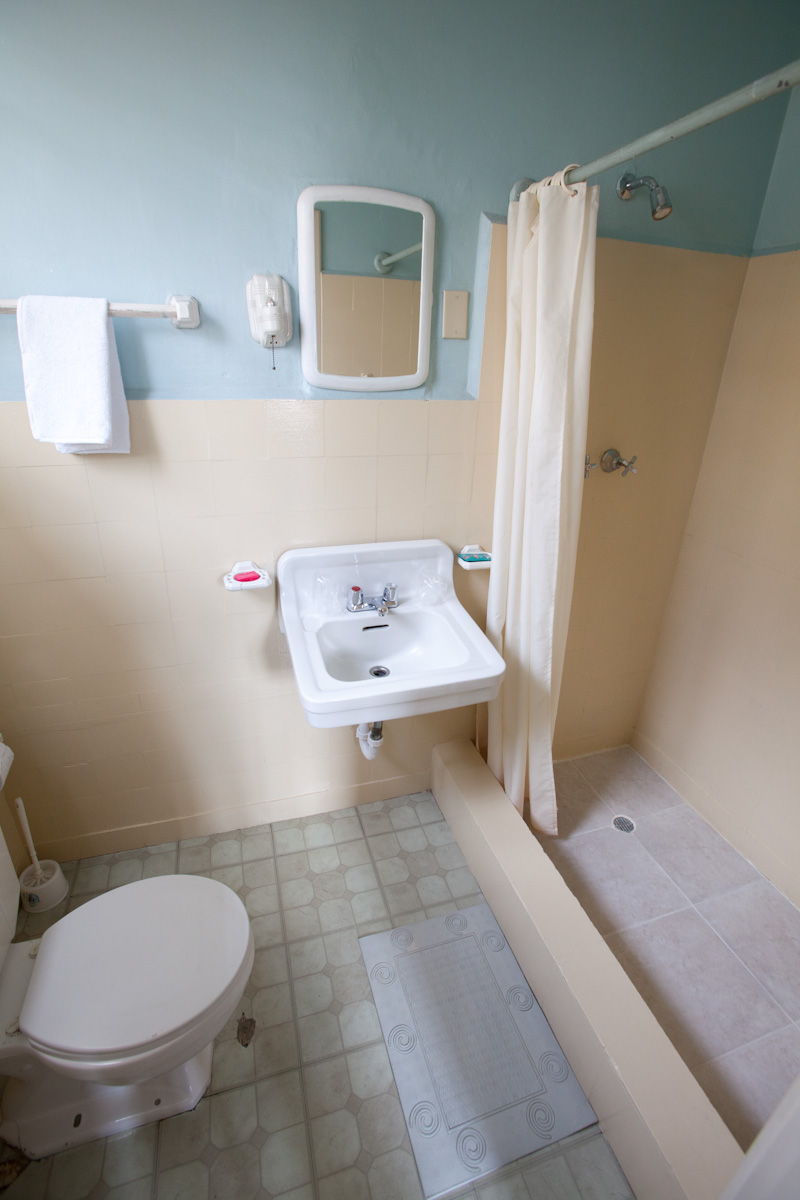
We are now on the top floor of the house. We have the whole floor to ourselves. It is comprised of two bedrooms (sleeps a total of 4), a private bathroom, walk-in closet, a lovely balcony, and views of the mountains through most of the windows and from the balcony. Way more space than we need, but we’re enjoying every inch of it. The ceilings are high, maybe 10 or 12 feet, and wood shelves from floor to ceiling adorn every wall. It must have been a library at one time. Oh, and we have wifi access in our room. Most rooms don’t have wifi – it’s only in the common areas. Again, this turned into a big plus seeing as Chris has been sick and bedridden for the past three days. On the negative, because the room faces the street, it is very, very noisy. Earplugs are a must!


Breakfast is served between 7:30 and 9:30 am. Each morning, we go down to the dining room and eat the exact same breakfast. Eggs, scrambled or fried, coffee or tea, croissant with a piece of cheese that sort of tastes like cream cheese, glass of yogurt, glass of fruit juice, and small plate of fruit. The fruit and the juice change each day, but everything else is the same.


It’s a big breakfast and keeps us going well into the afternoon. It was a great breakfast for the first few days, but now we are sick of this breakfast. I haven’t eaten so many eggs ever.  Note the eggs had not yet arrived when I took the photo to the right.


When we leave the hostel, we leave our key with the front desk. And whoever is manning the desk opens the three locked doors to let us out. Let’s just say they don’t take security lightly here.


There is a locked, iron gate at the street. You must ring a doorbell to get in.


Once inside the yard and once you have been identified as a guest, you are allowed through another locked gate at the top of the stairs, and then finally you enter the house through another locked door. The entire perimeter of the house is fenced and above the fence is about three feet of barbed wire. It feels like you’re in a compound once inside but I’m not complaining. I’m quite content to have multiple layers of security between me and whatever lurks beyond the fence, especially at night.

Happy hour is from 5-8 and you can buy a large Pilsner beer for a buck. They have snacks for purchase as well. We enjoyed happy hour for the first few nights, but now that Chris is sick, we’ve gone dry. We also spent a little bit of time in the common area in the evenings. Guests hang out here, with the family, watching TV (American shows, all English, with Spanish sub-titles) or American movies.

Overall, I’d say our experience thus far has been very positive.  The family that runs this place is very friendly, helpful, and caring of their guests. Most of them speak very good English. We love our current rooms (minus the noise).  We would definitely recommend this place, although I would not recommend staying in the first room we stayed in, that was just bad, very very bad.

We’ve learned some lessons from this experience:

1. Access to a kitchen would have made our lives so much easier, especially with Chris being sick. It would have been nice to make a cup of tea or coffee whenever you wanted one, or to be able to make some of your own food. I went to a grocery store and picked up non-perishable items (bread, fruit, snacks, etc.) that we could keep in our room. It helped, but a kitchen would have been better.

2. It’s worth spending a little extra for the private bathroom. Again, good thing we switched rooms before Chris got sick – he really used that bathroom, let me tell you.

3. Prices are always negotiable. We received a $6 per night discount because we stayed longer.  It never hurts to ask.

4. It pays to shop around. If Chris hadn’t gotten sick, we probably would have looked around a little more to see if we could find a better deal. As it turns out, there is a condo right across the street (you can see it in one of the photos above) that rents fully furnished, 1 bedroom apartments for $100/week. Oh well, we’ll know for next time.

5. It would be nice to have a comfortable chair to sit in and a desk to work at. While the beds are much more comfortable in the current room, there is nowhere to sit other than on the bed.  My back is start to object.

My first run in Quito

Yesterday I went on my first run. After a week in Quito, I feel fully acclimatized and I was curious to see if I would feel a difference running at this altitude (2800 m / 9800 ft).  It wasn’t going to be an accurate test seeing as I haven’t run (I hate to admit this) in about six weeks. If I felt winded, it may be the altitude, or it could just as easily be that I’m little out of shape.

I planned my route ahead of time.  I wanted to run to el Parque Metropolitano.  This park is the largest urban park in South America at 1,376 acres (5.5 km²) (as reference, New York’s Central Park is 843 acres (341 ha). The park is located in northern Quito, on the hill of Bellavista behind Estadio Olímpico Atahualpa. The park is suited for mountain biking, walking, and running. Most of it is eucalyptus forest with trails, but there also are numerous sculptures on display. The park has four sites that can be used for picnics or barbecues, and the eastern section has a view of Cotopaxi, Antisana, and the Guayllabamba river basin. (Thanks Wikipedia.)

From the map, I figured it would take no more than a half hour to get to the park running a very easy pace.  I would then walk around the park a bit and then run back to the hostel.  I didn’t want to run more than one hour today since I haven’t been running for a while.  Off I went, dressed in my regular running clothes, equipped with my water skin, 5 bucks in case I needed to take a taxi, a business card of my hostel in case I got completely lost, and of course a map (thank goodness).  Sorry, didn’t take the camera so no pictures with this post.

I was pretty confident I knew where I was going as I had studied the map in advance, and I was getting quite familiar with the area north of our hostel.  Well, when I arrived at the first major intersection – a roundabout – I was completely perplexed.  There were about five major streets (I’m talking 4-6 lane boulevards) feeding into the roundabout.  Two problems:  which way do I go and how the heck do I cross this intersection with no traffic lights to help me.  I studied the map again and observed the traffic pattern for a while to figure out how to cross without getting hit (pedestrians do NOT have the right of way in this city).  This became the norm at every major intersection thereafter.  Stop.  Study the traffic pattern – sometimes for two cycles of lights just to figure out when it might be safe to cross.  Then run, literally, across the street.  The streets in Quito are not laid out squarely – they curve, they criss-cross, they turn into other streets.  It’s quite confusing.  At least it is to me. And drivers rarely yield to pedestrians.  If you’re in their way, they’ll be sure to let you know with a friendly, or not-so-friendly honk.

I was running a nice and easy pace and for about ten minutes it was very flat.  I felt great.  Legs were fresh (no surprise there) and my breathing was easy.  But then the terrain changed to one great big hill.  The park is afterall at the top of a hill.  This is a dream location if you want to do hill training.  As soon as I began to ascend, I quickly became short of breath and got a headache immediately.  This didn’t surprise me as I get winded just going up a flight of stairs here – I know it is the altitude because I couldn’t be that out of shape so quickly, at least I hope not.

I kept going.  I ran a little, walked a little.  It was getting steeper and steeper.  One half hour in, and I still wasn’t at the park.  In fact, I was now in a more residential area high above the city (great views) looking west, down at the city below with the mountains behind.  The streets were quite deserted in this area and I wasn’t exactly sure how to get into the park.  I wasn’t quite lost, as I could see some trees way above me which I figured must be the park but it was still a ways to go.

At this point, I decided to turn back mainly because I wasn’t feeling secure about being alone in this area without knowing exactly where I was going.  It may have been fine, but I prefer to err on the side of caution.  Besides, I had reached the half-way point in my run so it was time to turn back anyways.

I managed to make my way down the hill to Carolina Park – the park I walked through the other day.  I enjoyed the rest of my run on the flat running path that traverses the park.  I hadn’t seen the entire park yesterday so enjoyed the opportunity to run it from one end to the other.  I was surprised to see an airplane, yes a real airplane (not sure what kind – it had two propellers on each side) parked in the park.  I have no idea why.  Wish I had my camera with me, it would have made a great shot seeing as it was plastered in graffiti.

I returned to the hostel, satisfied with my run.  Total time:  1 hour 15 minutes.  Total distance:  No idea.

The top three dangers when running in Quito (in my humble opinion) and my advice for dealing with them (based on my one run):

1.  Traffic:  Never, never enter an intersection before looking in every single direction.  At lights, make sure you understand the traffic pattern before entering the intersection.  It may look like it’s safe to go, but look out, there’s a lane turning right in front of you! Better yet, latch onto a local and go when they go.

2.  Sidewalks:  Not only are there potholes and cracks and loose cement, the sidewalks are not flat, they go up and down unexpectedly.  And be mindful of all the dog s*** – they clearly don’t have any by-laws to keep the sidewalks clean.  I want to know what Ecuadorian dogs are eating as I have never seen such huge piles of s*** before.

3.   Altitude: Finally, the effects of altitude are very real and should not be minimized.  I don’t think it’s a good idea to go running if you haven’t properly acclimatized. Like anything respect your limits and listen to your body.  There’s no shame in walking up a hill that is practically vertical and that increases your altitude in every step.

A walk in the park – take 2

This afternoon, I decided to walk to Carolina Park. We passed by this park last Saturday when we took the bus to Otavalo and at the time I was very surprised by the size of the park and by the number of people in it, not to mention all the runners. The park was about ten minutes north of our hostel straight down Rio Amazonas.

La Carolina is a 165.5-acre park in the centre of the Quito main business area, bordered by the avenues Río Amazonas, de los Shyris, Naciones Unidas, Eloy Alfaro, and de la República. This park started from the expropriation of the farm La Carolina in 1939. The design of the park was made by the Dirección Metropolitana de Planificación Territorial (DMPT). Pope John Paul II headed a great mass in the park during his visit to Ecuador in 1985. A giant cross has been built in this place.

I began my walk around 2:30 in the afternoon. The traffic was so heavy you would have thought it was rush hour.  Just crossing an intersection can be tricky business.  Often there is no pedestrian signal.  So you must guess when it is safe to go.  If you’re in someone’s way, they will be sure to honk you.

We have a view of these mountains from our hostel room.


Within a block of our humble hostel sits this grand J.W. Marriott Hotel.  Quito is a city of contrasts.  As I continued, the area became more and more upscale.  Beautiful condominiums lined the street. The shops were a little classier, and of course, more expensive.


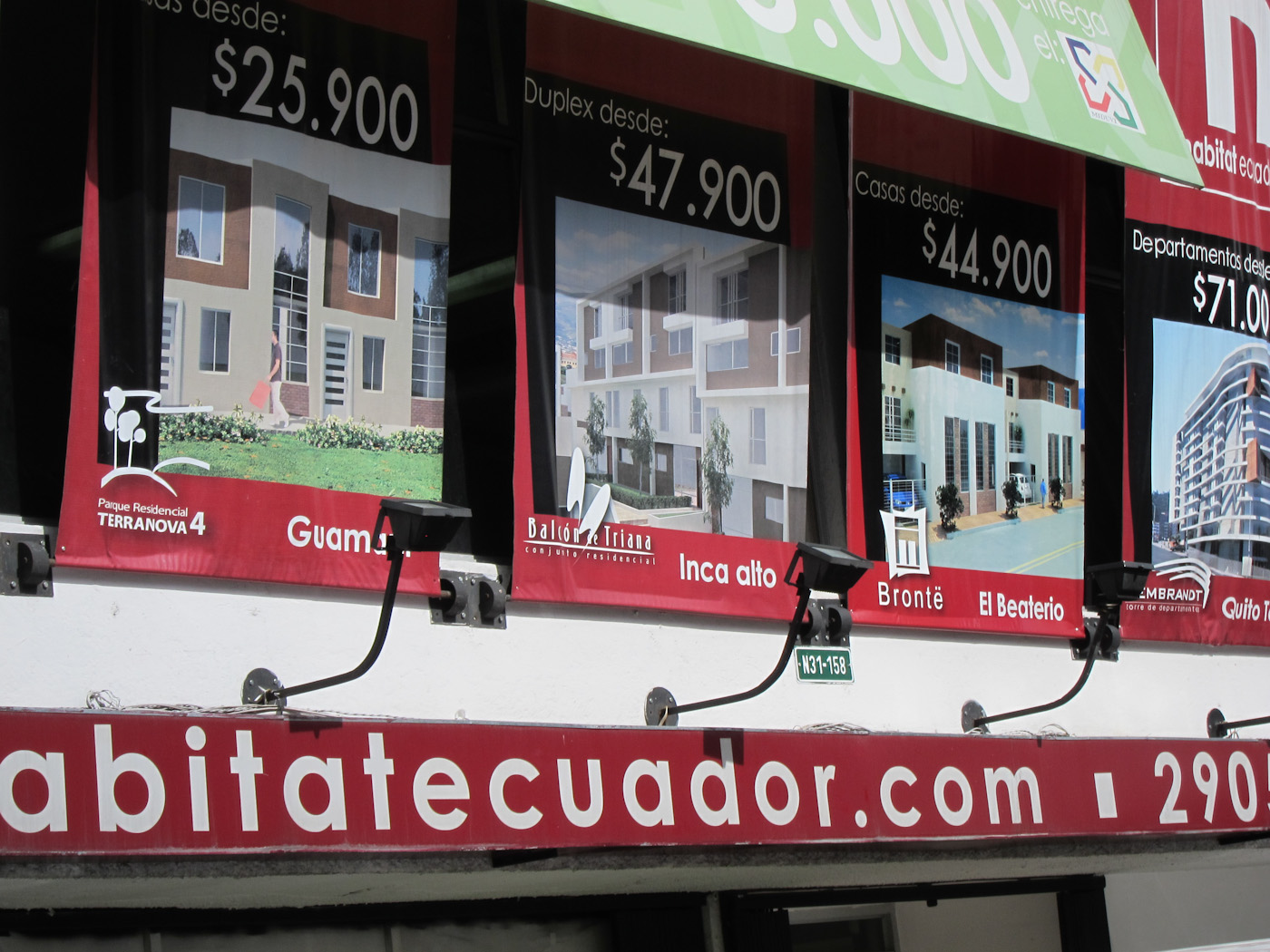
Even in this posh neighbourhood, condo prices were downright cheap by Canadian standards.


Graffiti is everywhere in Quito.

But notice the bike path – cycling and jogging are very popular here. Every Sunday, Rio Amazonas, a major thoroughfare that runs North – South, is closed to traffic and open to cyclists and runners.  Reminds me of Ottawa.


A sculpture of a bull in front of a large office tower.


Imagine my surprise when I stumbled upon a large, modern shopping mall that would have rivalled any in Canada.  Once inside this three-story shopping Mecca, I could have been anywhere.  It reminded me of both the Eaton Centre in Toronto and Bayshore in Ottawa.  There were many familiar stores in the mall and the prices were equally familiar – no deals in this place.  It made me wonder: who besides tourists could afford such luxuries? And yet, I was the only tourist in sight!  Clearly not all Ecuadorians are earning $300 per month.


My first impression of the park:  it’s huge and empty.


Football (soccer) is very popular here.  There was a game on yesterday afternoon and many restaurants in our neighbourhood were advertising the game.  Even our school organized a “field trip” to watch the game somewhere.


The Botanical Gardens are within the park.  Our school has planned an excursion here tomorrow afternoon.  Chris and I have signed up to go.  These excursions cost a few dollars each and students are accompanied by a teacher.


This beats work any day!


A large skate board park, covered in graffiti.

All school children where uniforms.  We have observed so many different colours of uniforms that we are wondering if every school has its own.  Notice the uniforms the girls are wearing in this photo.


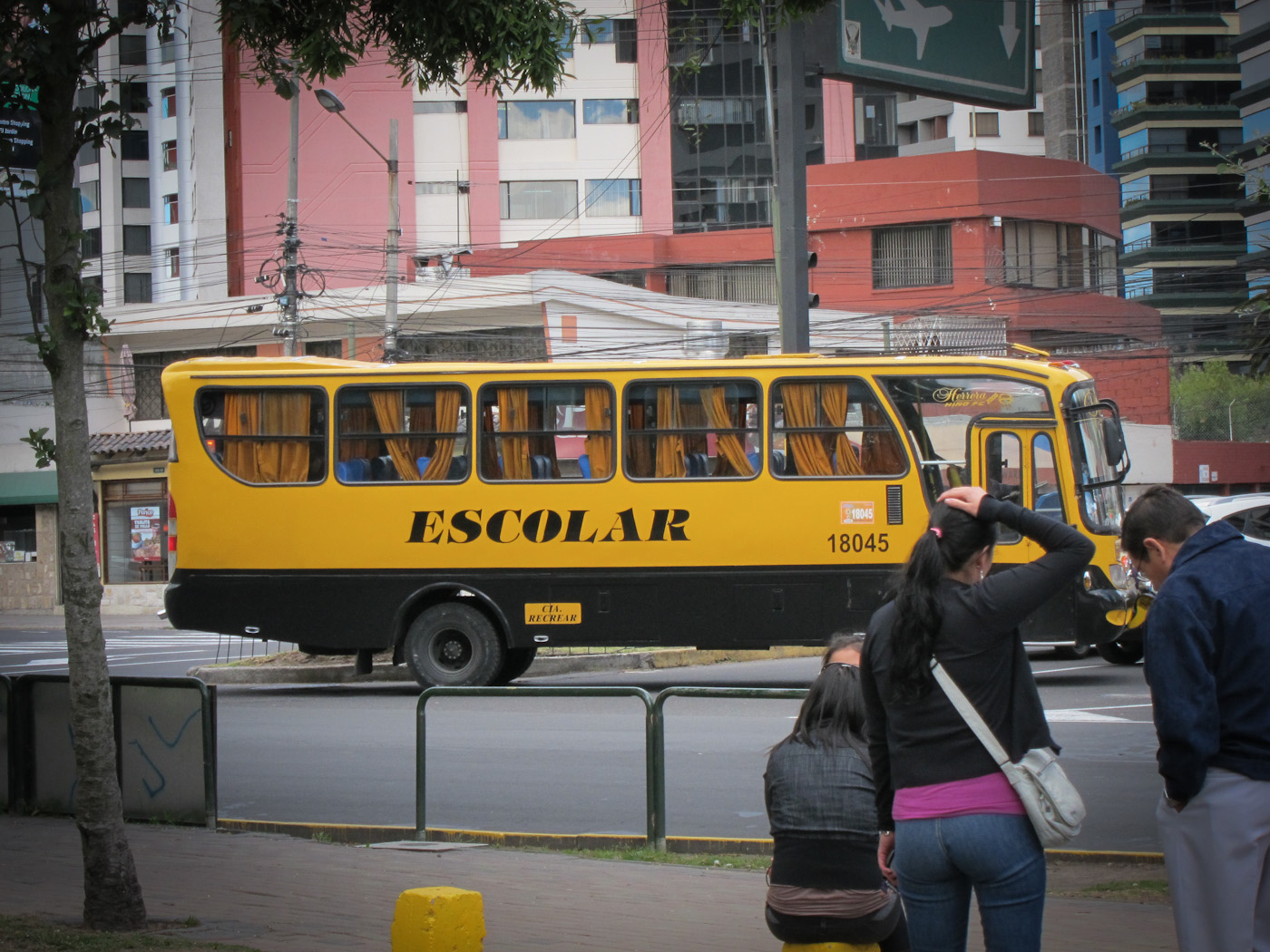
A school bus.

Notice how the people are dressed. This is the typical attire I see everywhere – dark jackets, jeans and the young girls wear slouch boots.


This area seems to be thriving, with new construction all around.  This building caught my attention as these construction workers were manually hauling rods of metal to the top floor.


In case you were wondering, gas costs $1.40 per gallon.

The vendor in the foreground is very typical – street vendors are everywhere.  But they are not aggressive.


And that’s it for my walk in the park.  Hope you were able to get a sense of the area from the pictures and descriptions.  And I hope I haven’t crashed any computers with all these images on one page.


A walk in the park

Today I was solo as Chris has been hit with a case of gastro – at least that is what we think it is. We ate exactly the same things yesterday, but by the end of the day, he was finished – fever, headache, body aches, and of course diarrhea.  Relax, that’s all the details I’m giving.

Let’s just say, the little drugstore I packed for this trip has come in handy.  That being said, everything I brought down – Advil, Tylenol, Advil Cold & Sinus, Immodium, Benadryl, Gravol – is readily available at the local grocery store – at a fraction of the cost.  I’m talking name brand drugs.  For instance, you could buy a bottle of 24 Advil for under two bucks.  We haven’t been in a pharmacy yet, but I imagine there would be an even bigger selection, and most likely even cheaper drugs than in the grocery store. Continue reading…

Spanish 101

Today we decided on our Spanish school and signed up for a week of one-on-one lessons – 20 hours each.  There is a plethora of Spanish schools in Quito and it can be a daunting chore to research all the options available and an even more daunting task to make a decision.  Our job was made easy because of a casual conversation over breakfast this morning.

After spending another day playing tourist yesterday, this time in Quito’s Centro Historico (also known as Old Town), we decided that today we must focus on finding a school and deciding on our accommodations.  We’ll share more about our afternoon in Old Town later, along with some amazing pictures.

Today we planned to spend the day researching and visiting the top three or four schools we could find that met our criteria: the school must be professional with a good reputation.  Originally we had thought we would stay in Quito to study Spanish for a month but we have since changed our minds (we’re allowed you know).  We are anxious to get out of this large city to start exploring the country side which is more our style.  So, we’ve decided to take a week, maybe two of lessons here in Quito before we move on.

Breakfast (included with our room) is served in a common dining room. Each morning we meet different people and exchange basic information:  Where are you from? How long are you in Ecuador?  (I love the reaction when I answer that question with – oh, for a while, not sure how long.) What have you seen/done? What are you doing today? It’s a relaxed, friendly atmosphere and there is no end to the interesting people we meet.

Today we met Tom and Lynn and their one year old son Kaj.  They are a young, thirty-something couple who broke free from their conventional lives in the US (their words, not ours) a few years ago and have settled on the coast of Ecuador.  Trained as scientists, they worked in the area of water quality before turning to property development.  They are currently working on a 30 unit condominium project.  They are having the time of their lives.  Near the end of our breakfast, we casually mentioned we were looking for a Spanish school today and they suggested we consider a school a friend of theirs had recently attended and had highly recommended.

After breakfast they emailed us the name of the school, we looked it up, called the school director via Skype and then headed over to check it out.  It was a mere ten minute walk from our hostel.  The school director, Andrew Kirby greeted us at the door and took us on a tour.  He explained how the school was created as a way to raise funds for the Yanapuma Foundation, a non-profit organization “driven by the enthusiasm of its national and international staff and volunteers to work towards the realization of its vision of marginalized communities achieving equity and well-being, ecological, social and economic sustainability, and developing a sense of the uniqueness of their culture and place in the global context.”

Andrew explained the school’s teaching methodology (a holistic approach focused on all facets of communication – speaking, listening, comprehension, reading and writing) and invited us to chat with present students while they took their morning break.  He described the volunteer opportunities that are available and he told us his story of how he came to Ecuador 7 years ago on vacation and has never left!

We loved the idea that our school fees would be used to better the lives of the locals through the many projects sponsored by this foundation.  We admired the lofty goals of this foundation and its core values.  We liked the comfortable, relaxed atmosphere of the classroom, and the teaching methodology in use.  We signed up right then and there.  Lesson #1 begins tomorrow morning at 9:00.

We haven’t decided on our accommodations yet.  We can stay in the current hostel, or do a home stay where you live with a local family.  We’ll figure that out next.

Market Day in Otavalo

To market, to market, to buy a fat pig,
Home again, home again, dancing a jig;
To market, to market, to buy a fat hog;
Home again, home again, jiggety-jog;
To market, to market, to buy a plum bun,
Home again, home again, market is done.
~Mother Goose Nursery Rhyme


Otavalo is a town in the province of Imbabura, about 110 kilometers north of Quito. It is renowned for its market – the most economically important craft market in all of South America. On Saturday, the main market day, one third of the town becomes full of stalls selling textiles, tagua nut jewelry, musical instruments, dream catchers, leather goods, fake shrunken heads, indigenous costumes, hand-painted platters and trays, purses, clothing, spices, raw foods, spools of wool, animals, and almost anything else you can think of.

Yesterday we travelled to Otavalo to experience this market first hand.  We had the choice of travelling with a guided group for about $30 each, or travelling by bus on our own.  We decided to venture out on our own, equipped with some basic instructions on how to get there.  Remember, we don’t speak Spanish yet….but what better way to learn than to dive right in!

Finding the bus station

First step was to get to the Carcelen bus station.  Again we had a few choices – private car through our hostel for $10, taxi for $5 or local bus for 25 cents which we could catch at the end of our street.  Seemed simple enough.  But which bus?  The buses don’t have numbers and they all said “Carcelen something or other” on their sign.  We let a few buses go by as we tried to decipher the Spanish signs displayed in the front window.  Finally I just flagged a bus down and asked “Carcelen bus station?”  The bus driver stared at me blankly, but his assistant (each bus has a driver and a guy who collects the fare), said something in Spanish and nodded his head.  That looked promising, so we hopped onto the bus quickly as he was already starting to leave.  Bus fare is .25 per person.

The bus ride took us through the city to the North.  This was our first real glimpse of the city beyond our neighbourhood.  We were surprised by the number of American fast food joints – MacDonald’s, Burger King, KFC, Tony Roma’s. Business owners were opening up their shops – unlocking large padlocks that secured their premises.  Trucks full of oranges were setting up on every block – $1.00 for a bag of 20 oranges.

We were motioned to get off the bus at what looked like a bus station – except it wasn’t the Carcelen bus station – doh!  Luckily we met up with another group of travelers who were also trying to find their way to Otavalo (four were from the UK and one from Israel we later learned) and a couple of the girls in the group could speak Spanish.  Turns out we were at the Ofelia bus station and we now needed to catch another bus to the Carcelen bus station.  Once at that station, it was very clearly marked where to buy your ticket ($2.00 each) and where to find the bus.  It would be another two hours or so before we reached Otavalo.

The bus ride to Otavalo

This inter-city bus was a step up from the regular city bus.  Comfy, reclining red velvet seats, curtains on the windows, and even a TV at the front of the bus.  They played an American film (Unstoppable) – Spanish with English sub-titles.  It wasn’t quite as nice as a Voyageur bus, but pretty close.  We settled in for the ride, our knapsack securely on our laps.  We had been warned never to put our bags in the overhead compartment or on the floor – as it was common practice to steal the bags from above, or to cut open the bags on the floor and steal the contents unbeknownst to the owner.

Up and down we went as we traversed the Andes mountains, mesmerized by the beautiful vistas all around.  The trip was pleasant and uneventful – just the way we like it.

The market

Otavalo was a much larger city than I had imagined.  As the bus made its way through the busy streets to the bus station, we caught glimpses of the market stalls that seemed to have sprouted on every inch of sidewalk available.  Street upon street of vendors – everywhere you looked – vendors were selling everything imaginable.

As we left the bus station, we thanked our fellow travellers for their help and made our way into the center of town on our own.   We were only browsing, so we just glanced at the merchandise for sale as we passed by each stall.  Any subtle pause in our step would prompt the vendor to start offering his wares to us.  It was better to just keep moving slowly.  Thankfully, the vendors were not aggressive at all, and pretty much left us alone.

There were very few tourists at the market, probably because this is low season.

The market population was primarily locals of which many are indigenous people who were easily identified by their traditional dress.  The men wear blue ponchos, fedoras, white calf-length knickers and the ashimba, a long braid that hangs down their back.  Women were dressed in white blouses adorned with bright embroidery, blue skirts and shawls.  Beautiful jewellery – strands of gold beads around the neck, gold dangly earrings, and red coral bracelets seemed to be the standard amongst the women.

We meandered through the market, munching on some buns we purchased from a street vendor.  We debated whether or not to eat the street food – something we opted not to do this time (we hope to go back) as we weren’t sure how our stomachs would handle it.  You could buy a full plate of food – meat, potatoes, rice, vegetables – for as little as a dollar.

Fried pork – fritado – was a speciality . . . and there was no shortage of pigs to choose from!  Lunch anyone?

As we were heading back to the bus station, I noticed a group of “gringos” across the street all wearing funning looking hats that had obviously been bought at the market.  I remarked to Chris something like – they sure look like gringos over there….hey, wait a minute, those are our gringos from the bus!  What were the odds we would run into them again amidst the crowded market.  Chris took the opportunity to take their picture and we got their email address to send it to them.

Return to Quito

The bus back to Quito was a little more run down – the seats were more worn, most of the windows didn’t open, and while there was a T.V. at the front, there was no movie this time around.  Clearly, not all buses are of the same standard.  We did get the chance to meet a young lad from Germany who spoke excellent English.  Kevin had been travelling throughout Ecuador for the past 2 months and was enjoying his last day in the country before heading home where he would begin his first year of University, studying Physics.  You learn a lot about a person during a 2 hour bus ride.  He had arrived with no Spanish whatsoever, and after a month of Spanish lessons was quite conversational.  He shared many tips and stories with us on the way back to Quito.  He kindly helped us find our way through the maze of buses at the bus station and we all travelled back into Quito together on the trolley – a much faster route than the one we did in the morning.

Safe and sound in Quito

In spite of the shaky start yesterday, we arrived safely in Quito last night around 11:30 pm.  The travel day went pretty smoothly and without any major incidents– remarkable when you consider we were on the milk run: Ottawa – Boston – Houston – Quito.  But that’s what you get when you fly on points I guess.

Just one minor incident along the way that had me far more worried than Chris. Back in Ottawa, the Air Canada attendant who checked us in suggested we put our back packs into large plastic bags.  This would keep all the straps secure and keep them dry in the event they were stuck on the tarmac in pouring rain.  Seemed like a good idea.  He packed them up, and secured our flight tags to the plastic bags.  I did ask what would happen if security needed to go through the bags – he assured me, no problem, just come back here and we’ll repackage and re-tag them.  What if they get opened up in the States?  Won’t happen, he says, once they have cleared this security, they will be clear sailing right through to Quito.  Wrong!

As we waited to board the flight to Houston, I saw our backpacks being loaded onto the plane – that was a relief as I’m always a little worried that our bags won’t make it to our destination (or let me clarify – that MY bag won’t make it).  So I was happy to see pack # 1 neatly wrapped in plastic, but as the second bag appeared, something was wrong, very wrong.  The plastic bag on Pack #2 had been ripped open and was half off the bag.  I kinda freaked because if the plastic bag came off, the pack did not have a routing tag on it.  But there was nothing we could do.  Just kept my fingers crossed that both bags would make it to Quito.

When we arrived in Houston, I watched with eagle eyes to see the state of our bags as they came off the plane.  To my alarm, the baggage handler who took the bags from the plane ripped off the torn plastic bag and threw it to the ground.  I caused a bit of commotion, but nothing could be done.  It was an anxious flight to Quito as I wondered whose bag wasn’t going to make it.  I should clarify – I was anxious, Chris took it in stride.  Easy for him to do.  His bag never gets lost. I was certain it was my bag since it is always my bag that gets lost.  For example, when we did a Mediterranean cruise a few years ago, it was my bag that got lost and I was without luggage for the first three days of the cruise!  I had nothing but the clothes on my back.  Oh, and I had a toothbrush, toothpaste and comb compliments of the cruise line  – gee thanks, that was helpful.

Anyways, to make a long story short, we arrived in Quito and lo and behold, both bags were there.  I was immensely relieved.

Here’s travel tip #1 from Chris and Chris:  Always make sure your bag is tagged directly.  If wrapped in a plastic bag, put two tags on it.  Bring a change of clothes in your carry-on just in case.  And finally, if you’re travelling with a companion, pack your bags so that you divide your belongings between both bags.  If one bag gets lost, at least you both still have half your stuff.  Great advice – hope we follow it next time we fly!

Off to a shaky start!

DepartureToday we are flying to Quito, Ecuador.  The past couple of weeks have been a whirlwind of activity as we completed our work, said our final good-byes to friends and family, and wrapped up all the loose ends of our lives.  We were overwhelmed with the sincere expressions of kindness from friends and family alike as they extended their hospitality and contributed to plumping us up before we left!

Recently, many have asked how I am feeling about what lies ahead.  Am I anxious? Worried? Nervous?  No, No and No.  Rather, I feel an inner peace that has come from a sense of certainty that this is exactly what I need to be doing at this time in my life.  Each day I awake feeling alive and excited about the adventure ahead. . . .

Ok, I must now confess.  I started this entry a couple of days ago and that is how I felt then.  Today, on the day of departure, the situation has changed dramatically.  Both Chris and I awoke with our stomachs in knots feeling intense fear and anxiety to the point we both felt physically sick to our stomachs.  I can’t even find the words to describe the intensity of our emotions.    Chris described it in this way:  I feel like I’m standing on the edge of the highest diving board (like Tower 4 at the Nepean Sportsplex), looking down thinking, what the F*** am I doing?

These feelings persisted all the way to the airport, through check-in and security.  By the time we reached the gate, with an extra large Timmies in hand (our last for a while!) we were managing our anxiety by using a technique that has served us well running marathons – to break the distance in small manageable chunks.  Nobody begins a marathon thinking – I have 42.2 kilometres ahead of me.  Instead, you think of the first 5, then the next 5, and so on.  And so we began telling ourselves we can come back in a month if we want and we joked that we could continue the blog as an exercise of our imagination from the comfort and security of Canada.   We’d just have to be careful not to be spotted at the mall!

But seriously,  we’re still feeling anxious and fearful as we await our plane.  I just hope we have the guts to board the plane!