January 2013

Cooking up a storm, Thai style

Massages, custom-tailored suits, night markets, elephant camps, temple sightseeing and Thai cooking classes sums up the itinerary of most visitors when they come to Chiang Mai, and I must admit that we were no exception.  One Thai massage was more than enough for both of us; it took days for us to recover from the after effects of being pummelled and kneaded and bent in ways our bodies had never experienced before.  Chris splurged on a couple of tailored suits and custom shirts while I decided to forego the experience for myself.

At the regular night market, open every evening of the week, you can find everything imaginable, including lots of delicious street food.  As you know, we’re not doing much shopping on this trip, but I must admit I have been collecting badges of flags of the countries we have visited and have sewn these onto our large packs.  It makes for a great conversation starter and makes our bags easily recognizable which is a good thing from a security perspective.  I was thrilled to find a lady selling flags from most countries and stocked up on all the countries we were missing.

Our favourite night market has been the Sunday night market, which attracts both locals and tourists.  You need to get there early because by 9:00, you can barely move along the street that has been closed to traffic so that vendors can fill the sidewalks with their wares.  The best part of this market is the street food.  Contrary to our usual cautious approach to food, we made a point of trying different foods each week, and we’ve enjoyed most of what we’ve sampled.  Prices are ridiculously cheap, ranging from 60 cents for a snack to a buck or two for a full meal.

Speaking of food, after spending almost a month eating Thai cuisine, we thought we should learn how to cook it ourselves and so we spent a day at a farm about a half hour outside of the city, cooking up an array of dishes in the company of 10 other tourists and under the careful direction of Huey, our talented and patient instructor.  We each prepared five dishes: a main dish, an appetizer, a curry, a soup and a dessert.

Of course, we ate everything we cooked.  The class was very hands on, and was a great way to learn about Thai seasonings, cooking techniques and other unique ingredients that we had never seen before.  My favourite dish was a chicken panang curry, which quite frankly, was the best panang curry I have ever eaten.  The other dishes were made with varied success, some better than others.

Chris and I look forward to practising our new culinary skills on our friends and family when we return to Canada in the springtime.  But for now, we’ve got more exploring to do.  Today marks the end of our sojourn in Chiang Mai; we’re heading south tonight by overnight bus to Bangkok where we’ll catch a flight, bus and ferry to Koh Lanta, an island off the west coast of Thailand.  We plan to island hop over the next few weeks, making our way back to Bangkok by the end of the month.

With our return date to Canada looming in the not so distant future, we’re planning to get a few more countries in under our belt.  Coming up, we plan to visit Cambodia, Vietnam and Laos and if we can squeeze it in, Myanmar (Burma).  I may even get to India if I’m lucky.  So don’t give up on us now, we’ve got more adventures ahead to share with you.

Banned by Adsense

I don’t know where we went wrong, but we have been banned for life from using Adsense ads!  As you know, last month we initiated an experiment with advertising on this site to see if it was possible to earn income from a travel blog.  We incorporated Adsense ads as well as Affiliate ads into our site.
The application and approval process used by Adsense is particularly rigorous.  I guess they need to make sure the sites that host the ads of their paying advertisers will comply with their equally stringent rules and policies.  After getting approved, it then took some effort to incorporate the ads into our site, although, admittedly, this was quite easily achieved through the use of a very user-friendly plug-in for WordPress.

We spent the month of December monitoring our Adsense account, watching our earnings grow almost daily.  Daily earnings ranged between a few cents at the low end and a little over a dollar on a good day.  We had no idea how this compared to the average site, although these numbers were much higher than we expected.  By the end of the month, we had earned a whopping $28.82. This got us thinking about the possibilities of setting up multiple sites on niche subjects that we could write about.  It seemed a simple matter of economies of scale, the more sites we hosted, the higher our earnings.  Could we be onto something here?  Or was this too good to be true?  You know what they say…….

Concurrent with our Adsense ads, we set up a few affiliate ads for companies that we have personally done business with and would recommend them to our friends, namely: iPage our website hosting provider, World Nomads our travel insurance provider, and CheapoAir where we get the best prices on airfare.  The pricing model for affiliate ads is quite different from Adsense where you get paid based on users clicking on your ads.  With affiliate ads, you get paid a percentage or flat fee when someone makes a purchase through the link on your site.  Our one month of affiliate ads yielded a big fat zero in earnings.

As we prepared to settle down in Chiang Mai for a while, our creative juices were flowing  as visions of dollar signs danced in our heads.  We spent time researching ideas and playing with the technology.  Our enthusiasm ebbed and flowed as we got excited with each new idea, only to be crushed when we poked holes into it or realized it had already been done before.  While we were doing all of this work – and it really did feel like work, at least from what we remember work feels like – I met Monique, the lady with the non-profit Association who I mentioned in an earlier post, for whom I offered to create a website.  My efforts at finding a money-making venture were put on hold, as this altruistic project consumed far more time than I had planned.

Suddenly, out of the blue, we received an email from Google Adsense, telling us that our ad account was permanently disabled because we were in violation of their policies.  No explanation.  All appeals for an explanation, for more information, for some direction on how to correct our mysterious violations, were flatly refused now that  we were allegedly guilty of invalid click activity.  Not to mention any names, but we strongly suspect some of our readers may have been a little over-zealous in helping our coffee fund.  Obviously, Big Brother is watching!

To add insult to injury, we can’t even get paid our measly $28.82 because they locked us out of our account before we received our PIN number which we needed for security reasons.  They really aren’t kidding when they say we are banned from their program.  In reality, our Adsense earnings for the month was another big fat zero.  Good thing we didn’t quit our day jobs…..wait a minute, we did quit our day jobs….guess that’s why we’re heading home in April.  

Thanks guys.


The temples of Chiang Mai

Chiang Mai is home to over 300 Buddhist temples designed in a mixture of architectural styles that reflect the varied heritage of Northern Thailand.  Each temple is extravagently decorated with intricate woodcarvings, serpent staircases, gold trim, glass and mirror mosaic, elephants, gilded umbrellas, and buddhas in all shapes, sizes and materials.  Unlike the temples in Bangkok which are rarely more than 200 years old, many of the temples in Chiang Mai date back to the founding of the city itself, over 700 years ago.  

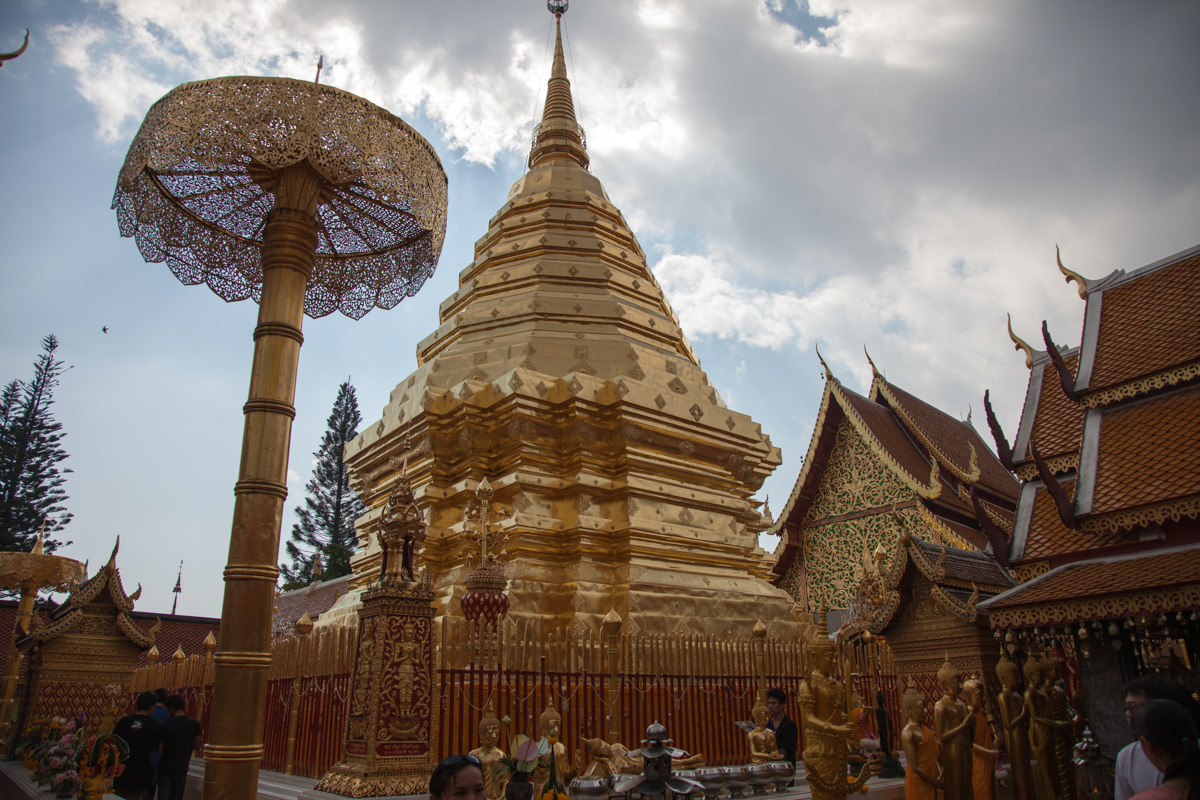
Outside the city, temples flank the hillsides like shiny beacons of light, including one of the most important temples in the area, Wat Phrathat Doi Suthep.  Located about 20 km west of the city, this pilgrimage temple is also a popular tourist attraction.  According to legend, a Buddha relic magically replicated itself just before it was about to be enshrined in the big chedi at Wat Suan Dok. The “cloned” relic was placed on the back of a sacred white elephant, which was allowed to roam whereever it wanted. The elephant eventually climbed to the top of Suthep Mountain, trumpeted three times, turned around three times, knelt down and died. This was taken as a sign that this was the spot where the relic wanted to be, so King Ku Na built the original of the chedi on Doi Suthep at the end of 14th century.  

We visited this temple with a couple, Andy and Sue from the UK, who we met at our guest house. They invited us to join them on a day trip up the mountain and we were happy to tag along.  Leading the way on their motorbike, we putt putted behind them on our rented scooter, up the winding road to the top of the mountain where the temple was located.  Once we got the hang of it, navigating the turns turned into a lot of fun and I felt the carefree, exhilaration that motorcycle enthusiasts rave about.  

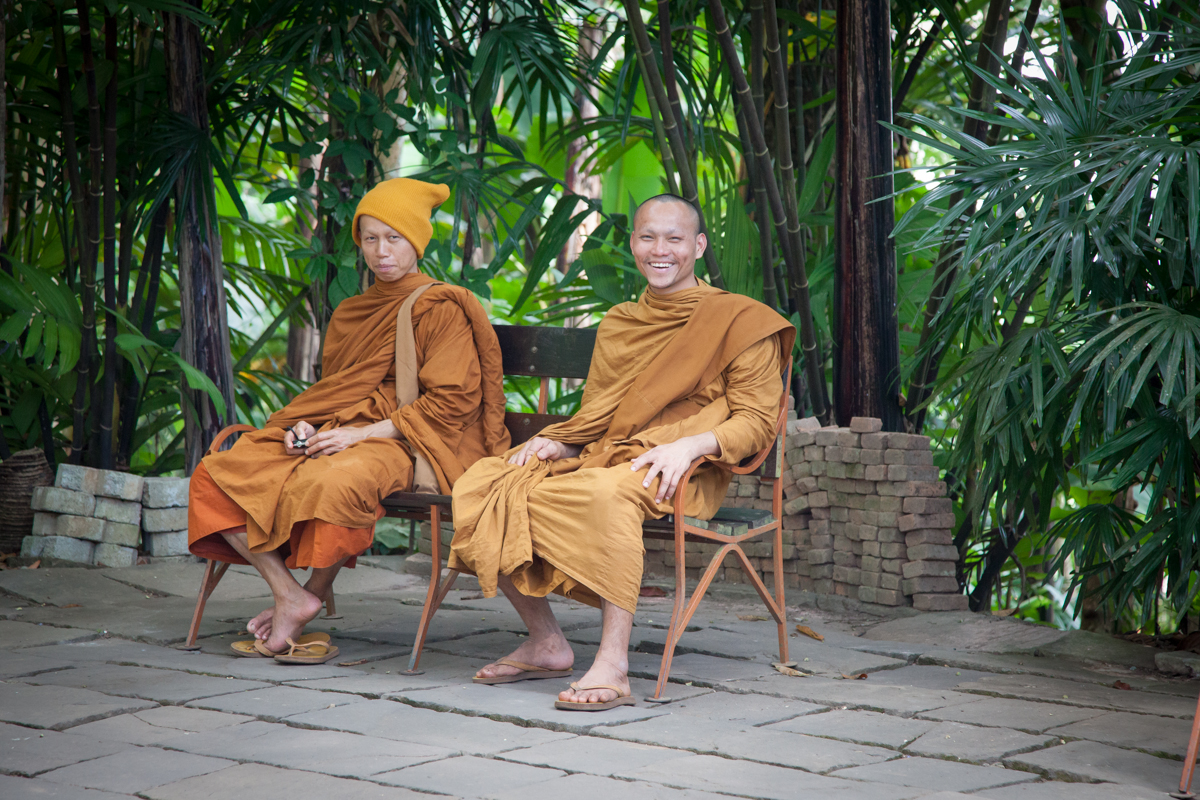
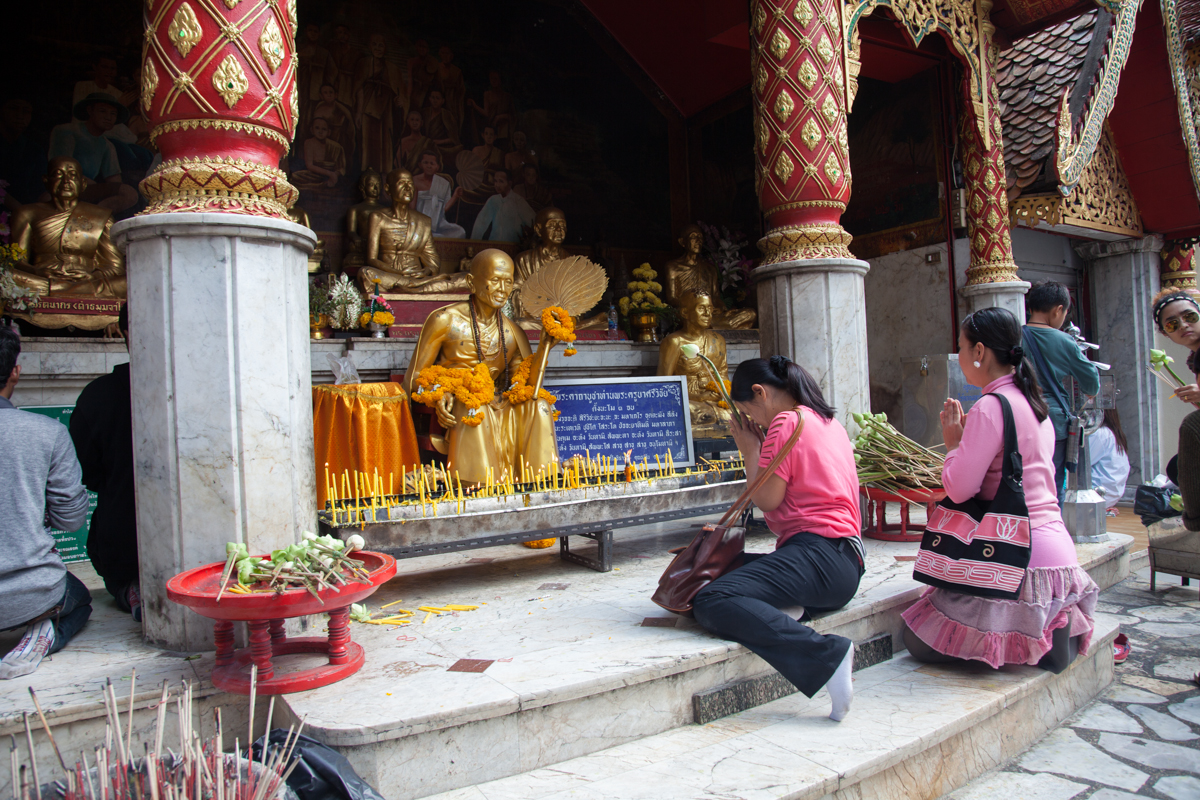
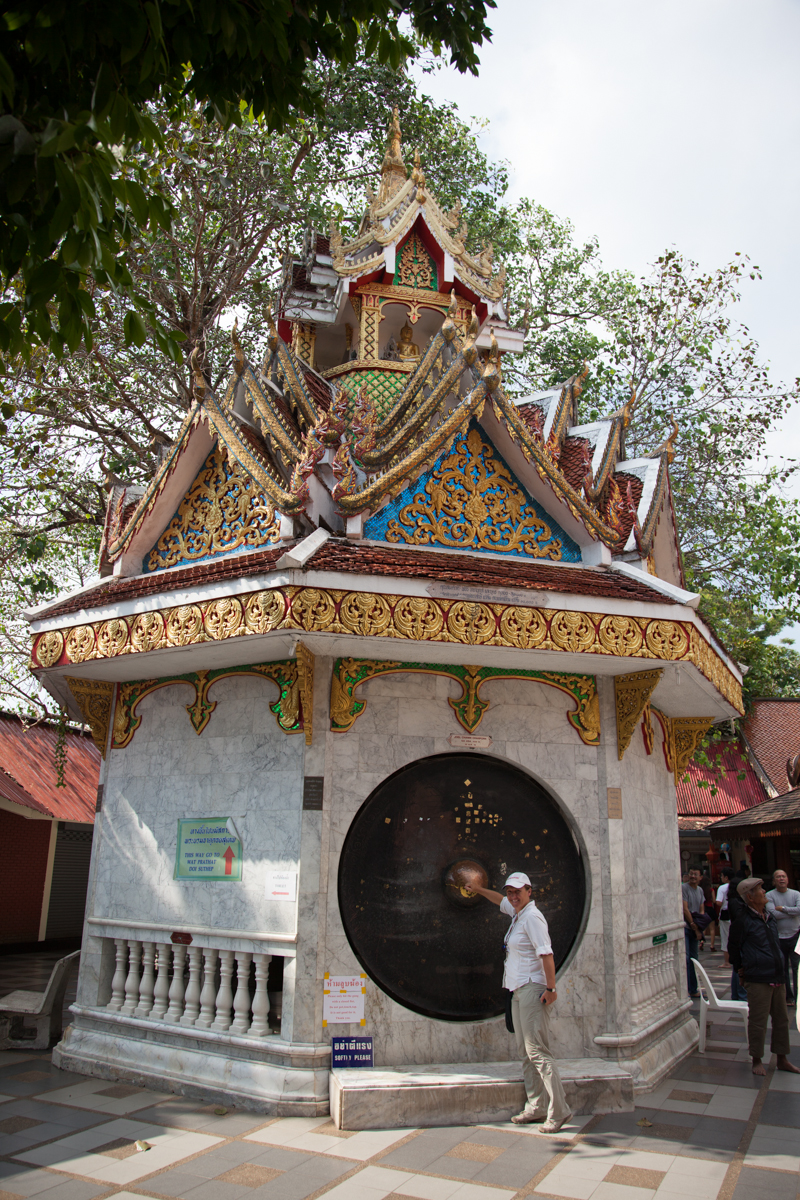
The temple sat at the top of almost 400 steps which were flanked by two green dragons that extend along the full length of the staircase.  It is said that every Thai must visit this temple at least once in their lifetime which may explain why there were so many locals and monks praying and making offerings.  The temple was beautiful, but I was a little put off by the crowds of tourists which gave the site a Disney-like appearance. 

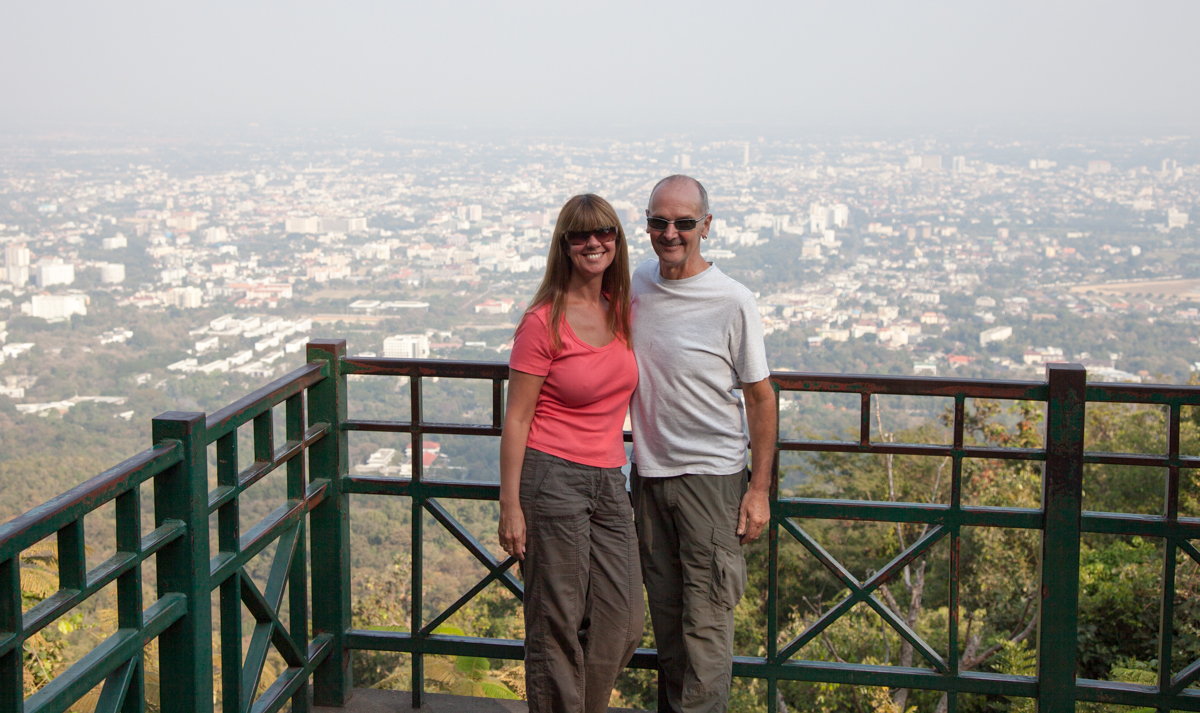
On the way to Wat Phrathat Doi Suthep,  our new friends
Sue and Andy pose with a view of Chiang Mai in the background.

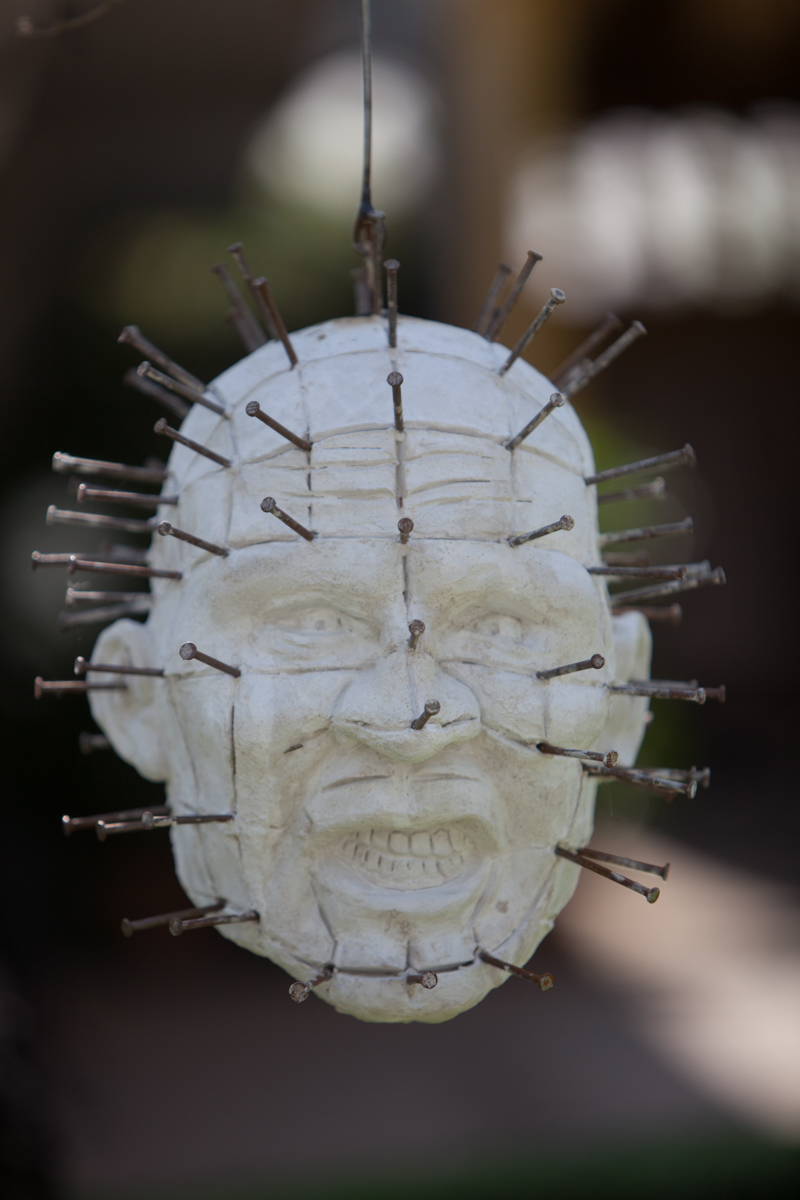
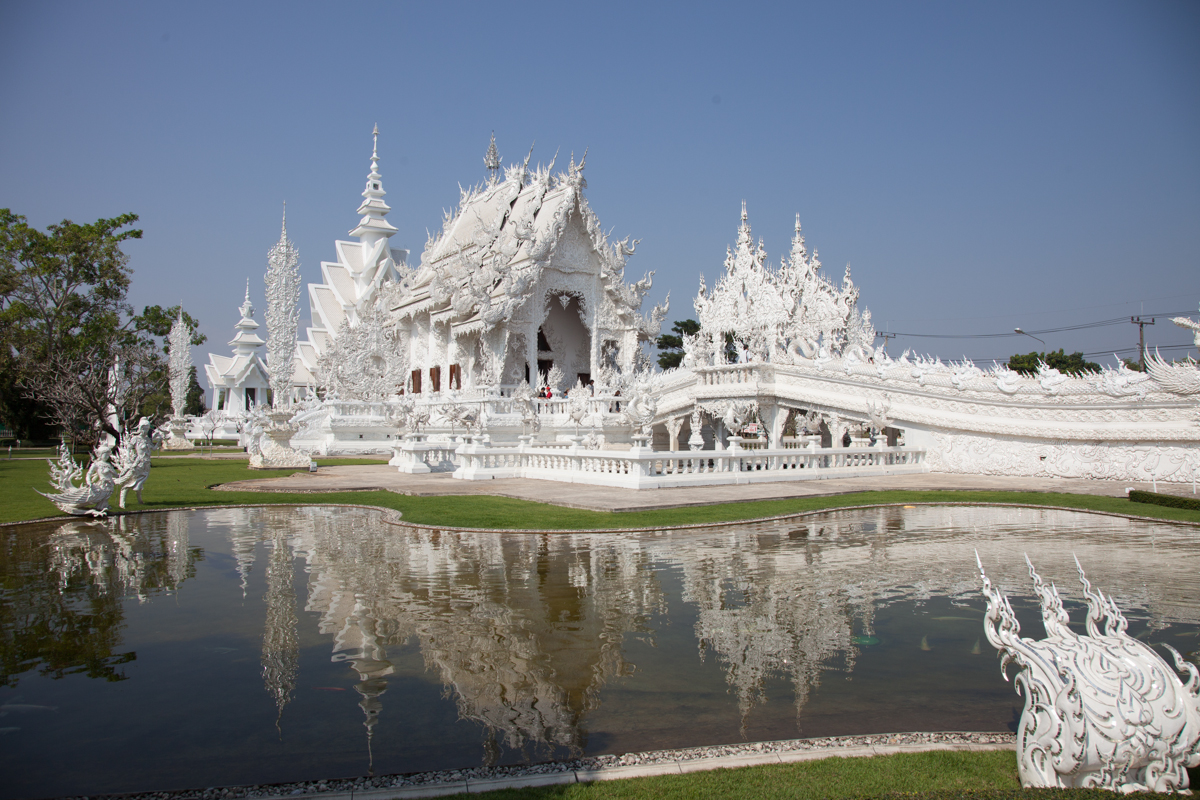
The White Temple was our first stop on our way to Chiang Rai during a day trip in a rented car accompanied by Monique, our friend from our guest house, and Momo, a young man from Taiwan who we met a couple of days earlier in our Thai cooking class.  This temple was perhaps the most unusual temple we have seen thus far.  Parts of it were downright weird, like the sculpted heads hanging from the tree branches. It was beyond me what these represented.

It is a contemporary, unconventional Buddhist temple that is still a work in progress. The architect who began this project in 1996 asserts he doesn’t expect it to be completed until 90 years after his death.  True to its name, all the buildings in the temple complex are white, sparkling with mirrored mosaic tiles that are embedded in intricate patterns covering every square inch of surface.  In contrast, the building housing the toilets was made of gold.  I’m not sure if there was any significance to that.


There were plenty of other temples on the way to Chiang Rai, but it was impossible to stop for each one of them.  Our final destination on that trip was the Golden Triangle, where three countries – Thailand, Myanmar (Burma) and Laos – intersect at the confluence of the Mekong and Ruak Rivers.  Today this destination is popular amongst tourists, especially those needing to exit the country to renew their Thai visa (known as a “visa run”), but in the past, this area was the centre of one of the largest illicit opium growing regions in the world.

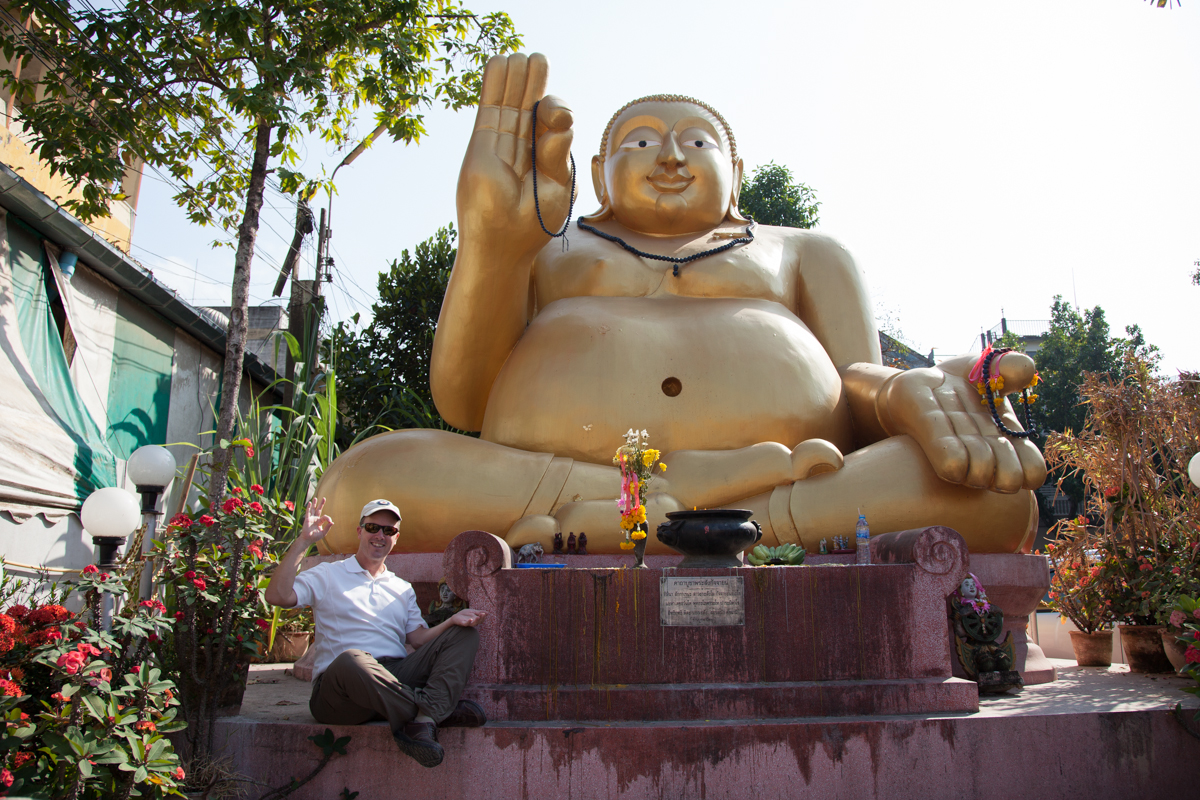
Monique at the entrance to a temple on the way to the Golden Triangle.

Posing with Momo, our young Taiwanese friend who we met
at the cooking class we attended. 

Ringing in the New Year Thai style

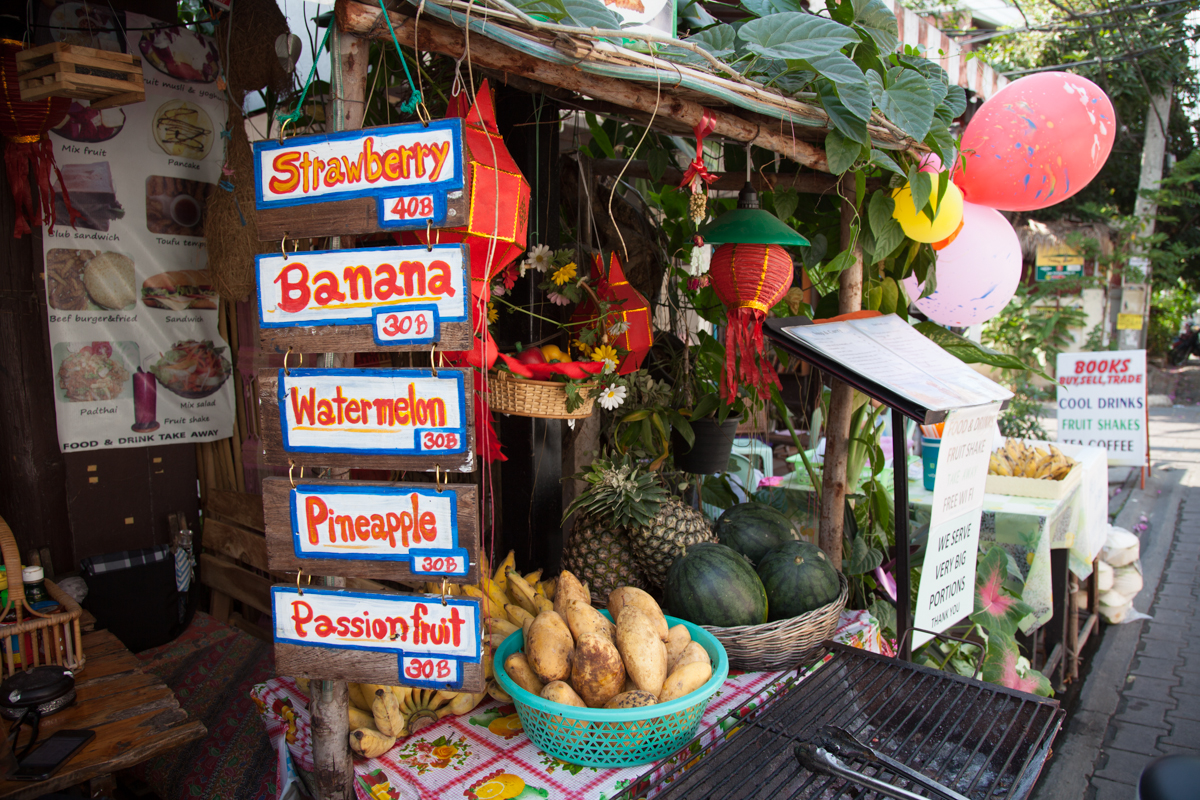
The countdown began a week ago when Thapae Gate was transformed into a temporary night market offering up food for every palate, and a large variety of stalls selling everything from clothing to key chains.  Live music and cultural shows provided nightly entertainment on the large band stand that was set up in the middle of the square.  We went to the market almost every night this past week, enjoying the amazing street food – sushi, dim sum, corn on the cob, grilled fish, pad thai – there was so much to choose from, and everything was delicious and cheap.

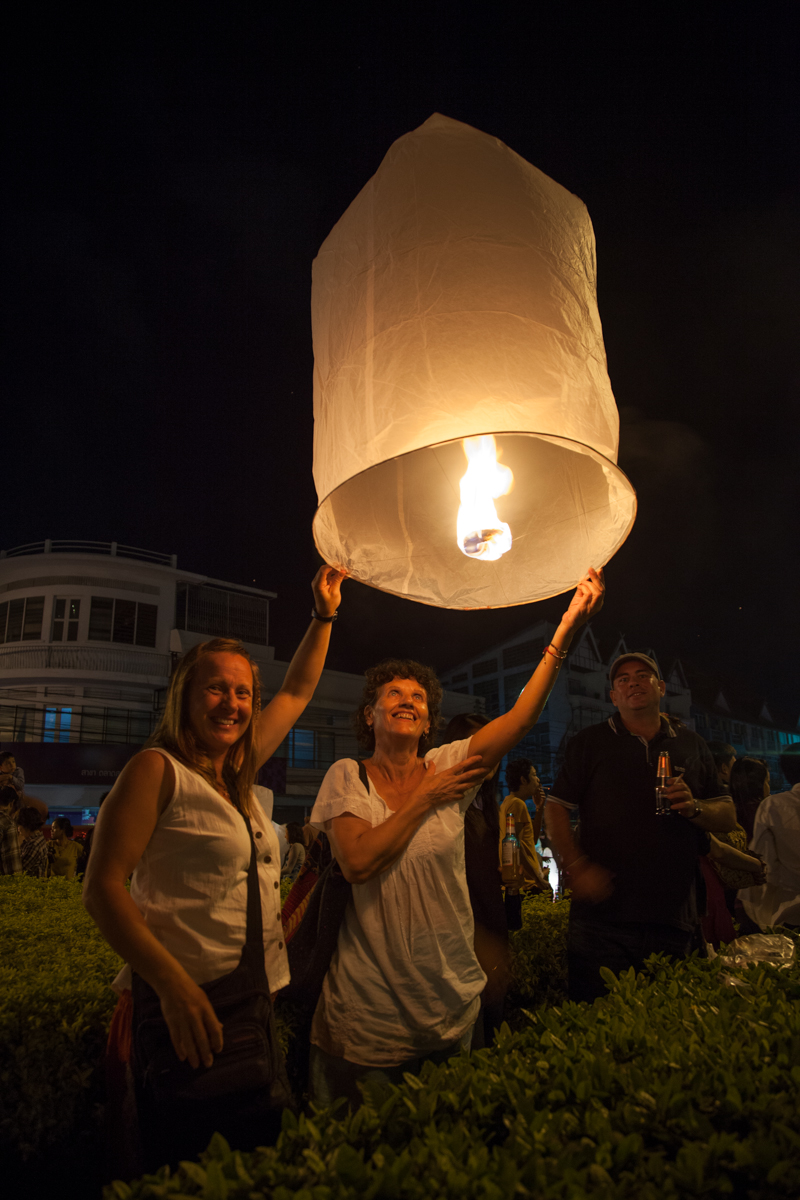
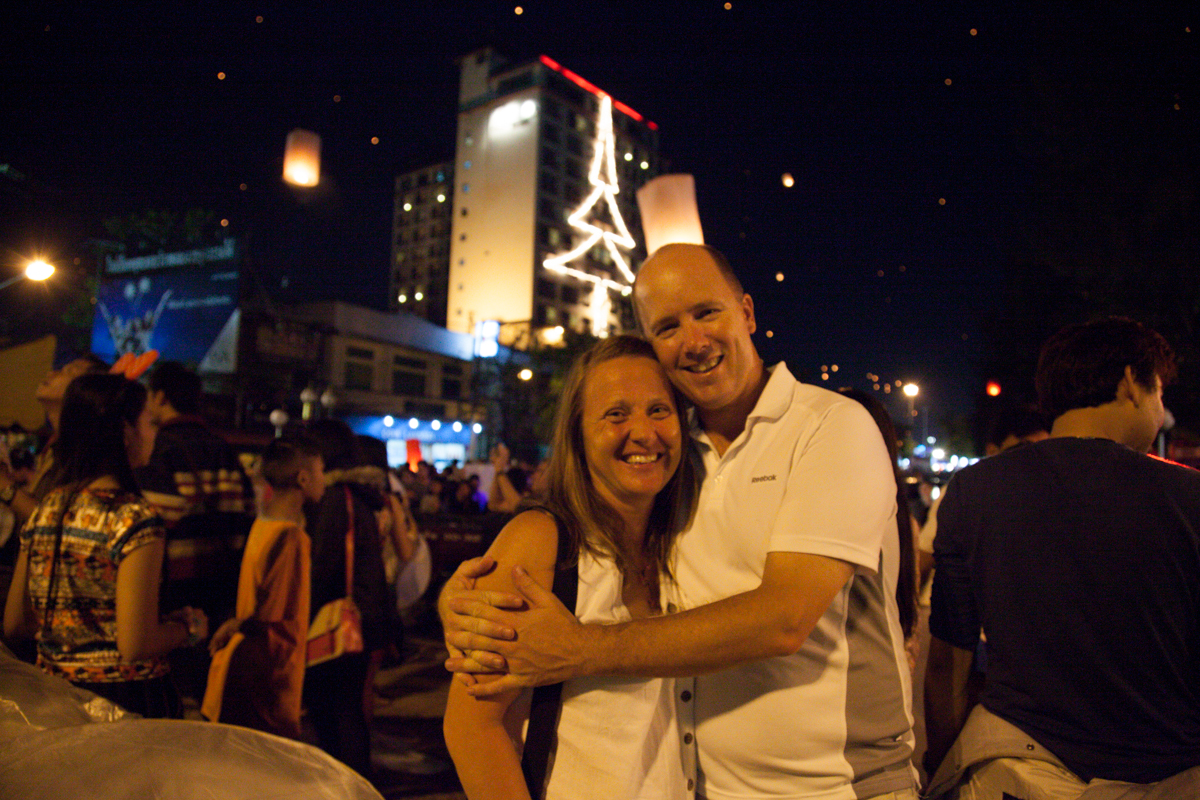
The “Countdown to 2013”  festival culminated on New Year’s Eve where thousands of people congregated around Thapae Gate and the  immediate vicinity.  Closed to traffic, the surrounding streets sprouted even more markets on this final night of festivities.  The atmosphere was charged with happy energy as people released floating lanterns into the night sky as a way to show respect to Buddha, to release bad memories and to make a wish for the future.

These paper lanterns came in a variety of sizes and colours and could be bought from hawkers on the street for 30-50 Baht apiece.  Most were white and quite large, about a metre high and a half a metre in diameter.   At the base of the lantern, held in place by thin wire, was a disk that when lit produced a strong flame.  After a few moments, the heat from the flame created a pocket of hot air trapped within the lantern that caused it to rise and float away much like a hot air balloon.

Chris and I set our lantern afloat early in the evening and we both found the experience to be magical as we watched our lantern get swept away high in the sky joining a myriad of lanterns that already dotted the horizon like a new constellation twinkling in the black sky.   Not all lanterns were released successfully – some got caught in tree branches and turned into balls of fire that just burned out quickly, while others were released prematurely and lacking sufficient heat to rise, fell to their demise in the waters of the moat below.  But these were the exception as most were carried up and  away swiftly by a gentle breeze.

Fireworks kept going off all around us, in every direction throughout the evening.  Children shot fireworks from tubes that were sold by street hawkers, creating little pops of light and sparkles.  Others had purchased fireworks earlier and set these off in random places.  The official fireworks went off after the final countdown to midnight, a dazzling, beautiful display that lasted for about ten minutes. Just past midnight, we released another lantern with our new friend Monique who we had befriended earlier in the day.  Monique is staying at our guesthouse too and up until today we have simply exchanged courteous greetings with her each morning at breakfast.

But today was different and for some reason we had an extended chat with her.  One thing led to another, and before I knew it, she was telling me about her recent trip to India where she volunteered at a school for a month.  It turns out she runs a non-profit association, Petit Plus, and she has been searching for a new project to support through her association.  This school has captured her heart and her passion. Her enthusiasm was infectious and when I learned she didn’t have a website for her association, I suggested this was something I could perhaps help her with……and so Monique and I released our lantern wishing great things for this school in India, for her association, and for our new found friendship and collaboration.

Best wishes to all our family and friends, new and old, from Canada and around the world.  We wish you all a new year full of peace, happiness, and prosperity….with a little adventure thrown in for good measure.

 Video:  New Year’s Eve in Chiang Mai, Thailand.


In search of an apartment during high season in Chiang Mai

Thailand is a land of beautiful beaches, tropical forests, magnificent temples, and gentle people. It is also the land of cheap living.  Even now, after a decade of explosive growth in the tourism industry, Thailand is still a bargain for foreigners.  After a week in Chiang Mai, we are amazed at how cheap things are.  A delicious, nutritious meal costs $1-2 CAD in a local restaurant, (street food is even cheaper), a dorm bed starts at $3 CAD, AND a 500 ml bottle of mineral water costs 7 Baht (0.21 CAD) at the local 7/11 corner store.  It’s no wonder so many people come here for longer stays, many ex-pats making this their permanent home away from home.

Apartments are cheap too.  A small studio starts at about 8,000 Baht.  That’s just $240 CAD per month!  Of course, as with everything, you get what you pay for.  Larger 1 bedroom apartments in buildings with amenities like a pool and a gym, cost between 10,000 and 15,000 Baht.  Want a brand new, modern building?  The cost goes up even more.  If you’re willing to go out of town a little, you can rent a large house for about 20,000 Baht per month. Sounds great, doesn’t it?  So why have we found it so hard to find an apartment?  Here’s what we’ve learned so far during our apartment search:

  1. Supply and demand.  Christmas time is peak season with many places being reserved months or even a year in advance.  That means there are fewer units available, and of course, whatever is left is going at a premium.
  2. Short versus long term rental. Most units require a 6-12 month lease which puts them out of our search.  We want a 1-2 month contract for a fully furnished unit.
  3. Serviced apartment versus condominium.  A serviced apartment is very much like a hotel.  You enjoy amenities like daily housekeeping, pool and fitness area.  On the down side, these apartments tend to be quite small and sterile like a hotel room and are much pricier.  These units are very popular amongst foreigners because they are geared to short term stays  from one week or more.  Of course, that means there aren’t many units available this time of year. Condominiums, on the other hand, are usually rented out by the owner and are furnished in a more homier manner.  It takes time to find these one-off units and then it takes time to make enquiries about availability, price, etc.
  4. New versus older buildings:  There’s been a building boom going on in Chiang Mai for a while, resulting in lots of glossy new condos which makes the older buildings look pretty dated and sometimes downright shabby.  Apartments in newer buildings cost significantly more than those in older buildings and generally have better amenities as well as units that boast clean, modern decor and design.
  5. With or without a kitchen:  Kitchens are a novelty here in Thailand, especially a western style kitchen.  A typical kitchen has a small bar fridge, hot plate and microwave.  That’s it.  Moving up a notch on the price scale might yield a two burner stove and a larger fridge and a foot or two of counter space, but not much more.   These minuscule kitchens are quite poorly equipped as well – a single wok, a few dishes and cutlery is all you’re going to find.  Apartments with full kitchens are rare and are accordingly priced at a premium.  We thought we needed a full kitchen, but quickly adjusted our “needs” to meet what was available.  Soon we found ourselves saying things like: look at this kitchen, it even has a cutting board and knife!
  6. Size really does matter: Studio sized apartments with less then 40 sq m of space are a dime a dozen here in Chiang Mai and are the easiest and cheapest places to find on a short term basis.  But these units don’t feel much bigger than a hotel room and typically have the most basic of kitchens if they have a kitchen at all.
  7. Location, Location, Location: We quickly learned that it’s virtually impossible to find a one bedroom unit with a functioning kitchen within walking distance of the Old City.  Larger apartments seem to be located a few kilometres away from the city core, while houses are even further afield, up to 10 km away.

After a thorough two-week search, we had narrowed our options down to two apartments both of which were located a few kilometres away from the city center.

One apartment was in a serviced building with gorgeous amenities.  At 43,000 Baht per month, it was the most expensive apartment we saw and it was only available for the month of January.

The other apartment was in an older building but the unit itself had just been renovated into a modern, spacious, open layout with breathtaking views from the wrap-around 13th floor balcony.  It was priced a little better at 35,0000 Baht plus utilities.

We weren’t over the moon over either property – each had its pros and cons, the biggest con of each being the remote location.

After a lot of debate and oscillating back and forth between the two, we decided to take neither.  We realized that location was the most important factor for us; we love being in the city center where we can walk everywhere.  Even with a scooter, we still prefer to be in a walkable location.

Besides, we are very comfortable in our current location, Kamala’s Guesthouse.  This place is super clean, the rooms are bright and spacious, and the owners are friendly and extremely helpful.  The common areas are inviting, relaxing and comfortable too.  The onsite restaurant serves up great food, as does the little restaurant next door.  And it’s dirt cheap compared to the apartments at a mere $3300 Baht per week.  Best of all is the location.  We are within less than a block from the moat which marks the perimeter of the old city center.  We can walk everywhere and we do, everyday.  I’ve even marked out a nice running route through the twisty, winding lanes and alley ways.

Cat’s restaurant next to Kamala’s – we have at least one meal here a day.
The food is freshly prepared with lots of healthy ingredients and its tasty and cheap too! 

Another restaurant just around the corner from us.

Lots of laundry shops in our neighbourhood.  It costs 30-40 Baht per kg
(about $1 CAD) to have your clothes washed, dried, pressed and folded.  At that
price, it would be foolish to try to do it ourselves!    

In short, we are comfortable where we are, so we’ve signed up for another two weeks.  After that we’ll just play it by ear, like we always do.

8 tips for renting a scooter in Thailand

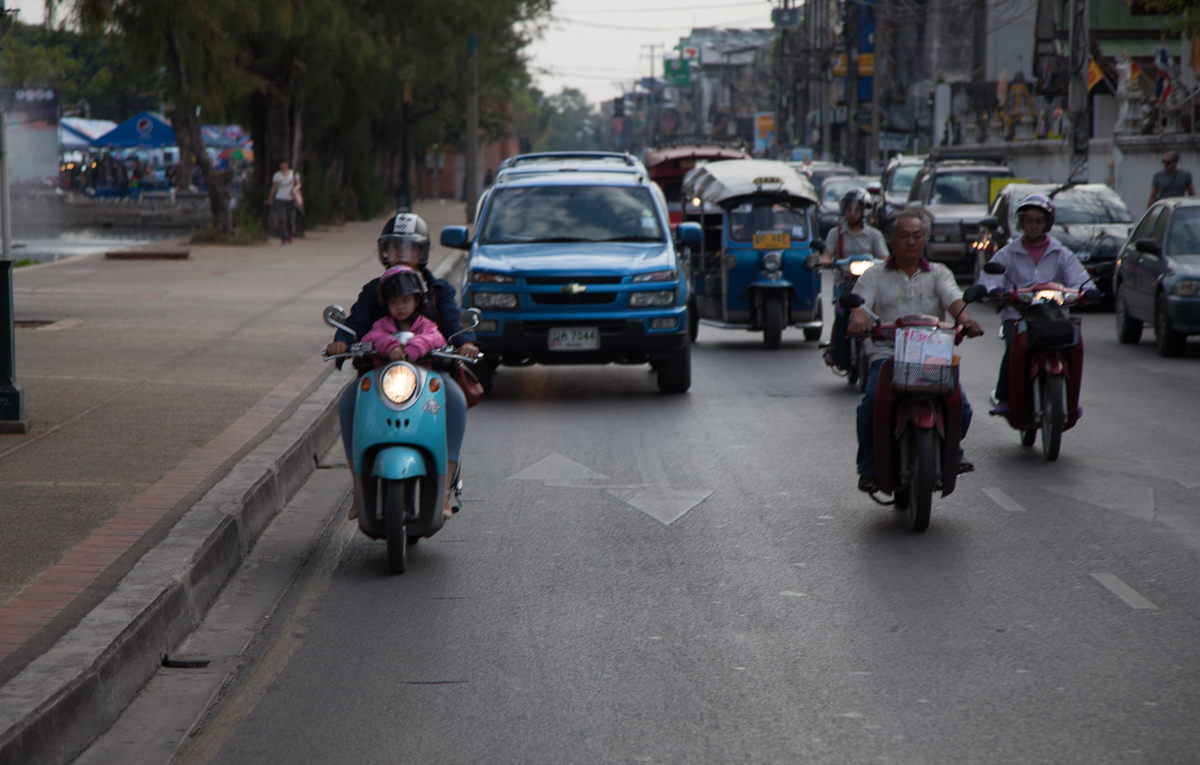
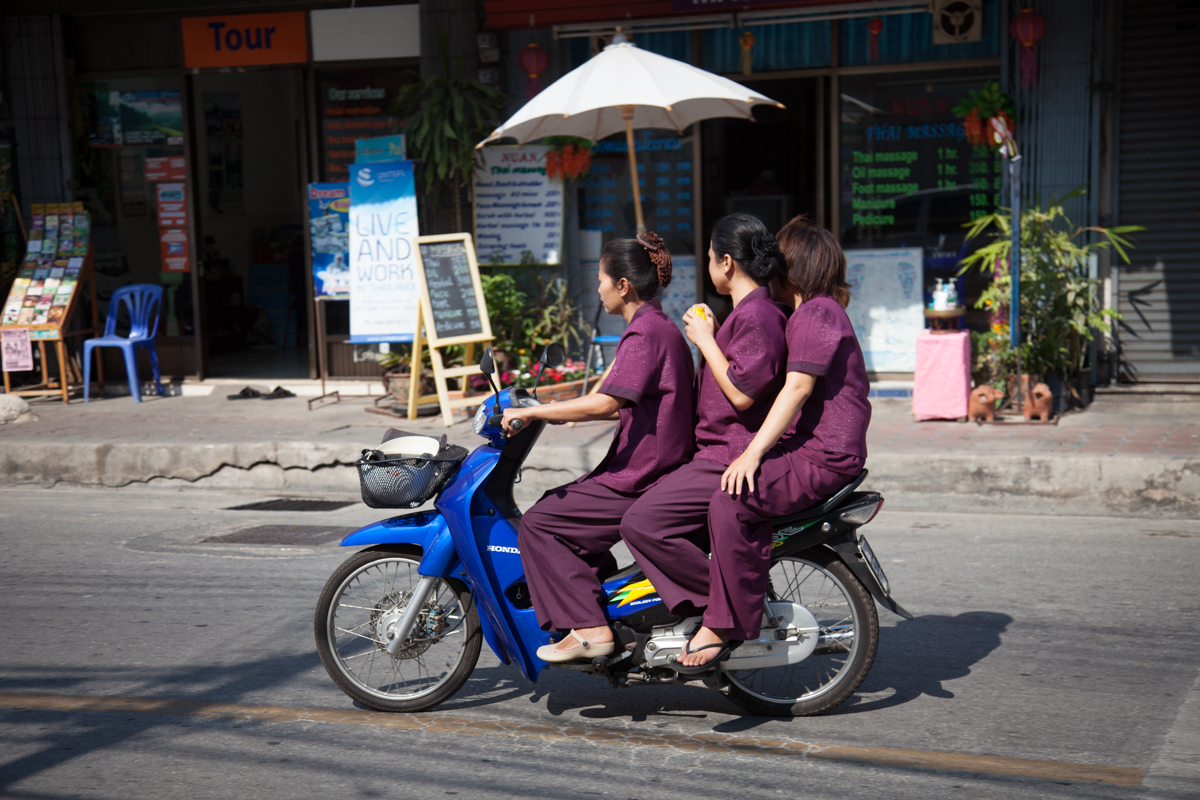
After exhausting all the apartment rental options within the city center, it was time to take our search further afield and to do that we needed some wheels.  Like most Asian cities, scooters are more common than cars here in Chiang Mai, and it’s no surprise when you consider how cheap they are.  A brand new scooter goes for about $1200 CAD, but a one day rental is a mere 200 BAHT (about $6 CAD).   And it’s cheap to run when gasoline costs just over a buck a litre (CAD) and you get about 40 km per litre.

We are scooter newbies – we’ve never even sat on a scooter let alone driven one.   Neither of us are big fans of motorcycles, mainly because we just can’t imagine feeling safe with nothing between us and the road should things go wrong.  But when everyone is driving a scooter, from young kids to grandmothers, we figured we should at least give it a try.  Besides, we needed some mobility to look at apartments within a few kilometre radius of the Old City.
After spending a day on a scooter – Chris drove and I navigated from behind – and surviving to tell the tale, we have a few tips to share in case anyone is thinking about doing the same.

  1. Don’t surrender your passport when you sign the rental contract.  We have heard stories of unscrupulous people who refuse to return your  passport because they have fabricated bogus problems with the scooter and they want you to pay up to fix them.  Even worse, some go so far as to steal the bike while it’s in your possession and then insist you replace it before returning your passport.   It’s better to leave a deposit (3,000 BAHT in our case) which is a lot easier to walk away from should you find yourself in such a situation.
  2. Do wear your helmet even if it looks like it would give you less protection than your bike helmet back home. It’s the law to wear a helmet in Thailand, and I saw more than one ticket being issued to helmet-less people.  Besides, even a lousy helmet is better than no helmet if you have a mishap. Of course, you could carry your helmet in your front basket like most of the locals do if you really want to.
  3. Do take a few spins around the block on quiet streets before venturing out into a busy thoroughfare just to get the feel of the scooter.  It’s a lot harder to balance when you have a passenger on the back, so be sure to practice a bit with your passenger on board too.
  4. Don’t fill the tank.  You receive the scooter with an almost empty tank and you can return it empty as well.  It’s not like a car rental where you’re expected to return the vehicle with a full tank.  Even though the tank only holds a couple of  litres, chances are you won’t be driving that many kilometres especially if you’re staying close to town.
  5. Do follow the crowd.  This is no time to assert your leadership abilities.  The roads in Chiang Mai are chaotic and traffic rules appear to be optional, even red lights.  To make matters worse, they drive on the “wrong” side of the road (from a Canadian perspective that is), so remember to drive on the left hand side.  Things get tricky when you find yourself in a turning lane but you’re going straight.  Where exactly do you need to be to avoid getting crushed by bigger vehicles around you?  We found it helpful to pick a bike ahead of us, and just follow behind them. Chances are the guy in front knows how to navigate better than you do.
  6. Don’t use your horn unless absolutely necessary.  Unlike other countries like Egypt where the horn is used incessantly, drivers in Thailand are far less aggressive and much more yielding to those around them on the road.  Just remember you’re the smallest guy on the road, and quite likely the slowest if you’re a newbie like us, so keep to the side and stay out of harm’s way.
  7. Do drive defensively like your life depends on it, because frankly, it probably does.  Watch the drivers ahead of you, beside you, behind you and don’t forget to watch the road for speed bumps and potholes.  This is no time for speed, besides you probably won’t top 60 km/h on your little bike anyways.  We putted about at an easy 40 km/h most of the day.  I know, we’re not exactly speed demons but we would rather be safe and alive than have a thrill with a mishap.
  8. Do relax and have fun.  Really.  It is possible.  We had a great day touring around and discovering new areas impossible to reach on foot.

We enjoyed our day on the scooter so much that we’ve decide to rent a scooter on a monthly basis once we’ve found an apartment.  Imagine, our own set of wheels for less than $100 CAD per month!  It’s just one of the many bargains here in Chiang Mai, Thailand.