November 2012

A pseudo jungle experience in Borneo

After spending five days in the Peruvian jungle a few years ago, we thought we were prepared for the jungles of Borneo.  With visions of wild orangutans, herds of pygmy elephants and troops of proboscis monkeys dancing in our heads, we made our way to the Kinabatangan Nature Lodge where we planned to spend 3 days and 2 nights exploring this natural wonderland. The area has been touted as a must see attraction so understandably our expectations were set quite high.  We were prepared to suffer through unbearable heat and humidity, attacks of tenacious mosquitoes and whatever other discomforts nature sent our way with hopes of being rewarded with seeing some amazing wildlife in their natural habitat.

The first thing we noticed when we took the small motor boat across the river to the Lodge was how close it was to other homes and lodges. It was anything but remote. The Lodge itself was very comfortable, in fact far more comfortable than we had expected. Our private cabin with ensuite bathroom would put many of our recent hostel stays to shame.Tasty meals were served up in the communal dining room; they even had wifi available although it was pretty slow. We were definitely not roughing it on this jungle journey.

Our program included four river boat excursions, two night walks and one three hour trek through the jungle.  It was a full schedule, and I found it a challenge to keep up as I was still sick with what I was sure was another throat infection.  On each outing we saw lots of monkeys, mainly long tailed macaques and proboscis monkeys.  It didn’t take us long to spot the monkeys as we cruised down the river.  The rustling of leaves in the branches was a sure indication monkeys were about.  I loved watching them leap through the trees fearlessly as they raced from one tree to the next.  Often they just sat quietly in the tree branches, grooming each other meticulously.

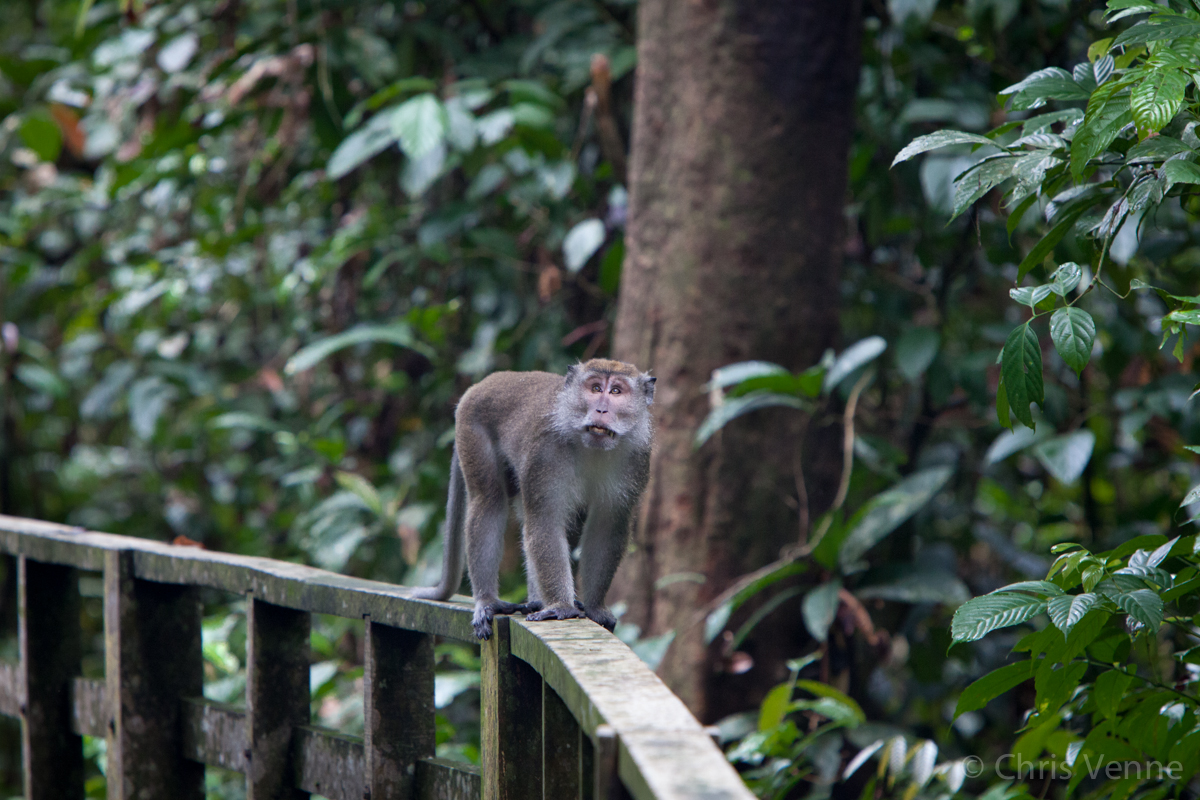
Long tailed macaque staring at us from the riverbank.

Proboscis mother and child getting ready to leap to another tree.

During one of our outings, we saw a mother/offspring pair of wild Orangutans chomping away on fruit in a tree high above us.  But the highlight for me was seeing a newborn long tailed macaque; it was still wet from its birth.  We witnessed its tentative first steps along the branches, with mama watching close by.

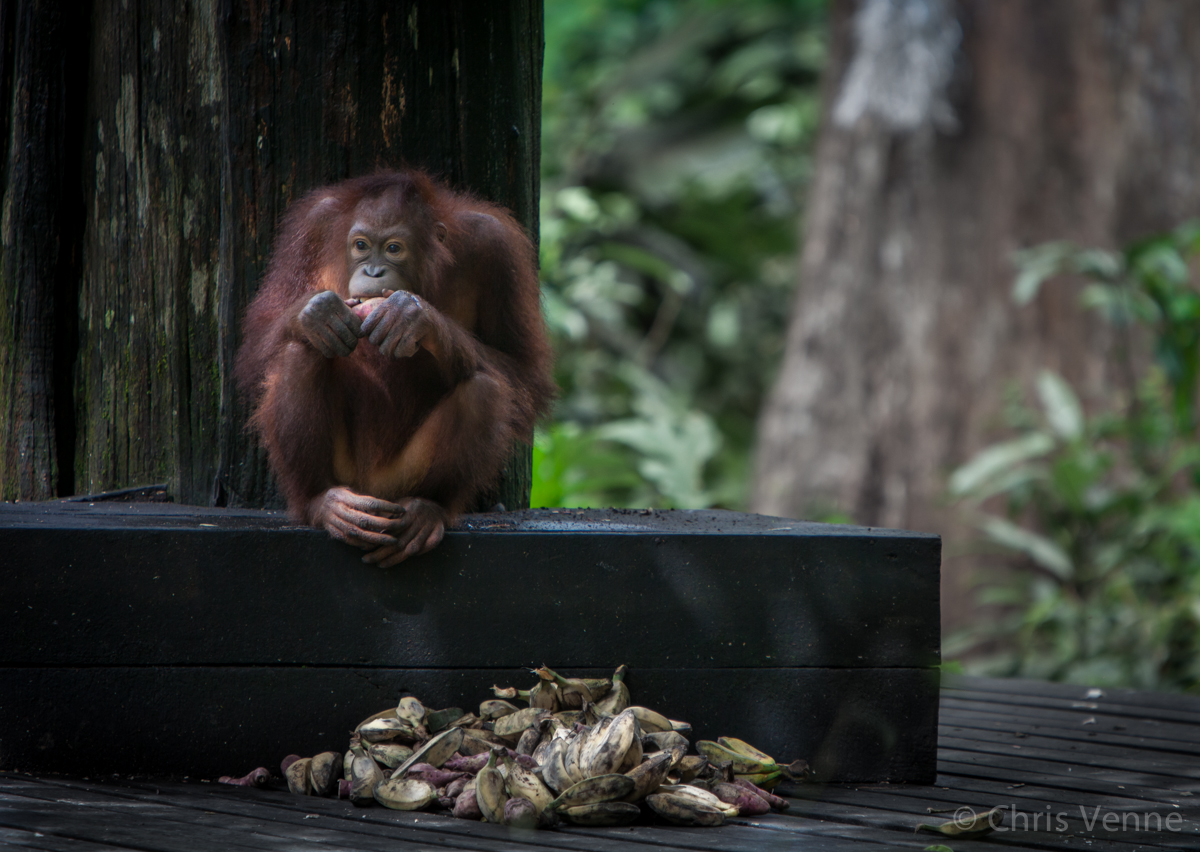
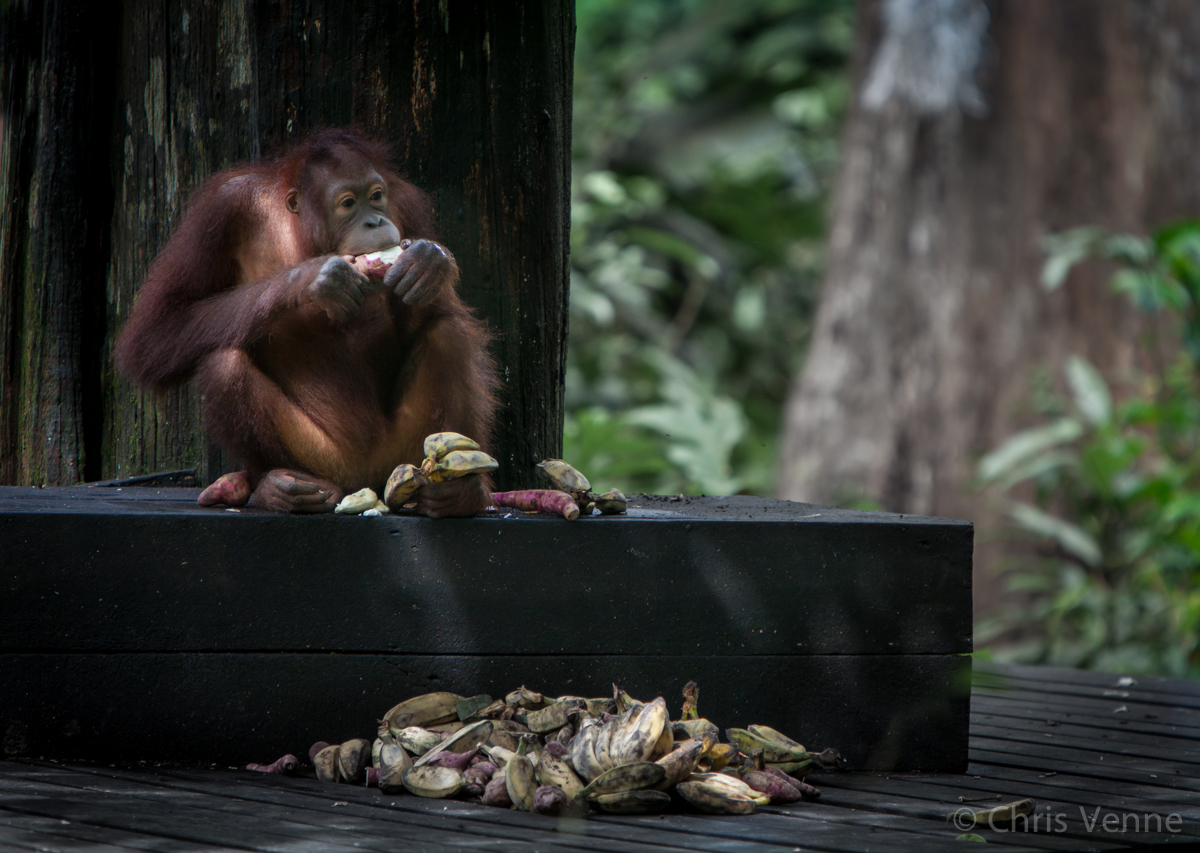
Wild Orangutan “toddler”.

Newborn long tailed macaque.

Baby long tailed macaque with its mother.

Typical pose of a proboscis monkey.

There were a few bird sightings along the river, the most impressive being the Hornbill.  There were lots of eagles, colourful kingfishers, and we even saw an owl at the start of one of our night walks.  The night walks were rather disappointing as there wasn’t much to see in spite of our best efforts to walk quietly.  We saw a few birds sleeping on low branches which was something I had never seen before, a few insects and a frog.  That’s it.  During our three hour jungle trek where we traipsed through mud as high as our rubber boots, we saw nothing, not a single form a life.  It was a complete bust.    And no, we did not see the pygmy elephants either.  Apparently they were somewhere upstream, about 70 km away.  All in all, it was a rather disappointing experience in terms of the minimal wildlife we saw.

Male Hornbill eating berries in a tree.

Male and female Hornbills.  Can you see the difference?

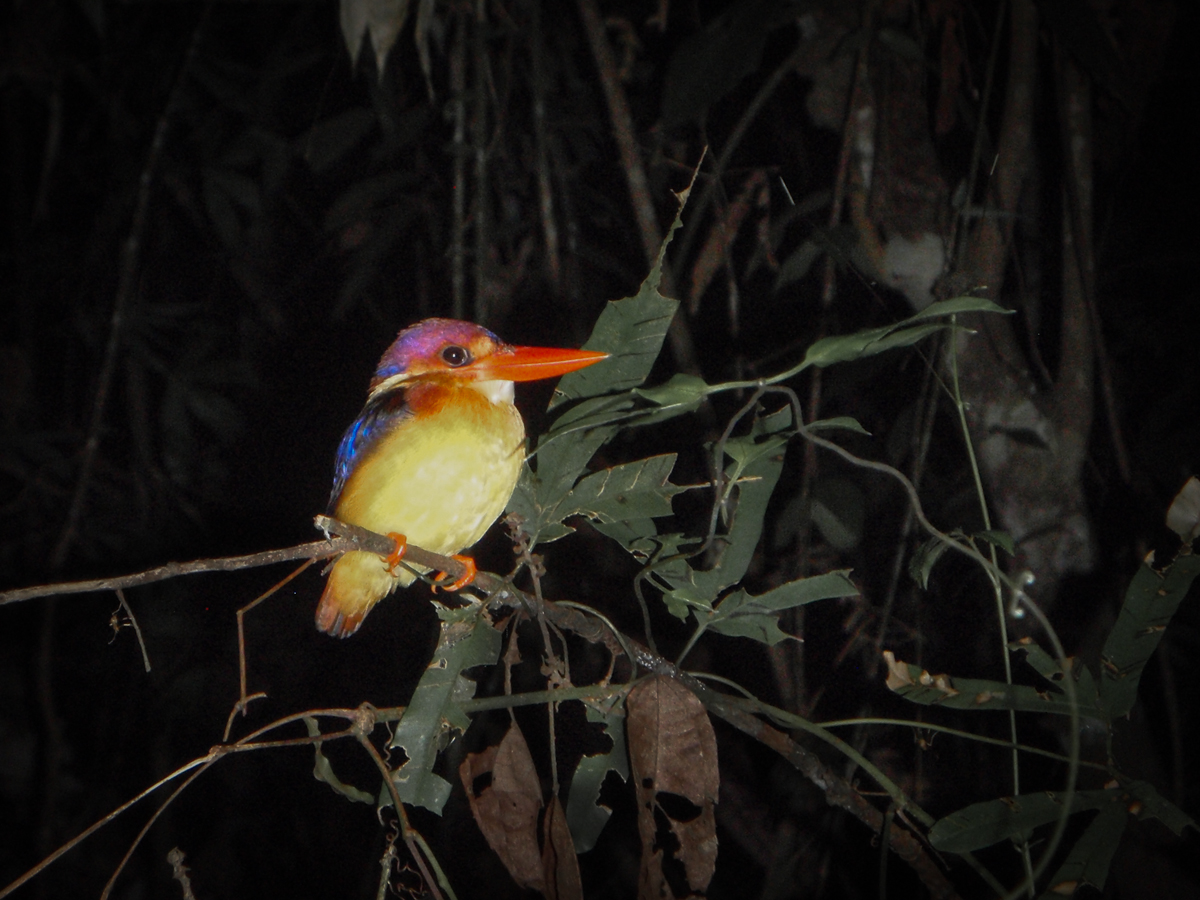
Kingfisher seen during our night walk.

Both the rainforest and its inhabitants have been severely affected by human activity.  The rainforest itself is second generation meaning it had previously been razed by humans. There are signs of Palm Oil plantations everywhere, encroaching more and more on this natural habitat.  What was once a vast forested region, is now a forest corridor along the Kinabatangan River, connecting the coastal mangrove swamps with the upland forests.  At least the area is now protected under the Wildlife Conservation Enactment which went into effect in 1997.  Hopefully as the forest regenerates itself, its inhabitants will have the chance to flourish once again.

Video:  Monkeying around in Borneo
 

Meeting the man of the forest in Borneo

After exploring the underwater world off the coast of Borneo for three days, we were ready to discover the natural wonders of the jungle.  Our first stop was the Sepilok Rehabilitation Centre where orphaned Orangutans are rescued and then nurtured to maturity in a 23 sq km protected area at the edge of the Kabili Sepilok Forest Reserve.  Each year many adult organ utans are killed because of illegal logging and deforestation activities, leaving their young offspring to die.  Others have been illegally caught and kept as pets.  Today, there are about 25 young orphaned oOrangutans living at the centre in addition to those living freely in the reserve. The centre is open to tourists who visit during the twice daily feeding times in order to catch a glimpse of these adorable creatures.

It was an easy 4.5 hour bus ride from Semporna to Sepilok Junction where the bus deposited us on the side of the road, in the middle of nowhere. We had been told it was a 3 km walk to our hostel (Sepilok Jungle Resort) which was next to the Centre, but if we were lucky, a car might offer us a lift for a few ringgits.  Luck was definitely on our side that morning.  Not only did the torrential rain stop as soon as we were dropped off, but a car approached us within minutes to offer us a ride.

We had two nights booked at the Sepilok Jungle Resort which allowed us a full day to visit the Centre and the nearby Rainforest Discovery Centre.  After reading mixed reviews about this resort, we were pleasantly surprised with our very spacious, comfortable room tucked amidst a lovely, tropical garden setting.  It turns out we were staying at the more posh end of the resort with prices to match.  The other end offers up basic, hostel-like accommodations at more reasonable rates.  At $50 CAD per night for a large double room with ensuite, we were paying about double the rate of our other accommodations in Malaysia.  But it was worth every penny!  The hotel restaurant served up tasty, reasonably priced meals too.  There was a very inviting pool which unfortunately we didn’t have time to use.

By the time we arrived at the resort, I was feeling sick again.  My sore throat had returned with a vengeance and my energy was very low.  I pushed myself since we only had the one day to visit the Orangutans and I didn’t want to miss it because of a stupid cold.  The Centre cannot guarantee that visitors will see Orangutans because they really are living in the wild and may or may not choose to visit the feeding platform for some free bananas.  The day of our visit, they were out in full force, including a huge male who rarely comes to the platform.  Apparently, he’s looking for a mate, so he has been showing up about once a month lately.  In the afternoon, another male, much smaller than the one we saw in the morning, found himself a female to his liking, and mated her right there and then as we all watched in amazement.

Before the feedings began, I had a close encounter with a group of long tailed macaque monkeys.  After walking ahead beyond the feeding platform towards the exit, a dozen or so monkeys appeared on the railings about a hundred feet away from me.  I was alone and to my astonishment, they all started walking towards me, pausing and staring at me with as much curiosity towards me as I had for them.  I got a little nervous when a large male stopped beside me and glared with piercing eyes, baring his teeth like he meant business.  There was really nowhere for me to go because I was surrounded by them, so I carefully avoided eye contact and stood still to let him pass; after all, these monkeys are wild and have been known to be aggressive, especially if they feel threatened.  I got some great video footage which you can see at the end of this post.

In between feedings, we walked to the Rainforest Discovery Centre  about a kilometre away. While this environmental education centre is geared towards teachers and students, it is open to everyone. Their mission is to create public awareness and appreciation for the importance of conserving forests, as well as the sustainable use of forest resources. Arriving in the middle of the day, when it was stinking hot guaranteed we would see no animals.  They were all taking a siesta which we should have done too.  The only animal we saw was a long tailed squirrel, which looked exactly like a squirrel in Canada, except it had a long tail.  Even though we didn’t see any wildlife or birds or flowers for that matter, we did enjoy the 300 m long canopy walkway, which was 25 m above the forest floor, giving us a great perspective of the rainforest from above. There is a vast network of many kilometres of well kept trails throughout the rainforest too. The dense forest canopy kept us surprisingly dry when it poured rain a few times during our visit.

The highlight of our day were the Orangutans, which we saw again at the afternoon feeding back at the Rehabilitation Centre.  These endangered apes only live in Borneo and Sumatra so it was a real thrill to see them up close like we did.  Their numbers are declining because their habitat has decreased rapidly, mainly because of the conversion of large areas of the tropical forest to palm oil plantations.  Everywhere we went, we saw miles and miles of these plantations, visible reminders of the shrinking forest.  Sharing 96.4 % of our DNA, it’s not surprising that these apes act so human-like and are so endearing to us.  These gentle primates are highly intelligent and have the ability to reason and think.  In Malay, Orangutan means “man of the forest”, a fitting name, don’t you think?

Our next stop is at a jungle lodge on the Kinitabangan River where we will spend three days and 2 nights exploring the wildlife along the river banks and into the jungle interior.  We hope to see Orangutans in the wild as well as the funny looking proboscis monkeys. If we’re lucky, we might even spot a pygmy elephant.

Video:  The Man of the Jungle and a Troop of Macaques
 

Playing with sharks and turtles in the Celebes Sea

Sipadan Island is reputed to be one of the best diving spots in the world, some even say it is one of the top three, but as we found out, it can be hit or miss during monsoon season.  When we learned that Sipadan Island is in the center of the richest marine habitat in the world, the heart of the Indo-Pacific basin, teaming with more than 3000 species of fish and hundreds of coral species, we weren’t going to let a little rain get in the way of our fun. Besides, people usually book months in advance to secure a diving spot because there is a strictly enforced daily diving limit of 120 people on Sipadan Island. This government imposed regulation is in place to protect this fragile eco-system.  When we managed to snag a couple of dive spots at the last minute, we decided to go for it.

But first we had to get there. Sipadan Island is the only oceanic island in Malaysia, rising 600 metres (2,000 ft) from the seabed, located in the Celebes Sea off the east coast of Sabah, about 600 km from Kota Kinabalu. There are two ways to get there – by road or by air.  Almost immediately, I regretted our decision to travel by bus.  We thought the bus would give us a chance to see some of the countryside. I didn’t anticipate getting car sick as the bus rocked from side to side as we twisted our way through the mountains. It took 11 hours to reach Semporna during which time I slept most of the way thanks to Gravol. Again, our trusty medicine bag to the rescue.

We stayed overnight in Semporna at the Sipadan Inn, a very comfortable and clean hotel with excellent air conditioning.  Early the next morning, as we were kitted up with our dive gear, we met Denise, a fellow Canadian who had booked the same package as us: 1 day diving at Sipadan Island and a 2 day/2 night diving package at Mabul Island for a total of 9 dives in 3 days – a lot for us.  We  booked our package through Sipidan.com and we think we got good value for our money.

It takes one hour by boat to reach Sipadan Island.  The island itself is very much what you would imagine a remote, tropical island to be – powder white sandy beach, turquoise waters, palm trees swaying ever so gently in the breeze.  Simply stunning.  After each dive, we had a break on the island, but we were restricted to one specific area, no exploring allowed.

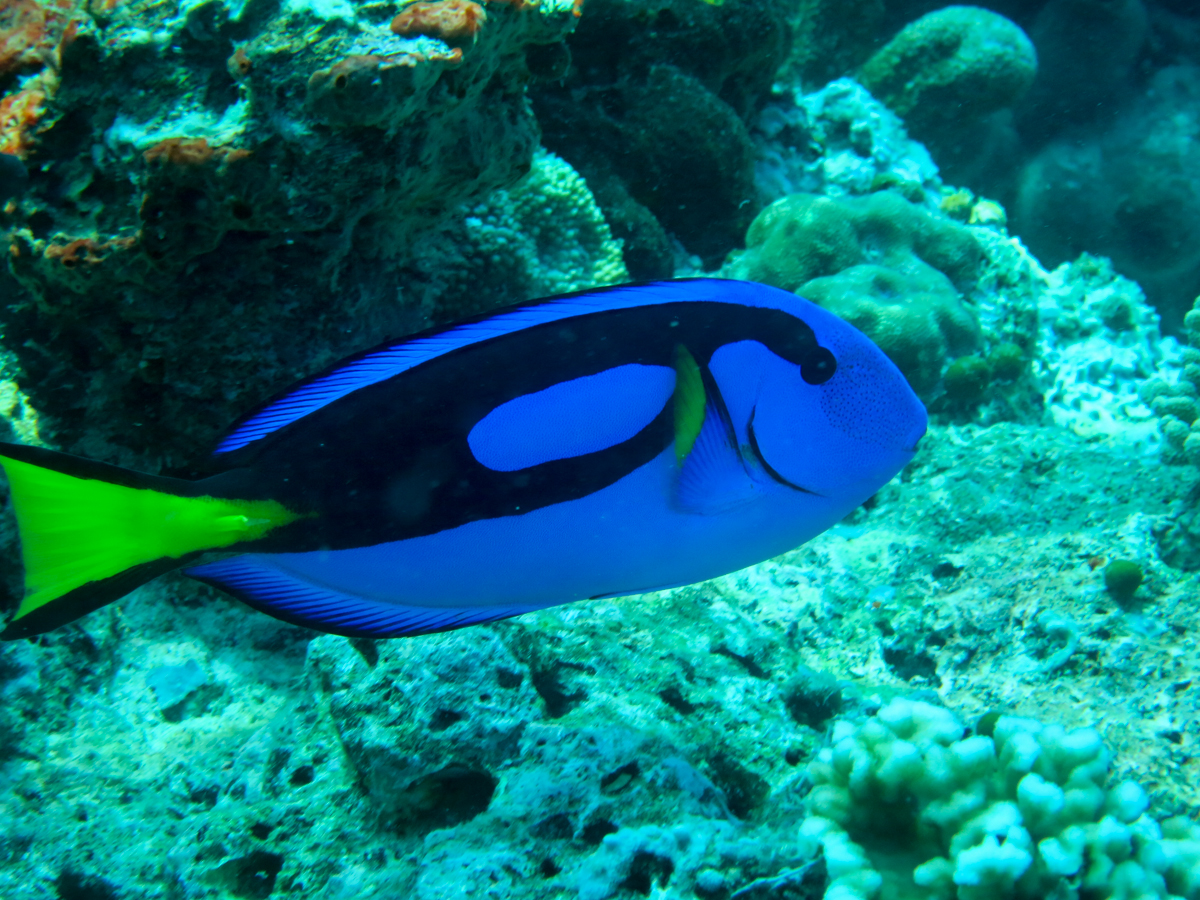
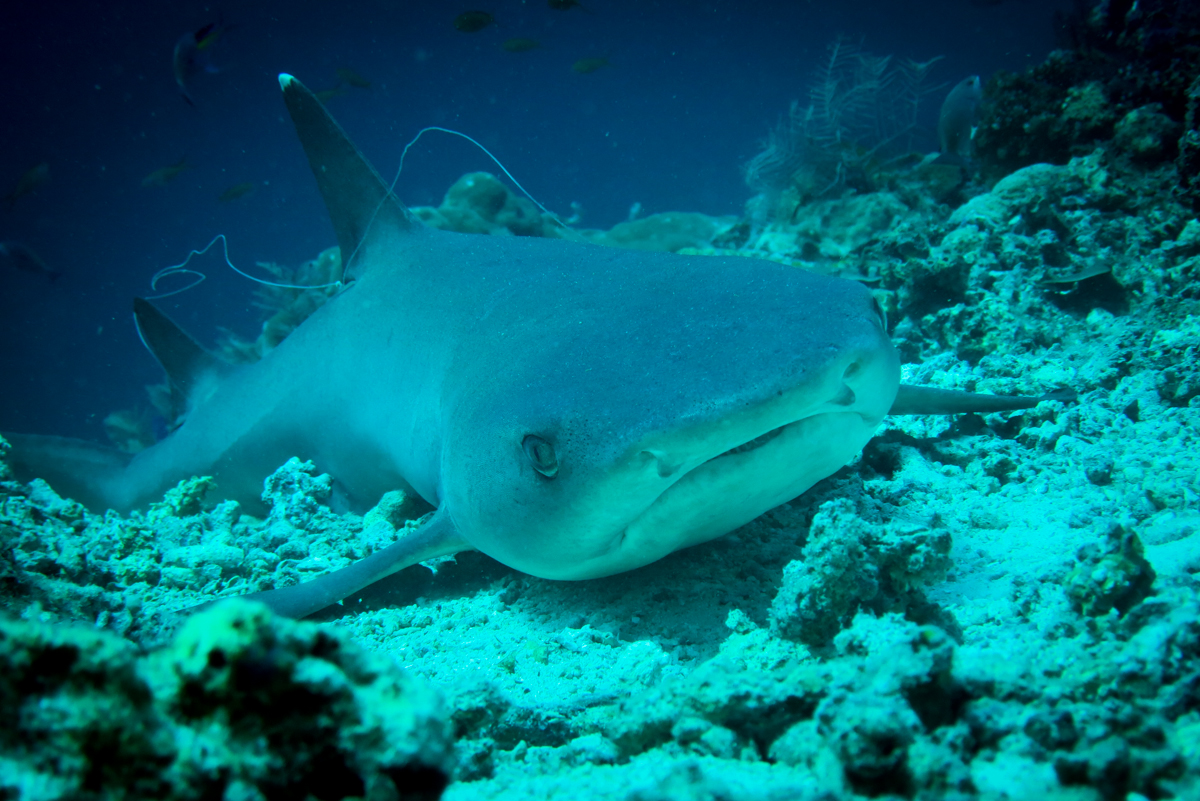
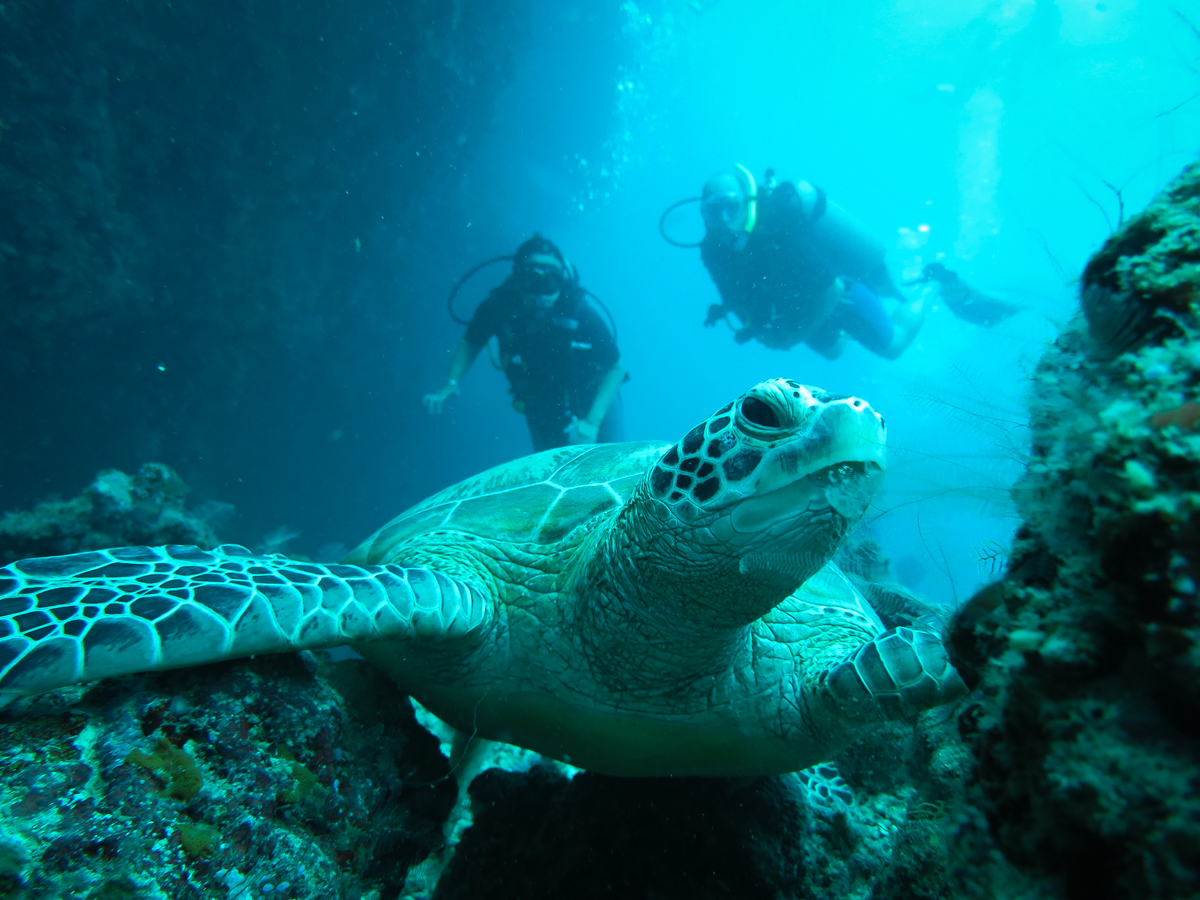
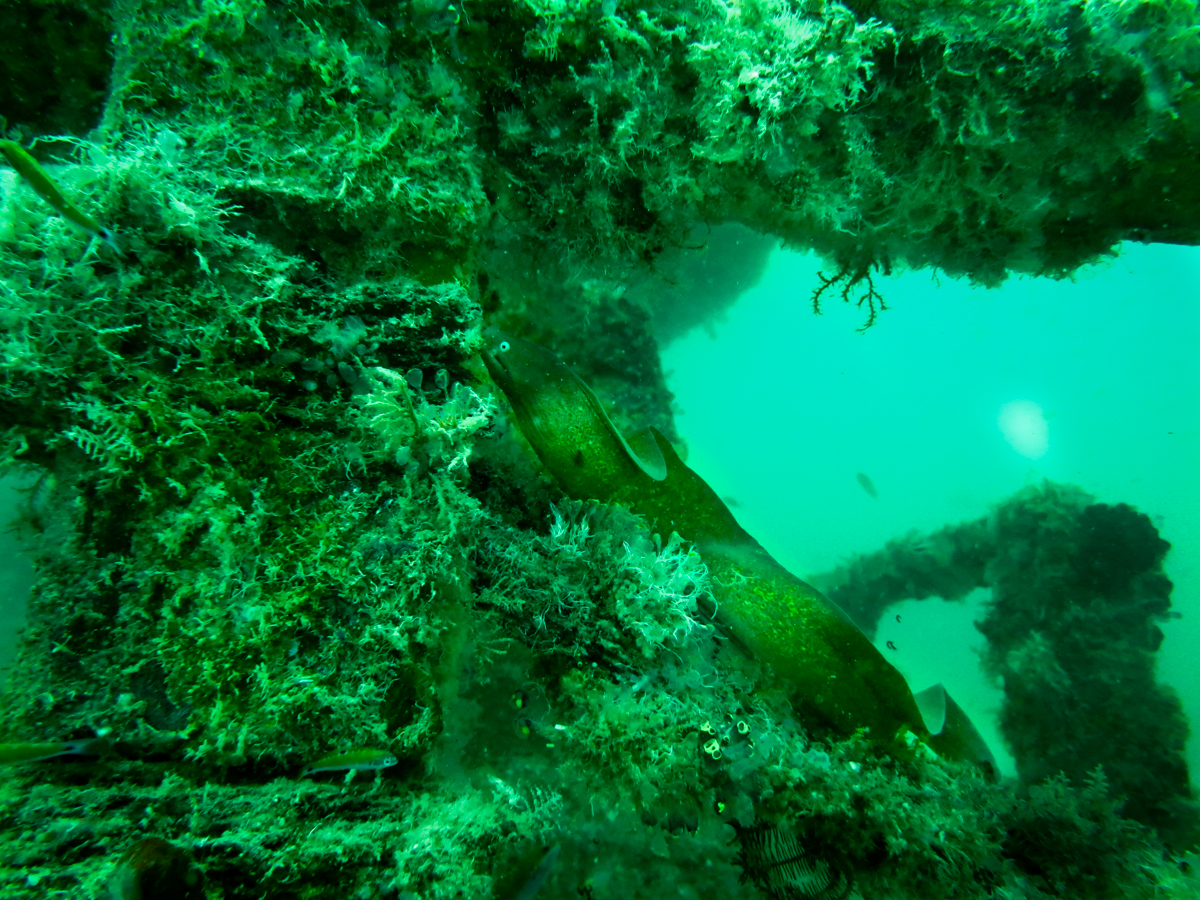
In spite of the poor visibility, the sea served up a vast array of strange and wonderful looking creatures and plants. There were lots of white tipped sharks, huge green and hawksbill turtles, and loads of other colourful fish we had never seen before.  The corals were spectacular, not so much in their colours, but in their size and shapes.

For me the most amazing experience happened near the end of the second dive when we came across a massive school of Jackfish; there must have been thousands of them.  As I casually swam along side them, they would shift their patterns to encircle me and before I knew it, I was in the middle of them, everywhere I looked there was a thick wall of Jackfish. Simply amazing.  The most unusual fish we saw were the Bumphead parrotfish which  is the largest species of parrotfish.   These fish were big, about 4 feet long, and up to 100 pounds in weight.  Their large, protruding  teeth gave them a rather menacing appearance which kept me at a safe distance.

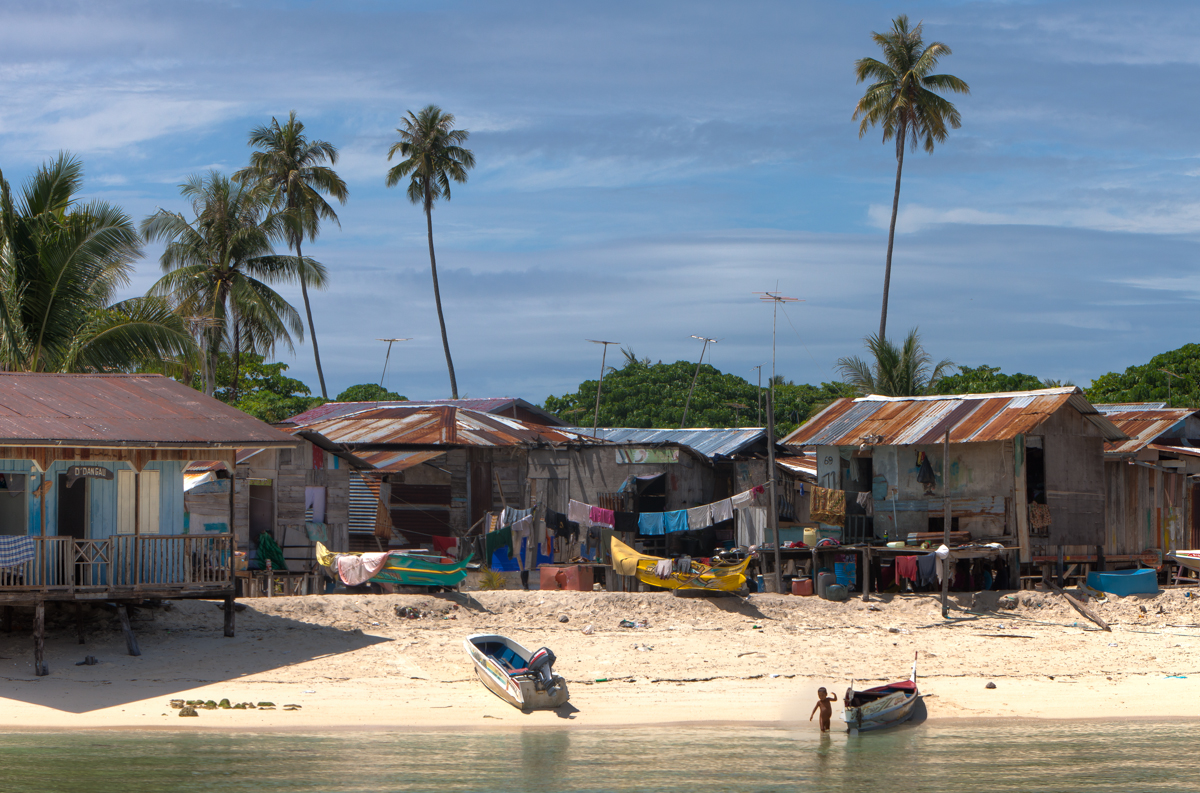
After our three dives at Sipadan, we were dropped off at Mabul Island, 20 km away, where we would spend the next two nights at our “resort”.  This small island has been a fishing village since the 1970s, but more recently it has become popular to divers, mainly because of its proximity to Sipadan.  Several resorts, ranging from bare bone to luxury, along with a large village of locals are all crammed onto this 20-hectare piece of land that sits just 2–3 meters above sea level.

My heart sank as we climbed out of our boat onto the deck of our resort.  I knew we had opted for budget accommodations, but this was really basic, and frankly, quite grim.  Our resort was really nothing more than a long, rectangular wooden structure on stilts overhanging the water.  At one end was three long tables with plastic patio chairs where we ate all our meals and hung out, and at the other end was the kitchen, shared bathroom and staff quarters.  In between, about 10 small rooms lined both sides of the building.  Each room had a window and was equipped with a bed, a table and a fan.  This really did give us an opportunity to see what it was like to live as the locals live.  It was okay for a couple of nights, but I wouldn’t have wanted to live here for a few months like the instructors do.

Entrance to our resort from the island.

Inside view of the resort looking towards the kitchen. 

Island living:  It was common to see young children, under five years of age,
butt naked, paddling around in little dugout canoes.  The sea was their playground.

At over $1,000 p/p per night, these luxury bungalows
on the water were way out of our league.
What a sharp contrast to how the locals live.

Beautiful sunsets were free for all to enjoy!

As we have discovered, it is often the people that make the experience and this place was no exception.  We met the dive instructors – Ann and Gary, a couple originally from the UK, and Matt who was from Slovenia.  All three had just arrived a few days earlier and were still getting oriented.  Mohammed was the resident dive master who knew the outlying waters like the back of his hand.  Alex was another instructor who was on his way out after doing a three month stint.  There was only one other guest, Jenny, an older Asian woman from Spain.  And of course, there was the staff who worked hard to keep the place spotlessly clean, and to prepare our meals and snacks.

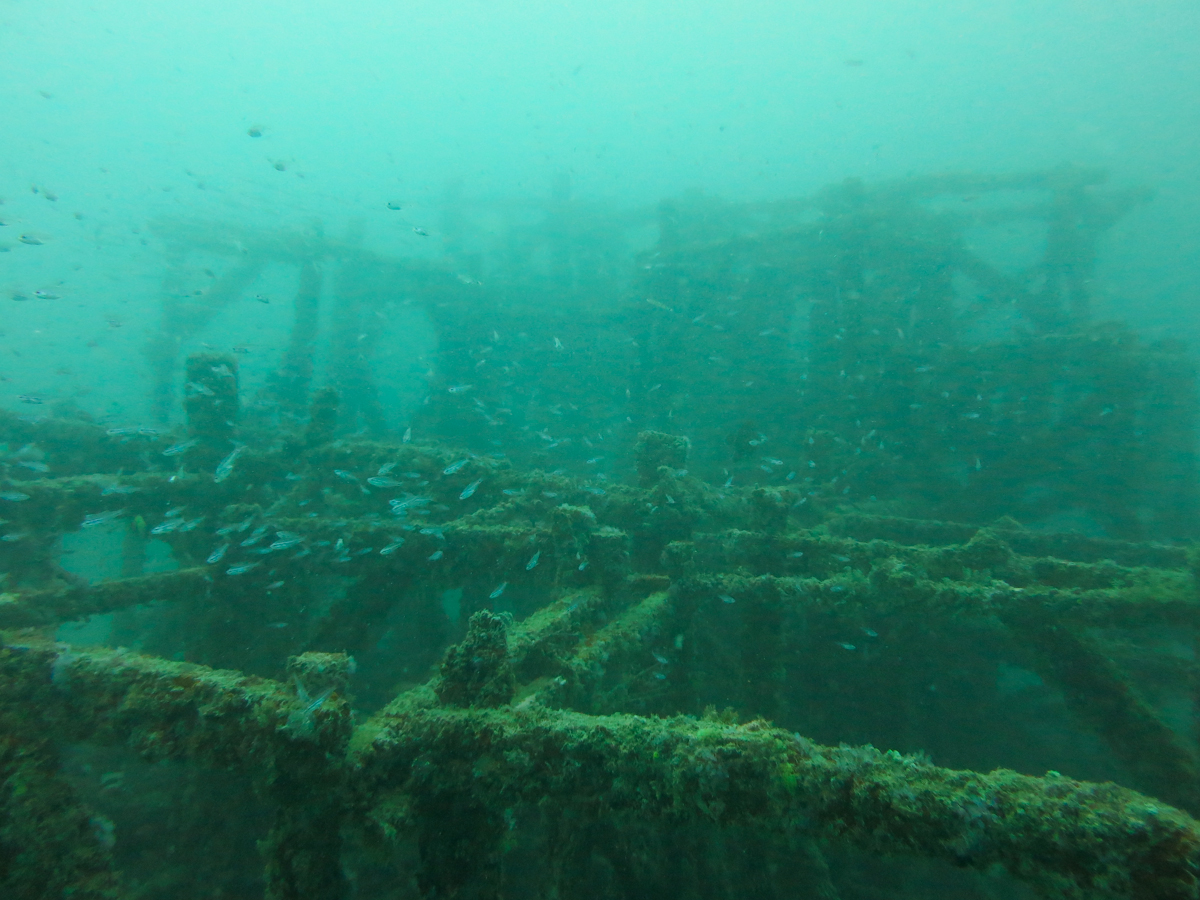
Our dives were varied, but most were shallow, less than 20 metres.  I saw underwater wrecks for the first time as well as some man made reefs which are underwater structures that are made out of wood, rope, tires, and whatever else is available, and which over time become transformed into lovely reefs with lots of plants and fish.  Most of this diving was macro, where we saw smaller things.  Up until now, it was the big things that excited me, like sharks and turtles, but soon I was appreciating the smaller things too.  The visibility was quite poor most of the time, around 10 metres, which made some of the wreck diving downright eerie.

Each day it rained, often really hard, and usually when we were heading out for a dive which was rather miserable and not much fun at all.  But it never lasted very long and soon the seas would calm down and the sun would be shining again.  The rain cooled things off a bit which was quite welcome in the unbearable heat and humidity.  We practically lived in our swim suits so it didn’t really matter if we got wet from the rain.  I think the worst part of diving in the rainy season was the low visibility. Other than that, it was great.

Video:  Diving in Borneo

We ended our diving excursion back on land with a final night at the Sipadan Inn where Denise was staying as well.  Ann and Gary had a couple of days off, so they came back with us. As we were getting ourselves organized to go out for dinner in the hotel lobby, a man approached us to tell us about his menu that night.  His makeshift kitchen was set up in front of a bar a couple of doors down. We had already decided to eat Indian food, but this guy was pretty convincing, and it didn’t take more than a taste of his home fries, to capture my vote. Besides, the bar where we would eat his dinner served beer and the Indian restaurant didn’t, so it was seafood for us that night, and what a feast we had.  A couple of plates of complimentary sushi were served as starters, followed by a set menu that included the best grilled squid I have ever had, delectable scampi, and several fillets of fish, all nicely de-boned and grilled to perfection.  It was a fitting end to a fun diving excursion.

Before dinner, Denise (center) and Ann (right) were finishing up the final
review of material for the Advanced course that Denise
successfully completed while on Mabul Island.  Way to go Denise! 

The next morning we were up bright and early to catch the 7:30 am bus to Sandakan where a jungle adventure awaited us.

Shopping and eating our way through Malaysia

It took us 24 hours to travel from the Middle East to Malaysia which included a 7 hour stop over in Jeddeh, Saudi Arabia  one of the dirtiest airports we have been in.  However, our carrier, Saudi Arabia Airlines, was top notch and provided service we don’t see in Canadian airlines these days, including plenty of free food and drink, cozy fleece blankets, pillows with soft cotton covers, and toiletry packs which even included a pair of socks.

We haven’t had the best start here in South East Asia as it took us a couple of days to get over our jet lag even though it was just a six hour time difference and then we both got sick with some sort of throat infection that knocked us off our feet for another few days.  A round of antibiotics from our trusty medicine bag came to our rescue.

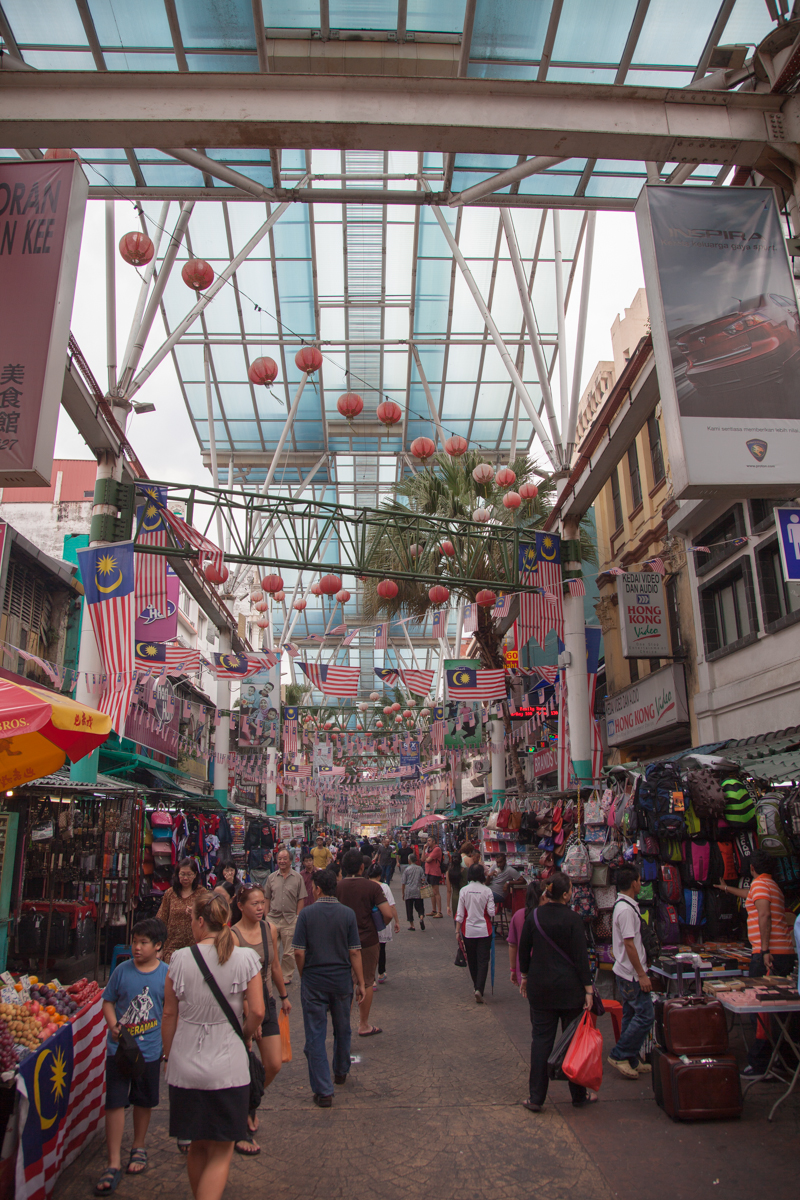
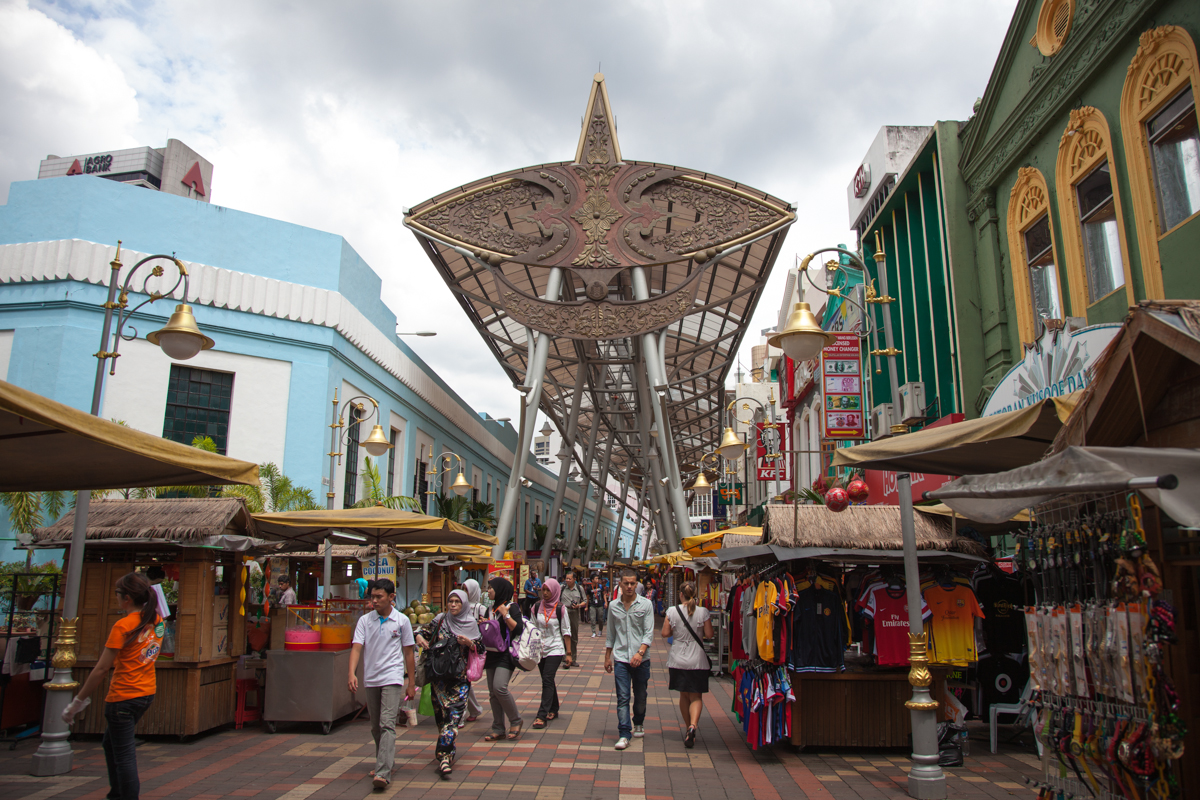
There isn’t much to see culturally or historically in Kuala Lumpur (KL) although architecturally there are many beautiful, modern buildings to admire.  While most people just spend a few days here in transit to other destinations, we spent almost a week here.  It wasn’t the worse place to slow down and recover.  It seems the main things to do in KL are shopping and eating.  There are 66 malls in KL alone, many of which were within walking distance of our hostel, The Nest Guest House, which is located in the area known as the Golden Triangle.  Our hostel was very clean, well located, and our room was quite spacious.  But we both found the bed to be rather uncomfortable and the breakfast dismal – white toast with jam, tea/instant coffee, and bananas, but I think it is the standard in this part of the world. It was still pretty good value at 99 RM ($33 CAD) per night.

The malls vary in size but most are huge mega-complexes up to ten or twelve stories high which made the Eaton Centre in Toronto look pale in comparison.   The shops range from cheap discount stores to high end designer labels and everything in between with some noticeable exceptions.  For instance, we searched high and low for hiking sandals but came up empty handed.  Turns out Malaysians aren’t big on outdoorsy type activities. The sizing and styles are quite different from North America too.  It was a challenge to find anything that fit us, and neither of us are overly large, at least not by North American standards.  We looked like giants amongst the majority of the Asian population!  No matter the time of day, the malls were jam packed with people, tourists and locals alike.  Shopping is big business and contributes billions of dollars to the local economy each year.

Entrance to Times Square Plaza overlooking the
Deepavali 2012 greeting made of coloured rice.

Entrance to China Town.

Entrance to Central Park – another shopping plaza with
both outdoor and indoor stalls.

There is a plethora of food options on offer throughout the city including Indian, Malaysian, Chinese, and Thai.  Street stalls are everywhere – outdoor restaurants with tables and chairs under umbrellas or other makeshift shelters.  We cautiously ate most of our meals at these street stalls.  If you haven’t noticed by now, Chris and I are not the most adventurous when it comes to food.  We like to eat where the locals eat, but we’re ever conscious of the health dangers, and we are reluctant to eat anything we don’t readily recognize, especially meat.  Most of our meals cost about $5 CAD each which is pretty expensive by Asian standards.  We’ve been told Thailand is much cheaper, but we’ll see when we get there.  As much as I enjoy Asian cuisine, after a few days, I was already tired of it.  Indian food was a nice alternative and we ate some mighty tasty dishes in KL.  But when we got sick, I craved homey, recognizable food and was quite content to eat a bowl of chili from Wendy’s and a burger from MacDonald’s.

On a whim, we decided to make a detour to Borneo, which was a quick, cheap flight away (just a hundred bucks a piece).  Borneo is home to the Orang Utan along with lush jungles and rain forests and some of the best diving in the world, especially at the island of Sipadan off the north east coast.  We are now in Borneo, in a place called Kota Kinabalu, a large city on the north west coast.  It’s taking a little longer than expected to organize our itinerary which will hopefully include a day or two of diving, some jungle trekking and a visit to an Orang Utan Rehabilitation Centre.   We’re anxious to get out of the city and into nature, but when we do, we’ll probably be off line frequently. We’ll be sure to share our adventure whenever we can.

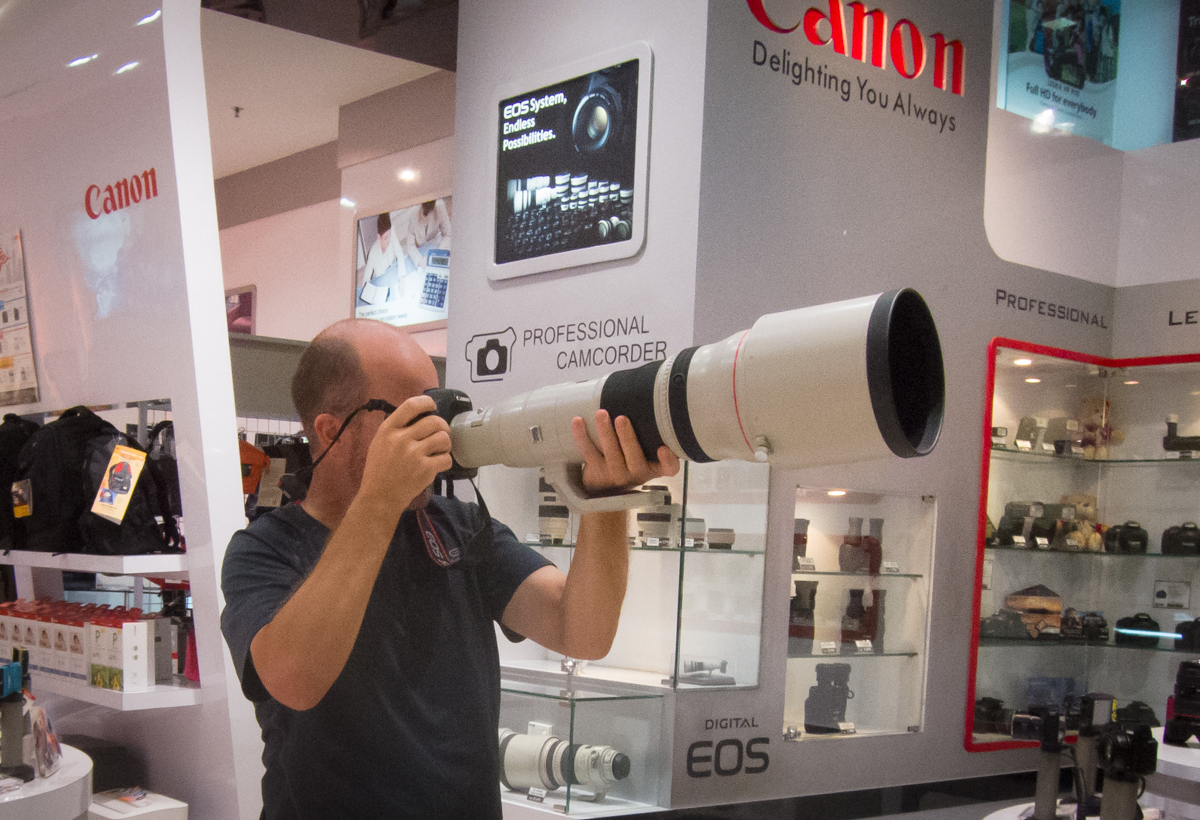
Chris’ Xmas wishlist – at almost 45,000 RM, that’s a whopping $15,000 CAD
and  weighing in over 5 kg, I’m not sure what would hurt more, the budget
or Chris’ back as he lugged it around the world. 

A new low in Israel

During our week in Jerusalem, we squeezed in a couple of day trips that we organized ourselves using public transportation which is very easy to use, affordable, reliable and comfortable.  We spent half a day exploring the ruins of Masada which is Israel’s most popular paid tourist attraction, we indulged in an afternoon floating 423 metres below sea level in the Dead Sea, and we ventured over  the border to Palestine to spend a few hours exploring Bethlehem.

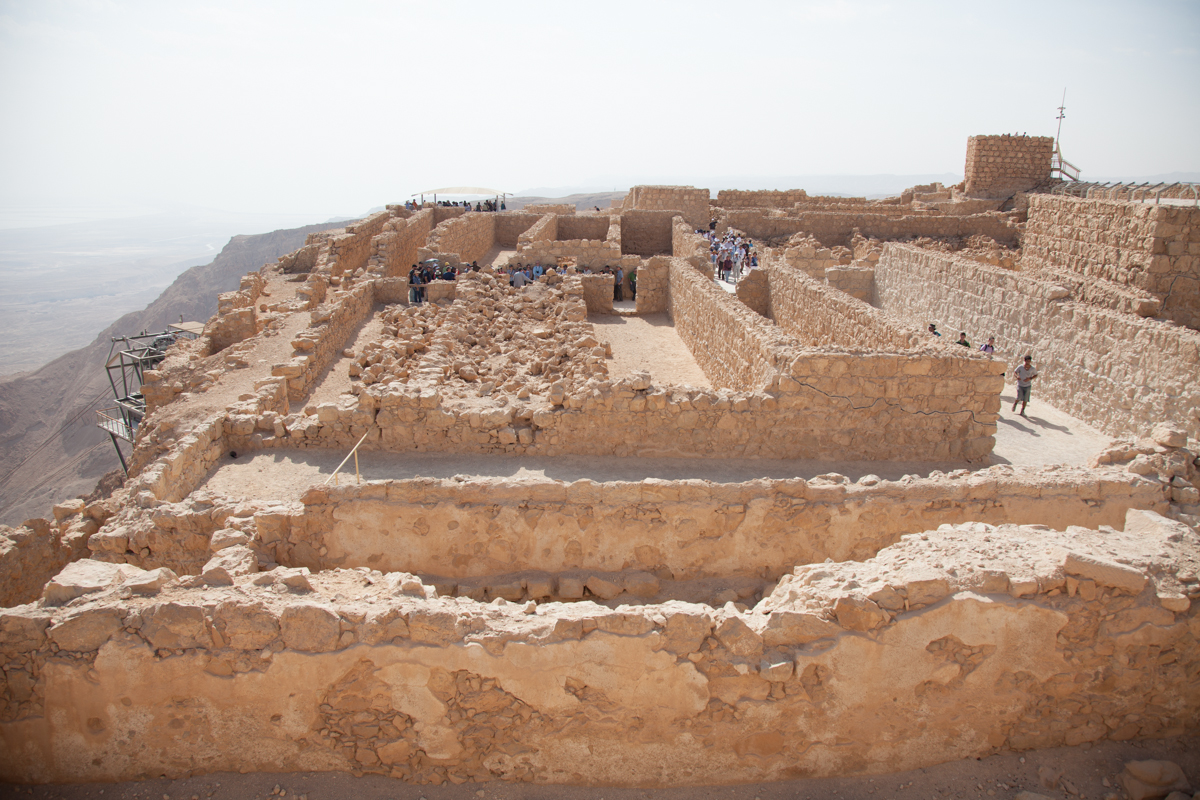
Masada is an ancient fortification on top of  an isolated rock plateau on the eastern edge of the Judaean Desert, overlooking the Dead Sea.  This is the place where 960 Jewish extremists known as the Sicarii committed mass suicide after being holed up here for months under seige by the troops of the Roman Empire.  This all happened shortly after the Second Temple was destroyed in 70 CE.

When we arrived at about 9:30 in the morning, it was already close to 40C making the decision to walk up the mountain or take the cable car an easy one to make. The air-conditioned cable car whisked us to the top in just five minutes giving us lots of time to explore this impressive archaeological site on the mountain top.  The audio guide that we purchased in addition to our entrance fee tickets was one of the best we have ever heard and well worth the extra cost.  As we walked through the ruins, the narrator explained what each area was, as well as provided a captivating history lesson.

Aside from the infamous seige and mass suicide, I knew very little about this site.  According to the 1st century Jewish Roman historian, Josephus Flavius, Masada was fortified by Herod the Great between 37 and 31 BCE as a refuge for himself in the event of a revolt.   We saw the remains of the two grand palaces at opposite ends of the hill top, Roman bath houses, the synogogue built by the rebels, the elaborate water system including huge cisterns, and many storerooms.  There was enough water and food stored on this hill top fortress to support an army for many months, even years.  So why did the Jews commit suicide?

In 72 CE, the Roman army established camps at the base of Masada (the remains of which are clearly visible to this day), laid siege to it and built a circumvallation wall. They then constructed a rampart of thousands of tons of stones and beaten earth against the western approaches of the fortress and, in the spring of the year 74 CE, moved a battering ram up the ramp and breached the wall of the fortress. On the eve of their capture after a 3 year siege, Josephus dramatically recounts the story told to him by two surviving women. The zealots – almost one thousand men, women and children – led by Eleazar ben Ya’ir, decided to burn the fortress and end their own lives, rather than be taken alive by the Romans.

View from the East side where the cliffs are 400 m high.

Dead Sea in the distance.

Massive store houses held years’ worth of provisions.

Ramp on the Western side built by the Romans.

Remains of one of the Roman camps where thousands of
soldiers 
lived while the city lay under siege. 

At the base of the mountain there is also a museum, admission to which is included with the audio guide. Although the museum is rather unique in that it provides a theatrical re-enactment of the siege of Masada along with a few artefacts, I didn’t find it offered much value.  If you’re short on time, it could easily be skipped.

View of cable car from the top.  We decided to walk down – a thirty minute
descent that wasn’t too hard but it was extremely hot. 

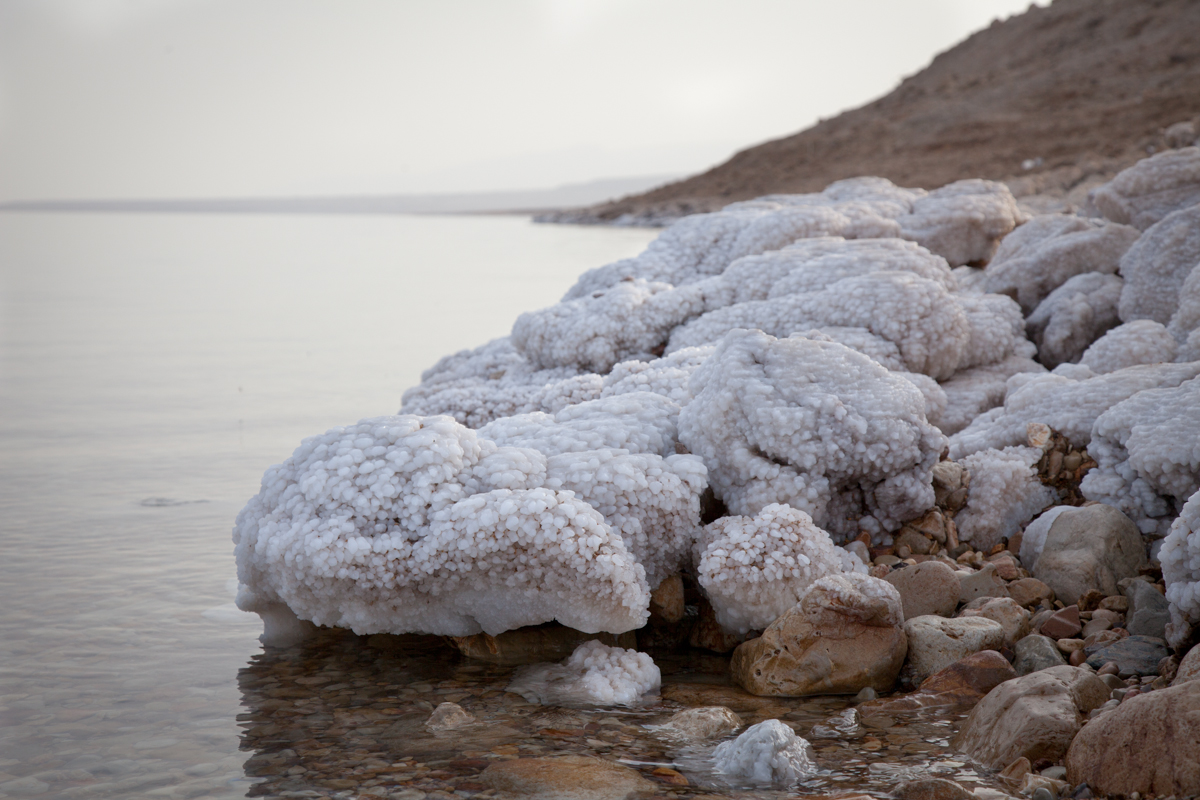
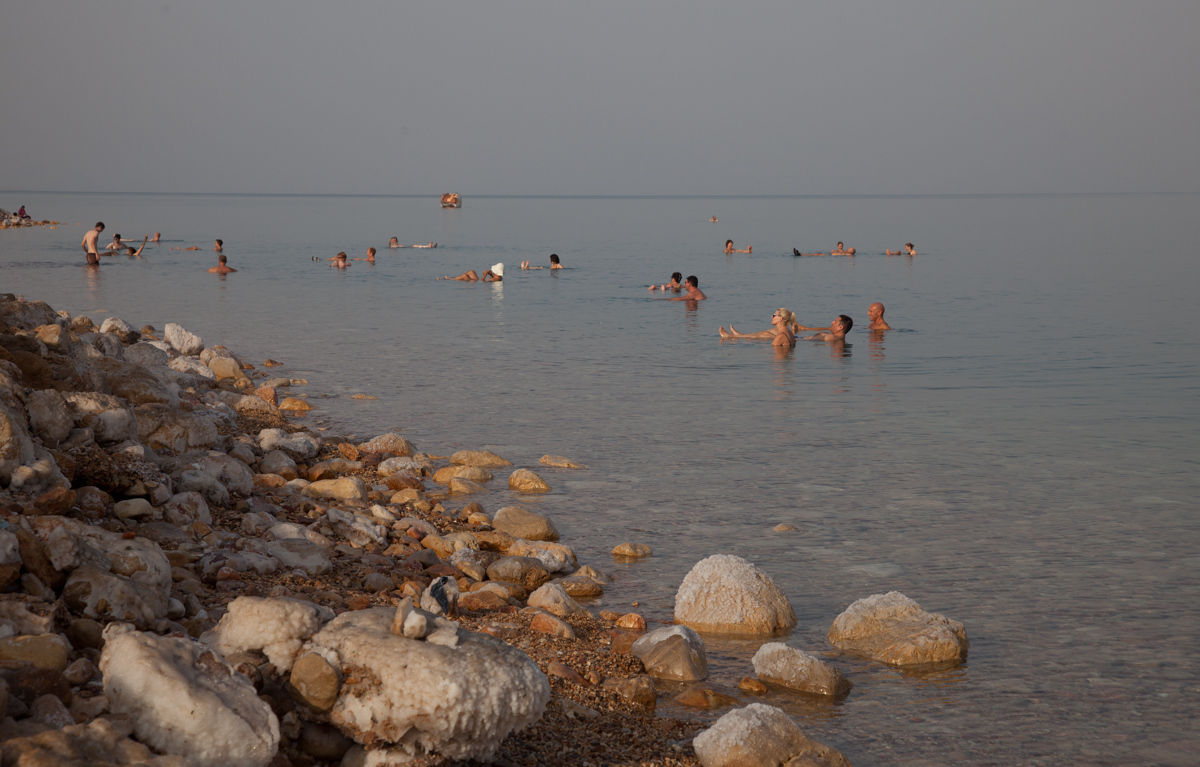
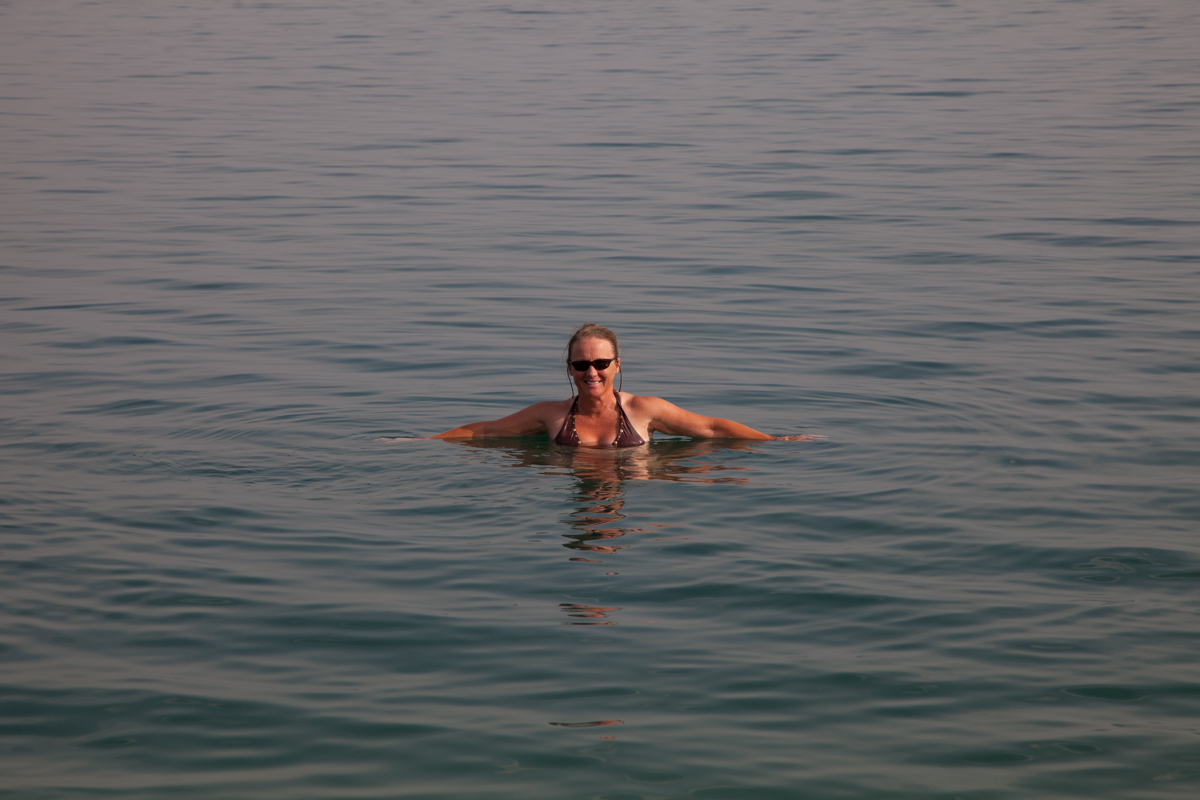
After a full morning at Masada, our next stop was the Dead Sea, earth’s lowest elevation on land, and thus our “new low” in Israel. People have been coming to the Dead Sea for millennia to avail themselves of the therapeutic effects of the water and air in this region.  There are many beautiful resorts all along the Dead Sea, but we decided to visit it on a budget and go to a public beach instead.  Besides, we thought we’d just have a quick dip to see what all the fuss was about, and then head back to Jerusalem.  Little did we know that we would float in the Sea for several hours, even luxuriating in a natural mud bath which left our skin feeling as soft as a baby (although rather stinky I might add), before returning to Jerusalem at sundown.

So, do you really float in the Dead Sea?  Yes, like a cork!  It felt like you had a life preserver on making it very difficult to swim properly.  The water is so salty (8.6 times saltier than the ocean) that you must use extreme caution not to get any water in your eyes.  After losing my balance, I splashed a mere drop or two of water into my eyes causing extreme pain, and forcing me to seek relief with a rinse of fresh water.  Floating around effortlessly in the calm water was so relaxing, we could have spent many more hours there.

Video:  Floating in the Dead Sea

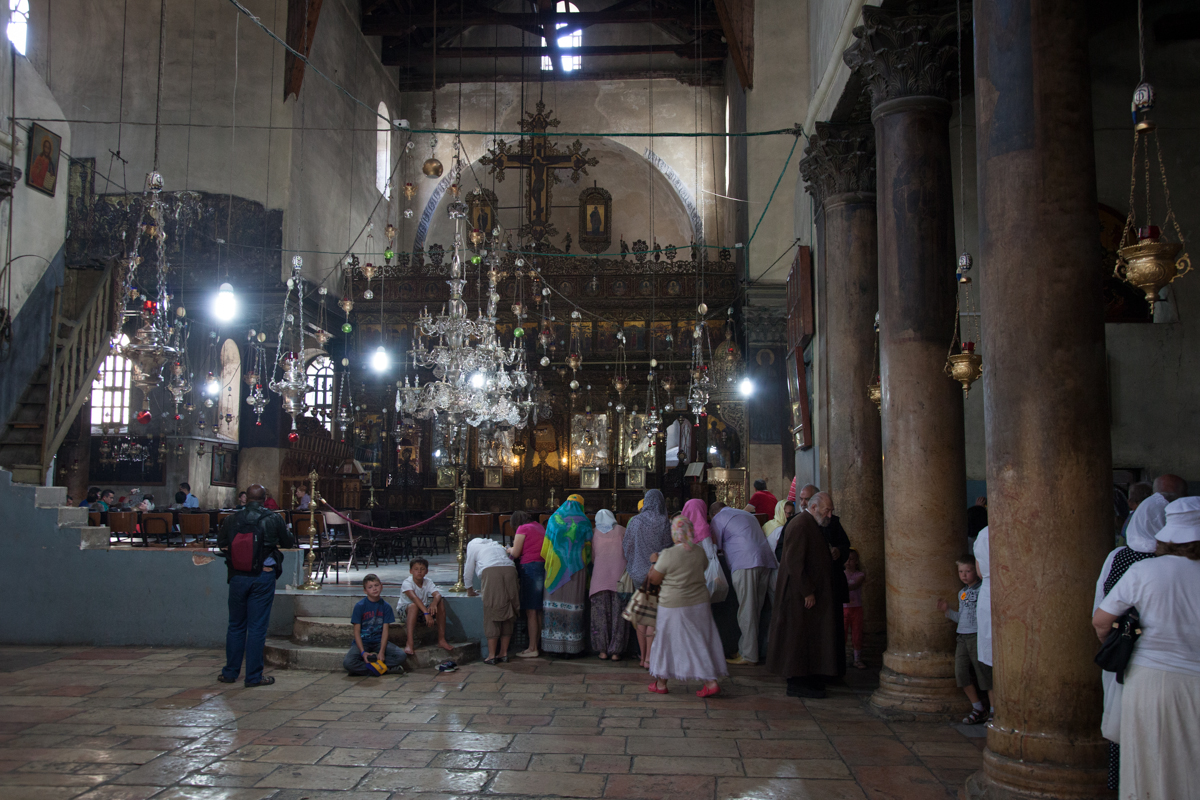
Our final excursion was a visit to Bethlehem, the birthplace of Jesus.  In my fertile imagination, I had conjured up a place that looked like a country village with sandy streets where donkeys and oxen were still used for transport.  Instead, we were dropped off on a busy thoroughfare in the middle of this city with a population of about 25,000 people, of whom the majority are Muslim, but it also has one of the largest Palestinian Christian communities.  Located on the central West Bank, just south of Jerusalem, it has been governed by the Palestinian National Authority since 1995.

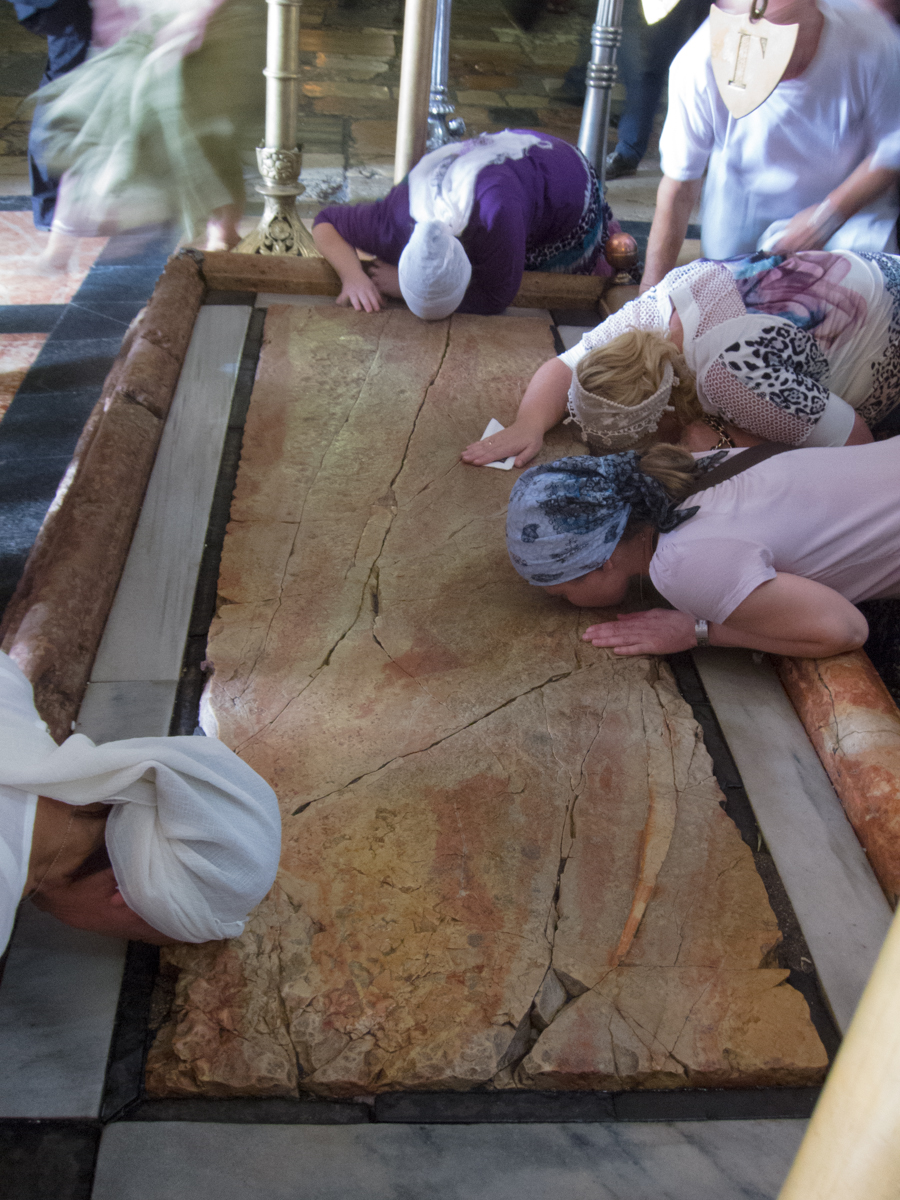
Bethlehem’s economy is tourist driven, and the main attraction that brings in throngs of tourists each year, peaking during the Christmas season, is of course the place where Jesus was born.  The Church of the Nativity stands in the center of the city — a part of the Manger Square — over a grotto or cave called the Holy Crypt, where Jesus supposedly was born.  We had been duly warned that there would be hordes of tourists and long lines to enter the Holy Crypt, and sure enough, the tour groups were out in full force.  Luckily, people who were not in  tours were allowed to avoid the long lines altogether and enter through the exit, two at a time.  We again saw people venerating this site by kneeling down and kissing the stone upon which the manger supposedly laid.

Manger Square

Around the corner from the church on a street of the same name, is the Milk Grotto where the Holy Family took refuge on their flight to Egypt.  Legend has it that Mary stopped to breastfeed Jesus here, and when she spilt some milk it turned the stone of this cave a “white stone” color.

We had our own little miracle on the road from Bethlehem when we stumbled upon a Starbucks. Our mouths salivated at the thought of a good cup of coffee, something we haven’t had for months, but our hopes were dashed when we realized the coffee shop we were staring at was called Stars and Bucks.  They still made a damn fine cup of coffee, quite possibly the best we’ve had in the Middle East, and a delicious milk shake concoction of ice cream, fresh fruit, nuts and dried fruits which we thoroughly enjoyed after our coffee.

While we were in Bethlehem, we walked to the wall that divides Israel and Palestine. At 8 metres in height, the concrete, graffiti painted wall is a formidable presence.

When returning by bus from Palestine to Jerusalem (Israel), we passed through one check point where our passports were examined carefully.  The Palestinian woman who sat beside me on the bus expressed clear disdain for the guards manning the checkpoint.  She told me in her limited English that I should tell all my friends at home what trouble the Israelis were causing the Palestinian people as exemplified by the border crossing we were passing through.

I must admit that I am quite ignorant about the complex political situation in this region and it is something I will research more fully as our short visit to Israel has certainly piqued my interest.  My one regret during our visit was that we did not take a guided tour that may have given us some insight into both the Israeli and Palestinian perspectives of the complex issues that impact their daily lives.

A visit to the Holy Land

Jerusalem is a holy city to three major religions (Judaism, Christianity, and Islam), and is one of the oldest cities in the world.   It is the holiest city in Judaism and the spiritual center of the Jewish people since the 10th century BCE, the third-holiest city in Islam (next to Mecca and Medina)  and it is also home to a number of significant and ancient Christian landmarks.  You don’t have to be religious to appreciate the intriguing history of this city.

We stayed at Abraham’s Hostel, one of the best hostels we have stayed in so far in our journey around the globe, even though we had to spend the week in a 4-bed dorm because it was booked solid.  This is also the largest hostel we have been in with close to 300 beds.  This place was designed with the international traveller in mind offering many on-site services like a functional, well equipped kitchen, self-service laundry machines, a bar complete with happy hour, separate tv room with large screen tv, a tour operator, not to mention the daily tours and events on offer.  The hostel attracts a diverse clientèle from young backpackers to small families to older folks like us.  There’s room for everyone in this clean, modern, purpose-built hostel.

Even though I am no longer religious, I do have a pretty good knowledge of the bible from my Jehovah’s Witness upbringing.  I must admit that when we arrived in Jerusalem, I was immediately filled with a sense of awe and wonder that I was actually in a place that held so much historical significance. Mind you, it does take some imagination to connect the stories in the bible with the modern day locations of where bible events were supposed to have taken place.   For instance, the bible says Jesus was killed on the Hill of Calvary and buried in a tomb close by. Well, today, you can visit Jesus’ supposed place of death and burial which is claimed to be inside the Church of the Holy Sepulchre, apparently the most holy Christian place on earth.

We spent the week visiting as many sites as we could both within the city and a few side-trips beyond.  Here’s some of the highlights of what we saw in Jerusalem this week.

Old City

Just 15 minutes walk from our hostel, we went to the Old City several times throughout the week.  On the first visit, we joined a walking tour which gave us a good overview of the four main quarters: Jewish, Christian, Muslim and Armenian.  The Old City has a large local population of mixed religions in each quarter.  The winding streets and narrow alleyways are clogged with homes, shops, tourists and locals.

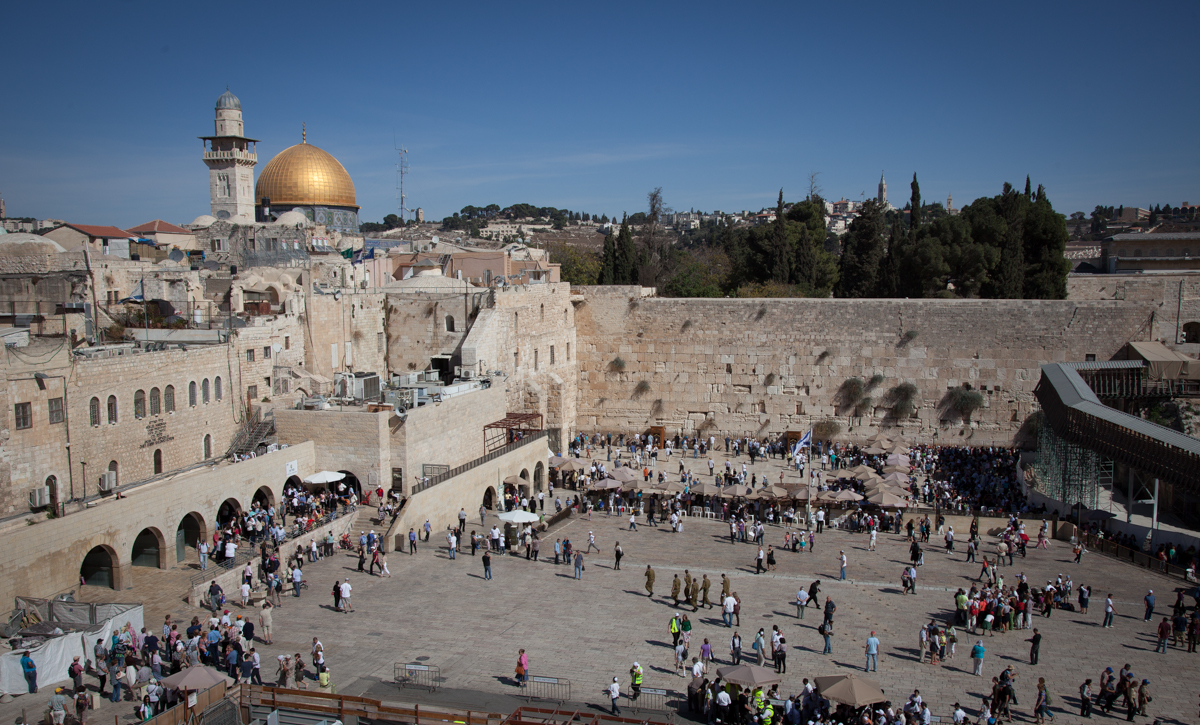
The Old City is home to several sites of significant religious importance: the Temple Mount and its Western Wall for Jews, the Church of the Holy Sepulchre for Christians, and the Dome of the Rock and al-Aqsa Mosque for Muslims.

Both the Temple Mount and the Western Wall filled me with an overwhelming sense of awe because of all the history that has occurred on these sites.  The Western Wall, also called the Wailing Wall, was much smaller than I had imagined it to be.  Divided by gender, two thirds of the wall is reserved for men, and one third for women.  This is where people of all faiths come to pray, often quite passionately.  One morning, we spent about an hour, sitting on our respective sides, watching those around us.  I found it to be a very emotional, moving experience as I watched people pray so intensely and with such conviction, some even crying out their supplications to their God.  The rock wall was riddled with tiny pieces of paper with prayers, stuffed into every crack.

Today, the Dome of the Rock sits in the middle of the Temple Mount which is where Solomon’s Temple used to be, as well as the rebuilt Temple from Jesus’ day.  Tourists are permitted to go to the Temple Mount during limited hours, which means there is always a long line-up, usually over an hour long.  As much as we hate line-ups, I’m glad we didn’t miss this opportunity to visit the Temple Mount.  Non-Muslims are not permitted in the mosque, which is the third most holy mosque in the world for Muslims (behind Mecca and Medina) but it was still interesting to walk around the site, which was much larger that I expected.

The Church of the Holy Selpuchre is venerated as the site of the Hill of Calvary where Jesus was killed, and it is said to also contain the place where Jesus was buried (the Sepulchre).  Many pilgrims travel from afar to visit this important Christian site.  The church was incredibly crowded with long line ups to the most holy places within.

Between all these holy sites, there are alleyways and winding narrow streets that are full of shops selling everything imaginable, especially religious icons.  You can tell which quarter you are in by the merchandise in the shops.

Mount of Olives and Garden of Gesthemane

When I read that the olive trees in the Garden of Gesthemane are over 2,000 years old, I really wanted to visit this garden at the base of the Mount of Olives, to walk amongst the trees that would have supposedly witnessed the fervent prayers of Jesus and his disciples the night before his death.  Today you can walk around the perimeter of the garden, but not amongst the trees which are safely secured behind a fence.  Of course, not everybody agrees that this is the actual garden where Jesus  prayed before his death, nor do all experts agree that the trees are 2,000 years old.  Again, it takes some imagination, and I suppose some faith, to believe these locations match the bible stories.

View of the Old City from the Mount of Olives

The Yad Vashem (Holocaust) Museum 

We spent a full day at the Yad Vashem Museum which was profoundly moving as we walked through the history of the Jewish nation, from bible times to modern times, with an emphasis of course on the Holocaust.  Within this broader historical context, it was possible to understand how deeply rooted anti-Semitism has been over the centuries and it helped me to understand how such hatred as well as apathy played a role in causing humanity to fail to help the plight of the Jews during the Second World War.  The museum is housed in a beautiful building in a peaceful, garden like setting, offering a place for quiet reflection after visiting the museum.

Israel Museum

The Israel Museum is the largest in all of Israel and is home to the most extensive collection of biblical and Holy Land archaeology in the world.  A uniquely designed monument called the Shrine of the Book, houses the Dead Sea Scrolls along with artefacts discovered at Masada.  Next to the Shrine is the Model of Jerusalem during the Second Temple Period, before it was destroyed in 70 CE.  The scaled model was amazing, a large reconstruction of the topography and the architectural character of the city as it would have been during Jesus’ day.

Food, food, food

The Mahane Yehuda Market was just around the corner from our hostel, making it an easy stop on our way home after each day of sightseeing.  It was here we enjoyed delicious bagels, reminding us of those from the Bagel Shop in Ottawa, the best baklava we’ve ever had, as well as cheese, olives and fruits and vegetables.  We cooked our own food most nights and haven’t eaten so well in quite some time.

Each Friday evening at sunset, our hostel hosts the Shabbat meal where everyone pitches in to help with the preparation and clean up afterwards.  Before the meal, candles are lit and a blessing is recited over the wine.  There is another blessing recited over two loaves of challah (bread).  Then everyone digs in.  This was our first Shabbat experience, one that we enjoyed very much.

During our week, we made a couple of side trips venturing into the West Bank and Palestine using public transportation which I will tell you about in the next post. But first we must fly to our next destination – Kuala Lumpur, Malaysia.  We’re leaving around 2:00 this afternoon and we’re expected to arrive tomorrow at 1:00 pm.  See you there!

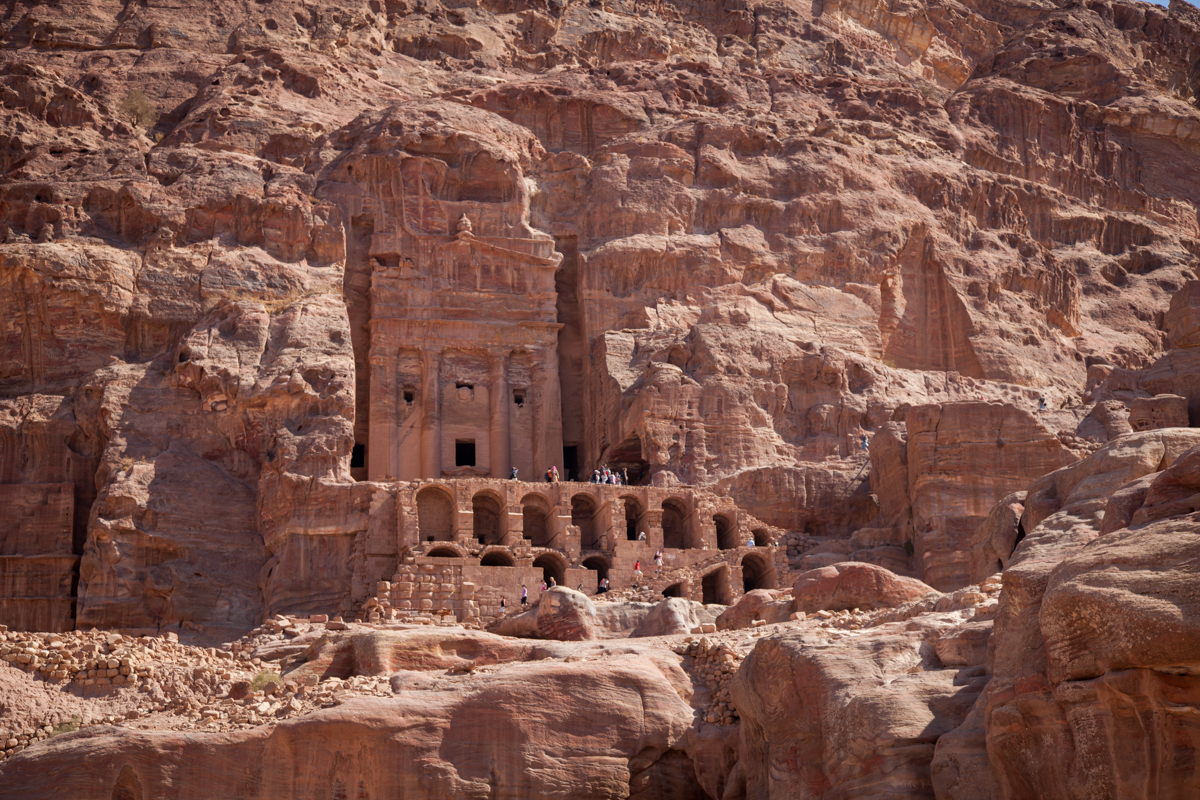
The wonders of Petra

We made the long, arduous journey to Jordan with the express purpose of visiting Petra, one of the world’s most famous archaeological sites. Recognized as a World Heritage Site by UNESCO in 1985, it was also named one of the Seven New Wonders of the World in 2007.  But for many people (myself included), Petra was made famous by the movie, Indiana Jones and the last Crusade, released in 1989.

Petra dates back to around the 6th century BCE when it was the impressive capital of the Nabataean kingdom.  Then the Romans absorbed it into their empire around 106 AD, and they continued to expand the city.  A catastrophic earthquake in 663 AD destroyed most of the buildings and the ingenious water management system.  By the time Saladin conquered the Middle East in 1189, Petra was long abandoned and forgotten for many centuries.

It wasn’t until the early 19th century when Western explorers and historians discovered this ancient city, and another century would pass before real excavations would begin, in 1929.  Today Petra is Jordan’s major tourist attraction, generating about 80% of the country’s tourism income.

Our first day in the modern town of Petra began with a typical middle eastern breakfast at our hostel (Cleopetra Hotel) – boiled eggs, humus, tomatoes, cucumbers, flat bread, cheese, butter, jam, tea and instant coffee.  Our hostel also offered a bagged lunch for a mere 3 JOD (about $4.50 CAD) which we took advantage of both days we were there.  The hostel was very clean, and the beds super comfortable, making our stay in Petra very enjoyable.  They offer a free shuttle service to the entrance of Petra, and they also can arrange any tours or transportation you need while in Petra.  We would definitely recommend this hostel to other budget travellers.

At breakfast, we met a Canadian couple (Jim and Sophia) who we immediately hit it off with.  They had just arrived from Jerusalem where they would return after spending two days exploring Petra.  Turns out, we had reservations at the same hostel in Jerusalem, on the same day….how’s that for a coincidence.

By the time we arrived mid-morning, the sun was already high in the sky and very hot, although the ambient temperature was a comfortable low-20’s Celsius.  The site was crowded with throngs of tourists including many large tour groups.  Motorized vehicles are not permitted and the site is huge, about seven square miles.  If you get tired, you can travel by camel, donkey, horseback , or horse and buggy.  I loved watching the camels with their long, gangly legs plodding along silently on their oversized, thickly padded feet.  They looked so graceful yet goofy at the same time.

Video:  Camels in Petra

Entrance fees are steep, 50 JOD for a one-day ticket, or 55 JOD for a two-day pass.  We opted for the two-day pass because of all the recommendations we had read on-line to give yourself more than a day to fully explore the site.

On the first day, we hit all the major sites, and on the second day we hiked to the High Place of Sacrifice.  Here are the highlights.

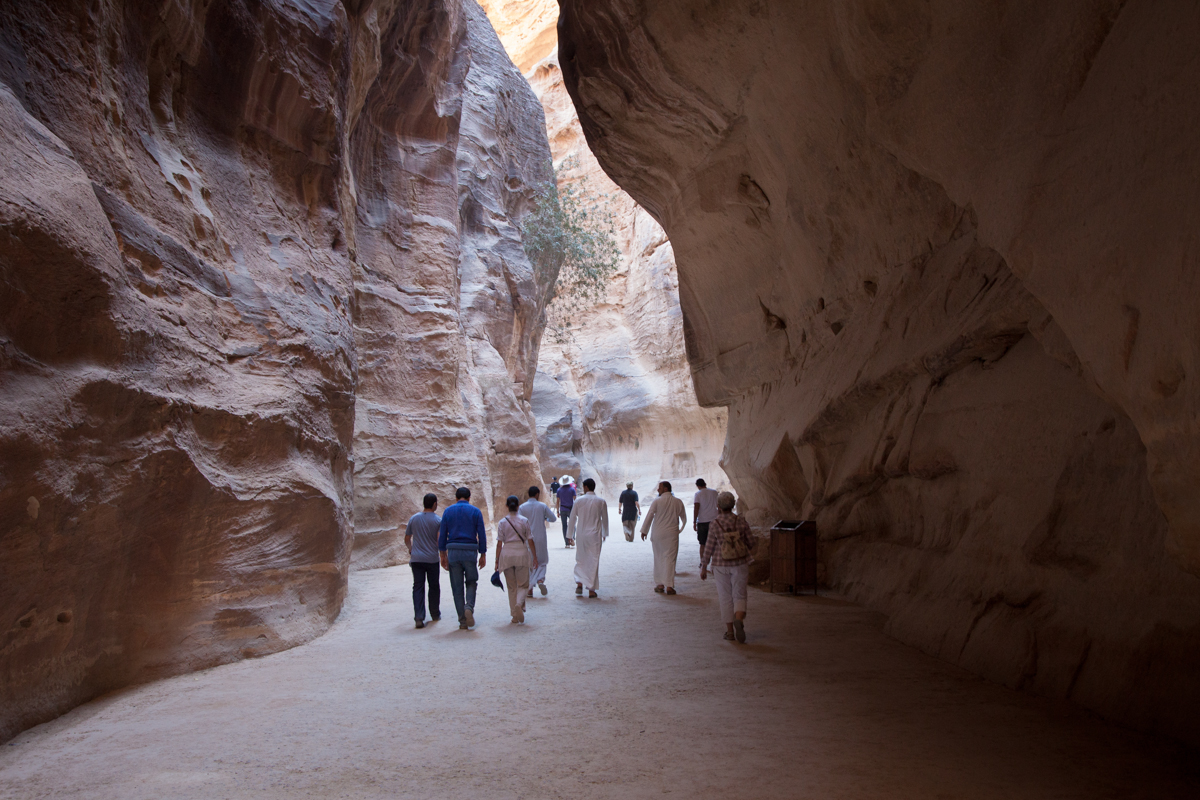
The Siq: Our journey began with a two kilometre long trek,, winding through a sandstone canyon that featured colorful and unusual patterns in the rock walls. You can still see the remains of the terracotta pipes built into the sides of the canyon that were used in Roman times as part of an extensive water system that made it possible to live in this arid land.

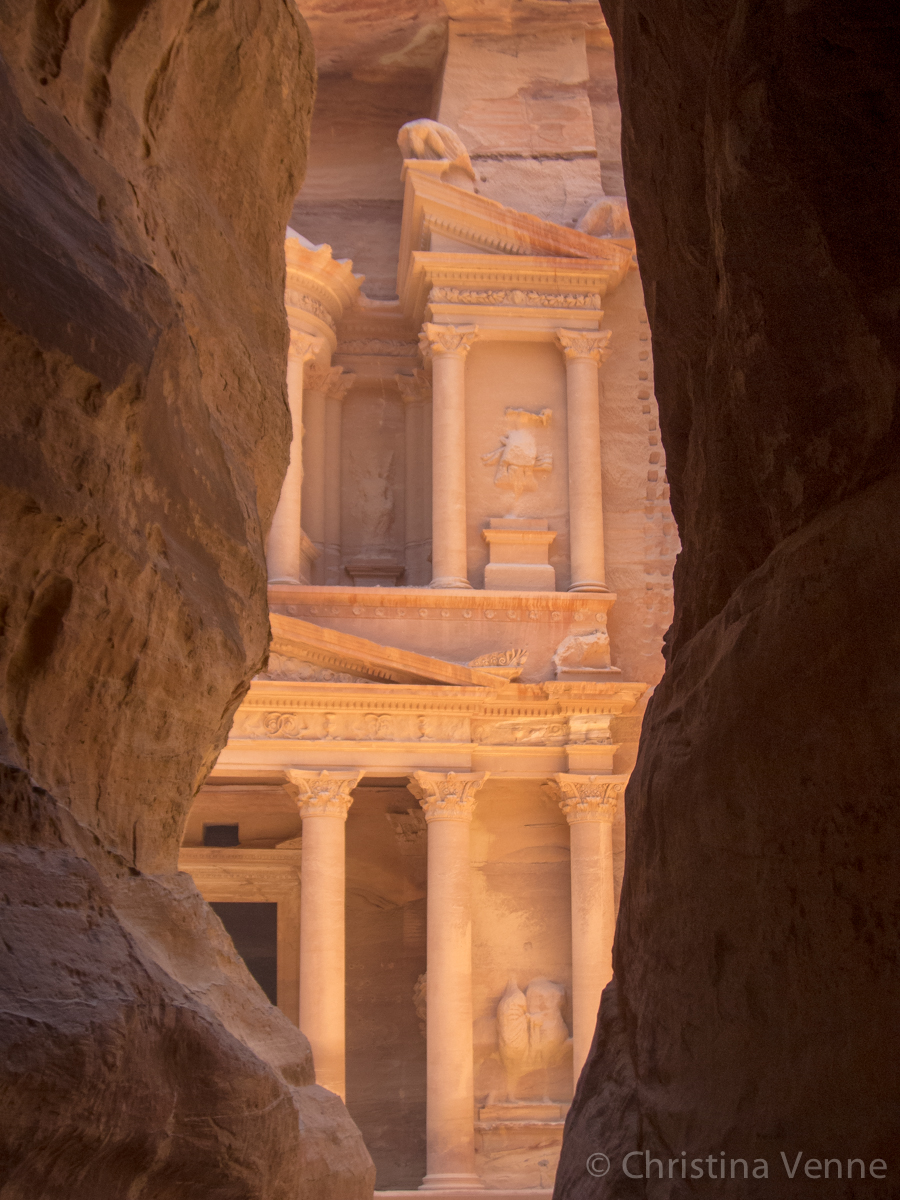
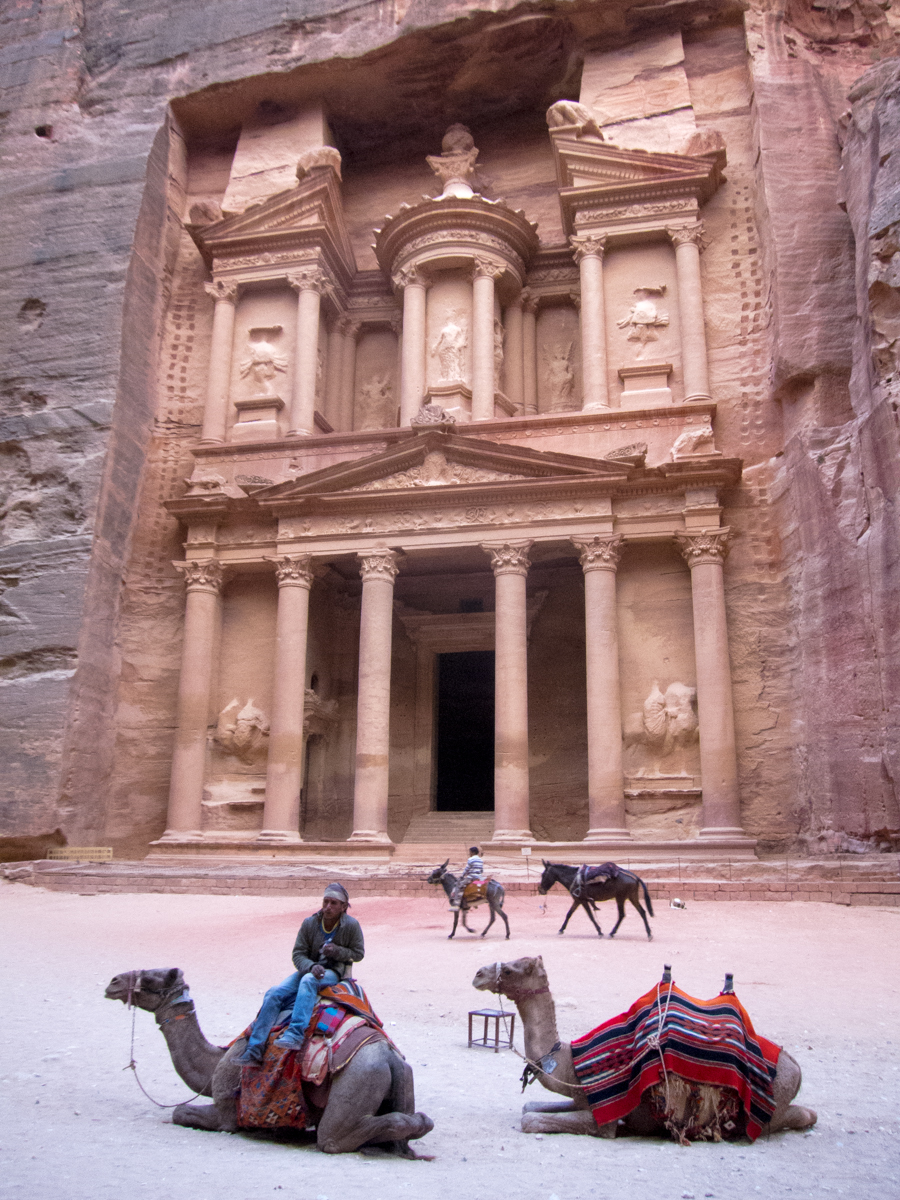
The Treasury:  At the end of the Siq, through the cracks of the narrow rocks, you catch your first glimpse of this is stunning edifice carved into the sheer mountainous rock face. Leaving the gorge, you enter a natural square where you now see the colossal, overwhelming façade of the Treasury in all its majestic glory.  Too bad there were so many tourists crowding the area when we first arrived.  Later in the day, it was far less crowded and much more enjoyable to view in the shadows of the late afternoon sun.

The Colonnaded Street:  For several more kilometres, you follow what was once a grand boulevard ornamented with a double row of columns, along which you can see the remains of ancient buildings, tombs, a 7,000 seat amphitheatre, temples and much more.

At the end of our first day, as we made our way back through the boulevard, the sound of a choir reached our ears.  We thought perhaps there was a recording being played in the royal tombs in the distance, and I jokingly said perhaps it was a passing choir who decided to test the acoustics of the tomb.  Well, the ethereal voices drew us to climb to the royal tombs, even though we were dead tired and were ready to call it a day.  Much to our surprise, there was indeed a choir singing the most beautiful music imaginable, their voices being carried far and wide.  It turns out, they were in Jordan for a choir festival and decided to take advantage of the ethereal setting to practice for their performance scheduled the following day.  What a special treat!

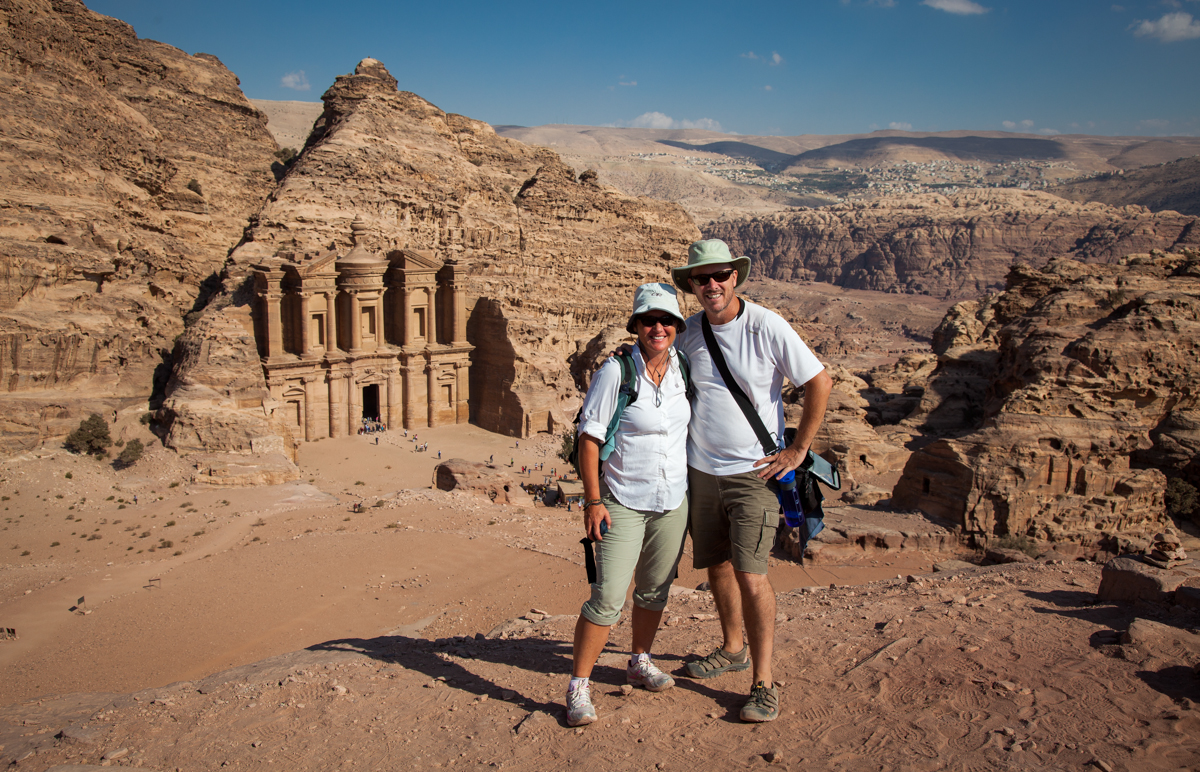
The Monastery: At the end of the boulevard, you begin the 850-step trek to the Monastery, tucked away, high in the mountains.  After climbing for about an hour, we entered a large courtyard area where the imposing Monastery stood, a beautifully carved building literally cut out of the side of the mountain.  It is huge, even the doorway is several stories high.  Interestingly, the name of this site does not accurately reflect its purpose; it was probably a temple.  It may have been named the Monastery because of its remote location.  This was my favourite site in the entire ancient city because of its isolation on the mountain top, the wonderful 360 views we enjoyed and the peacefulness that I felt looking down at this magnificent testament to an ancient peoples while perched on a hill top on the opposite side of the courtyard.

High Place of Sacrifice:  On our second day, we hiked to the High Place of Sacrifice, another moderately challenging hike up 700+ steps to the top of another mountain.  There on the mountain top, we were rewarded with the remains of an ancient place of worship along with spectacular views of the lost city below.  The hike down the back side of the mountain offered new sites that were completely hidden from the main boulevard where we had walked the day before. Very few people chose this longer route down the mountain, and we enjoyed peaceful, solitude for much of the way.

After our first day in Petra, we were exhausted from over eight hours of hiking in the hot, desert sun and minimal sleep the night before.  Earlier, we had made plans to have dinner with Jim and Sophia and I think we all thought it was going to be an early night.  Little did we know that we would quite literally run into the Canadian ladies we met on the Ferry the day before who were staying at the hotel where we decided to have dinner.  We ended up having a party of ten at dinner, enjoying one of the best meals we’ve had in a while.  Not surprising to me, we all ran into each other on our second day at Petra (the ladies’ first day), because it just happens that way sometimes.

On Sunday, we left Petra for Jerusalem at 8:00 am, about a half hour after Jim and Sophia.  They were planning to take the southern route via Eliat, while we had opted for the northern route via Amman.  Since we were all travelling to the same hostel in Jerusalem, we jokingly challenged each other to a “mini amazing race” to see who got there first.  Much to our surprise and relief, our journey to Jerusalem went smoothly.

It took three hours to reach Amman by bus (5 JOD each), including a 15-minute bathroom stop along the way.  From the bus station, we hired a taxi (21 JOD) to take us to the King Hussein/Allenby Bridge where we passed through the Jordanian customs without queues or issues of any kind.  A special bus (5.30 JOD) transported us to the Israeli side, where we went through five distinct checkpoints (each with their own queue) before clearing customs.  It was crowded and chaotic on the Israeli side, but it only took us an hour and a half to get through which we thought was pretty good.  Now that we were on the Israeli side, it was a simple matter of exchanging some of our Jordanian money for Israeli Shekels so that we could purchase our bus tickets (38 shekels each) to Jerusalem which was only an hour away.  We were dropped off near the Damsacus Gate, which was about a half hour walk from our hostel.  Unfortunately, we made a few wrong turns and it took us close to an hour, arriving around 4:00 pm.  As we finished checking in, Jim and Sophia arrived, having had an equally easy and incident free travel day.