With only three days at our disposal, we limited our explorations to the downtown core of Cairo and focused on a few of the most interesting and important sites. We used the metro system when we ventured a little further afar and found it to be a reliable, safe, cheap and fast way to get around. One metro trip costs 1 EGP, or about 15 cents CAD. The underground system is comparable to any similar system we have used in other cities with one very noticeable difference. Each station has signs along the platform that say “Women Only”. We puzzled over these signs and quickly learned what they meant when we entered a car full of women who cried out in unison – women, women. Clearly, no men were allowed on the cars that stopped between the “Women Only” signs. Ahhh, mystery solved!
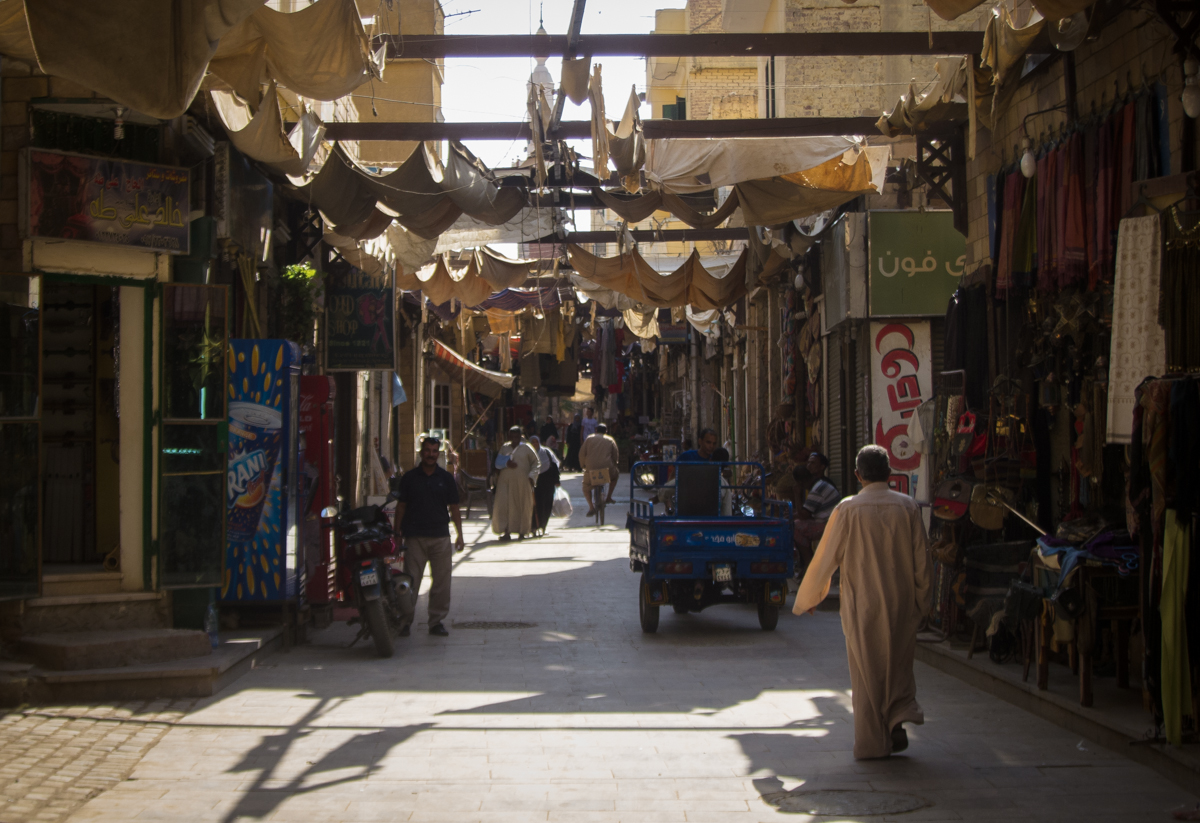
During the day, the down town core is dirty, chaotic, and noisy with people busily going about their affairs. But every night, the area is transformed into a festive, fun, almost carnival like atmosphere. At sunset, vendors start setting up stalls in the already crowded streets, selling everything imaginable. The shops are illuminated like bright Christmas trees. There are balloon vendors, and popcorn carts just like a country fair in Canada. The people fill up the sidewalks, walking slowly from window display to window display, pausing to admire the goods. The restaurants are abuzz with customers. I loved walking around at night watching all the families going about their business. We were never bothered or felt ill at ease. People were friendly towards us, often saying “Welcome to Egypt” as we passed by. One night, we were approached by a young woman, a university student who was interviewing tourists to find out their experience in the down town area. She wanted to know if we felt safe, if we were being harassed, etc. We gladly answered her questions and she was so appreciative. It did raise an interesting question though: where are all the tourists? They are noticeably absent, yet we knew there are tourists around as we see busloads of them when we visit the tourist sites. I surmise they are probably cloistered away in their Western style hotels far away from the real Egyptian life. They are missing out on so much, in my opinion.


 A papyrus paper making demonstration.
The Egyptian Museum
The Egyptian Museum in down town Cairo is reputed to be have one of the best repositories of Egyptian antiquities in the world. Now that we had visited the temples and tombs in Upper Egypt, I was thrilled to have the opportunity to view some of the treasures from that region, especially the infamous gold treasures from King Tut’s tomb. They strictly enforced the “no camera” rule, so we have no photos to share. But there are plenty on line if you are interested.
The museum is a relic in its own right, dating back to 1902. The architecture is beautiful, with high ceilings and lofty spaces designed to showcase a plethora of antiquities.
The museum is filled to the rafters, yet apparently only a fraction of the 120,000 piece collection is on display. Each item has been catalogued, yet most exhibits are not labelled which was frustrating at times. The labels that do exist, seemingly with no rhyme or reason, were small type-written notes on faded paper looking as old as the museum itself. All the display cases are the old-fashioned kind, the ones made of heavy wood with dusty glass shelves, relics of a bygone area. Each cabinet is secured with a flimsy, rusted out lock. Many cabinets were simply secured with thin piece of twisted wire. At least the treasures, including the stunning 11 kg solid gold death mask and the two innermost golden anthropoid coffins from King Tut’s tomb were segregated in a separate, highly secure room. I found it quite incredible that the security was so minimal in a museum that housed such a vast collection of invaluable ancient artefacts.
The museum sure could use a good cleaning as most exhibits are buried under a thick layer of dust. Yet in spite of its tired, faded, old fashioned appearance, there was a charm to this unpretentious museum that made it a pleasure to explore.
The museum is vast; you could easily spend a day here if you had the stamina for it. I personally get overloaded after about 3 hours in a museum. After a couple of hours, we took a lunch break and then returned later in the afternoon for a couple more hours. It was good to break it up this way and we had no problem re-entering the museum with our ticket. We opted not to pay the extra 100 EGP per person to visit the Royal Mummies display. They had plenty of other mummies on exhibit so I didn’t feel the need to see more. Again, a quick google search will yield many photos of these mummies if you’re interested.
 Old Cairo and the Coptic Museum
Old Cairo was known to the Greeks, Romans and early day Christians as Babylon, but this should not be confused with the Mesopotamian city of the same name. This was the original fortified town around which the rest of the city grew. It is now home to the Coptic community who form about 15 percent of Cairo’s population. The “Copts” were one of the earliest peoples to adopt Christianity.
We found our way to this area by metro, our first venture using the underground system. Egyptians are very similar to South Americans in that they will give you directions even if they don’t have a clue where you are going. They just want to be helpful. So it shouldn’t have surprised us when we were given wrong information, from the Information Desk no less. After two wrong stops, we were finally directed to the correct station (Mari Girgiss in case you happen to be there) by a kind gentleman who took the initiative to help us out as we were puzzling over our map. We knew we were in the right place by the groups of tourists milling about the streets.

 To be honest, we had no intention of going to the Coptic Museum, but we were both desperate to use the bathroom and we knew the museum would have decent toilet facilities. Of course, after buying the admission ticket, we felt compelled to at least do a quick spin through. Again, no cameras were allowed, so we have no photos to share. This museum gives you an excellent idea as to what the interior of a 5th, 6th or 7th century church would have looked like. The most prized collection is the “Nag Hammadi Codices”: 1,200 papyrus pages bound together as books – the earliest books with leather covers found to date. These Coptic writings date to the 4th century and offer a rare insight to early Christianity. We learned a lot about the early Coptic Christians and I was particularly interested to see how many of the practices and symbols from Egyptian mythology was adopted by those early day Christians, most notably the symbol that represented life to the Egyptians was transformed into a Coptic cross.
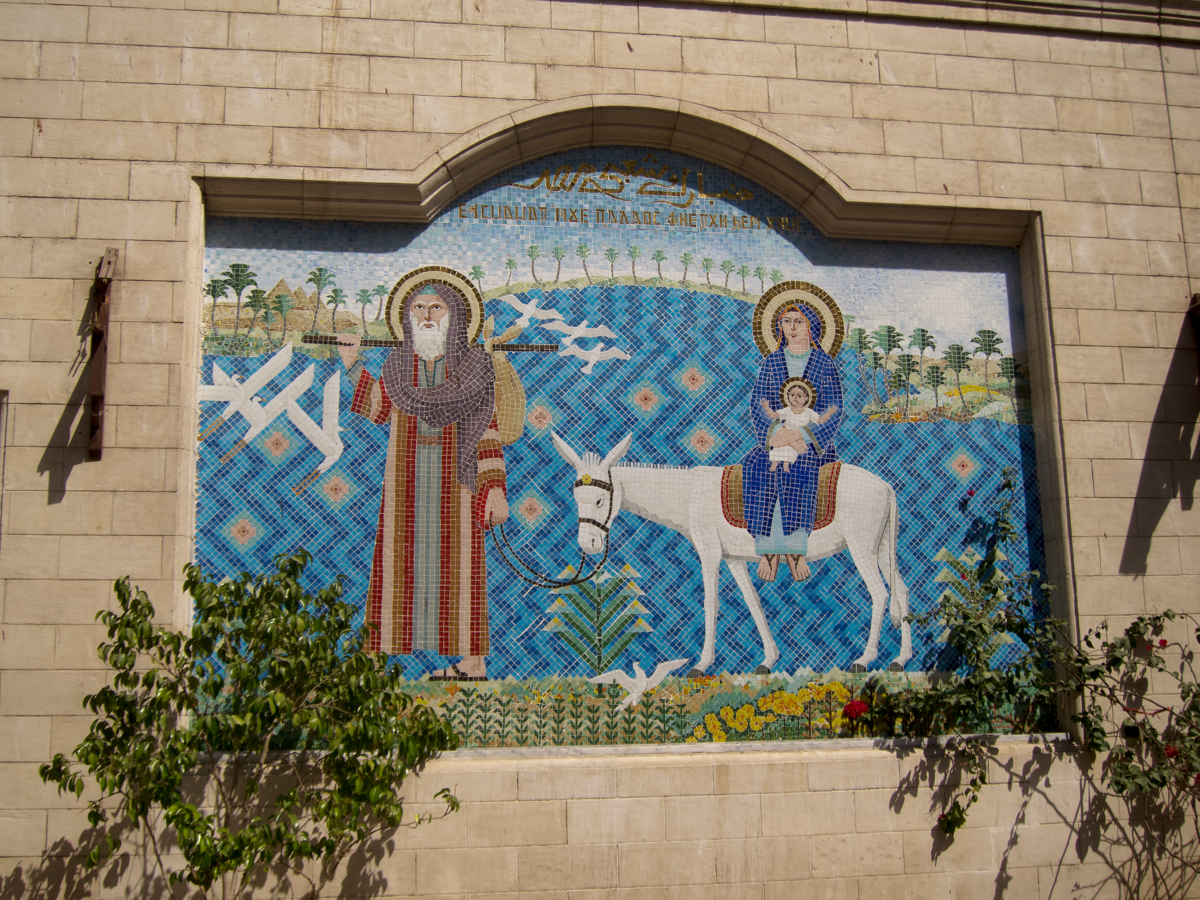

There are many churches, mosques and a synagogue clustered within the ancient walls of Old Cairo. We followed alleyways (and the tour groups) to find our way around and explore these diverse religious centres. The whole area is steeped in history. For example, the spring next to the Ben ‘Ezra Synagogue is supposedly where Mary stopped to wash Jesus, and where Pharoah’s daughter found baby Moses in the bullrushes.


 The Citadel
On a hill overlooking Cairo sits the Saladin Citadel, a medieval Islamic fortification that has been well preserved to this day. This complex houses the Mosque of Mohamed Ali, the Mosque of El-Nasser Mohamed, the Military Museum and the El-Gouhara Palace.
The location offered a fantastic view of Cairo which extended as far as they eye could see. We could even see the Giza Pyramids in the far distance.
Many students of various ages were touring this site on the afternoon of our visit. We were approached by a few groups who wanted to have their picture taken with us. One group of female university students approached me while I was sitting on the Mosque floor just taking in the atmosphere. One girl in particular spoke English quite fluently. She approached me rather shyly and said hello. She was very interested in where I came from and where I had been in Egypt and what I thought of her country. There was no ulterior motive, she was genuinely interested in learning about me. We have been engaged several times like this, usually by young people and it always leaves me with such a warm feeling. These interchanges make me feel very welcome in this country.


Footnote: A map on the wall of the Egyptian Museum indicated a room that contained the famous Rosetta Stone. This unique ancient artefact provides the key to our modern understanding of Egyptian hieroglyphs because the stone contains inscriptions of the same text in three different scripts: Ancient Egyptian hieroglyphs, Demotic script and Ancient Greek.
We weren’t exactly sure what we were looking for, in terms of size or shape but surely something of such historical importance would be prominently displayed and well labelled. We scoured the room and verified the map twice. There was nothing to indicate which stone was the Rosetta Stone if it was there at all. One stone, tucked away in the far corner of the room, had three distinct scripts inscribed on it. This stone was displayed in a an upright position, in a very shabby wood case that resembled the photo below. Did we find the Rosetta Stone or was it just a replica?

Photo of the Rosetta Stone courtesy of Wikipedia.
A subsequent internet search indicates the Rosetta Stone has been a prized possession of the British Museum since 1802. Yet some on-line descriptions of the Egyptian Museum state the Rosetta Stone resides there. The official site for the Egyptian Museum in Cairo says nothing about the Rosetta Stone, so my money is on the British Museum, but that doesn’t explain the stone we did see. That remains a mystery!