orangutan

A pseudo jungle experience in Borneo

After spending five days in the Peruvian jungle a few years ago, we thought we were prepared for the jungles of Borneo.  With visions of wild orangutans, herds of pygmy elephants and troops of proboscis monkeys dancing in our heads, we made our way to the Kinabatangan Nature Lodge where we planned to spend 3 days and 2 nights exploring this natural wonderland. The area has been touted as a must see attraction so understandably our expectations were set quite high.  We were prepared to suffer through unbearable heat and humidity, attacks of tenacious mosquitoes and whatever other discomforts nature sent our way with hopes of being rewarded with seeing some amazing wildlife in their natural habitat.

The first thing we noticed when we took the small motor boat across the river to the Lodge was how close it was to other homes and lodges. It was anything but remote. The Lodge itself was very comfortable, in fact far more comfortable than we had expected. Our private cabin with ensuite bathroom would put many of our recent hostel stays to shame.Tasty meals were served up in the communal dining room; they even had wifi available although it was pretty slow. We were definitely not roughing it on this jungle journey.

Our program included four river boat excursions, two night walks and one three hour trek through the jungle.  It was a full schedule, and I found it a challenge to keep up as I was still sick with what I was sure was another throat infection.  On each outing we saw lots of monkeys, mainly long tailed macaques and proboscis monkeys.  It didn’t take us long to spot the monkeys as we cruised down the river.  The rustling of leaves in the branches was a sure indication monkeys were about.  I loved watching them leap through the trees fearlessly as they raced from one tree to the next.  Often they just sat quietly in the tree branches, grooming each other meticulously.

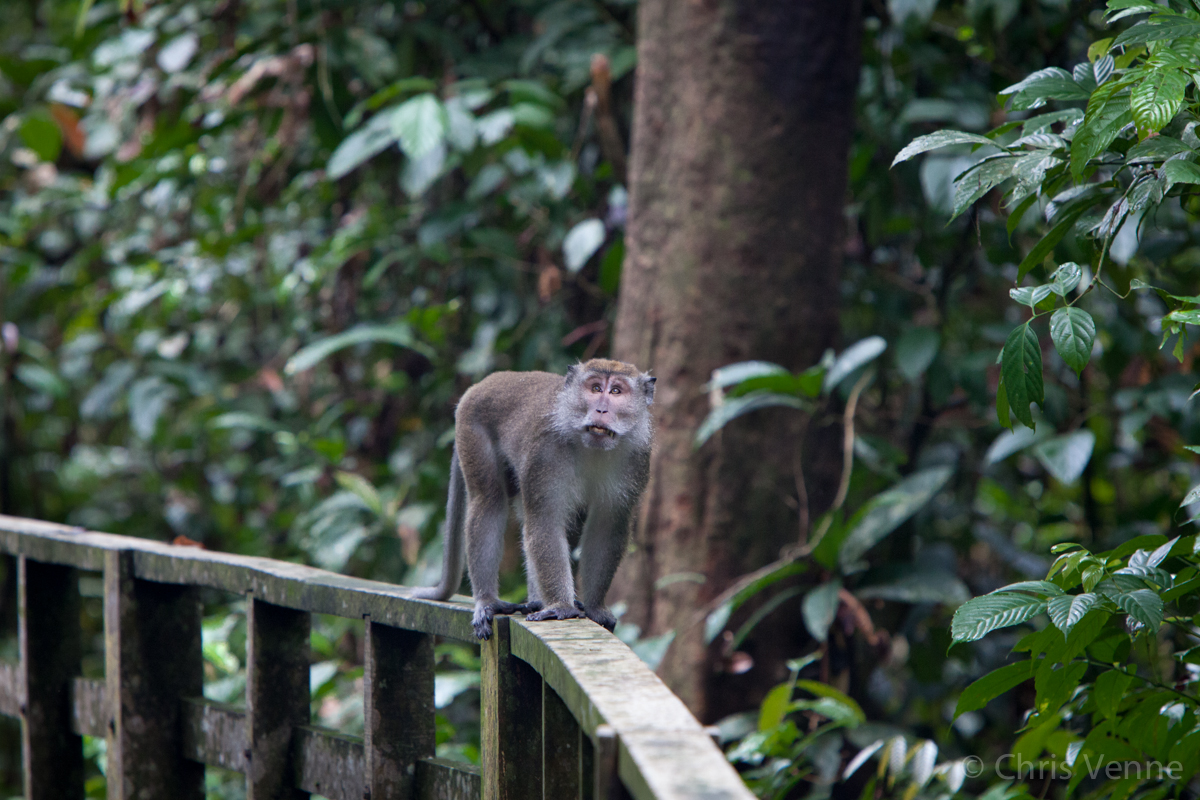
Long tailed macaque staring at us from the riverbank.

Proboscis mother and child getting ready to leap to another tree.

During one of our outings, we saw a mother/offspring pair of wild Orangutans chomping away on fruit in a tree high above us.  But the highlight for me was seeing a newborn long tailed macaque; it was still wet from its birth.  We witnessed its tentative first steps along the branches, with mama watching close by.

Wild Orangutan “toddler”.

Newborn long tailed macaque.

Baby long tailed macaque with its mother.

Typical pose of a proboscis monkey.

There were a few bird sightings along the river, the most impressive being the Hornbill.  There were lots of eagles, colourful kingfishers, and we even saw an owl at the start of one of our night walks.  The night walks were rather disappointing as there wasn’t much to see in spite of our best efforts to walk quietly.  We saw a few birds sleeping on low branches which was something I had never seen before, a few insects and a frog.  That’s it.  During our three hour jungle trek where we traipsed through mud as high as our rubber boots, we saw nothing, not a single form a life.  It was a complete bust.    And no, we did not see the pygmy elephants either.  Apparently they were somewhere upstream, about 70 km away.  All in all, it was a rather disappointing experience in terms of the minimal wildlife we saw.

Male Hornbill eating berries in a tree.

Male and female Hornbills.  Can you see the difference?
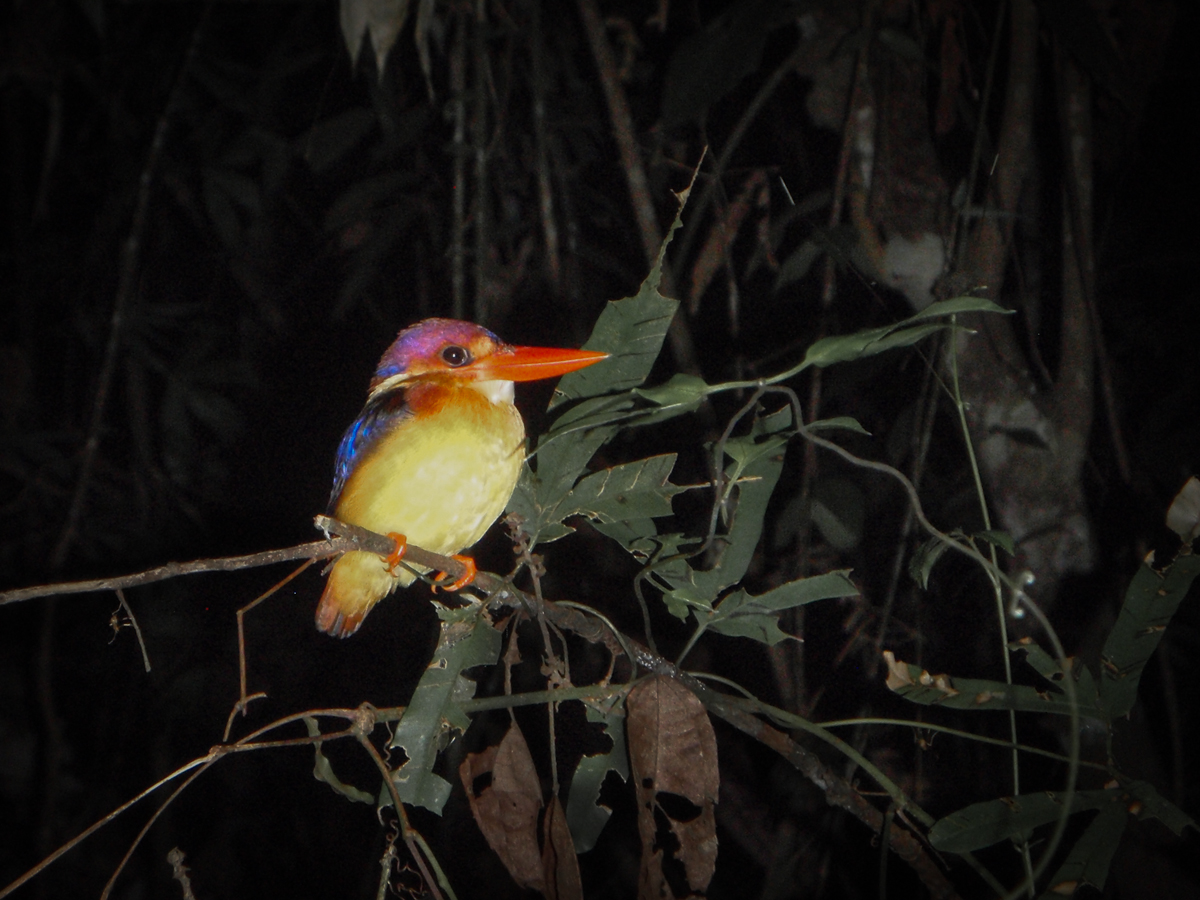
Kingfisher seen during our night walk.

Both the rainforest and its inhabitants have been severely affected by human activity.  The rainforest itself is second generation meaning it had previously been razed by humans. There are signs of Palm Oil plantations everywhere, encroaching more and more on this natural habitat.  What was once a vast forested region, is now a forest corridor along the Kinabatangan River, connecting the coastal mangrove swamps with the upland forests.  At least the area is now protected under the Wildlife Conservation Enactment which went into effect in 1997.  Hopefully as the forest regenerates itself, its inhabitants will have the chance to flourish once again.

Video:  Monkeying around in Borneo
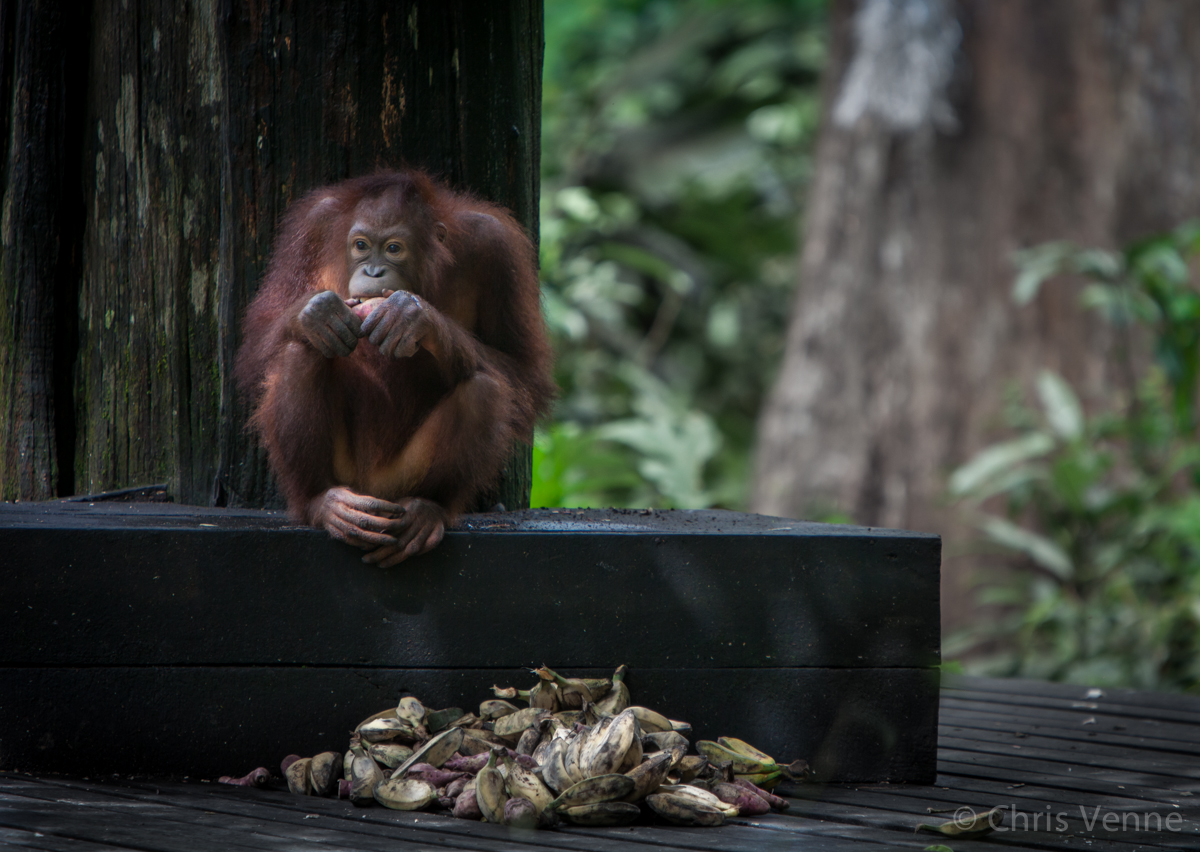
 

Meeting the man of the forest in Borneo

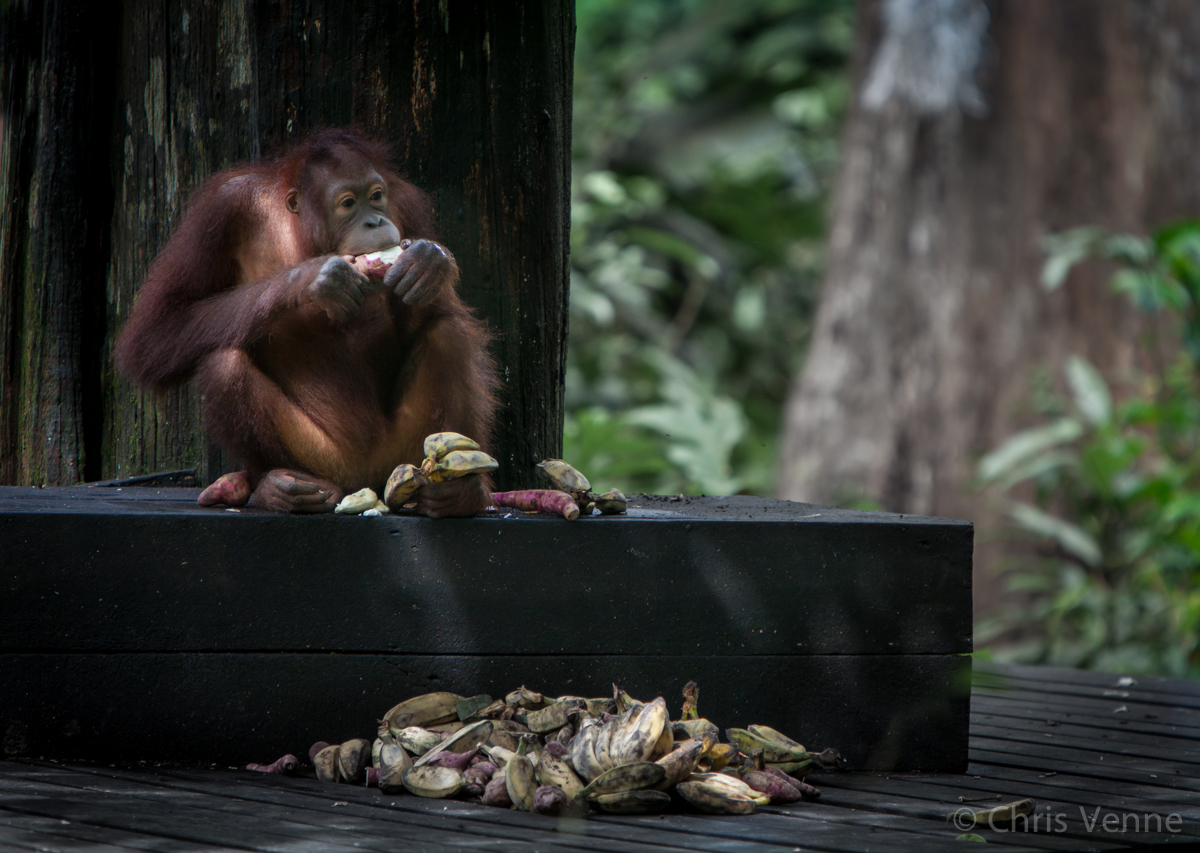
After exploring the underwater world off the coast of Borneo for three days, we were ready to discover the natural wonders of the jungle.  Our first stop was the Sepilok Rehabilitation Centre where orphaned Orangutans are rescued and then nurtured to maturity in a 23 sq km protected area at the edge of the Kabili Sepilok Forest Reserve.  Each year many adult organ utans are killed because of illegal logging and deforestation activities, leaving their young offspring to die.  Others have been illegally caught and kept as pets.  Today, there are about 25 young orphaned oOrangutans living at the centre in addition to those living freely in the reserve. The centre is open to tourists who visit during the twice daily feeding times in order to catch a glimpse of these adorable creatures.

It was an easy 4.5 hour bus ride from Semporna to Sepilok Junction where the bus deposited us on the side of the road, in the middle of nowhere. We had been told it was a 3 km walk to our hostel (Sepilok Jungle Resort) which was next to the Centre, but if we were lucky, a car might offer us a lift for a few ringgits.  Luck was definitely on our side that morning.  Not only did the torrential rain stop as soon as we were dropped off, but a car approached us within minutes to offer us a ride.

We had two nights booked at the Sepilok Jungle Resort which allowed us a full day to visit the Centre and the nearby Rainforest Discovery Centre.  After reading mixed reviews about this resort, we were pleasantly surprised with our very spacious, comfortable room tucked amidst a lovely, tropical garden setting.  It turns out we were staying at the more posh end of the resort with prices to match.  The other end offers up basic, hostel-like accommodations at more reasonable rates.  At $50 CAD per night for a large double room with ensuite, we were paying about double the rate of our other accommodations in Malaysia.  But it was worth every penny!  The hotel restaurant served up tasty, reasonably priced meals too.  There was a very inviting pool which unfortunately we didn’t have time to use.

By the time we arrived at the resort, I was feeling sick again.  My sore throat had returned with a vengeance and my energy was very low.  I pushed myself since we only had the one day to visit the Orangutans and I didn’t want to miss it because of a stupid cold.  The Centre cannot guarantee that visitors will see Orangutans because they really are living in the wild and may or may not choose to visit the feeding platform for some free bananas.  The day of our visit, they were out in full force, including a huge male who rarely comes to the platform.  Apparently, he’s looking for a mate, so he has been showing up about once a month lately.  In the afternoon, another male, much smaller than the one we saw in the morning, found himself a female to his liking, and mated her right there and then as we all watched in amazement.

Before the feedings began, I had a close encounter with a group of long tailed macaque monkeys.  After walking ahead beyond the feeding platform towards the exit, a dozen or so monkeys appeared on the railings about a hundred feet away from me.  I was alone and to my astonishment, they all started walking towards me, pausing and staring at me with as much curiosity towards me as I had for them.  I got a little nervous when a large male stopped beside me and glared with piercing eyes, baring his teeth like he meant business.  There was really nowhere for me to go because I was surrounded by them, so I carefully avoided eye contact and stood still to let him pass; after all, these monkeys are wild and have been known to be aggressive, especially if they feel threatened.  I got some great video footage which you can see at the end of this post.

In between feedings, we walked to the Rainforest Discovery Centre  about a kilometre away. While this environmental education centre is geared towards teachers and students, it is open to everyone. Their mission is to create public awareness and appreciation for the importance of conserving forests, as well as the sustainable use of forest resources. Arriving in the middle of the day, when it was stinking hot guaranteed we would see no animals.  They were all taking a siesta which we should have done too.  The only animal we saw was a long tailed squirrel, which looked exactly like a squirrel in Canada, except it had a long tail.  Even though we didn’t see any wildlife or birds or flowers for that matter, we did enjoy the 300 m long canopy walkway, which was 25 m above the forest floor, giving us a great perspective of the rainforest from above. There is a vast network of many kilometres of well kept trails throughout the rainforest too. The dense forest canopy kept us surprisingly dry when it poured rain a few times during our visit.

The highlight of our day were the Orangutans, which we saw again at the afternoon feeding back at the Rehabilitation Centre.  These endangered apes only live in Borneo and Sumatra so it was a real thrill to see them up close like we did.  Their numbers are declining because their habitat has decreased rapidly, mainly because of the conversion of large areas of the tropical forest to palm oil plantations.  Everywhere we went, we saw miles and miles of these plantations, visible reminders of the shrinking forest.  Sharing 96.4 % of our DNA, it’s not surprising that these apes act so human-like and are so endearing to us.  These gentle primates are highly intelligent and have the ability to reason and think.  In Malay, Orangutan means “man of the forest”, a fitting name, don’t you think?
Our next stop is at a jungle lodge on the Kinitabangan River where we will spend three days and 2 nights exploring the wildlife along the river banks and into the jungle interior.  We hope to see Orangutans in the wild as well as the funny looking proboscis monkeys. If we’re lucky, we might even spot a pygmy elephant.

Video:  The Man of the Jungle and a Troop of Macaques
 

Shopping and eating our way through Malaysia

It took us 24 hours to travel from the Middle East to Malaysia which included a 7 hour stop over in Jeddeh, Saudi Arabia  one of the dirtiest airports we have been in.  However, our carrier, Saudi Arabia Airlines, was top notch and provided service we don’t see in Canadian airlines these days, including plenty of free food and drink, cozy fleece blankets, pillows with soft cotton covers, and toiletry packs which even included a pair of socks.

We haven’t had the best start here in South East Asia as it took us a couple of days to get over our jet lag even though it was just a six hour time difference and then we both got sick with some sort of throat infection that knocked us off our feet for another few days.  A round of antibiotics from our trusty medicine bag came to our rescue.

There isn’t much to see culturally or historically in Kuala Lumpur (KL) although architecturally there are many beautiful, modern buildings to admire.  While most people just spend a few days here in transit to other destinations, we spent almost a week here.  It wasn’t the worse place to slow down and recover.  It seems the main things to do in KL are shopping and eating.  There are 66 malls in KL alone, many of which were within walking distance of our hostel, The Nest Guest House, which is located in the area known as the Golden Triangle.  Our hostel was very clean, well located, and our room was quite spacious.  But we both found the bed to be rather uncomfortable and the breakfast dismal – white toast with jam, tea/instant coffee, and bananas, but I think it is the standard in this part of the world. It was still pretty good value at 99 RM ($33 CAD) per night.

The malls vary in size but most are huge mega-complexes up to ten or twelve stories high which made the Eaton Centre in Toronto look pale in comparison.   The shops range from cheap discount stores to high end designer labels and everything in between with some noticeable exceptions.  For instance, we searched high and low for hiking sandals but came up empty handed.  Turns out Malaysians aren’t big on outdoorsy type activities. The sizing and styles are quite different from North America too.  It was a challenge to find anything that fit us, and neither of us are overly large, at least not by North American standards.  We looked like giants amongst the majority of the Asian population!  No matter the time of day, the malls were jam packed with people, tourists and locals alike.  Shopping is big business and contributes billions of dollars to the local economy each year.

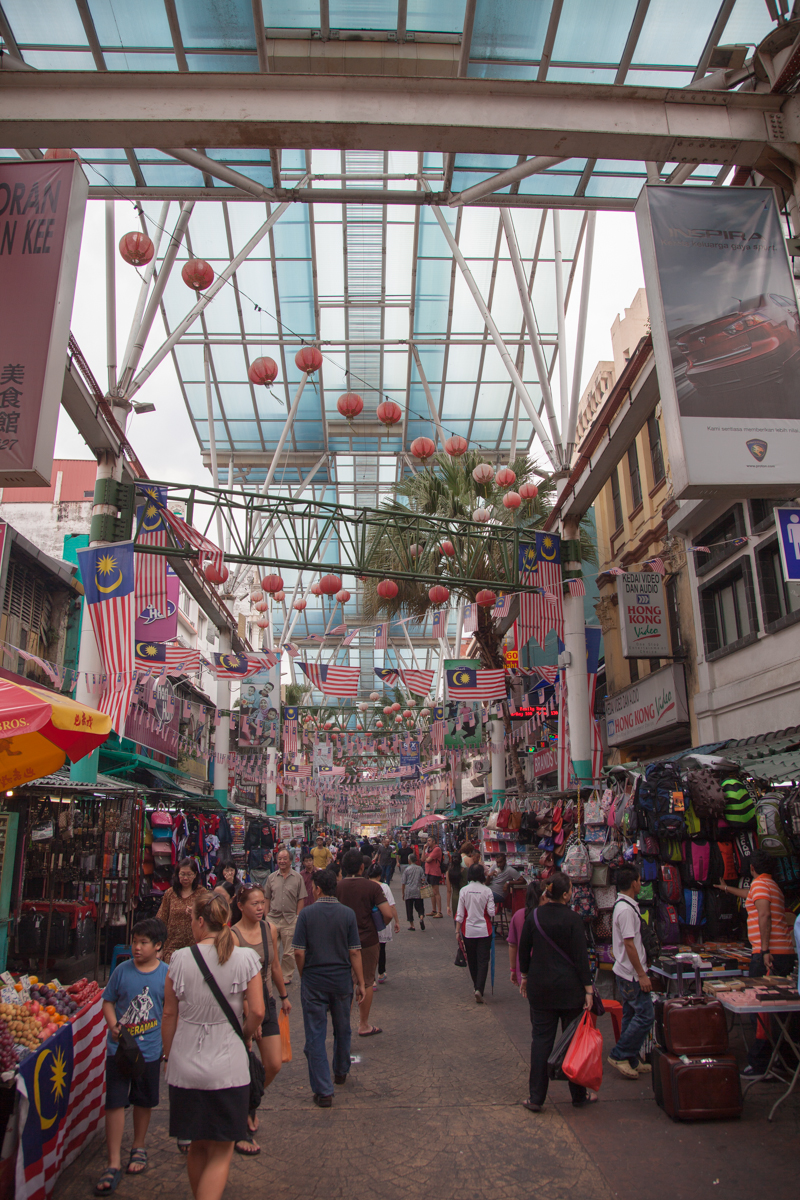
Entrance to Times Square Plaza overlooking the
Deepavali 2012 greeting made of coloured rice.

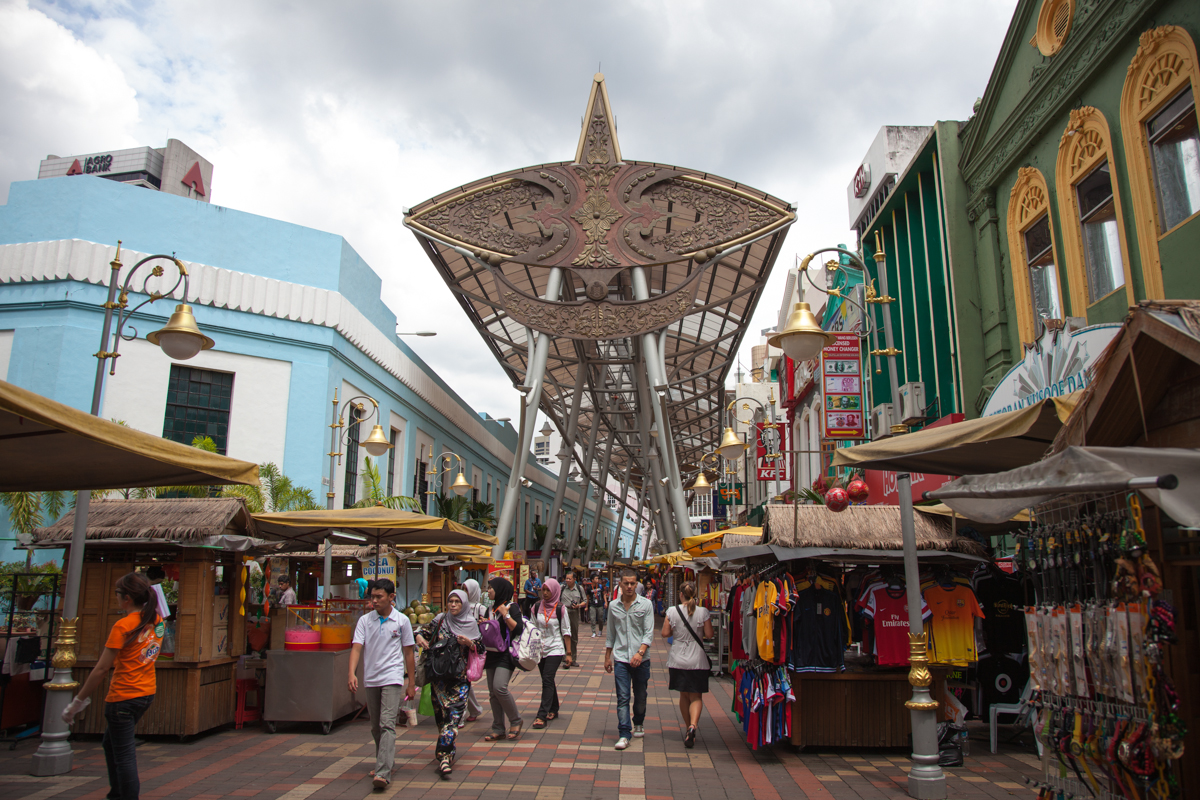
Entrance to China Town.

Entrance to Central Park – another shopping plaza with
both outdoor and indoor stalls.

There is a plethora of food options on offer throughout the city including Indian, Malaysian, Chinese, and Thai.  Street stalls are everywhere – outdoor restaurants with tables and chairs under umbrellas or other makeshift shelters.  We cautiously ate most of our meals at these street stalls.  If you haven’t noticed by now, Chris and I are not the most adventurous when it comes to food.  We like to eat where the locals eat, but we’re ever conscious of the health dangers, and we are reluctant to eat anything we don’t readily recognize, especially meat.  Most of our meals cost about $5 CAD each which is pretty expensive by Asian standards.  We’ve been told Thailand is much cheaper, but we’ll see when we get there.  As much as I enjoy Asian cuisine, after a few days, I was already tired of it.  Indian food was a nice alternative and we ate some mighty tasty dishes in KL.  But when we got sick, I craved homey, recognizable food and was quite content to eat a bowl of chili from Wendy’s and a burger from MacDonald’s.

On a whim, we decided to make a detour to Borneo, which was a quick, cheap flight away (just a hundred bucks a piece).  Borneo is home to the Orang Utan along with lush jungles and rain forests and some of the best diving in the world, especially at the island of Sipadan off the north east coast.  We are now in Borneo, in a place called Kota Kinabalu, a large city on the north west coast.  It’s taking a little longer than expected to organize our itinerary which will hopefully include a day or two of diving, some jungle trekking and a visit to an Orang Utan Rehabilitation Centre.   We’re anxious to get out of the city and into nature, but when we do, we’ll probably be off line frequently. We’ll be sure to share our adventure whenever we can.

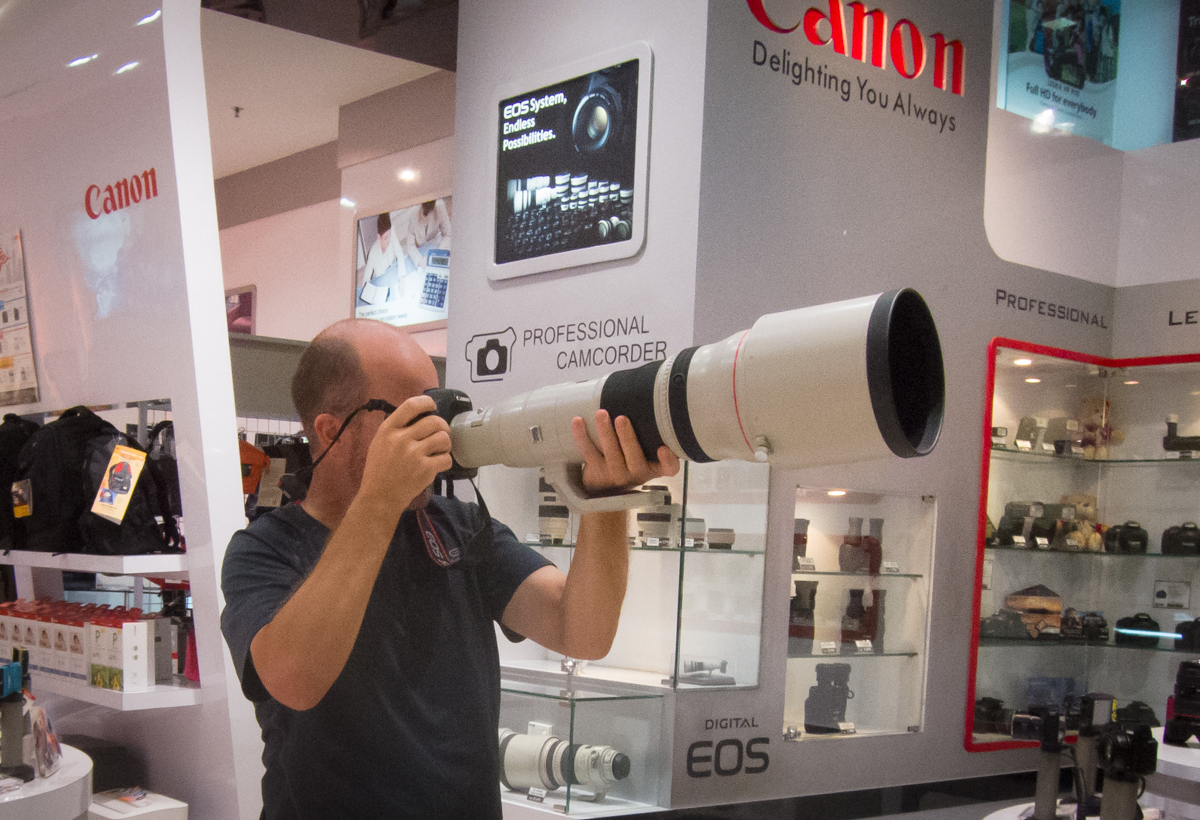
Chris’ Xmas wishlist – at almost 45,000 RM, that’s a whopping $15,000 CAD
and  weighing in over 5 kg, I’m not sure what would hurt more, the budget
or Chris’ back as he lugged it around the world.