 As tensions flared, erupting into riots and demonstrations in Tehrir Square on Friday afternoon, we witnessed an incident at the pyramids in Giza that caught us off guard and made us realize how quickly situations can escalate and how important it is to stay alert to your surroundings and to avoid large gatherings of any kind. I’ll tell you more about what happened later, but first let me share with you how we managed to have the most amazing experience at the most touristy attraction in Egypt.
There are 93 pyramids in Egypt, the three most famous being those in Giza, which is now a suburb of Cairo. I had read about how there are condos and fast food restaurants right next to the pyramids so I guess I was expecting the worse. It really isn’t as bad as that sounds as there is still a good buffer of desert around the site.

These are probably the most visited pyramids, maybe even the most visited tourist site in all of Egypt. It is also a magnet for pushy Egyptians looking to make a buck off or rip off (depending on your perspective) tourists by hawking their cheap souvenirs, camel rides, horseback rides, as well as guide services. When people talk about going to Giza, they often talk about their negative experience getting hassled and hustled which seems to overshadow the visit to the pyramids themselves. For this reason, many guide books recommend taking an organized tour so that you are somewhat buffered by these tenacious hawkers.
 But we hate going in large tour groups and so did our new friend Felippe, a fellow long term traveller from Chile who we met at our hostel. One evening, we talked about our respective plans to do the pyramids independently. Felippe went the day before us and when we saw him that night, he looked exhausted and disappointed with what had transpired earlier. “I am Chilean”, he said, “I should be able to deal with these hustlers, because Chile is full of them! But they got me, they got me good!” He then shared his story with us.
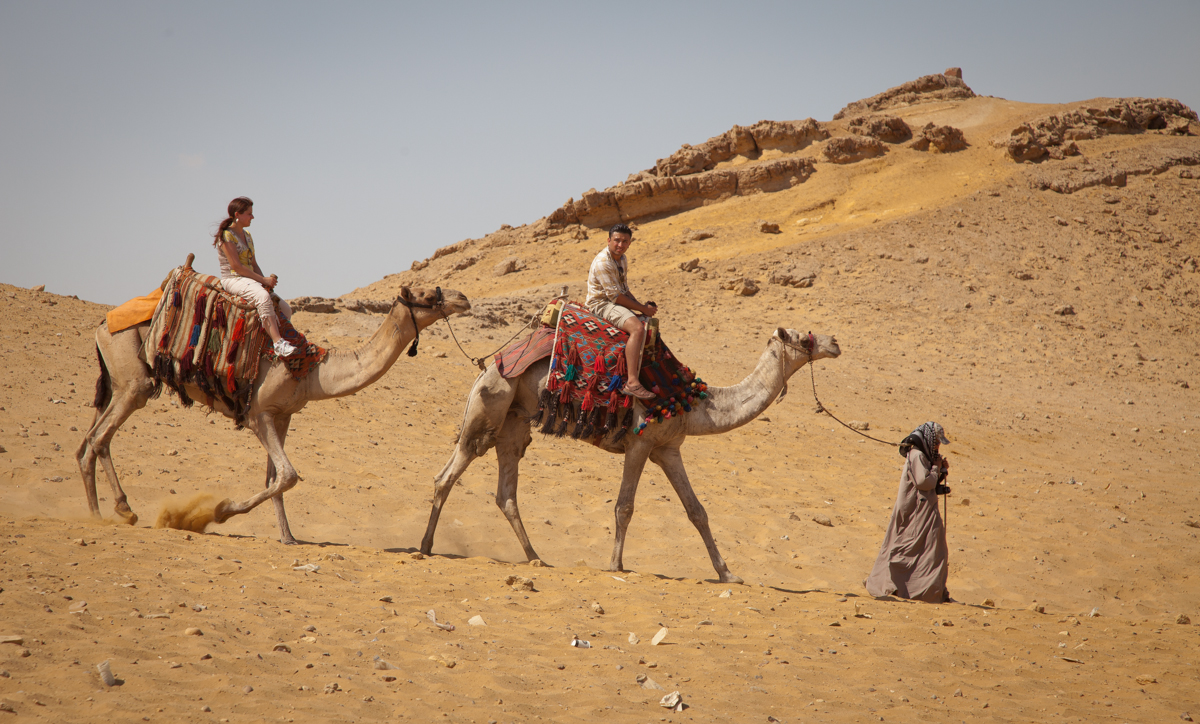
 He took the metro to the Giza station and then grabbed a taxi for the short ride to the Pyramids. With plans to visit two other pyramid sites that day, he arranged for the taxi to wait for him. Instead of going to the entrance where you purchase your entry ticket, he was deposited on a side street where he was quickly accosted by tour operators and guides. They told him all kinds of lies like you can’t visit the pyramids alone, it’s too far to walk so you need to hire a camel or horse, you need a guide, etc. etc. He was duped into buying a “package” that included his entrance fee, a camel ride and a guide. At 80 Euros, but he knew it was too much, but he felt trapped. The whole experience left a bad taste in his mouth, although he was really happy to get his photo on a camel with the pyramids in the background – we all joked that it was one expensive photo. He subsequently had some problems with his taxi driver who wanted to charge him more than the agreed price. He ended up going to just one other site before calling it a day, completely exhausted and fed up with the whole hassle of it all. It just wasn’t worth it.
So what were we going to do? After much debate, we decided we would try it on our own as well, feeling a little bit more prepared with the knowledge of what happened to Felippe. We figured we have been dealing with these hawkers for three weeks now, surely we could handle this. Felippe had misgivings and gravely wished us the best of luck. I promised him I would write our tale in the blog so he would know how it turned out – good or bad. Here is our story.
Before I continue, I should warn you that you’ll need some time to read this tale as I do go on a bit. I hope you don’t mind. Maybe go and get a cup of coffee or tea, or go to the bathroom now, because this is probably one of my longest written posts to date. Or you can just skip to the bottom to see the photos. But I do hope you take the time to read our story as it was quite an experience to go through and maybe we can help others who, like us, want to see the pyramids on their own terms and not be held hostage by an organized tour, or worse, by the army of hawkers that have taken over the site.
As I mentioned in the last post, we unexpectedly had to leave our hostel on Friday morning, the morning we were planning to visit the pyramids. We had already booked our flight to Dahab for Saturday morning, so we had to go to the pyramids that day, no matter what. Our original plan was to take the metro and bus avoiding any taxi hassle. We did some research so we knew what bus number we needed. I suspected the bus numbers might only be in Arabic, so I carefully wrote down the Arabic numbers (0-9) in my note book as reference. The only thing I wasn’t sure about was if the numbers were to be read left to right or right to left. We’d have to figure that out on the fly.
But all that changed when we switched hotels that morning. We flagged down a taxi in front of our hostel, and amazingly our taxi driver took us to our new hotel using the meter, directly and quickly. Wow, a taxi driver you can trust. Imagine that! He didn’t speak a word of English so at the hotel, we had the desk clerk tell him to take us to the Giza Pyramids by meter. He agreed so off we went. We felt relaxed, confident that we had found perhaps the only honest taxi driver in Cairo. What a nice feeling to be able to sit back and let our guard down because we didn’t have to worry about being scammed by our taxi driver. Then I noticed he passed the bridge that had a sign to the Giza pyramids. Hmmmm…..that was weird. Well, maybe there was more than one way to get there. But as we were heading straight back downtown from where we had originally come, I started to get suspicious. Remember our driver speaks no English, so it’s not like we could ask him where the hell he was going. Finally, he pulls up to the “Pyramisio Hotel” which is nowhere close to the pyramids and points to it as if this is where we had asked to go. Bullshit. He knew we wanted to go to the pyramids. This is such a classic taxi scam – taking you to the wrong address – I couldn’t believe this guy did this. Well, there goes his tip! Chris used his mad, firm voice and motioned with his hands that we want to go to the pyramids in Giza not this damn hotel. Ohhh, he looked all surprised, as if to say, you mean THE pyramids. So now our guard was back up and we were mad which actually served us well for what came next.
Our taxi was immediately accosted as we entered the road that lead to the entrance gate. It is not uncommon for these unscrupulous characters to jump right into your cab, or block your passageway. At the first onslaught, we locked our car doors, rolled up our windows, and yelled out of the front windows “La, la, la” (no, no, no) in really angry voices, and we motioned to our taxi driver not to stop, to keep going straight ahead. I think we scared the shit out of him. Then the next wave came up to us, and a guy with a bunch of horses tried to block our way, well we yelled even louder to everybody to get out of our way, and for our taxi driver to keep driving. Amazingly, they cleared out and we proceeded to the gate. We congratulated ourselves for getting to the ticket entrance relatively unscathed. Our fare cost us 70 EGP (about $12 CAD) which included the ride to the hotel in the suburbs and the unnecessary detour to the Pyramisio Hotel which we figured cost us an extra 20 pounds. Still, not too bad when you consider our hostel offered to arrange a car and driver to take us there and back for five times that amount (350 EGP).
 Now that we had our tickets (60 EGP site entrance and 30 EGP tomb entrance each), we knew we would have to deal with another onslaught as soon as we passed through the entrance gate. We had a simple strategy. Ignore them. Speak not a single word to them. No smiles, no eye contact, act as if they did not exist. This might seem extreme and pretty rude and really it is under normal circumstances. But these were not normal circumstances. You have to understand that these people will harass you for an hour if you let them, they just won’t leave you alone until they have worn you down so badly that you give in and buy something just to get rid of them.
Amazingly, our strategy worked. I’m telling you, this was not for the faint of heart. You had to be as ruthless as they were. But after a couple of minutes trying to engage us, and being met with a wall of silence and a glazed over look that did not even acknowledge their presence, they quickly gave up and moved on to easier prey.

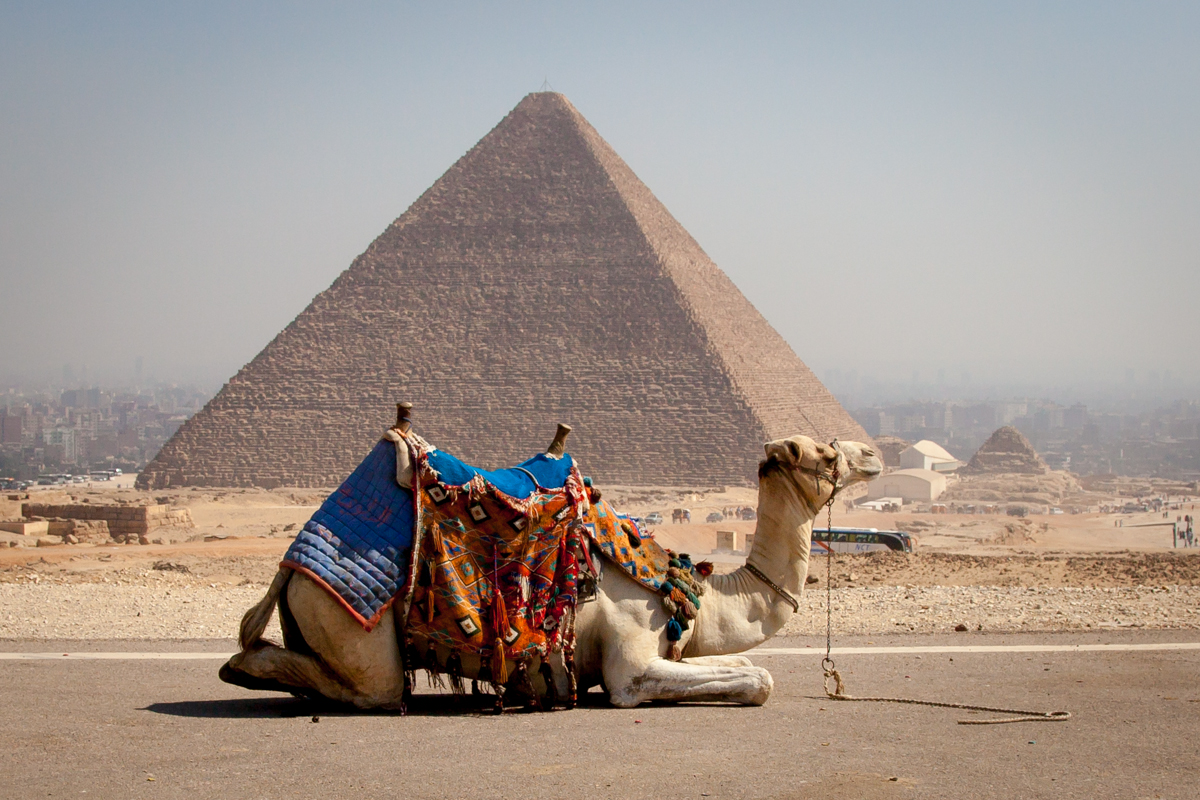
Now we could focus on the reason for being here. The pyramids. The first thing I noticed was how massive they were. Up close, you can see how the stones were laid in perfect alignment and it boggles the mind as to how this was accomplished over 5,000 years ago. There are three main pyramids and three smaller ones.

- The most famous Pyramid in Egypt is the Great Pyramid of Khufu. It is the biggest, tallest and most intact, and the only remaining one of the Seven Wonders of the Ancient World. Until the Eiffel Tower was built in 1889, this Pyramid was the tallest building on earth, originally measuring 146.5 m high. Today it measures 137 m in height, the missing 9m were stolen by the Ottoman Turks in the 15th century to build houses and mosques in Cairo. The four sides face the four cardinal points precisely angled at 52 degrees. It contains around 1,300,000 blocks ranging in weight from 2.5 to 15 tons each. It’s square base has sides measuring 230 m and covers 13 acres! Like I said, it is huge.
- Khafre’s Pyramid (the middle one) appears larger than the Great Pyramid but is is merely an illusion because it stands on a higher part of the plateau. Today it is 134.5m tall (originally 136m) with sides equalling 214.5m, a surface area of 11 acres and an angle of 53 degrees.
- The smallest of the three main pyramids was built by Khafre’s son, Menkaure. It is relatively tiny, just 65.5m tall (today 62m), with sides equalling 105m angled at 51.3 degrees. Unlike the other two pyramids which were constructed entirely of limestone, the first 15m of this one was built from pink granite which came all the way from Aswan.
- The three small pyramids next to the Menkaure Pyramid are believed to have been built for Menkaure’s wife and children.
- The Great Sphinx is probably one of the most recognizable constructions in history. It was sculpted from soft sandstone and would probably have disappeared long ago if it hadn’t been buried in sand for so many long periods in its history. The body is 60m long and 20m tall. It faces the rising sun and was so revered that a temple was built in front of it.


We walked around each of the pyramids getting a good, close view of each side. Then we headed out into the desert where the tour buses were taking the tourists to see the pyramids from afar. We continued to walk further into the desert, maybe half a kilometre from the pyramids, stopping on a hilltop that offered a magnificent view. Here I sat for over an hour marvelling at the panorama of these magnificent, iconic structures. I was completely alone (Chris was off taking photos). It was so peaceful far away from the crowds – no vendors, no tourists, just me and the pyramids. The hot sun seared my back, but I felt cool and comfortable on the breezy hilltop.


At 11:30, the city of Cairo erupted into a symphony of prayer; it was time for the noon prayers which are broadcast over loud speakers from every mosque in the city. I was surprised I could hear it in the distance. It was as if the city was singing. Here I was in one of the most touristic sites in Egypt enjoying complete solitude as I soaked in the magnificent view and atmosphere. Nothing short of magical. (Sorry Felippe, I’m sure you didn’t want to hear this!)

As we made our way towards the exit where we would see the infamous Sphinx, we became aware of a sudden change in our surroundings. People were talking loudly in excited voices and there was tension in the air. We looked around to see what could be the reason when a truck came barrelling towards us, the driver and passengers screaming at the top of their lungs. As it passed, I turned to see a man lying on the back of the truck, his chest bloody red. What the hell was that all about, we wondered. Maybe someone fell off a camel or horse, I speculated. But then, cars and horses with their carriages all started to turn around and come back up the hill. We stopped in our tracks about half way down the hill, realizing something was terribly wrong at the bottom, about a couple of hundred feet ahead of us. A police truck was lying overturned on its side, and a small car sat in ruins next to it. What happened? Was it a bomb? An accident? A terrorist attack? Another truck came screaming by, this one with two bodies on the back. Were they injured or dead? Without understanding the language, we had no idea what was going on. Locals were running down the hill, some in tears, a large crowd gathering near the overturned vehicles. There was screaming and yelling and as the crowd swelled, the noise escalated. This was no place for us, so we quickly turned around and headed to safer ground where we could exit through the entrance.

As we left the area, we saw two police trucks arrive, full of police men. Further on, we saw some police men getting kitted up in riot gear. We still don’t know what happened as there was nothing reported on the news. I must admit it shook me up a little. This incident occurred suddenly and it was easy to see how one could find themselves in the wrong place at the wrong time. It was a good reminder to be cautious and aware of one’s surroundings at all times.
We made our way back to our hotel via mini bus which we flagged down on the main road and metro for a total cost of 4 EGP, about 60 cents CAD. Total cost for the day: 254 EGP or about $42 CAD. What a great day visiting one of the greatest sites in the world!
Are you curious about how we are doing after one year of travel? I’ve written all about it – how we’re getting along, how we’re managing our money, what our plans are for the future and what are some of the biggest challenges facing us right now. Read “Checking in at 12 months” located in the Travel Diary widget on the column to the left.
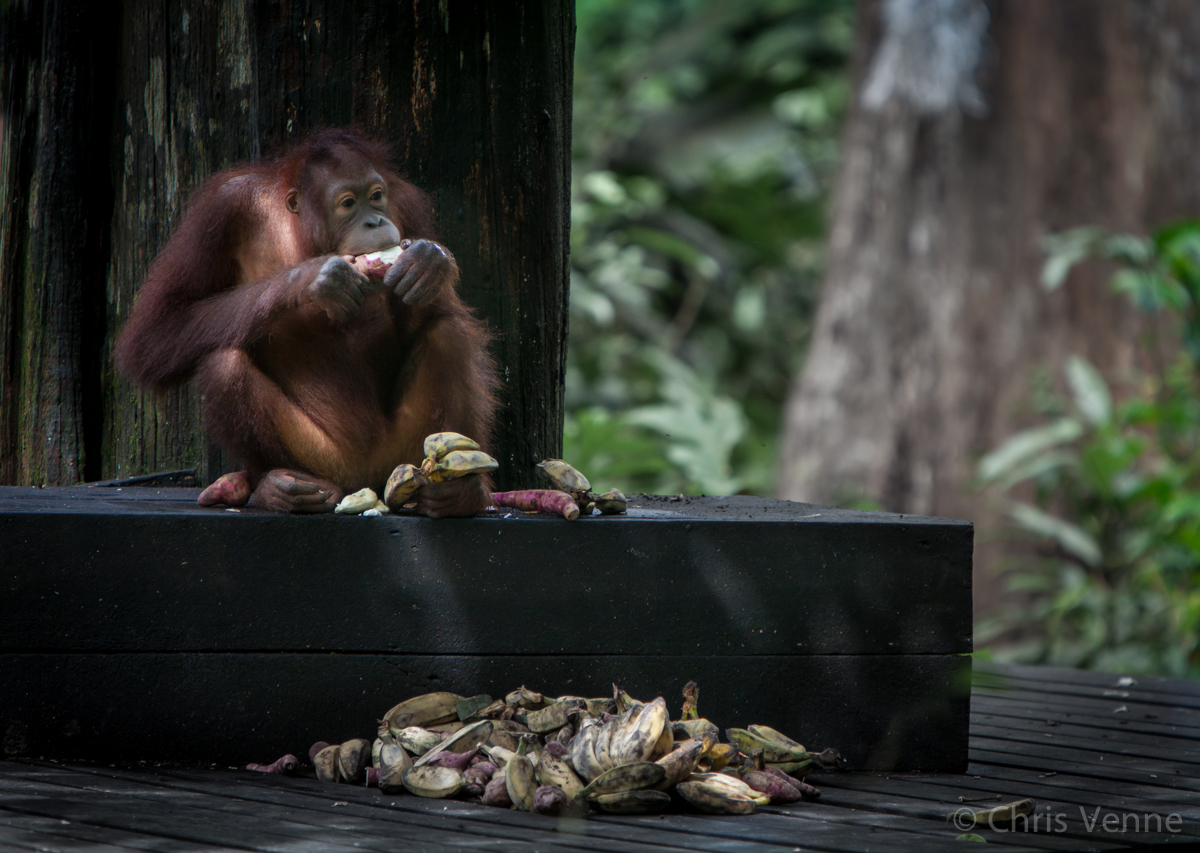
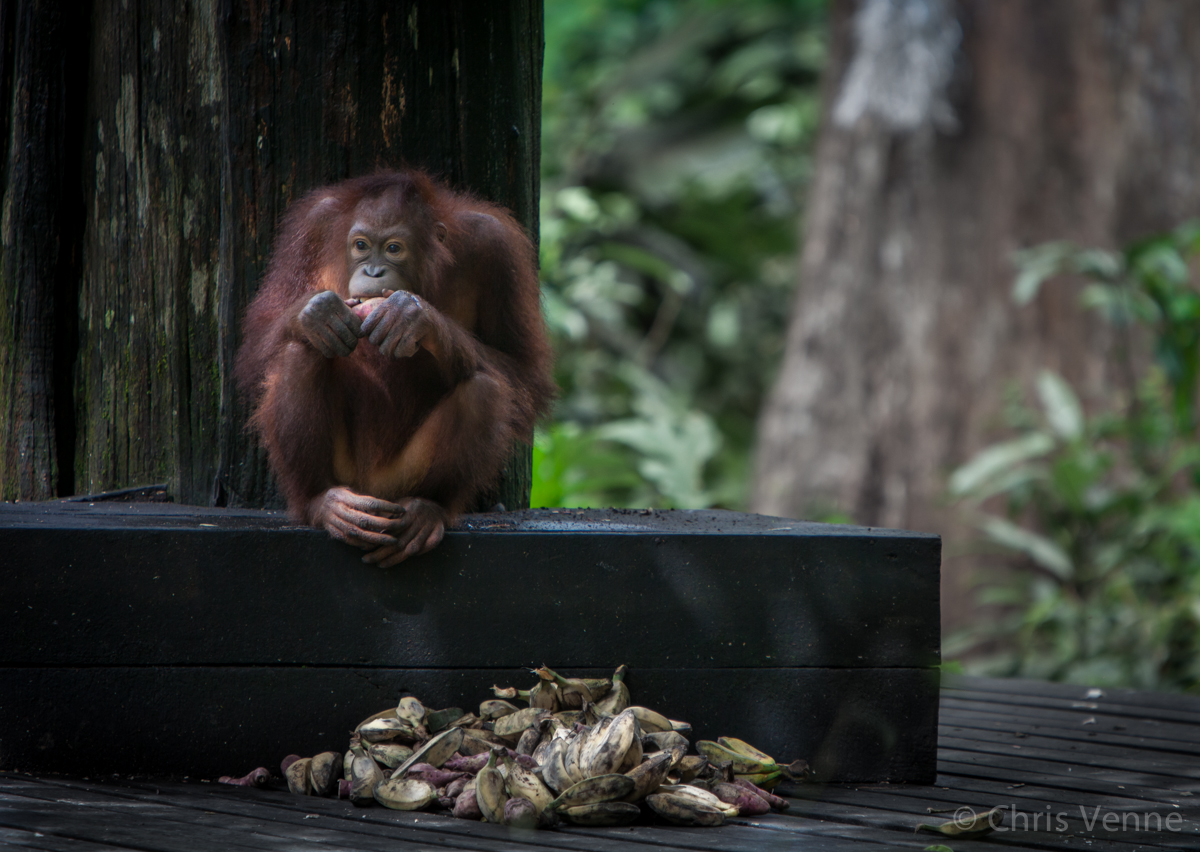 After exploring the underwater world off the coast of Borneo for three days, we were ready to discover the natural wonders of the jungle. Our first stop was the Sepilok Rehabilitation Centre where orphaned Orangutans are rescued and then nurtured to maturity in a 23 sq km protected area at the edge of the Kabili Sepilok Forest Reserve. Each year many adult organ utans are killed because of illegal logging and deforestation activities, leaving their young offspring to die. Others have been illegally caught and kept as pets. Today, there are about 25 young orphaned oOrangutans living at the centre in addition to those living freely in the reserve. The centre is open to tourists who visit during the twice daily feeding times in order to catch a glimpse of these adorable creatures.
 We had two nights booked at the Sepilok Jungle Resort which allowed us a full day to visit the Centre and the nearby Rainforest Discovery Centre. After reading mixed reviews about this resort, we were pleasantly surprised with our very spacious, comfortable room tucked amidst a lovely, tropical garden setting. It turns out we were staying at the more posh end of the resort with prices to match. The other end offers up basic, hostel-like accommodations at more reasonable rates. At $50 CAD per night for a large double room with ensuite, we were paying about double the rate of our other accommodations in Malaysia. But it was worth every penny! The hotel restaurant served up tasty, reasonably priced meals too. There was a very inviting pool which unfortunately we didn’t have time to use.
 By the time we arrived at the resort, I was feeling sick again. My sore throat had returned with a vengeance and my energy was very low. I pushed myself since we only had the one day to visit the Orangutans and I didn’t want to miss it because of a stupid cold. The Centre cannot guarantee that visitors will see Orangutans because they really are living in the wild and may or may not choose to visit the feeding platform for some free bananas. The day of our visit, they were out in full force, including a huge male who rarely comes to the platform. Apparently, he’s looking for a mate, so he has been showing up about once a month lately. In the afternoon, another male, much smaller than the one we saw in the morning, found himself a female to his liking, and mated her right there and then as we all watched in amazement.
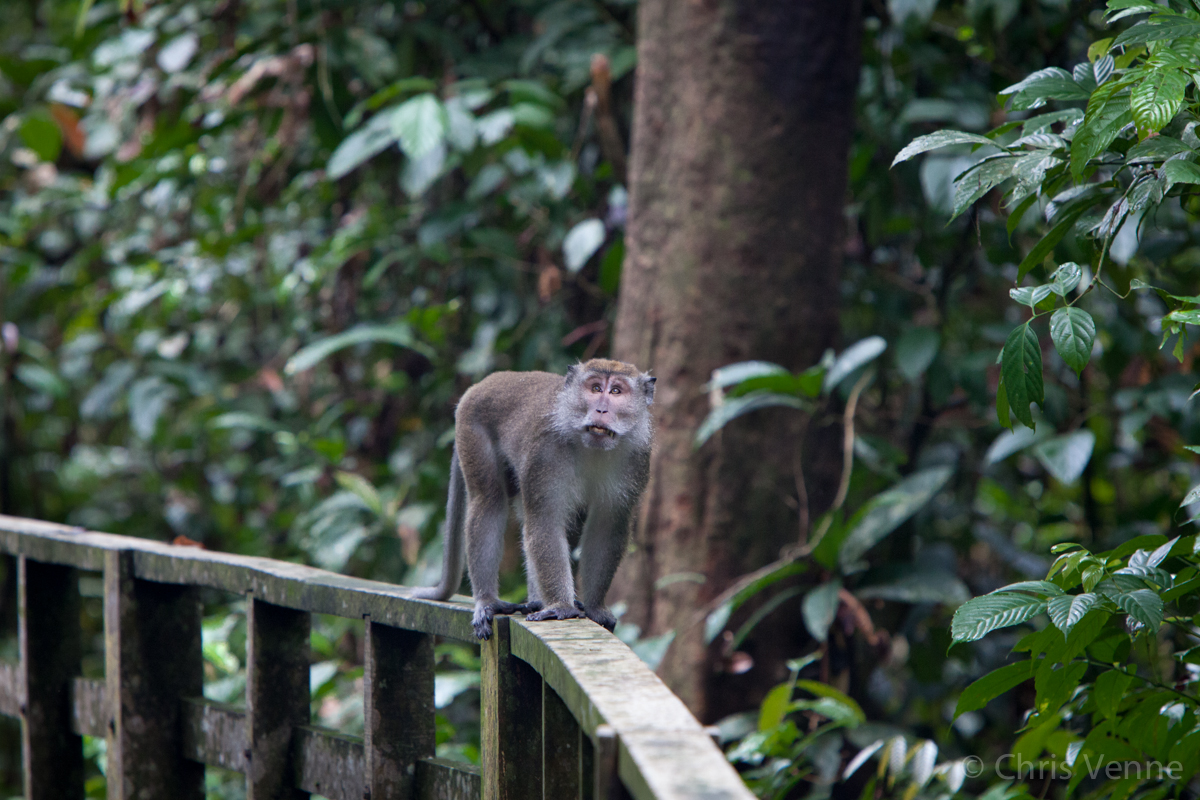 Before the feedings began, I had a close encounter with a group of long tailed macaque monkeys. After walking ahead beyond the feeding platform towards the exit, a dozen or so monkeys appeared on the railings about a hundred feet away from me. I was alone and to my astonishment, they all started walking towards me, pausing and staring at me with as much curiosity towards me as I had for them. I got a little nervous when a large male stopped beside me and glared with piercing eyes, baring his teeth like he meant business. There was really nowhere for me to go because I was surrounded by them, so I carefully avoided eye contact and stood still to let him pass; after all, these monkeys are wild and have been known to be aggressive, especially if they feel threatened. I got some great video footage which you can see at the end of this post.


 In between feedings, we walked to the Rainforest Discovery Centre about a kilometre away. While this environmental education centre is geared towards teachers and students, it is open to everyone. Their mission is to create public awareness and appreciation for the importance of conserving forests, as well as the sustainable use of forest resources. Arriving in the middle of the day, when it was stinking hot guaranteed we would see no animals. They were all taking a siesta which we should have done too. The only animal we saw was a long tailed squirrel, which looked exactly like a squirrel in Canada, except it had a long tail. Even though we didn’t see any wildlife or birds or flowers for that matter, we did enjoy the 300 m long canopy walkway, which was 25 m above the forest floor, giving us a great perspective of the rainforest from above. There is a vast network of many kilometres of well kept trails throughout the rainforest too. The dense forest canopy kept us surprisingly dry when it poured rain a few times during our visit.