Our ‘bucket’ list

It seems that everyone has been putting together their ‘bucket list’ lately… during the last month at Trove farm/vineyard in the Tuscany region of Italy, we’ve had plenty of time to contemplate ours. Here’s hoping you enjoy our very unique ‘bucket list’.  Parental guidance is advised; may not be suitable for all audiences, especially those with weak stomachs.

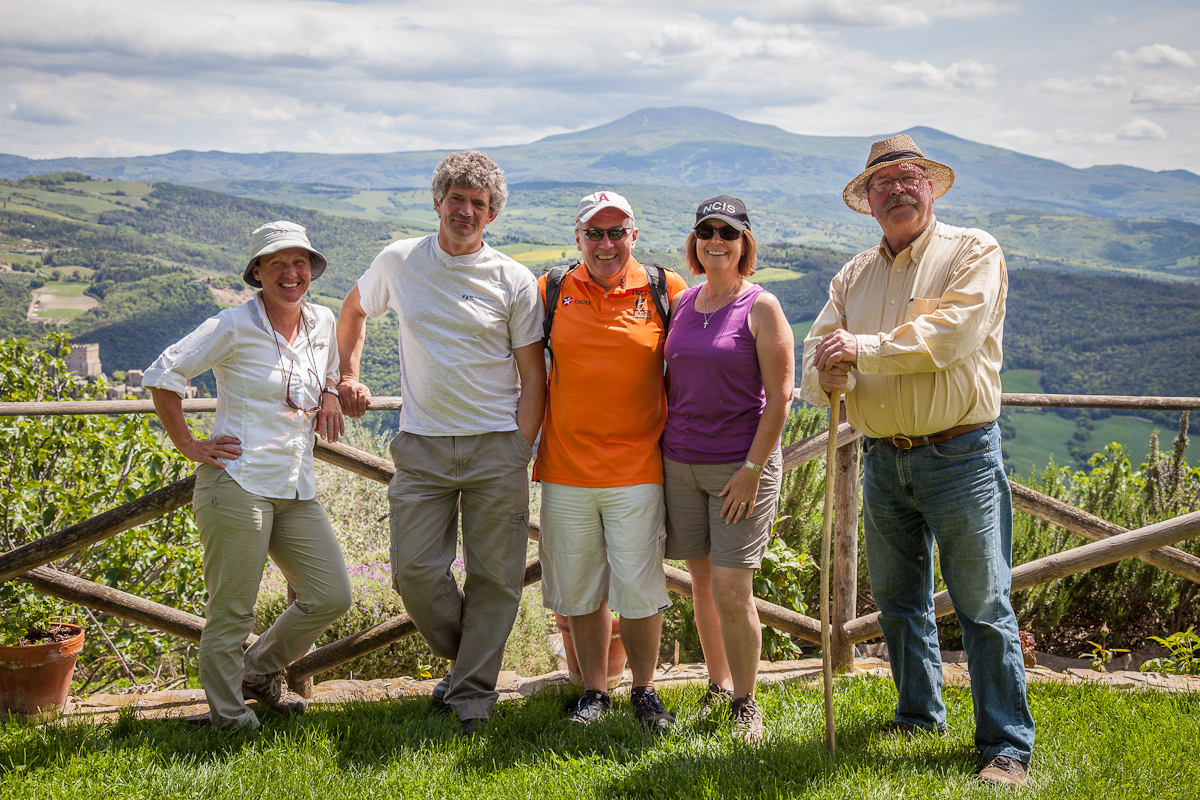
A walking tour of Tuscany

Ugo was hosting a walking tour in our area during our second week at Trove and we were invited to join in some of the walks, but only if his clients, an Australian couple, were in agreement.  Ugo and Barbara arranged for us to meet the clients one evening early in the week so that they could size us up to see if they could put up with our company for a few days.  Of course I’m joking, but seriously, it really was up to them whether or not they wanted our company.  We had our fingers crossed (and we were on our best behaviour for that initial meeting) because we were dying to join them.  We had nothing to worry about, as we felt an immediate connection with Jenny and Tony and they felt the same.

For the next four days, we toured the Tuscan countryside with Ugo, our faithful guide, and Jenny and Tony with whom we became fast friends.  We covered all the expenses we incurred during the tour, money that was well spent in our opinion.

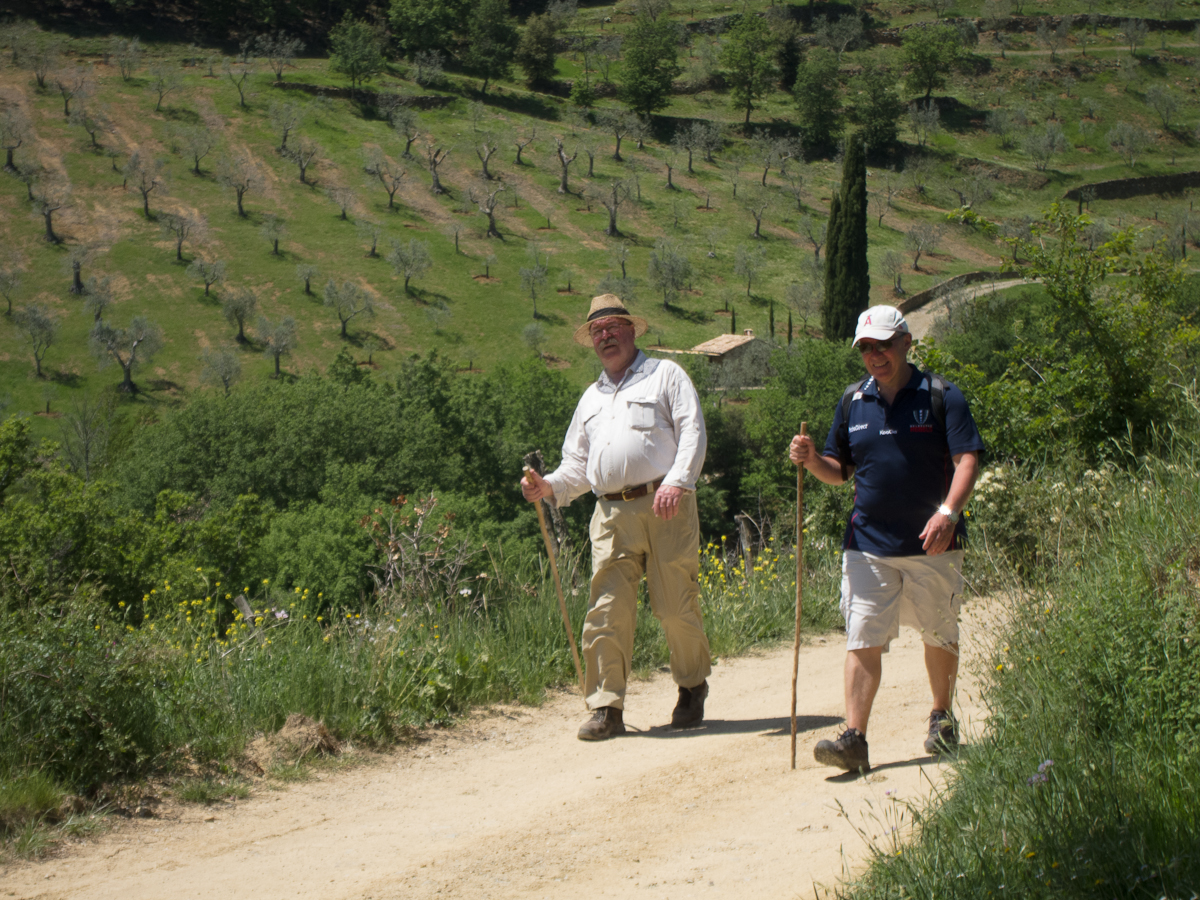
Day 1:  After some local sightseeing, we began our first walk – two hours through the Tuscan countryside following the via Francigena, a pilgrim route that has been travelled upon since the Middle Ages.  We met one pilgrim while walking, a young fellow from Germany who was doing an 18 day pilgramage along this route.

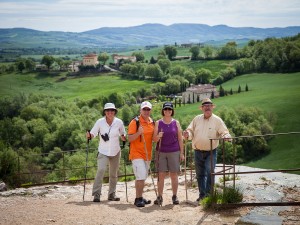
A postcard-perfect scene unfolded everywhere you looked: rolling hills awash with wild flowers of all colours, fields of red poppies gently blowing in the wind, perfectly symmetrical vineyards and olive groves, and medieval homes along roads lined with majestic cypress trees.

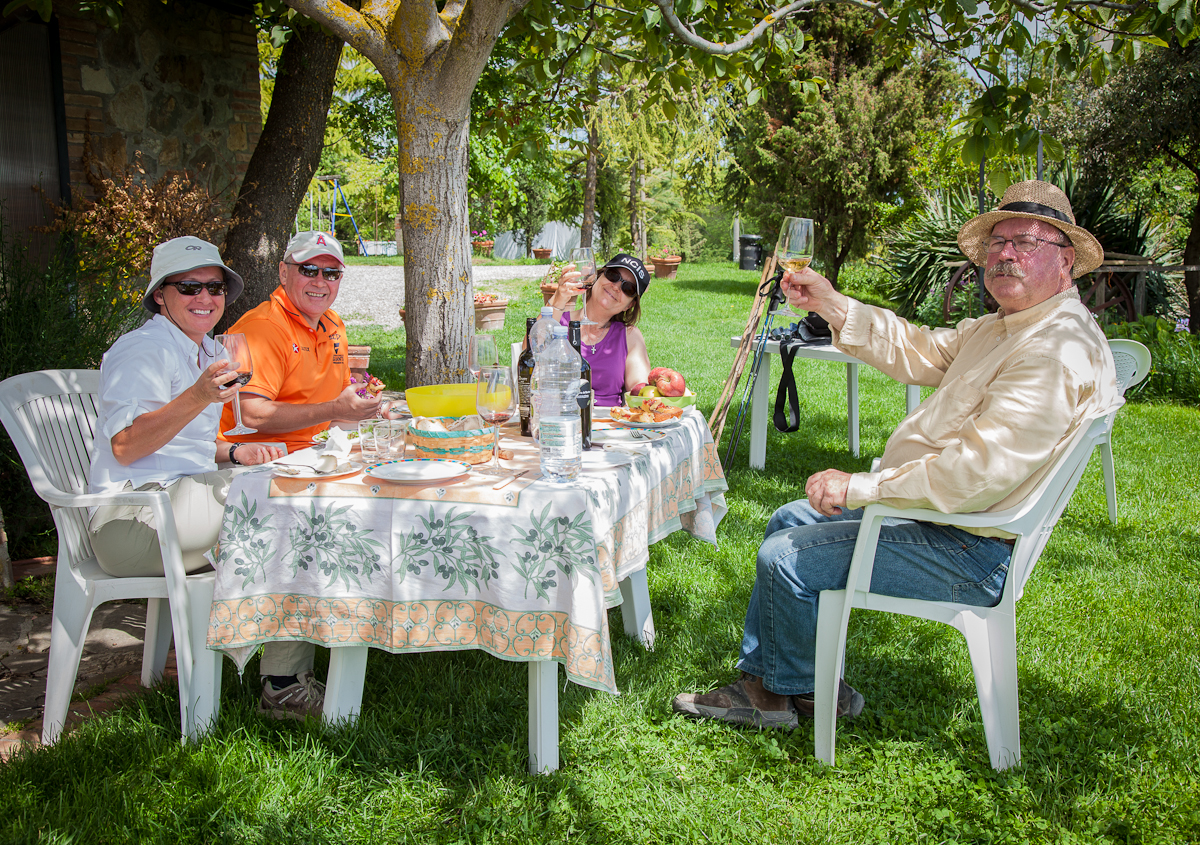
We ended our walk at Poggio Al Vento where we ate lunch and enjoyed a wine tasting.  We were about 5 km from the medieval village of S. Quirico d’ Orcia. A picnic table was set up on a grassy terrace overlooking Monte Amiata and Montalcino’s hills which are speckled with Brunello vineyards.  Poggio al Vento has a vineyard and olive tree plantation where they produce delicious red wines which are Orcia Rosso DOC – I don’t remember what the DOC means exactly other than it indicates wine of a high quality. DOC does not mean Department of Control – but it was a good guess on Chris’ part.  Their oil, Extra Virgin Olive Oil Frantoio is produced from a special selection of olives picked earlier than normal which results in a uniquely aromatic and tasty product – the best olive oil I have ever tasted.

Once we were seated on the terrace, we met the owner, Roberto, a very friendly and engaging man who introduced us to his farm, in very good English I might add. We began our meal with small toasted pieces of white bread that had been drizzled with olive oil and sprinkled with salt – how could something so simple be so unbelievably delicious! We tasted several types of wine and learned about the process of making wine on a small, multi-generational, family-run vineyard.  Everything we ate had been produced locally from the salamis (thanks to Rosalie the pig), pecorino cheese (a local speciality), bread, olive oil and lovely homemade desert prepared by Roberto’s grandmother.  If you’re looking for a unique place to stay in Tuscany (you will need a car), they also rent apartments on-site.  We didn’t see the accommodations, but based on everything else we experienced, I’d suspect you wouldn’t be disappointed.

After lunch we walked, or should I say staggered, back down the hill to Bagno Vinoni for a soak in the therapeutic thermal baths. Swimming in the warm thermal waters that have been used by the Etruscans and Romans for centuries was a wonderful way to spend the afternoon.  Imagine, we soaked in waters where eminent personalities of the past such as Pope Pius II, Santa Caterina da Siena, Lorenzo the Magnificent and many other artists had been before us.  A special bonus for Chris and I:  we enjoyed a real shower with warm, running water…ahh the simple pleasures!

Day 2: Again we began our day with a walk for a couple of hours, from Monte Follonico to the medieval and renaissance hill town of Montelpulciano.  The countryside was similar to the previous day offering one beautiful view after another.  The pretty town of Montelpulciano is renowned for its pork, cheese, pici pasta, lentils, and honey, and it is known world-wide for its wine. Connoisseurs consider its Vino Nobile, which should not be confused with varietal wine merely made from the Montepulciano grape, among Italy’s best.

We passed by several properties with For Sale signs and Chris and I briefly entertained the idea of picking up a fixer upper and then flipping it once we had restored it.  Chris and Tony even went to take a closer look at a property close to town.  Ugo swiftly dashed this idea when he mentioned the prices for these run down country estates could run into the millions of Euros even for properties without a roof and windows!  He conceded we might be able to pick up a bargain say for a million bucks given the current economic downturn in Italy.  That would still be way out of our league.  Ah well, so much for that fantasy!

We lingered for two and a half hours at a wonderful winery and restaurant, Gattavecchi  where we enjoyed good conversation, excellent wine and one of our best meals in Italy thus far.  Lunch began with tomatoes served with buffalo mozzarella and fresh basil, drizzled with olive oil.  We all had a good laugh when the waitress tried to remove the seemingly empty dish and we all dove in like a flock of vultures, each with a piece of bread to sop up the remaining olive oil.  If that isn’t a compliment to the food, I don’t know what is.  The waitress graciously and wisely left the plate on the table for us.  The rest of the meal included roasted potatoes with fresh herbs under melted pecorino cheese, duck lasagna, pork scallopini in cream sauce, and a garden fresh salad.  We sampled generously from the vineyard:  Rosso di Montepulciano DOC, Vino Nobile di Montepulciano DOC, and Riserva dei Padri Serviti.

After lunch we walked along the main street of Montepulciano that stretches for 1.5 kilometers from the Porta al Prato to the Piazza Grande at the top of the hill. The city core is car free which makes it very walkable.  The streets are lined with touristy shops selling all the specialities from the area such as wine and cheese.  Local artists are showcased in several galleries.  Later, we sipped coffee and ate dessert on a terrace overlooking the valley far below. It just doesn’t get much better than this!

Day 3:  This was the day for the cooking lesson at Trove.  Chris and I were recruited first thing in the morning to help with the preparations.  It reminded us of preparing for one of our family get-togethers back home. Marizza, an 82-year old local woman from Pienza would teach us how to make Peci, a type of pasta that was a local speciality.  Everyone participated and agreed it was harder than it looked.  Marizza made it look so easy.

Video:  Making Pici in Tuscany

Under a clear blue sky, lunch was served on the concimaia (literal translation: shit heap).  This was the area where hundreds of years ago the animal and human waste was discarded but today it is the location of a lovely patio.  Lunch consisted of a typical Tuscan menu: Peci (that we had made earlier) with tomato sauce, pan cooked chicken and rabbit, roasted potatoes and salad.  We enjoyed “corrected dessert” a phrase cleverly coined by Chris.  We had heard of “corrected coffee” which consists of a shot of espresso and a shot of grappa.  Well, we dipped our cantucci (similar to biscotti) into glasses of vino santo (dessert wine) and voila, corrected dessert.

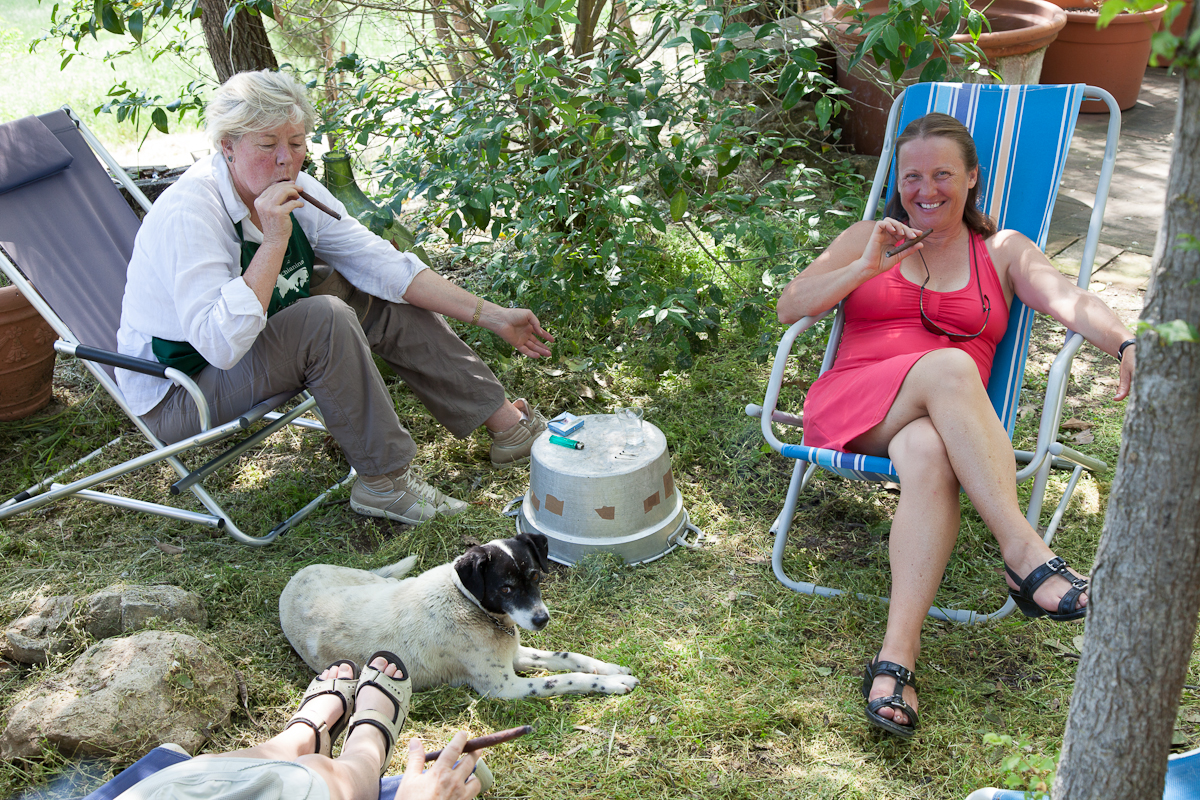
After lunch, we all retired to the lounge chairs in the shade (Ugo went for a nap in the house) and Chris brought out his cigars and the grappa we had bought the other day at Roberto’s.  It was a very relaxing way to spend a couple of hours before heading off to Petroia to visit the terracotta museum, after which we brought Jenny and Tony back to Pienza where they were staying.  Back at Trove, we helped Barbara with some of the tidy up – but we didn’t have to do the dishes!

Day 4:  By now we had spent three full days with Jenny and Tony and the more we spent time with them, the more we liked them and I think (hope) the feeling was mutual.  There was an easiness between all of us that doesn’t usually come until years into a friendship, if it comes at all.  Jenny and I are almost the same age (just 18 months apart) and I felt a kindred spirit from the start.  We talked about all kinds of things and found we had a lot in common.  Conversation came easily between all of us, as did the laughter.  We laughed so much during those days together, it was so much fun.  Meeting this couple and having the opportunity to develop a friendship with them was an unexpected gift we received in Tuscany. We hope to see them again when we reach Sydney, Australia (their home city) later this year.

Back to our last day in Tuscany with Jenny and Tony and Ugo of course.  We did our longest walk that day – 10 km from Montalcino to Sant’ Antimo. Ugo wasn’t feeling well and we were all concerned for him, but he was determined to keep going.  It turned out to be the most interesting and challenging hike.  Not only was the distance longer, but the terrain was more rugged as we traversed several rather steep hills.  We passed through forests which offered us a respite from the relentless heat and sunshine (it was close to 30C) where we observed the tracks of wild boar.  The views were stunning.  We ended in Sant’ Antimo where we lingered in the coolness of the abbey where the monks sing Gregorian chants during mass.  Unfortunately, no service was underway while we were there; maybe we’ll have a chance to go back before our time is up.

We took the bus back to Montalcino where we enjoyed another wine tasting before we said our final good byes.  Jenny and Tony were heading to the town of Chuisi from where they would catch a train the next day to Nice (well actually, it would take four trains to get there, but who’s counting).  They still had another month of vacation to enjoy and they were planning to spend it doing similar walking tours in the wine regions of Southern France.  I was tempted to drop our plans and join them, but we were committed to Barbara and Ugo for the next two weeks, and the Camino was beckoning as well.  We’ll just have to wait until Sydney to enjoy their company again.

After experiencing four days of walking tours with Ugo, I would highly recommend this form of travel to anyone who wants to get off the tourist track in exchange for a more authentic Tuscan experience.  Ugo is very organized and experienced and knows the region like the back of his hand, and everyone knows him too.  He adapts the tours based on the needs and interests of the clients (more walking, less walking), and of course the weather.  Speaking of the weather, we enjoyed warm, sunny days without so much as a hint of rain for the entire week.  It felt more like summer than spring  On Sunday, when Tony and Jenny left for Nice, the weather turned and we had a ferocious storm that night followed by much cooler, wetter conditions.

Travel Tip:  If you want to see fields of poppies (as depicted in so many photos and paintings), visit Tuscany in the springtime (May is best in my opinion as it can still be quite cold and wet in April).  At this time of year, the fields have been planted and are just starting to sprout.  The vineyards have been pruned and are also budding new growth.  There are so many shades of green, it is dazzling to behold.

Travel Tip:  If you really want to explore Tuscany, join a walking tour such as those offered by Ugo and Barbara’s company, Tuscany Under the Skin or rent a car and do it independently. Buses and trains connect you to the larger towns, but there is really no other way to see the charming medieval hill towns and gorgeous countryside.

Attention to all our readers:  First we are assuming there are still a few people out there who are reading our blog.  Did anybody notice anything unusual about our Rome posting? And what about the naked photo of Chris bathing in a bucket – did anybody notice that one?  We thought for sure these photos would have prompted a comment or two, but nada, not a word.   So what’s it going to take? Do we need to post pictures of Chris bending over to pick up the soap? Let us know while we’re still in Tuscany 🙂
Sunshine and tragedy in Siena

At Barbara’s insistence, we began our second week at Trove with a visit to Siena. You may recall that we had attempted a visit to this beautiful Tuscan hill town earlier during my sister’s visit but we had been rained out.  This time, the weather cooperated with warm sunshine all day long. We were looking forward to an excursion after feeling somewhat isolated on the farm all week.

We travelled to Siena by bus which we caught at the train station in Sinalunga (Barbara drove us to the station) and we took the train back.  Once in Siena, we found our way into the historic centre which has been declared a World Heritage Site by UNESCO.  Siena is famous for its cuisine, art, museums, medieval cityscape and the Palio which is a horse race held twice a year, once in July and then again in August right in the middle of town.  Like other Tuscan hill towns, Siena was first settled in the time of the Etruscans (c. 900-400 BC).  The Etruscans were an advanced people who changed the face of central Italy through their use of irrigation to reclaim previously unfarmable land.  Throughout Tuscany, medieval towns are perched on the top of hills – a legacy of the Etruscans who strategically built their settlements in well-defended hill forts.

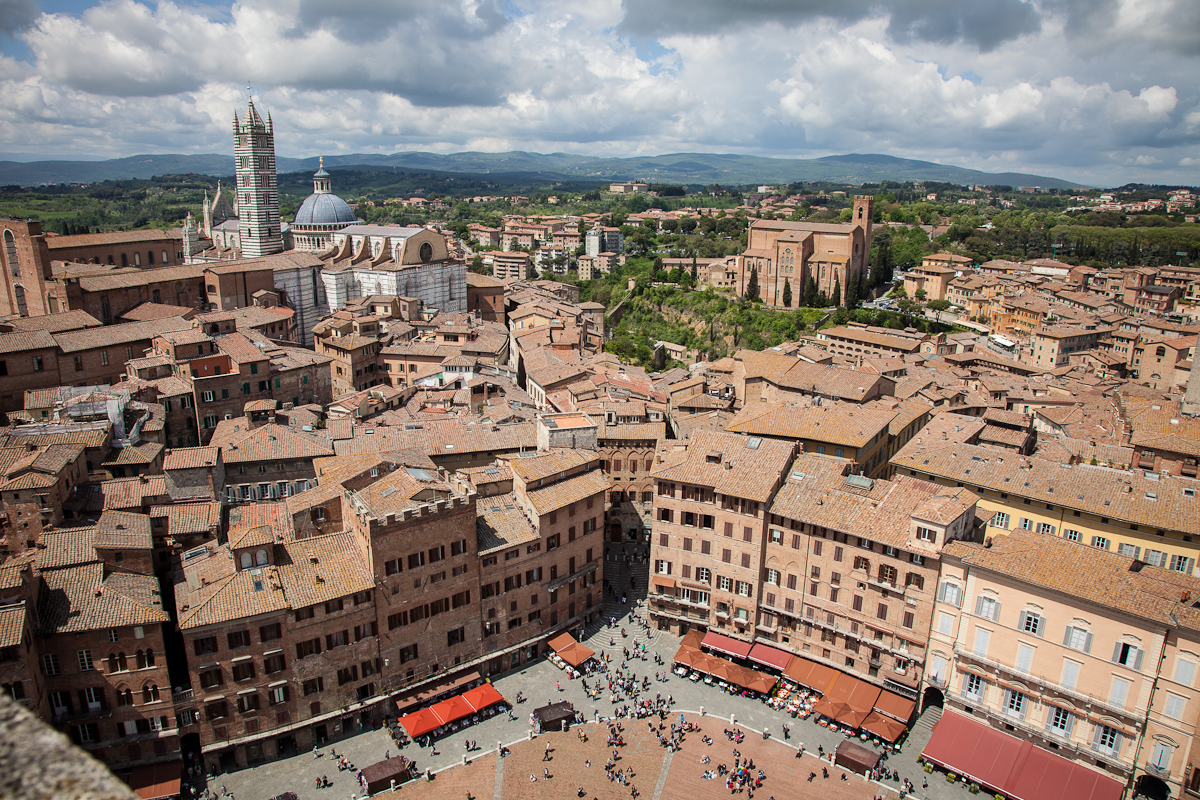
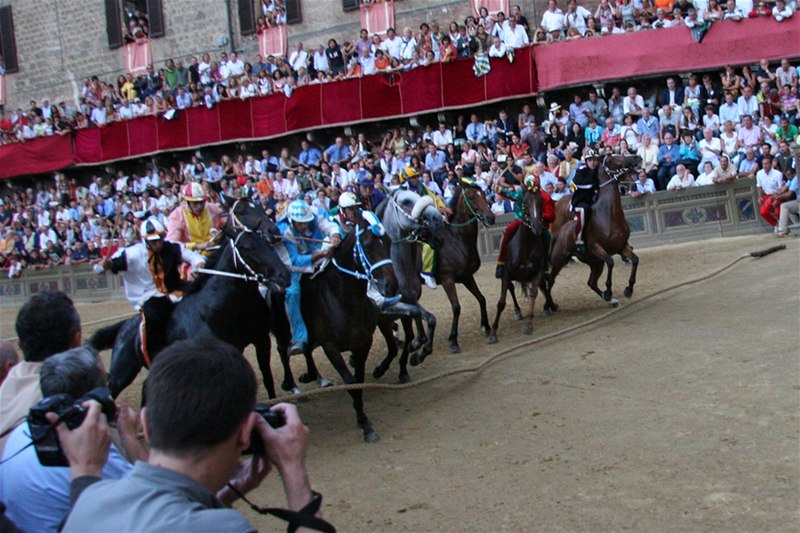
We headed to the unusually shell-shaped town square, the Piazza del Campo which is famous for hosting the Palio horse race. I hope you don’t mind, but I’m going to take a few moments to tell you about this unusual horse race which began in medieval times and has been featured in many movies over the years; you might remember this from the 2008 James Bond movie, Quantum of Solace.

File:Mossa lg palio provenzano 2007 (83).jpg

Source: Wikipedia

Before the race begins, there is a magnificent pageant, the Corteo Storico, which attracts visitors and spectators from around the world. The race is comprised of ten horses and riders, bareback and dressed in the appropriate colours, representing ten of the seventeen contrade, or city wards. Three times they encircle the Piazza del Campo, on which a thick layer of dirt has been laid,  and the race usually lasts no more than 90 seconds. It is not uncommon for a few of the jockeys to be thrown off their horses while making the treacherous turns in the piazza, and it is not unusual to see unmounted horses finishing the race without their jockeys.  What makes this race rather unique is the fact that the jockeys not only try to win, but also try to prevent the other racers from winning by any means possible.  Also, it is the horse that wins the race, not the jockey.  Finally, the winner is the horse that comes in first and the loser is the one that comes in second.  It’s all or nothing with this race.

Piazza del Campo is also home to the Palazzo Pubblico and the Torre del Mangia.  I regretted not going to the top of the Duomo in Florence, especially after my friend Marc mentioned  in one of his comments on the blog that this had been a highlight for him when he visited Florence.  So I was determined to go to the top of the Torre del Mangia which promised and delivered beautiful views of the red rooftops of Siena and the rolling Tuscan countryside beyond.  We also visited the museum in the Palazzo Pubblico which features an amazing series of frescos (which means a mural that has been painted directly on a plaster or stone wall) by Ambrogio Lorenzetti (I never heard of him before but maybe you have) that focus on the theme of good government and the results of good government versus bad.  These frescos showed scenes of day to day life in 14th century Siena – just fascinating!  What was even more impressive was the building itself, a testimony of medieval architecture.  Unfortunately, photos were not permitted in the Palazzo.

View of tower from the palace courtyard.

Narrow staircase to the top of the tower.

Only one person at a time could go up or down.

View from the tower.- Siena and beyond

View of the Duomo from the top of the Bell Tower.

Tuscan countryside beyond the Duomo.

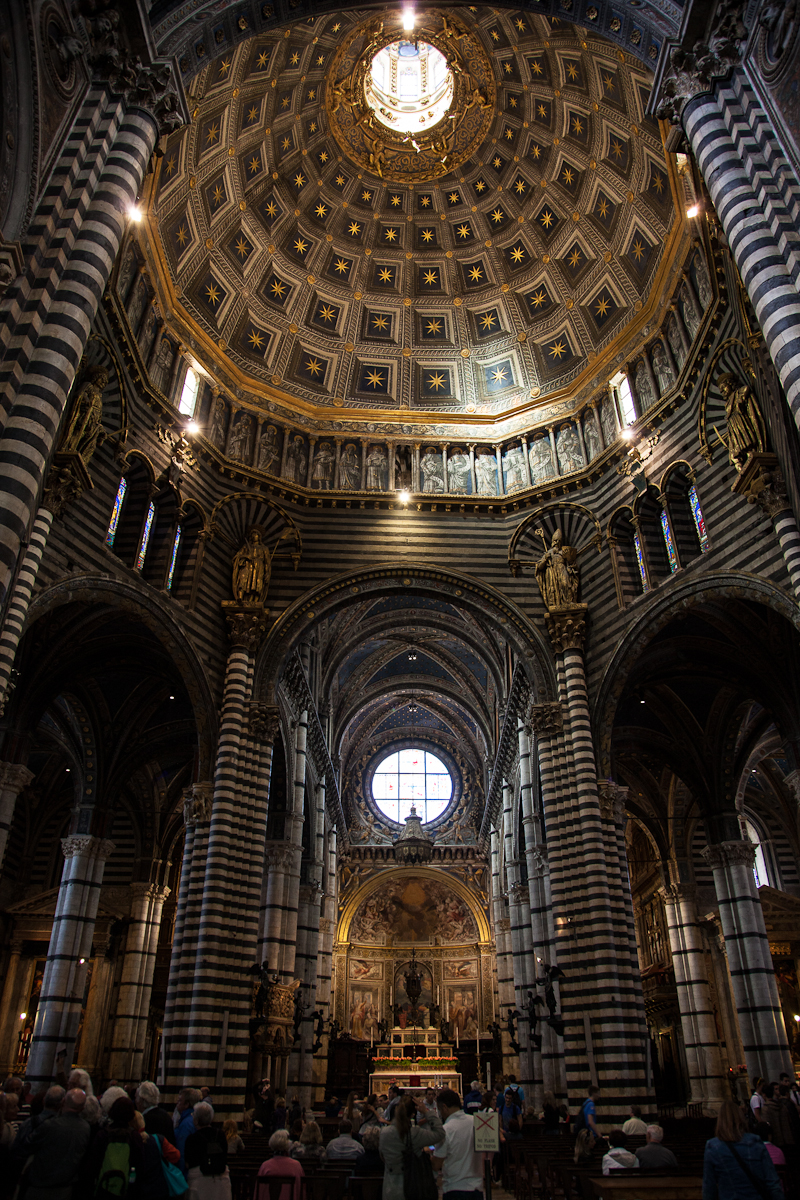
The construction of Siena’s cathedral, or Duomo, began in the 12th century and is a great example of Italian Romanesque-Gothic architecture.  It reminded me of a smaller version of the Duomo we visited in Milan (remember, the one where we walked the rooftop).  It is unusual for a cathedral in that its axis runs north-south. This is because it was originally intended to be the largest cathedral in the world, with a north-south transept and an east-west nave. After the completion of the transept and the building of the east wall (which still exists and may be climbed by the public via an internal staircase) the money ran out and the rest of the cathedral was abandoned.

Duomo interior

We bought the OPI SI PASS (12 euro) which includes admission to six monuments and attractions associated with the cathedral, including access to the panoramic terrace  on the east wall (mentioned above).  It was a long, full day by the end of which I had reached my capacity to retain any more information.  I must admit that our visit to the cathedral and associated attractions was pretty much a blur to me but we have some great photos that will tell the story even if I can’t.

Museo dell'Opera: Stained glass window removed from the Duomo during WWII for fear it would be destroyed.

The Battistero at the back of the Duomo.

It was while we were on the terrace that tragedy struck.  A gust of wind came out of nowhere and blew Chris’ cherished hat onto the rooftops below. This was the ball cap that Chris had bought a few days before we began our trip and I didn’t realize how attached he was to it.  I watched as he went through all the stages of mourning – denial (maybe another gust of wind will blow it onto the street so I can get it), anger (why did that damn wind blow at that moment), bargaining (if only I had taken my hat off, if only I had tightened it, if only…..) and finally acceptance (my hat is gone).

When we arrived back in Sinalunga we decided to take the local bus back to Trove.  With an hour to kill before the bus came, we enjoyed a couple of glasses of vino in the train station bar that also serves free snacks each night at 7:00. This was probably our fourth time in this bar in a week (first a drink with Ugo on arrival, drinks with Barbara when we did our laundry/grocery run, lunch with Barbara when Chris ran errands with her). The bartender recognized us, and treated us like we were locals.  It was a great way to end the day!


Note:  Chris has commissioned his buddy Kaj in Ottawa to find a replacement ball cap, or rather, to find the exact hat.  Good luck Kaj, you’re a good man to help out your friend this way!


Toiling under the Tuscan sun

On our second day at Trove, Ugo gave us a crash course on vine pruning and staking.  He was leaving the next day for a week-long tour and the old vineyard was in desperate need of attention.  Chris got some driving lessons on the tractor, and a lesson on how to empty the poop bucket in Ugo’s absence. I may have mentioned that already, but it’s worth another mention as I must admit, I was pretty impressed that Chris accepted this job without complaint.  And so our work began.  We worked hard on that first Saturday and again on Sunday in response to the urgency of the task at hand.  Good progress was made and by Monday the vines had been pruned quite ruthlessly as per our instructions (I’ve got my fingers crossed that we didn’t do any permanent damage) and we had begun to clear the rows of debris from previous seasons.

The new vineyard with the olive grove in the background.

There are two vineyards – one that is about a hundred years old and a newer one that is about 40 years old.  In a good year, the vineyard might yield about 1,000 litres of wine but in some years, they get nothing for one reason or another; last year it was the birds who came and ate all the ripe grapes just before harvest time! They use the wine for their own consumption only.  They also have two olive groves that yield the most delicious olive oil that again they use for themselves.

Part of the old vineyard.

We pruned the old vineyard as Ugo had already pruned the newer vines.  But the entire vineyard, old and new, needed to be cleaned up of old debris and that task took us a couple of days of back breaking effort.  Chris drove the tractor up each row and I followed behind collecting all the twigs and placing them in the tractor bucket.  After a while we changed our tactic as quite frankly I was doing all the hard work and Chris was just sitting on the tractor waiting for me to finish.  We got into a routine where he would drive the tractor about fifty feet ahead and then together we collected the old vines.  No reason why I should be the only one breaking my back!  We then put all the dead branches into a huge pile that we will burn one day soon.

Our pile of debris - what a bonfire it will make!

At this point, we had already had a discussion with Barbara who had outlined the tasks she wanted us to do and their respective priority.  She also shared the details of their schedule for the month of May and it was at this time that we learned that they would both be gone for a 10 day period doing tours and we would be left to hold down the fort.  Once we were finished in the vineyard (number one priority), Chris had a list of jobs to do including refinishing some old windows and furniture.  My job would be the garden – weeding it and then planting the vegetables. It was a large garden, completely over run with weeds.

By mid-week, we were pulled from the vineyard (we only had the staking left to do) as other tasks became more pressing.  One day, we all went into town to do laundry, grocery shopping and some miscellaneous errands.  And then Chris was recruited to assist in getting the house back in order – moving things around, hanging pictures, etc.  Meanwhile, I started in the garden tackling the heavy weeds and pruning the bushes near our patio.  There was another tour scheduled for the following Monday which included a cooking lesson at the end of the week so Barbara was under the gun to get the house in order by then.

Collecting wood.

I’ve mentioned tours a few times and should probably offer an explanation.  Barbara and Ugo run a tour company, Tuscany Under The Skin, that focuses on walking tours in Tuscany.  Springtime is one of their busiest seasons and this year was no exception. We were offered the opportunity to join in some of the local walking tours the following week which gave us incentive to work more than our required hours that first week.

By the end of the week, we were physically exhausted and were so grateful for a rainy, cold Sunday which gave us a good excuse to light the wood stove, and have a cozy movie day, giving our weary, aching bodies a much needed rest.  We didn’t realize how soft we had gotten these last few months! We had spent much of the week on our own, what with Ugo away on tour, and Barbara distracted with getting her house back in order and working on upcoming tours, work she had fallen behind on. It was obvious that Chris had made a good impression on Barbara as she kept complimenting him on his many talents but it wasn’t clear to me where I stood.  Frankly, I often felt like “hair in the soup”, like my presence was just being tolerated.  It was a strange situation to be in, one that caught us off guard.  We chalked it up to their distraction with their renovations and their tours, and I did my best not to take it too personally.

Our arrival at Trove

Arriving almost two hours late isn’t the best way to make a first good impression, but the train from Rome was delayed, which caused us to miss our connection in a small town called Chiusi.  At least we were able to phone our hosts to let them know of our delay, thanks to the generosity and friendliness of a fellow traveller.  Luca, a dentist from Naples, was on his way to meet a friend in Siena from where they were going to begin a three day pilgrimage route on their bikes.  They were planning to stay in a convent along the way.  I couldn’t help but notice that I seem to keep bumping into pilgrims these days.

When we finally pulled into Sinalunga, Ugo was waiting for us and welcomed us warmly.  We piled our stuff into his car, and we got our first introduction to this small town (population around 12,000) as Ugo did a few errands before heading out to the farm which is called Trove, just 10 km south.

View from the farm

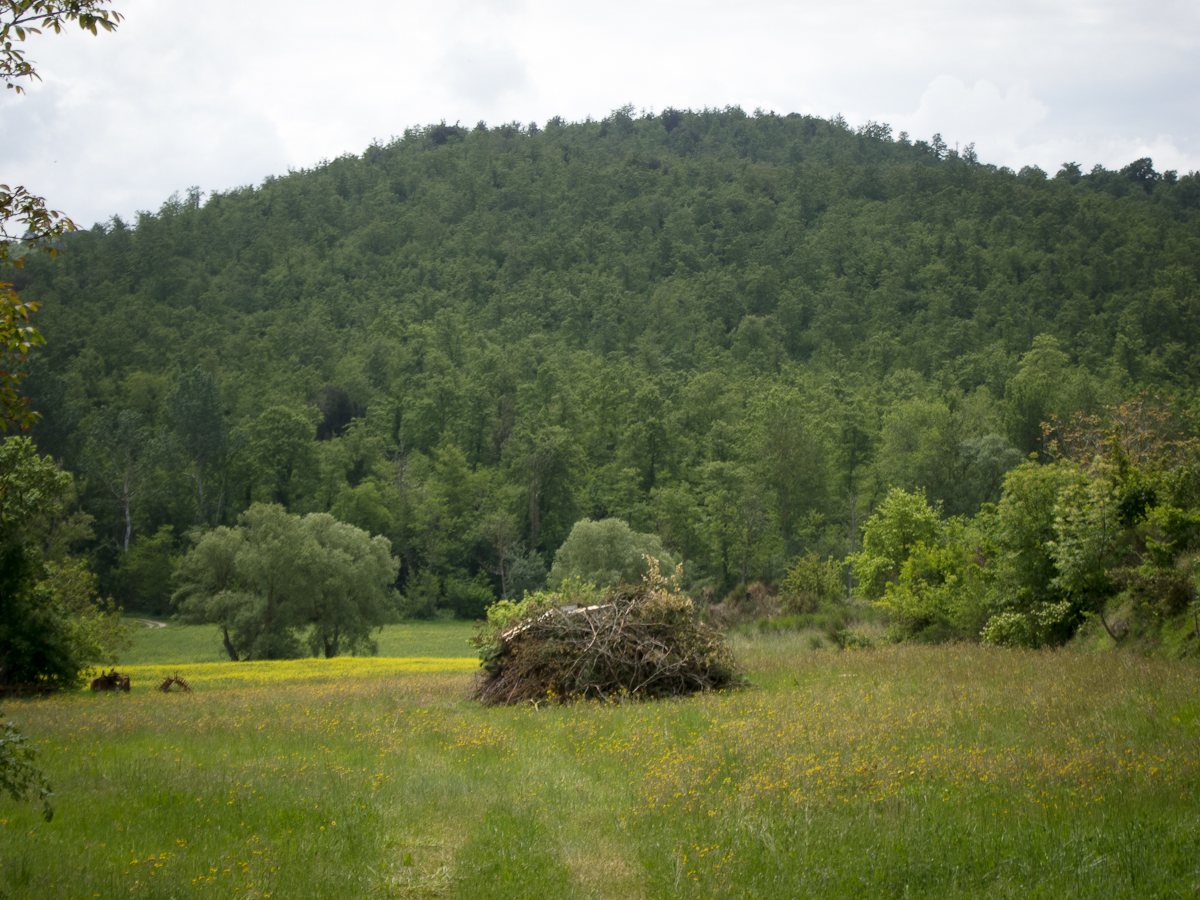
The countryside in this area which is about 50 km south of Siena is breathtakingly beautiful marked by lush rolling hills dotted with geometrical vineyards and olive groves, old stone farm houses with laneways lined with tall slender dark green cypress trees, and fields awash with wild poppies and streaked with yellow canola.  This is the same luscious landscape used for movie sets like “Under the Tuscan Sun” and “The English Patient”.  In fact, the monastery where some of the English Patient was filmed is a stone’s throw away and a place we plan to visit sometime later this month. The farm is nestled between two medieval hill towns – Castelmuzio and Petroia both of which are within easy walking distance from the farm.

As we approached the farm, Ugo explained how they were in the middle of some renovations that they decided to do rather spontaneously and as a result, things were a little upside down.  Although we assured him that we have lived through renovations and would be fine, I couldn’t deny the sinking feeling that settled in my gut.  What had I gotten us into?

After meeting Barbara, Ugo’s wife, we were shown to our “quarters” and given a tour around the house and the property.  The farm dates back to the 14th century although the house has “only” been around for a couple of centuries.  It is an authentic, unrenovated stone farm house that has seen very few changes over the years.  Barbara, who is from Australia, and Ugo who is Italian born and who grew up in Lucca which is just north of Florence, bought the farm in the early 70’s but only started living here full time 14 years ago.  Before that, they lived in Australia where they raised their son and worked in the film industry.  About 20 years my senior, this hardworking couple would give people half their age a run for their money.

Entrance to our “suite”.

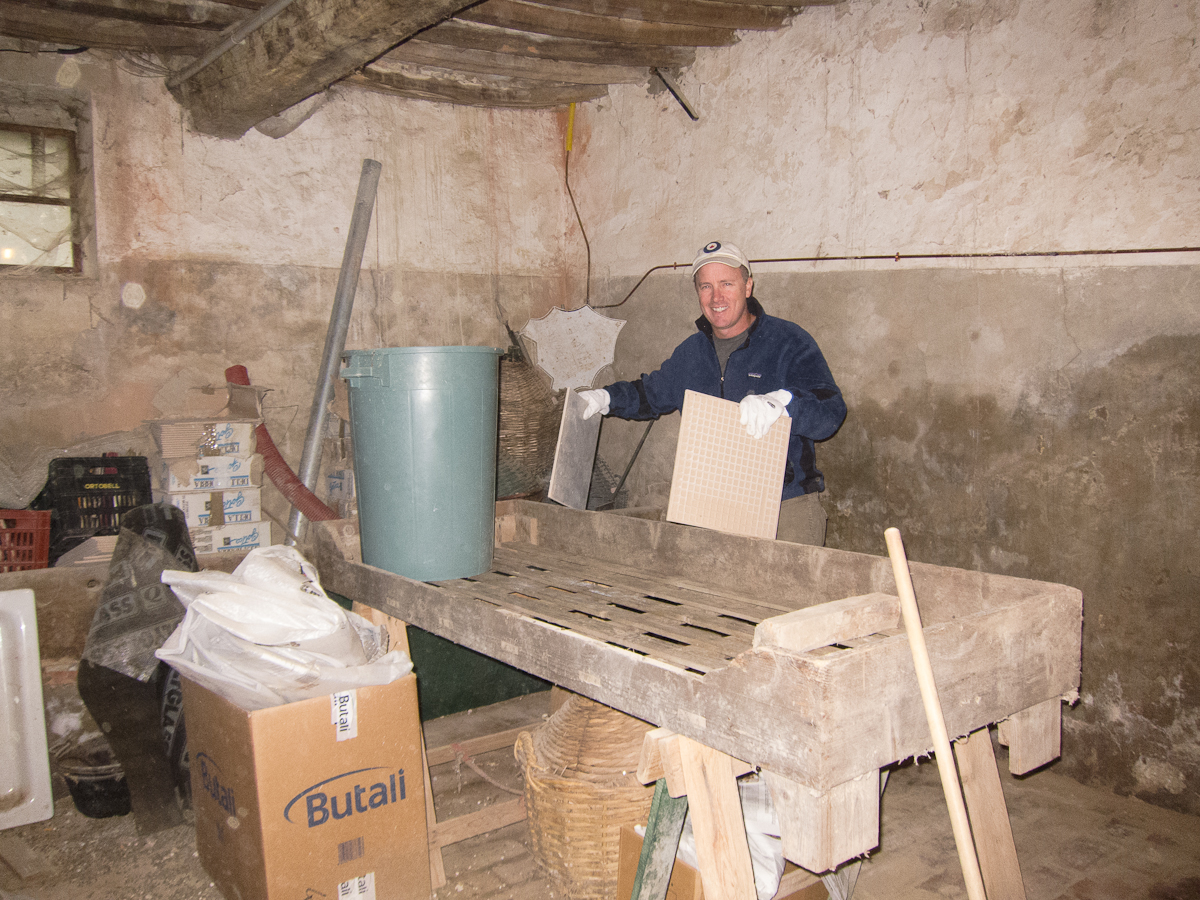
Necessary improvements have been made to the place over time – like fixing the roof and replacing some of the windows – but they did not make any significant changes until now.  They have electricity but no indoor plumbing (more about that in a minute).  As part of the renovation project, a new kitchen was installed with running hot and cold water. The first indoor plumbing! The floor in the main living area was reinforced and retiled – a major undertaking that was necessary to prevent the whole floor from collapsing.  A new bathroom is also part of the renovation project but it won’t be ready for a while, at least not while we’re visiting.

As is typical of these old farm houses, the main living space is on the second floor.  The house has four bedrooms, living/dining room, a kitchen and a sunroom/storage room; while the farm was operational, as many as five families would have lived here.  Today, it is home to Barbara and Ugo, their dog Merry Moon and their two cats.  And of course they open their home to a steady stream of helpers like us.

Storage area next to our room. One of our first jobs was to get this area cleaned up and organized.

The ground floor would have housed the animals.  You can still see the manger that would hold the animal feed, the sloped floor that allowed the animal waste to slide down into a trough.  Today, Ugo’s workshop, a storage room and the helper’s “suite” is located in this space.  That’s right, we are living in a stable.  Aside from the whitewashed walls, it looks pretty much the same as it would have looked back when it was housing animals.


Our “suite” is one  large room with a small window at one end, a doorway to the storage area along one wall and a door leading to the patio outside on the wall opposite the window.  The floors are tiled in terracotta.  The bed (two twins put together so lots of space) is at the far end of the room along with a dresser, two night tables and two lamps. The other half of the room has a couch, a kitchen table, some cabinets that serve as kitchen storage, a fridge, a cooking stove and a wood burning stove.  The space is very well equipped with all your necessities – bed linens, towels, dishes, pots, etc.  The room has a rustic charm.  We didn’t mind having this little “apartment” to ourselves and we later learned that we would do all our own cooking too which has suited us very well.

Video:  Welcome to our humble abode for the month of May.
 

Outdoor kitchen sink

We couldn’t help but wonder where the bathroom was.  Ugo showed us their toilet system which was a little room next to the storage area that offered two options – you could sit on a toilet seat that was on a bucket, or you could squat over a bucket that was in the ground.  An old fashioned wash basin was in the corner with a clean towel and soap. A bucket of wood shavings sat next to each bucket.  After doing one’s business, you were to throw a scoop or two of the wood shavings into the bucket to neutralize any odor.  Surprisingly, it works as there is no odor whatsoever.  The wood shavings, by the way, come from a harpsichord maker in Castelmuzio.  On our first day at Trove, Ugo showed Chris how to dump the poop bucket into a larger poop bucket which would become Chris’ job during Ugo’s absence. At the risk of sounding sexist, I wholeheartedly agreed that this was definitely a man’s job.

Outdoor shower area

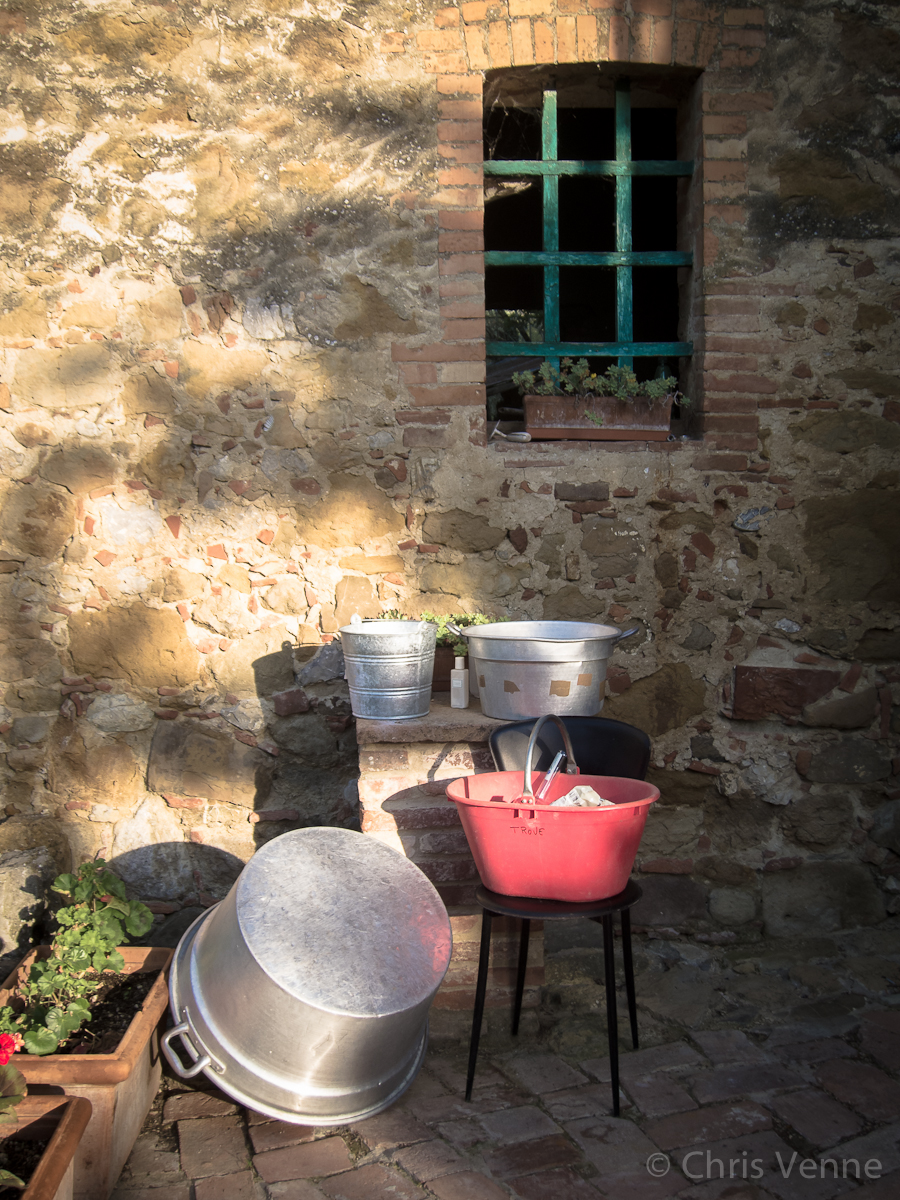
Now we were wondering where do we shower.  Hadn’t we noticed? It was the two buckets stacked in our room along the wall.  Oh, well, we’d have to give that some thought as to how that worked.  The next day, after working in the vineyard under the hot sun, we had no choice but to figure out our bathing system.  This is how it works.  We boil a pot of water on the stove.  We have a tap outside our room, next to a sink.  The tap (cold water only) is connected to town water and is the clearest, most delicious water I have ever tasted from a tap.  But the sink drains into a bucket.  Didn’t I mention this was rustic?  So, we fill a pot from the tap, bring it to a boil on the gas stove, dump it into the larger bucket and then add two more buckets of cold water.  We then stand in the largest bucket and using a plastic pitcher, we pour warm water over our bodies.  We give ourselves a good scrub and then rinse off with more warm water.  Surprisingly, it only takes the three pots of water (one hot, two cold) for both of us to get cleaned up.  Where do we do this?  Well, Barbara suggested we could do it inside, in front of the wood stove since it was still a little chilly when we arrived.  We opted for the outdoors, in the warm sunshine.

Kitchen sink

As I mentioned, after our first day, Barbara proposed that we do our own cooking as Ugo was leaving for a tour (more about that later) and she was swamped with work and seemed quite overwhelmed by the upset the renovation had caused.  She gave us some provisions from her reserves to get us through the first few days.  We have then gotten into the routine of doing a weekly grocery run in Sinalunga where I select our food for the week, and she pays for it.  That is the deal after all – free room and board in exchange for four hours of work a day, six days a week.  She is very generous and urges me to not be shy about getting sufficient provisions. We pay for our own treats and snacks. This past week, we went to the local market held in Sinalunga every Tuesday to get our fruits and vegetables and the local porcini cheese which is absolutely delicious.

We have slipped into a familiar routine where Chris makes the coffee each morning using a mocha pot, then I make breakfast (something hearty since our work is quite physical) and we take turns doing the clean up although it seems Chris does it more often than I do.  I’ve been doing all the cooking which I’ve enjoyed.  It has been a bit of a challenge to cook in such a small space – there is no counter, just the table on which to work.  But we keep our meals simple and it has been working out well.

We have been at the farm for two weeks already and we have been quite comfortable. At first, the nights were cold and we were grateful for the warmth of the wood stove. And we’ve given our new down sleeping bags a good test run before using them on the Camino next month. (Thanks again to Sonja for picking them up from MEC and bringing them with her!) During the second week we had more summer like temperatures and we were grateful for the coolness that comes from the metre thick stone walls.  I would compare our living conditions to camping as you spend a lot of time outdoors, but with some of the comforts of home thrown in like a roof over your head and a bed to sleep in.

I love getting up in the morning and stepping outside onto our patio, feeling the crispness of the morning air, drinking in the beauty and serenity of our surroundings. It’s not a bad way to start each day!

Running around in Rome

By the time we arrived in Rome, we were all starting to show signs of travel fatigue but we continued our gruelling pace for the final three days, in fact, I think our pace intensified as there was so much to see in Rome.  We had another great apartment located  a short bus ride from the historic core.  It was a large two bedroom, two bathroom apartment with a very modern kitchen and a lovely, private patio/garden.


Trevi Fountain

We arrived at the tail end of Culture Week (held each year during the first week after Easter) which allows visitors free access to all the national museums with a few exceptions. Over the course of three days, we saw the following sights:  the Spanish Steps, the Pantheon, the Trevi Fountain, St. Peter’s Basilica, the Colosseum, the Arch of Constantine, Palantine Hill, the Vatican Museums and the Sistine Chapel, numerous churches as well as several smaller museums.  We walked everywhere and along the way enjoyed the different squares: Piazza del Popolo, Piazza Venezia, Piazza Navona, Piazza del Campidoglio, Piazza di Spagna, Piazza de Trevi to mention a few.  Rome is a treasure chest of archaeological and artistic treasures, with a rich history that spans two and a half thousand years; it is a melting pot of architectural styles such as ancient, medieval, renaissance, baroque, and neoclassical.  We barely skimmed the surface as we tried to cram as much in as we could; you could easily spend a month in Rome and still have more to see.

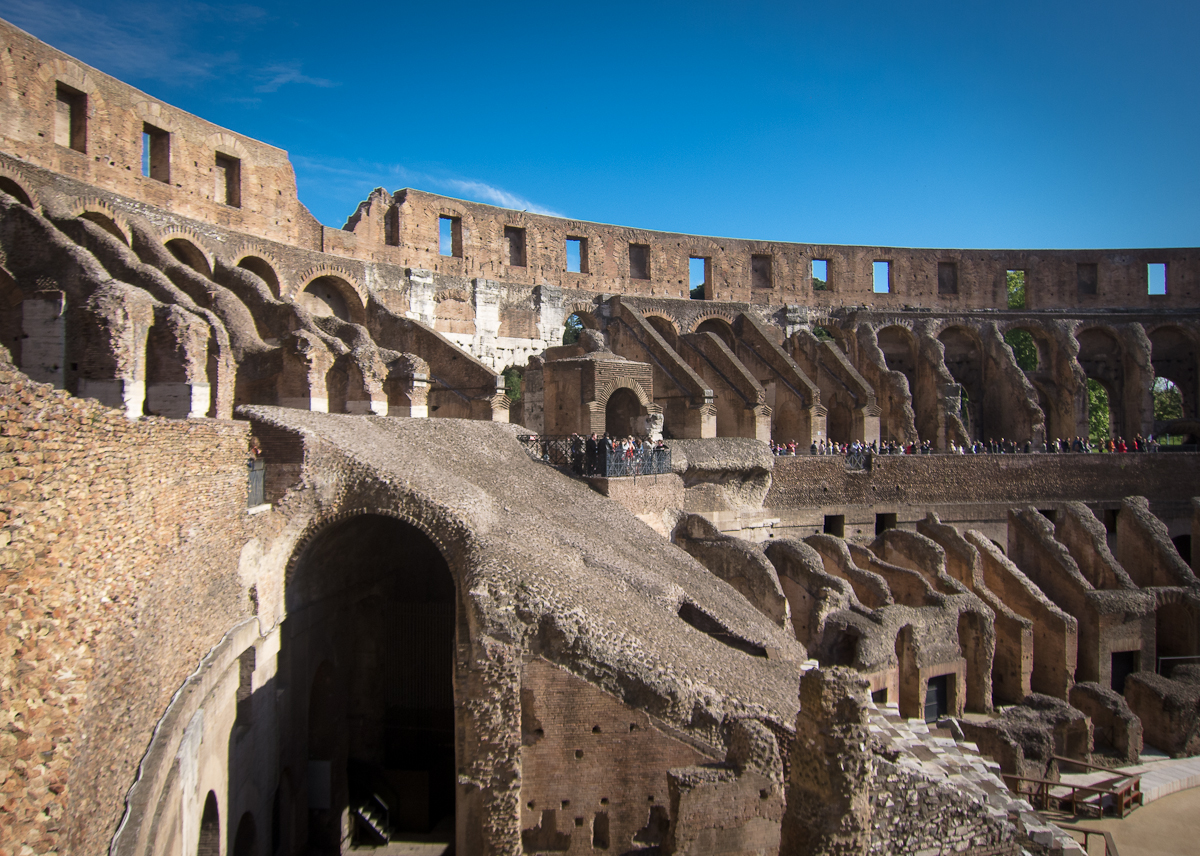
The Colosseum
Inside the Colosseum
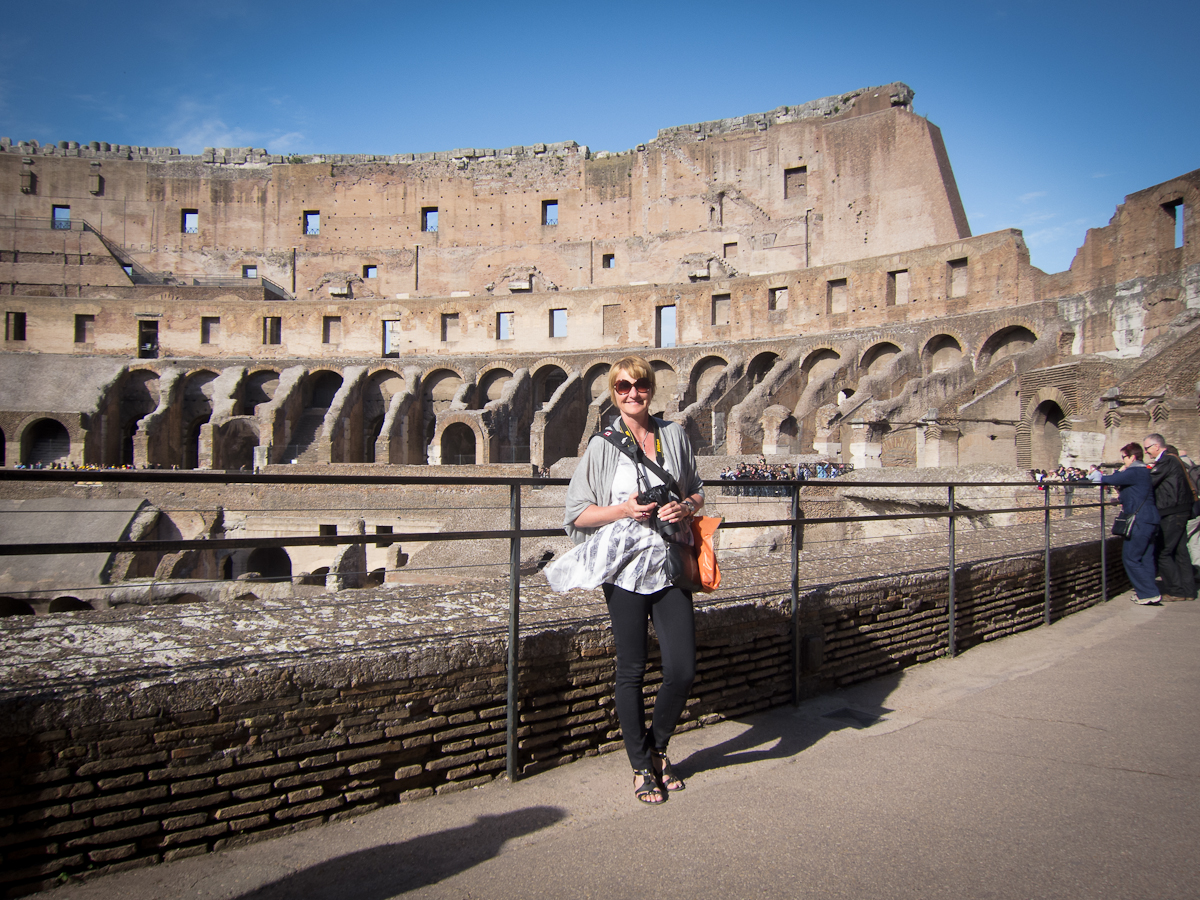
 Sonja at the Colosseum
Piazza Venezia
The Spanish Steps
Sonja and Christina in a courtyard of a museum.
Street scene in Rome
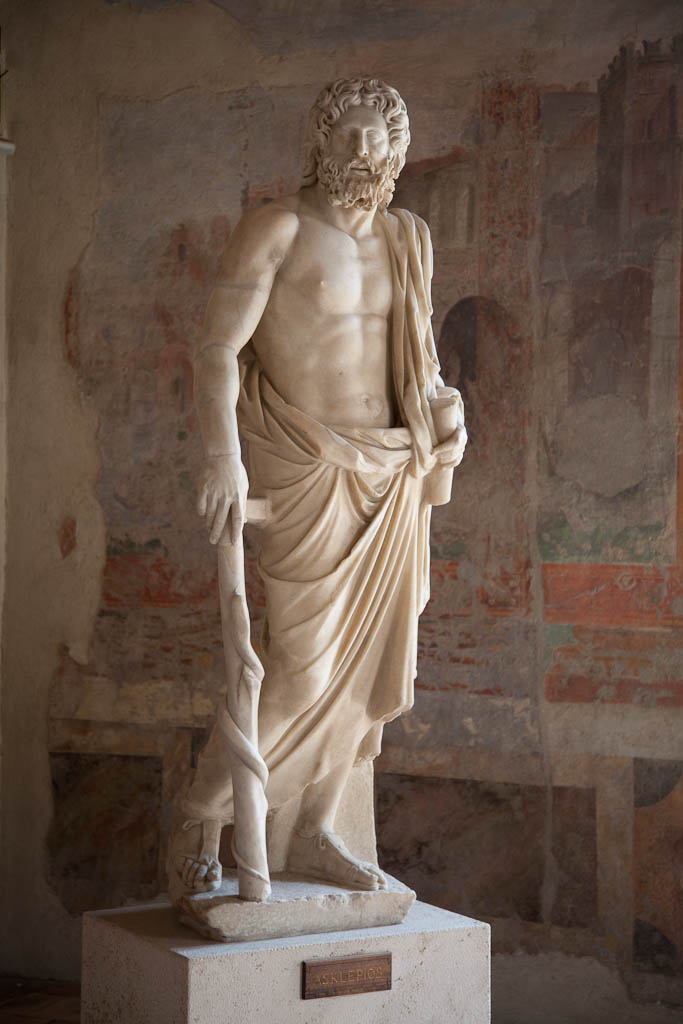
One of many statues we saw in Rome.
The Pantheon
Inside the Pantheon.

The opening at the top of the dome measures 43.3 m in diameter, which also happens to be the height of the Pantheon at its highest point.

Amongst the ancient ruins.

Piazza del Popolo

While in Rome, Sonja ran another marathon distance – she has committed to running the equivalent of a marathon each week this year.  Why? She thought it was a fitting challenge for her 52nd year of life, thus the name of her year-long event: 52 @ 52.  As part of this event, she is raising funds for the Ottawa Chapter of the Snowsuit Fund.  You can follow her weekly runs from the comfort of your couch via her website:  There’s Something About Running.  Or if you’re a runner, you are welcome to join her Sunday running group most of whom run 20K with her. And everyone is welcome to support a good cause and help her reach her goal of raising $5,200 for the Snowsuit Fund.

Sonja planned to run the Rome Marathon route which proved to be rather complicated and difficult to follow.  I joined her at the beginning with the intention of running the first 10K, but somewhere along the way we took a wrong turn and got off track by a few kilometres.  There was nothing I could do but keep running with her until we got back to a more recognizable neighbourhood and a bus stop.  I surrendered after 20K (didn’t know I still had it in me to tell you the truth) and after enjoying a cappuccino together in a little café, we went our separate ways – Sonja continued on to complete the route a couple of hours later, and I headed back to the apartment to meet up with Chris for another afternoon of sightseeing.  It was a fun run and the route was great passing all kinds of interesting historic sights, even though we got lost for a while.  It was a sunny, dry day, almost too warm by early afternoon, but much better than the miserable weather we had in Milan the week before.

Video:  Running in Rome (before we got lost)
 

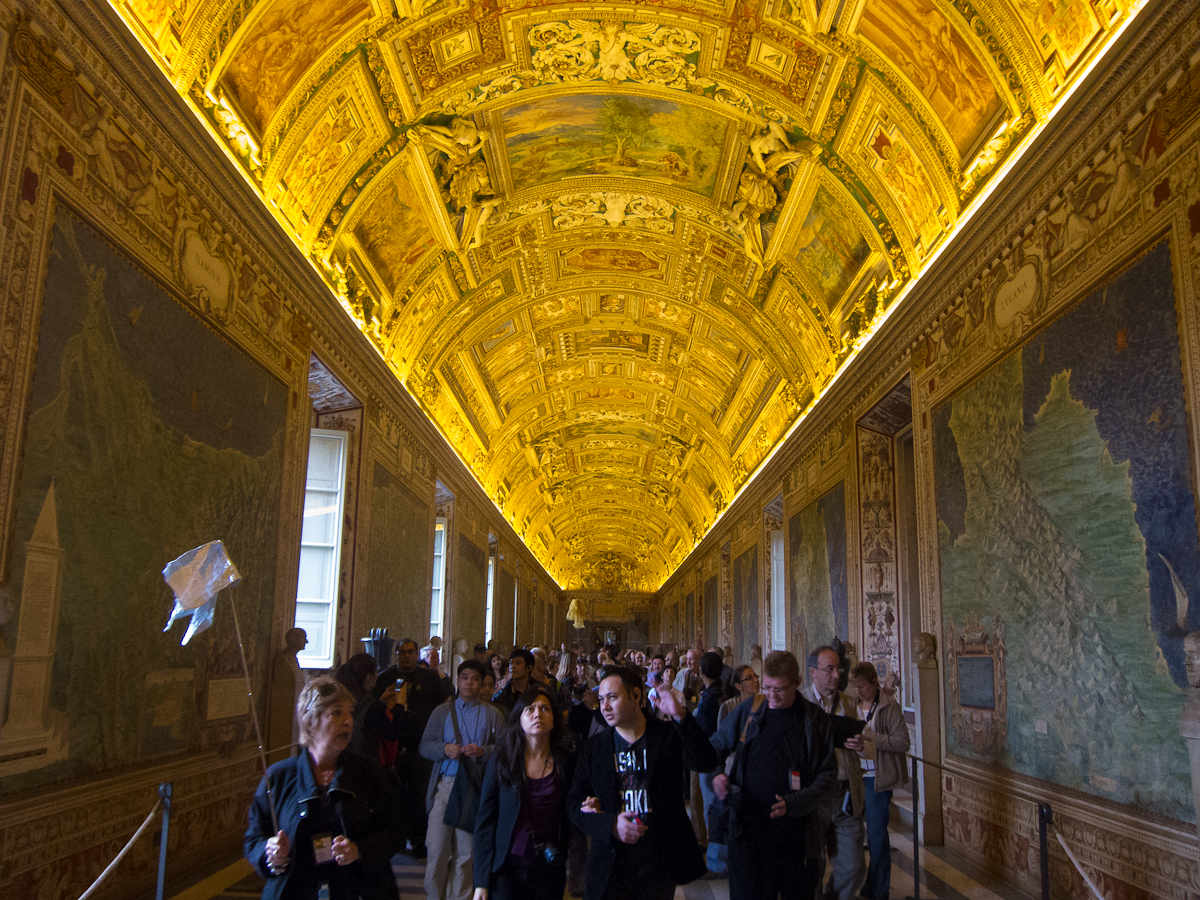
My favourite sight in Rome was our visit to St. Peter’s Basilica, the Vatican Museums and the Sistine Chapel.  We arrived at St. Peter’s before 8:00 well ahead of the crowds.  This was the most beautiful and largest church we have seen to date.   The Basilica is almost a kilometre away from the entrance to the Vatican museums and the lineup was almost as long.  Happily, we had reserved our tickets in advance (see travel tip below) and could therefore walk to the front of the line.  It was only 9:00 when we entered and the long corridors were already clogged with tour groups.  We agreed in advance that we would go our separate ways and meet later in the afternoon – a wise decision given the crowds.

Crowded corridors in the Vatican.

St. Peter’s Dome and Altar

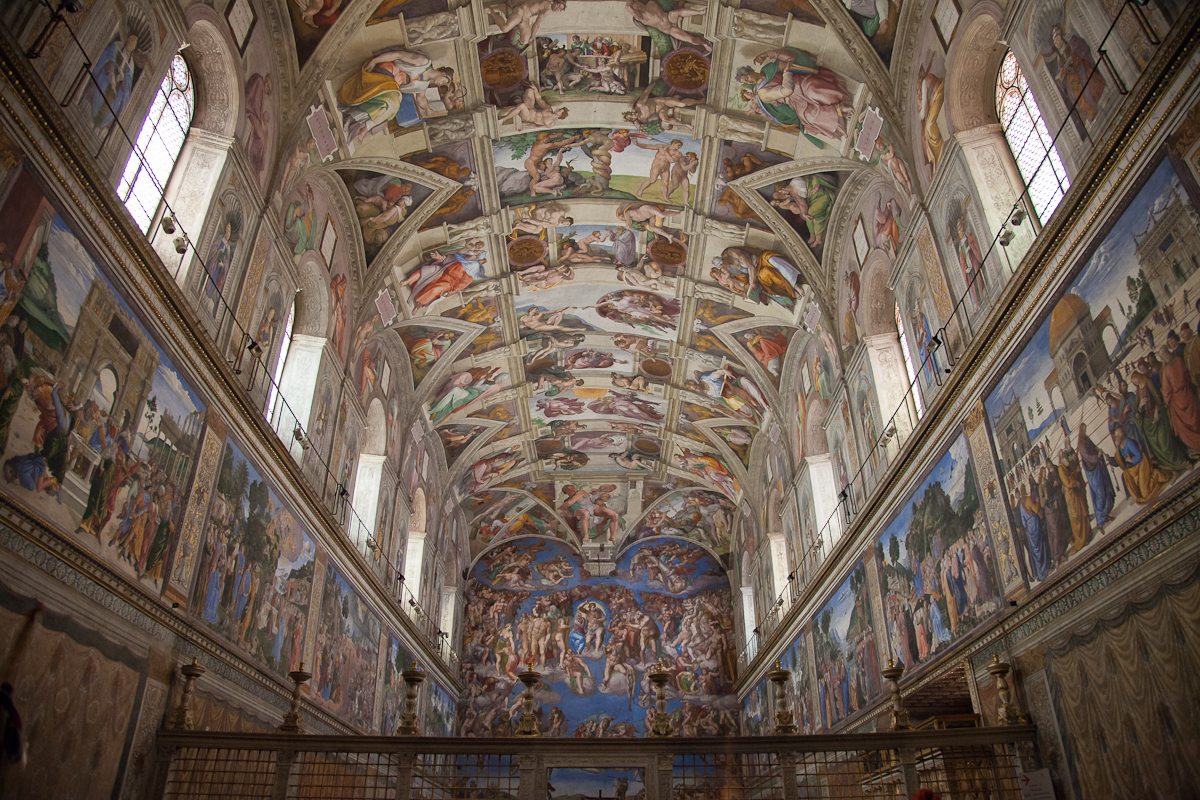
Since I was most interested in the Sistine Chapel, I headed in that direction, elbowing my way through the tour groups that would stop and block the entire passageway – how annoying!  As I entered the dimly lit Sistine Chapel, I felt a twang of disappointment.  The large rectangular room, reputed to be the same dimensions as King Solomon’s temple, was jam packed with tourists – wall to wall, you could barely move.  It felt claustrophobic and seemed almost irreverent the way people were talking so loudly, especially the tour guides.  I walked to the centre of the room and just stood there quietly, looking all around me.  My neck started to hurt as I peered at the ceiling above.  I caught snippets of information from the tour guides. As I started to understand some of the paintings, I wanted to learn more.  After all, here I was standing before Michelangelo’s masterpieces that some authorities deem to be the best in the entire world.

Ceiling of the Sistene Chapel with the famous “Creation of Adam” panel,
one of six that told the tale of the creation and downfall of mankind.

Sistene Chapel – Judgement Day by Michelangelo

Sistene Chapel – View looking towards the back.

Sistene Chapel – View looking towards the front.

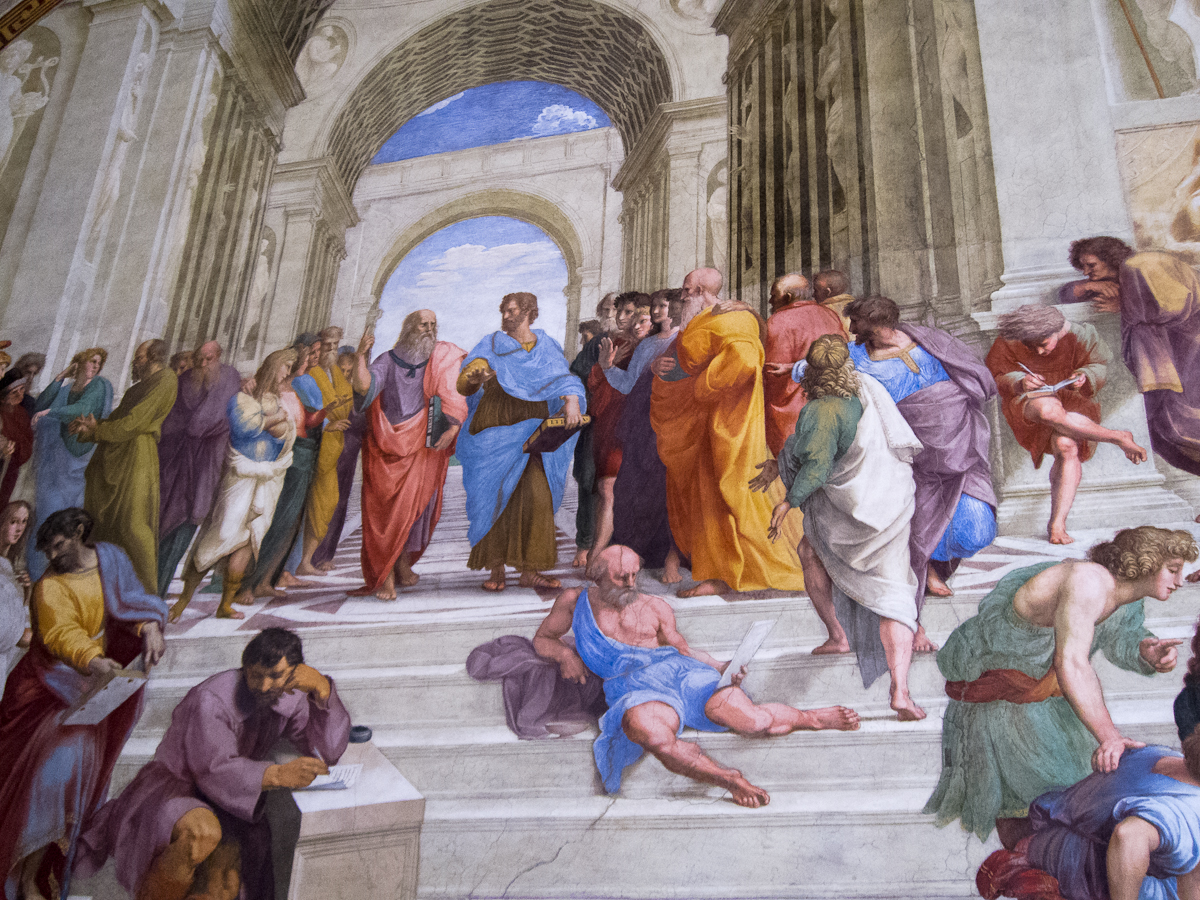
I decided to go back to the entrance and get an audio guide and then proceeded to spend the next five hours slowly making my way back to the Sistine Chapel, visiting the many museums along the way.  The amount and variety of art I saw that day was simply astounding. As I made my way back to the Sistene Chapel, I took a “wrong” turn and discovered the four rooms known as the Stanze of Raphael.  These rooms formed part of the apartment situated on the second floor of the Pontifical Palace that was chosen by Julius II della Rovere (pontiff from 1503 to 1513) as his own residence and used also by his successors. The walls and ceilings were covered with frescos painted by Raphael and his school between 1508 and 1524.  Below are scenes from the Raphael rooms.

Back at the Sistine Chapel which was even more crowded in the afternoon, I sat on a bench along the wall and listened to all the audio segments describing every aspect of the Chapel.  I left with a much better appreciation and a deep feeling of gratitude for having the opportunity to witness in person such magnificent masterpieces from the past.

As our whirlwind tour through Italy came to an end, we saw Sonja off at the airport and we spent the the next three days just taking it easy in our apartment in Rome.  Honestly, we were exhausted and tired of playing the tourist.  We were very much looking forward to our next adventure, a month on a farm in Tuscany.

Travel Tip: To avoid insanely long lineups, I’m talking hours of waiting, purchase tickets to the Vatican Museums and Sistene Chapel (one ticket covers admission to both) online in advance.  Buy the tickets directly from the Vatican ticket office to avoid excessive surcharges. The entrance fee per person (unguided) is 15 euros plus a pre-sales fee of 4 euro.  Once you complete your on-line purchase, a voucher will be emailed to you.  Simply print the voucher, and show it to the ticket agent at the front of the line.

Travel Tip:  Avoid the long lineups at the Colosseum by purchasing your ticket at the entrance to Palantine Hill which is just a few minutes away.  Your ticket gives you access to both sites.

Travel Tip: If you are staying outside the historic district as we were, purchase a multi-day bus pass (12 Euro for 7 days).  We used the bus system extensively. Piazza Venezia was a central hub where most bus lines terminated.

Travel Tip:  For better food at more reasonable prices, head over to the Travestere neighbourhood.  It’s a 5 minute bus ride from Piazza Venezia.

Note: We have been at Trove, the farm in Tuscany for more than two weeks already. I have several entries ready to post but a bad storm a few nights ago knocked out the telephone service and we have been without internet ever since.  Such is country living I suppose.  Currently finishing this entry from an internet cafe in a town called Sinalunga.  Hopefully we’ll be back on line within next couple of days and will then be able to post to the blog.

Getting lost in Venice

Upon the recommendation of one of our guidebooks, we spent two days deliberately getting lost in Venice which is not hard to do when you consider Venice is really a collection of 118 islands connected by 400+ bridges.  At times we split up and went our separate ways but for the most part we wandered through the streets together.

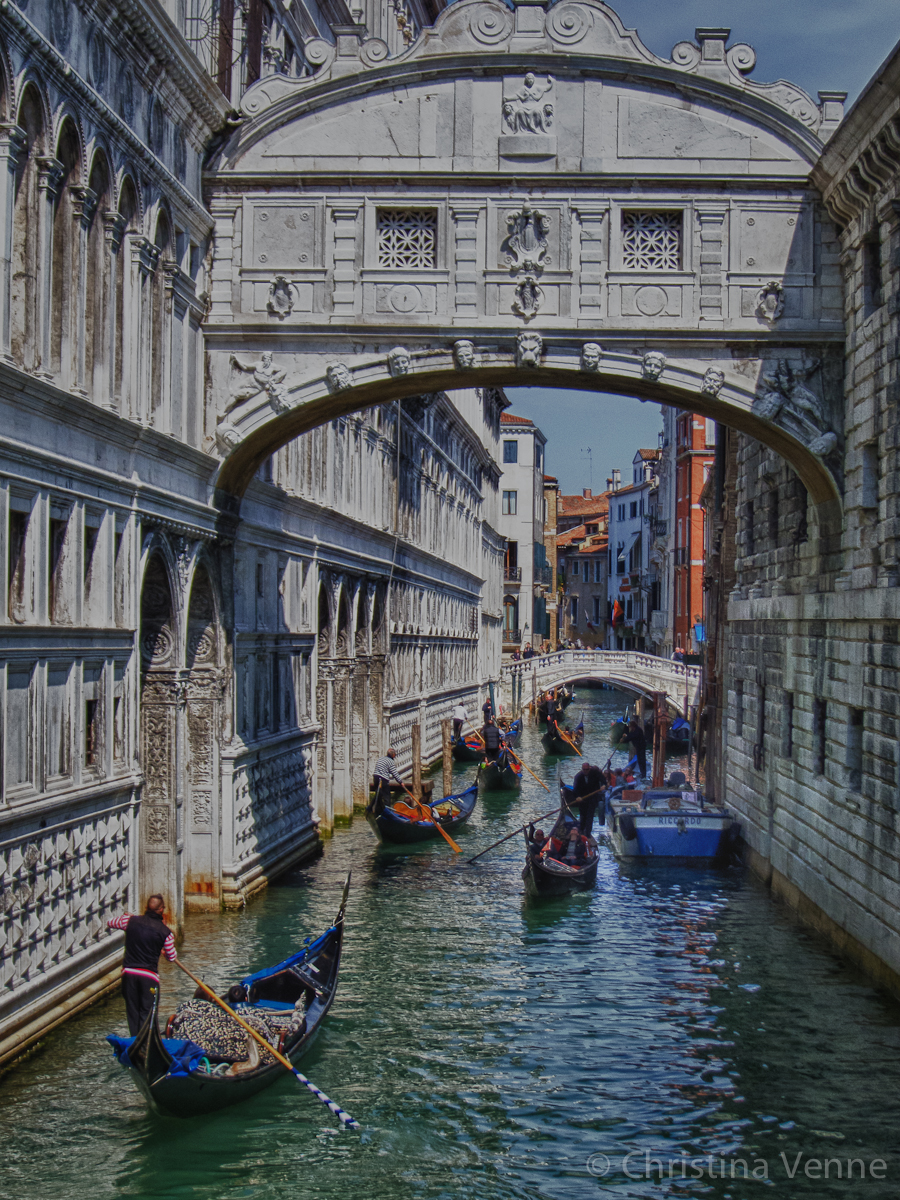
Around every corner, we saw charming scenes unfold: winding alleyways some just a few feet wide, medieval buildings bulging this way and that, stone bridges over canals, unexpected piazzas, gondolas and their drivers in their black and white striped jerseys and straw hat – it was a photographer’s dream.  Sonja was giving her new camera a good workout – I think by the end of our trip, she exceeded 1500 photos!  I tagged along with the little point and shoot which I use to entertain myself more than anything as I wait for the photographers with the real cameras.  I would describe myself as a reluctant photographer, a photographer of circumstance not necessarily of choice.  Sometimes I do surprise myself when I manage to take a half decent photo.  And I must admit I am always secretly pleased and perhaps even a little smug when I happen to get a great shot other’s have missed.

Sonja and I managed to squeeze in a few early morning runs while in Venice which was a great opportunity to see the city awaken.  It was surprising to see the number of people already heading off to work at 6:30 am.  I was intrigued by the way boats were used to make deliveries of every sort in much the same way trucks are used in other cities.  The other thing that amazed me was how the postal service managed to deliver the mail in what looked to me like a maze.  After our run each morning, Sonja treated us (I always forgot to bring money, convenient, I know) to a couple of cappuccino’s at the coffee bar around the corner from our apartment – we were practically regulars on a first-name basis with the owner by the end of our visit.

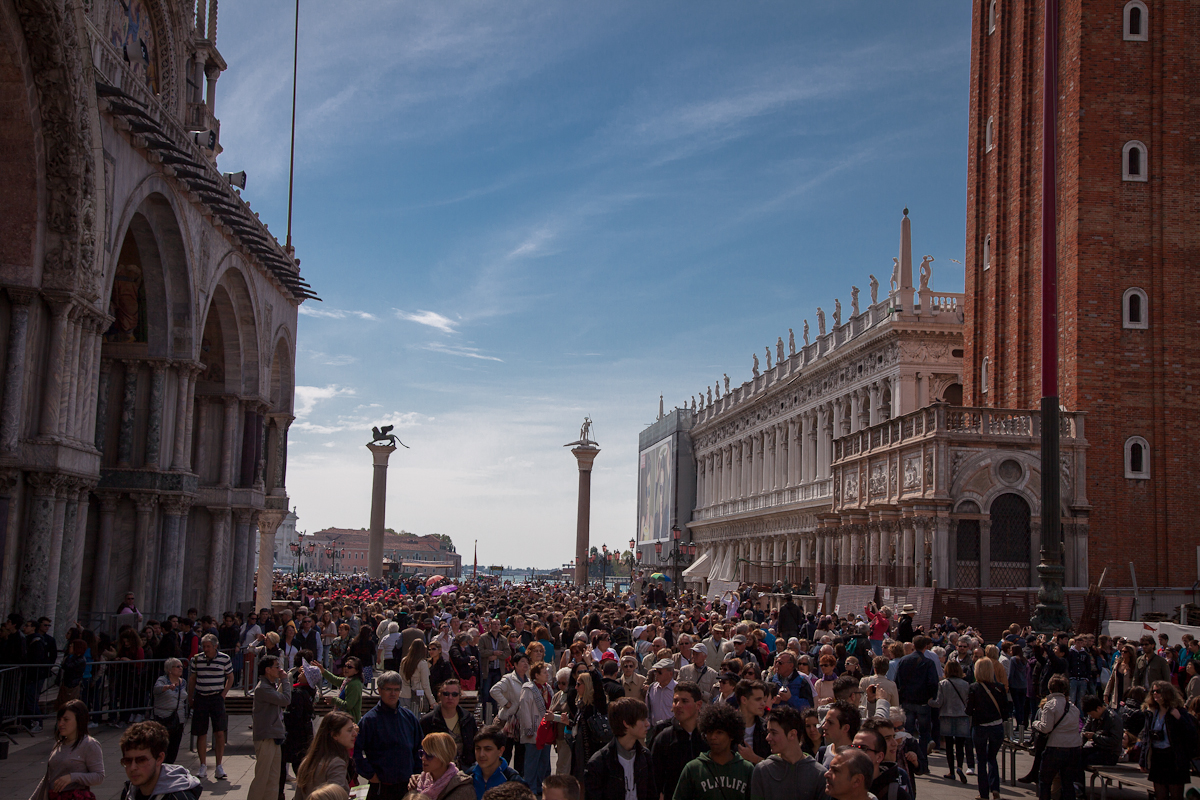
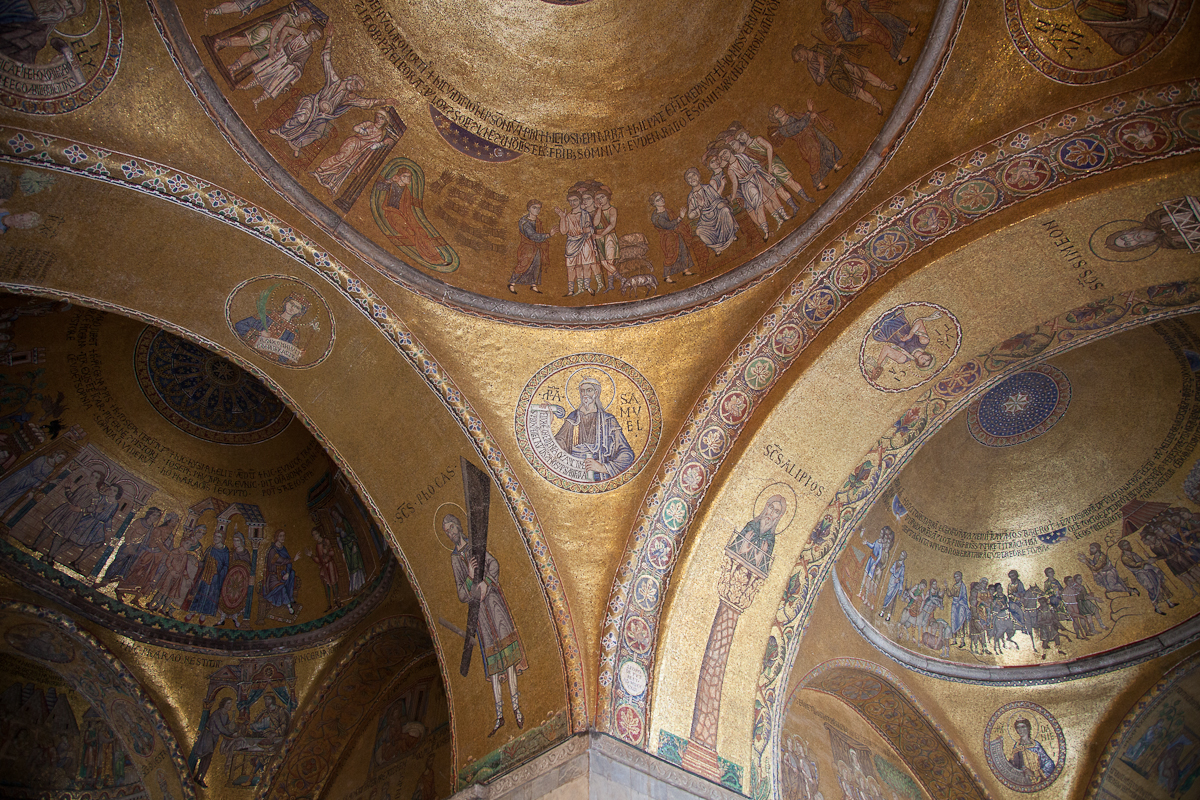
We visited Piazza San Marco both during the day and one evening.  Because of a tip offered to us by the hostel owner on our first night in Venice, we managed to avoid the long line up of tourists waiting to get into the Basilica (see travel tip below for more details).  It felt a little like cheating when we walked past everyone to the head of the line, showed our pass, and waltzed right in.  The Basilica is an example of Byzantine architecture that dates back to the 9th century although much has been altered over time. Once inside, we were in awe: the walls, ceiling and floor of the Basilica were adorned with complex, bright mosaics.  We couldn’t take pictures inside, but managed to capture a few shots in the corridor just outside the main entrance.

When we returned to the Piazza at night, we were surprised to see a wooden walkway erected from one side of the Piazza to the other because it was now covered in ankle deep water that was rising.  We were experiencing what is known as the Acqua Alta, “high water” which is caused when several events coincide: a very high tide, low atmospheric pressure, and a scirocco wind blowing up the narrow, shallow Adriatic Sea which forces water into the Venetian Lagoon.  By official definition, acqua alta occurs when the tide is 90 mm (3.54 inches) above normal high tide.  I’m not sure how high the water got the night we were there, but it was up to the knees of those who waded into the lowest parts of the Piazza.  This natural phenomenon used to be rare, but lately it happens quite frequently, many times each year in fact, mainly during the winter months between September and April.  As you can imagine, this type of flooding causes all kinds of problems so much effort is being made to find solutions that range from floodgates at the Lagoon’s entrances to raising of pavements in low-lying areas of the city.

We wandered into many churches which could easily be mistaken for art galleries as these churches were home to wonderful works of art, even some masterpieces, from famous Italian artists.  The buildings themselves were stunning examples of Renaissance architecture.  

A trip to the Peggy Guggenheim Museum, home to a collection of modern art, offered a refreshing change of scenery. The museum is housed in what used to be the home of Peggy Guggenheim and her family for over 40 years.  It was interesting to learn how this rich American heiress used her inherited wealth to advance living artists of her day.  The museum is a tribute to her generosity towards the arts and a lasting legacy of her contribution to the art community.

Before we arrived in Venice, I had the romantic notion of taking a ride in a gondola with Chris, but this fantasy was dashed when we saw the gondolas lined up like taxis, and then stuck in traffic jams along the canals.  It was anything but romantic.  We decided we could find a better way to spend 120 Euros – yup, that’s what 30 minutes in a gondola will set you back these days.

In Venice, and in many other places in Italy, restaurants will charge a service charge (not to be confused with a tip which is still expected), a cover charge (for the privilege of stepping foot in the establishment) and now something we had never seen before, a table charge (an added cost for sitting at a table rather than standing at a counter).  We discovered (the hard way of course) having a coffee at the table could cost as much as 3 times what you would pay if you drank it at the counter. No wonder Italians order their shot of espresso and down it quickly while standing.  It is a very different culture from North America where lingering over a coffee at Starbucks or Tim Horton’s while reading the paper or a book or catching up on your email is a common way to spend an hour or two.  In spite of the added charges, we still enjoyed some great meals in Venice but suffered through a few misses too.  The gelato was divine, especially the mango flavour which tasted just like the fruit.

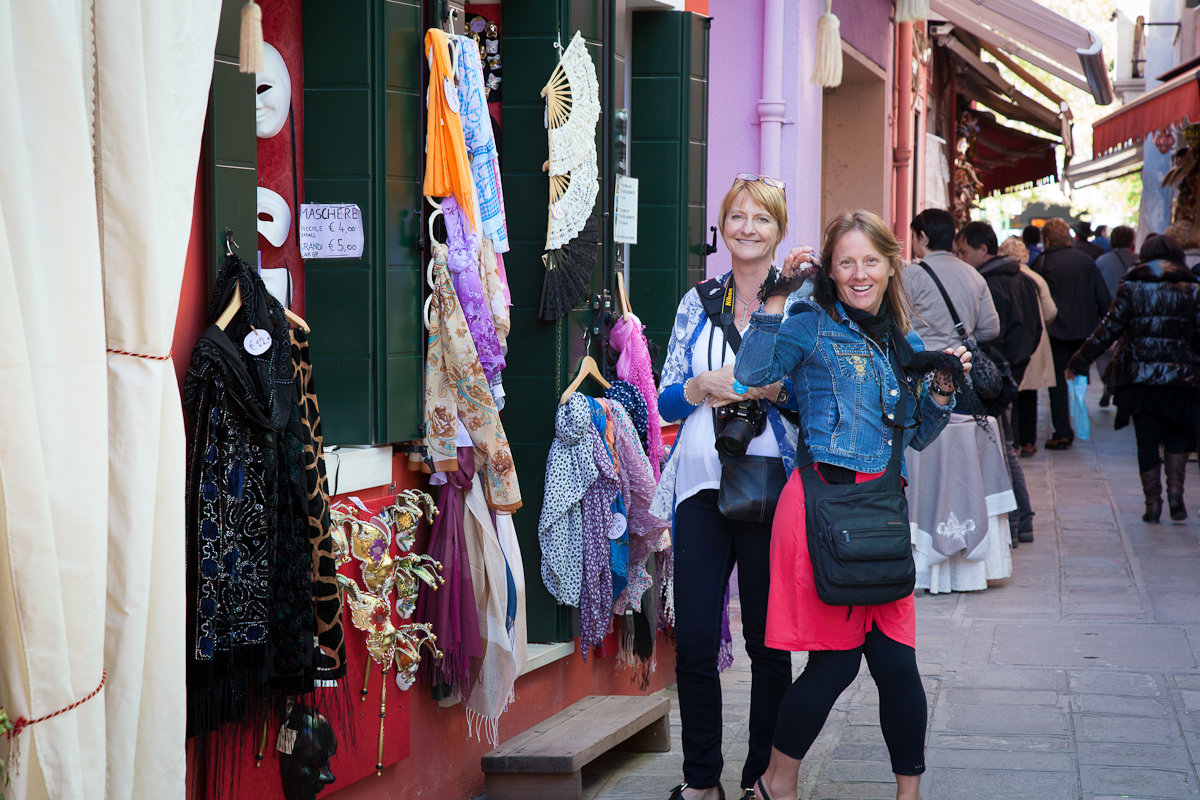
Venetian masks, a centuries-old tradition of Venice, are typically worn during Carnivale  (Carnival of Venice), but have been used on many other occasions in the past, usually as a way for hiding the wearer’s identity and social status. Mask are sold everywhere in Venice but shoppers must be wary of the cheap knock-offs from China which are distinguished by their low price and equally low quality.  The masks that are made in Italy are often made right in the shop where you can observe the artist at work.  These masks are works of art and can be quite elaborate, with a matching price tag (hundreds of Euros).  I took advantage of my sister’s presence (and willingness to be our mule both bringing provisions to us from Canada and taking things back home), and selected a beautiful mask for my daughter Alyssa who had just celebrated her 25th birthday. As a collector of masks, this seemed like the perfect gift for her.  I’m not sure why we made an exception to our “policy”of not buying gifts or souvenirs….it just seemed like the perfect opportunity that I didn’t want to pass up.

After spending four full days in Venice, we all agreed that this was our favourite city in Italy and that four days was a sufficient amount of time to get a good sense of the city and to see the highlights.  Much more time would be needed if you wanted to visit more museums.  And so we were off to Rome, our final destination on this whirlwind tour through Italy.

Video:  Snapshot of Venice
 

Travel Tip:  Avoiding the line ups and saving hours of precious time at San Marco Basilica is as simple as checking a bag.  The baggage storage is located off a small alleyway to the left of the church.  Just ask a security guard on the side of the building to point you in the right direction.  You simply leave a bag (we left an empty camera bag) in exchange for a token which then permits you (and your group) to walk straight into the church, avoiding the line altogether.  You see, entrance to the Basilica is free of charge; people are lined up just to have their bags searched by the security guards.


Follow the shopping carts to the Lido market

As we pulled into the train station in Venice, the sun broke through the clouds promising us a respite from the rain.  Once we figured out the water bus system (conveniently located on the canal immediately in front of the train station), we managed to find our apartment without too many wrong turns along the way.  The apartment, located on the third floor of another old building without elevators, was everything we had hoped for.  It was in the heart of the historic district in the Cannaregio neighbourhood, just a five minute walk from the Rialto bridge and within walking distance to all the major tourist sights.  Each of the two bedrooms had two large, shuttered windows overlooking the canal. It had a large living room, dining room, kitchen and even a balcony on which was a washing machine and clothes line from which to hang our laundry – just like the locals.

We settled into our apartment, and then explored the neighbourhood; we were delighted to find the following amenities within a couple of blocks radius: a grocery store, an outdoor fruit and vegetable stand, a cheese shop, bakery, and a unique wine store that sold wine in volume by the litre.  In this shop, the wine was stored in an array of large carboys from which you selected your variety, after sampling it, of course.  The shop keeper then poured the desired amount into a recycled plastic water bottle.  We picked up a couple of bottles on the first day but our enthusiasm for this concept waned as we realized the wine was not as good as we had hoped.  No worries, as there were several wine shops in our neighbourhood as well as wine in the local grocery store.

Our first full day in Venice was spent visiting the nearby islands of Lido, Murano and Burano.  We purchased a 12-hour water bus pass for 16 Euro each and we were determined to get our money’s worth.

Lido is an 11 km long sandbar, home to about 20,000 residents.  It is renowned for its beaches which became popular way back in 1857 when the first bathing facility was set up. This was the first time that anything similar had been seen in Europe. Soon, it became “The Lido”, meaning a beach resort. Major beach facilities, hotels and private summer villas have remained the heart of the island that is still known as the “Golden Island”.  But we were not going to see the beaches, we wanted to visit the local market held every Tuesday morning.

We followed the ladies with the shopping carts right to the market.

View of Venice from the Lido market.

Water bus on the Grand Canal

Water buses travel slowly along the Grand Canal offering plenty of opportunity to sightsee along the way.  As we inched our way closer to Lido, the tourists thinned out and were replaced by little old Italian ladies with their shopping carts.  I made the observation that all we needed to do once we arrived in Lido was follow the ladies with the shopping carts.  And that is exactly what we did, practically running after them to hop onto a regular bus, and then jumping off at the last minute as they quickly exited without warning.  And so we found the market, a bustling affair full of locals out doing their regular shopping at the food stalls.  We saw lots of clothes, shoes, and household goods too.  It was as much fun to look at the merchandise as it was to people watch.

Video:  Taking the water bus along the Grand Canal

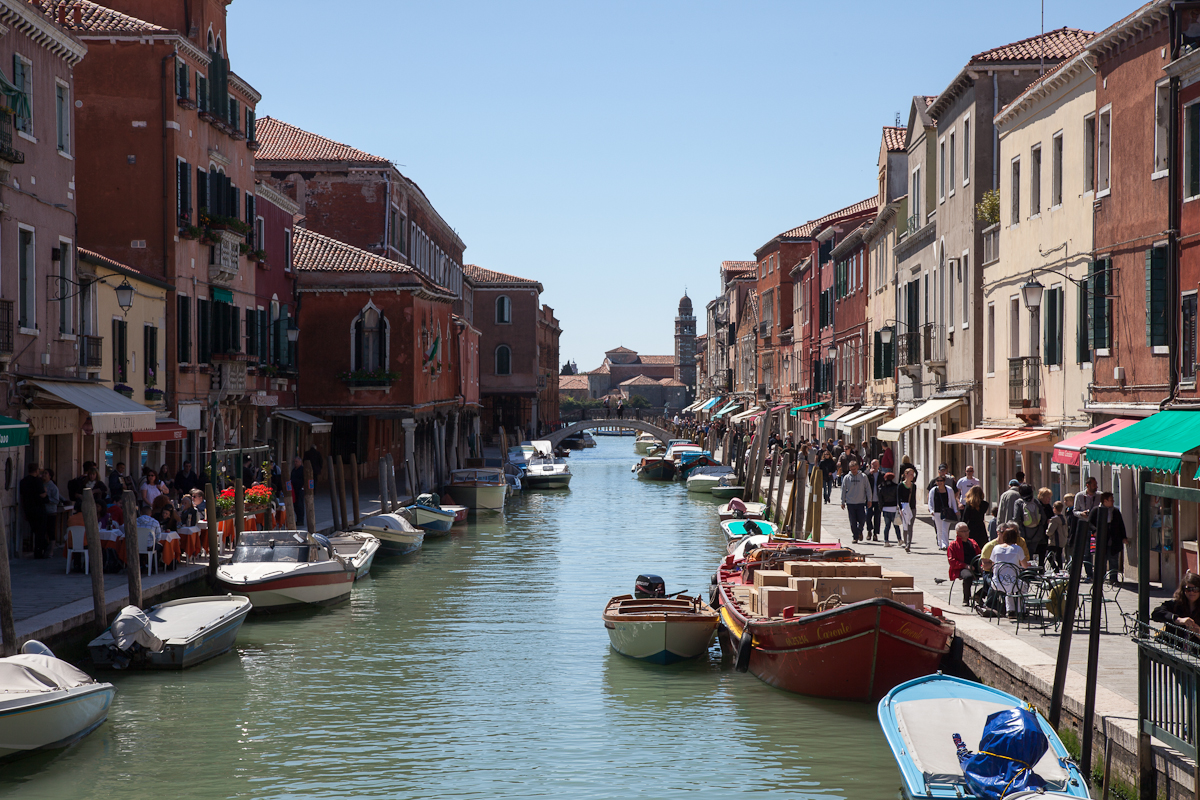
Next stop was Murano renowned the world over for its hand blown glass.  It is a series of small islands connected by bridges about 1.5 km north of Venice.  It measures about 1.5 km across with a population of just over 5,000.  We were taking full advantage of the glorious day of sunshine – our first since we stepped foot in Italy.   After a couple of hours meandering along the canals, admiring the exquisite works of art and jewellery all made from glass, we stumbled upon some glass makers making intricate pieces for a huge chandelier. It was fascinating to watch these artistic craftsmen at work.


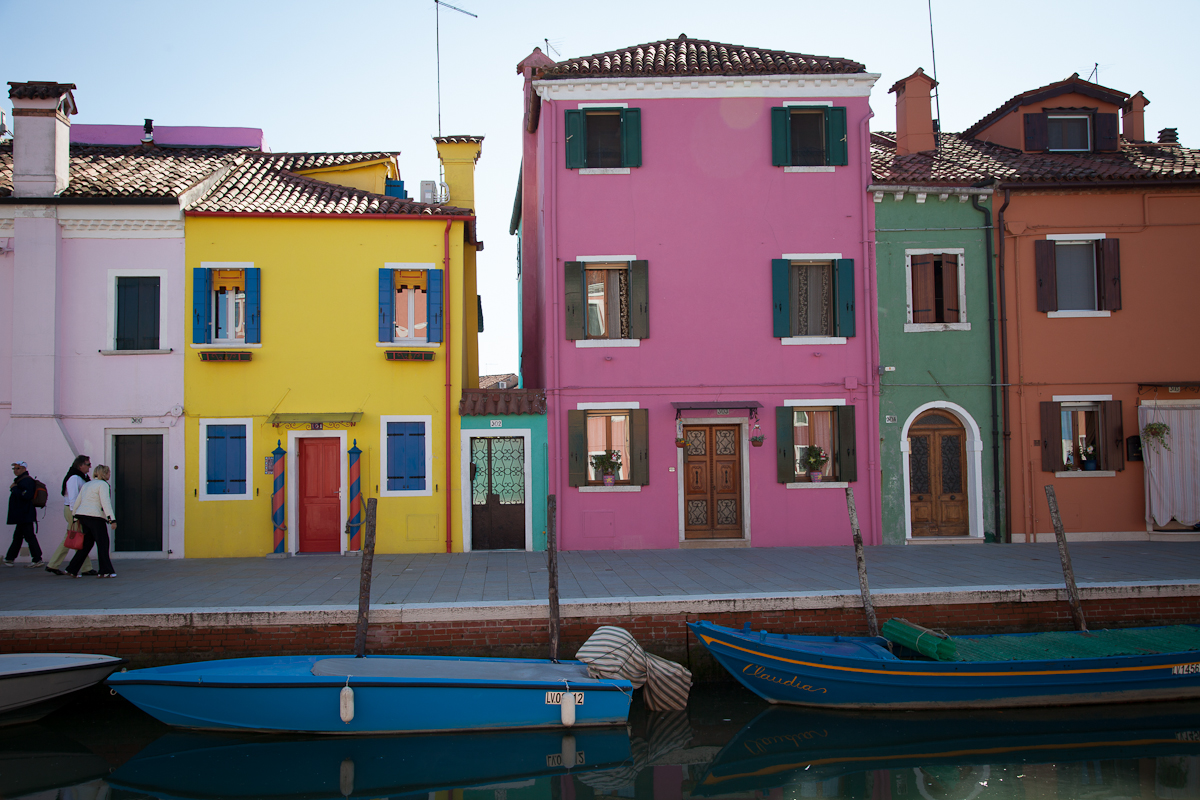
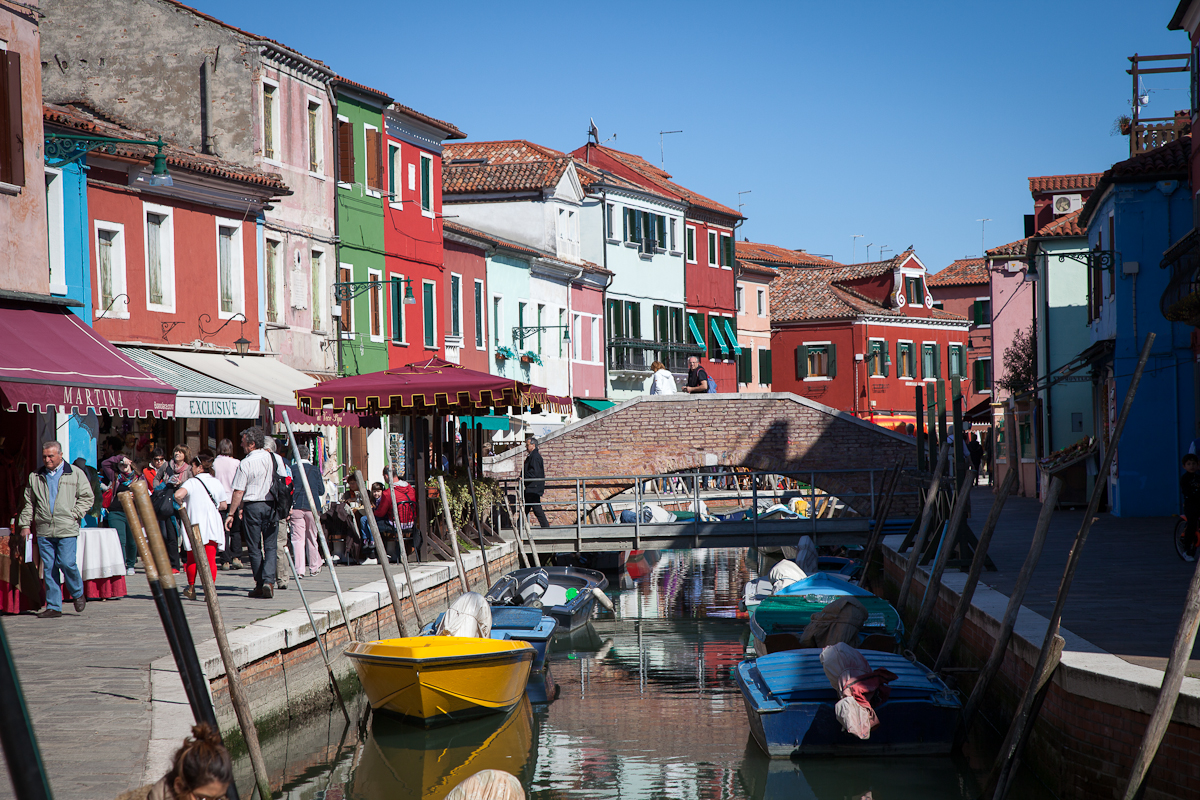
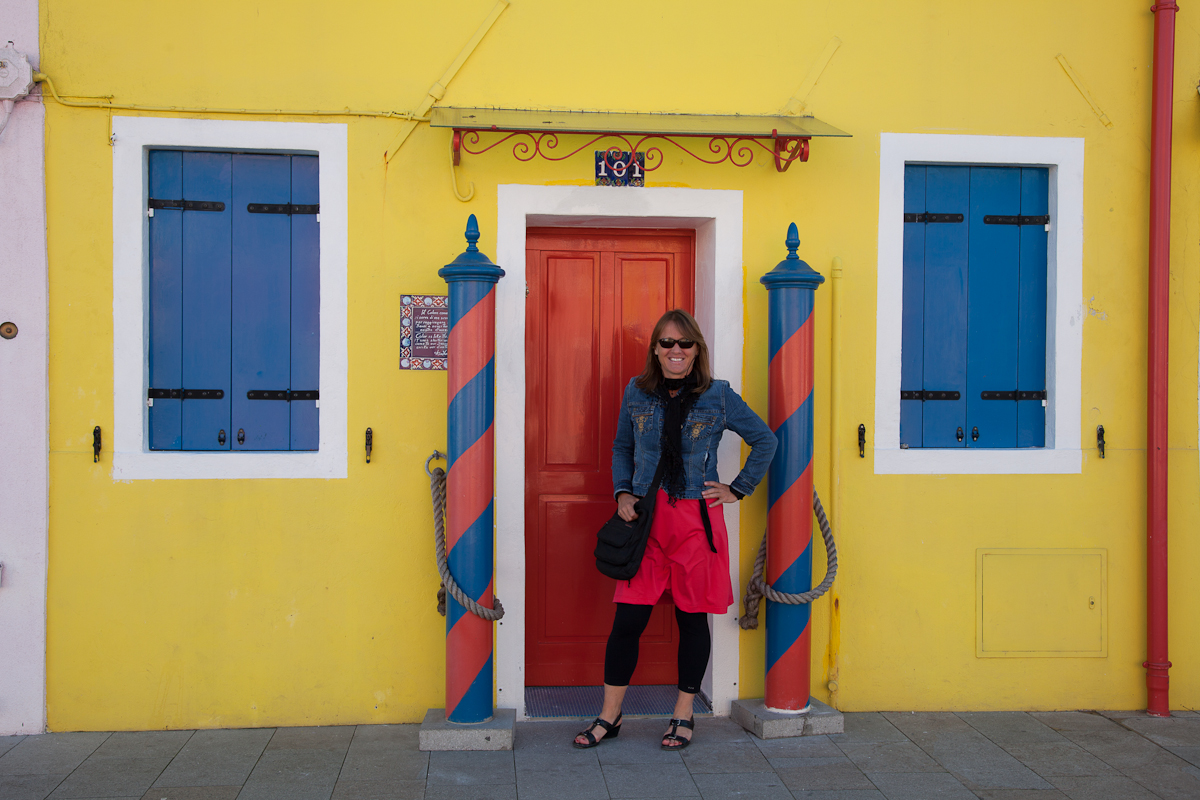
The final stop of the day was the island of Burano, also accessed via water bus.  This island is renowned for its brightly coloured houses and lacework.  The colours of the houses follow a specific system originating from the golden age of its development so if your house needs to be painted, you must make a request to the government who will then let you know what colour you can use.  We ended our busy day with a relaxing glass of white wine on a patio basking in the fading sunshine.

A wet weekend in Milan

Accommodations were scarce in Milan on the weekend we planned to visit because of several events going on in the city including the Milan Marathon.  Sonja managed to find us two nights in an apartment a little outside the city centre.  This modern apartment with paper thin walls (and a screaming baby as a neighbour) lacked character, in stark contrast to the museum-like apartment in Florence.  It was less than ideal, but it was across the street from a Metro station giving us easy access to the entire city.  This was the smallest apartment we stayed in – a loft bedroom with twin beds and a double bed in the living area – but it was also the cheapest.  For two nights, it was sufficient to meet our needs.

As the second largest city in Italy (Rome is the largest), Milan is the main industrial, commercial and financial centre of Italy.  The city is recognized as a major world fashion and design capital with 12,000 companies, 800 show rooms, and 6,000 sales outlets, and four weeks dedicated to top design shows each year.  It is also well-known for several international events and fairs, including Milan Fashion Week and the Milan Furniture Fair, which was one of the events happening during the weekend we were there.

But we were there for the marathon so the first order of business was a visit to the race expo where Sonja picked up her race kit, after which we headed towards the historic centre to check out the sights – in the pouring rain.  In fact, it rained from the minute we arrived on Saturday afternoon until we left on Monday morning.

We found the Castello Sforzesco, one of the most famous monuments in Milan dating back to the 14th century, and wandered around the grounds for a short while; you could easily spend an entire day going through the twelve mini-museums and large archives that cover a vast array of subjects and periods from Palaeolithic history through to 1950s furniture of all things. The Castello complex includes The Museum of Ancient Art, The Furniture Museum, The Museum of Musical Instruments and the Applied Arts Collection, The Egyptian and Prehistoric sections of the Archaeological Museum and the Achille Bertarelli Print Collection. The best known of the current civic museums is the Pinacoteca del Castello Sforzesco, with an art collection which includes Michelangelo’s last sculpture, the Rondanini Pietà, Andrea Mantegna’s Trivulzio Madonna and Leonardo da Vinci’s Codex Trivulzianus manuscript. During the 15thcentury, this castle was home to the aristocratic court of Lovico ‘il Moro’ Sforza, patron of Leonardo da Vinci.  Of course, we didn’t have time to visit any of these museums.

The highlight that afternoon was a visit to the Duomo.  This gothic cathedral took over five centuries to build; it is the third largest cathedral in the world and the largest gothic cathedral in the world.  To say it was impressive would be an understatement.  We entered the cathedral during mass and so we were privy to the medley of sounds of the organ, the choir and the priests.

On Sunday, Sonja arose before dawn to find her way to the marathon starting point. It was still raining and it was quite cold.  Chris and I thought of her as we stayed behind in our cosy beds (yes, we had the twin beds in the loft) sipping our espresso coffee.  We could easily have just lounged around all day, but we pushed ourselves and went back to the historic centre to do a little more sightseeing.  Imagine our surprise when we found ourselves next to the marathon route when we exited the subway in front of the Duomo.  We watched the runners for about a half an hour, clapping and cheering them on as loudly as we could even though the handful of other spectators lining the course were as quiet as church mice and kept darting puzzled looks our way.  We were even more surprised and pleased to see my sister heading our way – we couldn’t have planned it any better.  Chris managed to get a few photos of her as she made her way through the piazza.  I think she was happy to see our familiar faces even though she still had 16 km to go.

We went into the Duomo for a second look and I was surprised to see so many things I had missed the day before, like the huge crucifex hanging high above the alter at the front of the church, reputed to have one of the nails from the cross Christ died on.  After climbing 250 steps to the roof top, we stood outside on the Duomo roof in absolute awe.  Even though it was raining steadily, we walked slowly around the entire perimeter of the Duomo, taking in all the fine details of the gothic spires that were adorned by over 2000 statues.  I have never seen anything quite like it.

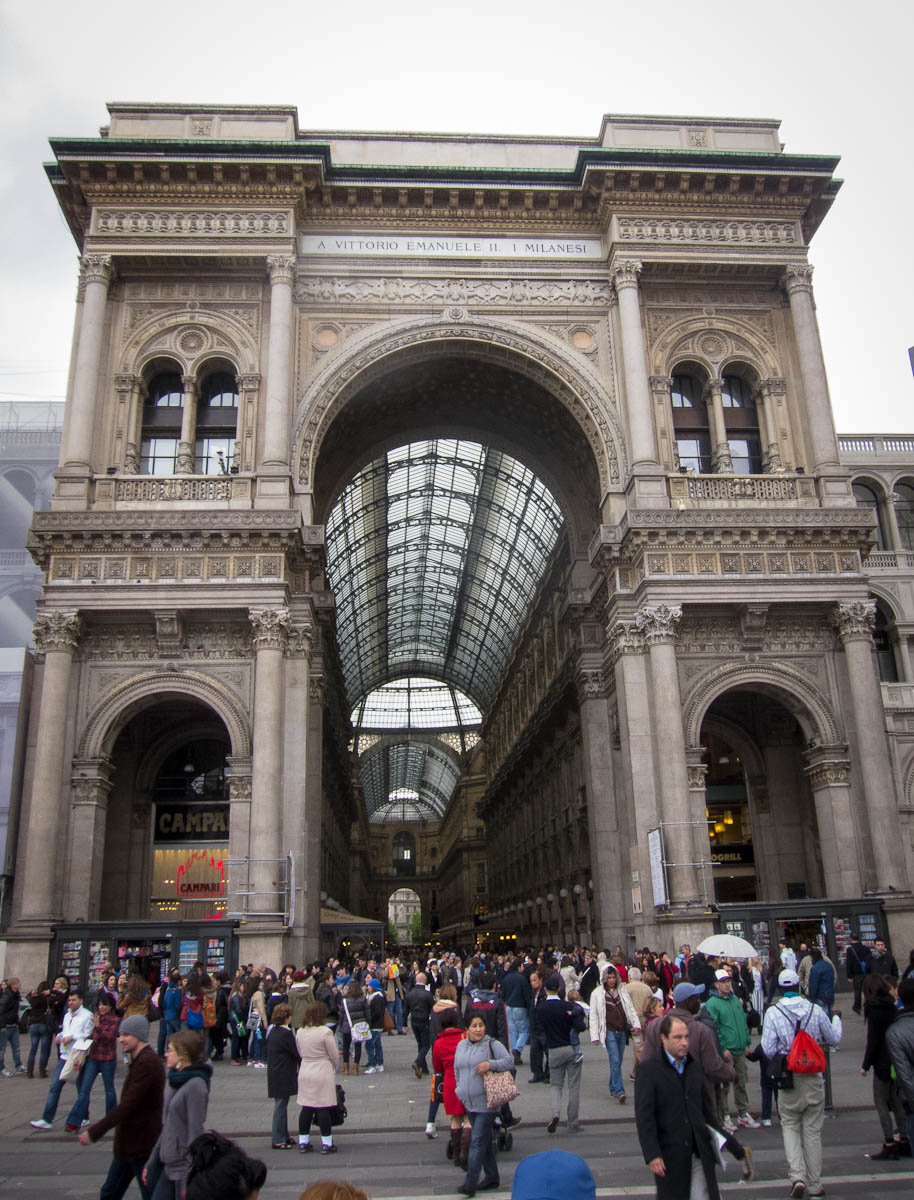
Off to the side of the piazza, we discovered the Galleria Vittorio Emanuele II, where we joined hordes of tourists seeking shelter from the rain under the double glass vaulted arcades. Apparently, this Milanese Galleria, larger in scale than its predecessors, was an important step in the evolution of the modern glazed and enclosed shopping mall. It has inspired the use of the term galleria for many other shopping arcades and malls.

We only spent a weekend in Milan but it was enough time to see the most important and memorable sights.  We found the city to be rather drab, an impression that I don’t think was entirely influenced by the dismal weather.  It seemed ironic that some of the world’s leading fashion designers came from such a dull and dreary place.

History and art in Florence

By now you may be wondering if we spent any time at all in Florence with all the day trips we had been doing.  Since it was our home base, we managed to squeeze in some sightseeing after our excursions to Pisa and Sienna but we hardly did the town justice.  A case in point, we stayed across the street from Santa Croce Basilica and didn’t have time to visit it!

As you probably know, Florence is the capital city of the Italian region of Tuscany and of the province of Florence. It is the most populous city in Tuscany, with approximately 370,000 inhabitants, expanding to over 1.5 million in the metropolitan area.  Florence is famous for its history and is considered the birthplace of the Renaissance.  It was declared a World Heritage Site by UNESCO in 1982, and it has been ranked by Forbes as one of the most beautiful cities in the world, due to Florence’s artistic and architectural heritage.

The best-known site of Florence is the domed cathedral of the city, Santa Maria del Fiore, known as The Duomo, whose dome was built by Filippo Brunelleschi. Some 600 years after its completion, the Duomo is still the largest dome built in brick and mortar in the world. The cathedral has an imposing presence in the centre of the historic district. When we entered the cathedral, the sombre notes of an organ echoed throughout the cathedral.  While I loved the exterior of the Duomo, the interior was a disappointment for me.  Sure it was huge and had some beautiful mosaic pictures on the walls, but the overall architecture was just not very inspiring, at least not to me.  I still can’t say whether or not the music, which I must admit was a nice touch, was live from the huge organ or whether it was just piped in, no pun intended.

A visit to the Uffizi Gallery marked our last afternoon in Florence.  Imagine, for centuries, people have been walking the hallways I was standing in, admiring the very paintings I was admiring.  Next to each painting, after the artist’s name, title and date of the painting, was the date the painting was acquired by the museum.  I was intrigued to see paintings that had been acquired as far back as the 16th century and as recently as the 1970’s.  As for the art, well I think Sonja summed it up rather nicely:  “If I see one more painting of the virgin and baby, I’m going to scream!”  Yes, the renaissance artists loved this theme and we saw it repeated in room after room.  This was the first museum where I have seen paintings represented in relief format next to the original painting for the visually impaired.

My favourite part of the gallery was the temporary exhibit of tapestries that left me perplexed as to how it could be possible to create such magnificent masterpieces on the loom.  One tapestry was hung backwards to demonstrate the original, vivid colors which had long since faded from the front.  Much effort and expense is expended annually to restore these beautiful pieces of art to their original glory.

We elbowed our way through hordes of tourists and tour groups in the museum.  You could barely move without bumping into someone.  I hate crowds like that, especially in a museum because it is so difficult to see anything (notice the crowds in the photo above).  Florence in general was inundated with tourists.  I shudder to think what it is like in the middle of summer at the height of the tourist season.  No wonder the locals flee the cities to escape the heat and crowds.

“Pinocchio”, a classic of children’s literature and Italy’s second most read book after Manzoni’s “The Betrothed”, was written by Tuscan writer Carlo Lorenzini who was born in Florence in 1820.  He wrote under the pen name of C. Collodi and the story was first published in Rome in 1881. Naturally, there is an abundance of shops selling everything imaginable with a Pinocchio theme.  While very touristy, Sonja and I found this particular shop (photo above) to be very charming, filled with hand made wooden Pinocchio paraphernalia.

Sonja, posing with the artist of the artwork she bought.  
The Duomo is in the background.

Sonja’s photo – she was obsessed with bikes – and
had lots of photo opportunities to indulge her passion.

Our time in Florence was far too short, as there was much more to see.  I was disappointed that we didn’t have time to visit the Accademia Gallery where the original “David” sculpture by Michelangelo was on display.  I guess we’ll have to go back one day.