 We travelled by overnight bus from La Paz to Uyuni where we would start our 3 day, 2 night tour of the world’s largest salt flat. We arranged to travel on the most expensive bus (Todo Turismo: $33 US each) because we wanted to be as comfortable and safe as possible. It was money well spent; the bus was spacious, the amenities were good (dinner, breakfast, blankets and pillows provided), and the driver got us to our destination safely.
When I had read that Bolivia’s road system was 95% unpaved, I thought this might be an exaggeration, but after travelling through Bolivia, I can vouch for the accuracy of that statistic. After 3 hours on a paved road, between La Paz and Ororo, the remaining 9 hours were spent on very bumpy, dirt roads that were washed out in many places because of recent rain; it is the rainy season afterall. We didn’t sleep too much because the bus lurched from side to side as the bus driver manoeuvred around the impassable sections. Often the bus came to a complete stop and we could imagine the driver contemplating which way to go. Sometimes he even got out of the bus to assess the dire situation in front of him. There were times when I popped my head out of the window and I was horrified at the sight ahead – nothing but water and mud. But somehow, we got to Uyuni safe and sound.
Before I tell you about the tour, I must say a few words about the process of selecting a tour. We arrived in Uyuni without any reservations which by now, you must realize, is nothing new for us. We had done lots of research in advance and had a short list of tour operators (based on online reviews) we planned to visit to see what they could offer us. There are plenty of bad reviews on the internet (Trip Advisor in particular), some are down right appalling. So we wanted to be careful about the tour we selected. It seemed the biggest grievance people had was the number of passengers in a car. Most tour operators tried to squeeze 6 passengers in a Land Cruiser, plus the driver and cook in the front seats. The other common grievance was the quality of vehicle. Breakdowns and flat tires were commonplace.
When we found a tour operator offering a tour with just two other passengers (for a premium of course) we jumped on it. When probed for information about the truck, we were given vague answers such as: our trucks are not new, but they are in very good mechanical condition. The lady in the office would not commit to any more detail than that. We signed up for the tour through Tonito Tours and crossed our fingers that all would go well.
Day 1
On Wednesday morning, we went to the designated meeting place only to wait for over an hour for our truck to show up (the delay was caused by an apparent gas shortage, or so we were told). We had the chance to meet the other couple we would be travelling with: James, a Brit currently living in Italy, and Donatella, his girlfriend who was Italian.
As the truck pulled up, I had a sinking feeling. It was old. Really old. A 1996 Toyota Land Cruiser to be exact. It was quickly apparent this vehicle had seen better days – one passenger window did not work, the windshield wipers did not work. Who knows what else was wrong under the hood – we would find out soon enough.
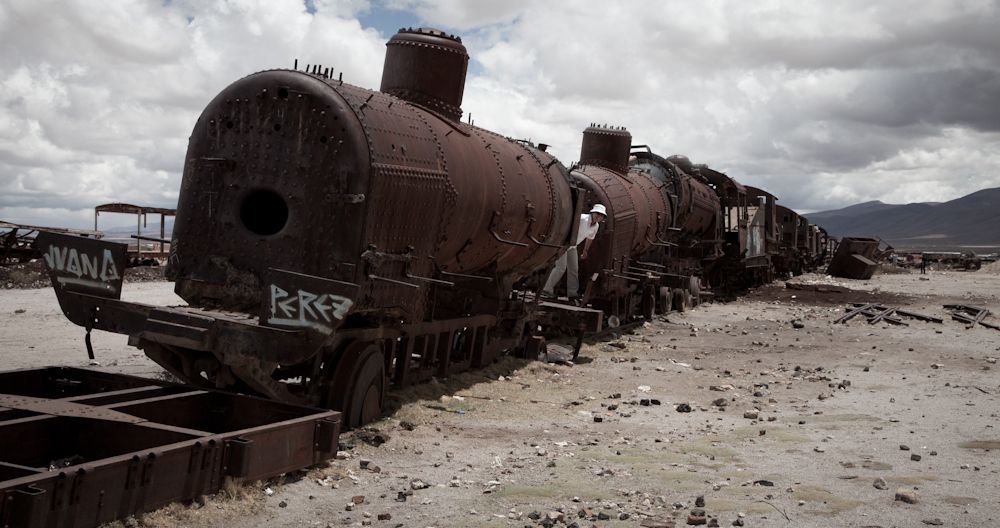
 First stop on the tour was the “Train Cemetery”, one of the major tourist attractions of the area. In the past, the town of Uyuni was a distribution hub for trains carrying minerals on their way to the Pacific Ocean ports. The train lines were built by British engineers who arrived near the end of the 19th century and formed a sizeable community in Uyuni. Rail construction began in 1888 and ended in 1892. The trains were mostly used by mining companies so when the mining industry collapsed in the 1940’s (partly due to mineral depletion), many of the trains were abandoned, resulting in the train cemetery.
We made a few stops on the way to the salt flats, for instance, to visit artisan stalls – like we haven’t seen enough artisan stuff for sale! It was interesting to see some of the art they made from the salt. It reminded me of what we do with ice and snow in Canada.
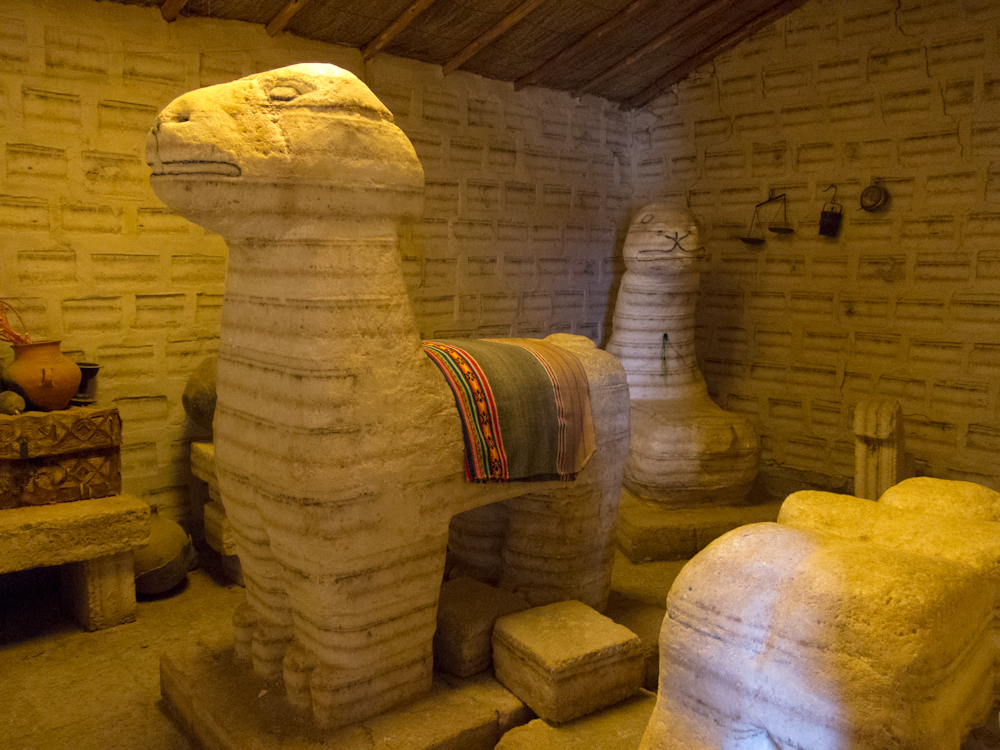 Salt Art at one of the artisan stalls.
They even have salt hotels where everything is made of salt.
When we reached the salt flats, we were in awe of their magnitude. Salar de Uyuni is the world’s largest salt flat at 10,582 square kilometers (4,086 sq mi). It is located in southwest Bolivia, near the crest of the Andes, and is elevated 3,656 meters (11,995 ft) above sea level. The Salar was formed as a result of transformations between several prehistoric lakes. It is covered by a few meters of salt crust, which has an extraordinary flatness with the average altitude variations within one meter over the entire area of the Salar. The crust serves as a source of salt and covers a pool of brine, which is exceptionally rich in lithium. It contains 50 to 70% of the world’s lithium reserves, which is in the process of being extracted. The large area, clear skies and exceptional surface flatness make the Salar an ideal object for calibrating the altimeters of the Earth observation satellites.
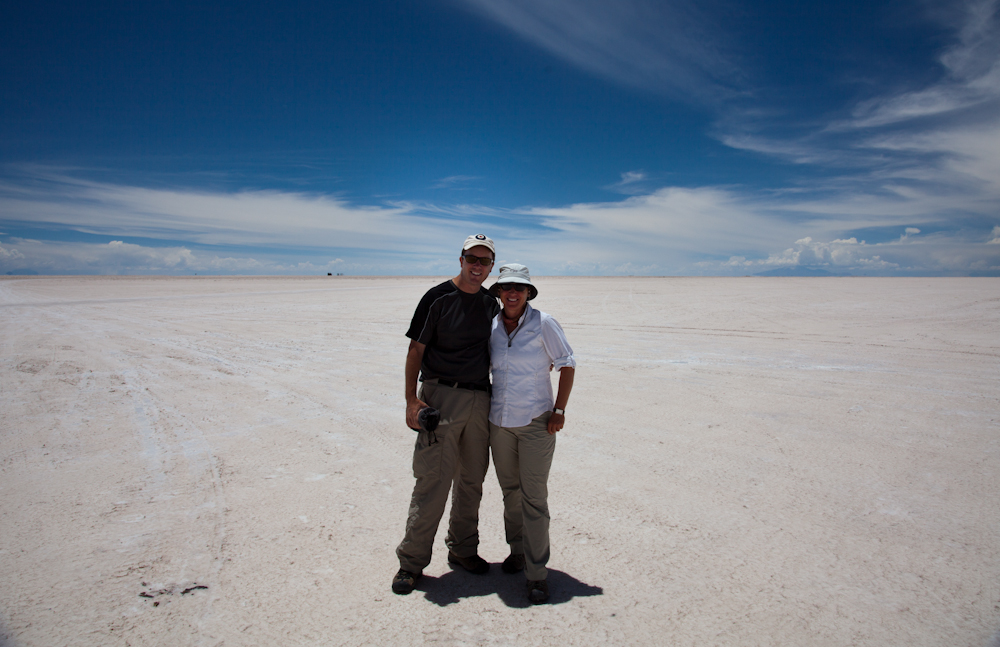
Walking on the salt flats was surreal; it was difficult to ascertain where the land ended and the sky began as it all blurred together on the horizon. It was very much like walking on a frozen lake; the texture, the crunch under your feet and of course the color all looked like snow and ice. As we drove further, we travelled through inches of water that covered the salt giving the appearance that we were driving on a lake. Without functioning wipers, our wind shield became so salt encrusted that it was impossible to see through. Walter tossed water onto the wind shield now and then to try to gain some visibility.
 Goofing off – does Chris have bionic legs?
 Our flag has seen better days.
 Driving along the salt flats.
 Dry salt flats.
 Salt flats under a few inches of water.
 One of the other dozen or so trucks that were doing the same tour as us. We saw these trucks at every stop over the next three days.
We stopped for lunch and a hike on Fish Island (so named because of its shape); this island would have been more aptly named Cactus Island in my opinion as the island was home to hundreds of huge cactii, some older than 1,000 years.
 Walter checked out the truck whenever he had a chance.
So far, so good.
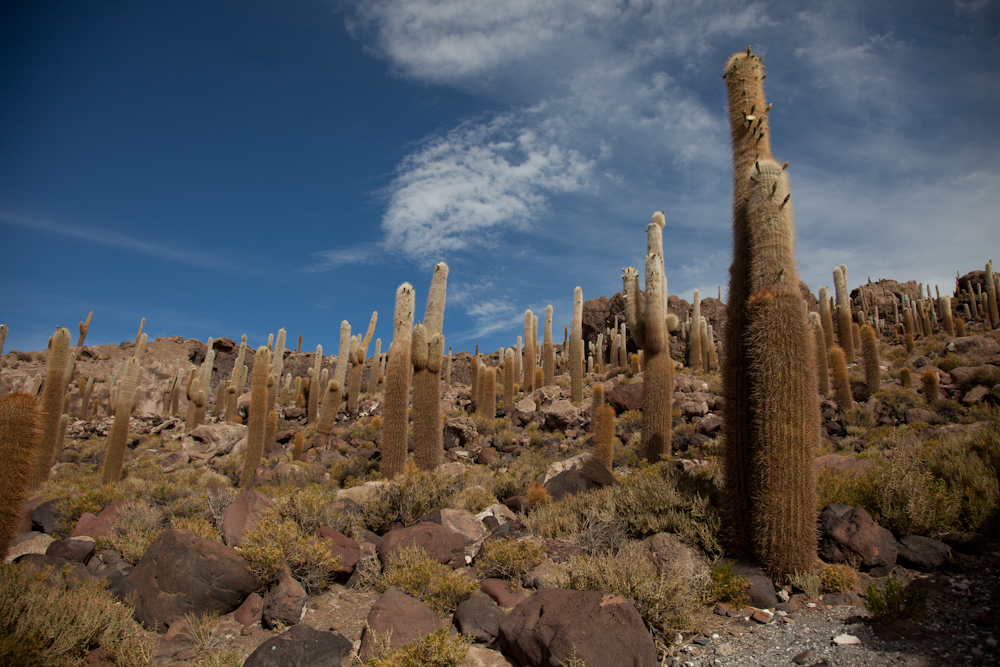 Cactus on Fish Island
 Donatella and James checking out the island.
 Giant cactus!
 Salt along the edge of the island.
 View from the top of the island, watching more trucks arrive.
Apart from the few stops we made, much of the day was spent travelling in the Land Cruiser over the salt flat. To my surprise the truck held up quite well. No breakdowns or flat tires. We rolled into Bellavista around 6:30 where we would be spending the night. On our arrival, we were greeted by a woman who announced there was no water whatsoever. No showers. No running toilets. No sinks. With this news, we got a glimpse of Donatela’s fiesty Italian heritage as she adamantly refused to spend the night in a place without water. There was a lot of discussion between her and James in Italian, and then between James and Walter our driver, and then, the next thing we knew, we were packing up the truck again and heading out on the road towards San Juan, just as the sun was setting, a 45-minute car ride away. Chris and I would have stayed at Bellavista; we didn’t even find it all that bad and figured we could survive one night without water. I was feeling a little concerned for our driver, Walter, who was not a young man (I estimated he was close to 70). He had been driving all day; he must be tired, and now he had to drive another hour in the dark along the worst roads we have ever been on.
As the sun set, the temperature dropped significantly. Guess what – no heat in the car! About fifteen minutes outside of Bellavista, in pitch darkness and freezing temperatures, the truck broke down. I jokingly said: Bellavista isn’t looking so bad now, is it? Chris thought that was hilarious, but both James and Donatella did not see the humour in it. They were upset. More than upset. They were angry. The italian words began flying again. Walter asked if anyone had a flashlight – we were the only ones who did (thank goodness). Chris and I got out of the truck and waited outside as Walter tinkered under the hood. It took him about 45 minutes; during that time, Chris and I were considering the options. We could walk back to Bellavista or spend the night in the truck. To my astonishment, Walter got the truck working again. And we were off.
As we bumped along the road at the furious pace of 35-40 km/hr, we slowed down as we passed each road sign where Walter had the cook read out the places on the sign; we were comforted to see San Juan each time……until we reached a sign that did not have San Juan. Walter was incredulous – he asked the cook several times – No San Juan? No San Juan? No, we took a wrong turn and now we were lost. In the middle of freaking nowhere. In the freezing cold. By now, James and Donatella were silent, which I think was worse that the noisy exchanges between them – they were just fuming in silence.
 At 11:00 pm, we rolled into San Juan which seemed to be a rather sizeable town, and into the yard of our hostel. The entire town was pitch black, as was our hostel. There was nobody there. I kid you not, this place looked like a prison or a concentration camp. A row of tiny cement block rooms with two cots in each, bare light bulb in the middle of each room, with shared, so-called bathroom facilities at the end of the hall. Bellavista was looking like the Hilton at this point, an observation I chose not to share with Donatella. She was visibly upset and I actually felt sorry for her. She had never done this type of travel before and I could just imagine the culture shock she was experiencing. She was a city girl from Milan for goodness sakes. We were all dead tired but now the cook insisted on making us dinner although nobody really wanted to eat, and Walter continued to work on the truck late into the night. It was after midnight before we hit the sack. Our cots felt quite comfortable, and we slept like babies throughout the silent night.
 A new low in accommodations. But we had running water!
 Our truck at the end of Day 1 – will it make it to the end?
Day 2
I always say that things look better in the morning…..well in this case, in the brightness of daylight, the so-called bathroom looked far worse. Regardless, Chris and I had a quick shower, and surprisingly, the water was hot and the pressure was good. It was one of our best showers thus far in South America, as long as you ignored the filth and decay around you. James and Donatella broke down and used the bathroom facilities, even having a quick shower together. Breakfast was comparable to any breakfast served in prison (or at least what I imagine you would get if you were in prison – but come to think of eat, prisoners probably eat much better). We had dry buns with margarine and jam and tea. A bowl of scrambled eggs was on the table when we sat down but the eggs smelt so vile, no-one but James dared to try them.
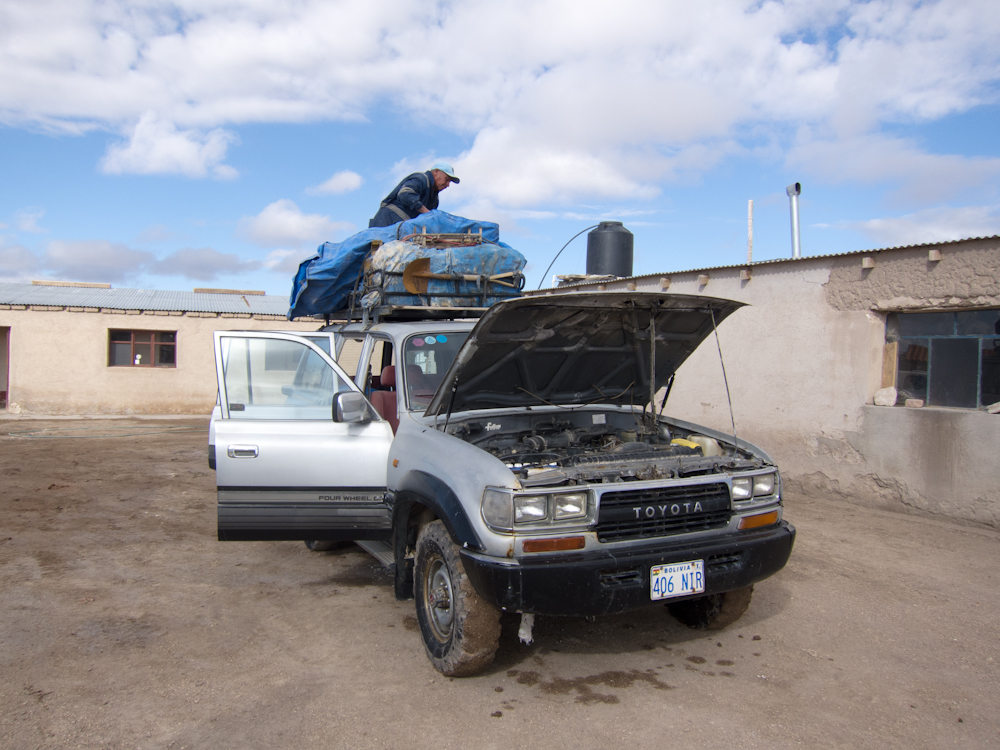 Walter had washed the car sometime between midnight and 6:00 am. He’s on top, loading it up as we get ready to start Day 2.
Accommodations are in the background.
We were on the road again by 8:00. The day was spent travelling along the bumpy, dusty roads through the desert of southern Bolivia, admiring tiny lakes of different colours, all home to hundreds of flamingoes.
The scenery was magnificent, and the sight of large flocks of flamingoes made us think of the measly five flamingoes that we saw on the Galapagos Islands.


We passed by many strange rock formations, including the Arbol de Piedra, a rock that is in the shape of a tree.

We also saw heards of llamas and vicunas, an animal that resembles a small llama.

At one point we stopped to take pictures of a rock formation where we also saw the vizcacha, a small desert animal that resembles a rabbit.

Little did we know that Walter would take this opportunity to do a rear brake job on the truck. That’s right. Before we knew it, the back wheel was off and the brakes were dismantled on the desert sand. We didn’t even know we had a brake problem. Chris and I climbed the rocks for a while and then wandered out into the desert and did a goofy video. There wasn’t much else to do as we waited for Walter to put the truck back together again.
 Not looking too good.
 Watching the other trucks come and go as we wait
for our truck to be repaired.
 Walking in the desert alone – it was windy, cold and oh, so peaceful.

We stopped for our second night at the edge of Laguna Colorado. I always say that things are relative, and they can always be worse. And sure enough, conditions on that second night, far surpassed the deplorable conditions of the first. There were many people staying here, and everybody had to double up in the available rooms. So the four of us picked our beds in our dormitory style room. We offered the double bed to James and Donatella and they didn’t refuse. Oh, did I mention there was no running water. And we were filthy, covered in dust from head to toe. Donatella wanted to leave right away and go back to Uyuni, she didn’t care what it cost. Unfortunately, we were 8 hours from Uyuni and there was no transportation available that night. She had to just suck it up and deal with it, something she didn’t accept very graciously.
I haven’t mentioned anything about the food. Things started off quite well, with a delicious pasta and chicken lunch on the first day. Even then, my stomach was a little off after that meal. Soon it became apparent to me that our cook was carrying our three day food supply in her cooler – with no ice – including meat. Even after three months in South America, my stomach is not made of iron. After each meal, my digestive issues became worse until I was eating the barest amount necessary to stave off my hunger pains.
We survived our second night – James and Donatella slept in their clothes, ready to get the hell out of this hell hole at the crack of dawn, literally.
Day 3
We awoke before dawn and were on the road at 4:30 am in order to visit a few more sites before dropping us off at the Bolivia-Chile border and ensuring there was enough time to get James and Donatella back to Uyuni in time for them to catch their overnight bus back to La Paz. It was freezing cold, probably below zero. Our warm hats that we bought in La Paz served us well. First stop was the geysers, followed by a visit to the natural hot springs where we had breakfast from the back of the truck – two pancakes each and a cup of tea.
 Breakfast from the back of the truck.
 These geysers were hot!
One final stop to take in the Laguna Verde (green lake) and then we headed off to the border. We were only a half hour from the border when we had to cross a small stream that had washed over the road. Can you guess what happened next? Our car decided to die in the middle of the stream. I felt Walter’s pain as he groaned under his breath, Ohhhh nooooo. Walter spryly climbed out of the truck, onto the roof of the car and over the hood. He managed to fix the car without even getting his toes wet. Not bad for an older guy!

In short order we were deposited at the border where there was a Bolivian Immigration Office, quite literally in the middle of the desert.
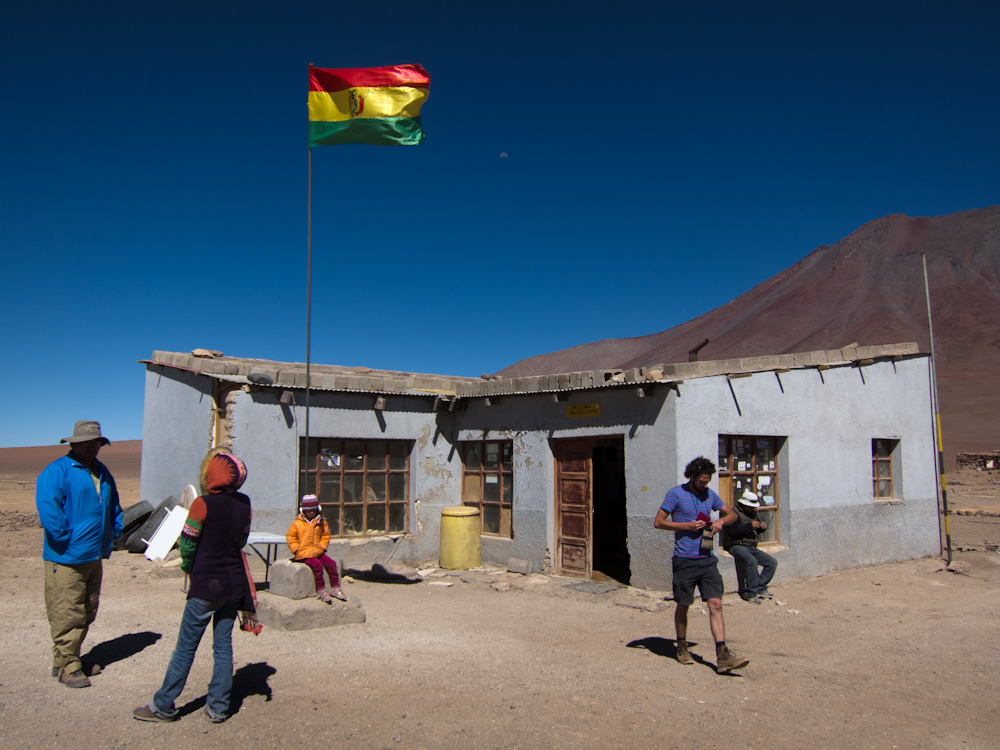 Bolivian immigration office.
With our passports stamped allowing us to leave Bolivia, we waited for the bus that would take us to San Pedro de Atacama, Chile. We bade farewell to our fellow travellers; I hope they made it back to Uyuni without incident. I don’t think Donatella could take much more.
Travel Tip: If we could do it again, we would only do the one day salt flat tour. While we saw some interesting sights during the second and third day of our tour, the highlight was the salt flats on the first day. You can save yourself some potential discomfort, time and money by just doing the one-day tour.
 Border crossing between Bolivia and Chile.
The gate was always up, receiving vehicles both ways.
UPDATE: We just added a video of our 3-day tour reduced to 13 minutes and 49 seconds. Enjoy!
 Print Friendly


