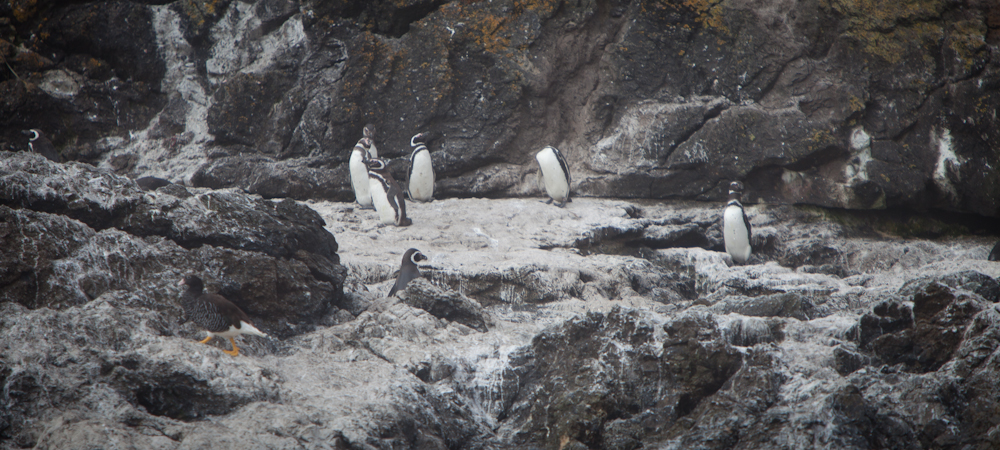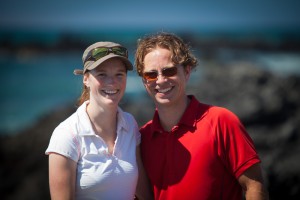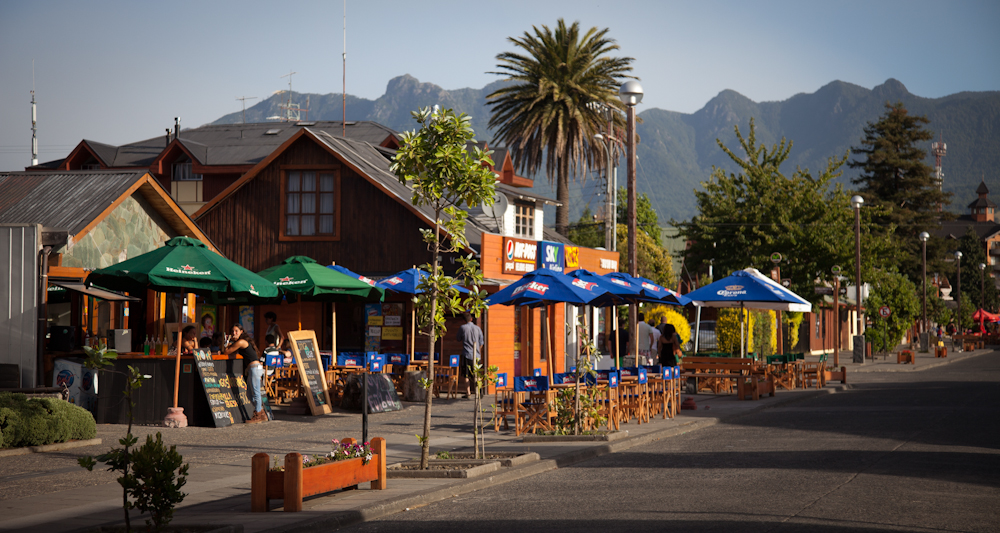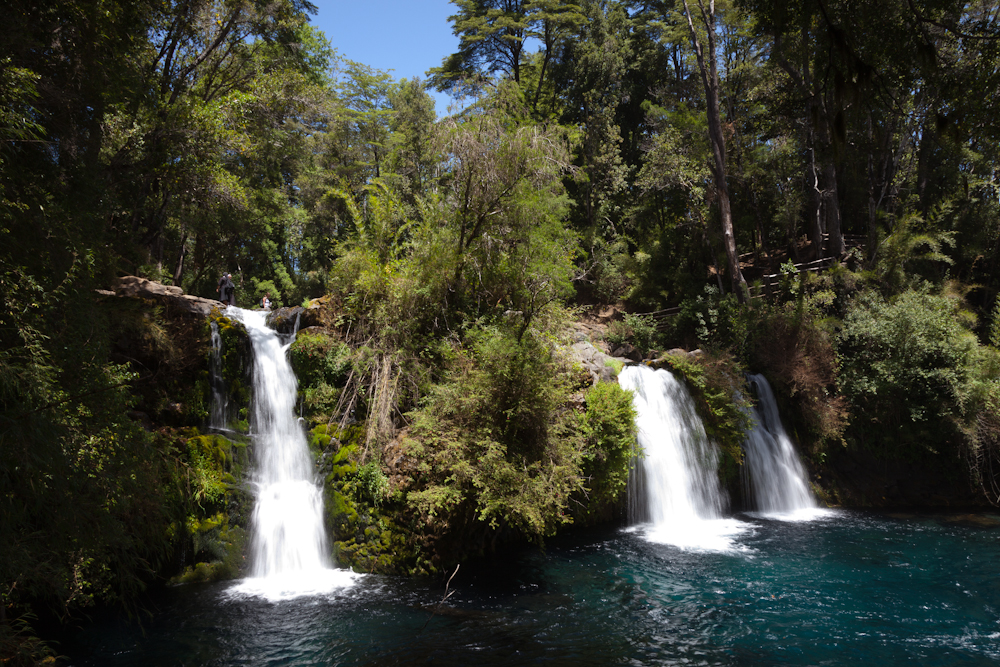
South America

Baby it’s cold down here

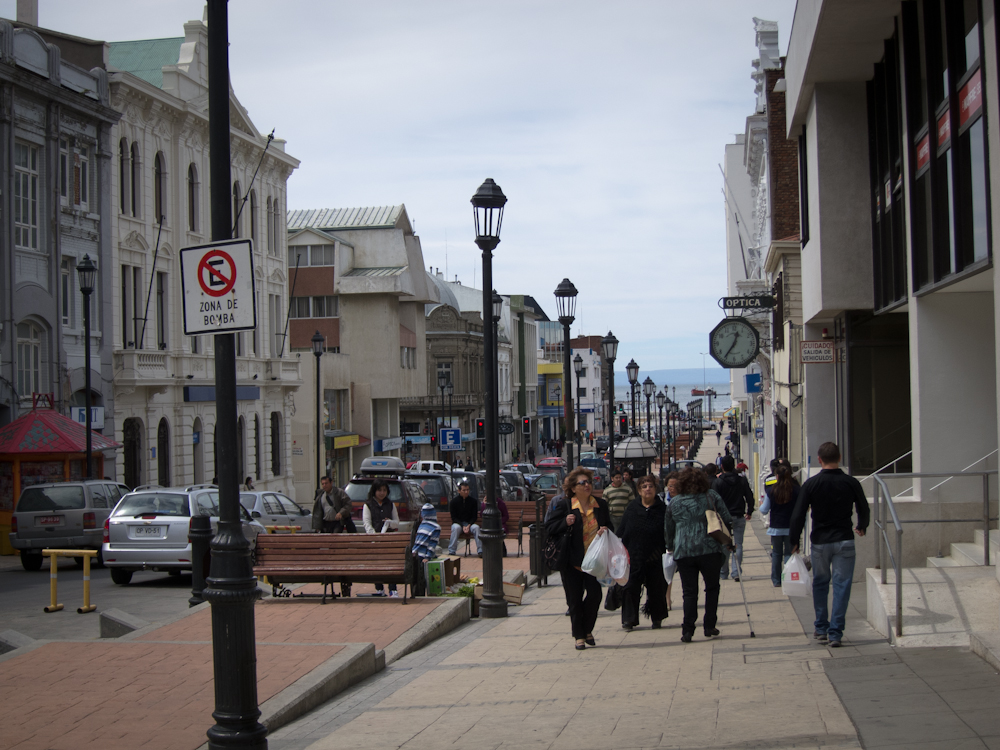
As we stepped off the plane in Punta Arenas last Thursday, we were greeted with a definite chill in the air.  Maybe not as cold as Canada, but definitely the coldest weather we have experienced so far. Daytime temperatures were in the mid-teens if the sun was out, probably closer to ten when it was cloudy. At night, it dipped below zero.  Is anybody feeling sorry for us yet?  I didn’t think so.

As we pulled up to our hostel, La Estancia, the peeling paint and faded sign did not exactly exude warmth and comfort.  On the inside, more peeling paint, worn out carpets and creaking floor boards gave us a sinking feeling.  But all this changed when we met Alejandro, or Alex, the hostel owner.  He warmly greeted us and made us feel so welcome. He helped us get oriented and even made all the arrangements for our tour to a penguin colony the next day (more about that in a separate posting).

Our spotless room was very large with three comfortable single beds (we pushed two together to make a king sized bed – luxury), all covered in thick blankets and down duvets.  We had a TV with English channels (unheard of to date) in our room in addition to WiFi. The towels were extra large and extra thick, another rare indulgence. Each room had newly installed heaters and the common areas were also heated; a must in this climate, but not a very common sight in Chile.  We had access to the kitchen, including a fridge.  To top it off, they served unlimited, extra large mugs of real, filtered coffee with breakfast.  We couldn’t remember the last time we had real coffee in a hostel.  Instant Nescafé is the South American favourite. All this to say, you can’t always judge a book by it’s cover.  All of a sudden, this old, worn out 1920’s era house felt warm and cozy like a comfy old pair of slippers.  It served as an excellent base from which to explore the area.

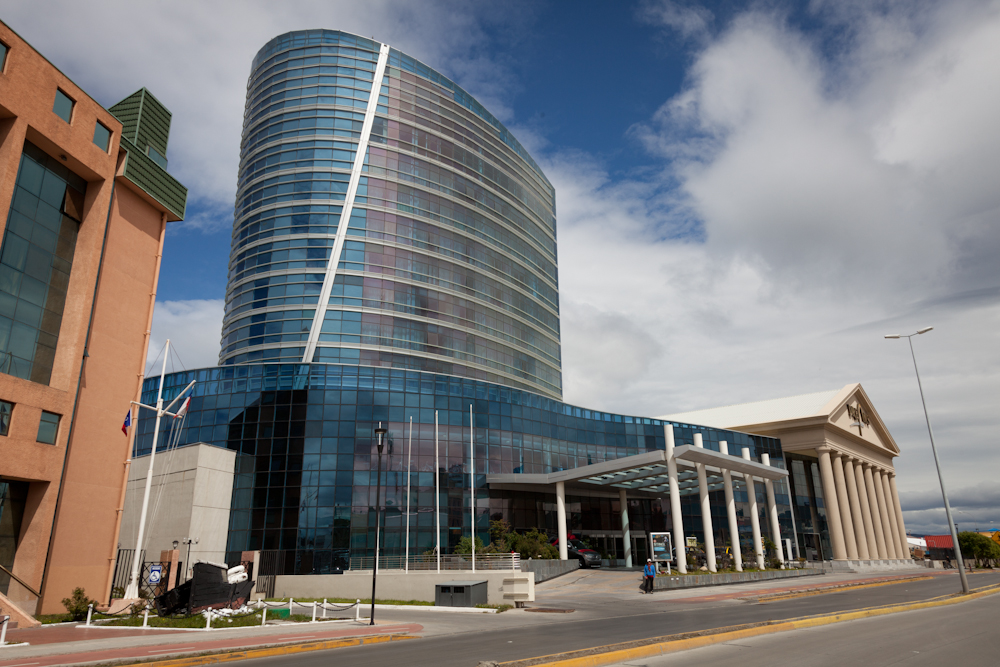
Punta Arenas is the largest city south of the 46th parallel south with a population greater than 154,000. The city is vibrant and modern.  In the summer (which is now) the city can get dangerously windy to the point where city officials put up ropes in the downtown area to assist with unique wind currents created by the buildings.  It was rather calm during the few days we were there with a mix of sun and cloud each day. When it was cloudy, it felt a lot like a day in late October in Ottawa….brrrrrr. Unlike Ottawa, we are enjoying very long days – it doesn’t get dark until about 10:45 at night and dawn begins around 4:30 in the morning.  It’s deceiving and a little disorienting at times.

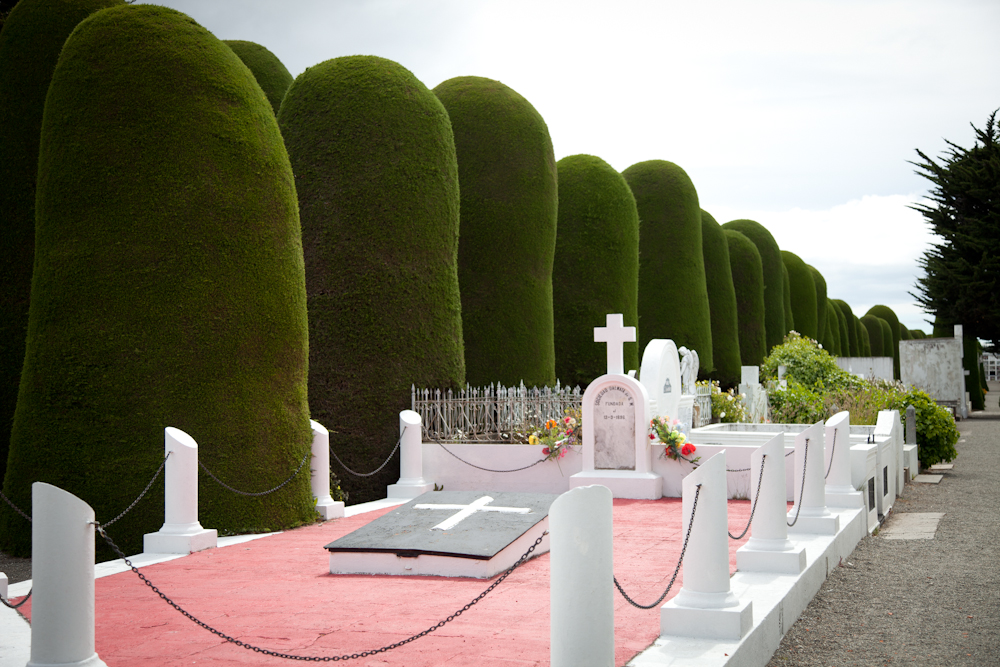
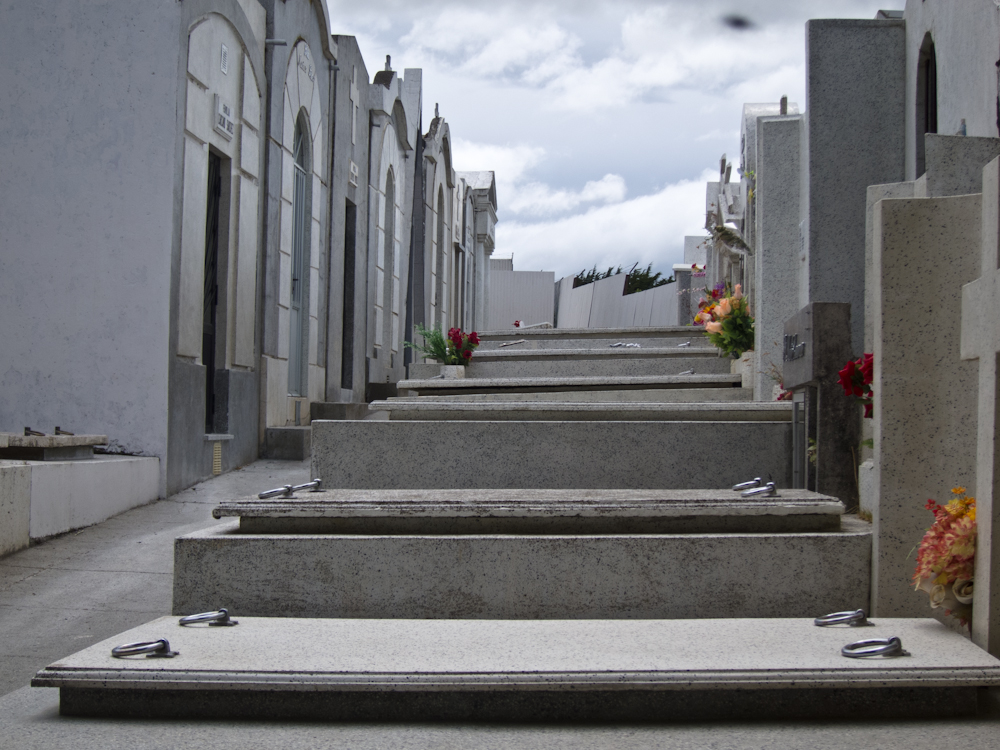
We spent some time exploring the city, wandering around the harbour and malecon as well as the Plaza des Armas. The cemetery in Punta Arenas resembled the one we visited in Guayaquil, Ecuador and is similarly called the White City.  It was impressive.

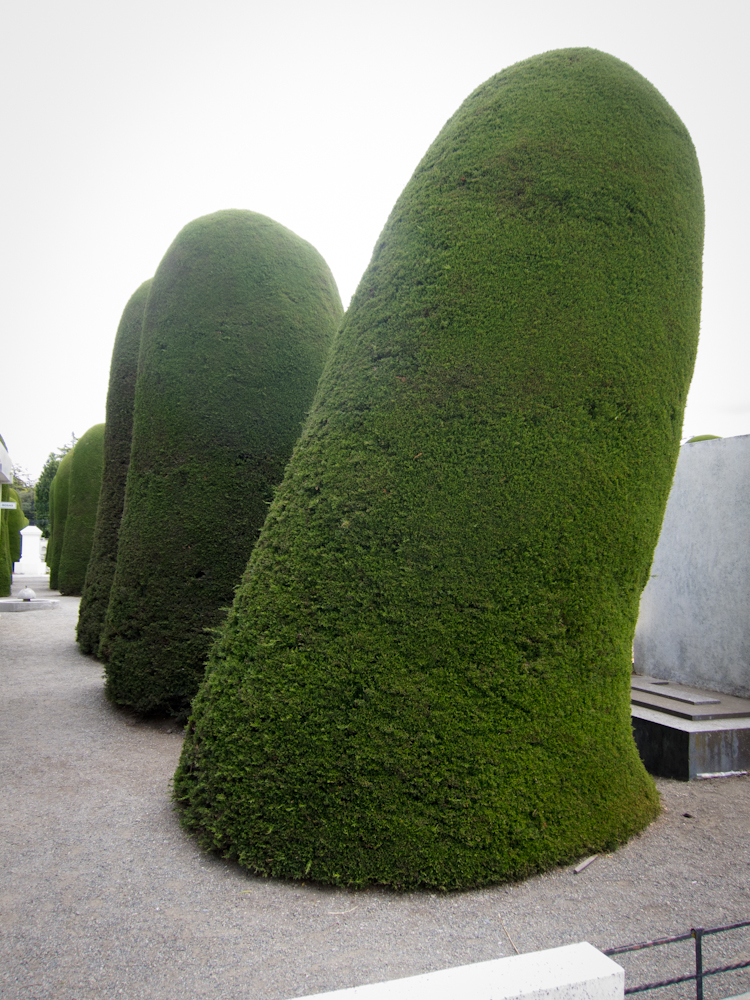
Perfectly trimmed European Cypress trees stood like sentries in the city cemetery.

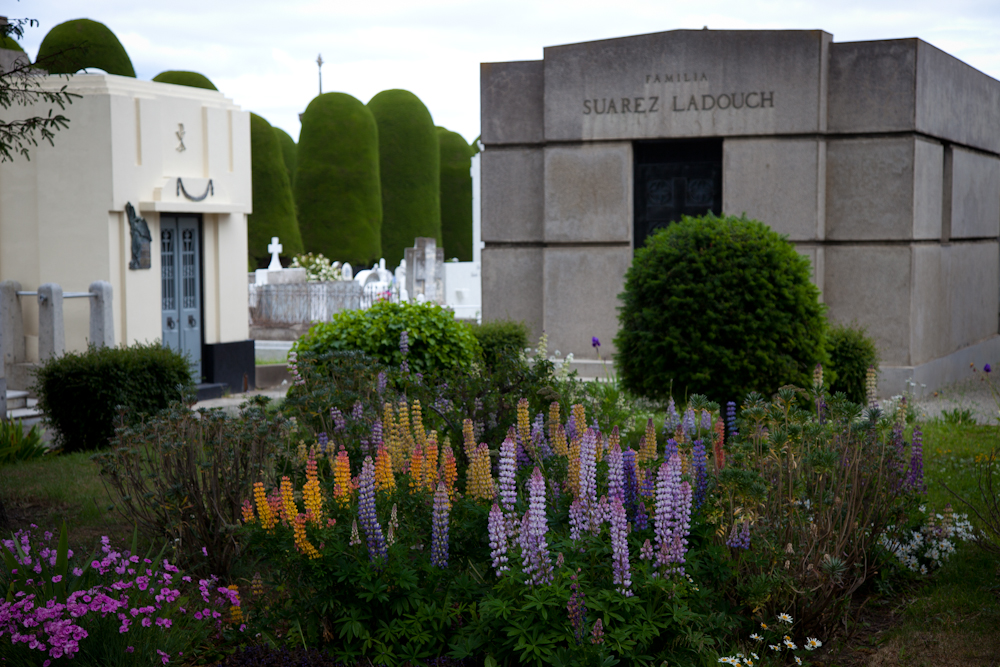
Tombs in the municipal cemetery which was founded in 1894.

These European Cypress trees were perfectly manicured,
even though they were not always perfectly straight.

We were surprised to see flowers such as lupins and roses growing
abundantly everywhere around town – on the side of the road,
in people’s gardens as well as here in the cemetery. 

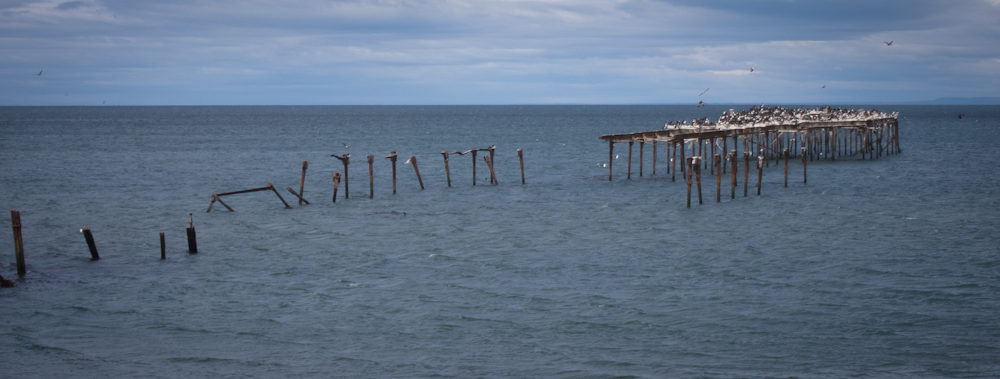
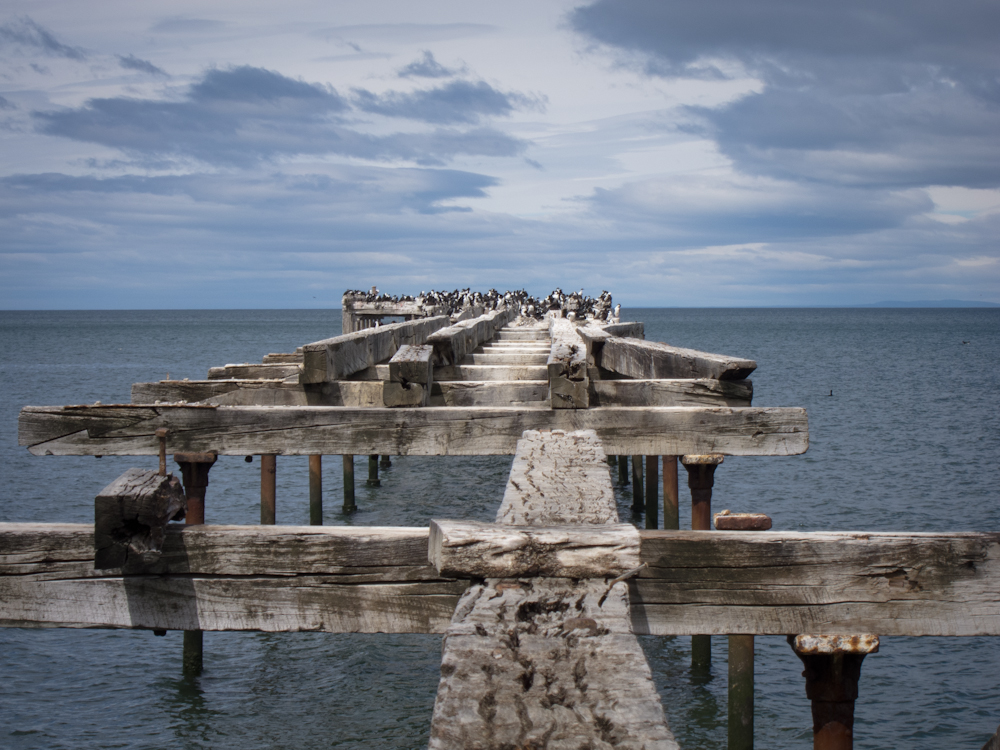
This old dock had seen better days but it made a
great perch for hundreds of seagulls.

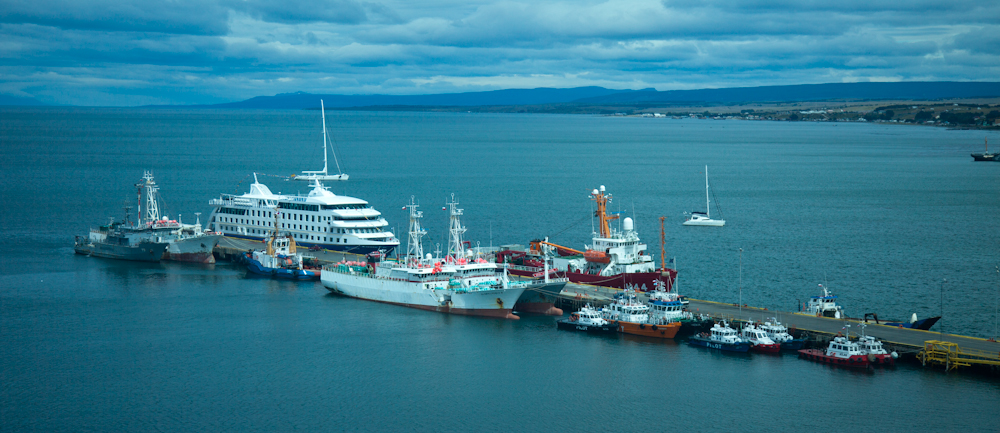
Boats docked in the port.

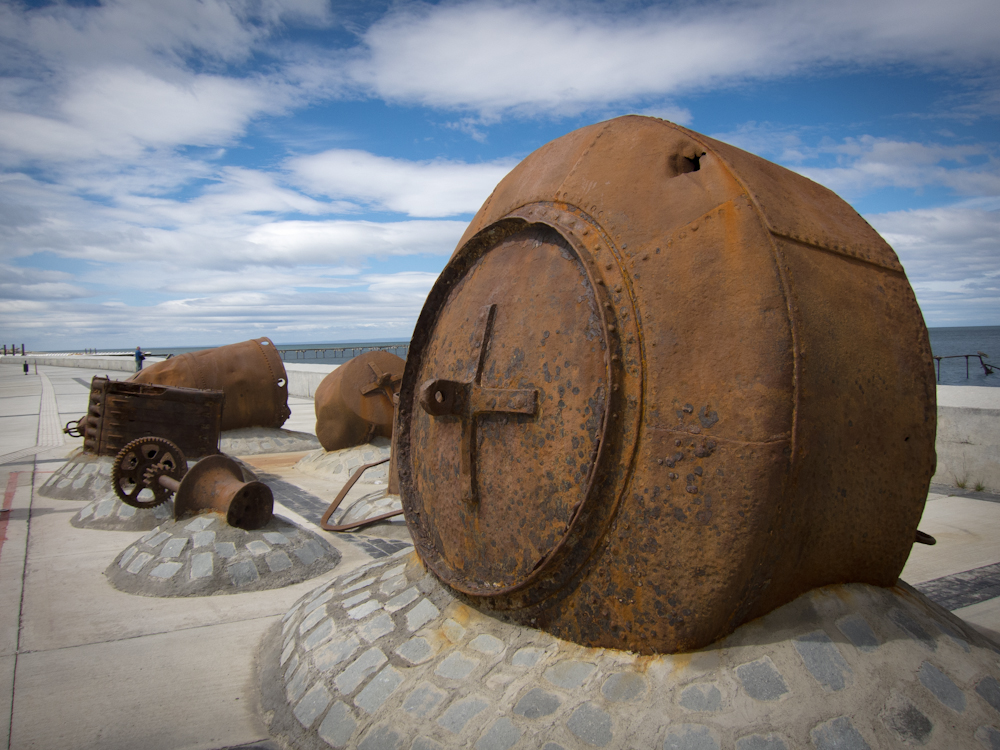
A nautical monument in honor of the past.

As I walked along the old beams of this dock for a short distance
over the deepening sea,  
the strong wind sent ripples
along the surface of the water below making me a little

dizzy and wobbly, but I kept going and I didn’t fall in! 

Originally we had planned to stay in Punta Arenas for just a day to visit the penguin colony and then head north to Puerto Natales from where we would organize ourselves for our camping trip in Torres del Paine National Park.  Unfortunately, a forest fire has been burning in the park since just after Christmas. This has caused quite a raucous here in Chile since we are now in high season and that park attracts millions of tourist dollars at this time of year.  An Isreali tourist is being blamed (and charged) for starting the fire, an action he is vehemently denying.  This is serious stuff – the tourist has been detained and if found guilty will go to jail and be ordered to pay a fine.  Right now, part of the park has been re-opened but the fire continues to burn and fire fighters are still working day and night trying to put it out. We think it is still a precarious situation since any change in wind direction or strength could put the rest of the park, and tourists, in danger again.

So, we’ve decided to hold off on visiting the park, and go to Ushuaia, Argentina instead.  We will then circle back to Torress del Paine in a couple of weeks if the fire situation is resolved. At least we have the luxury of time on our side.


Side trip to Chiloé

Listed as one of the top ten islands to see before you die by Yahoo Travel, we were compelled to spend a few days exploring the Island of Chiloé which is separated from mainland Chile by a 30-minute ferry ride across the Chacao Channel.  The island is renowned for its sixteen wooden churches which have UNESCO World Heritage status.  The churches are clustered around the capital, Castro on the island’s east coast.  The traditional palafitos (houses on stilts), distinctive folklore, mythology, cuisine and unique architecture contribute to the island’s appeal.

The island is 190 km (118 mi) from north to south, and averages 55–65 km wide (35 to 40 mi).  Chiloé is located about 80 km south west of Puerto Montt which was the city from which we were flying to Punta Arenas on January 5th.  We decided to reduce our stay in Pucón in order to have a few days to explore this island, which was again recommended as a “must see” by many travellers we have met.

On January 1, we travelled from Pucón to Chiloé, with a bus transfer in Puerto Montt.  When we took the ferry across, we were delighted to see dozens of dolphins swimming alongside the boat, breaching right in front of us.  We even saw a few penguins bobbing to the surface now and then. Closer to shore, we spotted a group of sea lions sunning themselves on a wooden raft. And then we caught a glimpse of a flock of black necked swans, creatures I have never seen before.   What an unexpected spectacle!

We spent the first two nights in Castro, followed by two nights in Ancud, a town on the north west part of the island. Again, we enjoyed perfect weather: warm, sunny, cloudless days.  Considering that for 75% of the year, this island is shrouded in mist and rain, we were incredibly lucky.

View from our hostel, El Mirador (white building to the left of Chris) in Castro.
Our room faced the water offering a gorgeous view, but the hostel
itself was old and worn out and wreaked of stale smoke.
It reminded Chris of his grannie’s house when he was a kid.

Out hostel in Ancud, Nuevo Mundo, was lovely – huge room (queen bed) with
cathedral ceiling with large bay window overlooking the water.
This hostel had the cleanest kitchen we have seen so far
and offered beautiful and comfortable common areas. 

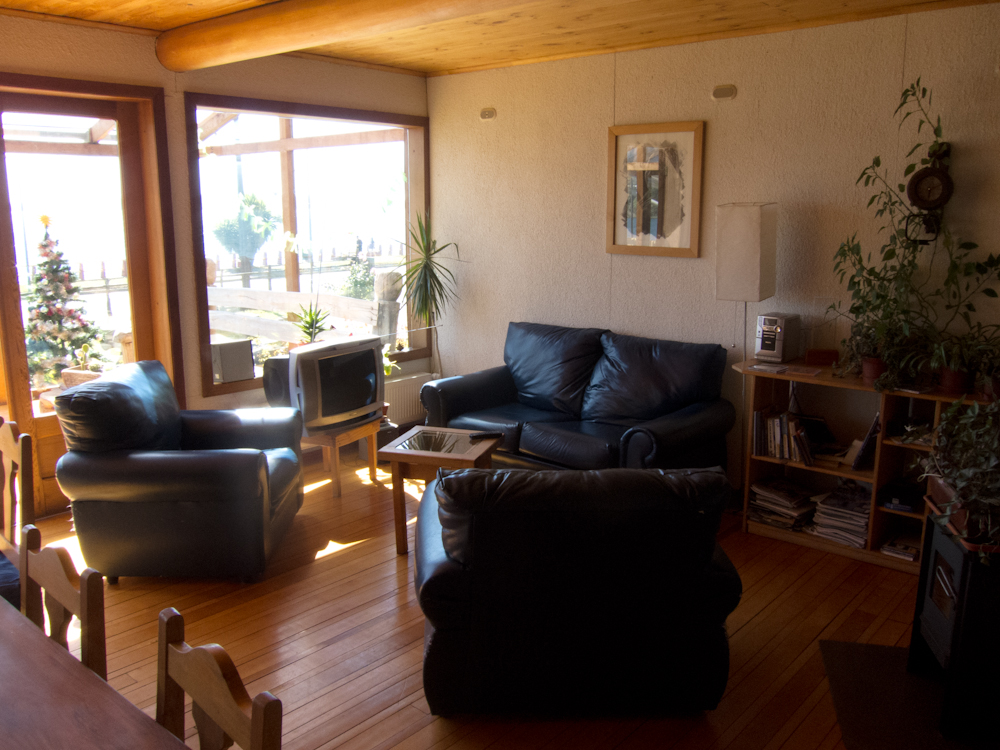
Nuevo Mundo on the inside.

Throughout our visit on the island, I kept trying to figure out what all the fuss was about. Sure, it had lovely, picturesque landscapes of rolling hills, meadows of wild flowers, healthy livestock grazing contentedly…… but it really could have been anywhere in rural Ontario as far as I was concerned.  The little towns and villages that dotted the coast reminded me of Atlantic Canada. Again, very pretty, but also very similar to home.  Of course, we observed subtle differences like the unusual patterns of shingles used as siding on the houses.

A typical house on the island.

One of the famous churches; this one was in Achao, a small fishing village
we travelled to by local bus for an afternoon.

The pier and beach in Achao while the tide was out.

Colourful houses on one of the main streets in Castro.

A common scene when the tide was out.

Many of these boats were badly in need of repair.

Chris was fascinated by the technique being used to repair this boat:
one guy wedged string between the new boards using a hammer and chisel,
and the other guy applied some sort of a putty or seal on top,
followed by a thick coat of paint.

The language was different too, in fact, completely different from mainland Chile which left me puzzled and frustrated in equal measure.  Ordering food became such an ordeal – I could not understand the menu and then I could not understand the waitress who tried to explain the menu – towards the end, I resigned myself to eating salmon for several meals because that is all I could recognize on the menu. I know, no sense of culinary adventure, but what can I say, sometimes, I just want to eat something remotely familiar. We did get our fill of seafood and enjoyed a few local dishes that were very good.

Perhaps a visit to the cove of Puñihuil, home to two types of penguins, Humboldt and Magellan, would knock our socks off.  We were certainly amazed by the sudden change in weather as we approached the western side of the island.  Within minutes, we went from warmth and sunshine to heavy mist and cold wind.  This shift in weather completely changed our impression of the landscape; suddenly it all looked very mystical and mysterious.  Maybe our grand weather was a curse after all!

We spent about twenty minutes in a small boat visiting three tiny islets just off the shore line where we observed a few dozen penguins along with a variety of birds.  This may have been impressive if we had never seen penguins before; perhaps the Galapagos Islands have forever ruined us.

A short video of our visit to the penguin colony.  


While we didn’t feel the magic of Chiloé, it was a very pretty island and our few days meandering around the island were relaxing and quite enjoyable.  On Thursday morning we left bright and early to head back to Puerto Montt where we would catch our flight to Punta Arenas, located in the southern most region of Chile.

Example of the palafitos, houses on stilts,
with a flock of black neck swans in the foreground.  

These swans are smaller than the swans we have at home
with distinctly black necks and white bodies.
Unfortunately, I think they had all dunked their heads in the water just as I took this picture!

A new year, a new look!

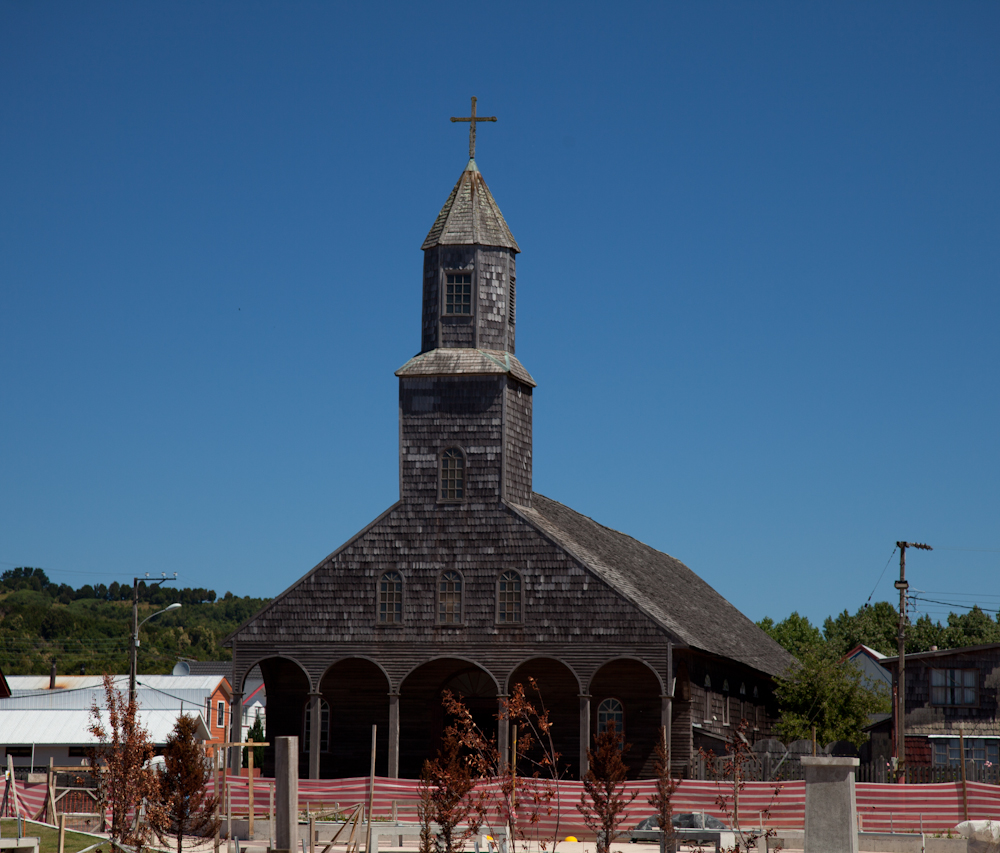
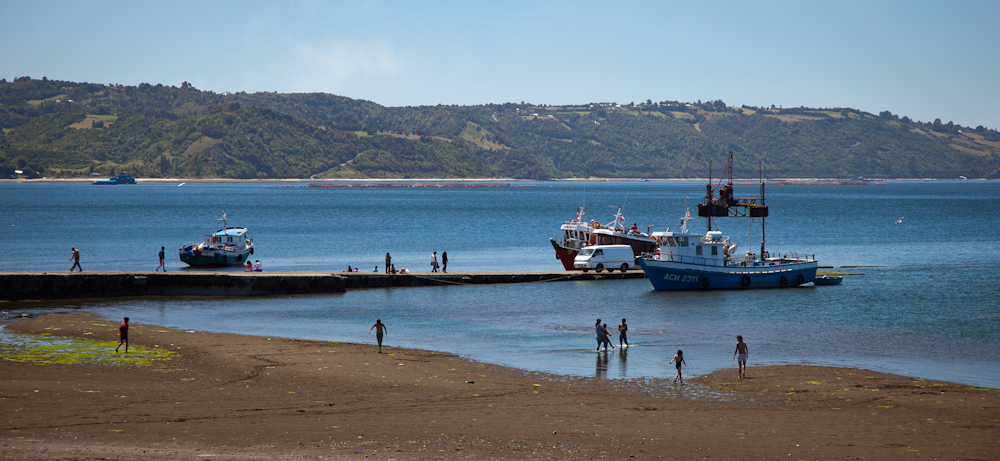
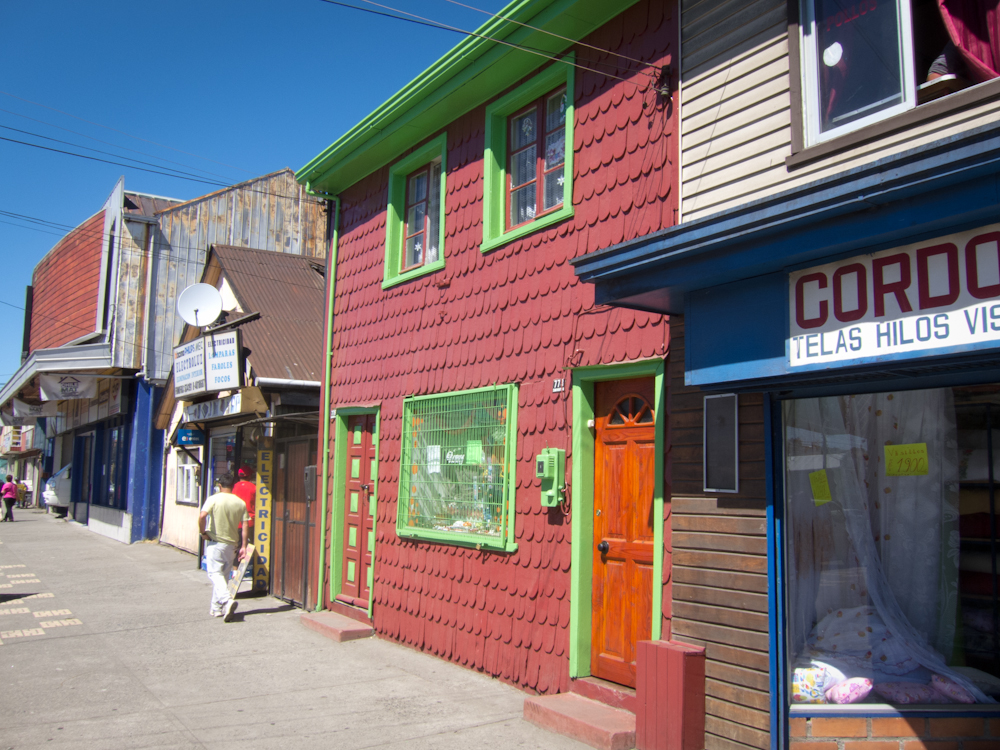
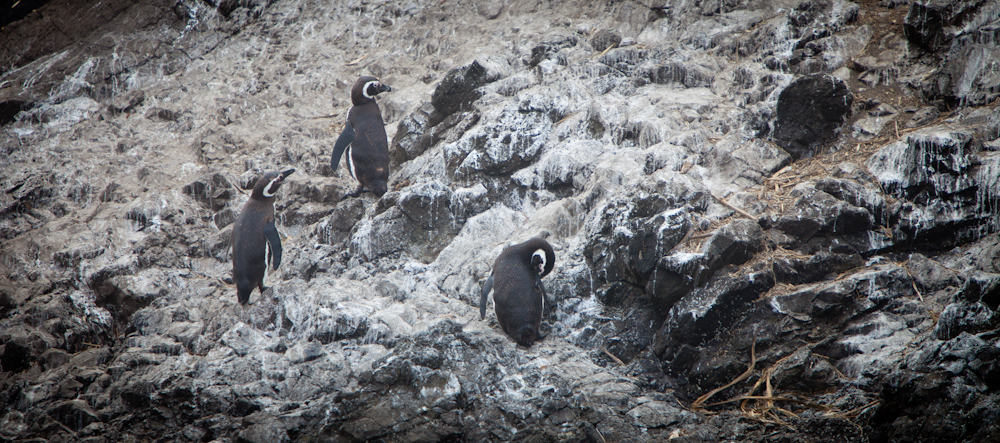
A big thanks to our friend Daphne in Holland (pictured to the left with her boyfriend Jasper) who customized the header on our website with personalized images from our recent travels.  We think she did an awesome job and we’re thrilled with the new look. Daphne is a young web designer with clearly lots of talent.  She did this on her own initiative and sent it to us as a gift.

If you’ve been following our travels, you may recall that we met Daphne and Jasper while on our Galapagos cruise which seems like ages ago.  They were the young couple that joined us on the second day of the cruise.  It was Daphne who took all the great underwater shots when we were snorkelling.  We hit it off with them right away and ended up spending time with them after the cruise too.  In fact, we kept running into them so often that we jokingly accused each other of stalking.  It was downright bizarre when we ran into them weeks later while watching the Mama Negra parade in Latacunga.   Such a small world out there.

Thanks again for a wonderful gift; it’s one we’ll enjoy all year long!

Happy New Year!

I think we’re going to remember the last day of 2011 for quite some time as it’s not every day you climb to the brim of an active volcano that is covered in snow, and then slide all the way down on your bum. But I’m getting a little ahead of myself.

We arrived in Pucón last Thursday morning after a pleasant 10 hour (780 km) overnight bus ride from Santiago.  Pucón was added to our itinerary on the recommendation of many travellers we have met over the last couple of months.  We’re glad we listened to the advice of so many strangers.  As we neared Pucón, we felt like we were travelling in Ontario cottage country; it all looked so familiar, from the landscape to the types of trees to the style of houses.  It was like the mirror image of Ontario in the Southern Hemisphere.  We felt so at home.

The town of Pucón reminded us of Banff in the summer time.  This was obviously a tourist mecca that offered outdoor enthusiasts plenty of options. In the winter, people flock here for the outstanding skiing and in the summer, for the biking, rafting, hiking, kayaking, fishing, birdwatching – you name it, you could do it here.  Located on the shores of a huge lake, it offered swimming and boating too. The beach was made of coarse stone that resembled gravel, but that didn’t stop the tourists from sunbathing and swimming.  The town was bursting with restaurants, bars, and boutiques, and gorgeous flowers everywhere.  We loved this place, the energy, the atmosphere, the whole look of the place.

We settled into our hostal, called Ecole, which we loved – felt like we were in a cottage with our pine panelled room. We spent Thurday exploring the town and checking out the adventure options.  We decided we would go mountain biking on Friday and then hike the Villarrica volcano on Saturday.

Little did we know our cycling route would be so strenuous that we could barely walk our bikes up many of the hills – probably not the wisest thing to be doing before a major hike.  Our goal was to cycle to the Caburgua waterfalls, supposedly an easy 20 km bike ride from town, or at least that was how Chris understood it when he got directions.  But first, we got lost and went about 5 km down the wrong road.  Getting lost seems to be something we do quite easily these days, whether on foot or on a bike!

Once we found our way, we enjoyed the stunning views – snow capped volcanoes served as a backdrop to picturesque meadows with sheep and horses grazing contentedly.  We were exhausted by the time we reached the waterfalls and wondered if we could somehow hitch a ride back to town like we had done on our Baños bike trip – but no such luck. We were pretty exhausted by the end of the day – it was much more challenging that we expected and we were wondering if we were doomed for our hike the next day.

The water was icy cold – too cold to swim.

Back at our hostel, enjoying a well deserved “cerveza” after the bike ride.

After biking, we headed over to the shop to get suited up for the big hike.  There we learned we were part of a large group – close to thirty people plus all the guides.  The next morning, we met at the shop at 6:45 am and by 7:30 we were at the base of the mountain trekking to the chairlift.  Taking the chairlift was optional but highly recommended; everyone in the group took advantage of this option.  We were surprised at how high we already were once we got off the chairlift.  We donned our helmets and listened to the instructions on how to use our ice pick to stop ourselves in case we lost our footing and started to slide down the mountainside out of control, a visual I didn’t really need.

A hot day ahead of us!

I’ve never used an ice pick before!

There were lots of other groups on the mountain that day which I wasn’t too thrilled about. It was downright crowded.  Guess it was to be expected as this was one of the most popular activities and it was the last day of the year.  We started the hike in single file, ascending at a slow, steady pace.  The first half was actually quite easy – we found the pace very slow and the slope was not too steep.  And our footing was quite secure in the snow.  All that changed in the second half when the pace remained the same, but the slope became much more vertical.  We were all huffing and puffing as we reached the top.  Imagine walking up flights of stairs for over 4 hours steady – you’d be huffing and puffing too.

Feeling good at our first rest stop – but we’ve barely begun.

Hordes of tourists making the trek.

About half way there.

Can you believe this slope?

Peanut butter and jelly sandwiches – yummy!

Caught with my mouth full.

Spectacular scenery even though visibility was obscured by the continuing
ash being spewed by a nearby volcano that had erupted six months ago.

Having fun with the ice pick.

It got very steep near the top.

We were warmed by the hot air emanating from the mouth of the volcano as we peered into the caldera. Toxic fumes took our breath away and seared our lungs forcing us to retreat a few feet, gasping for some clean air to breathe. As I walked along the rim of the caldera (leaving Chris behind), I was astounded by the views both within the caldera and the gorgeous 360 degree vistas in front of me.  You could clearly see the lava flows from previous eruptions, not to mention more volcanoes and mountains in the distance.

We made it!

Peering into the caldera.

The rim of the volcano.

The view from the top.

After celebrating our achievement and the end of the year with champagne, we prepared ourselves for the descent – which would happen on our bums for the most part.  Imagine a luge, you know the kind you see during the Olympics.  Imagine the track the luge travels on.  And imagine the speed it goes and the way it slides from side to side as it builds momentum. Now, forget about the luge – our bodies were the luge and when we needed more speed, we sat on little plastic sleds. Our ice picks and our own strength served as the brakes.  The tracks were like tunnels of snow carved into the mountainside.

We did a test run without the sleds, where we all slid down the first set of tracks at a pretty decent speed, but nothing too scary.  It was a blast.  I felt like I was ten years old again. There were four or five more segments to go, each of varying length and slope. It took a little bit of practice to get your form (sitting upright, knees bent and feet together – total ab workout), and to handle your ice pick without gouging yourself, but after the first leg, I felt confident that I could manage the rest.

After the second segment, I was terrified.  I was going so fast down that hill and using every ounce of my strength to try to slow myself down, I thought my arms were going to fall off.  At one point, I was airborne after careening over a huge mogul, landing off the track, creating my own track as I continued to barrel full speed ahead down the mountain. I was sure death would follow next, but somehow I managed to get myself back into the track without seriously injuring myself.  I have to say, that segment scared the crap out of me, and with arms aching with fatigue,  I didn’t think I had the strength needed to keep death at bay on the next segments.  I mustered up my strength and courage to keep going and was relieved that nothing was quite as daunting as that second segment, and the rest of the way down turned out to be a lot of fun, with only minor moments of fear and terror.

That hike and slide down the mountain did me in.  I barely had energy to get showered up and eat dinner before I crashed in bed at around 7:00 pm.  Chris followed closely behind.  We had set the alarm for 11:00 pm thinking we would get up and get out and join the New Year’s Eve celebrations; but when the alarm rang, we both awoke, mumbled we were both tired, turned the alarm off, rolled over and slept til the morning.  Happy New Year everybody!

Video of our trek to the top of Villarrica Volcano.


Christmas in Santiago

Santiago is the biggest, most modern city we have visited in South America thus far. With a population of more than 7 million inhabitants in the greater metropolitan, sprawling over an area of 58 km2, this city is huge. It boasts a sophisticated transportation infrastructure that includes an underground metro system that would match any North American city. This cosmopolitan city has extensive suburban development, dozens of shopping centers, and impressive high-rise architecture.  The city is also undergoing a building boom – cranes and construction sites were everywhere.

We stayed for one week in a very tiny apartment in the Santiago Centro district, about a 10 minute walk from the Santa Lucia metro station. We found the apartment on airbnb.com, the same place we found our Quito apartment.  The apartment was in an ideal location within walking distance to most tourist attractions and a 10 minute walk to the metro.  The apartment was somewhat disappointing; it was very compact (about the size of our old kitchen), the kitchen was minimally and rather poorly equipped, and the apartment was very noisy. Still, we were happy to be in an apartment where we could have some privacy and make our own food.  And it did give us a sense of how many Chileans live in the congested down town core.

View from our 16th floor apartment balcony.  It was congested.

While in Santiago, I was recovering from a rather nasty chest cold and had to spend two days in bed. We were also feeling some travel fatigue where we were just tired of playing the tourist.  This was bound to happen especially with the pace we’ve been following the last few weeks.  Frankly, I was in a bit of a funk probably from a combination of being sick and feeling a little homesick for family and friends over the Christmas season. So we took it easy this week, keeping our sightseeing to a minimum. We cooked a few meals in the apartment which was grounding for us too – a little taste of normal life.

When we were tired of just hanging out in the apartment, we walked around the down town area (Santiago Centro) and the popular Bellavista neighbourhood. We were impressed by this city – it is clean, safe, lively, and very modern. And of course Chilean wines were abundant and cheap, just $2-3 CAD dollars for bottles that retail for about $15 in Ottawa. We drank a lot of wine – that helped the funk too!

The Metropolitan Cathedral in the Plaza de Armas.

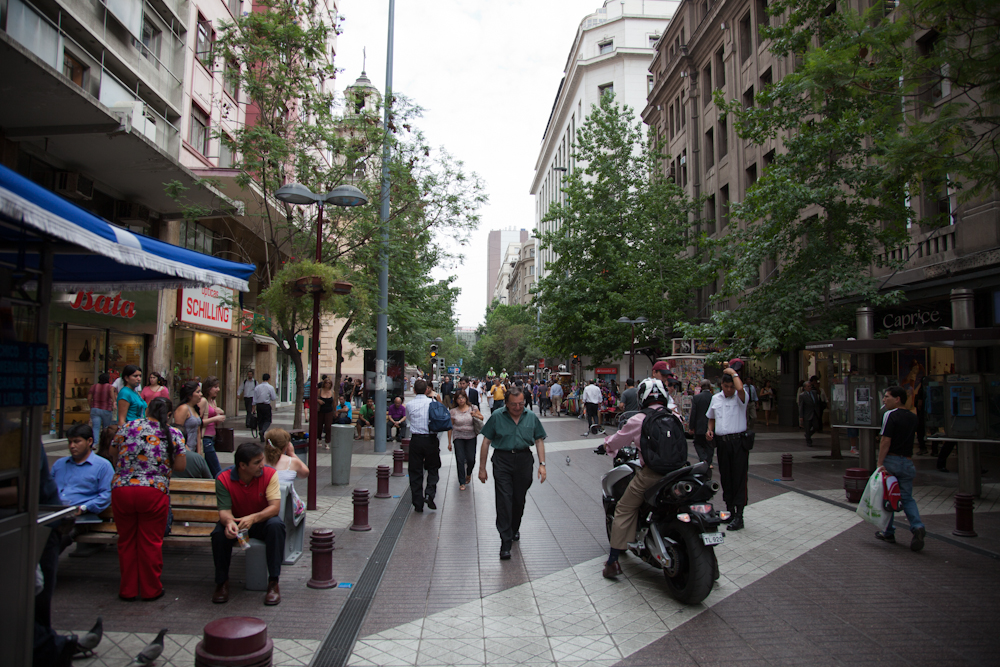
Common street scene: lots of people doing their Christmas shopping.

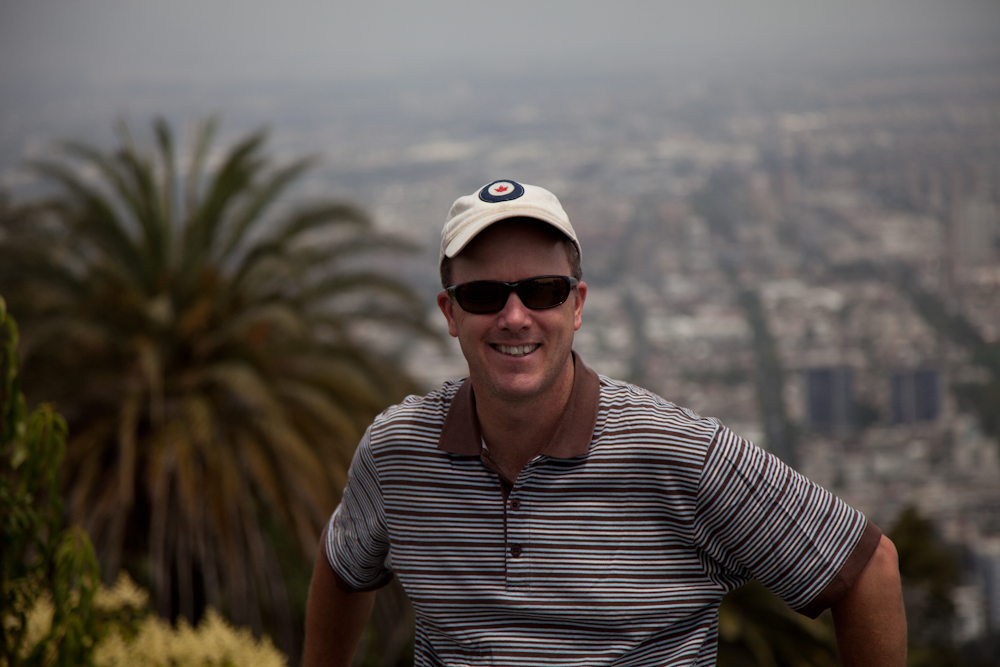
At the top of Cerro San Cristóbal – great views of the city,
and I think Chris looks pretty good too. 

More views from the top of Cerro San Cristóbal.

The statue of the Virgin Mary graces the top of Cerro San Cristóbal.
Even though it was the day after Christmas, we enjoyed listening to
familiar, English Christmas music which was piped into this park like setting.

We also visited a winery, Chile’s third largest winery, Santa Rita which is located about 35 km south of the city. We decided to venture there on our own using public transportation. It took over 2 hours to get there but at least we found the place. We got a little lost on our way back since we took the wrong bus, but with the help of strangers, we found our way back by bus, train and metro. Chileans are very friendly and more than once we have received the assistance of a helpful passer by.  Often people will just stop and ask if we need help – in Spanish of course – more about that later.

The main gate to the winery.  We had to walk another kilometre
to the main building where the tour began.

The Maipo valley is located in the Metropolitan Region to the south of Santiago in the foothills of the Andes, which causes high thermal variation of 20ºC between day and night. It has a Mediterranean climate with hot dry summers, dry falls, moderate winters and springs free of frost – perfect conditions for growing grapes.

Next year’s crop.  Harvest is from March – May, 
the fall in the southern hemisphere. 

As the third largest winery in Chile, Santa Rita is equipped
to produce large volumes  – something like 72 million bottles of wine each year. 

One of the wines offered during the wine tasting.  
This is now one of our favourites.  At $4,000 pesos (about $8 CAD), its expensive by Chilean standards, but we think its a real bargain.  I hope we can get this in Ottawa when we go home.

Lots of wine ready for market.

We splurged on lunch in the winery’s lovely restaurant.
Exactly one year ago, I came up with the crazy idea for this trip.
We thought that was something worth celebrating! 

A comment about the language in Chile – I can’t understand a word of it! They speak their own Spanish dialect which includes a lot of unique vocabulary. Plus they have the habit of dropping off the last syllable of a word so “dos” (two) becomes “do”. As if this wasn’t bad enough, they talk so fast, I can’t even distinguish one word from another. All this to say I am quite discouraged about my language skills and feel I’ve taken a giant step backwards. Quite frankly, I’ve pretty much given up using my Spanish while in Chile. Chris cracks me up when he asks someone to speak “mas despacio por favor”, more slowly please, like that is going to help us at all. We’ll listen to someone give us directions, and Chris will ask them to speak more slowly so they’ll repeat what they just said, just as fast, and then we’ll walk away, look at each other and shake our heads, nope, didn’t understand a single word.

Taking shelter from the sweltering sun whatever way we can
as we wait for the train back to the city. It was sunny and hot every day –
daytime temperatures in the high 30’s but the heat was dry so quite bearable.

On the subject of directions, we have learned you can’t trust a Chilean to point you in the right direction.  They mean well, but I think they would rather give you wrong directions than none at all. For example, one day we were trying to find a very large, very popular shopping mall and we were given three completely different directions from three different people.  We eventually found our way, but 2 of those three people were wrong.  Or who knows, maybe we just didn’t understand what they were saying!

A week passed quickly, and on Wednesday we packed up our stuff and hit the road again, this time we were going south to a town called Pucon, about a 10 hour bus ride from Santiago.   Here we would ring in the new year, and we wanted to do something memorable.  I’ll tell you all about it in the next post.


Passing through the driest place on earth

Chile is a mere sliver of a country wedged between the Andes mountains and the Pacific Ocean.  It is only 430 km wide at its widest point, but it is more than ten times that in length, at just over 4,630 km.  We are heading to the most southern town of Punta Arenas where we plan to do some serious hiking in the Patagonia region. This journey is daunting and we debated how best to cover this amount of distance.  Of course, we could fly, but that would mean missing out on seeing large parts of this beautiful country.  We’ve decided to do most of the journey by bus, but we would break the trip up into several manageable segments.

The buses in Chile are amazing – they come in various classes from basic to luxury with an accompanying price tag of course. For overnight legs of our journey, we have only managed to secure “semi-cama” seats as the “full-cama” have always been booked solid. Regardless, the semi-camas are spacious, comfortable, almost fully reclining with good support for your lower legs.  We are served snacks during the trip, similar to the snacks you get on an airplane.  Averaging 5-6 hours of sleep during the night, we we feel pretty good when we reach our destination in the morning.

San Pedro De Atacama

After travelling for several days on unpaved roads in Bolivia, it was a relief to get onto a paved road about 500 m from the Bolivian border. We cleared Chilean customs in the small desert town of San Pedro de Atacama, a tourist mecca (population about 5,000 although 95% of the people we saw were tourists).  San Pedro de Atacama was built around an oasis in the Puna de Atacama, an arid high plateau in the Atacama Desert, reputed to be the driest place on earth.  This 105,000 kmdesert is so dry that the average annual rainfall in a neighbouring city, Antofagasto is a mere 1 mm.  Evidence suggests that the Atacama Desert may not have had any significant rainfall from 1570 to 1971. Needless to say, it didn’t rain while we were there, continuing our lucky streak of sunny, dry days. With the desert came the heat and we basked in the glorious warmth, marvelling that it was below zero back home.

We were shocked by two things in this little town – the number of tourists around town and the price of everything.  A matrimonial room with private bath in a simple hostel ran $30,000 pesos, about $60 CAN.  We settled on a room without private bath at almost half the price.  Meals were similarly overpriced running about $15-20 per person for a decent dinner.  It wasn’t uncommon to spend $20-25 for a very basic breakfast for the two of us.  Our pocket book took a hit and we hoped prices would be better once we got away from the touristy areas. Unfortunately, since we are now travelling in the high season (Dec-Feb) in Chile, we have been warned that we will be gouged wherever we go, often paying more than double the low season rates for everything from transportation to meals to accommodations.  Oh well, hopefully it all balances out in the end.

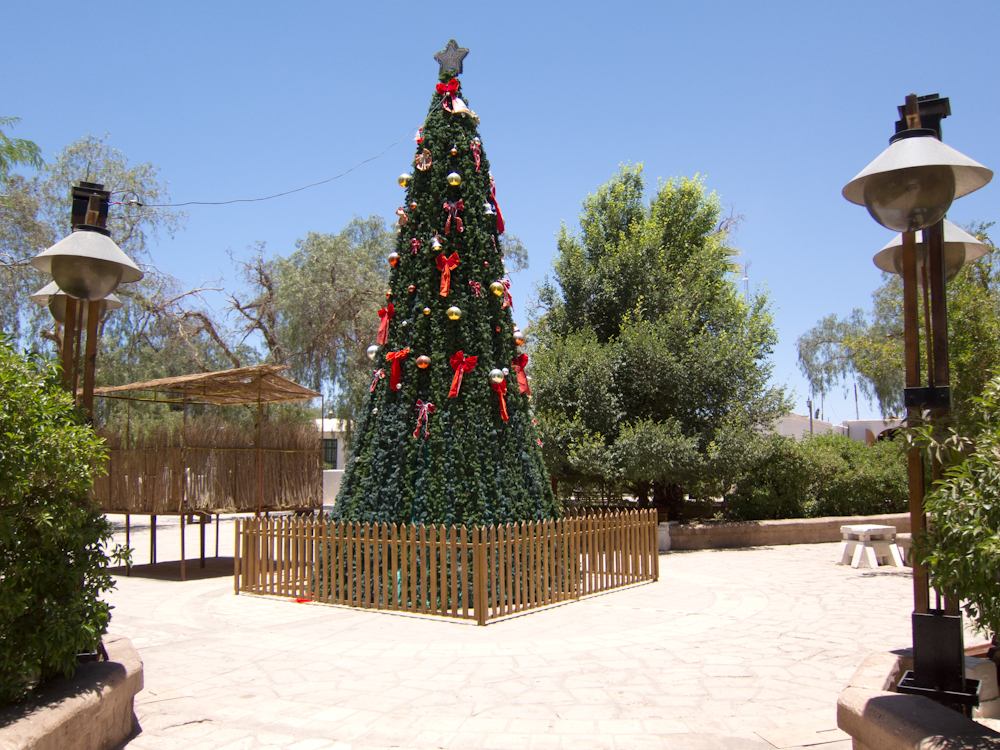
A little bit of Christmas in San Pedro de Atacama.

Now that we were back on line, we had some catching up to do with emails, etc.  We were saddened to learn that Chris’ uncle Wayne (McKinnon) was gravely ill.  We managed to contact Chris’ sister Connie (through Skype) who brought us up to date. Sadly, Uncle Wayne passed away later that very night.  This was very hard on Chris; he was very close to his uncle growing up and was saddened that he had not stayed in touch with him for the past few years, and that he missed his chance to say goodbye. Chris spent a couple of days laying low, coming to terms with his loss.

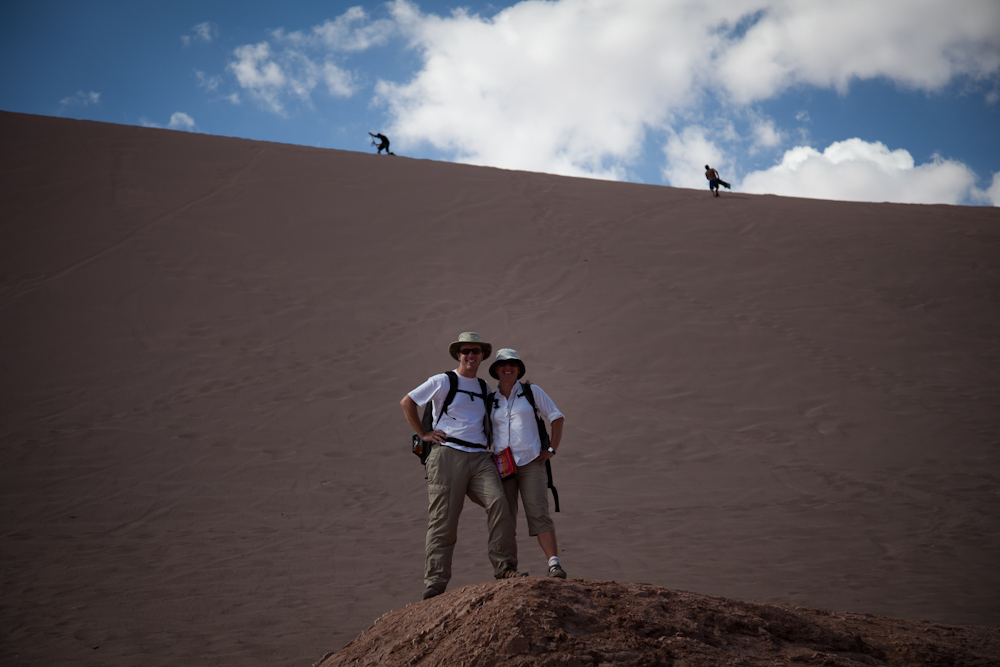
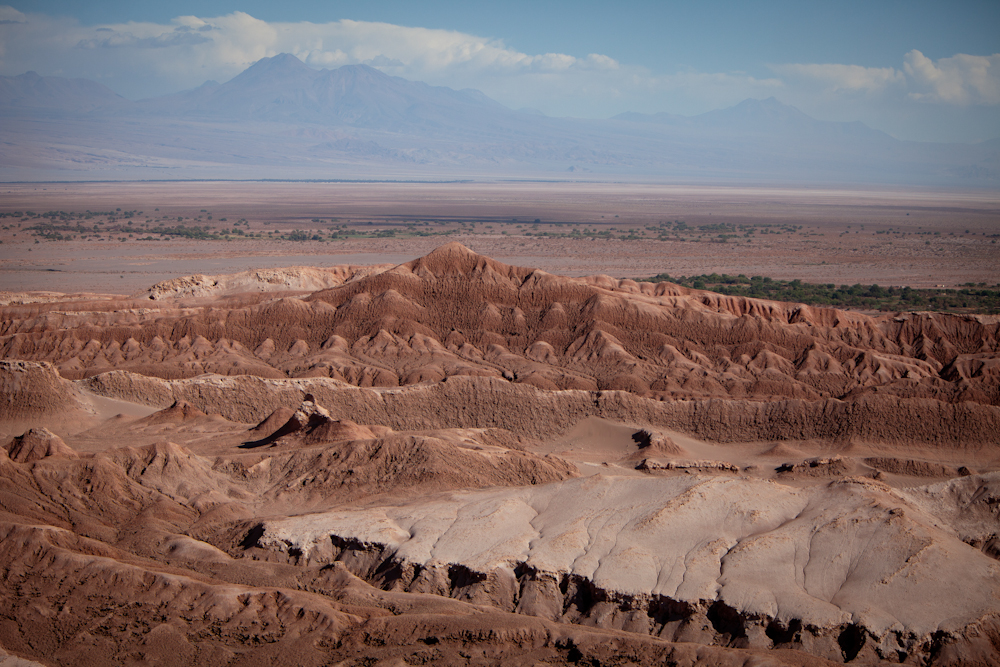
Before we left San Pedro, we did a 4-hour guided tour hiking the Valley of the Moon and Death Valley. Valley of the Moon is so named because of its moon-like landscape with ruins of old Chilean salt mines, and worker huts.  Death Valley has gigantic sand dunes and strange rock formations.  It was a lot of fun; the highlight for me was running down the huge dunes in my socks and watching the sand boarders “ski” down on their boards.

We ran down this dune, but this was only the bottom half!
Notice the guys at the top getting ready to sand board down the hill. 

Hiking through Death Valley.

Cool rock formations.

I couldn’t coax Chris any closer to the edge.

Sandboarders walking to the top of the sand dune.

People travel from far and wide to San Pedro to go star gazing at night, and the lucky ones get a spot on a tour with French Astronomer, Alain Maury.  The tour begins with a geographic explanation of the sky and its constellations, continuing with observations of really amazing objects, such as moon craters, Saturn rings, cumulus of stars, galaxies, and other wonders of the universe through his private collection of powerful telescopes.

Our tour began at 11:00 pm, way past our bedtime.  Maybe it was the hiking tour we did on the same day, or the two very strong Pisco Sours we consumed at dinner, but we were dead tired by the time we started the tour.  In fact, we could barely stay awake during the first part of the tour.  We perked up when we started looking through the telescopes and Chris was completely engaged when a photography lesson was given about how to shoot the night sky.  The constellations in the Southern Hemisphere are very different from what we are used to seeing in the North.  In spite of our fatigue, it was a very informative and interesting night.

La Serena

After a 16-hour overnight bus ride through the Atacama Desert, we arrived in La Serena at 7:00 in the morning with plans to stay for 3 nights. Unfortunately, a mix-up with our hostel reservation meant we only had a room for one night. We made the best of it, and spent the day walking around the main plaza of this very popular beach destination. The town was bustling with Christmas shoppers as it was only a few days before Christmas. We were back on the bus by 11:00 the next morning, on our way to Santiago.

Touring the world’s largest salt flats

We travelled by overnight bus from La Paz to Uyuni where we would start our 3 day, 2 night tour of the world’s largest salt flat.  We arranged to travel on the most expensive bus (Todo Turismo: $33 US each) because we wanted to be as comfortable and safe as possible.  It was money well spent; the bus was spacious, the amenities were good (dinner, breakfast, blankets and pillows provided), and the driver got us to our destination safely.

When I had read that Bolivia’s road system was 95% unpaved, I thought this might be an exaggeration, but after travelling through Bolivia, I can vouch for the accuracy of that statistic.  After 3 hours on a paved road, between La Paz and Ororo, the remaining 9 hours were spent on very bumpy, dirt roads that were washed out in many places because of recent rain; it is the rainy season afterall.  We didn’t sleep too much because the bus lurched from side to side as the bus driver manoeuvred around the impassable sections. Often the bus came to a complete stop and we could imagine the driver contemplating which way to go. Sometimes he even got out of the bus to assess the dire situation in front of him.  There were times when I popped my head out of the window and I was horrified at the sight ahead – nothing but water and mud. But somehow, we got to Uyuni safe and sound.

Before I tell you about the tour, I must say a few words about the process of selecting a tour.  We arrived in Uyuni without any reservations which by now, you must realize, is nothing new for us.  We had done lots of research in advance and had a short list of tour operators (based on online reviews) we planned to visit to see what they could offer us.  There are plenty of bad reviews on the internet (Trip Advisor in particular), some are down right appalling.  So we wanted to be careful about the tour we selected.  It seemed the biggest grievance people had was the number of passengers in a car.  Most tour operators tried to squeeze 6 passengers in a Land Cruiser, plus the driver and cook in the front seats. The other common grievance was the quality of vehicle.  Breakdowns and flat tires were commonplace.

When we found a tour operator offering a tour with just two other passengers (for a premium of course) we jumped on it.  When probed for information about the truck, we were given vague answers such as: our trucks are not new, but they are in very good mechanical condition. The lady in the office would not commit to any more detail than that. We signed up for the tour through Tonito Tours and crossed our fingers that all would go well.

Day 1

On Wednesday morning, we went to the designated meeting place only to wait for over an hour for our truck to show up (the delay was caused by an apparent gas shortage, or so we were told).  We had the chance to meet the other couple we would be travelling with: James, a Brit currently living in Italy, and Donatella, his girlfriend who was Italian.

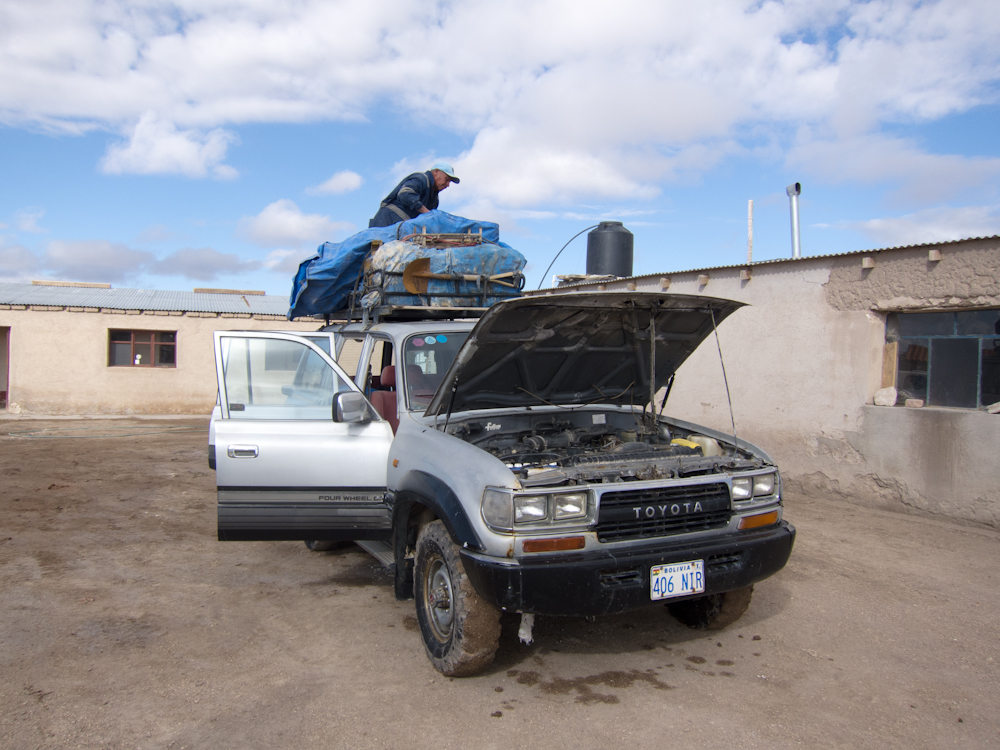
As the truck pulled up, I had a sinking feeling.  It was old. Really old.  A 1996 Toyota Land Cruiser to be exact.  It was quickly apparent this vehicle had seen better days – one passenger window did not work, the windshield wipers did not work. Who knows what else was wrong under the hood – we would find out soon enough.
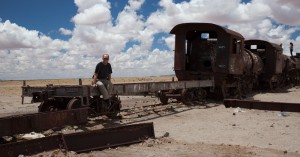
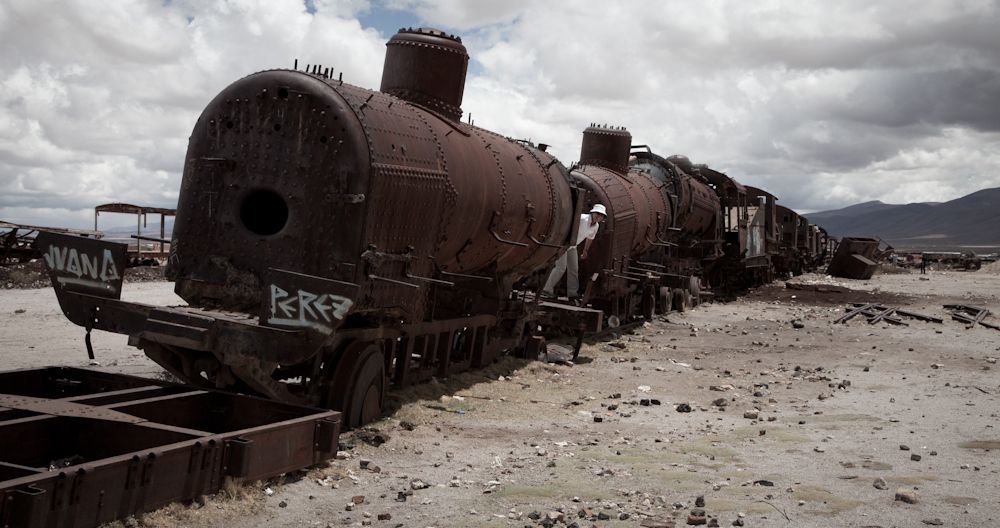
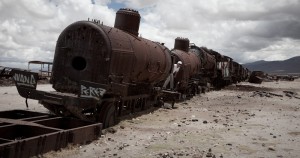
First stop on the tour was the “Train Cemetery”, one of the major tourist attractions of the area.  In the past, the town of Uyuni was a distribution hub for trains carrying minerals on their way to the Pacific Ocean ports.  The train lines were built by British engineers who arrived near the end of the 19th century and formed a sizeable community in Uyuni.  Rail construction began in 1888 and ended in 1892. The trains were mostly used by mining companies so when the mining industry collapsed in the 1940’s (partly due to mineral depletion), many of the trains were abandoned, resulting in the train cemetery.
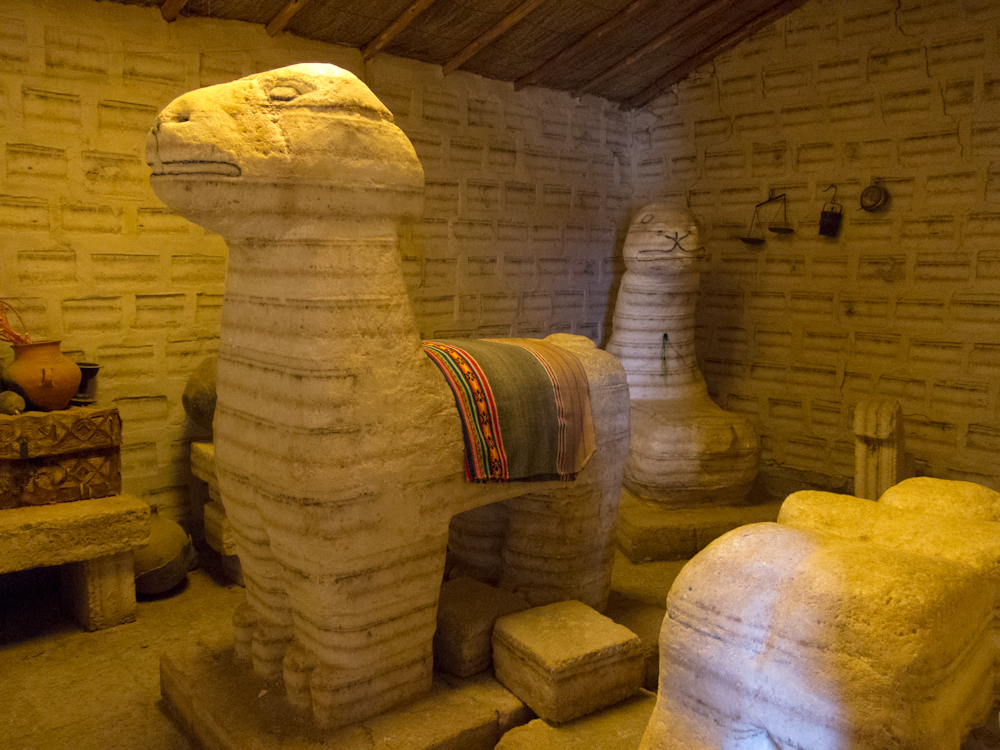
We made a few stops on the way to the salt flats, for instance, to visit artisan stalls – like we haven’t seen enough artisan stuff for sale!  It was interesting to see some of the art they made from the salt.  It reminded me of what we do with ice and snow in Canada.
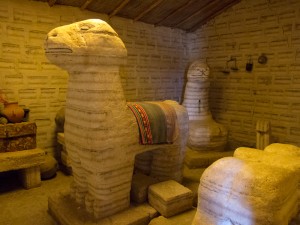
Salt Art at one of the artisan stalls.
They even have salt hotels where everything is made of salt.

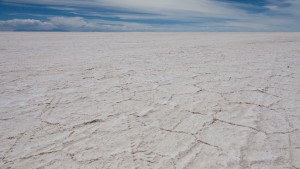
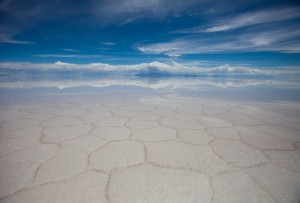
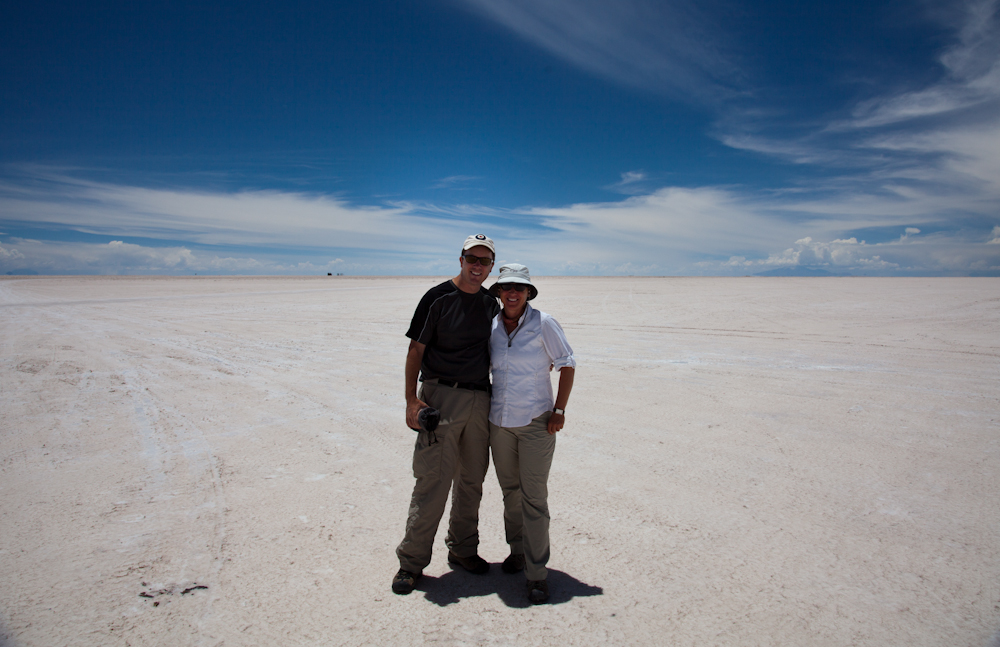
When we reached the salt flats, we were in awe of their magnitude.  Salar de Uyuni is the world’s largest salt flat at 10,582 square kilometers (4,086 sq mi). It is located in southwest Bolivia, near the crest of the Andes, and is elevated 3,656 meters (11,995 ft) above sea level. The Salar was formed as a result of transformations between several prehistoric lakes. It is covered by a few meters of salt crust, which has an extraordinary flatness with the average altitude variations within one meter over the entire area of the Salar. The crust serves as a source of salt and covers a pool of brine, which is exceptionally rich in lithium. It contains 50 to 70% of the world’s lithium reserves, which is in the process of being extracted. The large area, clear skies and exceptional surface flatness make the Salar an ideal object for calibrating the altimeters of the Earth observation satellites.
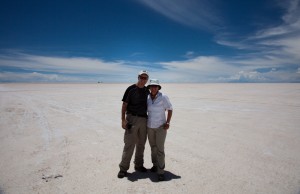
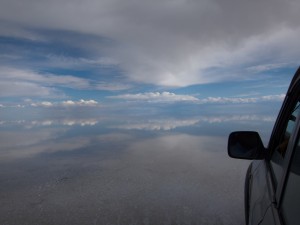
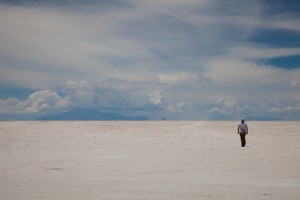
Walking on the salt flats was surreal; it was difficult to ascertain where the land ended and the sky began as it all blurred together on the horizon.  It was very much like walking on a frozen lake; the texture, the crunch under your feet and of course the color all looked like snow and ice.  As we drove further, we travelled through inches of water that covered the salt giving the appearance that we were driving on a lake.  Without functioning wipers, our wind shield became so salt encrusted that it was impossible to see through.  Walter tossed water onto the wind shield now and then to try to gain some visibility.
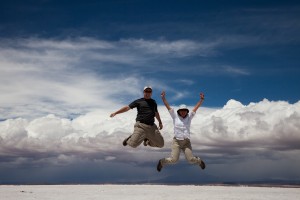
Goofing off – does Chris have bionic legs?
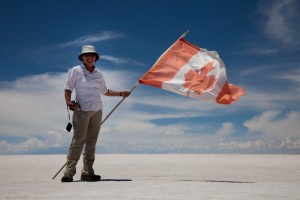
Our flag has seen better days.

Driving along the salt flats.

Dry salt flats.

Salt flats under a few inches of water.
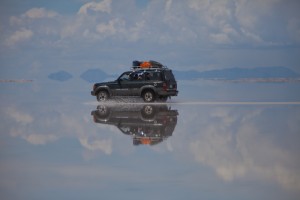
One of the other dozen or so trucks that were doing the same tour as us.  We saw these trucks at every stop over the next three days.

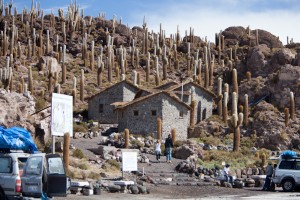
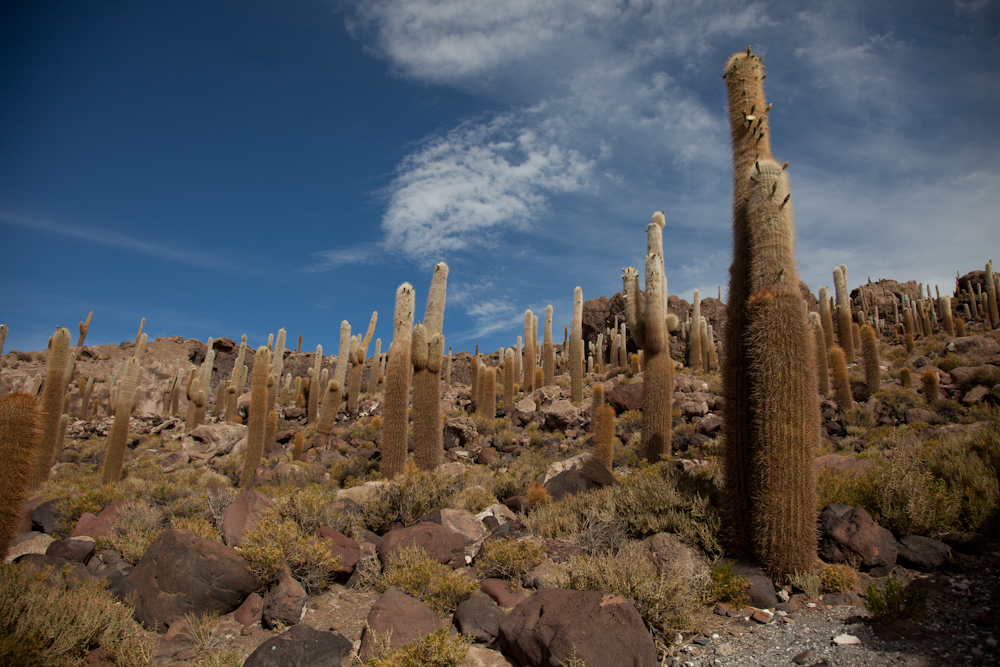
We stopped for lunch and a hike on Fish Island (so named because of its shape); this island would have been more aptly named Cactus Island in my opinion as the island was home to hundreds of huge cactii, some older than 1,000 years.
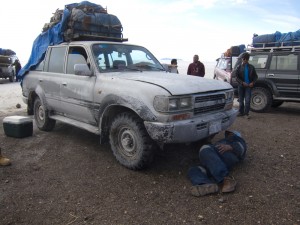
Walter checked out the truck whenever he had a chance.
So far, so good.
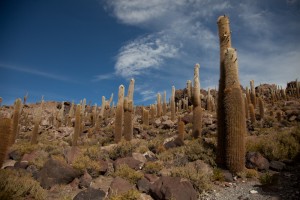
Cactus on Fish Island

Donatella and James checking out the island.
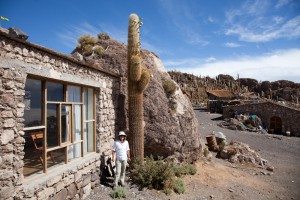
Giant cactus!

Salt along the edge of the island.

View from the top of the island, watching more trucks arrive.

Apart from the few stops we made, much of the day was spent travelling in the Land Cruiser over the salt flat. To my surprise the truck held up quite well. No breakdowns or flat tires. We rolled into Bellavista around 6:30 where we would be spending the night.  On our arrival, we were greeted by a woman who announced there was no water whatsoever. No showers.  No running toilets. No sinks.  With this news, we got a glimpse of Donatela’s fiesty Italian heritage as she adamantly refused to spend the night in a place without water. There was a lot of discussion between her and James in Italian, and then between James and Walter our driver, and then, the next thing we knew, we were packing up the truck again and heading out on the road towards San Juan, just as the sun was setting, a 45-minute car ride away.  Chris and I would have stayed at Bellavista; we didn’t even find it all that bad and figured we could survive one night without water.  I was feeling a little concerned for our driver, Walter, who was not a young man (I estimated he was close to 70).  He had been driving all day; he must be tired, and now he had to drive another hour in the dark along the worst roads we have ever been on.

As the sun set, the temperature dropped significantly.  Guess what – no heat in the car!  About fifteen minutes outside of Bellavista, in pitch darkness and freezing temperatures, the truck broke down.  I jokingly said:  Bellavista isn’t looking so bad now, is it?  Chris thought that was hilarious, but both James and Donatella did not see the humour in it. They were upset.  More than upset.  They were angry.  The italian words began flying again.  Walter asked if anyone had a flashlight – we were the only ones who did (thank goodness).  Chris and I got out of the truck and waited outside as Walter tinkered under the hood.  It took him about 45 minutes; during that time, Chris and I were considering the options.  We could walk back to Bellavista or spend the night in the truck.  To my astonishment, Walter got the truck working again.  And we were off.

As we bumped along the road at the furious pace of 35-40 km/hr, we slowed down as we passed each road sign where Walter had the cook read out the places on the sign; we were comforted to see San Juan each time……until we reached a sign that did not have San Juan.  Walter was incredulous – he asked the cook several times – No San Juan?  No San Juan?  No, we took a wrong turn and now we were lost.  In the middle of freaking nowhere.  In the freezing cold.  By now, James and Donatella were silent, which I think was worse that the noisy exchanges between them – they were just fuming in silence.
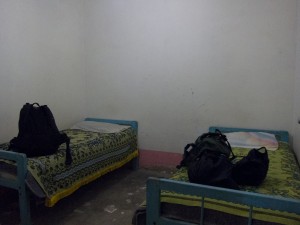
At 11:00 pm, we rolled into San Juan which seemed to be a rather sizeable town, and into the yard of our hostel.  The entire town was pitch black, as was our hostel.  There was nobody there. I kid you not, this place looked like a prison or a concentration camp. A row of tiny cement block rooms with two cots in each, bare light bulb in the middle of each room, with shared, so-called bathroom facilities at the end of the hall. Bellavista was looking like the Hilton at this point, an observation I chose not to share with Donatella. She was visibly upset and I actually felt sorry for her. She had never done this type of travel before and I could just imagine the culture shock she was experiencing. She was a city girl from Milan for goodness sakes. We were all dead tired but now the cook insisted on making us dinner although nobody really wanted to eat, and Walter continued to work on the truck late into the night. It was after midnight before we hit the sack. Our cots felt quite comfortable, and we slept like babies throughout the silent night.

A new low in accommodations. But we had running water!
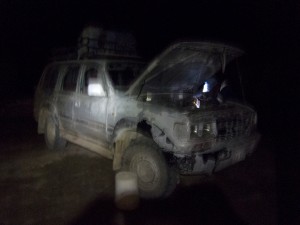
Our truck at the end of Day 1 – will it make it to the end?

Day 2

I always say that things look better in the morning…..well in this case, in the brightness of daylight, the so-called bathroom looked far worse. Regardless, Chris and I had a quick shower, and surprisingly, the water was hot and the pressure was good. It was one of our best showers thus far in South America, as long as you ignored the filth and decay around you. James and Donatella broke down and used the bathroom facilities, even having a quick shower together. Breakfast was comparable to any breakfast served in prison (or at least what I imagine you would get if you were in prison – but come to think of eat, prisoners probably eat much better).  We had dry buns with margarine and jam and tea.  A bowl of scrambled eggs was on the table when we sat down but the eggs smelt so vile, no-one but James dared to try them.
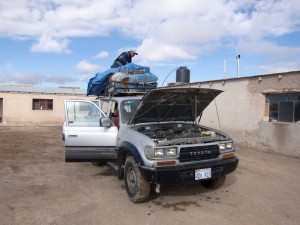
Walter had washed the car sometime between midnight and 6:00 am.  He’s on top, loading it up as we get ready to start Day 2.
Accommodations are in the background.

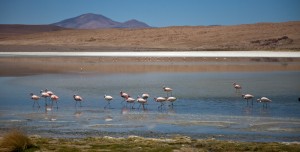
We were on the road again by 8:00. The day was spent travelling along the bumpy, dusty roads through the desert of southern Bolivia, admiring tiny lakes of different colours, all home to hundreds of flamingoes.

The scenery was magnificent, and the sight of large flocks of flamingoes made us think of the measly five flamingoes that we saw on the Galapagos Islands.
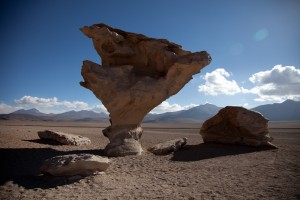
We passed by many strange rock formations, including the Arbol de Piedra, a rock that is in the shape of a tree.
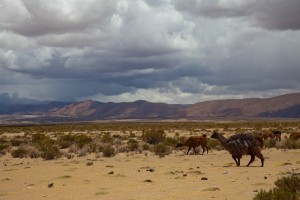
We also saw heards of llamas and vicunas, an animal that resembles a small llama.
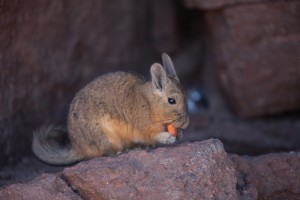
At one point we stopped to take pictures of a rock formation where we also saw the vizcacha, a small desert animal that resembles a rabbit.
Little did we know that Walter would take this opportunity to do a rear brake job on the truck.  That’s right.  Before we knew it, the back wheel was off and the brakes were dismantled on the desert sand.  We didn’t even know we had a brake problem.  Chris and I climbed the rocks for a while and then wandered out into the desert and did a goofy video. There wasn’t much else to do as we waited for Walter to put the truck back together again.
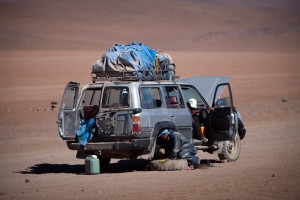
Not looking too good.

Watching the other trucks come and go as we wait 
for our truck to be repaired. 
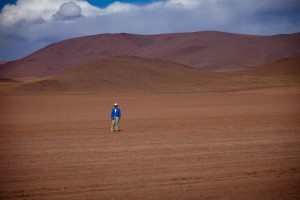
Walking in the desert alone – it was windy, cold and oh, so peaceful.
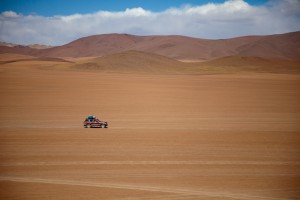
We stopped for our second night at the edge of Laguna Colorado.  I always say that things are relative, and they can always be worse.  And sure enough, conditions on that second night, far surpassed the deplorable conditions of the first.   There were many people staying here, and everybody had to double up in the available rooms. So the four of us picked our beds in our dormitory style room.  We offered the double bed to James and Donatella and they didn’t refuse.  Oh, did I mention there was no running water.  And we were filthy, covered in dust from head to toe.  Donatella wanted to leave right away and go back to Uyuni, she didn’t care what it cost.  Unfortunately, we were 8 hours from Uyuni and there  was no transportation available that night.  She had to just suck it up and deal with it, something she didn’t accept very graciously.

I haven’t mentioned anything about the food.  Things started off quite well, with a delicious pasta and chicken lunch on the first day.  Even then, my stomach was a little off after that meal.  Soon it became apparent to me that our cook was carrying our three day food supply in her cooler – with no ice – including meat.  Even after three months in South America, my stomach is not made of iron.  After each meal, my digestive issues became worse until I was eating the barest amount necessary to stave off my hunger pains.

We survived our second night – James and Donatella slept in their clothes, ready to get the hell out of this hell hole at the crack of dawn, literally.

Day 3

We awoke before dawn and were on the road at 4:30 am in order to visit a few more sites before dropping us off at the Bolivia-Chile border and ensuring there was enough time to get James and Donatella back to Uyuni in time for them to catch their overnight bus back to La Paz.  It was freezing cold, probably below zero.  Our warm hats that we bought in La Paz served us well.  First stop was the geysers, followed by a visit to the natural hot springs where we had breakfast from the back of the truck – two pancakes each and a cup of tea.
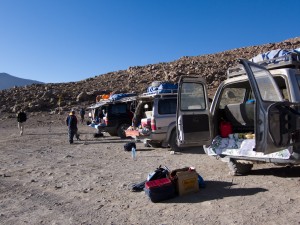
Breakfast from the back of the truck.
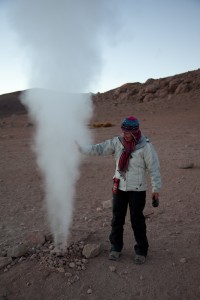
These geysers were hot!

One final stop to take in the Laguna Verde (green lake) and then we headed off to the border.  We were only a half hour from the border when we had to cross a small stream that had washed over the road.   Can you guess what happened next?  Our car decided to die in the middle of the stream.  I felt Walter’s pain as he groaned under his breath, Ohhhh nooooo.  Walter spryly climbed out of the truck, onto the roof of the car and over the hood.  He managed to fix the car without even getting his toes wet.  Not bad for an older guy!
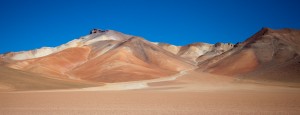
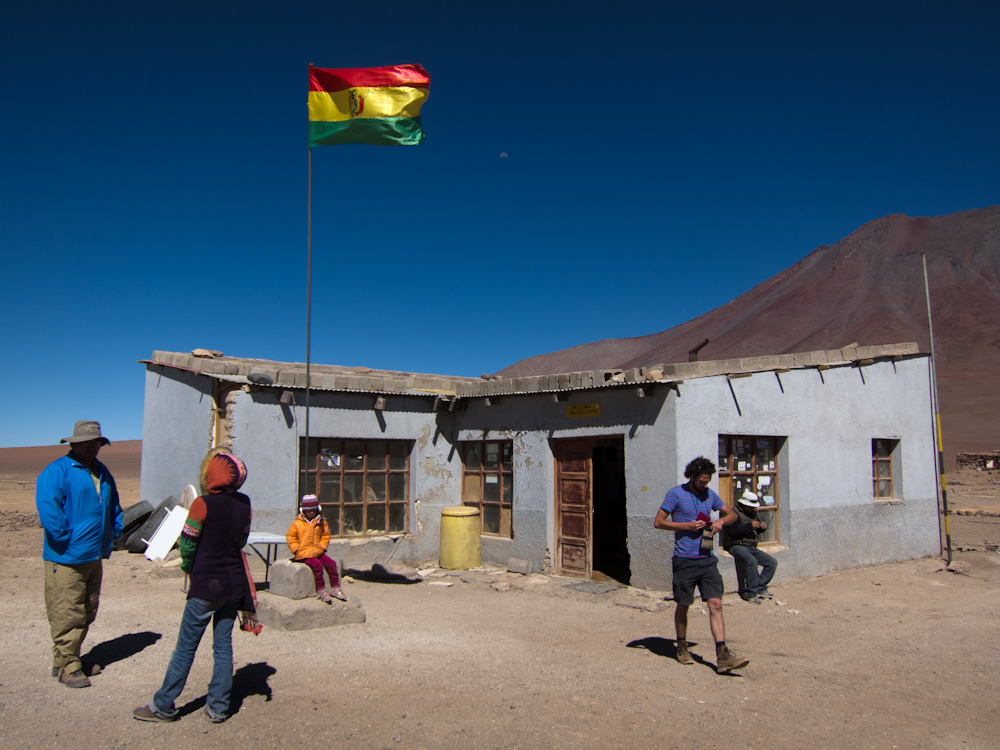
In short order we were deposited at the border where there was a Bolivian Immigration Office, quite literally in the middle of the desert.
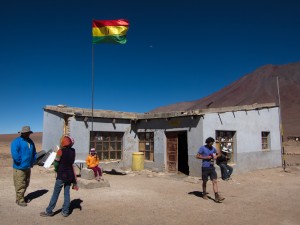
Bolivian immigration office.

With our passports stamped allowing us to leave Bolivia, we waited for the bus that would take us to San Pedro de Atacama, Chile.  We bade farewell to our fellow travellers; I hope they made it back to Uyuni without incident.  I don’t think Donatella could take much more.

Travel Tip:  If we could do it again, we would only do the one day salt flat tour.  While we saw some interesting sights during the second and third day of our tour, the highlight was the salt flats on the first day.  You can save yourself some potential discomfort, time and money by just doing the one-day tour.
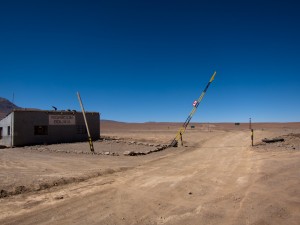
Border crossing between Bolivia and Chile.  
The gate was always up, receiving vehicles both ways.

UPDATE:  We just added a video of our 3-day tour reduced to 13 minutes and 49 seconds.  Enjoy!


La Paz: Where old and new converge

I’m afraid I’ve gotten a little behind on the blog postings.  Guess that’s what happens when you whirl through a country in one week. That’s right. We spent a total of one week in Bolivia which means we really didn’t do it justice. However, at this point in our travels, things are starting to look very similar in each South American country we visit – landscape, geography, economy, architecture, people, food, etc. Of course there are subtle differences, but we don’t feel the need to visit every single city or hike every mountain or volcano to discern such differences. We have the gist of it now.  Rather, we want to focus on the “must see” or “must do” aspects of each country.  In Bolivia, we wanted to tour the Salt Flats.


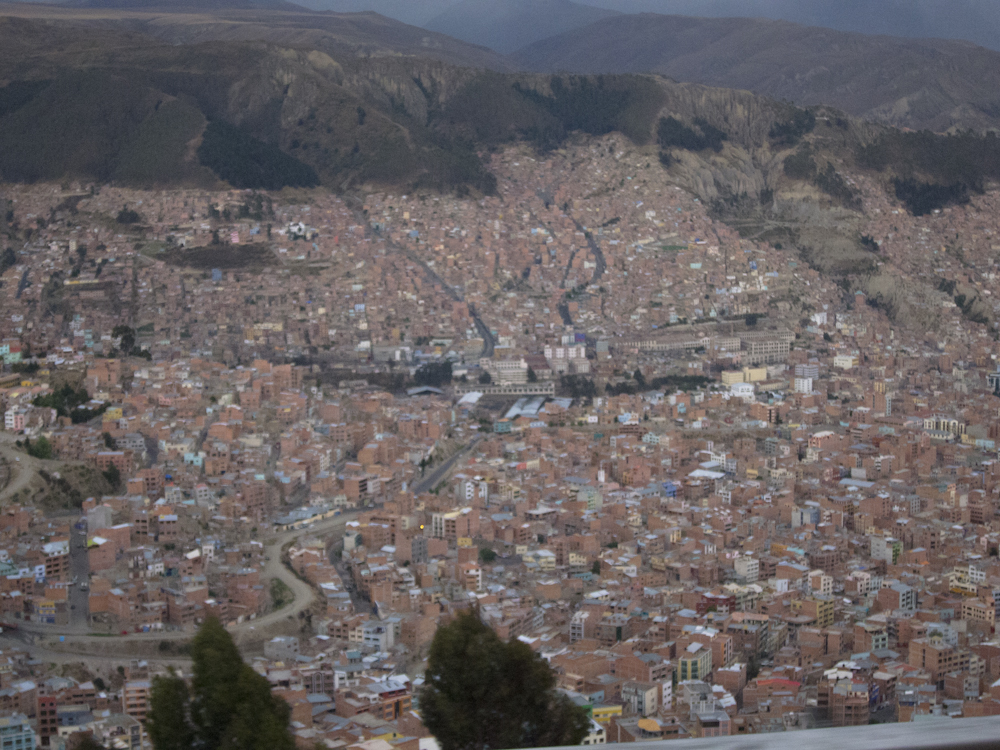
But before I get to that (in the next post), we had a few days to discover La Paz (population 2 million), the defacto capital of Bolivia.  As you enter La Paz, you can’t help but be impressed by its size and its geographic location.  First, you pass through the slums that go on as far as the eye can see.  You may think this is the city until you realize you are only on the the rim of the valley in which the entire city is sprawled out.  It was quite astonishing to see this vast city sitting in a “bowl” surrounded by the high mountains of the altiplano. As the city grows, the city climbs the hills, resulting in varying elevations from 3,000 m to 4,100 m (9,840 ft to 13,450 ft).

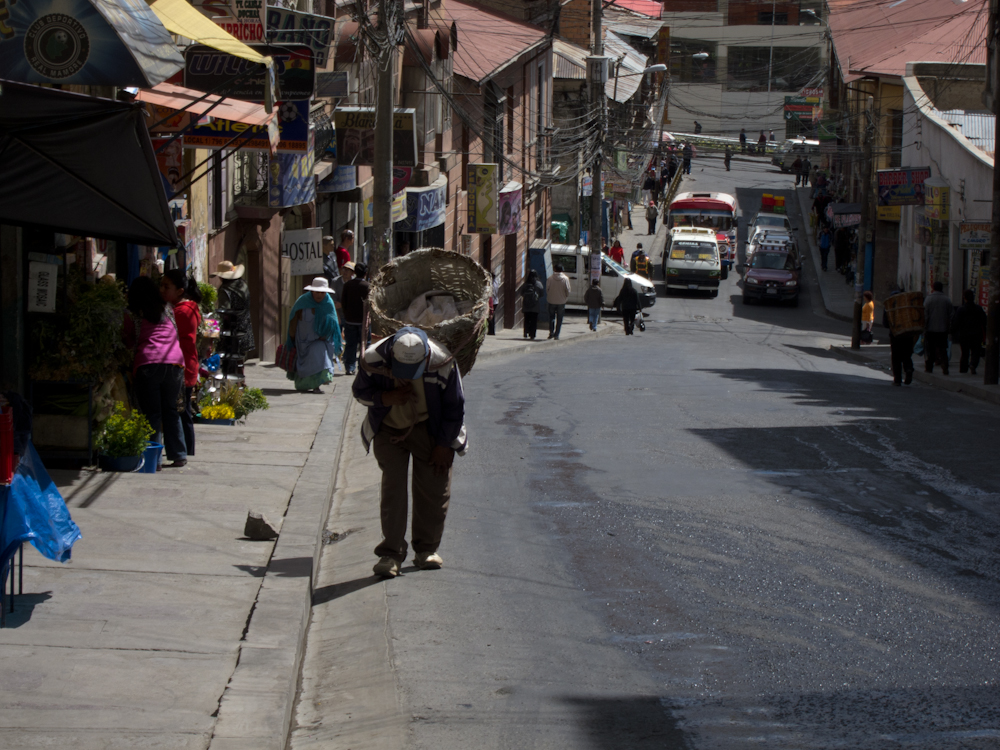
When we arrived in La Paz we were overwhelmed by the chaos – the people, the traffic, the markets – the city was hustling and bustling at all hours of the day.  The streets were steep, far steeper than any street I walked in San Francisco, and the altitude was high, making for a lot of huffing and puffing as we probed the various neighbourhoods close to our centrally located hostel.

Old man with basket walking up steep street.

Hang on to those bananas!

The city was one of contrasts from modern, imposing high rise buildings to abject poverty as evidenced by the women with very young children, even infants, begging on the streets late into the night, a troubling sight.  Just when you felt you should do something, then you caught sight of another mother on the next corner, and another, and another.  Maybe I’m becoming cynical, but I suspected that these women were strategically choosing their locations to target tourists returning to their hotels after dinner. One could hardly fault these women though.  I’m sure they would have preferred to be in a cozy home with their children tucked safely in bed rather than sitting on the cold side walk begging late into the night. It was a reflection of the suffocating poverty that choked the majority of the population and a visible reminder that Bolivia is indeed the poorest country in South America.

A main boulevard with manicured pedestrian
walkway in the middle.

Typical building in state of disrepair.

A modern high rise.
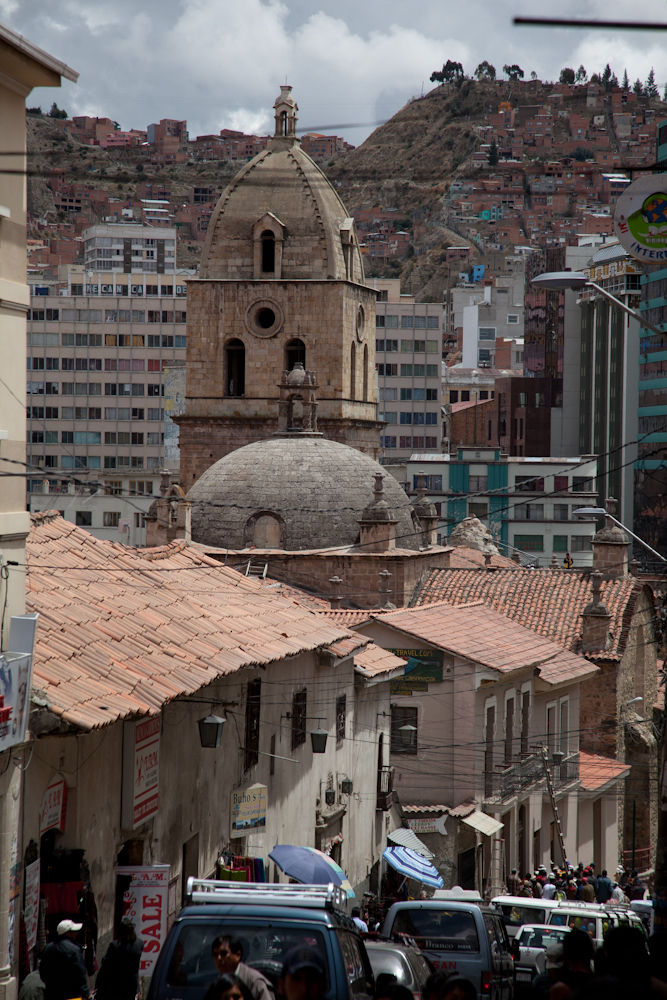
San Francisco Church, founded in 1548 and rebuilt 1784.
The Witches Market (Mercado de Brujas)

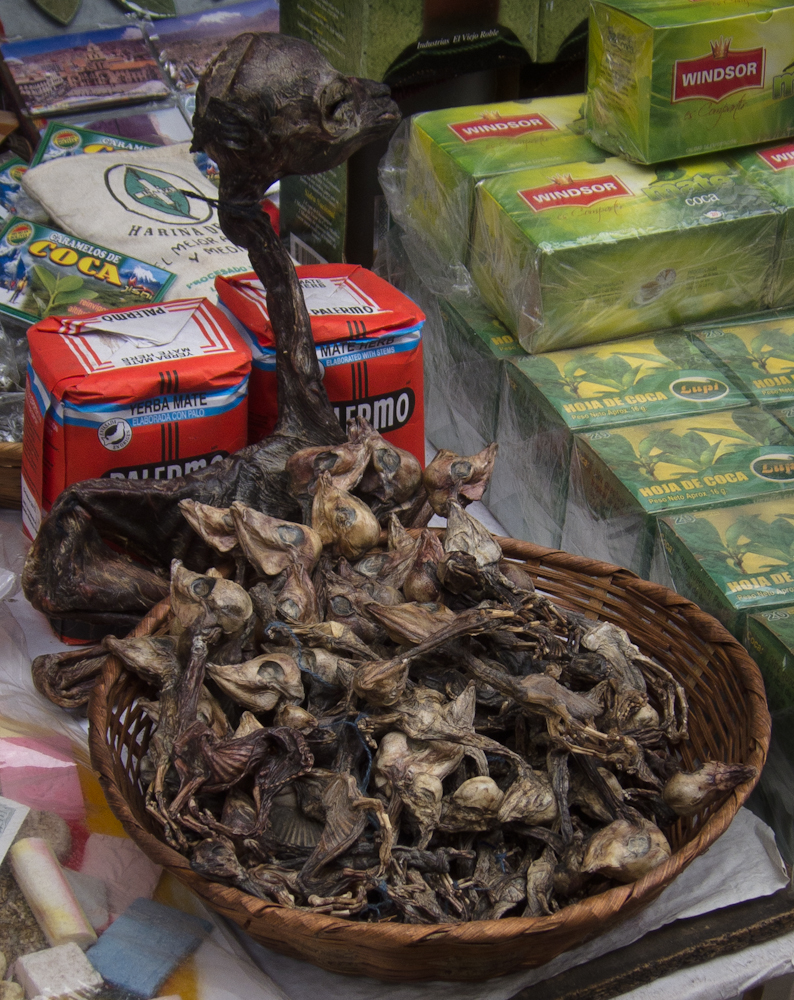
The illusion of a sophisticated city was shattered when we stepped into the side streets and discovered a market offering everything a witch could possibly need, like shriveled llama fetuses, dried frogs, dried armadillos, concoctions of dried plants and teas, and a wide variety of ceramic figures.  It was fascinating to see these strange and exotic objects and one couldn’t help but wonder what they were used for.  Well, why don’t I tell you.

  • Dried llama fetuses:  These are placed under the foundation of a house when it is being built for good luck.  Apparently, an estimated 99% of Bolivian families have a dried llama under their feet.  It’s a good business to be in.
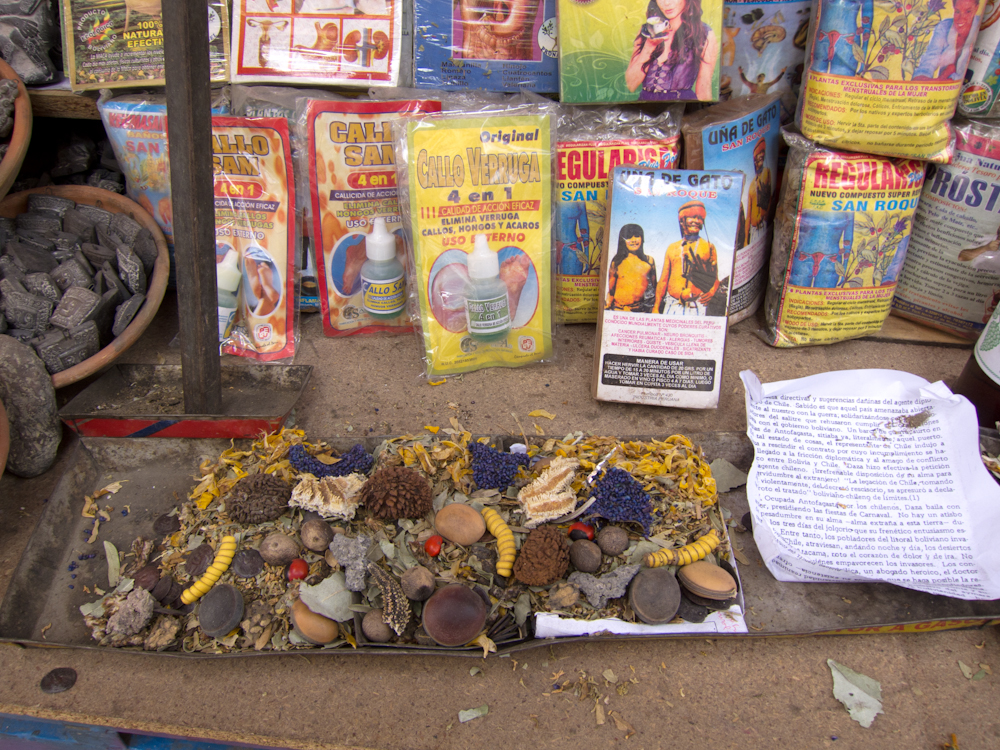
  • Burnt llama fetus (presented on a plate of sweets and herbs): Ensures good luck for a new business venture.
  • Dried frogs: Brings prosperity and if you stick a cigarette in your frog’s mouth, your chances of striking it rich will increase.
  • Bolivian armadillos: Forget ADT Security. Stick one above the entrance to your house, and it will prevent thieves from entering
  • Amulette d’amor (ceramic couple embracing): Use one of these to get hitched although I’m not quite sure how you use it.
  • Naked ceramic couples: These are supposed to improve your sex life, rectify impotency, and increase fertility.

Basket of llama fetuses.

A tray of good luck potions.
(with instructions on the side)

Something for everyone.
Everything a backpacker could possibly want.

One Big Market

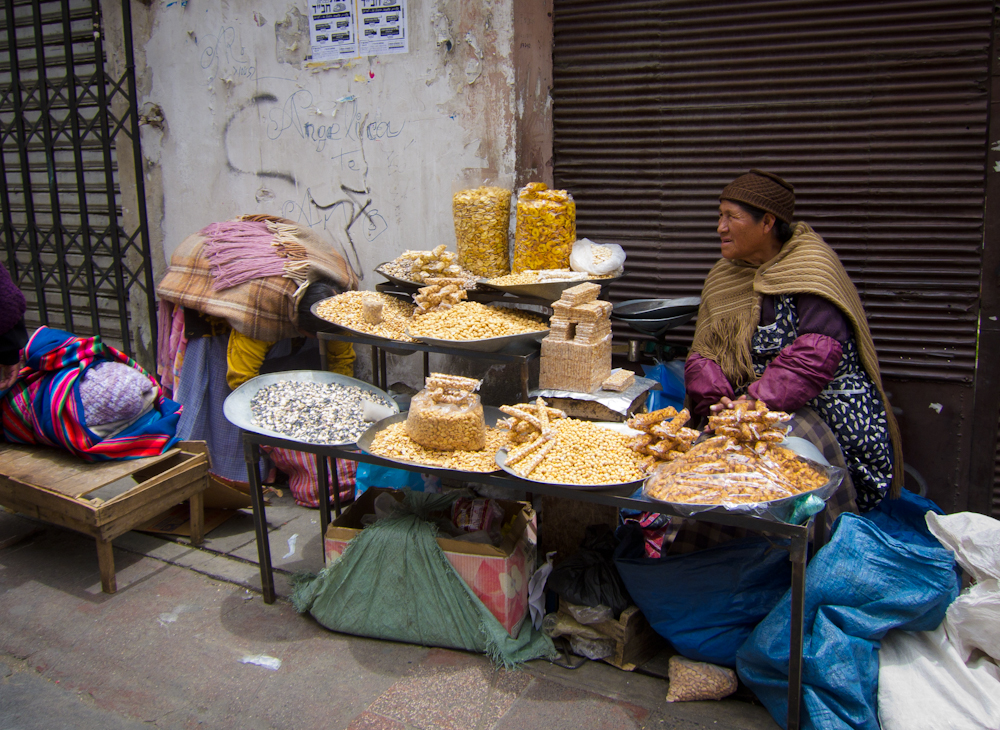
Unlike other towns and cities we have visited, we couldn’t find a central market.  This may be because the entire city appears to be one big market where vendors set up their mats or stalls with their wares covering every inch of every side walk, often spilling into the streets.  Streets were dedicated to certain products or services.  Want a suit? Then visit the suit street.  A pair of shoes for the suit? Yes, go to the shoe street. Some streets just looked like one big flea market with stall after stall of merchandise.  I have never seen so much stuff for sale.  Imagine all the products in Wal Mart laid out on a side walk on small tables and then multiply that by about 50. At times the streets turned into a maze of stalls each leading to yet another street of stalls.  It was easy to get lost amongst the utter confusion.
Closed on Sunday.

One afternoon, we headed in the opposite direction of the tourist district to try to get more of a feel for where the locals hang out.  As we meandered through the maze of stalls, we stumbled upon what we believed to be the black market.  This was where knock offs and counterfeits and all sorts of illegalities were the order of the day. The entire street seemed dark and sinister, like a black cloud had settled over this notorious black market district. People conducted their business in a hushed and subdued manner. Ironically, this market which mainly featured electronic goods was in the shadows of the adjacent street that prominently advertised legitimate electronic goods from well known companies like Sony, Samsung, LG, etc.

Legitimate electronics stores.

Come shopping with us for a few minutes!

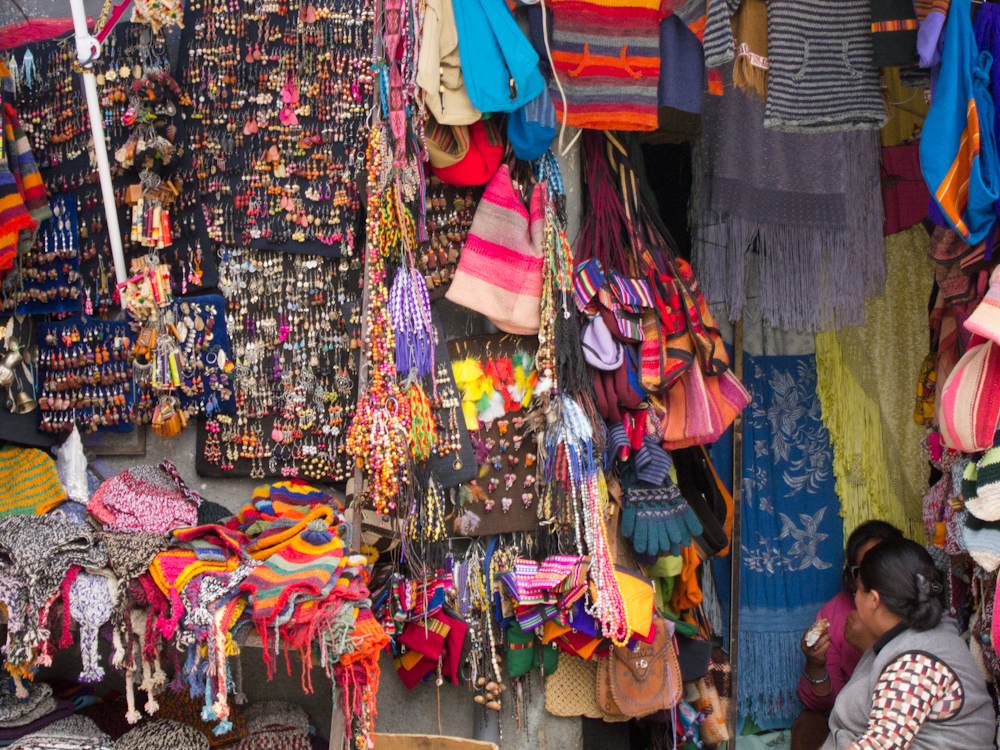
Aside from all the every day products sold on every street corner, La Paz was overflowing with artisan shops targeting the tourist dollar.  We spent some time browsing the kaleidoscope of colorful textiles and purchased a couple of warm hats in preparation for our visit to the Salt Flats.  I also bought a scarf that I just love.  Things were dirt cheap – $3 bought you a warm, hand-knit hat or scarf made of alpaca wool.  We were so tempted to buy a textile wall hanging to ship home, but in the end we decided not to.

Typical indigenous clothing.

Showing off my new scarf.

A Local Food Fair

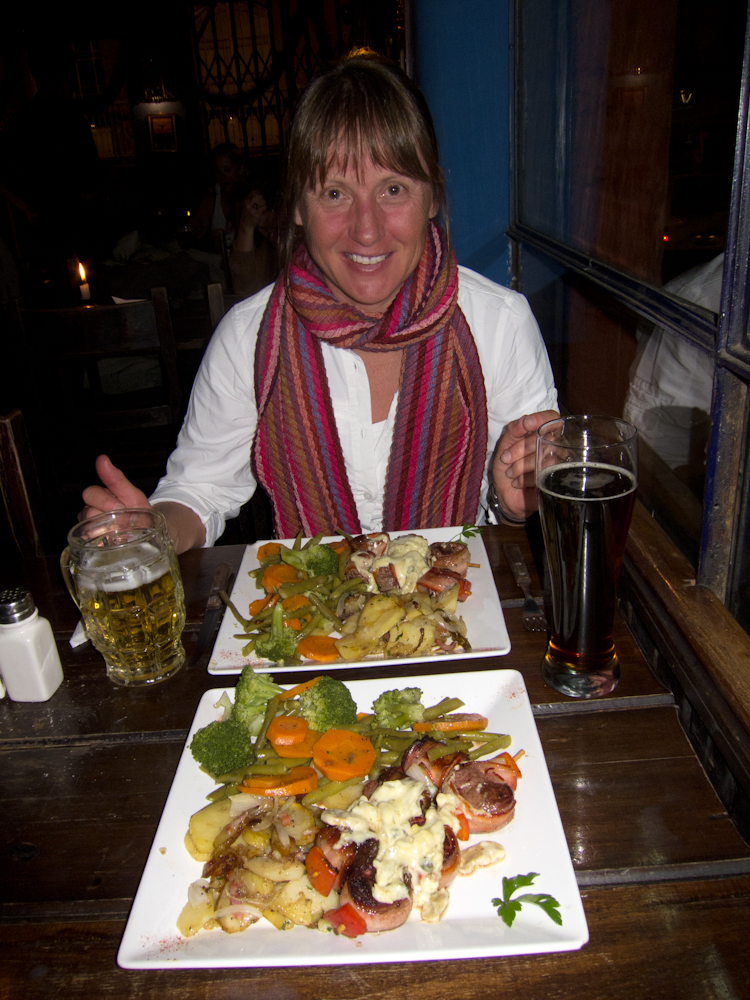
Every single meal we had in Bolivia was delicious.  We tended to stick to the tourist restaurants which we don’t usually do, but I think we were ready for some recognizable food.  We ate amazing Indian food that would have rivalled any British curry house.  We thought we had died and gone to heaven as we savoured melt in your mouth bacon wrapped filet mignon brochettes served with potatoes that had been fried in bacon – yes real bacon – and onions, accompanied with a plate full of wonderful vegetables.  We ate mouth-watering pasta and pizza.  I know, nothing Bolivian.  But with such a fine array of international cuisine to choose from, we just couldn’t resist.

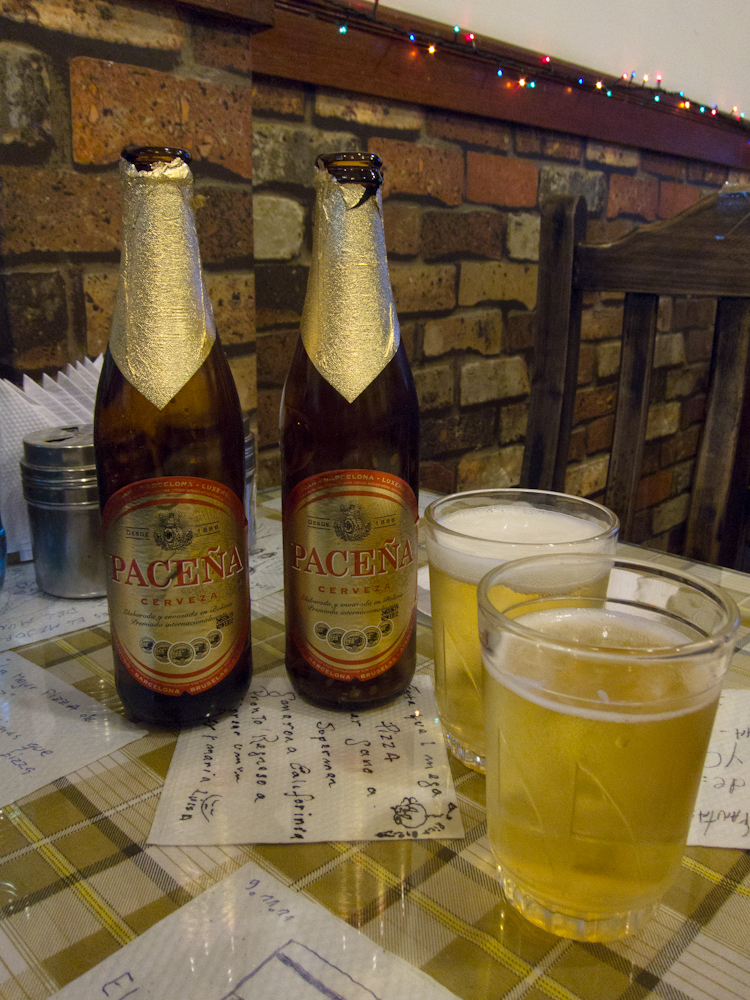
Enjoying the local brew.

We did enjoy one afternoon of cultural cuisine when we stumbled upon a Food Fair which provided a forum for local restaurants to showcase their best cuisine.  This was not a tourist attraction, in fact, we were the only visible tourists amongst the entire crowd.  We stuck to what was recognizable and were impressed with the quality of the food on offer. Throwing caution to the wind, we lined up for something that we couldn’t really recognize, although we could tell it was some kind of meat.  When it was our turn, the servers looked at us skeptically and then suggested they give us just a little taste to see if we liked it. Under their watchful eyes, I took one small bite of the meat and it was all I could do to swallow it.  It was awful!  With a straight face, I offered it to Chris – here honey, you should give this a try. Unsuspecting, he took a bite and I could tell right away that he was ready to gag.  Politely, we handed the plate back to the servers, shaking our head, and with a “no, gracias” and a “sorry”, we gave that place a big pass.  I think they were serving tongue – that was the shape of the meat – although I don’t know whose tongue it was!

Entrance to the food fair.

Fancy vegetable art.

Food samples – yummy!

Dancing in the Streets

It seems South Americans are always celebrating something and La Paz was no exception.  The sound of a marching band in the distance drew us to the location of a local parade in full swing.  This was a great opportunity to legitimately take pictures of the beautiful costumes which we had been admiring on the local indigenous women ever since we arrived.  The smell of booze mixed with urine permeated the street as the parade passed by.  Liquor and beer were being consumed openly in copious quantities by both the parade participants and those watching from the sidelines.  We discovered why the smell of urine is so prevalent in this city – men and boys alike use the side walks and streets as urinals whenever the need arises!

  Dancing in the streets

Money Woes

Our last afternoon in La Paz was spent frantically trying to get money from the notoriously unreliable bank machines.  Only the day before, I had withdrawn the full limit allowed with my bank card so I was surprised that my card didn’t work at any of the dozen or so ATMs we tried the next day.  Chris’ card didn’t work at all, in fact, we realized it hadn’t worked for about 10 days or so.

Finally we contacted our bank to see if perhaps they had put a hold on our cards.  Sure enough, Chris’ card had been frozen since we entered Peru, and mine had just been frozen that day.  What a hassle. And here we had thought the bank machines were at fault.  Well, they were some of the time, but not all of the time.  We got our cards sorted out just before we had to leave for our overnight bus to Uyuni where we would start the tour of the Salt Flats.

Our new toques from La Paz served us well on the
Salt Flats – but more about that in the next post.

Getting a Brazilian Visa in La Paz

The main reason we came to La Paz was to get our Brazilian visas, a pre-requisite for Canadians travelling to Brazil.  We’re taking our transatlantic cruise from Sao Paola in March, so we needed to make sure we secured our visas in advance.  We anticipated needing a week in La Paz to allow for the visa application to get processed.  There was limited information on line about the process so we didn’t know quite what to expect.

When we arrived in La Paz late Thursday afternoon, we immediately got our paperwork in order for our visa applications and found a place to print and make the necessary copies.  These types of services are provided on every corner of every South American city and town we’ve been in and La Paz was no exception.  There is a significant amount of paperwork required when applying for the tourist visa, including a copy of your airline tickets to show you are intending to leave Brazil (our cruise receipt sufficed), copies of 3 months of bank statements to demonstrate you have sufficient money to visit Brazil, a passport quality photograph (we got these in Canada before we left), a copy of your Yellow Fever vaccination record, and of course, the completed application form and your original passport. The Embassy of Brazil in La Paz website (http://www.brasil.org.bo/ml_vis_tur.php) explains very clearly everything you need for your application.

With our paper work in order, we arrived at the Brazilian Embassy at 9:00 on Friday morning – customers # 0 and 1 in the queue.  We were the first to arrive and the last to leave that morning.  We were told to complete an on line form instead of the paper form on the computer they provided. No problem, it was identical to the paper form we had downloaded and completed by hand so we had all the necessary information at our fingertips (things like where you plan to stay in Brazil, your employer address and phone number, etc.)

We were then asked to wait until an Embassy official could speak to us.  Within a half hour, a very pleasant man named Clovis came out to talk to us, thankfully in English.  He had some questions about our paperwork and was satisfied with our answers.  He asked us when we needed our visas and I said we were in La Paz until they were ready, so hopefully by Monday or Tuesday.  He said he would try to process them that very morning, but first we had to pay the application fee – $65 US each – at the Bank of Brazil which was about 10 blocks away.  He was such an amiable fellow, apologizing to us for such an inconvenience.  We didn’t mind – we had the time, and he was going to process our visas today – so all was good.

We grabbed a cab to the bank, paid the bill in Bolivianos as we did not have enough American dollars and the bank machines did not dispense them either.  The bank was very accommodating – money is money.

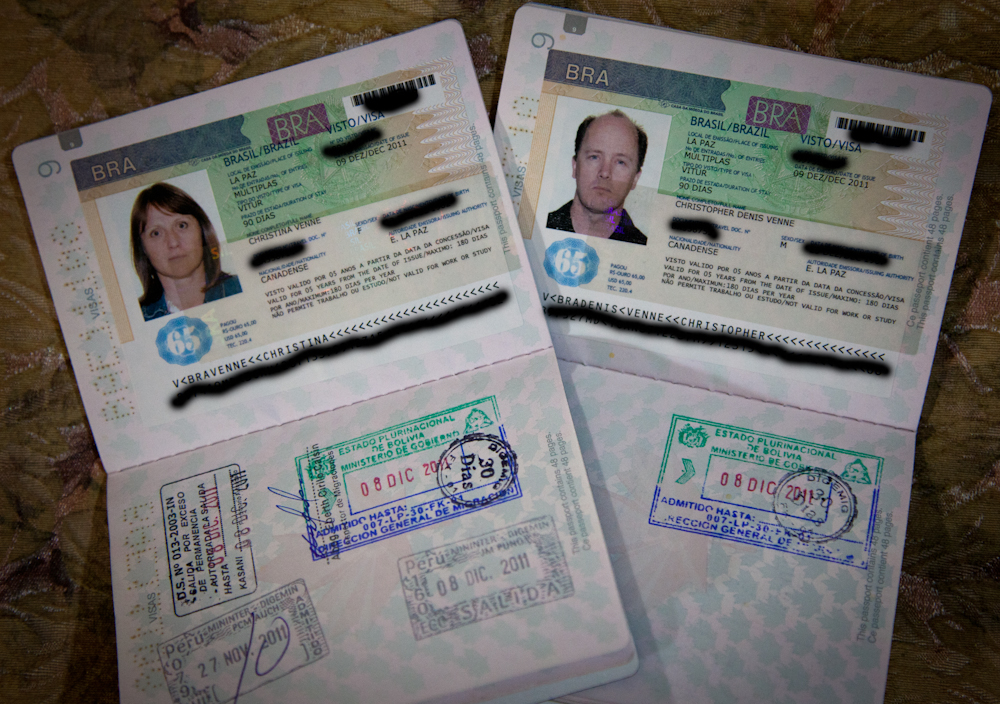
Back to the Embassy where we were asked to wait again.  Clovis came back out after about a half hour and suggested we go for a walk and come back at 12:30, before the office closed at 12:45.  We went for lunch and returned just before the office closed.  At 1:00 pm, Clovis came out with our passports in hand – complete with our Brazilian visas in place.  Now, how easy was that!

Crossing the border from Peru to Bolivia by land

We were a little anxious about doing our first over land border crossing from Peru into Bolivia but based on all the research we had done, we felt confident that we had picked the route with the best reputation for easy crossings – Puna to Copacabana.  It was also reassuring to see most of our early morning bus filled with other tourists so we weren’t on our own doing this crossing.

First stop was a few minutes from the actual border where we were told we should exchange our Peruvian soles for Bolivianos. I knew the exchange rates at the border were not the best, but we only had 90 soles to exchange, so it didn’t really make much difference.  I proceeded to exchange all of our soles with the exception of my pocket change which amounted to about 4 soles.  I reserved this as I had read online about a stupid requirement to provide a photocopy of your passport to the Bolivian immigration official, after he had stamped it. And apparently they didn’t have a photocopier handy, so you would have to go find somewhere to make copies.  Turns out this wasn’t required at this crossing, but it was good to be prepared nonetheless.

Speaking of being prepared, the night before, I suggested to Chris that we get a couple of hundred US dollars from the ATM to have with us just in case we needed it – an emergency fund if you will.  Part of the reasoning was that ATM’s are so incredibly unreliable here in South America, we didn’t ever want to be stuck somewhere, low on funds and unable to access any cash.  Especially heading to a new country, who knew what the banking situation would be like.  A case in point:  our bank card did not work on any of the 5 ATM’s in Puno.  We ended up taking a cash advance on our credit card, and we were limited to $100 US at that!  But it turns out that emergency fund was a life saver at the border.

Back to our border crossing saga.  After exchanging our money at less than fair rates, we were then taken to the Peruvian immigration offices.  We lined up in front of one office where the guy looked at our tourist visa, and stamped it.  We then lined up in the building next door to get our passports stamped by the immigration official.  Since several buses had arrived at the same time, there were lots of people getting processed.  Our bus assistant, Jose, was very helpful making sure everybody from our bus went to the right line ups.  Surprisingly, the lines moved quite quickly.

When it was our turn to get our passports stamped, I could tell right away there was a problem.  The two officials whispered to each other, then asked us if we spoke Spanish.  I said a little, and then he told us in English that we must pay a tax.  Why, we asked.  We had overstayed our visit in Peru.  That’s ridiculous, we said,  we’ve only been in Peru for 11 days, we’re allowed to stay much longer.  Not so, they said, as they pointed to a “10” scribbled by hand on our tourist card that we received in Lima at the airport.  Apparently, the “10” meant we were only allowed to be in the country for 10 days. We thought they were trying to pull one over on us, so we argued with them that the regulations permitted us to be in the country for at least 60 days. After a few minutes of arguing that wasn’t getting us anywhere, I asked – how much is the tax anyways?  $1 for every day over the limit.  I quickly did the math and realized we were only over by 1 day.  Well that meant $1 for each of us.  No big deal.  We’ll pay the tax even though we think we shouldn’t have to.

Peru Immigration Office (where all the fuss occurred).

As soon as I agreed to pay the tax, they said if I wanted to pay them, it would cost an additional $10 each, but we could go to the bank and pay the $1 tax, get a receipt and then come back to get our passport stamped. Where was the bank?  They pointed outside, to the left.  We found our bus attendant Jose (the guy in the blue striped shirt in the picture above) and asked him if he could help us out, plus we wanted to make sure the bus and our packs didn’t leave without us.  He said we could take a taxi to the bank – it was just a few minutes away – but the bank was closed.  Great.  That was helpful.

So we had no choice but to go back into the Immigration office.  Jose came with us to try to hurry things along. While we were going through this, another guy was also pulled aside and they were trying to get $15 out of him. I asked the Immigration officer if we can pay in Bolivian soles – no, only Peruvian soles or American dollars. Well, we just exchanged all our money to Bolivian soles.  We did have our $100 US emergency fund but didn’t want to play that card yet.

For some reason, the guy then reduced our fee to $1 each (maybe just to shut us both up and get us out of there or maybe he thought we didn’t have the money to pay the fine).   I offered my 4 soles, but he insisted it should be 6 soles.  I pulled out 2 american dollars in coins but they wouldn’t accept this either -had to be bills.  Finally, we took out a $20 US bill, and asked for change – which surprisingly they gave to us.  All I can say is thank goodness we had that emergency fund as I’m not sure what would have happened otherwise.

Unfortunately, the other fellow was not so lucky.  I think he really pissed them off when he took his camera out and threatened to take pictures.  He was forced to pay the full amount if he wanted out of the country.  All three of us were convinced we had been scammed by corrupt officials.

We finally got our passports stamped so we could leave the country.  We then walked over to the Bolivian side and got our passports stamped again along with a 30 day tourist visa (we checked this time).  Aside from the tax “scam”, the crossing was really simple.  We left our bags on the bus, and the bus met us on the Bolivian side.

The road to Bolivia.

Crossing the border.

We’re in Bolivia!

Another line up for Bolivian customs which were a breeze.

And now for the part of the story I hate to admit…….we were wrong!  Apparently, when you enter Peru, the amount of time you are allowed to stay is at the complete discretion of the Customs Officer who processes you at your entry point – the Lima airport in our case. They normally give 30, 60 or 90 time limits, but in our case, they only gave us 10 days.  I think the guy must have been in a bad mood or something.  It turns out that if you exceed the time you are permitted to be in the country, you have committed a criminal offence.  That’s right. We were criminals as far as the Peruvian officials were concerned.  It is well documented that the $1 a day tax is the levy imposed for such criminal behaviour. However, the $10 fee that was waived is clearly not an official tax.  I don’t know how I missed all this information in my research before we entered the country.  I am usually quite thorough, reviewing our government’s website as well as registering our whereabouts with Foreign Affairs.

But here’s the thing.  When you’re being rushed through customs on entry, the guy is looking at your passport and tourist card, then quickly stamping everything and scribbling something on your tourist card and waves you on.  You think everything is fine, however, it’s the scribble on the tourist card that indicates how many days you are allowed in the country. If that number does not align with the number of days you plan to be in the country, then you must ask the official to change the number.  Hopefully he agrees because he doesn’t have to change it. As soon as you walk away from his desk, that number is sealed and you have no opportunity for recourse – you must leave the country within the number of days on your card or you become criminals, like us.  Unfortunately, it was these finer details that alluded us.  Still, I feel quite bad about losing our cool with the officials when we were exiting.  Aside from the extra $20 “administration fee” they were trying to scam coerce out of us, they were really just doing their jobs and following their rules.

For me this was a good lesson.  We need to be extra diligent reviewing the entry and exit requirements of each country we visit.  And we need to keep our cool even if we think we’re being scammed by corrupt officials.  A small reserve of American dollars can go a long way to getting you out of a pickle.  At the end of the day, I think it’s better to pay off the official rather than end up in jail, or worse.

Travel Tip:  When entering Peru, check the number written by the Customs Agent on your tourist card.  If it doesn’t cover the number of days you plan to be in the country, ask, beg or plead with the agent to change the number.  Otherwise, be prepared, on exit, to pay a tax of $1 per day you exceed your limit.  Don’t kick up a fuss, just pay the damn tax.

Travel Tip:  When travelling in South America, be prepared in case your debit card does not work at any of the local ATM’s.  Some suggestions:

  • Try to get money before you really need it, for example, the day before you need to pay your hostel bill.  This way, you have a couple of days to try to get money from the bank machines. There is no rhyme or reason when your card will work.  One day it works; they next day it doesn’t.  One hour it works; the next hour it doesn’t.
  • Carry a Mastercard or Visa credit card with you for emergencies.  This has saved us more than once when we just couldn’t get our debit card to work.  It’s expensive to take cash advances – a hefty $7.50 transaction fee is not uncommon, plus any fees your credit card company tacks on for the international transaction.
  • Carry a small reserve of American dollars for emergency purposes, including paying off corrupt officials.  At least you’ll be able to stay out of jail, or pay your hostel bill before leaving town.
Stay tuned for our next encounter with government officials – this time with the Brazilian Embassy in La Paz.  Things didn’t turn out at all the way we thought they would.

Interested in learning a little bit about Bolivia – where it is, its currency, a little about its geography and economy and a few other interesting facts?  Follow the “Bolivia” link on the top left side of the website under “Where are we now” or just click here to make it easy.