Italy

History and art in Florence

By now you may be wondering if we spent any time at all in Florence with all the day trips we had been doing.  Since it was our home base, we managed to squeeze in some sightseeing after our excursions to Pisa and Sienna but we hardly did the town justice.  A case in point, we stayed across the street from Santa Croce Basilica and didn’t have time to visit it!

As you probably know, Florence is the capital city of the Italian region of Tuscany and of the province of Florence. It is the most populous city in Tuscany, with approximately 370,000 inhabitants, expanding to over 1.5 million in the metropolitan area.  Florence is famous for its history and is considered the birthplace of the Renaissance.  It was declared a World Heritage Site by UNESCO in 1982, and it has been ranked by Forbes as one of the most beautiful cities in the world, due to Florence’s artistic and architectural heritage.

The best-known site of Florence is the domed cathedral of the city, Santa Maria del Fiore, known as The Duomo, whose dome was built by Filippo Brunelleschi. Some 600 years after its completion, the Duomo is still the largest dome built in brick and mortar in the world. The cathedral has an imposing presence in the centre of the historic district. When we entered the cathedral, the sombre notes of an organ echoed throughout the cathedral.  While I loved the exterior of the Duomo, the interior was a disappointment for me.  Sure it was huge and had some beautiful mosaic pictures on the walls, but the overall architecture was just not very inspiring, at least not to me.  I still can’t say whether or not the music, which I must admit was a nice touch, was live from the huge organ or whether it was just piped in, no pun intended.

A visit to the Uffizi Gallery marked our last afternoon in Florence.  Imagine, for centuries, people have been walking the hallways I was standing in, admiring the very paintings I was admiring.  Next to each painting, after the artist’s name, title and date of the painting, was the date the painting was acquired by the museum.  I was intrigued to see paintings that had been acquired as far back as the 16th century and as recently as the 1970’s.  As for the art, well I think Sonja summed it up rather nicely:  “If I see one more painting of the virgin and baby, I’m going to scream!”  Yes, the renaissance artists loved this theme and we saw it repeated in room after room.  This was the first museum where I have seen paintings represented in relief format next to the original painting for the visually impaired.

My favourite part of the gallery was the temporary exhibit of tapestries that left me perplexed as to how it could be possible to create such magnificent masterpieces on the loom.  One tapestry was hung backwards to demonstrate the original, vivid colors which had long since faded from the front.  Much effort and expense is expended annually to restore these beautiful pieces of art to their original glory.

We elbowed our way through hordes of tourists and tour groups in the museum.  You could barely move without bumping into someone.  I hate crowds like that, especially in a museum because it is so difficult to see anything (notice the crowds in the photo above).  Florence in general was inundated with tourists.  I shudder to think what it is like in the middle of summer at the height of the tourist season.  No wonder the locals flee the cities to escape the heat and crowds.

“Pinocchio”, a classic of children’s literature and Italy’s second most read book after Manzoni’s “The Betrothed”, was written by Tuscan writer Carlo Lorenzini who was born in Florence in 1820.  He wrote under the pen name of C. Collodi and the story was first published in Rome in 1881. Naturally, there is an abundance of shops selling everything imaginable with a Pinocchio theme.  While very touristy, Sonja and I found this particular shop (photo above) to be very charming, filled with hand made wooden Pinocchio paraphernalia.

Sonja, posing with the artist of the artwork she bought.  
The Duomo is in the background.

Sonja’s photo – she was obsessed with bikes – and
had lots of photo opportunities to indulge her passion.

Our time in Florence was far too short, as there was much more to see.  I was disappointed that we didn’t have time to visit the Accademia Gallery where the original “David” sculpture by Michelangelo was on display.  I guess we’ll have to go back one day.

The Leaning Tower of Pisa

We couldn’t argue with Sonja’s logic:  How can you go to Italy and not see the Leaning Tower of Pisa?  Off we went by train to Pisa one morning, only an hour from Florence and only 7 euros per person each way.  By now we were getting the hang of the train system which was very easy to use.  The trains were fast, clean, comfortable, and most important, on time.  Tickets could be booked online or purchased at the ticket machine at the train station.  We each had a euro rail pass which we used for the more costly trips between the major cities.

We arrived in Pisa without a map and without any idea where the Tower was located.  Luckily, there was a large tourist map outside the train station where the path to the Tower was actually worn out from use!  We studied the map for a minute, committed the route to memory and set out for the half hour walk through streets that were lined with many chic shops and restaurants along with a few churches which of course we popped in to see.


Suddenly, while walking down the street, the Tower appeared before our eyes, leaving me with a memorable first impression. I have seen pictures of the tower, but nothing prepared me for this first glimpse of it.  Quite simply, it was beautiful.  It was also much larger than I had expected.  For some reason, perhaps because all the photos I have seen the Tower stands alone, I wasn’t expecting it to be part of a large complex of equally stunning buildings which are now museums, open to the public. I don’t know what I was thinking because, after all, the tower is the freestanding bell tower of the cathedral. It is situated behind the Cathedral and is the third oldest structure in Pisa’s Cathedral Square after the Cathedral and the Baptistry.

The photo to the right is not an illusion.  It accurately illustrates the degree to which the tower is leaning – 3.99 degrees to be exact.  Prior to restoration work performed between 1990 and 2001, the tower leaned at an angle of 5.5 degrees. The top of the tower is now displaced horizontally 3.9 metres (12 ft 10 in) from where it would be if the structure were perfectly vertical.

Just like in Florence, this place was swarming with tourists, tour groups, and school children on class trips.  It was difficult to take a photo without a dozen strangers in it.  And of course everyone was posing for photographs pretending to “hold up” the leaning tower to prevent it from falling. The illusion is created through the principle of forced perspective.  We didn’t even bother trying to take such a photo mainly because we thought it was pretty cheesy but also because there were just too many people in the way.

Given our time constraints (we wanted to be back in Florence by early afternoon), we walked around the area, taking lots of pictures, before heading back to the train station.  Although our time in Pisa was short, we all agreed it was well worth the trip to see the Tower in person.

Of course, Chris and I were secretly content with the knowledge that we could return for a day to explore the Tower and the museums in depth later in May.

A walk back in time on the Italian Riviera

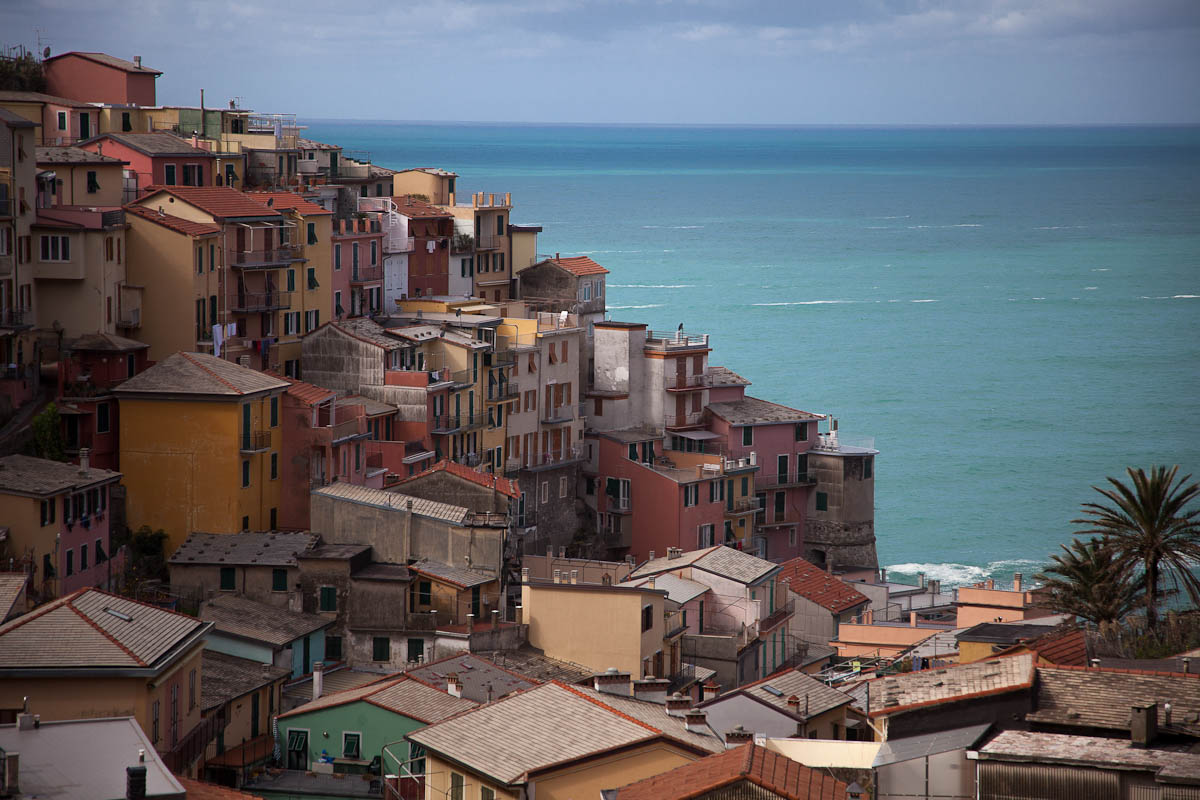
Cinque Terre is comprised of five quaint fishing villages connected by ancient rustic paths that hug this rugged part of the Italian Riviera coastline.  A century ago, the trails and boats were the only means of transport to and from the villages.  Today trains link the five villages offering visitors and locals more convenient access.  This area is now protected within the boundaries of a National Park ensuring the region retains its historic integrity. The lack of modern development gives visitors the opportunity to enjoy the charm and beauty of these villages that date back to the Middle Ages. Grapes are grown on terraced gardens perched high on the cliffs overlooking the Ligurian Sea.  Lemon trees dot the hillsides in abundance.

We booked our tour through Viator which is a third party agency that offers access to tours worldwide.  The local tour company was called WalkaboutFlorence.  We would recommend both Viator in general and this tour in particular.

As we travelled 2.5 hours by bus to the starting point of the tour which would begin at the second village, Manarola, our tour guides Alex and Chris introduced themselves and offered excellent information en route such as clarifying the white mountains we saw in the distance were not covered in snow but were actually glistening with Carrera marble.  It then made sense why we saw so many yards along the highway full of huge slabs of marble ready to be cut.

We began in the second village, Manarola, where we had the opportunity to walk along some of the ancient paths along the edge of the terraced hills, overlooking the village.  We took the train to the next village, Corniglia which was perched about 100 metres above sea level.


After climbing 382 steps, or the equivalent of 33 flights of stairs, we were rewarded with spectacular views.  We enjoyed a delicious lunch on a terrace overlooking the town and the sea we returned to the train station, yes, back down those 382 steps, and on to the next town, Vernazza.


View of Corniglia from the restaurant terrace where we had lunch.
Notice the lemon tree in the foreground. 


Vernazza was the town which was greatly affected by the floods and mudslides last November.  They have made tremendous progress cleaning up the mud and the damage – mud went as high as the first story of many buildings.


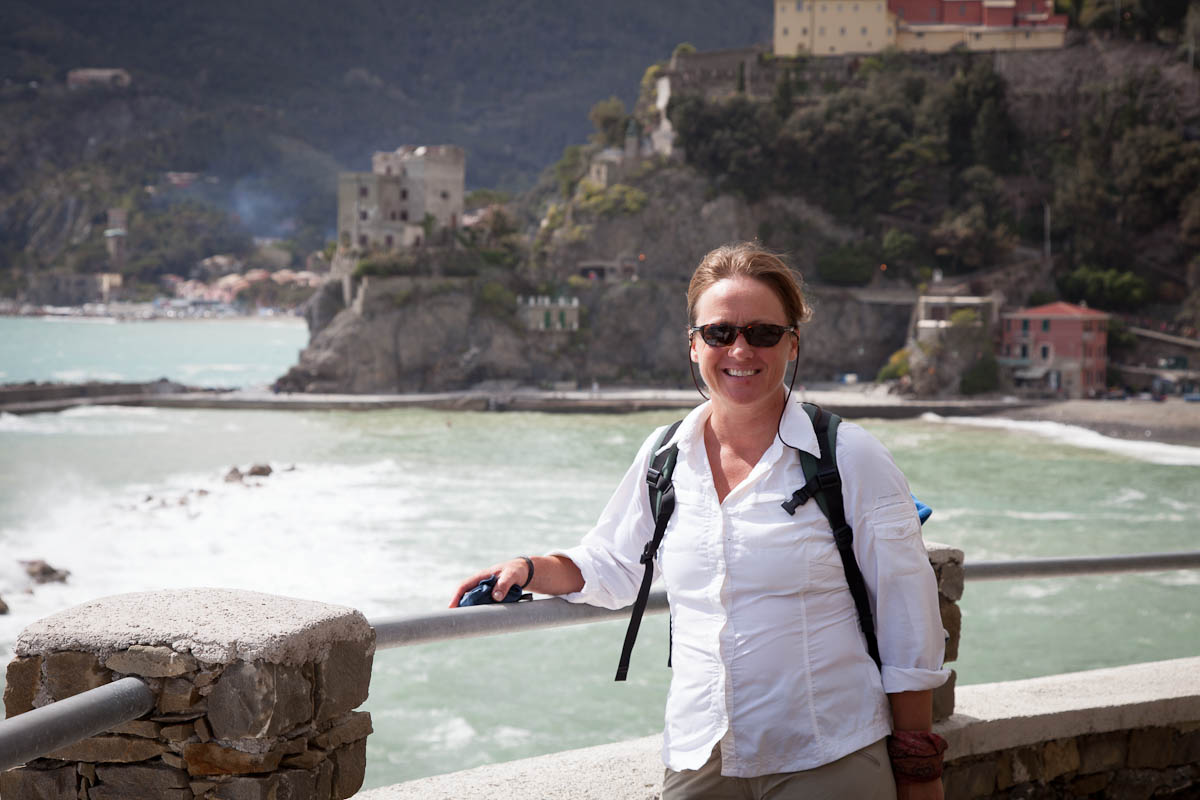
It was from here that we hiked to the last town, Monterosso.  The hike was challenging as we traversed the hills following rather narrow and sometimes treacherous and slippery paths.  It was no surprise that Sonja lead the pack setting a rather quick pace.  As she pointed out, the sooner we got there the more time we would have to do some shopping and sample the local food and wine. The two hour hike only took us one hour!


In Monterosso, we discovered a lovely little shop where the shopkeeper encouraged us to sample everything in the store, including several of the wines from the region.  Sonja found many items to purchase as souvenirs.  With a half an hour to spare, we parked ourselves on a patio overlooking the sea and enjoyed a couple of glasses of the local white wine.  I couldn’t think of a better way to spend a Tuesday afternoon.

Dipping our toes in the Mediterranean Sea.

Back on the train, we returned to the first village, Riomaggiore where we explored for a little while before we stopped for another glass of wine on yet another beautiful patio overlooking the sea.  This time, our guides treated the group to compensate for not being able to take the boat from Monterosso due to high winds which was hardly their fault but we appreciated the gesture of goodwill nonetheless.  We did one final walk along the coast back to the train station which took us to La Spezia where we boarded our bus for the journey to Florence.

It was a long day – almost 12 hours – but well worth it.  The weather cooperated with a mixture of sun and cloud, comfortable temperatures and most importantly, no rain.  Our tour guides, Alex and Chris were knowledgeable, energetic, and very attentive to the needs of each member in the group.  They were some of the best tour guides we have encountered in our travels.  The entire tour was well organized; we would highly recommend it to anyone who is tight on time and wants to see Cinque Terre in a day.


Rained out in Sienna

Our trip with my sister Sonja began in Florence where we met at the train station; we came from Venice and Sonja came from Rome.  We stayed in an apartment in the historic centre, across the street from Santa Croce Basilica.  In fact, our living room windows looked out to the Basilica.  It was a perfect location and a wonderfully charming apartment, with more space than we needed or even used.  We walked everywhere from the apartment, including to the bus and train stations.  The apartment was on the third floor of an old building that did not have an elevator.  While the apartment boasted all modern conveniences it was filled with antiques, wonderful artwork, and lots of interesting knick knacks giving it a very authentic feel.

Santa Croce Basilica – Our apartment is to the left of the church.

Sonja had a “must see” list that included excursions to Sienna and Pisa.  We also had a full day tour already booked to Cinque Terre.  We were cramming a lot into our four days but first we had to get ourselves oriented.  I am always surprised at how we drop ourselves into a new place that is completely foreign to us and within 24 hours I know my way around sufficiently to feel like I have been there for a month.  In short order, we found a grocery store to stock up on provisions, ate an over-priced and not very good lunch on a patio, and we were unpacked and had the first load of laundry on the go.  And then the rain began.  It rained on and off for the next four days.

Sonja snapped this photo after we ducked into a cafe to seek shelter from the relentless rain.

We awoke the next morning to steady drizzle.  Chris suggested it might be a good museum day, but Sonja made the astute observation (of which we reminded her frequently afterwards):  We’re going to get a little wet no matter what we do.  And so we stuck to our original plan and took the bus to Sienna which was only an hour away – on the express bus – and an hour and a half on the local bus which we inadvertently took.  By the time we arrived, it was pouring buckets.  We wandered around for a while browsing through the infamous “Tuesday Market” and stocking up on some local cheese, salami and vegetables.  But when the thunder and lightning began and the rain turned to hail, and we were soaked to the skin, we all agreed it was time to go home.  Sienna was a bust as far as I was concerned, but Sonja was satisfied that she had at least caught a glimpse of it and saw the beautiful countryside as well.  I comforted myself with the knowledge that Chris and I would go back later in May while we were on the farm which was only 50 km south of Sienna.

Soaked to the skin and ready to go back to Florence.

Travel Tip:  If travelling with three or more people, consider staying in an apartment of which there are many to choose from.  It can be very cost effective and offers a lot more space than a traditional hotel room not to mention full kitchen and often laundry facilities too.  Airbnb.com is a great site for accommodations – we found all our South American apartments through this site as well as those in Italy.  Click here to see the airbnb listing for the Florence apartment.

A whirlwind through Italy

We have been in Italy with my sister Sonja for just over two weeks and have visited the major tourist destinations: Florence, Venice and Rome.  We even managed to squeeze in a weekend in Milan so that Sonja could run the Milan Marathon.  We did as much as humanly possible so that Sonja could see and experience everything on her bucket list. What a time we have had!  The history and architecture, the plethora of art, sculptures, churches, mosaics, tapestries – it has left us in awe. We have discovered Italian coffee – cappucino is my absolute favourite and I may never go back to drinking American coffee again.  And the gelato – divine! We have tasted what “al dente” really means and now understand why Italians think we massacre pasta in America.  The cheese and salamis and abundance of cheap but good red wine – we love it all.  Was I Italian in a former life??

This was the first time I have travelled for more than a weekend with my sister and while the pace was much more intense than what we’ve been used to these past few months, I was pleasantly surprised at how well we all travelled together.  We all seemed to be in agreement most of the time as to what to see, where to go and what to eat.  And when we didn’t agree, we were quite happy to go our separate ways for a few hours to pursue our own interests before regrouping later in the day. Amazingly, our itinerary was executed perfectly: we never missed a train, we always found our apartments, all our accommodations were better than expected, we never got lost unless it was intentional (more about that later), we never lost each other.

Everything was perfect, except, of course, the weather.  We arrived in Venice to cold temperatures (below 10C which felt freezing cold to us after spending the last two months in the tropics) and cloudy skies but at least it didn’t rain on that first day in Italy.  The rain began the next day and it rained on and off for a week! Some days were downright miserable like the day we visited Sienna and got soaked to the skin as the relentless rain turned to hail accompanied by thunder and lightening.  But then the sun came out in Venice and continued to shine right through to the end of Sonja’s visit.   I’ve been told temperatures are going to hit 30C by the weekend!

Sonja left yesterday and we have now resumed our slow travel pace.  Today is a national holiday in Italy and most things are closed so we are taking a welcome break from sightseeing.  Besides, my brain is so full right now, I don’t think I can absorb anything new, and my feet are still aching from wearing the wrong shoes for hours on end on those ancient cobblestone streets in Rome. The price of vanity I suppose.

I will now take some time to write about what we did during these past two weeks and share some of the amazing photos that have been taken.  There is so much to tell but I will try to stick to the highlights.

In the meantime, check out the latest addition to our website: the photo gallery.  After much discussion and many debates, this part of the website is finally coming together in a way that I have always envisioned it.   It can be accessed from the header image at the top of the website – it is the first item listed on the sign post – or you can access it from the left hand column, about half way down in the “Other Info” section.  We have created a Flickr account to host all our photos and we have linked our website to Flickr via a slick plugin very appropriately called “slickr flickr”.

The main purpose of the photo gallery is to showcase more of the amazing photos taken by Chris.  While the photos in the blog support the narrative text, they are a drop in the bucket compared to the thousands of photos that Chris has taken. But the photo gallery offers so much more.  Chris manipulates many of his photos using a variety of techniques that transforms them into veritable works of art.  He is continuously finessing his technique and striving for the perfect shot. As his biggest fan, I am thrilled to have a forum in which to display his wonderful work.

The photo gallery is a work in progress and we’re still trying to figure out the best way to organize the photos to make them easy to access and enjoyable to view.  You’ll notice that Chris has added a watermark to his photos, also something that we’re experimenting with in terms of size and location on the photo.  The purpose of the watermark is to prevent his photos from being reproduced without his permission.  You’re free to enjoy them on-line but if you wish to print them or use them in any way, we’d appreciate hearing from you beforehand.  We’re also exploring commercial opportunities and it’s important to retain ownership of the photos in order to leverage such possibilities.

You can expect a lot more photos to be added to the gallery in the coming days and weeks. We’d love to hear your feedback on the photo gallery both in terms of how we have organized the photos as well as the content itself.